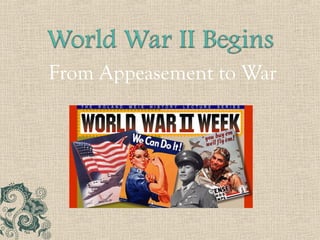
From Appeasement to War
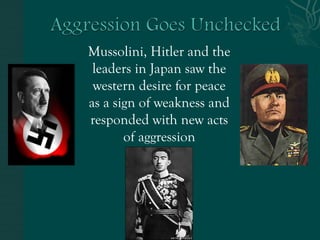
Mussolini, Hitler and the
leaders in Japan saw the
western desire for peace
as a sign of weakness and
responded with new acts
of aggression
 Japan wanted an empire similar to those of
Western powers.
 It seized Manchuria in 1931
 When the league condemned them they simply
left the League
 Their early success at colonizing areas in South
East Asia with no intervention from the
Western powers strengthened their military and
desire for conquest.
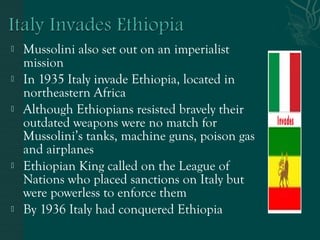
 Mussolini also set out on an imperialist
mission
 In 1935 Italy invade Ethiopia, located in
northeastern Africa
 Although Ethiopians resisted bravely their
outdated weapons were no match for
Mussolini’s tanks, machine guns, poison gas
and airplanes
 Ethiopian King called on the League of
Nations who placed sanctions on Italy but
were powerless to enforce them
 By 1936 Italy had conquered Ethiopia
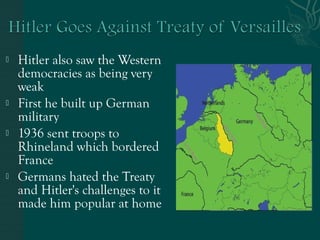
 Hitler also saw the Western
democracies as being very
weak
 First he built up German
military
 1936 sent troops to
Rhineland which bordered
France
 Germans hated the Treaty
and Hitler's challenges to it
made him popular at home
 Western democracies denounced his moves but
took no real action
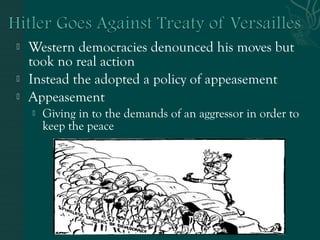
 Instead the adopted a policy of appeasement
 Appeasement
 Giving in to the demands of an aggressor in order to
keep the peace
Why the West Appeased Hitler
•Fear of the destructive power of modern technology
• Widespread pacifism (opposition to war) following
World War I
• Hitler’s actions seen as a justifiable response to the
harsh Treaty of Versailles
• Widespread economic depression
• Hitler’s fascism seen as a defense against Soviet
communism
• Faith in diplomacy and compromise
• Misreading of Hitler’s intentions
Agree or Disagree with the
following statement:
“World War II was in large part
a continuation of World war I.”
Provide evidence from the chart
and your knowledge of history to
support your view.
 US passed Neutrality Acts
 Forbid the sale of weapons to any nation at war
 Outlawed loans to warring nations
 Prohibited Americans from traveling on ships of
warring nations
 Main goal of the neutrality acts was to avoid US
involvement in a European conflict not to
prevent a conflict
 In response to Britain, France and the US,
Germany, Italy and Japan formed what became
known as the Rome-Berlin-Tokyo Axis.
 Become known as the Axis Powers
 Three nations agreed to fight Soviet communism
 Agreed not to interfere with each others plans to
territorial expansion
 1936 Spain has a civil war
 Conservative Francisco Franco led a revolt with
fascists and nationalists backing him
 Soviet Union sent soldiers to fight back
 Hitler and Mussolini sent troops to help Franco
 War took more than 500,000 lives
 By 1939 Franco triumphed and created a fascist
dictatorship similar to Hitler and Mussolini
 Hitler wanted to bring all German speaking
people into the Third Reich
 Believed he had the right to remove any inferior
group of people from lands to make more space
for Germans
 “Nature is cruel therefore we too may be cruel…
I have the right to remove millions of an
inferior race that breeds like vermin.”
 Austria Annexed
 Hitler had a plan called Anschluss – unification of
Austria and Germany
 He forced the Austrian Chancellor to appoint Nazis
to key cabinet posts
 When the Austrian leader refused to give into
Hitler’s demands Hitler sent in the German army
 Western democracies took no action and Hitler
made a speech from the Hapsburg Palace to indicate
his position as the new ruler of Austria
 The Czech Crisis
 After Austria Hitler turned his attention to
Czechoslovakia
 First Hitler wanted 3 million Germans in the
Sudetenland (part of north Czech) to have
independence from Czech
 Britain and France were not willing to go to war to
help Czech and so Hitler increased his demands and
said he wanted all the land as a part of Germany
 The Czech Crisis
 Munich Conference – 1938
 British and French leaders chose appeasement
 Caved unto Hitler’s demands and persuaded the
Czechs to surrender the Sudetenland without a
fight
 In exchange Hitler promised that he had no
further plans to expand his territory
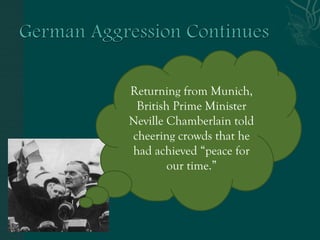
Returning from Munich,
British Prime Minister
Neville Chamberlain told
cheering crowds that he
had achieved “peace for
our time.”
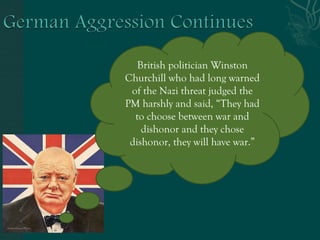
British politician Winston
Churchill who had long warned
of the Nazi threat judged the
PM harshly and said, “They had
to choose between war and
dishonor and they chose
dishonor, they will have war.”
 Just as Churchill had predicted, Europe plunged
rapidly toward war.
 March 1939 Hitler broke the promise he made
at the Munich Conference and took over all of
Czechoslovakia
 Democracies finally accepted that appeasement
had failed
 They promised to protect Poland which was the
next likely target of Hitler’s expansion
What was the policy of
appeasement?
What convinced Britain and
France to end their policy of
appeasement?
Why?
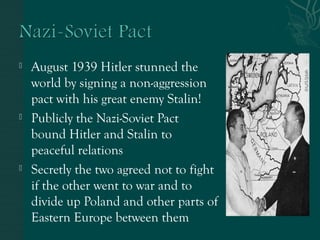
 August 1939 Hitler stunned the
world by signing a non-aggression
pact with his great enemy Stalin!
 Publicly the Nazi-Soviet Pact
bound Hitler and Stalin to
peaceful relations
 Secretly the two agreed not to fight
if the other went to war and to
divide up Poland and other parts of
Eastern Europe between them
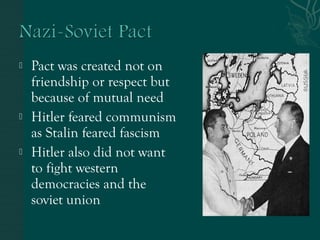
 Pact was created not on
friendship or respect but
because of mutual need
 Hitler feared communism
as Stalin feared fascism
 Hitler also did not want
to fight western
democracies and the
soviet union
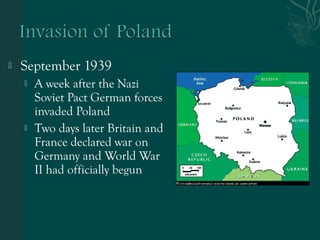
 September 1939
 A week after the Nazi
Soviet Pact German forces
invaded Poland
 Two days later Britain and
France declared war on
Germany and World War
II had officially begun

World History - Appeasement

  • 1.
  • 2.
    Mussolini, Hitler andthe leaders in Japan saw the western desire for peace as a sign of weakness and responded with new acts of aggression
  • 3.
     Japan wantedan empire similar to those of Western powers.  It seized Manchuria in 1931  When the league condemned them they simply left the League  Their early success at colonizing areas in South East Asia with no intervention from the Western powers strengthened their military and desire for conquest.
  • 4.
     Mussolini alsoset out on an imperialist mission  In 1935 Italy invade Ethiopia, located in northeastern Africa  Although Ethiopians resisted bravely their outdated weapons were no match for Mussolini’s tanks, machine guns, poison gas and airplanes  Ethiopian King called on the League of Nations who placed sanctions on Italy but were powerless to enforce them  By 1936 Italy had conquered Ethiopia
  • 5.
     Hitler alsosaw the Western democracies as being very weak  First he built up German military  1936 sent troops to Rhineland which bordered France  Germans hated the Treaty and Hitler's challenges to it made him popular at home
  • 6.
     Western democraciesdenounced his moves but took no real action  Instead the adopted a policy of appeasement  Appeasement  Giving in to the demands of an aggressor in order to keep the peace
  • 7.
    Why the WestAppeased Hitler •Fear of the destructive power of modern technology • Widespread pacifism (opposition to war) following World War I • Hitler’s actions seen as a justifiable response to the harsh Treaty of Versailles • Widespread economic depression • Hitler’s fascism seen as a defense against Soviet communism • Faith in diplomacy and compromise • Misreading of Hitler’s intentions
  • 8.
    Agree or Disagreewith the following statement: “World War II was in large part a continuation of World war I.” Provide evidence from the chart and your knowledge of history to support your view.
  • 9.
     US passedNeutrality Acts  Forbid the sale of weapons to any nation at war  Outlawed loans to warring nations  Prohibited Americans from traveling on ships of warring nations  Main goal of the neutrality acts was to avoid US involvement in a European conflict not to prevent a conflict
  • 10.
     In responseto Britain, France and the US, Germany, Italy and Japan formed what became known as the Rome-Berlin-Tokyo Axis.  Become known as the Axis Powers  Three nations agreed to fight Soviet communism  Agreed not to interfere with each others plans to territorial expansion
  • 11.
     1936 Spainhas a civil war  Conservative Francisco Franco led a revolt with fascists and nationalists backing him  Soviet Union sent soldiers to fight back  Hitler and Mussolini sent troops to help Franco  War took more than 500,000 lives  By 1939 Franco triumphed and created a fascist dictatorship similar to Hitler and Mussolini
  • 12.
     Hitler wantedto bring all German speaking people into the Third Reich  Believed he had the right to remove any inferior group of people from lands to make more space for Germans  “Nature is cruel therefore we too may be cruel… I have the right to remove millions of an inferior race that breeds like vermin.”
  • 13.
     Austria Annexed Hitler had a plan called Anschluss – unification of Austria and Germany  He forced the Austrian Chancellor to appoint Nazis to key cabinet posts  When the Austrian leader refused to give into Hitler’s demands Hitler sent in the German army  Western democracies took no action and Hitler made a speech from the Hapsburg Palace to indicate his position as the new ruler of Austria
  • 14.
     The CzechCrisis  After Austria Hitler turned his attention to Czechoslovakia  First Hitler wanted 3 million Germans in the Sudetenland (part of north Czech) to have independence from Czech  Britain and France were not willing to go to war to help Czech and so Hitler increased his demands and said he wanted all the land as a part of Germany
  • 15.
     The CzechCrisis  Munich Conference – 1938  British and French leaders chose appeasement  Caved unto Hitler’s demands and persuaded the Czechs to surrender the Sudetenland without a fight  In exchange Hitler promised that he had no further plans to expand his territory
  • 16.
    Returning from Munich, BritishPrime Minister Neville Chamberlain told cheering crowds that he had achieved “peace for our time.”
  • 17.
    British politician Winston Churchillwho had long warned of the Nazi threat judged the PM harshly and said, “They had to choose between war and dishonor and they chose dishonor, they will have war.”
  • 18.
     Just asChurchill had predicted, Europe plunged rapidly toward war.  March 1939 Hitler broke the promise he made at the Munich Conference and took over all of Czechoslovakia  Democracies finally accepted that appeasement had failed  They promised to protect Poland which was the next likely target of Hitler’s expansion
  • 19.
    What was thepolicy of appeasement? What convinced Britain and France to end their policy of appeasement? Why?
  • 20.
     August 1939Hitler stunned the world by signing a non-aggression pact with his great enemy Stalin!  Publicly the Nazi-Soviet Pact bound Hitler and Stalin to peaceful relations  Secretly the two agreed not to fight if the other went to war and to divide up Poland and other parts of Eastern Europe between them
  • 21.
     Pact wascreated not on friendship or respect but because of mutual need  Hitler feared communism as Stalin feared fascism  Hitler also did not want to fight western democracies and the soviet union
  • 22.
     September 1939 A week after the Nazi Soviet Pact German forces invaded Poland  Two days later Britain and France declared war on Germany and World War II had officially begun