Impacts of World War One
Learning Objectives: What were the effects of WWI on the social, political and
economic structure of Russia?
Key Terms, Events, Names: Kaiser Wilhelm, Alliance system, General
Sukhomlinov, Battle of Tannenberg, Grand Duke Nikolai Nikolaevich
Instability of Europe
LO: What were the
effects of WWI on the
social, political and
economic structure of
Russia?
■ The fate of Tsarist Russia and its ruling family was bound up
in the tragedy of World War I.
■ Like most monarchs, Nicholas II believed that affection and
family ties with his royal relatives could overcome
diplomatic disputes.
■ Nicholas and the German Kaiser Wilhelm - to the tsar,
'Cousin Willy' - were both grandchildren of Queen Victoria
of England.
■ The tsar considered it highly unlikely that his cousin would
declare war on Russia.
■ Nicholas didn't count on Wilhelm's thirst for war or on the
other problems plaguing Europe.
Instability of Europe
LO: What were the
effects of WWI on the
social, political and
economic structure of
Russia?
■ The alliance system
placed legal obligations on
signatories to support other
nations if they were
attacked.
■ Russia, as a key ally of
Serbia, found itself being
dragged into a difficult
situation when the Serbs
were threatened by
Austria-Hungary, after the
assassination of Archduke
Franz Ferdinand in
Sarajevo.
Outbreak of WW1
LO: What were the
effects of WWI on the
social, political and
economic structure of
Russia?
■ The outbreak of war brought about a
temporary decline in revolutionary
activity within Russia.
■ For a few weeks at least, people forgot
about their economic hardships as a
wave of patriotism swept the nation.
■ The tsar, jeered and despised earlier in
1914, now found respect and affection
for him renewed.
■ He did not get to enjoy this revival for
very long, as Russia's war effort began
poorly and didn't improve.
A postcard showing a crowd
greeting the tsar outside the
Winter Palace, August 1914.
Outbreak of WW1
LO: What were the
effects of WWI on the
social, political and
economic structure of
Russia?
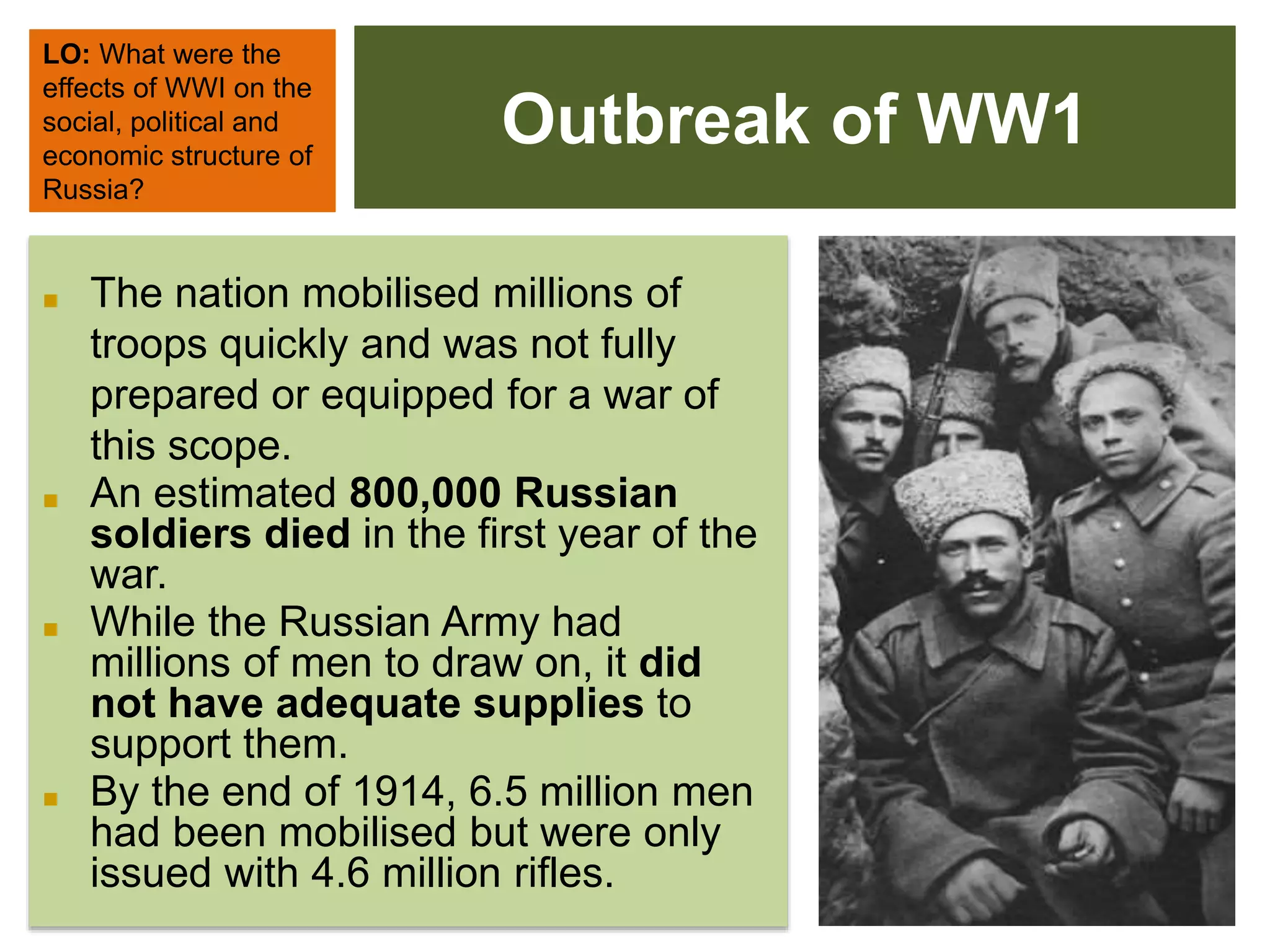
■ The nation mobilised millions of
troops quickly and was not fully
prepared or equipped for a war of
this scope.
■ An estimated 800,000 Russian
soldiers died in the first year of the
war.
■ While the Russian Army had
millions of men to draw on, it did
not have adequate supplies to
support them.
■ By the end of 1914, 6.5 million men
had been mobilised but were only
issued with 4.6 million rifles.
Defeats on the Eastern
Fronts
LO: What were the
effects of WWI on the
social, political and
economic structure of
Russia?
■ General Sukhomlinov (Minister for
War, 1914) distrusted modern warfare,
preferring to attack with sheer force of
troop numbers.
■ Poor military leadership resulted in
costly early defeats.
■ Impatient generals ordered an
invasion of German East Prussia in
the first month of the war but were
defeated at the Battle of Tannenberg
(August 1914)
■ There the Russians suffered 30,000
casualties and had almost 100,000
soldiers taken prisoner.
■ Key military leader General
Samsonov shot himself as a result of
the Russian humiliation.
Defeats on the Eastern
Fronts
LO: What were the
effects of WWI on the
social, political and
economic structure of
Russia?
 Battle of Masurian Lakes -
Russian First Army General
Rennenkampf orders a
retreat but not before 60,000
soldiers lose their lives.
 The Russian Military elite
were unfazed by the losses
and claimed that their
actions had required the
withdrawal of German forces
from the Western Front.
Defeats on the Eastern
Fronts
LO: What were the
effects of WWI on the
social, political and
economic structure of
Russia?
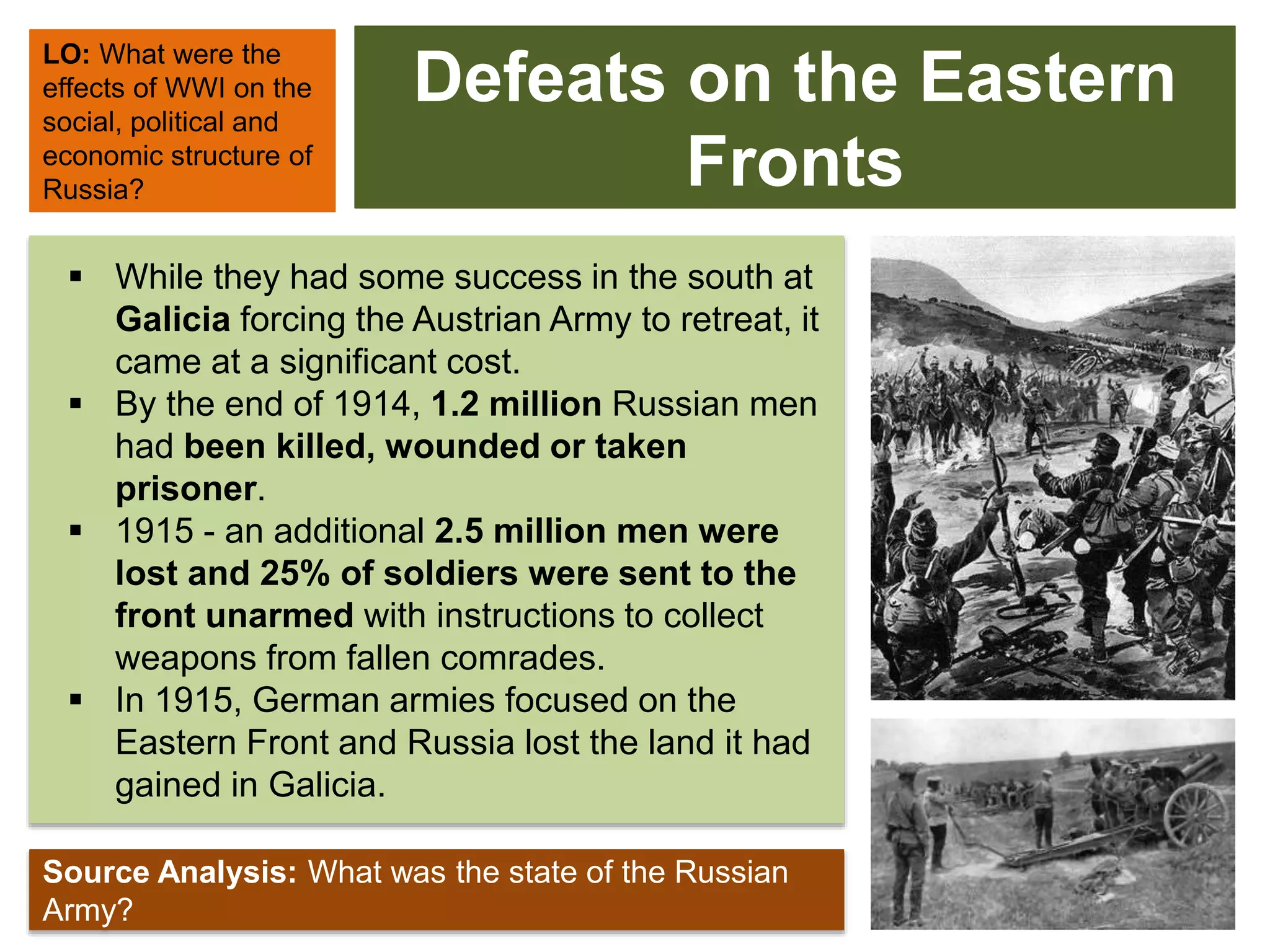
 While they had some success in the south at
Galicia forcing the Austrian Army to retreat, it
came at a significant cost.
 By the end of 1914, 1.2 million Russian men
had been killed, wounded or taken
prisoner.
 1915 - an additional 2.5 million men were
lost and 25% of soldiers were sent to the
front unarmed with instructions to collect
weapons from fallen comrades.
 In 1915, German armies focused on the
Eastern Front and Russia lost the land it had
gained in Galicia.
Source Analysis: What was the state of the Russian
Army?
Role of Tsar Nicholas II
LO: What were the
effects of WWI on the
social, political and
economic structure of
Russia?
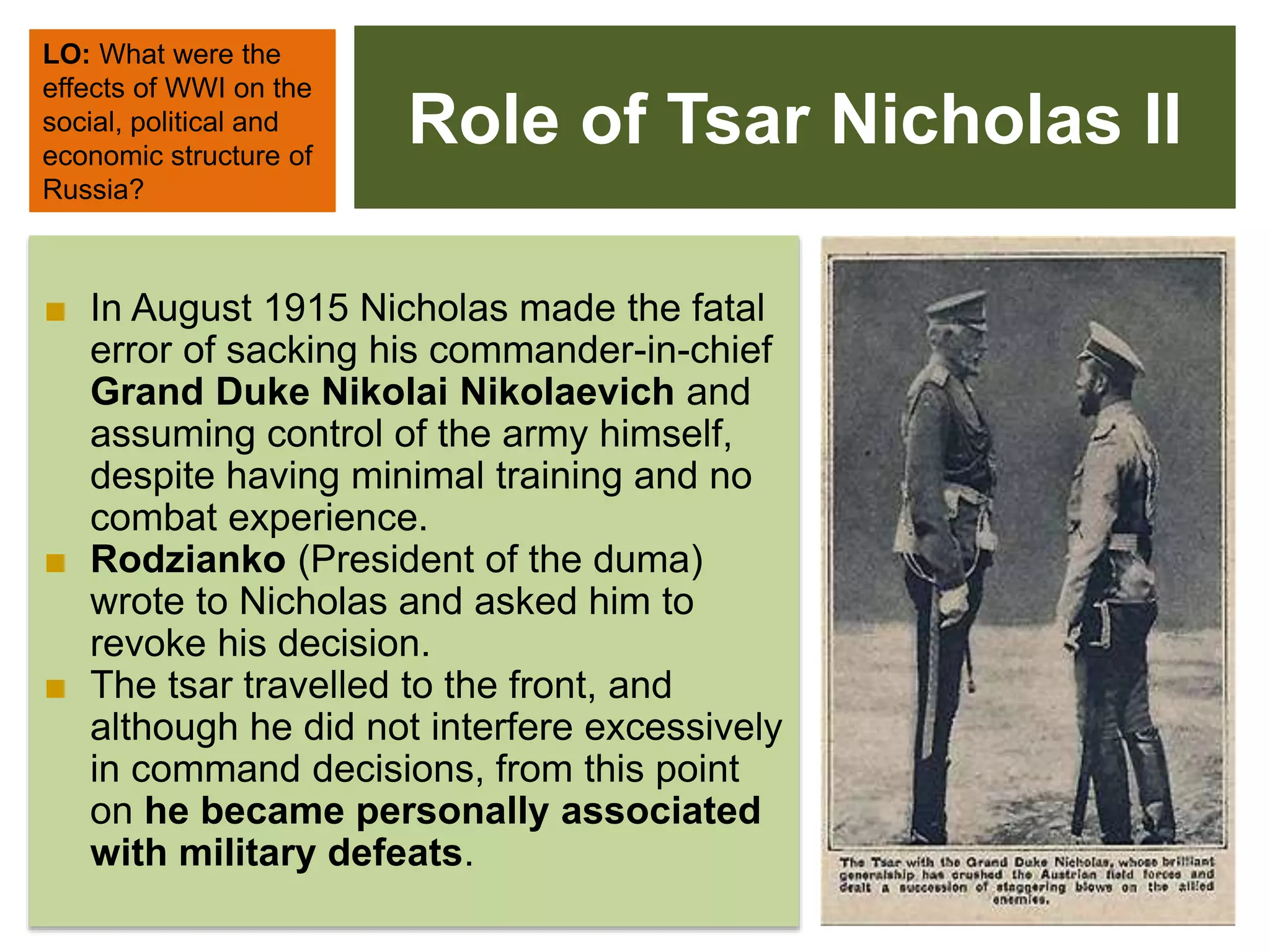
■ In August 1915 Nicholas made the fatal
error of sacking his commander-in-chief
Grand Duke Nikolai Nikolaevich and
assuming control of the army himself,
despite having minimal training and no
combat experience.
■ Rodzianko (President of the duma)
wrote to Nicholas and asked him to
revoke his decision.
■ The tsar travelled to the front, and
although he did not interfere excessively
in command decisions, from this point
on he became personally associated
with military defeats.
Role of Tsar Nicholas II
LO: What were the
effects of WWI on the
social, political and
economic structure of
Russia?
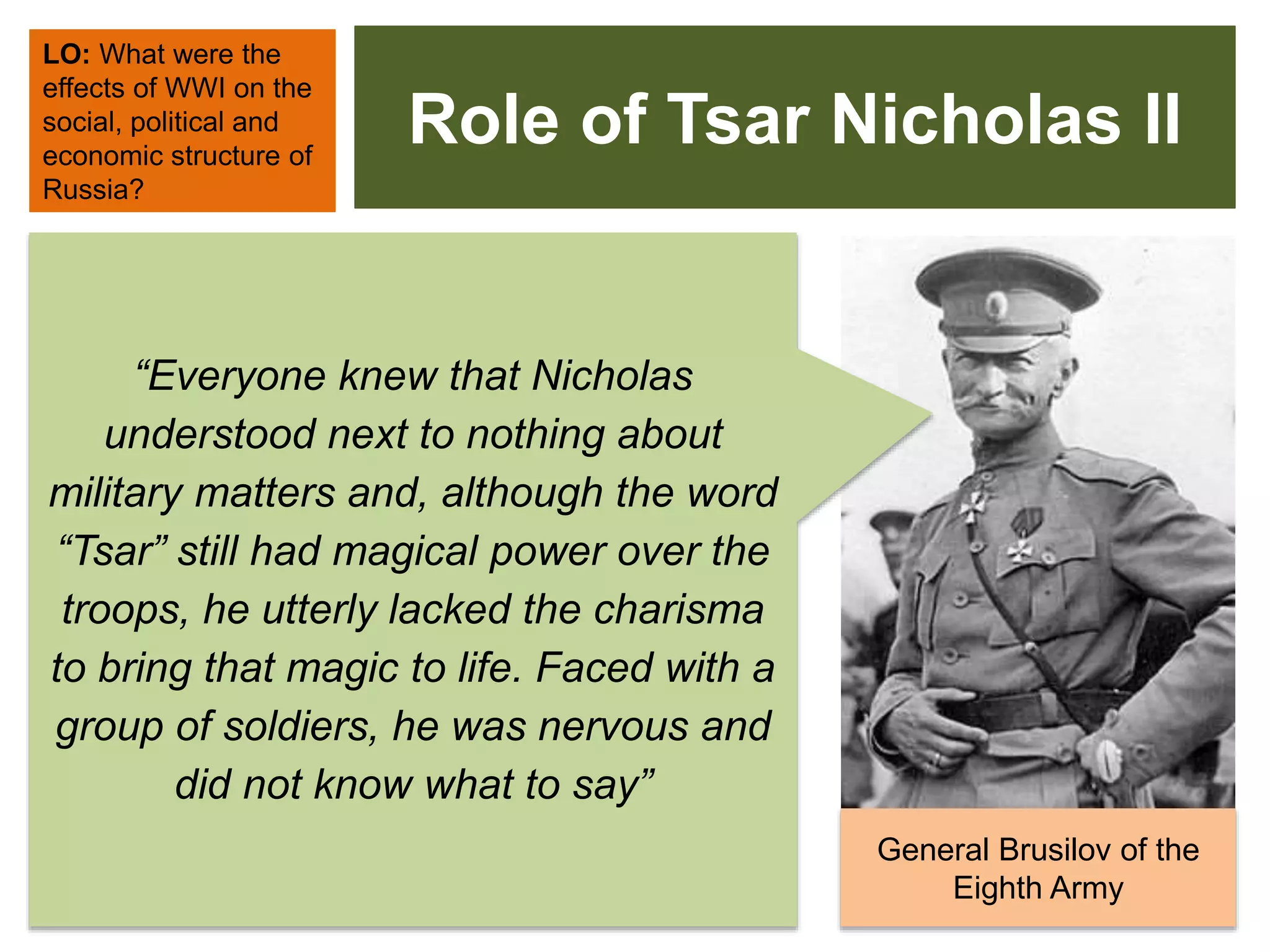
General Brusilov of the
Eighth Army
“Everyone knew that Nicholas
understood next to nothing about
military matters and, although the word
“Tsar” still had magical power over the
troops, he utterly lacked the charisma
to bring that magic to life. Faced with a
group of soldiers, he was nervous and
did not know what to say”
Social and Economic
Effects of WW1
LO: What were the
effects of WWI on the
social, political and
economic structure of
Russia?
■ Significant impact on Russia's economy.
■ The nation spent more than 1.5 billion roubles on the war and
was forced to increase taxation and borrow from foreign
powers to fund this expenditure.
■ They also resorted to printing more notes which in the short
term met wage demands and war expenditure.
■ However, this then led to inflation = while wages doubled, the
cost of basic foods quadrupled. 400% inflation by 1916.
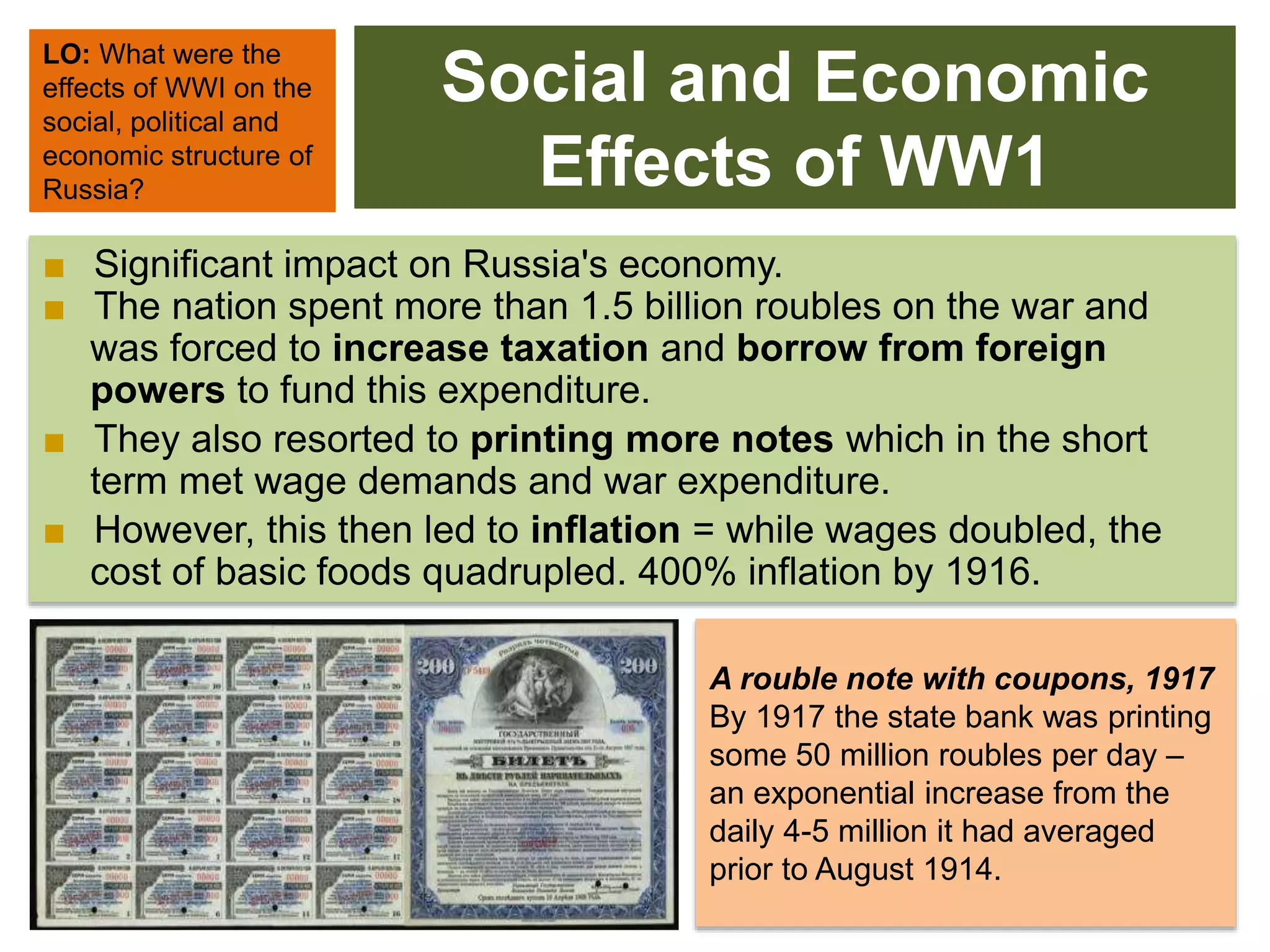
A rouble note with coupons, 1917
By 1917 the state bank was printing
some 50 million roubles per day –
an exponential increase from the
daily 4-5 million it had averaged
prior to August 1914.
Food Shortages
LO: What were the
effects of WWI on the
social, political and
economic structure of
Russia?
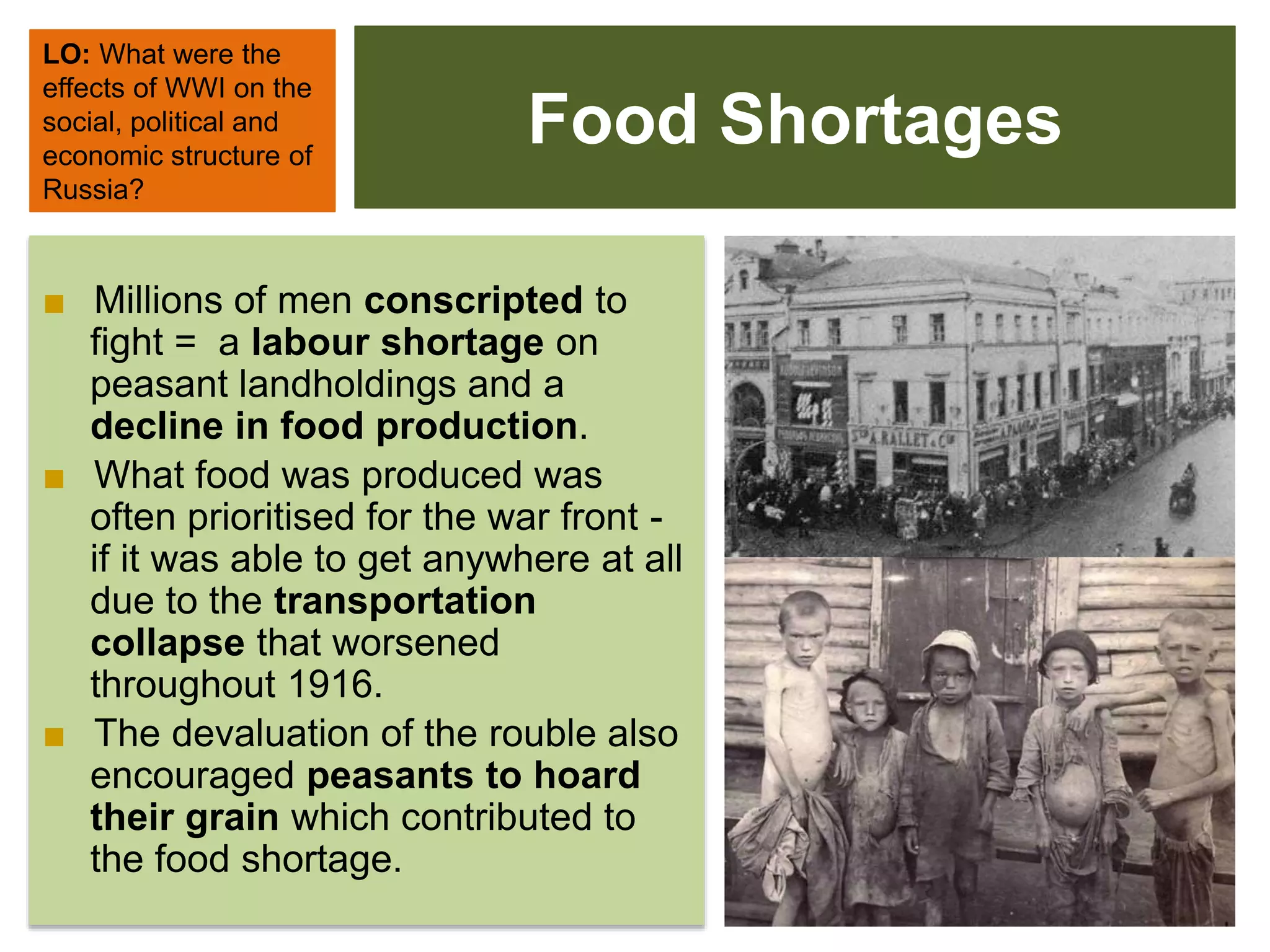
■ Millions of men conscripted to
fight = a labour shortage on
peasant landholdings and a
decline in food production.
■ What food was produced was
often prioritised for the war front -
if it was able to get anywhere at all
due to the transportation
collapse that worsened
throughout 1916.
■ The devaluation of the rouble also
encouraged peasants to hoard
their grain which contributed to
the food shortage.
Food Shortages
LO: What were the
effects of WWI on the
social, political and
economic structure of
Russia?
• Despite all these issues, 1915-1916 produced a bumper
crop - more than enough grain to feed Russia.
• However, inflation, hoarding of grain by the peasants and
forced requisitioning of grain for the armed forces meant
that it was not properly utilised.
• Food shortages spread to the cities and the calorie
intake of unskilled workers fell by ¼
• Infant mortality and crime increased.
• As the govt. had dedicated all its resources to the conflict,
this resulted in a significant reduction in the living
standards of Russians - particularly in urban areas.
Railways
LO: What were the
effects of WWI on the
social, political and
economic structure of
Russia?
 Russian railways could not cope with
the mass mobilisation of troops.
 Continued maintenance was required
on the railways - many railways were
single tracks only and when trains
broke down, entire lines stopped.
 By 1916, 30% of Russia’s railway
stock was unusable.
 Supply to the front suffered and was cut
back in the cities = 1919 Petrograd and
Moscow were only receiving ⅓ of their
food and fuel supplies.
Political Effects
LO: What were the
effects of WWI on the
social, political and
economic structure of
Russia?
 By 1917 the Russian forces had lost 1.7
million troops, 8 million wounded and 2.5
million taken as prisoners of war.
 Lack of rifles, ammunition, food, boots,
logistics and tactical leadership
compounded the issues faced by
soldiers.
 At home, the middle class lost their
savings to inflation.
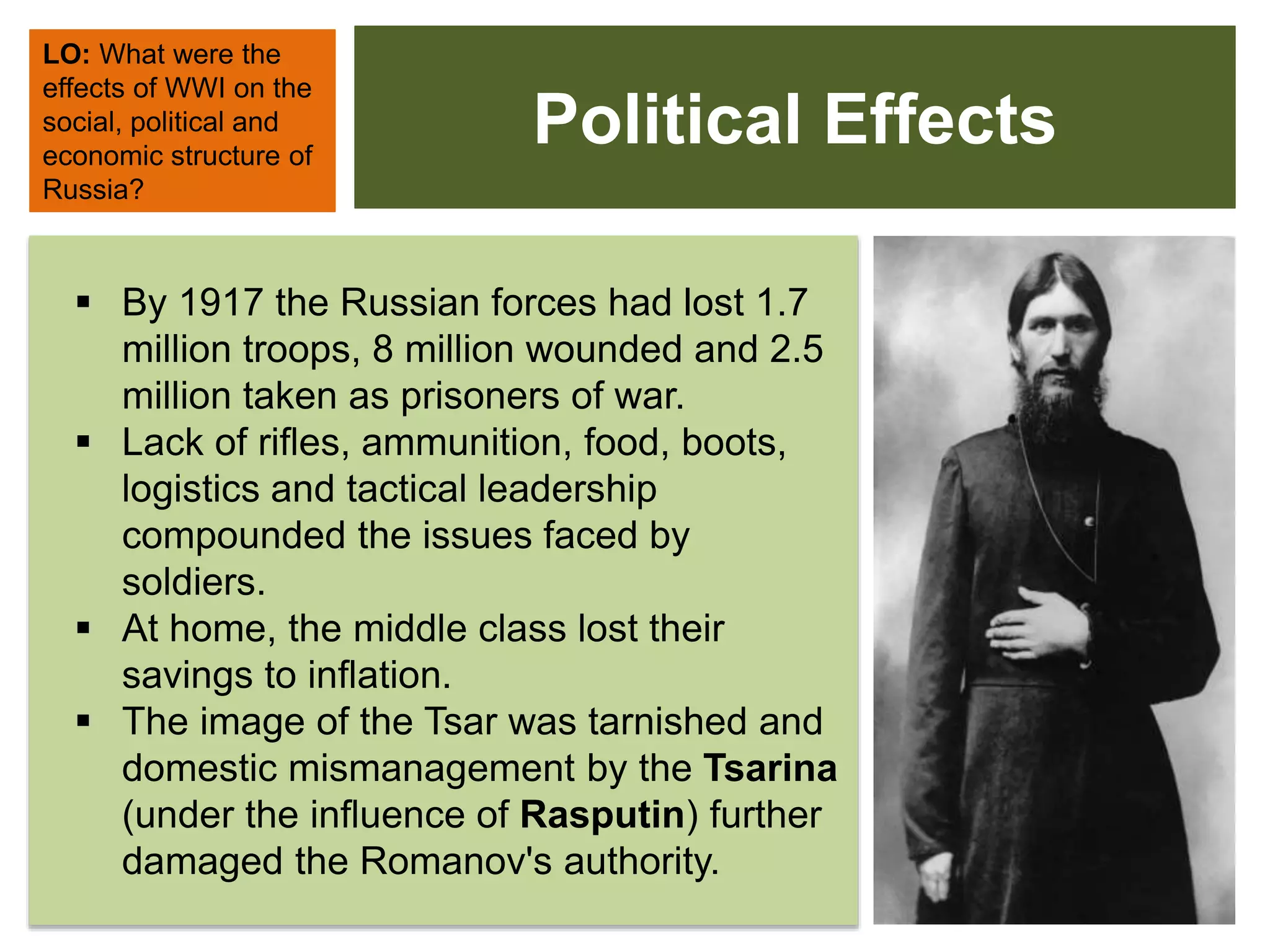
 The image of the Tsar was tarnished and
domestic mismanagement by the Tsarina
(under the influence of Rasputin) further
damaged the Romanov's authority.
Impact of WW1
LO: What were the
effects of WWI on the
social, political and
economic structure of
Russia?
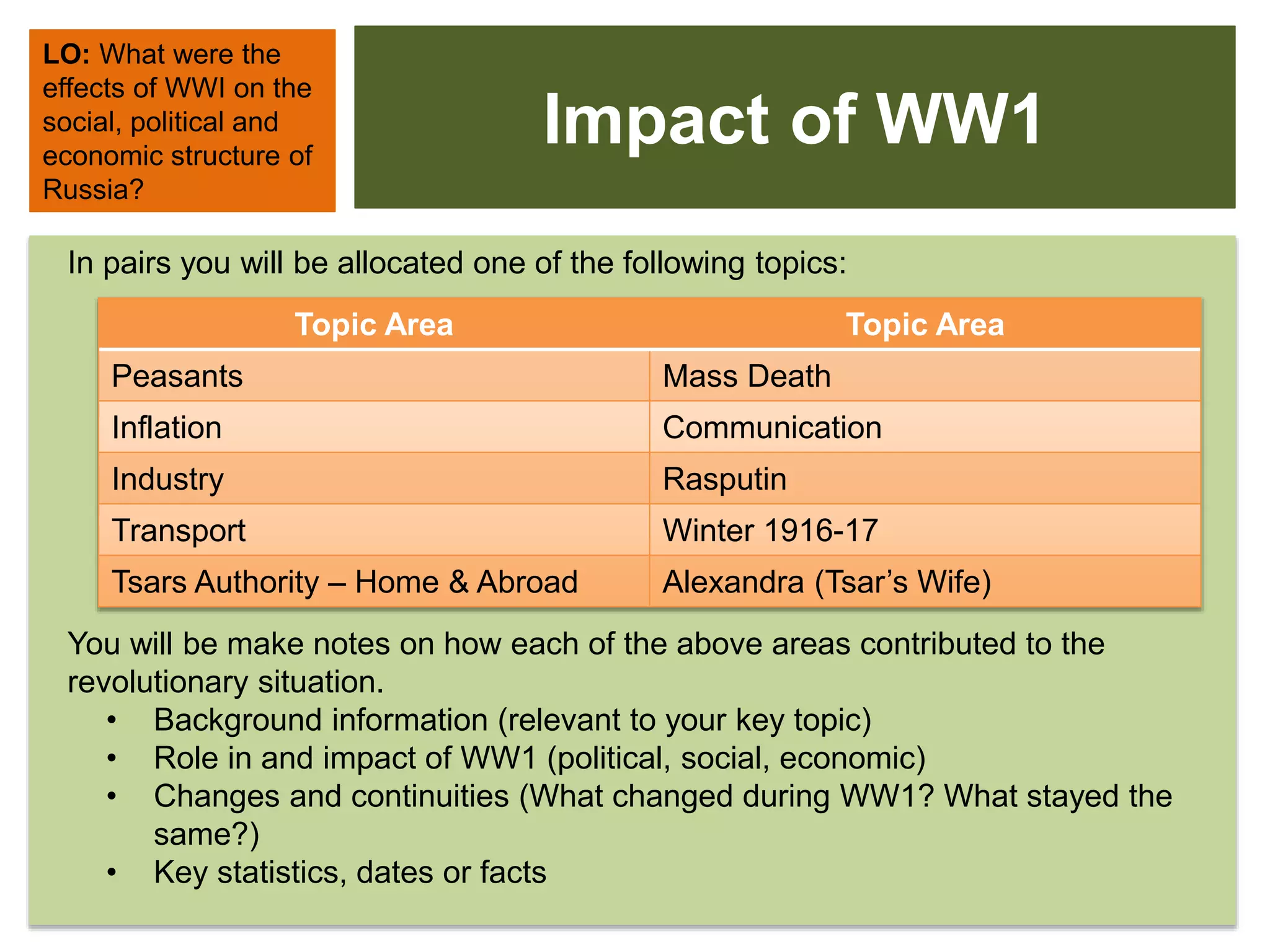
In pairs you will be allocated one of the following topics:
You will be make notes on how each of the above areas contributed to the
revolutionary situation.
• Background information (relevant to your key topic)
• Role in and impact of WW1 (political, social, economic)
• Changes and continuities (What changed during WW1? What stayed the
same?)
• Key statistics, dates or facts
Topic Area Topic Area
Peasants Mass Death
Inflation Communication
Industry Rasputin
Transport Winter 1916-17
Tsars Authority – Home & Abroad Alexandra (Tsar’s Wife)

The Impacts of WW1

  • 1.
    Impacts of WorldWar One Learning Objectives: What were the effects of WWI on the social, political and economic structure of Russia? Key Terms, Events, Names: Kaiser Wilhelm, Alliance system, General Sukhomlinov, Battle of Tannenberg, Grand Duke Nikolai Nikolaevich
  • 2.
    Instability of Europe LO:What were the effects of WWI on the social, political and economic structure of Russia? ■ The fate of Tsarist Russia and its ruling family was bound up in the tragedy of World War I. ■ Like most monarchs, Nicholas II believed that affection and family ties with his royal relatives could overcome diplomatic disputes. ■ Nicholas and the German Kaiser Wilhelm - to the tsar, 'Cousin Willy' - were both grandchildren of Queen Victoria of England. ■ The tsar considered it highly unlikely that his cousin would declare war on Russia. ■ Nicholas didn't count on Wilhelm's thirst for war or on the other problems plaguing Europe.
  • 3.
    Instability of Europe LO:What were the effects of WWI on the social, political and economic structure of Russia? ■ The alliance system placed legal obligations on signatories to support other nations if they were attacked. ■ Russia, as a key ally of Serbia, found itself being dragged into a difficult situation when the Serbs were threatened by Austria-Hungary, after the assassination of Archduke Franz Ferdinand in Sarajevo.
  • 4.
    Outbreak of WW1 LO:What were the effects of WWI on the social, political and economic structure of Russia? ■ The outbreak of war brought about a temporary decline in revolutionary activity within Russia. ■ For a few weeks at least, people forgot about their economic hardships as a wave of patriotism swept the nation. ■ The tsar, jeered and despised earlier in 1914, now found respect and affection for him renewed. ■ He did not get to enjoy this revival for very long, as Russia's war effort began poorly and didn't improve. A postcard showing a crowd greeting the tsar outside the Winter Palace, August 1914.
  • 5.
    Outbreak of WW1 LO:What were the effects of WWI on the social, political and economic structure of Russia? ■ The nation mobilised millions of troops quickly and was not fully prepared or equipped for a war of this scope. ■ An estimated 800,000 Russian soldiers died in the first year of the war. ■ While the Russian Army had millions of men to draw on, it did not have adequate supplies to support them. ■ By the end of 1914, 6.5 million men had been mobilised but were only issued with 4.6 million rifles.
  • 6.
    Defeats on theEastern Fronts LO: What were the effects of WWI on the social, political and economic structure of Russia? ■ General Sukhomlinov (Minister for War, 1914) distrusted modern warfare, preferring to attack with sheer force of troop numbers. ■ Poor military leadership resulted in costly early defeats. ■ Impatient generals ordered an invasion of German East Prussia in the first month of the war but were defeated at the Battle of Tannenberg (August 1914) ■ There the Russians suffered 30,000 casualties and had almost 100,000 soldiers taken prisoner. ■ Key military leader General Samsonov shot himself as a result of the Russian humiliation.
  • 8.
    Defeats on theEastern Fronts LO: What were the effects of WWI on the social, political and economic structure of Russia?  Battle of Masurian Lakes - Russian First Army General Rennenkampf orders a retreat but not before 60,000 soldiers lose their lives.  The Russian Military elite were unfazed by the losses and claimed that their actions had required the withdrawal of German forces from the Western Front.
  • 9.
    Defeats on theEastern Fronts LO: What were the effects of WWI on the social, political and economic structure of Russia?  While they had some success in the south at Galicia forcing the Austrian Army to retreat, it came at a significant cost.  By the end of 1914, 1.2 million Russian men had been killed, wounded or taken prisoner.  1915 - an additional 2.5 million men were lost and 25% of soldiers were sent to the front unarmed with instructions to collect weapons from fallen comrades.  In 1915, German armies focused on the Eastern Front and Russia lost the land it had gained in Galicia. Source Analysis: What was the state of the Russian Army?
  • 10.
    Role of TsarNicholas II LO: What were the effects of WWI on the social, political and economic structure of Russia? ■ In August 1915 Nicholas made the fatal error of sacking his commander-in-chief Grand Duke Nikolai Nikolaevich and assuming control of the army himself, despite having minimal training and no combat experience. ■ Rodzianko (President of the duma) wrote to Nicholas and asked him to revoke his decision. ■ The tsar travelled to the front, and although he did not interfere excessively in command decisions, from this point on he became personally associated with military defeats.
  • 11.
    Role of TsarNicholas II LO: What were the effects of WWI on the social, political and economic structure of Russia? General Brusilov of the Eighth Army “Everyone knew that Nicholas understood next to nothing about military matters and, although the word “Tsar” still had magical power over the troops, he utterly lacked the charisma to bring that magic to life. Faced with a group of soldiers, he was nervous and did not know what to say”
  • 12.
    Social and Economic Effectsof WW1 LO: What were the effects of WWI on the social, political and economic structure of Russia? ■ Significant impact on Russia's economy. ■ The nation spent more than 1.5 billion roubles on the war and was forced to increase taxation and borrow from foreign powers to fund this expenditure. ■ They also resorted to printing more notes which in the short term met wage demands and war expenditure. ■ However, this then led to inflation = while wages doubled, the cost of basic foods quadrupled. 400% inflation by 1916. A rouble note with coupons, 1917 By 1917 the state bank was printing some 50 million roubles per day – an exponential increase from the daily 4-5 million it had averaged prior to August 1914.
  • 13.
    Food Shortages LO: Whatwere the effects of WWI on the social, political and economic structure of Russia? ■ Millions of men conscripted to fight = a labour shortage on peasant landholdings and a decline in food production. ■ What food was produced was often prioritised for the war front - if it was able to get anywhere at all due to the transportation collapse that worsened throughout 1916. ■ The devaluation of the rouble also encouraged peasants to hoard their grain which contributed to the food shortage.
  • 14.
    Food Shortages LO: Whatwere the effects of WWI on the social, political and economic structure of Russia? • Despite all these issues, 1915-1916 produced a bumper crop - more than enough grain to feed Russia. • However, inflation, hoarding of grain by the peasants and forced requisitioning of grain for the armed forces meant that it was not properly utilised. • Food shortages spread to the cities and the calorie intake of unskilled workers fell by ¼ • Infant mortality and crime increased. • As the govt. had dedicated all its resources to the conflict, this resulted in a significant reduction in the living standards of Russians - particularly in urban areas.
  • 15.
    Railways LO: What werethe effects of WWI on the social, political and economic structure of Russia?  Russian railways could not cope with the mass mobilisation of troops.  Continued maintenance was required on the railways - many railways were single tracks only and when trains broke down, entire lines stopped.  By 1916, 30% of Russia’s railway stock was unusable.  Supply to the front suffered and was cut back in the cities = 1919 Petrograd and Moscow were only receiving ⅓ of their food and fuel supplies.
  • 16.
    Political Effects LO: Whatwere the effects of WWI on the social, political and economic structure of Russia?  By 1917 the Russian forces had lost 1.7 million troops, 8 million wounded and 2.5 million taken as prisoners of war.  Lack of rifles, ammunition, food, boots, logistics and tactical leadership compounded the issues faced by soldiers.  At home, the middle class lost their savings to inflation.  The image of the Tsar was tarnished and domestic mismanagement by the Tsarina (under the influence of Rasputin) further damaged the Romanov's authority.
  • 17.
    Impact of WW1 LO:What were the effects of WWI on the social, political and economic structure of Russia? In pairs you will be allocated one of the following topics: You will be make notes on how each of the above areas contributed to the revolutionary situation. • Background information (relevant to your key topic) • Role in and impact of WW1 (political, social, economic) • Changes and continuities (What changed during WW1? What stayed the same?) • Key statistics, dates or facts Topic Area Topic Area Peasants Mass Death Inflation Communication Industry Rasputin Transport Winter 1916-17 Tsars Authority – Home & Abroad Alexandra (Tsar’s Wife)

Editor's Notes

  • #4 Gavrilo Princip
  • #5 Gavrilo Princip
  • #6 Gavrilo Princip
  • #7 Gavrilo Princip
  • #9 They tolerated the losses as they were mostly soldiers of lower classes. This defeat allowed French forces to regroup, repel the German advances and save France. The Russian elite were also comforted by the success they had further south against the Austrians.
  • #10 Gavrilo Princip
  • #11 Gavrilo Princip
  • #12 Gavrilo Princip
  • #13 Gavrilo Princip
  • #14 Gavrilo Princip
  • #15 Gavrilo Princip
  • #16 Gavrilo Princip
  • #17 Gavrilo Princip
  • #18 Gavrilo Princip