Invasion of Nanking
• The Invasion of Nanking was a mass killing and ravaging of Chinese citizens
and soldiers by Japanese Imperial Army soldiers after its seizure
of Nanjing, China, on December 13, 1937, during the Sino-Japanese
War that preceded World War II.
• The number of Chinese killed in the massacre has been subject to much
debate, with most estimates ranging from 100,000 to more than 300,000.
• The destruction of Nanjing—which had been the capital of
the Nationalist Chinese from 1928 to 1937—was ordered by Matsui Iwane,
commanding general of the Japanese Central China Front Army that
captured the city. Over the next several weeks, Japanese soldiers carried
out Matsui’s orders, perpetrating numerous mass executions and tens of
thousands of rapes.
• The army looted and burned the surrounding towns and the city, destroying
more than a third of the buildings.
• In 1940 the Japanese made Nanjing the capital of their
Chinese puppet government headed by Wang Ching-wei.
• Shortly after the end of World War II, Matsui and Tani
Hisao, a lieutenant general who had personally participated
in acts of murder and rape, were found guilty of war crimes
by the International Military Tribunal for the Far East and were executed.
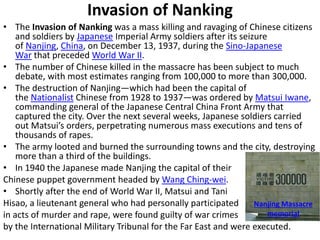
Nanjing Massacre
memorial
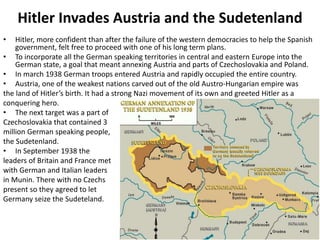
Hitler Invades Austria and the Sudetenland
• Hitler, more confident than after the failure of the western democracies to help the Spanish
government, felt free to proceed with one of his long term plans.
• To incorporate all the German speaking territories in central and eastern Europe into the
German state, a goal that meant annexing Austria and parts of Czechoslovakia and Poland.
• In march 1938 German troops entered Austria and rapidly occupied the entire country.
• Austria, one of the weakest nations carved out of the old Austro-Hungarian empire was
the land of Hitler’s birth. It had a strong Nazi movement of its own and greeted Hitler as a
conquering hero.
• The next target was a part of
Czechoslovakia that contained 3
million German speaking people,
the Sudetenland.
• In September 1938 the
leaders of Britain and France met
with German and Italian leaders
in Munin. There with no Czechs
present so they agreed to let
Germany seize the Sudeteland.
• This conference came to symbolize the British and French policy of
appeasement [making concessions to an aggressor in order to avoid
conflict] of Facist aggression. A policy attributed to the desire to avert war
and the belief that Germany had been treated too harshly at Versailles.
• But which the Russians saw as a plot against them, they believed Britain
and France were encouraging Hitler to expand eastward toward the soviet
Union in hopes that Nazi Germany and Soviet Russia would destroy each
other.
• Mussolini and Hitler were quite satisfied with the outcome of the Munich
conference. Hitler gained a tremendous military advantage by getting
control of the heavily fortified Sudeteland with its important Munichan
factories.
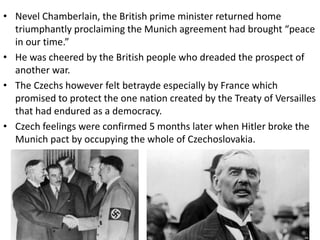
• Nevel Chamberlain, the British prime minister returned home
triumphantly proclaiming the Munich agreement had brought “peace
in our time.”
• He was cheered by the British people who dreaded the prospect of
another war.
• The Czechs however felt betrayde especially by France which
promised to protect the one nation created by the Treaty of Versailles
that had endured as a democracy.
• Czech feelings were confirmed 5 months later when Hitler broke the
Munich pact by occupying the whole of Czechoslovakia.
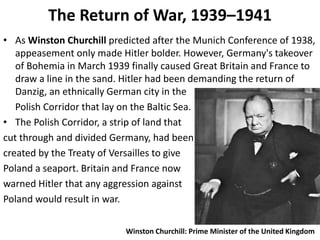
The Return of War, 1939–1941
• As Winston Churchill predicted after the Munich Conference of 1938,
appeasement only made Hitler bolder. However, Germany's takeover
of Bohemia in March 1939 finally caused Great Britain and France to
draw a line in the sand. Hitler had been demanding the return of
Danzig, an ethnically German city in the
Polish Corridor that lay on the Baltic Sea.
• The Polish Corridor, a strip of land that
cut through and divided Germany, had been
created by the Treaty of Versailles to give
Poland a seaport. Britain and France now
warned Hitler that any aggression against
Poland would result in war.
Winston Churchill: Prime Minister of the United Kingdom
Germany Reduces the Soviet Threat
• Hitler already planned to attack Poland and risk a general war in
Europe. Part of his planning for this war involved the Soviet Union. He
intended to eventually conquer the Soviet Union, which had vast farmlands
and other resources that could fulfill Germany's quest for Lebensraum, or
“living space.” However, Hitler needed the Soviet Union to remain neutral if
Britain and France went to war. The geography of such a war concerned
him. The Soviet Union lay to the east of Germany. Britain and France lay to
the west. Hitler did not want to fight on two fronts, east and west, at the
same time. For that reason, Soviet neutrality was vital.
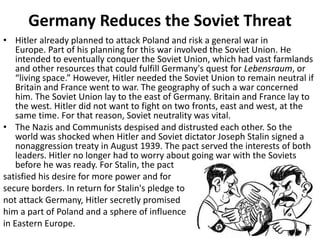
• The Nazis and Communists despised and distrusted each other. So the
world was shocked when Hitler and Soviet dictator Joseph Stalin signed a
nonaggression treaty in August 1939. The pact served the interests of both
leaders. Hitler no longer had to worry about going war with the Soviets
before he was ready. For Stalin, the pact
satisfied his desire for more power and for
secure borders. In return for Stalin's pledge to
not attack Germany, Hitler secretly promised
him a part of Poland and a sphere of influence
in Eastern Europe.
The War Begins
• With the Soviet Union neutralized, Hitler quickly sprang into action. On
September 1, 1939, Hitler announced that Germany was annexing Danzig. As
he spoke, German forces were invading Poland. Two days later, France and
Britain declared war on Germany.
• Hitler's attack on Poland introduced a new kind of warfare—
the Blitzkrieg [German for “lightning war,” a military tactic that combined
swift, massive, and highly coordinated attacks by planes, tanks, and infantry
to overwhelm and quickly conquer an enemy] , or “lightning war.” It consisted
of swift, massive, and highly coordinated attacks by waves of warplanes, tanks,
and infantry. Communications by radio, a new technology perfected in the
1920s, allowed such attacks to be coordinated and carried out. German
warplanes launched attacks on railroads, airfields, communications networks,
military bases, and other strategic sites. Meanwhile, infantry, supported by
tanks and artillery, pushed
toward key cities and other objectives. As
German planes rained bombs and bullets on
the enemy, motorized infantry units quickly
swept toward and around them. Then the
foot soldiers moved in to finish the job.
• Faced with such overwhelming force, the Polish army quickly
collapsed. Two weeks after the Blitzkrieg began, Soviet troops invaded
from the east. By early October, all of Poland was under German or
Soviet control.
• Hitler then switched his focus to the west. He moved 2 million soldiers
to Germany's border with France and the Low Countries—Belgium, the
Netherlands, and Luxembourg. France relied for its main defense on the
Maginot Line, a string of heavily armed fortresses along the German
border. Most French troops massed here, while others gathered along
the border with Belgium. British forces crossed the English Channel,
prepared to aid France and the Low Countries. For the next few months,
not much happened. Newspapers began referring to this as the “Phony
War.”
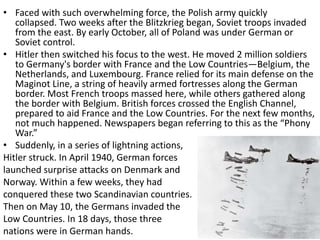
• Suddenly, in a series of lightning actions,
Hitler struck. In April 1940, German forces
launched surprise attacks on Denmark and
Norway. Within a few weeks, they had
conquered these two Scandinavian countries.
Then on May 10, the Germans invaded the
Low Countries. In 18 days, those three
nations were in German hands.
• Using Blitzkrieg tactics, a German army burst through Luxembourg and
southern Belgium into France in just four days. Then it began a dramatic
drive toward the French coast. Skirting the Maginot Line, the Germans sped
westward. Hundreds of thousands of French and British troops found
themselves trapped in a shrinking pocket of French countryside. They
retreated toward the port of Dunkirk on the northwest coast of France.
Britain sent every boat it could find across the English Channel to evacuate the
soldiers. The daring rescue saved some 338,000
men.
• Paris soon fell to the Germans as well.
Mussolini took this opportunity to declare
war on Great Britain and France. On June 22,
France surrendered to Germany. Under the
terms of the armistice, Germany occupied
three fifths of the country. A puppet
government [a government that is appointed
by and whose actions are controlled by an
outside authority] ruled the unoccupied region.
It was called Vichy France, for the town that
was its capital.
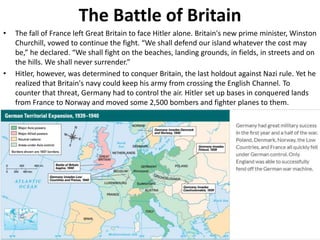
The Battle of Britain
• The fall of France left Great Britain to face Hitler alone. Britain's new prime minister, Winston
Churchill, vowed to continue the fight. “We shall defend our island whatever the cost may
be,” he declared. “We shall fight on the beaches, landing grounds, in fields, in streets and on
the hills. We shall never surrender.”
• Hitler, however, was determined to conquer Britain, the last holdout against Nazi rule. Yet he
realized that Britain's navy could keep his army from crossing the English Channel. To
counter that threat, Germany had to control the air. Hitler set up bases in conquered lands
from France to Norway and moved some 2,500 bombers and fighter planes to them.
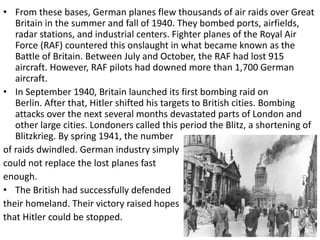
• From these bases, German planes flew thousands of air raids over Great
Britain in the summer and fall of 1940. They bombed ports, airfields,
radar stations, and industrial centers. Fighter planes of the Royal Air
Force (RAF) countered this onslaught in what became known as the
Battle of Britain. Between July and October, the RAF had lost 915
aircraft. However, RAF pilots had downed more than 1,700 German
aircraft.
• In September 1940, Britain launched its first bombing raid on
Berlin. After that, Hitler shifted his targets to British cities. Bombing
attacks over the next several months devastated parts of London and
other large cities. Londoners called this period the Blitz, a shortening of
Blitzkrieg. By spring 1941, the number
of raids dwindled. German industry simply
could not replace the lost planes fast
enough.
• The British had successfully defended
their homeland. Their victory raised hopes
that Hitler could be stopped.
The United States Prepares for War
• When war broke out in Europe, isolationism lost some of its appeal for
Americans. Most wanted to help the Allies, but they did not want the United
States to get involved in the fighting. Yet France and Britain needed weapons,
and the Neutrality Acts banned arms sales to belligerent nations. So in
November 1939, Congress passed another Neutrality Act through Congress that
repealed the arms embargo. However, the new law included a
“cash-and-carry” provision. Nations had to pay cash
for materials and carry them away in their own ships.
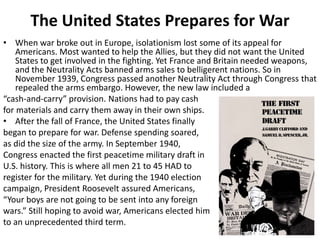
• After the fall of France, the United States finally
began to prepare for war. Defense spending soared,
as did the size of the army. In September 1940,
Congress enacted the first peacetime military draft in
U.S. history. This is where all men 21 to 45 HAD to
register for the military. Yet during the 1940 election
campaign, President Roosevelt assured Americans,
“Your boys are not going to be sent into any foreign
wars.” Still hoping to avoid war, Americans elected him
to an unprecedented third term.
• In December 1940, with the Battle of Britain still raging, Churchill
declared that his country was nearly bankrupt. Roosevelt was
determined to provide Britain “all aid short of war.” He urged
Congress to adopt a plan to lend, not sell, arms to Britain. This
legislation, the Lend-Lease Act, passed in March 1941, but only after
heated public and congressional debate.
• In June 1941, Hitler broke his pact with Stalin by attacking the Soviet
Union. The Soviet army retreated in the face of the invasion. With
Churchill's support, the United States began sending supplies to the
Soviets under the Lend-Lease Act.
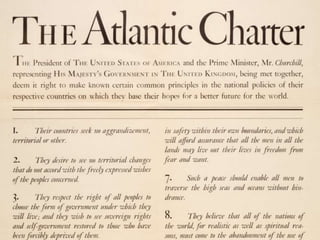
• In August, Churchill and Roosevelt secretly met aboard warships in
Canadian waters of the North Atlantic. There they prepared a
declaration of post-war aims known as the Atlantic Charter [the
statement of principles and war goals reached by U.S. President
Franklin D. Roosevelt and British Prime Minister Winston Churchill
in 1941, which later formed the basis for the charter of the United
Nations] , which later influenced the charter of the United Nations.
• Both agreed to not use the war to seek new territory or to make
peace with the Axis separately. They also asserted the right of all
peoples to self-government. Three months later, Congress voted to
allow American merchant ships to arm themselves and sail to Britain.
The United States Enters the War
• While war raged in Europe, Japan continued its expansion in Asia. After
Hitler conquered France, Japanese troops pushed into French Indochina, in
Southeast Asia. Japan also set its sights on the Dutch East Indies (now
Indonesia), then colonies of German-occupied Netherlands, and on British
Malaya. These regions would provide the oil, rubber, and other raw
materials needed by Japanese industries.
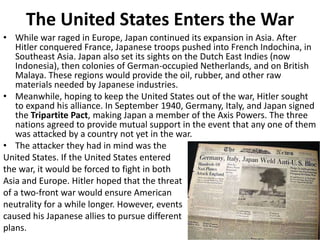
• Meanwhile, hoping to keep the United States out of the war, Hitler sought
to expand his alliance. In September 1940, Germany, Italy, and Japan signed
the Tripartite Pact, making Japan a member of the Axis Powers. The three
nations agreed to provide mutual support in the event that any one of them
was attacked by a country not yet in the war.
• The attacker they had in mind was the
United States. If the United States entered
the war, it would be forced to fight in both
Asia and Europe. Hitler hoped that the threat
of a two-front war would ensure American
neutrality for a while longer. However, events
caused his Japanese allies to pursue different
plans.
• The United States reacted strongly to Japan's actions in Indochina. In
August 1941, it froze Japanese assets in the United States and banned
the export of American oil and other vital resources to Japan. When
efforts to peacefully obtain oil from the Dutch East Indies failed,
Japanese leaders decided that war with the United States could not be
avoided. In October 1941, General Hideki Tojo became prime minister of
Japan, replacing a civilian leader. Tojo, an aggressive militarist, prepared
the nation for war.
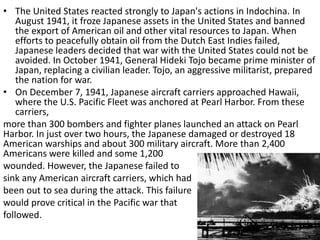
• On December 7, 1941, Japanese aircraft carriers approached Hawaii,
where the U.S. Pacific Fleet was anchored at Pearl Harbor. From these
carriers,
more than 300 bombers and fighter planes launched an attack on Pearl
Harbor. In just over two hours, the Japanese damaged or destroyed 18
American warships and about 300 military aircraft. More than 2,400
Americans were killed and some 1,200
wounded. However, the Japanese failed to
sink any American aircraft carriers, which had
been out to sea during the attack. This failure
would prove critical in the Pacific war that
followed.
The Bombing of Hiroshima and Nagasaki
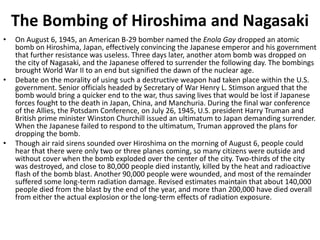
• On August 6, 1945, an American B-29 bomber named the Enola Gay dropped an atomic
bomb on Hiroshima, Japan, effectively convincing the Japanese emperor and his government
that further resistance was useless. Three days later, another atom bomb was dropped on
the city of Nagasaki, and the Japanese offered to surrender the following day. The bombings
brought World War II to an end but signified the dawn of the nuclear age.
• Debate on the morality of using such a destructive weapon had taken place within the U.S.
government. Senior officials headed by Secretary of War Henry L. Stimson argued that the
bomb would bring a quicker end to the war, thus saving lives that would be lost if Japanese
forces fought to the death in Japan, China, and Manchuria. During the final war conference
of the Allies, the Potsdam Conference, on July 26, 1945, U.S. president Harry Truman and
British prime minister Winston Churchill issued an ultimatum to Japan demanding surrender.
When the Japanese failed to respond to the ultimatum, Truman approved the plans for
dropping the bomb.
• Though air raid sirens sounded over Hiroshima on the morning of August 6, people could
hear that there were only two or three planes coming, so many citizens were outside and
without cover when the bomb exploded over the center of the city. Two-thirds of the city
was destroyed, and close to 80,000 people died instantly, killed by the heat and radioactive
flash of the bomb blast. Another 90,000 people were wounded, and most of the remainder
suffered some long-term radiation damage. Revised estimates maintain that about 140,000
people died from the blast by the end of the year, and more than 200,000 have died overall
from either the actual explosion or the long-term effects of radiation exposure.
• On August 9, 1945, the United States dropped an atomic bomb on the Japanese city of
Nagasaki. The bomb destroyed the city and killed tens of thousands of people. The U.S.
attack on Nagasaki followed the atomic bombing of Hiroshima on August 6; the two horrific
events brought Japan's unconditional surrender and marked the end of World War II and the
beginning of the nuclear arms race.
The United States had set a deadline for Japan's surrender, and when the deadline passed,
U.S. president Harry Truman ordered the atomic bombing of Japan. The United States had
been building and testing atomic weapons as part of the secret Manhattan Project and had
detonated the first one in New Mexico in July 1945. The August 6 bombing leveled
Hiroshima with a force that even astounded the bomb's creators. Four square miles were
destroyed, and close to 80,000 people were instantly killed in the most destructive war act
of all time.
The Japanese government did not immediately react to the Hiroshima bombing;
government leaders were unable to verify damage due to destroyed communications lines.
The following day, Tokyo failed to surrender, not realizing the magnitude of the catastrophic
bombing of Hiroshima. In absence of surrender, the United States dropped a second bomb,
code named "Fat Man," on Nagasaki. The bomb flattened the entire city. The next day, on
August 10, the Japanese Supreme Council surrendered unconditionally. Five days later, the
Allies accepted the surrender. World War II officially came to an end on September 2, 1945.
The atomic bombings of Hiroshima and Nagasaki changed the world in a dramatic and
instantaneous way. The sudden reality of the existence of such lethal weaponry triggered
global apprehension of open hostility and created a new concern for survival of the human
race itself. The bombings also readjusted world power arrangements and led to the cold war
and nuclear arms race.
The War in Europe, 1942–1945
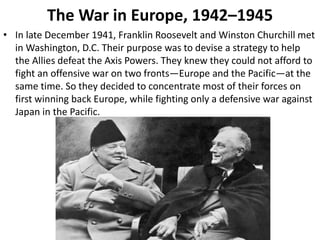
• In late December 1941, Franklin Roosevelt and Winston Churchill met
in Washington, D.C. Their purpose was to devise a strategy to help
the Allies defeat the Axis Powers. They knew they could not afford to
fight an offensive war on two fronts—Europe and the Pacific—at the
same time. So they decided to concentrate most of their forces on
first winning back Europe, while fighting only a defensive war against
Japan in the Pacific.
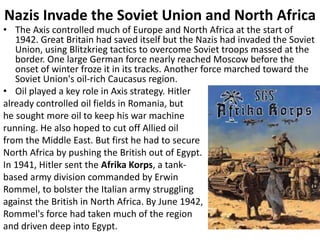
Nazis Invade the Soviet Union and North Africa
• The Axis controlled much of Europe and North Africa at the start of
1942. Great Britain had saved itself but the Nazis had invaded the Soviet
Union, using Blitzkrieg tactics to overcome Soviet troops massed at the
border. One large German force nearly reached Moscow before the
onset of winter froze it in its tracks. Another force marched toward the
Soviet Union's oil-rich Caucasus region.
• Oil played a key role in Axis strategy. Hitler
already controlled oil fields in Romania, but
he sought more oil to keep his war machine
running. He also hoped to cut off Allied oil
from the Middle East. But first he had to secure
North Africa by pushing the British out of Egypt.
In 1941, Hitler sent the Afrika Korps, a tank-
based army division commanded by Erwin
Rommel, to bolster the Italian army struggling
against the British in North Africa. By June 1942,
Rommel's force had taken much of the region
and driven deep into Egypt.
Nazis Begin to Persecute the Jews
• Conquered nations suffered greatly under Nazi rule. Millions of Europeans were forced
to work in the German arms industry. The Germans treated Russians, Poles, and other
Slavs with special contempt, partly because Hitler claimed that Slavs were
subhuman. The Nazis worked them to death and killed large numbers of them outright.
• No group suffered under Nazi Germany more than the Jews. After Hitler came to power,
he passed laws that increasingly persecuted Jews and stripped them of their
rights. Many Jews tried to flee, but most countries, including the United States, refused
to admit more than a token number of refugees. Hitler had long been obsessed with
the “Jewish question”—how to rid Germany of Jews. As German rule expanded, more
Jews came under Nazi control and the “Jewish question” grew more critical to the
Nazis.
• In some places, the Nazis forced Jews into
overcrowded ghettos [a section of a city in
which members of a minority group live,
especially because of force or social, legal,
or economic pressures] , small sections of cities
that could be walled off and guarded. Hundreds
of thousands of Jews in these ghettos died from
starvation and disease. In just two of the
hundreds of ghettos, more than 112,000 died
between 1941 and 1942 alone.
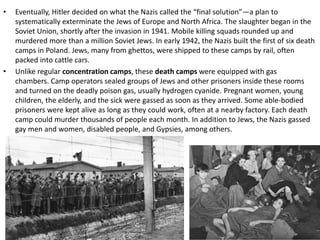
• Eventually, Hitler decided on what the Nazis called the “final solution”—a plan to
systematically exterminate the Jews of Europe and North Africa. The slaughter began in the
Soviet Union, shortly after the invasion in 1941. Mobile killing squads rounded up and
murdered more than a million Soviet Jews. In early 1942, the Nazis built the first of six death
camps in Poland. Jews, many from ghettos, were shipped to these camps by rail, often
packed into cattle cars.
• Unlike regular concentration camps, these death camps were equipped with gas
chambers. Camp operators sealed groups of Jews and other prisoners inside these rooms
and turned on the deadly poison gas, usually hydrogen cyanide. Pregnant women, young
children, the elderly, and the sick were gassed as soon as they arrived. Some able-bodied
prisoners were kept alive as long as they could work, often at a nearby factory. Each death
camp could murder thousands of people each month. In addition to Jews, the Nazis gassed
gay men and women, disabled people, and Gypsies, among others.
The Allies Debate War Strategies
• When Roosevelt and Churchill met in Washington in December 1941, they had
only a vague understanding of the extent of Hitler's extermination
policies. Their goal was to figure out how to win the war in Europe. To do this,
they had to choose from a number of possible strategies.
• Invading occupied France was a possibility, because the French people would
support such an invasion. Also, nearby Britain could serve as a staging area for
the massing of troops and resources before the assault. But the German army
had a strong presence in France that would make such an invasion extremely
difficult.
• Some thought a direct attack on Italy made more sense. The Italian army was
fairly weak, and Italy would provide a good base for securing the rest of
Europe. Others wanted to launch the Allied offensive in North Africa, which was
not as well defended and could serve as a gateway to Europe. But it was far
from the final target, Germany, and would also test the Allies' ability to
transport and supply their forces.
• Great Britain's choice of strategy was clear. Already caught up in the battle for
North Africa, Churchill wanted the Allies to strike there first. In contrast, Soviet
leader Joseph Stalin wanted an invasion of France to take pressure off his
army. The USSR, now one of the Allies, greatly needed help. Roosevelt
eventually was convinced to support the British plan. In June 1942, he made
the decision to invade North Africa in the fall.
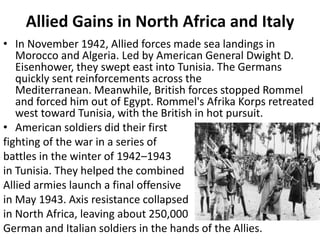
Allied Gains in North Africa and Italy
• In November 1942, Allied forces made sea landings in
Morocco and Algeria. Led by American General Dwight D.
Eisenhower, they swept east into Tunisia. The Germans
quickly sent reinforcements across the
Mediterranean. Meanwhile, British forces stopped Rommel
and forced him out of Egypt. Rommel's Afrika Korps retreated
west toward Tunisia, with the British in hot pursuit.
• American soldiers did their first
fighting of the war in a series of
battles in the winter of 1942–1943
in Tunisia. They helped the combined
Allied armies launch a final offensive
in May 1943. Axis resistance collapsed
in North Africa, leaving about 250,000
German and Italian soldiers in the hands of the Allies.
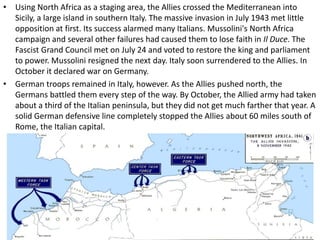
• Using North Africa as a staging area, the Allies crossed the Mediterranean into
Sicily, a large island in southern Italy. The massive invasion in July 1943 met little
opposition at first. Its success alarmed many Italians. Mussolini's North Africa
campaign and several other failures had caused them to lose faith in Il Duce. The
Fascist Grand Council met on July 24 and voted to restore the king and parliament
to power. Mussolini resigned the next day. Italy soon surrendered to the Allies. In
October it declared war on Germany.
• German troops remained in Italy, however. As the Allies pushed north, the
Germans battled them every step of the way. By October, the Allied army had taken
about a third of the Italian peninsula, but they did not get much farther that year. A
solid German defensive line completely stopped the Allies about 60 miles south of
Rome, the Italian capital.
The Battle of Stalingrad
• The decision to invade North Africa left the Soviet Union on its own. In June 1942,
Axis troops began to push farther into Soviet territory. Hitler split his forces so they
could seize the rest of the Caucasus and also take Stalingrad, a large city on the
Volga River. At Stalingrad, German firebombs set most of the city ablaze, but Stalin
ordered his soldiers to not retreat. By mid-September, Axis troops had a large
Soviet force trapped in a strip of the city along the Volga.
• Fierce street-by-street fighting followed for two months. Then, in November, the
Soviet Red Army began a counterattack, sending its troops forward against the Nazi
assault. In a few days, the Soviets had encircled the German troops. Hitler insisted that
his soldiers fight to the death, which most of them did. In January 1943, the remains of
Hitler's army, starving and frozen in the bitter Russian winter, surrendered.
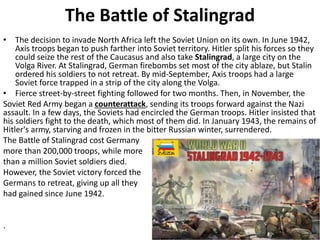
The Battle of Stalingrad cost Germany
more than 200,000 troops, while more
than a million Soviet soldiers died.
However, the Soviet victory forced the
Germans to retreat, giving up all they
had gained since June 1942.
.
Battle of Midway
• The Battle of Midway took place from June 3
to June 6, 1942. And in many ways the results
of that battle were a coming true of a
prophecy that was made by Isoroku
Yamamoto, that after enough time passed, the
vast industrial might of the United States
would turn the tables against Japan. Midway
saw that prophecy come true. The United
States scored a major victory in large part due
to the vast intelligence advantage that the
United States had.
• Midway was a key objective for the Japanese,
and it was a key strong point for the
Americans. Midway represented perhaps the
only significant piece of land between the
Hawaiian islands and the Japanese home
islands in the Central Pacific. Midway Island is
located almost 1,100 miles Northwest of the
Hawaiian island chain. It is a tiny, tiny group of
islands, just 2.4 square miles in surface.
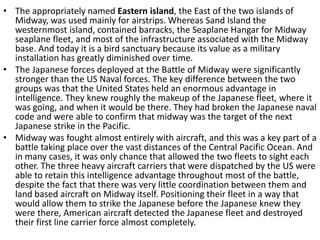
• The appropriately named Eastern island, the East of the two islands of
Midway, was used mainly for airstrips. Whereas Sand Island the
westernmost island, contained barracks, the Seaplane Hangar for Midway
seaplane fleet, and most of the infrastructure associated with the Midway
base. And today it is a bird sanctuary because its value as a military
installation has greatly diminished over time.
• The Japanese forces deployed at the Battle of Midway were significantly
stronger than the US Naval forces. The key difference between the two
groups was that the United States held an enormous advantage in
intelligence. They knew roughly the makeup of the Japanese fleet, where it
was going, and when it would be there. They had broken the Japanese naval
code and were able to confirm that midway was the target of the next
Japanese strike in the Pacific.
• Midway was fought almost entirely with aircraft, and this was a key part of a
battle taking place over the vast distances of the Central Pacific Ocean. And
in many cases, it was only chance that allowed the two fleets to sight each
other. The three heavy aircraft carriers that were dispatched by the US were
able to retain this intelligence advantage throughout most of the battle,
despite the fact that there was very little coordination between them and
land based aircraft on Midway itself. Positioning their fleet in a way that
would allow them to strike the Japanese before the Japanese knew they
were there, American aircraft detected the Japanese fleet and destroyed
their first line carrier force almost completely.
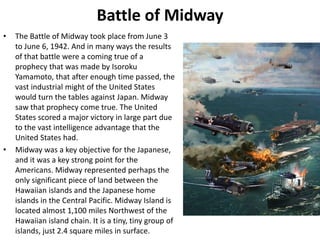
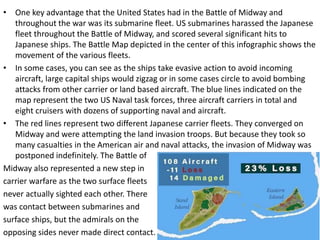
• One key advantage that the United States had in the Battle of Midway and
throughout the war was its submarine fleet. US submarines harassed the Japanese
fleet throughout the Battle of Midway, and scored several significant hits to
Japanese ships. The Battle Map depicted in the center of this infographic shows the
movement of the various fleets.
• In some cases, you can see as the ships take evasive action to avoid incoming
aircraft, large capital ships would zigzag or in some cases circle to avoid bombing
attacks from other carrier or land based aircraft. The blue lines indicated on the
map represent the two US Naval task forces, three aircraft carriers in total and
eight cruisers with dozens of supporting naval and aircraft.
• The red lines represent two different Japanese carrier fleets. They converged on
Midway and were attempting the land invasion troops. But because they took so
many casualties in the American air and naval attacks, the invasion of Midway was
postponed indefinitely. The Battle of
Midway also represented a new step in
carrier warfare as the two surface fleets
never actually sighted each other. There
was contact between submarines and
surface ships, but the admirals on the
opposing sides never made direct contact.
Allied Bombing Campaigns
• Hitler's losses in the Soviet Union left Germany with only one major source of oil—
Romania. The Romanian oil fields became a prime target of Allied bombing. However, the
Allies' main target in their air campaign was Germany.
• American pilots typically launched daytime raids. They favored aiming at specific targets
such as oil refineries, railroads, and factories with the intent of disrupting Germany's ability
to supply and equip its fighting forces. By the end of the war, Germany's infrastructure and
economy were in ruins.
• British pilots relied mainly on saturation bombing, the rapid release of a large number of
bombs over a wide area. They usually flew nighttime raids over enemy cities. The strategy
behind bombing cities, with its appalling loss of life, was to destroy civilian morale and force
a surrender. This tactic turned German cities like Dresden and Hamburg into rubble-strewn
graveyards. However, it did not bring an early end to the war.
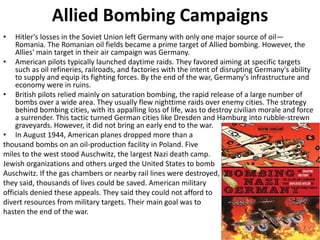
• In August 1944, American planes dropped more than a
thousand bombs on an oil-production facility in Poland. Five
miles to the west stood Auschwitz, the largest Nazi death camp.
Jewish organizations and others urged the United States to bomb
Auschwitz. If the gas chambers or nearby rail lines were destroyed,
they said, thousands of lives could be saved. American military
officials denied these appeals. They said they could not afford to
divert resources from military targets. Their main goal was to
hasten the end of the war.
The Allies Liberate France
• To meet that goal, Allies focused most of their resources in 1944 on an invasion of
France. General Eisenhower directed the effort. To prepare for the invasion he
gathered more than 1.5 million troops in southern England. Also at his command
were some 1,200 warships, 800 troops transport ships, 4,000 landing craft, 10,000
airplanes, and hundreds of tanks. Troops would cross the English Channel by ship to
Normandy, in northern France.
• D-Day [June 6, 1944, the day that Allied forces invaded France to free it from Nazi
rule and eventually defeat Germany in World War II] —the day the invasion
began—came on June 6, 1944. Allied planes overhead and warships offshore
provided covering fire, while landing craft delivered some 50,000 soldiers and
1,500 tanks to five Normandy beaches. German forces with well-entrenched guns
put up a fierce resistance. However, by the end of the day nearly 150,000 Allied
troops had come ashore and controlled a 59-mile section of the Normandy
coast. Over the next few weeks the rest of the Allies' huge army followed them into
France.
• In July, an American army under General
Omar Bradley and a British army under General
Bernard Montgomery began a rapid sweep across
France. In August, the Allies liberated Paris. In
September, the first American troops crossed the
French border into Germany.
Hiding The Holocaust
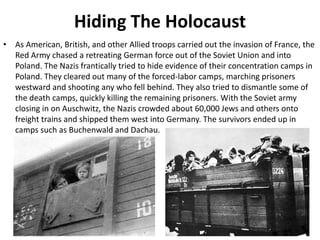
• As American, British, and other Allied troops carried out the invasion of France, the
Red Army chased a retreating German force out of the Soviet Union and into
Poland. The Nazis frantically tried to hide evidence of their concentration camps in
Poland. They cleared out many of the forced-labor camps, marching prisoners
westward and shooting any who fell behind. They also tried to dismantle some of
the death camps, quickly killing the remaining prisoners. With the Soviet army
closing in on Auschwitz, the Nazis crowded about 60,000 Jews and others onto
freight trains and shipped them west into Germany. The survivors ended up in
camps such as Buchenwald and Dachau.
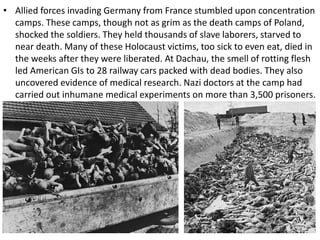
• Allied forces invading Germany from France stumbled upon concentration
camps. These camps, though not as grim as the death camps of Poland,
shocked the soldiers. They held thousands of slave laborers, starved to
near death. Many of these Holocaust victims, too sick to even eat, died in
the weeks after they were liberated. At Dachau, the smell of rotting flesh
led American GIs to 28 railway cars packed with dead bodies. They also
uncovered evidence of medical research. Nazi doctors at the camp had
carried out inhumane medical experiments on more than 3,500 prisoners.
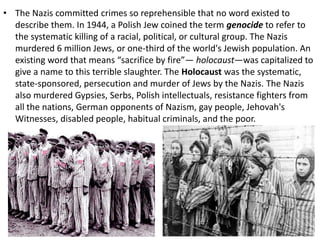
• The Nazis committed crimes so reprehensible that no word existed to
describe them. In 1944, a Polish Jew coined the term genocide to refer to
the systematic killing of a racial, political, or cultural group. The Nazis
murdered 6 million Jews, or one-third of the world's Jewish population. An
existing word that means “sacrifice by fire”— holocaust—was capitalized to
give a name to this terrible slaughter. The Holocaust was the systematic,
state-sponsored, persecution and murder of Jews by the Nazis. The Nazis
also murdered Gypsies, Serbs, Polish intellectuals, resistance fighters from
all the nations, German opponents of Nazism, gay people, Jehovah's
Witnesses, disabled people, habitual criminals, and the poor.
The War in Europe Ends
• When the Allies crossed from France into Germany, they met fierce resistance. By
December 1944, their offensive had stalled. Hitler made plans to burst through the
Allied lines in the wooded Ardennes region of Belgium, where the American forces
were weakest. He launched his counteroffensive
on December 16. Eight German armored divisions
smashed into the surprised Americans, creating a huge
bulge in the American line. Allied air support and quick
action by General George Patton's Third Army forced
the Germans to withdraw by mid-January. The Battle
of the Bulge was the last German offensive on the
western front.
• By April 1945, the Red Army had fought its way
through Poland and into Germany, to the outskirts
of Berlin. On April 30, with advancing Soviet soldiers
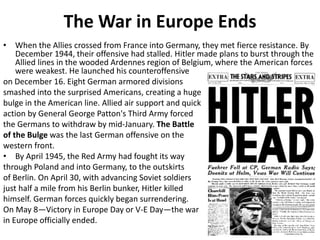
just half a mile from his Berlin bunker, Hitler killed
himself. German forces quickly began surrendering.
On May 8—Victory in Europe Day or V-E Day—the war
in Europe officially ended.
Next, we will talk about the
holocaust!

World War II Powerpoint

  • 2.
    Invasion of Nanking •The Invasion of Nanking was a mass killing and ravaging of Chinese citizens and soldiers by Japanese Imperial Army soldiers after its seizure of Nanjing, China, on December 13, 1937, during the Sino-Japanese War that preceded World War II. • The number of Chinese killed in the massacre has been subject to much debate, with most estimates ranging from 100,000 to more than 300,000. • The destruction of Nanjing—which had been the capital of the Nationalist Chinese from 1928 to 1937—was ordered by Matsui Iwane, commanding general of the Japanese Central China Front Army that captured the city. Over the next several weeks, Japanese soldiers carried out Matsui’s orders, perpetrating numerous mass executions and tens of thousands of rapes. • The army looted and burned the surrounding towns and the city, destroying more than a third of the buildings. • In 1940 the Japanese made Nanjing the capital of their Chinese puppet government headed by Wang Ching-wei. • Shortly after the end of World War II, Matsui and Tani Hisao, a lieutenant general who had personally participated in acts of murder and rape, were found guilty of war crimes by the International Military Tribunal for the Far East and were executed. Nanjing Massacre memorial
  • 3.
    Hitler Invades Austriaand the Sudetenland • Hitler, more confident than after the failure of the western democracies to help the Spanish government, felt free to proceed with one of his long term plans. • To incorporate all the German speaking territories in central and eastern Europe into the German state, a goal that meant annexing Austria and parts of Czechoslovakia and Poland. • In march 1938 German troops entered Austria and rapidly occupied the entire country. • Austria, one of the weakest nations carved out of the old Austro-Hungarian empire was the land of Hitler’s birth. It had a strong Nazi movement of its own and greeted Hitler as a conquering hero. • The next target was a part of Czechoslovakia that contained 3 million German speaking people, the Sudetenland. • In September 1938 the leaders of Britain and France met with German and Italian leaders in Munin. There with no Czechs present so they agreed to let Germany seize the Sudeteland.
  • 4.
    • This conferencecame to symbolize the British and French policy of appeasement [making concessions to an aggressor in order to avoid conflict] of Facist aggression. A policy attributed to the desire to avert war and the belief that Germany had been treated too harshly at Versailles. • But which the Russians saw as a plot against them, they believed Britain and France were encouraging Hitler to expand eastward toward the soviet Union in hopes that Nazi Germany and Soviet Russia would destroy each other. • Mussolini and Hitler were quite satisfied with the outcome of the Munich conference. Hitler gained a tremendous military advantage by getting control of the heavily fortified Sudeteland with its important Munichan factories.
  • 5.
    • Nevel Chamberlain,the British prime minister returned home triumphantly proclaiming the Munich agreement had brought “peace in our time.” • He was cheered by the British people who dreaded the prospect of another war. • The Czechs however felt betrayde especially by France which promised to protect the one nation created by the Treaty of Versailles that had endured as a democracy. • Czech feelings were confirmed 5 months later when Hitler broke the Munich pact by occupying the whole of Czechoslovakia.
  • 6.
    The Return ofWar, 1939–1941 • As Winston Churchill predicted after the Munich Conference of 1938, appeasement only made Hitler bolder. However, Germany's takeover of Bohemia in March 1939 finally caused Great Britain and France to draw a line in the sand. Hitler had been demanding the return of Danzig, an ethnically German city in the Polish Corridor that lay on the Baltic Sea. • The Polish Corridor, a strip of land that cut through and divided Germany, had been created by the Treaty of Versailles to give Poland a seaport. Britain and France now warned Hitler that any aggression against Poland would result in war. Winston Churchill: Prime Minister of the United Kingdom
  • 7.
    Germany Reduces theSoviet Threat • Hitler already planned to attack Poland and risk a general war in Europe. Part of his planning for this war involved the Soviet Union. He intended to eventually conquer the Soviet Union, which had vast farmlands and other resources that could fulfill Germany's quest for Lebensraum, or “living space.” However, Hitler needed the Soviet Union to remain neutral if Britain and France went to war. The geography of such a war concerned him. The Soviet Union lay to the east of Germany. Britain and France lay to the west. Hitler did not want to fight on two fronts, east and west, at the same time. For that reason, Soviet neutrality was vital. • The Nazis and Communists despised and distrusted each other. So the world was shocked when Hitler and Soviet dictator Joseph Stalin signed a nonaggression treaty in August 1939. The pact served the interests of both leaders. Hitler no longer had to worry about going war with the Soviets before he was ready. For Stalin, the pact satisfied his desire for more power and for secure borders. In return for Stalin's pledge to not attack Germany, Hitler secretly promised him a part of Poland and a sphere of influence in Eastern Europe.
  • 8.
    The War Begins •With the Soviet Union neutralized, Hitler quickly sprang into action. On September 1, 1939, Hitler announced that Germany was annexing Danzig. As he spoke, German forces were invading Poland. Two days later, France and Britain declared war on Germany. • Hitler's attack on Poland introduced a new kind of warfare— the Blitzkrieg [German for “lightning war,” a military tactic that combined swift, massive, and highly coordinated attacks by planes, tanks, and infantry to overwhelm and quickly conquer an enemy] , or “lightning war.” It consisted of swift, massive, and highly coordinated attacks by waves of warplanes, tanks, and infantry. Communications by radio, a new technology perfected in the 1920s, allowed such attacks to be coordinated and carried out. German warplanes launched attacks on railroads, airfields, communications networks, military bases, and other strategic sites. Meanwhile, infantry, supported by tanks and artillery, pushed toward key cities and other objectives. As German planes rained bombs and bullets on the enemy, motorized infantry units quickly swept toward and around them. Then the foot soldiers moved in to finish the job.
  • 9.
    • Faced withsuch overwhelming force, the Polish army quickly collapsed. Two weeks after the Blitzkrieg began, Soviet troops invaded from the east. By early October, all of Poland was under German or Soviet control. • Hitler then switched his focus to the west. He moved 2 million soldiers to Germany's border with France and the Low Countries—Belgium, the Netherlands, and Luxembourg. France relied for its main defense on the Maginot Line, a string of heavily armed fortresses along the German border. Most French troops massed here, while others gathered along the border with Belgium. British forces crossed the English Channel, prepared to aid France and the Low Countries. For the next few months, not much happened. Newspapers began referring to this as the “Phony War.” • Suddenly, in a series of lightning actions, Hitler struck. In April 1940, German forces launched surprise attacks on Denmark and Norway. Within a few weeks, they had conquered these two Scandinavian countries. Then on May 10, the Germans invaded the Low Countries. In 18 days, those three nations were in German hands.
  • 10.
    • Using Blitzkriegtactics, a German army burst through Luxembourg and southern Belgium into France in just four days. Then it began a dramatic drive toward the French coast. Skirting the Maginot Line, the Germans sped westward. Hundreds of thousands of French and British troops found themselves trapped in a shrinking pocket of French countryside. They retreated toward the port of Dunkirk on the northwest coast of France. Britain sent every boat it could find across the English Channel to evacuate the soldiers. The daring rescue saved some 338,000 men. • Paris soon fell to the Germans as well. Mussolini took this opportunity to declare war on Great Britain and France. On June 22, France surrendered to Germany. Under the terms of the armistice, Germany occupied three fifths of the country. A puppet government [a government that is appointed by and whose actions are controlled by an outside authority] ruled the unoccupied region. It was called Vichy France, for the town that was its capital.
  • 11.
    The Battle ofBritain • The fall of France left Great Britain to face Hitler alone. Britain's new prime minister, Winston Churchill, vowed to continue the fight. “We shall defend our island whatever the cost may be,” he declared. “We shall fight on the beaches, landing grounds, in fields, in streets and on the hills. We shall never surrender.” • Hitler, however, was determined to conquer Britain, the last holdout against Nazi rule. Yet he realized that Britain's navy could keep his army from crossing the English Channel. To counter that threat, Germany had to control the air. Hitler set up bases in conquered lands from France to Norway and moved some 2,500 bombers and fighter planes to them.
  • 12.
    • From thesebases, German planes flew thousands of air raids over Great Britain in the summer and fall of 1940. They bombed ports, airfields, radar stations, and industrial centers. Fighter planes of the Royal Air Force (RAF) countered this onslaught in what became known as the Battle of Britain. Between July and October, the RAF had lost 915 aircraft. However, RAF pilots had downed more than 1,700 German aircraft. • In September 1940, Britain launched its first bombing raid on Berlin. After that, Hitler shifted his targets to British cities. Bombing attacks over the next several months devastated parts of London and other large cities. Londoners called this period the Blitz, a shortening of Blitzkrieg. By spring 1941, the number of raids dwindled. German industry simply could not replace the lost planes fast enough. • The British had successfully defended their homeland. Their victory raised hopes that Hitler could be stopped.
  • 13.
    The United StatesPrepares for War • When war broke out in Europe, isolationism lost some of its appeal for Americans. Most wanted to help the Allies, but they did not want the United States to get involved in the fighting. Yet France and Britain needed weapons, and the Neutrality Acts banned arms sales to belligerent nations. So in November 1939, Congress passed another Neutrality Act through Congress that repealed the arms embargo. However, the new law included a “cash-and-carry” provision. Nations had to pay cash for materials and carry them away in their own ships. • After the fall of France, the United States finally began to prepare for war. Defense spending soared, as did the size of the army. In September 1940, Congress enacted the first peacetime military draft in U.S. history. This is where all men 21 to 45 HAD to register for the military. Yet during the 1940 election campaign, President Roosevelt assured Americans, “Your boys are not going to be sent into any foreign wars.” Still hoping to avoid war, Americans elected him to an unprecedented third term.
  • 14.
    • In December1940, with the Battle of Britain still raging, Churchill declared that his country was nearly bankrupt. Roosevelt was determined to provide Britain “all aid short of war.” He urged Congress to adopt a plan to lend, not sell, arms to Britain. This legislation, the Lend-Lease Act, passed in March 1941, but only after heated public and congressional debate. • In June 1941, Hitler broke his pact with Stalin by attacking the Soviet Union. The Soviet army retreated in the face of the invasion. With Churchill's support, the United States began sending supplies to the Soviets under the Lend-Lease Act. • In August, Churchill and Roosevelt secretly met aboard warships in Canadian waters of the North Atlantic. There they prepared a declaration of post-war aims known as the Atlantic Charter [the statement of principles and war goals reached by U.S. President Franklin D. Roosevelt and British Prime Minister Winston Churchill in 1941, which later formed the basis for the charter of the United Nations] , which later influenced the charter of the United Nations. • Both agreed to not use the war to seek new territory or to make peace with the Axis separately. They also asserted the right of all peoples to self-government. Three months later, Congress voted to allow American merchant ships to arm themselves and sail to Britain.
  • 16.
    The United StatesEnters the War • While war raged in Europe, Japan continued its expansion in Asia. After Hitler conquered France, Japanese troops pushed into French Indochina, in Southeast Asia. Japan also set its sights on the Dutch East Indies (now Indonesia), then colonies of German-occupied Netherlands, and on British Malaya. These regions would provide the oil, rubber, and other raw materials needed by Japanese industries. • Meanwhile, hoping to keep the United States out of the war, Hitler sought to expand his alliance. In September 1940, Germany, Italy, and Japan signed the Tripartite Pact, making Japan a member of the Axis Powers. The three nations agreed to provide mutual support in the event that any one of them was attacked by a country not yet in the war. • The attacker they had in mind was the United States. If the United States entered the war, it would be forced to fight in both Asia and Europe. Hitler hoped that the threat of a two-front war would ensure American neutrality for a while longer. However, events caused his Japanese allies to pursue different plans.
  • 17.
    • The UnitedStates reacted strongly to Japan's actions in Indochina. In August 1941, it froze Japanese assets in the United States and banned the export of American oil and other vital resources to Japan. When efforts to peacefully obtain oil from the Dutch East Indies failed, Japanese leaders decided that war with the United States could not be avoided. In October 1941, General Hideki Tojo became prime minister of Japan, replacing a civilian leader. Tojo, an aggressive militarist, prepared the nation for war. • On December 7, 1941, Japanese aircraft carriers approached Hawaii, where the U.S. Pacific Fleet was anchored at Pearl Harbor. From these carriers, more than 300 bombers and fighter planes launched an attack on Pearl Harbor. In just over two hours, the Japanese damaged or destroyed 18 American warships and about 300 military aircraft. More than 2,400 Americans were killed and some 1,200 wounded. However, the Japanese failed to sink any American aircraft carriers, which had been out to sea during the attack. This failure would prove critical in the Pacific war that followed.
  • 18.
    The Bombing ofHiroshima and Nagasaki • On August 6, 1945, an American B-29 bomber named the Enola Gay dropped an atomic bomb on Hiroshima, Japan, effectively convincing the Japanese emperor and his government that further resistance was useless. Three days later, another atom bomb was dropped on the city of Nagasaki, and the Japanese offered to surrender the following day. The bombings brought World War II to an end but signified the dawn of the nuclear age. • Debate on the morality of using such a destructive weapon had taken place within the U.S. government. Senior officials headed by Secretary of War Henry L. Stimson argued that the bomb would bring a quicker end to the war, thus saving lives that would be lost if Japanese forces fought to the death in Japan, China, and Manchuria. During the final war conference of the Allies, the Potsdam Conference, on July 26, 1945, U.S. president Harry Truman and British prime minister Winston Churchill issued an ultimatum to Japan demanding surrender. When the Japanese failed to respond to the ultimatum, Truman approved the plans for dropping the bomb. • Though air raid sirens sounded over Hiroshima on the morning of August 6, people could hear that there were only two or three planes coming, so many citizens were outside and without cover when the bomb exploded over the center of the city. Two-thirds of the city was destroyed, and close to 80,000 people died instantly, killed by the heat and radioactive flash of the bomb blast. Another 90,000 people were wounded, and most of the remainder suffered some long-term radiation damage. Revised estimates maintain that about 140,000 people died from the blast by the end of the year, and more than 200,000 have died overall from either the actual explosion or the long-term effects of radiation exposure.
  • 19.
    • On August9, 1945, the United States dropped an atomic bomb on the Japanese city of Nagasaki. The bomb destroyed the city and killed tens of thousands of people. The U.S. attack on Nagasaki followed the atomic bombing of Hiroshima on August 6; the two horrific events brought Japan's unconditional surrender and marked the end of World War II and the beginning of the nuclear arms race. The United States had set a deadline for Japan's surrender, and when the deadline passed, U.S. president Harry Truman ordered the atomic bombing of Japan. The United States had been building and testing atomic weapons as part of the secret Manhattan Project and had detonated the first one in New Mexico in July 1945. The August 6 bombing leveled Hiroshima with a force that even astounded the bomb's creators. Four square miles were destroyed, and close to 80,000 people were instantly killed in the most destructive war act of all time. The Japanese government did not immediately react to the Hiroshima bombing; government leaders were unable to verify damage due to destroyed communications lines. The following day, Tokyo failed to surrender, not realizing the magnitude of the catastrophic bombing of Hiroshima. In absence of surrender, the United States dropped a second bomb, code named "Fat Man," on Nagasaki. The bomb flattened the entire city. The next day, on August 10, the Japanese Supreme Council surrendered unconditionally. Five days later, the Allies accepted the surrender. World War II officially came to an end on September 2, 1945. The atomic bombings of Hiroshima and Nagasaki changed the world in a dramatic and instantaneous way. The sudden reality of the existence of such lethal weaponry triggered global apprehension of open hostility and created a new concern for survival of the human race itself. The bombings also readjusted world power arrangements and led to the cold war and nuclear arms race.
  • 20.
    The War inEurope, 1942–1945 • In late December 1941, Franklin Roosevelt and Winston Churchill met in Washington, D.C. Their purpose was to devise a strategy to help the Allies defeat the Axis Powers. They knew they could not afford to fight an offensive war on two fronts—Europe and the Pacific—at the same time. So they decided to concentrate most of their forces on first winning back Europe, while fighting only a defensive war against Japan in the Pacific.
  • 21.
    Nazis Invade theSoviet Union and North Africa • The Axis controlled much of Europe and North Africa at the start of 1942. Great Britain had saved itself but the Nazis had invaded the Soviet Union, using Blitzkrieg tactics to overcome Soviet troops massed at the border. One large German force nearly reached Moscow before the onset of winter froze it in its tracks. Another force marched toward the Soviet Union's oil-rich Caucasus region. • Oil played a key role in Axis strategy. Hitler already controlled oil fields in Romania, but he sought more oil to keep his war machine running. He also hoped to cut off Allied oil from the Middle East. But first he had to secure North Africa by pushing the British out of Egypt. In 1941, Hitler sent the Afrika Korps, a tank- based army division commanded by Erwin Rommel, to bolster the Italian army struggling against the British in North Africa. By June 1942, Rommel's force had taken much of the region and driven deep into Egypt.
  • 22.
    Nazis Begin toPersecute the Jews • Conquered nations suffered greatly under Nazi rule. Millions of Europeans were forced to work in the German arms industry. The Germans treated Russians, Poles, and other Slavs with special contempt, partly because Hitler claimed that Slavs were subhuman. The Nazis worked them to death and killed large numbers of them outright. • No group suffered under Nazi Germany more than the Jews. After Hitler came to power, he passed laws that increasingly persecuted Jews and stripped them of their rights. Many Jews tried to flee, but most countries, including the United States, refused to admit more than a token number of refugees. Hitler had long been obsessed with the “Jewish question”—how to rid Germany of Jews. As German rule expanded, more Jews came under Nazi control and the “Jewish question” grew more critical to the Nazis. • In some places, the Nazis forced Jews into overcrowded ghettos [a section of a city in which members of a minority group live, especially because of force or social, legal, or economic pressures] , small sections of cities that could be walled off and guarded. Hundreds of thousands of Jews in these ghettos died from starvation and disease. In just two of the hundreds of ghettos, more than 112,000 died between 1941 and 1942 alone.
  • 23.
    • Eventually, Hitlerdecided on what the Nazis called the “final solution”—a plan to systematically exterminate the Jews of Europe and North Africa. The slaughter began in the Soviet Union, shortly after the invasion in 1941. Mobile killing squads rounded up and murdered more than a million Soviet Jews. In early 1942, the Nazis built the first of six death camps in Poland. Jews, many from ghettos, were shipped to these camps by rail, often packed into cattle cars. • Unlike regular concentration camps, these death camps were equipped with gas chambers. Camp operators sealed groups of Jews and other prisoners inside these rooms and turned on the deadly poison gas, usually hydrogen cyanide. Pregnant women, young children, the elderly, and the sick were gassed as soon as they arrived. Some able-bodied prisoners were kept alive as long as they could work, often at a nearby factory. Each death camp could murder thousands of people each month. In addition to Jews, the Nazis gassed gay men and women, disabled people, and Gypsies, among others.
  • 24.
    The Allies DebateWar Strategies • When Roosevelt and Churchill met in Washington in December 1941, they had only a vague understanding of the extent of Hitler's extermination policies. Their goal was to figure out how to win the war in Europe. To do this, they had to choose from a number of possible strategies. • Invading occupied France was a possibility, because the French people would support such an invasion. Also, nearby Britain could serve as a staging area for the massing of troops and resources before the assault. But the German army had a strong presence in France that would make such an invasion extremely difficult. • Some thought a direct attack on Italy made more sense. The Italian army was fairly weak, and Italy would provide a good base for securing the rest of Europe. Others wanted to launch the Allied offensive in North Africa, which was not as well defended and could serve as a gateway to Europe. But it was far from the final target, Germany, and would also test the Allies' ability to transport and supply their forces. • Great Britain's choice of strategy was clear. Already caught up in the battle for North Africa, Churchill wanted the Allies to strike there first. In contrast, Soviet leader Joseph Stalin wanted an invasion of France to take pressure off his army. The USSR, now one of the Allies, greatly needed help. Roosevelt eventually was convinced to support the British plan. In June 1942, he made the decision to invade North Africa in the fall.
  • 25.
    Allied Gains inNorth Africa and Italy • In November 1942, Allied forces made sea landings in Morocco and Algeria. Led by American General Dwight D. Eisenhower, they swept east into Tunisia. The Germans quickly sent reinforcements across the Mediterranean. Meanwhile, British forces stopped Rommel and forced him out of Egypt. Rommel's Afrika Korps retreated west toward Tunisia, with the British in hot pursuit. • American soldiers did their first fighting of the war in a series of battles in the winter of 1942–1943 in Tunisia. They helped the combined Allied armies launch a final offensive in May 1943. Axis resistance collapsed in North Africa, leaving about 250,000 German and Italian soldiers in the hands of the Allies.
  • 26.
    • Using NorthAfrica as a staging area, the Allies crossed the Mediterranean into Sicily, a large island in southern Italy. The massive invasion in July 1943 met little opposition at first. Its success alarmed many Italians. Mussolini's North Africa campaign and several other failures had caused them to lose faith in Il Duce. The Fascist Grand Council met on July 24 and voted to restore the king and parliament to power. Mussolini resigned the next day. Italy soon surrendered to the Allies. In October it declared war on Germany. • German troops remained in Italy, however. As the Allies pushed north, the Germans battled them every step of the way. By October, the Allied army had taken about a third of the Italian peninsula, but they did not get much farther that year. A solid German defensive line completely stopped the Allies about 60 miles south of Rome, the Italian capital.
  • 27.
    The Battle ofStalingrad • The decision to invade North Africa left the Soviet Union on its own. In June 1942, Axis troops began to push farther into Soviet territory. Hitler split his forces so they could seize the rest of the Caucasus and also take Stalingrad, a large city on the Volga River. At Stalingrad, German firebombs set most of the city ablaze, but Stalin ordered his soldiers to not retreat. By mid-September, Axis troops had a large Soviet force trapped in a strip of the city along the Volga. • Fierce street-by-street fighting followed for two months. Then, in November, the Soviet Red Army began a counterattack, sending its troops forward against the Nazi assault. In a few days, the Soviets had encircled the German troops. Hitler insisted that his soldiers fight to the death, which most of them did. In January 1943, the remains of Hitler's army, starving and frozen in the bitter Russian winter, surrendered. The Battle of Stalingrad cost Germany more than 200,000 troops, while more than a million Soviet soldiers died. However, the Soviet victory forced the Germans to retreat, giving up all they had gained since June 1942. .
  • 28.
    Battle of Midway •The Battle of Midway took place from June 3 to June 6, 1942. And in many ways the results of that battle were a coming true of a prophecy that was made by Isoroku Yamamoto, that after enough time passed, the vast industrial might of the United States would turn the tables against Japan. Midway saw that prophecy come true. The United States scored a major victory in large part due to the vast intelligence advantage that the United States had. • Midway was a key objective for the Japanese, and it was a key strong point for the Americans. Midway represented perhaps the only significant piece of land between the Hawaiian islands and the Japanese home islands in the Central Pacific. Midway Island is located almost 1,100 miles Northwest of the Hawaiian island chain. It is a tiny, tiny group of islands, just 2.4 square miles in surface.
  • 29.
    • The appropriatelynamed Eastern island, the East of the two islands of Midway, was used mainly for airstrips. Whereas Sand Island the westernmost island, contained barracks, the Seaplane Hangar for Midway seaplane fleet, and most of the infrastructure associated with the Midway base. And today it is a bird sanctuary because its value as a military installation has greatly diminished over time. • The Japanese forces deployed at the Battle of Midway were significantly stronger than the US Naval forces. The key difference between the two groups was that the United States held an enormous advantage in intelligence. They knew roughly the makeup of the Japanese fleet, where it was going, and when it would be there. They had broken the Japanese naval code and were able to confirm that midway was the target of the next Japanese strike in the Pacific. • Midway was fought almost entirely with aircraft, and this was a key part of a battle taking place over the vast distances of the Central Pacific Ocean. And in many cases, it was only chance that allowed the two fleets to sight each other. The three heavy aircraft carriers that were dispatched by the US were able to retain this intelligence advantage throughout most of the battle, despite the fact that there was very little coordination between them and land based aircraft on Midway itself. Positioning their fleet in a way that would allow them to strike the Japanese before the Japanese knew they were there, American aircraft detected the Japanese fleet and destroyed their first line carrier force almost completely.
  • 30.
    • One keyadvantage that the United States had in the Battle of Midway and throughout the war was its submarine fleet. US submarines harassed the Japanese fleet throughout the Battle of Midway, and scored several significant hits to Japanese ships. The Battle Map depicted in the center of this infographic shows the movement of the various fleets. • In some cases, you can see as the ships take evasive action to avoid incoming aircraft, large capital ships would zigzag or in some cases circle to avoid bombing attacks from other carrier or land based aircraft. The blue lines indicated on the map represent the two US Naval task forces, three aircraft carriers in total and eight cruisers with dozens of supporting naval and aircraft. • The red lines represent two different Japanese carrier fleets. They converged on Midway and were attempting the land invasion troops. But because they took so many casualties in the American air and naval attacks, the invasion of Midway was postponed indefinitely. The Battle of Midway also represented a new step in carrier warfare as the two surface fleets never actually sighted each other. There was contact between submarines and surface ships, but the admirals on the opposing sides never made direct contact.
  • 31.
    Allied Bombing Campaigns •Hitler's losses in the Soviet Union left Germany with only one major source of oil— Romania. The Romanian oil fields became a prime target of Allied bombing. However, the Allies' main target in their air campaign was Germany. • American pilots typically launched daytime raids. They favored aiming at specific targets such as oil refineries, railroads, and factories with the intent of disrupting Germany's ability to supply and equip its fighting forces. By the end of the war, Germany's infrastructure and economy were in ruins. • British pilots relied mainly on saturation bombing, the rapid release of a large number of bombs over a wide area. They usually flew nighttime raids over enemy cities. The strategy behind bombing cities, with its appalling loss of life, was to destroy civilian morale and force a surrender. This tactic turned German cities like Dresden and Hamburg into rubble-strewn graveyards. However, it did not bring an early end to the war. • In August 1944, American planes dropped more than a thousand bombs on an oil-production facility in Poland. Five miles to the west stood Auschwitz, the largest Nazi death camp. Jewish organizations and others urged the United States to bomb Auschwitz. If the gas chambers or nearby rail lines were destroyed, they said, thousands of lives could be saved. American military officials denied these appeals. They said they could not afford to divert resources from military targets. Their main goal was to hasten the end of the war.
  • 32.
    The Allies LiberateFrance • To meet that goal, Allies focused most of their resources in 1944 on an invasion of France. General Eisenhower directed the effort. To prepare for the invasion he gathered more than 1.5 million troops in southern England. Also at his command were some 1,200 warships, 800 troops transport ships, 4,000 landing craft, 10,000 airplanes, and hundreds of tanks. Troops would cross the English Channel by ship to Normandy, in northern France. • D-Day [June 6, 1944, the day that Allied forces invaded France to free it from Nazi rule and eventually defeat Germany in World War II] —the day the invasion began—came on June 6, 1944. Allied planes overhead and warships offshore provided covering fire, while landing craft delivered some 50,000 soldiers and 1,500 tanks to five Normandy beaches. German forces with well-entrenched guns put up a fierce resistance. However, by the end of the day nearly 150,000 Allied troops had come ashore and controlled a 59-mile section of the Normandy coast. Over the next few weeks the rest of the Allies' huge army followed them into France. • In July, an American army under General Omar Bradley and a British army under General Bernard Montgomery began a rapid sweep across France. In August, the Allies liberated Paris. In September, the first American troops crossed the French border into Germany.
  • 33.
    Hiding The Holocaust •As American, British, and other Allied troops carried out the invasion of France, the Red Army chased a retreating German force out of the Soviet Union and into Poland. The Nazis frantically tried to hide evidence of their concentration camps in Poland. They cleared out many of the forced-labor camps, marching prisoners westward and shooting any who fell behind. They also tried to dismantle some of the death camps, quickly killing the remaining prisoners. With the Soviet army closing in on Auschwitz, the Nazis crowded about 60,000 Jews and others onto freight trains and shipped them west into Germany. The survivors ended up in camps such as Buchenwald and Dachau.
  • 34.
    • Allied forcesinvading Germany from France stumbled upon concentration camps. These camps, though not as grim as the death camps of Poland, shocked the soldiers. They held thousands of slave laborers, starved to near death. Many of these Holocaust victims, too sick to even eat, died in the weeks after they were liberated. At Dachau, the smell of rotting flesh led American GIs to 28 railway cars packed with dead bodies. They also uncovered evidence of medical research. Nazi doctors at the camp had carried out inhumane medical experiments on more than 3,500 prisoners.
  • 35.
    • The Naziscommitted crimes so reprehensible that no word existed to describe them. In 1944, a Polish Jew coined the term genocide to refer to the systematic killing of a racial, political, or cultural group. The Nazis murdered 6 million Jews, or one-third of the world's Jewish population. An existing word that means “sacrifice by fire”— holocaust—was capitalized to give a name to this terrible slaughter. The Holocaust was the systematic, state-sponsored, persecution and murder of Jews by the Nazis. The Nazis also murdered Gypsies, Serbs, Polish intellectuals, resistance fighters from all the nations, German opponents of Nazism, gay people, Jehovah's Witnesses, disabled people, habitual criminals, and the poor.
  • 36.
    The War inEurope Ends • When the Allies crossed from France into Germany, they met fierce resistance. By December 1944, their offensive had stalled. Hitler made plans to burst through the Allied lines in the wooded Ardennes region of Belgium, where the American forces were weakest. He launched his counteroffensive on December 16. Eight German armored divisions smashed into the surprised Americans, creating a huge bulge in the American line. Allied air support and quick action by General George Patton's Third Army forced the Germans to withdraw by mid-January. The Battle of the Bulge was the last German offensive on the western front. • By April 1945, the Red Army had fought its way through Poland and into Germany, to the outskirts of Berlin. On April 30, with advancing Soviet soldiers just half a mile from his Berlin bunker, Hitler killed himself. German forces quickly began surrendering. On May 8—Victory in Europe Day or V-E Day—the war in Europe officially ended.
  • 37.
    Next, we willtalk about the holocaust!