American
Imperialism
Causes of
American
Imperialism
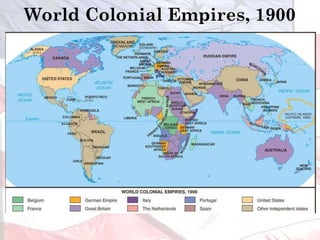
• Europeans had empires
• Extension of Manifest Destiny
1. Global Competition
World Colonial Empires, 1900
• Need raw materials
• Scientific farming  excess
production  low prices
• Exports = solution to Panic of 1893?
2. Business Interests
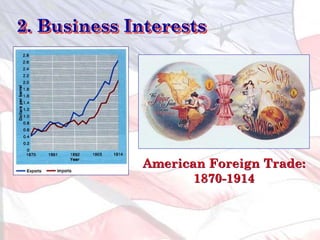
American Foreign Trade:
1870-1914
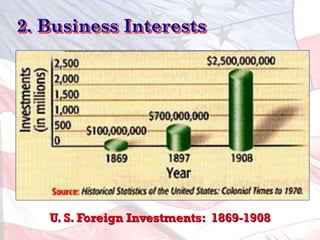
2. Business Interests
U. S. Foreign Investments: 1869-1908
2. Business Interests
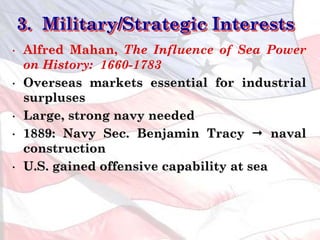
• Alfred Mahan, The Influence of Sea Power
on History: 1660-1783
• Overseas markets essential for industrial
surpluses
• Large, strong navy needed
• 1889: Navy Sec. Benjamin Tracy  naval
construction
• U.S. gained offensive capability at sea
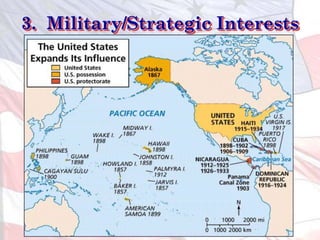
3. Military/Strategic Interests
4. Social Darwinian Thinking
• Josiah Strong, Our Country (1885)
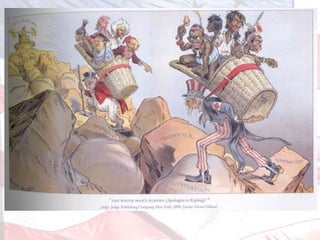
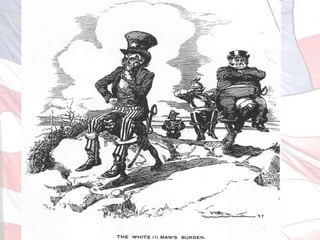
• “The White Man’s Burden” by Rudyard Kipling
(1899)
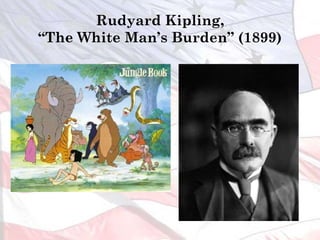
Rudyard Kipling,
“The White Man’s Burden” (1899)
Take up the White Man's burden--
Send forth the best ye breed--
Go bind your sons to exile
To serve your captives' need;
To wait in heavy harness,
On fluttered folk and wild--
Your new-caught, sullen peoples,
Half-devil and half-child.
Take up the White Man's burden--
In patience to abide,
To veil the threat of terror
And check the show of pride;
By open speech and simple,
An hundred times made plain
To seek another's profit,
And work another's gain.
Take up the White Man's burden--
The savage wars of peace--
Fill full the mouth of Famine
And bid the sickness cease;
And when your goal is nearest
The end for others sought,
Watch sloth and heathen Folly
Bring all your hopes to nought.
Take up the White Man's burden--
And reap his old reward:
The blame of those ye better,
The hate of those ye guard--
…
Take up the White Man's burden--
Ye dare not stoop to less--
Nor call too loud on Freedom
To cloke your weariness;
By all ye cry or whisper,
By all ye leave or do,
The silent, sullen peoples
Shall weigh your gods and you.
Take up the White Man's burden--
Have done with childish days--
The lightly proferred laurel,
The easy, ungrudged praise.
Comes now, to search your manhood
Through all the thankless years
Cold, edged with dear-bought wisdom,
The judgment of your peers!
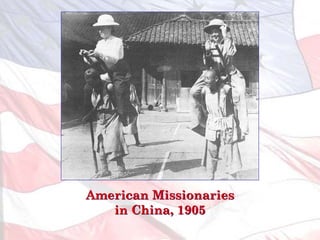
American Missionaries
in China, 1905
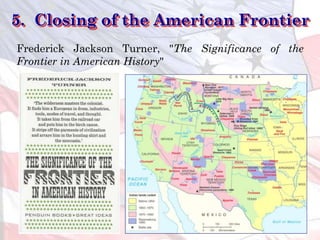
5. Closing of the American Frontier
Frederick Jackson Turner, "The Significance of the
Frontier in American History"
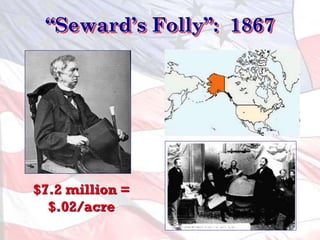
“Seward’s Folly”: 1867
$7.2 million =
$.02/acre
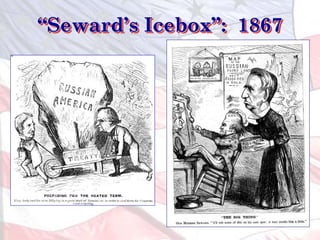
“Seward’s Icebox”: 1867
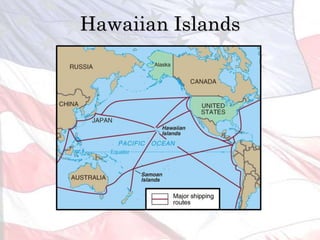
Hawaiian Islands
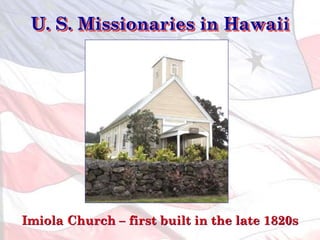
U. S. Missionaries in Hawaii
Imiola Church – first built in the late 1820s
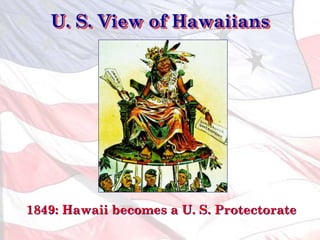
U. S. View of Hawaiians
1849: Hawaii becomes a U. S. Protectorate
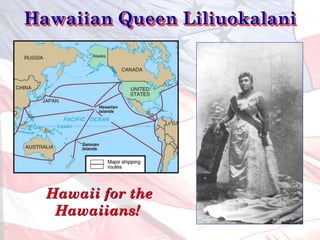
Hawaiian Queen Liliuokalani
Hawaii for the
Hawaiians!
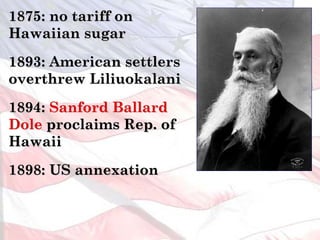
1875: no tariff on
Hawaiian sugar
1893: American settlers
overthrew Liliuokalani
1894: Sanford Ballard
Dole proclaims Rep. of
Hawaii
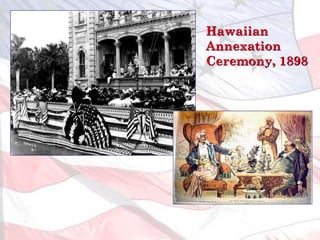
1898: US annexation
Hawaiian
Annexation
Ceremony, 1898
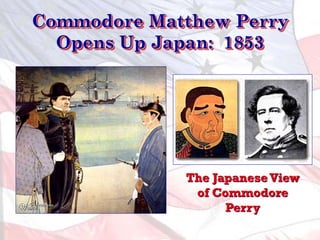
Commodore Matthew Perry
Opens Up Japan: 1853
The JapaneseView
of Commodore
Perry
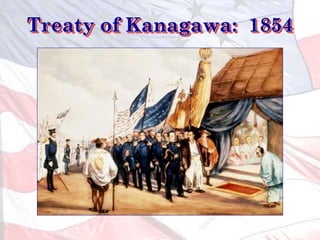
Treaty of Kanagawa: 1854
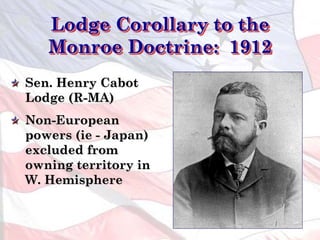
Lodge Corollary to the
Monroe Doctrine: 1912
Sen. Henry Cabot
Lodge (R-MA)
Non-European
powers (ie - Japan)
excluded from
owning territory in
W. Hemisphere
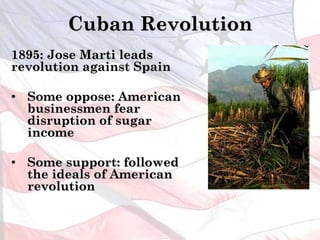
Cuban Revolution
1895: Jose Marti leads
revolution against Spain
• Some oppose: American
businessmen fear
disruption of sugar
income
• Some support: followed
the ideals of American
revolution
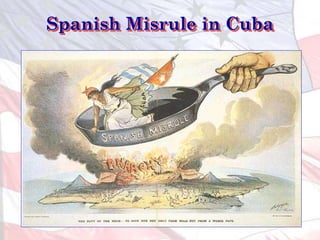
Spanish Misrule in Cuba
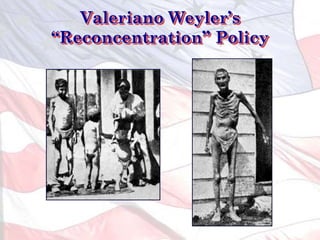
Valeriano Weyler’s
“Reconcentration” Policy
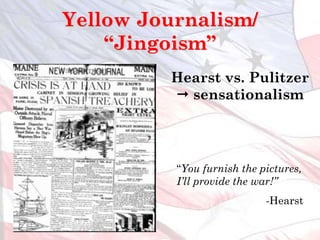
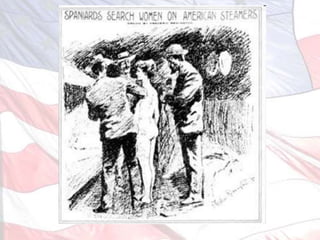
Yellow Journalism/
“Jingoism”
“You furnish the pictures,
I’ll provide the war!”
-Hearst
Hearst vs. Pulitzer
 sensationalism
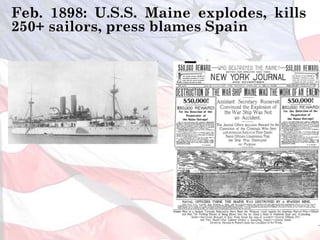
Feb. 1898: U.S.S. Maine explodes, kills
250+ sailors, press blames Spain
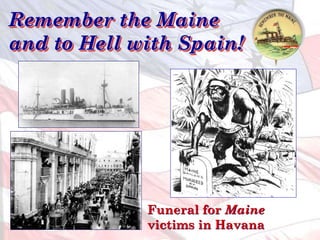
Remember the Maine
and to Hell with Spain!
Funeral for Maine
victims in Havana
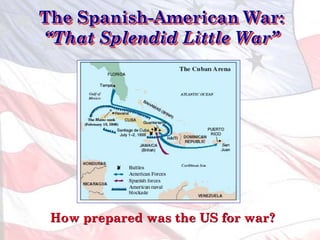
The Spanish-American War:
“That Splendid Little War”
How prepared was the US for war?
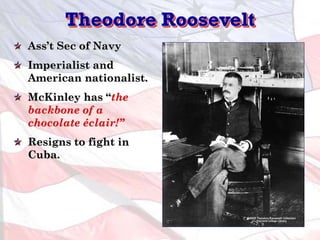
Theodore Roosevelt
Ass’t Sec of Navy
Imperialist and
American nationalist.
McKinley has “the
backbone of a
chocolate éclair!”
Resigns to fight in
Cuba.
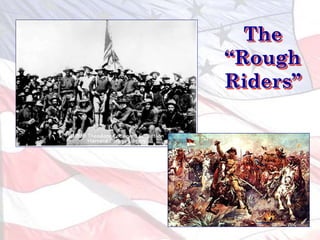
The
“Rough
Riders”
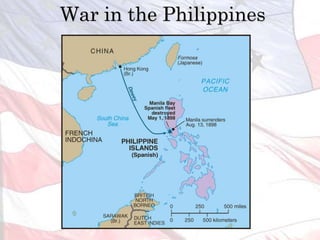
War in the Philippines
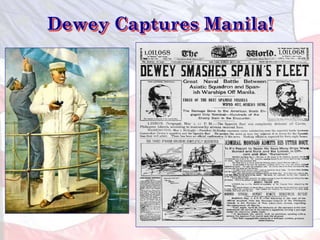
Dewey Captures Manila!
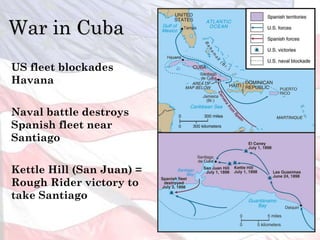
War in Cuba
US fleet blockades
Havana
Naval battle destroys
Spanish fleet near
Santiago
Kettle Hill (San Juan) =
Rough Rider victory to
take Santiago
The Treaty of Paris: 1898
Cuba freed from Spanish rule
US gains Puerto Rico, Guam, and the
Philippines; becomes an empire!
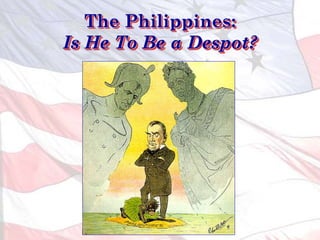
The Philippines:
Is He To Be a Despot?
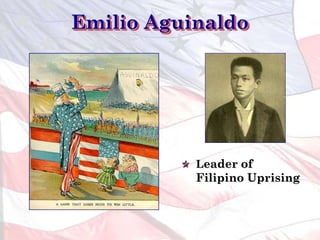
Emilio Aguinaldo
Leader of
Filipino Uprising
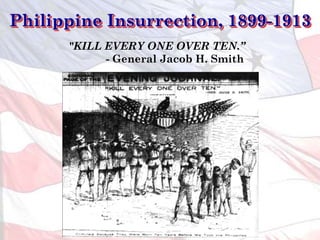
Philippine Insurrection, 1899-1913
"KILL EVERY ONE OVER TEN.”
- General Jacob H. Smith
Did the US conduct genocide?
Scorched earth policy
Concentration camps
Water-board torture of prisoners
200,000-1,500,000 Filipino civilian dead
Philippine Insurrection, 1899-1913
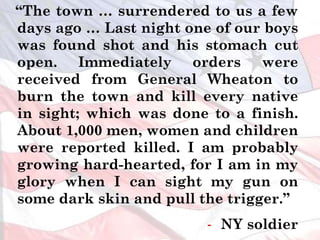
“The town … surrendered to us a few
days ago … Last night one of our boys
was found shot and his stomach cut
open. Immediately orders were
received from General Wheaton to
burn the town and kill every native
in sight; which was done to a finish.
About 1,000 men, women and children
were reported killed. I am probably
growing hard-hearted, for I am in my
glory when I can sight my gun on
some dark skin and pull the trigger.”
- NY soldier
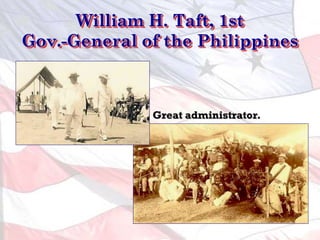
William H. Taft, 1st
Gov.-General of the Philippines
Great administrator.
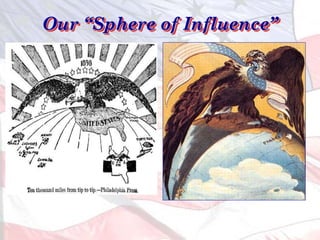
Our “Sphere of Influence”
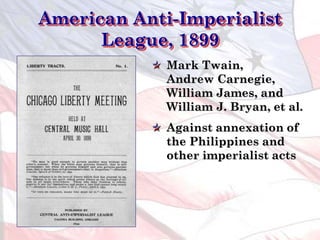
American Anti-Imperialist
League, 1899
Mark Twain,
Andrew Carnegie,
William James, and
William J. Bryan, et al.
Against annexation of
the Philippines and
other imperialist acts
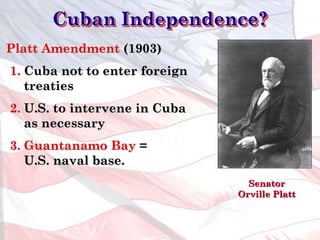
Platt Amendment (1903)
1. Cuba not to enter foreign
treaties
2. U.S. to intervene in Cuba
as necessary
3. Guantanamo Bay =
U.S. naval base.
Cuban Independence?
Senator
Orville Platt
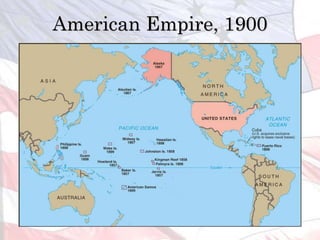
American Empire, 1900
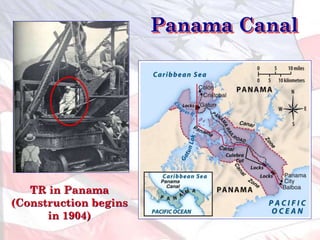
Panama Canal
TR in Panama
(Construction begins
in 1904)
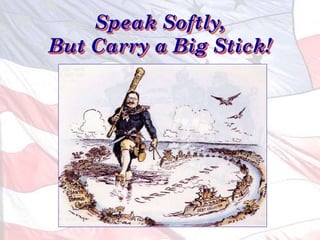
The Roosevelt Corollary
to the Monroe Doctrine, 1905
… [A]dherence of the
United States to the
Monroe Doctrine may
force the United States,
however reluctantly, in
flagrant cases of
[chronic] wrongdoing or
impotence, to the exercise
of an international
police power .
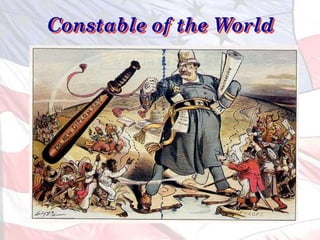
Speak Softly,
But Carry a Big Stick!
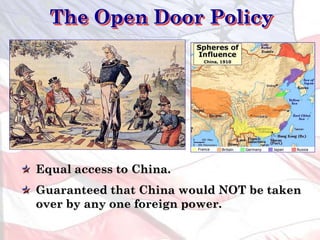
The Open Door Policy
Equal access to China.
Guaranteed that China would NOT be taken
over by any one foreign power.
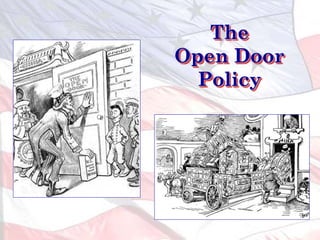
The
Open Door
Policy
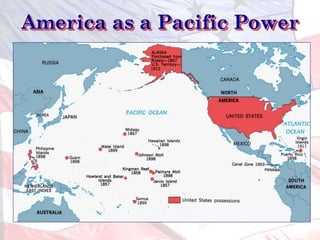
America as a Pacific Power
Constable of the World
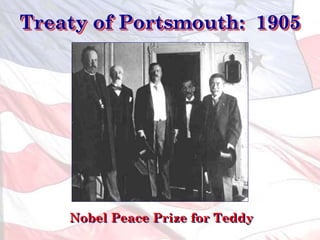
Treaty of Portsmouth: 1905
Nobel Peace Prize for Teddy
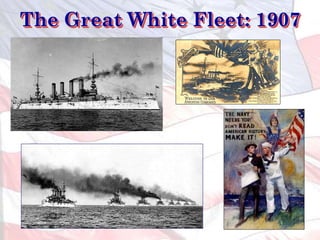
The Great White Fleet: 1907
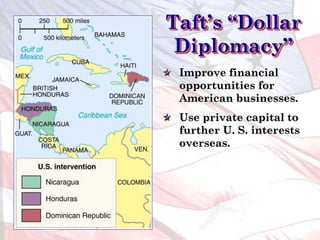
Taft’s “Dollar
Diplomacy”
Improve financial
opportunities for
American businesses.
Use private capital to
further U. S. interests
overseas.
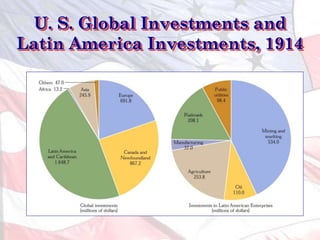
U. S. Global Investments and
Latin America Investments, 1914
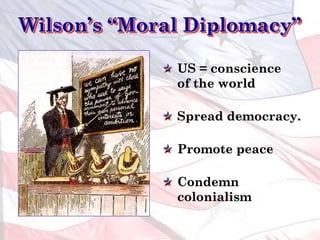
Wilson’s “Moral Diplomacy”
US = conscience
of the world
Spread democracy.
Promote peace
Condemn
colonialism
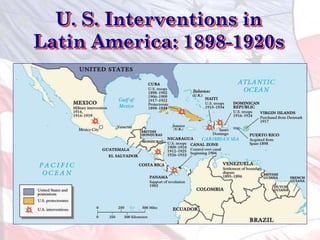
U. S. Interventions in
Latin America: 1898-1920s
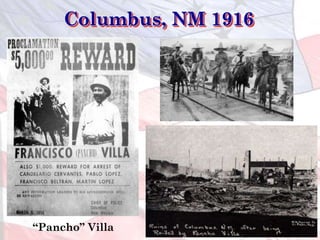
Columbus, NM 1916
“Pancho” Villa
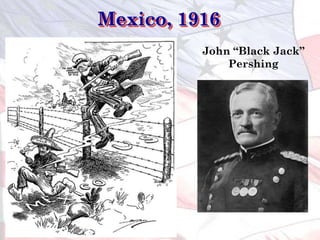
Mexico, 1916
John “Black Jack”
Pershing
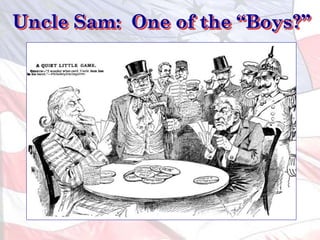
Uncle Sam: One of the “Boys?”
American imperialism

American imperialism