1914-1918:
   The
 World
 at War
Causes
of the
 War
Economic & Imperial Rivalries
Militarism
   Militarism means that the army and military forces are
    given a high profile by the government. The growing
    European divide had led to an arms race between the
    main countries. The armies of both France and
    Germany had more than doubled between 1870 and
    1914 and there was fierce competition between Britain
    and Germany for mastery of the seas
   The German, Von Schlieffen also drew up a plan of
    action that involved attacking France through Belgium
    if Russia made an attack on Germany.
Nationalism
    Nationalism means being a strong supporter of the
    rights and interests of one's country. Delegates from
    Britain, Austria, Prussia and Russia (the winning allies)
    decided upon a new Europe that left both Germany
    and Italy as divided states.
   The settlement at the end of the Franco-Prussian war
    left France angry at the loss of Alsace-Lorraine to
    Germany and keen to regain their lost territory. Large
    areas of both Austria-Hungary and Serbia were home
    to differing nationalist groups, all of whom wanted
    freedom from the states in which they lived.
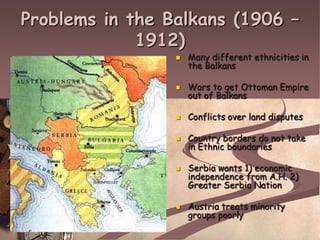
Problems in the Balkans (1906 –
             1912)
                    Many different ethnicities in
                     the Balkans

                    Wars to get Ottoman Empire
                     out of Balkans

                    Conflicts over land disputes

                    Country borders do not take
                     in Ethnic boundaries

                    Serbia wants 1) economic
                     independence from A.H. 2)
                     Greater Serbia Nation

                    Austria treats minority
                     groups poorly
Flashpoint

• Archduke Franz Ferdinand's Assassination, 28 June 1914
• The assassination of Archduke Franz Ferdinand, heir to the
  Austro-Hungarian throne, on 28 June 1914, set in train a
  series of diplomatic events that led inexorably to the
  outbreak of war in Europe at the end of July 1914.
• Ferdinand - and his wife Sophie - were killed by Serb
  nationalist Gavrilo Princip while on a formal visit to
  Sarajevo. Princip shot Ferdinand at point blank range while
  the latter was travelling in his car from a town hall reception,
  having earlier that day already survived one assassination
  attempt
The First War
Austria gave Ultimatum to Serbia
   Sent an Ultimatum to Serbia on July 19th,
    delivered July 23rd
   Serbs given 48 hours to respond

   Austria demands a large part of Serbia

   Serbia agrees to ALL except 1 key element:
         Serbia refused to allow the involvement of
          Austria in the investigation of the assassination
          within Serbia as this threatened Serbia’s
          sovereignty
Allies
  Britain ( and its Empire )
            France
             Russia            Central Powers
           Belgium                  Germany
              Italy              Austria Hungary
 USA( JOINED IN 1917)            Ottoman-Turkey
       Serbia, Portugal              Bulgaria
             Japan
and other minor participants
Escalation to War
July 25th
    Austria breaks off relations with Serbia
July 28th
    A.H. declares war on Serbia
July 30th
    Czar issues mobilization order
August 1st
    Germans mobilize, declare war on Russia
August 3rd
    France declares war on Germany
    Germany invades Belgium
August 4th
    Great Britain declares war on Germany
Countdown to World War
   June 1914 Franz Duke Ferdinand, heir to the
    Austrian throne assassinated
   28th July Austria Hungary declare war on Serbia.
    France and Russia back Serbia
   30th July Britain and Russia mobilize forces
   1st August Germany declares war on Russia
   2nd August Germany invades Belgium, declares
    war on France
   4th August Britain declares war on Germany
Americ
   a
 Joins
  the
The Sinking
of the Lusitania
In spite of America’s stern warning Germany
        continued use of submarines.
America declared war against Germany on 6th
                  April 1917.
 The central powers surrendered one by one
       Last to surrender was Germany.
November 11, 1918
The Big Four Leaders of World War I


       Woodrow Wilson
      (USA)
      David Lloyd George
      (England)
      Vittorio Orlando
      (Italy)
      Georges Clemenceau
      (France)
World War I Casualties

10,000,000
 9,000,000       Russia
 8,000,000       Germany
 7,000,000       Austria-Hungary
 6,000,000       France
 5,000,000
 4,000,000       Great Britain
 3,000,000       Italy
 2,000,000       Turkey
 1,000,000       US
         0
Curtis-Martin
U. S. Aircraft Plant
Sacrifices in War
World War 1

World War 1

  • 1.
    1914-1918: The World at War
  • 2.
  • 3.
  • 4.
    Militarism  Militarism means that the army and military forces are given a high profile by the government. The growing European divide had led to an arms race between the main countries. The armies of both France and Germany had more than doubled between 1870 and 1914 and there was fierce competition between Britain and Germany for mastery of the seas  The German, Von Schlieffen also drew up a plan of action that involved attacking France through Belgium if Russia made an attack on Germany.
  • 5.
    Nationalism  Nationalism means being a strong supporter of the rights and interests of one's country. Delegates from Britain, Austria, Prussia and Russia (the winning allies) decided upon a new Europe that left both Germany and Italy as divided states.  The settlement at the end of the Franco-Prussian war left France angry at the loss of Alsace-Lorraine to Germany and keen to regain their lost territory. Large areas of both Austria-Hungary and Serbia were home to differing nationalist groups, all of whom wanted freedom from the states in which they lived.
  • 6.
    Problems in theBalkans (1906 – 1912)  Many different ethnicities in the Balkans  Wars to get Ottoman Empire out of Balkans  Conflicts over land disputes  Country borders do not take in Ethnic boundaries  Serbia wants 1) economic independence from A.H. 2) Greater Serbia Nation  Austria treats minority groups poorly
  • 7.
    Flashpoint • Archduke FranzFerdinand's Assassination, 28 June 1914 • The assassination of Archduke Franz Ferdinand, heir to the Austro-Hungarian throne, on 28 June 1914, set in train a series of diplomatic events that led inexorably to the outbreak of war in Europe at the end of July 1914. • Ferdinand - and his wife Sophie - were killed by Serb nationalist Gavrilo Princip while on a formal visit to Sarajevo. Princip shot Ferdinand at point blank range while the latter was travelling in his car from a town hall reception, having earlier that day already survived one assassination attempt
  • 8.
    The First War Austriagave Ultimatum to Serbia  Sent an Ultimatum to Serbia on July 19th, delivered July 23rd  Serbs given 48 hours to respond  Austria demands a large part of Serbia  Serbia agrees to ALL except 1 key element:  Serbia refused to allow the involvement of Austria in the investigation of the assassination within Serbia as this threatened Serbia’s sovereignty
  • 10.
    Allies Britain( and its Empire ) France Russia Central Powers Belgium Germany Italy Austria Hungary USA( JOINED IN 1917) Ottoman-Turkey Serbia, Portugal Bulgaria Japan and other minor participants
  • 11.
    Escalation to War July25th  Austria breaks off relations with Serbia July 28th  A.H. declares war on Serbia July 30th  Czar issues mobilization order August 1st  Germans mobilize, declare war on Russia August 3rd  France declares war on Germany  Germany invades Belgium August 4th  Great Britain declares war on Germany
  • 12.
    Countdown to WorldWar  June 1914 Franz Duke Ferdinand, heir to the Austrian throne assassinated  28th July Austria Hungary declare war on Serbia. France and Russia back Serbia  30th July Britain and Russia mobilize forces  1st August Germany declares war on Russia  2nd August Germany invades Belgium, declares war on France  4th August Britain declares war on Germany
  • 13.
    Americ a Joins the
  • 14.
  • 15.
    In spite ofAmerica’s stern warning Germany continued use of submarines. America declared war against Germany on 6th April 1917. The central powers surrendered one by one Last to surrender was Germany.
  • 16.
  • 17.
    The Big FourLeaders of World War I Woodrow Wilson (USA) David Lloyd George (England) Vittorio Orlando (Italy) Georges Clemenceau (France)
  • 19.
    World War ICasualties 10,000,000 9,000,000 Russia 8,000,000 Germany 7,000,000 Austria-Hungary 6,000,000 France 5,000,000 4,000,000 Great Britain 3,000,000 Italy 2,000,000 Turkey 1,000,000 US 0
  • 21.
  • 23.