
THE GREAT WAR (1914-1918)
Lesson : History of England

Teacher : Marek Kawa
Students: Merve Özdemir
Akın Sırma
INTRODUCTION TO THE GREAT WAR


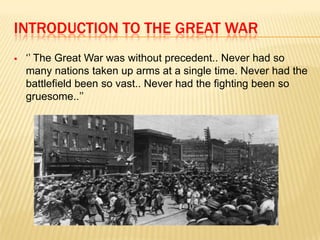
‘’ The Great War was without precedent.. Never had so
many nations taken up arms at a single time. Never had the
battlefield been so vast.. Never had the fighting been so
gruesome..’’


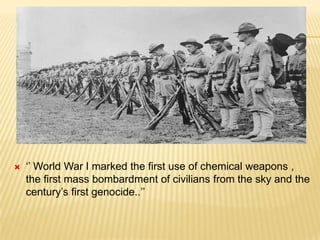
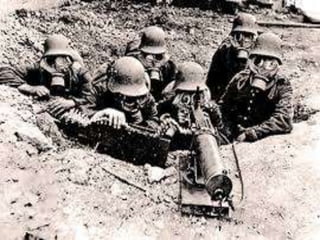
‘’ World War I marked the first use of chemical weapons ,
the first mass bombardment of civilians from the sky and the
century’s first genocide..’’








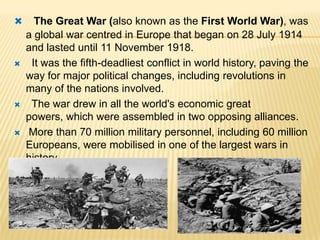
The Great War (also known as the First World War), was
a global war centred in Europe that began on 28 July 1914
and lasted until 11 November 1918.
It was the fifth-deadliest conflict in world history, paving the
way for major political changes, including revolutions in
many of the nations involved.
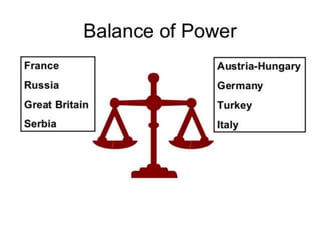
The war drew in all the world's economic great
powers, which were assembled in two opposing alliances.
More than 70 million military personnel, including 60 million
Europeans, were mobilised in one of the largest wars in
history.
BACKROUND
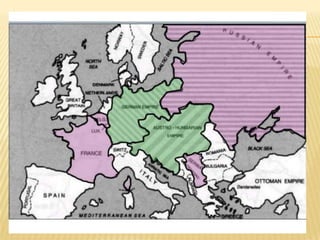
 In the 19th Century, the major European powers had gone

to great lengths to maintain a balance of power throughout
Europe, resulting in the existence of a complex network of
political and military alliances throughout the continent by
1900.
 Germany and Austria-Hungary in an alliance formed in

1879, called the Dual Alliance. This was seen as a method
of countering Russian influence in the Balcans as
the Ottoman Empire continued to weaken.


German industrial and economic power had grown greatly
after unification of the foundation of the Empire in 1871.
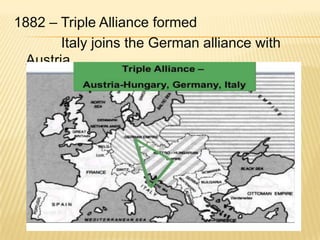
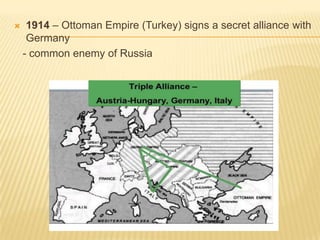
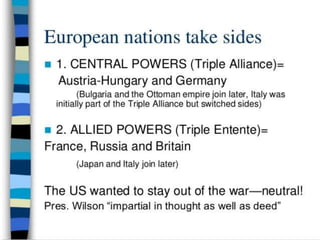
1882 – Triple Alliance formed
Italy joins the German alliance with
Austria
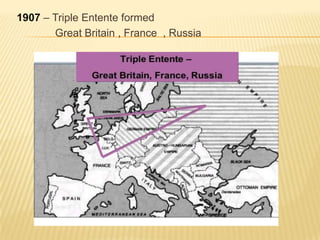
1907 – Triple Entente formed
Great Britain , France , Russia
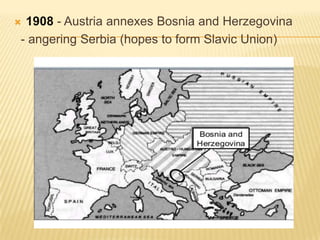
1908 - Austria annexes Bosnia and Herzegovina
- angering Serbia (hopes to form Slavic Union)




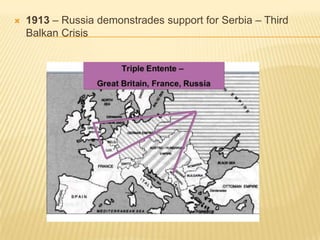
1913 – Russia demonstrades support for Serbia – Third
Balkan Crisis


1914 – Ottoman Empire (Turkey) signs a secret alliance with
Germany
- common enemy of Russia
The Start of the War ( July 14 Crisis)
• Although a resurgence of imperialism was an underlying
cause, the immediate trigger for war was the 28 June 1914
assassination of Archduke Franz Ferdinand of Austria, heir to
the throne of Austria-Hungary, by a Yugoslav nationalist.
• This began a month of diplomatic manoeuvring between
Austria-Hungary, Germany, Russia, France, and Britain called
the July Crisis.
• This set off a diplomatic crisis when Austria-Hungary
delivered an ultimatum to the Kingdom of Serbia, and
international alliances formed over the previous decades were
invoked.
• Within weeks, the major powers were at war and the conflict
soon spread around the world.
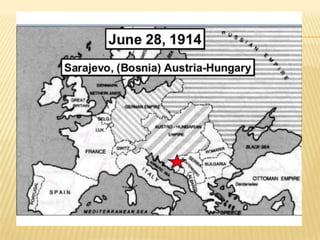
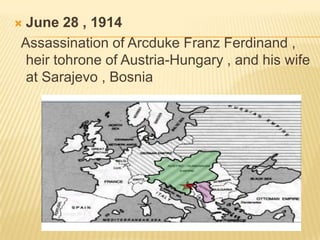
June 28 , 1914
Assassination of Arcduke Franz Ferdinand ,
heir tohrone of Austria-Hungary , and his wife
at Sarajevo , Bosnia


JULY 2 , 1914

Emperor Franz Josef(Austria) sends a letter to
Germany asking for support.
JULY 5, 1914
Germany sends a telegram indicating it would
honour its treaty obligations to support Austria.
JULY 23 , 1914
Austria delivers an ultimatom to Serbia ,
demanding a response in 48 hours.
JULY 25 , 1914
Serbia responds to the ultimatom by agreeing to
many , but not all ,of the terms.
JULY 28 , 1914
 Austria sends a telegram to Serbia declaring war.
JULY 30 , 1914

Russia , in support of Serbia , proclaims a general
mobilization.
JULY 31 , 1914

France , as Russia’s ally , also authorizes a full
mobilization.
August 1 , 1914

Germany declares war to Russia
AUGUST 3 , 1914

Germany declares war on France
August 2-4 , 1914

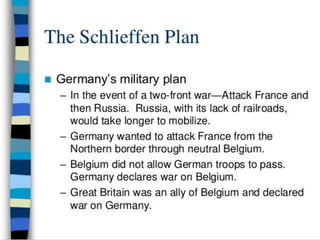
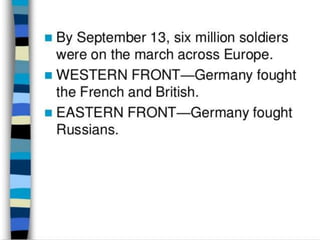
Germany puts Schlieffen Plan into motion , invading
Luxemburg and Belgium
The great war (1914 1918)

The great war (1914 1918)

  • 1.
    THE GREAT WAR(1914-1918) Lesson : History of England Teacher : Marek Kawa Students: Merve Özdemir Akın Sırma
  • 2.
    INTRODUCTION TO THEGREAT WAR  ‘’ The Great War was without precedent.. Never had so many nations taken up arms at a single time. Never had the battlefield been so vast.. Never had the fighting been so gruesome..’’
  • 3.
     ‘’ World WarI marked the first use of chemical weapons , the first mass bombardment of civilians from the sky and the century’s first genocide..’’
  • 4.
        The Great War(also known as the First World War), was a global war centred in Europe that began on 28 July 1914 and lasted until 11 November 1918. It was the fifth-deadliest conflict in world history, paving the way for major political changes, including revolutions in many of the nations involved. The war drew in all the world's economic great powers, which were assembled in two opposing alliances. More than 70 million military personnel, including 60 million Europeans, were mobilised in one of the largest wars in history.
  • 5.
    BACKROUND  In the19th Century, the major European powers had gone to great lengths to maintain a balance of power throughout Europe, resulting in the existence of a complex network of political and military alliances throughout the continent by 1900.  Germany and Austria-Hungary in an alliance formed in 1879, called the Dual Alliance. This was seen as a method of countering Russian influence in the Balcans as the Ottoman Empire continued to weaken.  German industrial and economic power had grown greatly after unification of the foundation of the Empire in 1871.
  • 9.
    1882 – TripleAlliance formed Italy joins the German alliance with Austria
  • 10.
    1907 – TripleEntente formed Great Britain , France , Russia
  • 11.
    1908 - Austriaannexes Bosnia and Herzegovina - angering Serbia (hopes to form Slavic Union) 
  • 12.
     1913 – Russiademonstrades support for Serbia – Third Balkan Crisis
  • 13.
     1914 – OttomanEmpire (Turkey) signs a secret alliance with Germany - common enemy of Russia
  • 15.
    The Start ofthe War ( July 14 Crisis) • Although a resurgence of imperialism was an underlying cause, the immediate trigger for war was the 28 June 1914 assassination of Archduke Franz Ferdinand of Austria, heir to the throne of Austria-Hungary, by a Yugoslav nationalist. • This began a month of diplomatic manoeuvring between Austria-Hungary, Germany, Russia, France, and Britain called the July Crisis. • This set off a diplomatic crisis when Austria-Hungary delivered an ultimatum to the Kingdom of Serbia, and international alliances formed over the previous decades were invoked. • Within weeks, the major powers were at war and the conflict soon spread around the world.
  • 17.
    June 28 ,1914 Assassination of Arcduke Franz Ferdinand , heir tohrone of Austria-Hungary , and his wife at Sarajevo , Bosnia 
  • 18.
    JULY 2 ,1914 Emperor Franz Josef(Austria) sends a letter to Germany asking for support. JULY 5, 1914 Germany sends a telegram indicating it would honour its treaty obligations to support Austria. JULY 23 , 1914 Austria delivers an ultimatom to Serbia , demanding a response in 48 hours. JULY 25 , 1914 Serbia responds to the ultimatom by agreeing to many , but not all ,of the terms.
  • 19.
    JULY 28 ,1914  Austria sends a telegram to Serbia declaring war. JULY 30 , 1914  Russia , in support of Serbia , proclaims a general mobilization. JULY 31 , 1914  France , as Russia’s ally , also authorizes a full mobilization. August 1 , 1914  Germany declares war to Russia AUGUST 3 , 1914  Germany declares war on France August 2-4 , 1914  Germany puts Schlieffen Plan into motion , invading Luxemburg and Belgium