Why World War One changed everything
A New Century, a New HopeThe people of Europe were feeling fairly optimistic at the beginning of the 1900s.There had not been a major war in Europe for nearly 80 years.New technologies were making life easier.
New Inventions (1890-1910)The diesel powered internal combustion engine.The motion picture camera.The radio.The zipper.Gas powered planes.SonarThe teabag.The first neon street lampThe Model T Ford
The Rise of GermanyThe only significant threat to this cosy world order was a rising power – Germany.Germany didn’t even exist as a nation until 1871 (New Zealand is older!)Until then it had been a loose collection of small kingdoms ruled by princes.These kingdoms were united by a common history, language, culture and desire to wear pointy helmets.
The German ThreatGermany had advanced industries and a large population.They also had a leader (Bismarck) who was prepared to use force to defend his young nation’s interests.In 1870 Bismarck’s armies defeated France in a war over borders.Otto von Bismarck
Containing the threat of Germany The nations that were most threatened by Germany were Britain, Russia and France.
BritainHad the world’s largest navy and wanted to protect its colonies and trade around the world. Threatened by Germany’s growing naval power (fleet of battleships).
RussiaRussia:Had the world’s largest army. Most soldiers were untrained. Russia did not have enough factories to supply a large army with the guns and bullets needed for a long war.Threatened by Germany’s advanced industry and well-trained army.
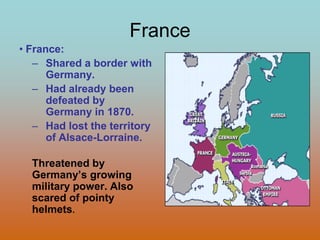
FranceFrance:Shared a border with Germany.Had already been defeated by Germany in 1870. Had lost the territory of Alsace-Lorraine.Threatened by Germany’s growing military power. Also scared of pointy helmets.
The Three nations formed an alliance against GermanyAlliance = An agreement to provide military support to an ally if they are attacked
The Great Power Alliances, 1914By 1914, the great European powers were divided into two main groups and were prepared for war.Triple Entente• Britain • France• Russia Triple Alliance• Germany• Austria -Hungary• Italy
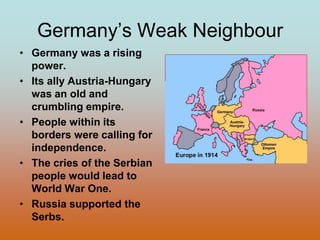
Germany’s Weak NeighbourGermany was a rising power.Its ally Austria-Hungary was an old and crumbling empire.People within its borders were calling for independence.The cries of the Serbian people would lead to World War One.Russia supported the Serbs.
The Royal Family of Austria-Hungary.Austria-Hungary was ruled by a royal family.In June 1914 the prince who would one day rule Austria was visiting the city of Saravejo.His name was Franz Ferdinand. His wife was called Sophie.They were a prime target for terrorists.
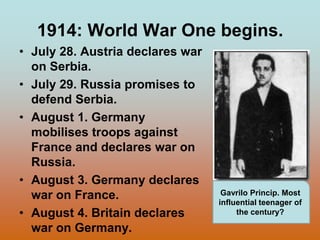
The War begins…with a teenager  carrying out an act of terrorism.On June 28, 1914 a Serbian teenager called GavriloPrincipassassinated Austrian Archduke Franz Ferdinand. The first assassination attempt (a bomb) had failed. Princip ran into Ferdinand by accident after the first failed attempt - and shot him and his wife.Principbelonged to a group called The Black Hand.Austriawas outraged and insisted that Serbia hand over The Black Hand.Serbia refused to cooperate.
1914: World War One begins.July 28. Austria declares war on Serbia.July 29. Russia promises to defend Serbia.August 1. Germany mobilises troops against France and declares war on Russia.August 3. Germany declares war on France.August 4. Britain declares war on Germany.GavriloPrincip. Most influential teenager of the century?
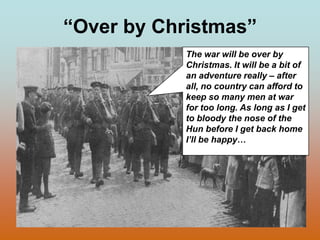
“Over by Christmas”The war will be over by Christmas. It will be a bit of an adventure really – after all, no country can afford to keep so many men at war for too long. As long as I get to bloody the nose of the Hun before I get back home I’ll be happy…
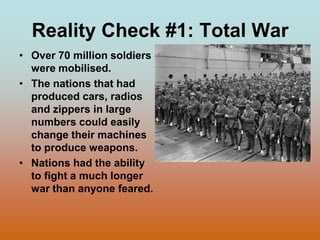
Reality Check #1: Total War Over 70 million soldiers were mobilised.The nations that had produced cars, radios and zippers in large numbers could easily change their machines to produce weapons.Nations had the ability to fight a much longer war than anyone feared.
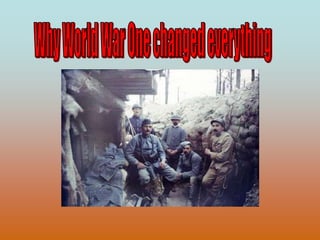
Reality Check #2: The Western FrontThe Germans marched a million men towards France.  At first they advanced rapidly, but then they came up against British and French forces.Unable to advance further, the Germans dug trenches protected by machine guns.  The British and French troops did the same.  THESE TRENCHES WERE KNOWN AS THE WESTERN FRONTThese trenches were slowly extended until they stretched over 600 kms from the coast of Belgium to the German border.
Reality Check #3: Trench Warfare
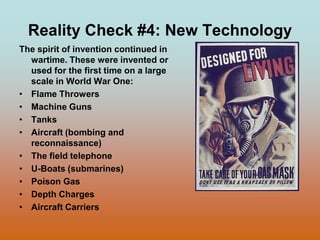
Reality Check #4: New TechnologyThe spirit of invention continued in wartime. These were invented or used for the first time on a large scale in World War One:Flame ThrowersMachine GunsTanksAircraft (bombing and reconnaissance)The field telephoneU-Boats (submarines)Poison GasDepth ChargesAircraft Carriers
Flamethrowers, Gas and Barbed Wire
Reality Check #5 : War comes homeFor centuries the English channel had protected England from European wars.With the invention of strategic bombers (including Zeppelins) London experienced war for the first time in nearly 1000 years.
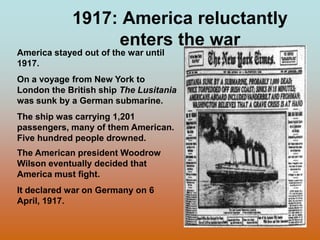
1917: America reluctantly enters the warAmerica stayed out of the war until 1917.On a voyage from New York to Londonthe British ship The Lusitania  was sunk by a German submarine.  The ship was carrying 1,201 passengers, many of them American.  Five hundred people drowned.The American president Woodrow Wilson eventually decided that America must fight.  It declared war on Germany on 6 April, 1917.
1918 The War grinds to a close During 1918, conditions in Germany worsened rapidly.
 The strain of fighting on two fronts was affecting Germany’s ability to feed its population.
 People were starving and the Spanish flu swept through the country killing thousands.
 Within Germany there were calls for revolution and a large number of sailors revolted rather than go to war.
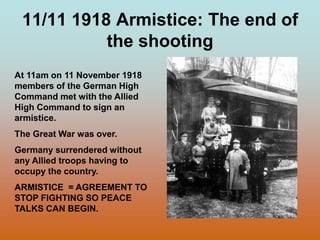
 On the 9 November, 1918, the Kaiser (leader of Germany) abdicated (left the throne).11/11 1918 Armistice: The end of the shootingAt 11am on 11 November 1918 members of the German High Command met with the Allied High Command to sign an armistice.  The Great War was over.Germany surrendered without any Allied troops having to occupy the country.ARMISTICE  = AGREEMENT TO STOP FIGHTING SO PEACE TALKS CAN BEGIN.

World War One

  • 1.
    Why World WarOne changed everything
  • 2.
    A New Century,a New HopeThe people of Europe were feeling fairly optimistic at the beginning of the 1900s.There had not been a major war in Europe for nearly 80 years.New technologies were making life easier.
  • 3.
    New Inventions (1890-1910)Thediesel powered internal combustion engine.The motion picture camera.The radio.The zipper.Gas powered planes.SonarThe teabag.The first neon street lampThe Model T Ford
  • 4.
    The Rise ofGermanyThe only significant threat to this cosy world order was a rising power – Germany.Germany didn’t even exist as a nation until 1871 (New Zealand is older!)Until then it had been a loose collection of small kingdoms ruled by princes.These kingdoms were united by a common history, language, culture and desire to wear pointy helmets.
  • 5.
    The German ThreatGermanyhad advanced industries and a large population.They also had a leader (Bismarck) who was prepared to use force to defend his young nation’s interests.In 1870 Bismarck’s armies defeated France in a war over borders.Otto von Bismarck
  • 6.
    Containing the threatof Germany The nations that were most threatened by Germany were Britain, Russia and France.
  • 7.
    BritainHad the world’slargest navy and wanted to protect its colonies and trade around the world. Threatened by Germany’s growing naval power (fleet of battleships).
  • 8.
    RussiaRussia:Had the world’slargest army. Most soldiers were untrained. Russia did not have enough factories to supply a large army with the guns and bullets needed for a long war.Threatened by Germany’s advanced industry and well-trained army.
  • 9.
    FranceFrance:Shared a borderwith Germany.Had already been defeated by Germany in 1870. Had lost the territory of Alsace-Lorraine.Threatened by Germany’s growing military power. Also scared of pointy helmets.
  • 10.
    The Three nationsformed an alliance against GermanyAlliance = An agreement to provide military support to an ally if they are attacked
  • 11.
    The Great PowerAlliances, 1914By 1914, the great European powers were divided into two main groups and were prepared for war.Triple Entente• Britain • France• Russia Triple Alliance• Germany• Austria -Hungary• Italy
  • 12.
    The Great PowerAlliances, 1914By 1914, the great European powers were divided into two main groups and were prepared for war.Triple Entente• Britain • France• Russia Triple Alliance• Germany• Austria -Hungary• Italy
  • 13.
    Germany’s Weak NeighbourGermanywas a rising power.Its ally Austria-Hungary was an old and crumbling empire.People within its borders were calling for independence.The cries of the Serbian people would lead to World War One.Russia supported the Serbs.
  • 14.
    The Royal Familyof Austria-Hungary.Austria-Hungary was ruled by a royal family.In June 1914 the prince who would one day rule Austria was visiting the city of Saravejo.His name was Franz Ferdinand. His wife was called Sophie.They were a prime target for terrorists.
  • 15.
    The War begins…witha teenager carrying out an act of terrorism.On June 28, 1914 a Serbian teenager called GavriloPrincipassassinated Austrian Archduke Franz Ferdinand. The first assassination attempt (a bomb) had failed. Princip ran into Ferdinand by accident after the first failed attempt - and shot him and his wife.Principbelonged to a group called The Black Hand.Austriawas outraged and insisted that Serbia hand over The Black Hand.Serbia refused to cooperate.
  • 16.
    1914: World WarOne begins.July 28. Austria declares war on Serbia.July 29. Russia promises to defend Serbia.August 1. Germany mobilises troops against France and declares war on Russia.August 3. Germany declares war on France.August 4. Britain declares war on Germany.GavriloPrincip. Most influential teenager of the century?
  • 17.
    “Over by Christmas”Thewar will be over by Christmas. It will be a bit of an adventure really – after all, no country can afford to keep so many men at war for too long. As long as I get to bloody the nose of the Hun before I get back home I’ll be happy…
  • 18.
    Reality Check #1:Total War Over 70 million soldiers were mobilised.The nations that had produced cars, radios and zippers in large numbers could easily change their machines to produce weapons.Nations had the ability to fight a much longer war than anyone feared.
  • 19.
    Reality Check #2:The Western FrontThe Germans marched a million men towards France. At first they advanced rapidly, but then they came up against British and French forces.Unable to advance further, the Germans dug trenches protected by machine guns. The British and French troops did the same. THESE TRENCHES WERE KNOWN AS THE WESTERN FRONTThese trenches were slowly extended until they stretched over 600 kms from the coast of Belgium to the German border.
  • 20.
    Reality Check #3:Trench Warfare
  • 21.
    Reality Check #3:Trench Warfare
  • 22.
    Reality Check #4:New TechnologyThe spirit of invention continued in wartime. These were invented or used for the first time on a large scale in World War One:Flame ThrowersMachine GunsTanksAircraft (bombing and reconnaissance)The field telephoneU-Boats (submarines)Poison GasDepth ChargesAircraft Carriers
  • 23.
  • 24.
    Reality Check #5: War comes homeFor centuries the English channel had protected England from European wars.With the invention of strategic bombers (including Zeppelins) London experienced war for the first time in nearly 1000 years.
  • 25.
    1917: America reluctantlyenters the warAmerica stayed out of the war until 1917.On a voyage from New York to Londonthe British ship The Lusitania was sunk by a German submarine. The ship was carrying 1,201 passengers, many of them American. Five hundred people drowned.The American president Woodrow Wilson eventually decided that America must fight. It declared war on Germany on 6 April, 1917.
  • 26.
    1918 The Wargrinds to a close During 1918, conditions in Germany worsened rapidly.
  • 27.
    The strainof fighting on two fronts was affecting Germany’s ability to feed its population.
  • 28.
    People werestarving and the Spanish flu swept through the country killing thousands.
  • 29.
    Within Germanythere were calls for revolution and a large number of sailors revolted rather than go to war.
  • 30.
    On the9 November, 1918, the Kaiser (leader of Germany) abdicated (left the throne).11/11 1918 Armistice: The end of the shootingAt 11am on 11 November 1918 members of the German High Command met with the Allied High Command to sign an armistice. The Great War was over.Germany surrendered without any Allied troops having to occupy the country.ARMISTICE = AGREEMENT TO STOP FIGHTING SO PEACE TALKS CAN BEGIN.