Mesopotamia and the Fertile Crescent
The Geography of Ancient Mesopotamia
Mesopotamia
 Region where Tigris & Euphrates Rivers flow
    Name means: “land between two rivers”
    Rivers: provide water and means of travel
Fertile Soil
 Rain & melting snow caused river flooding
    Soil picked up from mts.
    Rivers overflowed their banks causing flooding and
     spreading of silt onto land (good for growing crops)
An Arid Climate
 Less than 10” of rain w/ hot summers
    Arid Climate
 Ancient people could still grow crops due to rivers and
  fertile soil
 3500 B.C.
    Widespread farming villages across Mesopotamia
Flood & Droughts
 Floods were unpredictable
    Extent of floods dependent on amount of rain & snow
     melt
    Too little rain & snow melt meant no flood
       Would cause drought & people would starve
Irrigation
 6000 B.C.
    People took steps to control water supply
        Built earth walls to hold back water during floods
        Built canals to carry water to the fields
    Constant challenge to keep canals free from muddy silt
A Land of Few Resources
 No forests for wood in Mesopotamia
 Little stone and minerals
 Reed & Brick Houses
    Used to build homes
    Crumbled easily in bad weather & had to be repaired often
 Brick Walls
    Area was invaded easily because it was not surrounded by
     mts. or other natural barriers
    Mesopotamia often conquered or stolen from
        Built brick walls around their towns & villages
          Sometimes 25 feet thick w/ guard towers and surrounded by open
           ditches or moats
Trading for Resources
 Obtained stone, wood, copper, and tin through trade
 Traded for luxuries such as gold, ivory, ebony, and
  precious stones
 Offered grain, dates, and other farm products
   Could do this due to a surplus of crops
 Jobs such as trading, digging canals, building
  walls, and farming were done over and over
 Community leaders organized groups of people to do
  the work at the right time
The First Civilizations
The Rise of Civilization
 Villages grew larger & larger
    Eventually became cities
 Workers Organized to solve problems
    Building & cleaning irrigation canals
 Society & culture grew more complex
    Changes led to civilization
        1st 3300 B.C. in Sumer
Sumerian City-States
 Cities were:
    Centers of trade, learning, & religion
 Most people lived in countryside
    Over time cities ruled surrounding lands & villages
        Called a city-state
 Sumer had 12 city-states
    Babylon, Kish, Nippur, and Ur
    Fertile land; farmers grew lots of food; supported larger
     populations
A Sumerian City
 Narrow, winding streets; walls surrounded cities, w/
  gates to let people in
 Homes built of reeds and mud or brick
   Series of rooms arranged around a courtyard
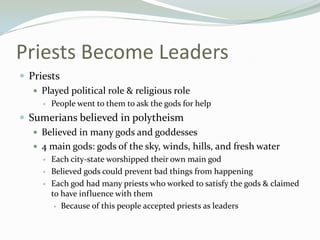
The Ziggurat: Center of the City
 Largest & most important structure in city
 Center of temple complex
    Like a city hall (priests ran irrigation system & other
     important aspects of city life)
        People paid for services with grain and other items
        Priests controlled grain surplus & city-state’s wealth
Priests Become Leaders
 Priests
    Played political role & religious role
        People went to them to ask the gods for help
 Sumerians believed in polytheism
    Believed in many gods and goddesses
    4 main gods: gods of the sky, winds, hills, and fresh water
        Each city-state worshipped their own main god
        Believed gods could prevent bad things from happening
        Each god had many priests who worked to satisfy the gods & claimed
         to have influence with them
           Because of this people accepted priests as leaders
New Leaders in Sumer
 3000 B.C.
    City-states were attacked because of their wealth
        Some from far off lands
        During these times a powerful man was asked to rule them and
         protect the city
           At 1st just in time of war; eventually full time

 New leaders
    Took over some of priests jobs
        Maintained canals, managed grain surplus, & acted as judges
        Eventually became a king of people
 2375 B.C.
    Sumer became a kingdom under one king
    Priests were still important for pleasing the gods and keeping
Sumerian Society
 Social Classes created
    King & priests were part of upper class
        Believed to have links to gods
        Landowners, gov’t officials, & rich merchants were also part of
         upper class
    Middle class
        All other free people (farmers, artisans, etc.)
    Lowest class
        Slaves: had some rights; could conduct business, borrow
         money, & buy freedom
Role of Women
 Women were included in all social classes
 Some were priestesses, owned land, worked as
 merchants and artisans, and raised children
Sumerian Scientific Developments
 Good at solving problems
 Invented and developed knowledge to better their lives
 Early Inventions:
    The plow: helped farmers
    The wheel: transport goods & used to make pottery
     faster
 Mathematics:
    Developed arithmetic to keep records of crops and trade
     goods
        Number system based on 60
Written language
 Invented writing to meet business needs
    Merchants needed records of exchange
    Also wanted to label goods
         Marked outside of containers with pictographs
 Pictographs:
    1st showed actual objects
    Later stood for ideas & sounds
 Eventually stopped using pictures & used wedge-shaped symbols
    Wedge-shaped writing called cuneiform
 Writing System was complex
    600 different symbols; took years to learn; few people were able to read
     and write
    Scribes: people to specialized in writing
         Professional record keepers
 Writing later used to write about wars, floods, & reigns of kings
Empires of the Fertile Crescent
The First Empire Builders
 3000 to 2000 B.C.
    Kings fought over Sumer land
       More land = more wealth and power to king
       No single king was able to control all of Mesopotamia
The Akkadian Empire
 Sargon
    2371 B.C. took control of region
    1st creator of 1st empire (Akkadian Empire)
    Eventually ruled lands from Persian Gulf through
     Mesopotamia to the Mediterranean Sea
       Area known as Fertile Crescent: rich soil and water made area
        good for farming
 Empires
    Important because they change the way people live
       May bring peace, encourage trade, include people from several
        cultures (ideas, technology, & customs)
The Babylonian Empire &
Hammurabi
 Akkadian Empire fell apart due to attacks from outside
  people
 Amorites invaded Sumer & set capital in Babylon
 Hammurabi ruled Empire
   Created a code of law to control the lands & that people
    had to follow
       He reviewed all existing laws and drew up a single law &
        displayed it on a huge pillar in Babylon
 Hammurabi Code
   Goal: justice to everyone in empire
        Id wrongdoings & their punishment
        Society should be run by the rule of law & apply to everyone
        People have right to know laws and the punishment for not
         following them
Assyrians & of F.C.
 Assyria took control
                       Chaldeans
    Built powerful army and set out to control neighboring
     lands
 A Powerful Empire
    Used latest inventions for war
        Iron swords, iron-tipped spears, battering rams, ladders,&
         dug tunnels
 Ashurbanipal
    Ruled during height of Assyrian Empire
 Assyrians governed land by appoint governor to rule
  each land
    Sent tribute to Assyrian emperor
      Pay for protection give by Assyrian army
        Fail to pay & army destroyed cities in governors land &
         people where exiled
Assyria Crumbles
 Medes & Chaldeans joined forces to defeat Assyrians
   Burned capital of Nineveh to the ground
A New Babylonian Empire
 Chaldeans ruled former Assyrian empire
    Capital was Babylon
 Nebuchadnezzar II was emperor
    Rebuilt city of Babylon
       Added artificial mts. covered with trees and plants; appeared
        to be floating gardens
 Chaldeans were cruel rulers
    Destroyed Hebrews’ sacred temple in Jerusalem
    Held thousands of Hebrews captive
Persia Controls Southwest Asia
 Medes
    Controlled east of F.C.
    Area bounded by mts. ranges
 Perians
    Nomads from Central Asia
       Created tiny kingdoms & thrived through trade
       Grew in power and threatened for control
Cyrus Founds the Persian Empire
 Cyrus took control of Medes Empire
 Vision of conquering lands around Persia & uniting to form one
  empire
 Conquered Anatolia, lands once controlled by Assyrians &
  Chaldeans
 Needed way to control lands filled w/ different people
 Set up a policy of toleration
    Allowed people to keep their customs & beliefs
        Worship their own gods, speak their language, & practice their own way
         of life
        Had to pay tribute though
    Fewer revolts & people lived in peace
Darius Expands the Empire
 Cambyses
      Successor of Cyrus
      Ruled through hard means
      After his death rebellions broke out
  Darius
     Strong leader who came to power & dealt with rebellions
     Looked to expand boundaries
          Expanded as far east as India (2,800 miles)
  New policies for huge empire
     Empire divided into 20 provinces
          Each had local gov’t
          Satraps (governors) carried out orders in provinces and collected taxes
          Military commander for each satrap
          Had spies (king’s eyes and ears) to be sure satraps followed orders
 Darius also built a Royal Road to help unite the empire
    1,775 miles long
    Royal messages sent along the road
    Mail and military troops also used road
 Darius set up a code of law based on Hammurabi’s model &
  minted coins (promoted business and made it easy to pay
  taxes)
 Planned a march against Egyptian rebels
   But died before that happened
   Son Xerxes dealt with Egypt

World history ch.2

  • 1.
    Mesopotamia and theFertile Crescent
  • 2.
    The Geography ofAncient Mesopotamia
  • 3.
    Mesopotamia  Region whereTigris & Euphrates Rivers flow  Name means: “land between two rivers”  Rivers: provide water and means of travel
  • 4.
    Fertile Soil  Rain& melting snow caused river flooding  Soil picked up from mts.  Rivers overflowed their banks causing flooding and spreading of silt onto land (good for growing crops)
  • 5.
    An Arid Climate Less than 10” of rain w/ hot summers  Arid Climate  Ancient people could still grow crops due to rivers and fertile soil  3500 B.C.  Widespread farming villages across Mesopotamia
  • 6.
    Flood & Droughts Floods were unpredictable  Extent of floods dependent on amount of rain & snow melt  Too little rain & snow melt meant no flood  Would cause drought & people would starve
  • 7.
    Irrigation  6000 B.C.  People took steps to control water supply  Built earth walls to hold back water during floods  Built canals to carry water to the fields  Constant challenge to keep canals free from muddy silt
  • 8.
    A Land ofFew Resources  No forests for wood in Mesopotamia  Little stone and minerals  Reed & Brick Houses  Used to build homes  Crumbled easily in bad weather & had to be repaired often  Brick Walls  Area was invaded easily because it was not surrounded by mts. or other natural barriers  Mesopotamia often conquered or stolen from  Built brick walls around their towns & villages  Sometimes 25 feet thick w/ guard towers and surrounded by open ditches or moats
  • 9.
    Trading for Resources Obtained stone, wood, copper, and tin through trade  Traded for luxuries such as gold, ivory, ebony, and precious stones  Offered grain, dates, and other farm products  Could do this due to a surplus of crops  Jobs such as trading, digging canals, building walls, and farming were done over and over  Community leaders organized groups of people to do the work at the right time
  • 10.
  • 11.
    The Rise ofCivilization  Villages grew larger & larger  Eventually became cities  Workers Organized to solve problems  Building & cleaning irrigation canals  Society & culture grew more complex  Changes led to civilization  1st 3300 B.C. in Sumer
  • 12.
    Sumerian City-States  Citieswere:  Centers of trade, learning, & religion  Most people lived in countryside  Over time cities ruled surrounding lands & villages  Called a city-state  Sumer had 12 city-states  Babylon, Kish, Nippur, and Ur  Fertile land; farmers grew lots of food; supported larger populations
  • 13.
    A Sumerian City Narrow, winding streets; walls surrounded cities, w/ gates to let people in  Homes built of reeds and mud or brick  Series of rooms arranged around a courtyard
  • 14.
    The Ziggurat: Centerof the City  Largest & most important structure in city  Center of temple complex  Like a city hall (priests ran irrigation system & other important aspects of city life)  People paid for services with grain and other items  Priests controlled grain surplus & city-state’s wealth
  • 15.
    Priests Become Leaders Priests  Played political role & religious role  People went to them to ask the gods for help  Sumerians believed in polytheism  Believed in many gods and goddesses  4 main gods: gods of the sky, winds, hills, and fresh water  Each city-state worshipped their own main god  Believed gods could prevent bad things from happening  Each god had many priests who worked to satisfy the gods & claimed to have influence with them  Because of this people accepted priests as leaders
  • 16.
    New Leaders inSumer  3000 B.C.  City-states were attacked because of their wealth  Some from far off lands  During these times a powerful man was asked to rule them and protect the city  At 1st just in time of war; eventually full time  New leaders  Took over some of priests jobs  Maintained canals, managed grain surplus, & acted as judges  Eventually became a king of people  2375 B.C.  Sumer became a kingdom under one king  Priests were still important for pleasing the gods and keeping
  • 17.
    Sumerian Society  SocialClasses created  King & priests were part of upper class  Believed to have links to gods  Landowners, gov’t officials, & rich merchants were also part of upper class  Middle class  All other free people (farmers, artisans, etc.)  Lowest class  Slaves: had some rights; could conduct business, borrow money, & buy freedom
  • 18.
    Role of Women Women were included in all social classes  Some were priestesses, owned land, worked as merchants and artisans, and raised children
  • 19.
    Sumerian Scientific Developments Good at solving problems  Invented and developed knowledge to better their lives  Early Inventions:  The plow: helped farmers  The wheel: transport goods & used to make pottery faster  Mathematics:  Developed arithmetic to keep records of crops and trade goods  Number system based on 60
  • 20.
    Written language  Inventedwriting to meet business needs  Merchants needed records of exchange  Also wanted to label goods  Marked outside of containers with pictographs  Pictographs:  1st showed actual objects  Later stood for ideas & sounds  Eventually stopped using pictures & used wedge-shaped symbols  Wedge-shaped writing called cuneiform  Writing System was complex  600 different symbols; took years to learn; few people were able to read and write  Scribes: people to specialized in writing  Professional record keepers  Writing later used to write about wars, floods, & reigns of kings
  • 21.
    Empires of theFertile Crescent
  • 22.
    The First EmpireBuilders  3000 to 2000 B.C.  Kings fought over Sumer land  More land = more wealth and power to king  No single king was able to control all of Mesopotamia
  • 23.
    The Akkadian Empire Sargon  2371 B.C. took control of region  1st creator of 1st empire (Akkadian Empire)  Eventually ruled lands from Persian Gulf through Mesopotamia to the Mediterranean Sea  Area known as Fertile Crescent: rich soil and water made area good for farming  Empires  Important because they change the way people live  May bring peace, encourage trade, include people from several cultures (ideas, technology, & customs)
  • 24.
    The Babylonian Empire& Hammurabi  Akkadian Empire fell apart due to attacks from outside people  Amorites invaded Sumer & set capital in Babylon  Hammurabi ruled Empire  Created a code of law to control the lands & that people had to follow  He reviewed all existing laws and drew up a single law & displayed it on a huge pillar in Babylon
  • 25.
     Hammurabi Code  Goal: justice to everyone in empire  Id wrongdoings & their punishment  Society should be run by the rule of law & apply to everyone  People have right to know laws and the punishment for not following them
  • 26.
    Assyrians & ofF.C.  Assyria took control Chaldeans  Built powerful army and set out to control neighboring lands  A Powerful Empire  Used latest inventions for war  Iron swords, iron-tipped spears, battering rams, ladders,& dug tunnels  Ashurbanipal  Ruled during height of Assyrian Empire  Assyrians governed land by appoint governor to rule each land  Sent tribute to Assyrian emperor  Pay for protection give by Assyrian army  Fail to pay & army destroyed cities in governors land & people where exiled
  • 27.
    Assyria Crumbles  Medes& Chaldeans joined forces to defeat Assyrians  Burned capital of Nineveh to the ground
  • 28.
    A New BabylonianEmpire  Chaldeans ruled former Assyrian empire  Capital was Babylon  Nebuchadnezzar II was emperor  Rebuilt city of Babylon  Added artificial mts. covered with trees and plants; appeared to be floating gardens  Chaldeans were cruel rulers  Destroyed Hebrews’ sacred temple in Jerusalem  Held thousands of Hebrews captive
  • 29.
    Persia Controls SouthwestAsia  Medes  Controlled east of F.C.  Area bounded by mts. ranges  Perians  Nomads from Central Asia  Created tiny kingdoms & thrived through trade  Grew in power and threatened for control
  • 30.
    Cyrus Founds thePersian Empire  Cyrus took control of Medes Empire  Vision of conquering lands around Persia & uniting to form one empire  Conquered Anatolia, lands once controlled by Assyrians & Chaldeans  Needed way to control lands filled w/ different people  Set up a policy of toleration  Allowed people to keep their customs & beliefs  Worship their own gods, speak their language, & practice their own way of life  Had to pay tribute though  Fewer revolts & people lived in peace
  • 31.
    Darius Expands theEmpire Cambyses  Successor of Cyrus  Ruled through hard means  After his death rebellions broke out  Darius  Strong leader who came to power & dealt with rebellions  Looked to expand boundaries  Expanded as far east as India (2,800 miles)  New policies for huge empire  Empire divided into 20 provinces  Each had local gov’t  Satraps (governors) carried out orders in provinces and collected taxes  Military commander for each satrap  Had spies (king’s eyes and ears) to be sure satraps followed orders
  • 32.
     Darius alsobuilt a Royal Road to help unite the empire  1,775 miles long  Royal messages sent along the road  Mail and military troops also used road  Darius set up a code of law based on Hammurabi’s model & minted coins (promoted business and made it easy to pay taxes)  Planned a march against Egyptian rebels  But died before that happened  Son Xerxes dealt with Egypt