The Great Depression and the New
                             Deal
Hoover and the Crash
Signs of Weakness
 Older industries declining
    Coal mining, railroads, & clothing manufactures
 Agriculture in prolonged downturn
 Stock prices soared
    Margin buying: people bought stocks at ta fraction of
     the cost at the outset & owing the balance
        Gambled that prices would be higher when they were ready to
         sell
The Stock Market Crashes
 May 1928-September 1929
   Industrial stocks doubled
 Wednesday October 23rd
   6 million shares of stock changed hands
        Falling prices caused losses of $4 billion
        Brokers who lent $ for people to buy on margin now recalled their loans
        Investors who could not pay had to sell their stocks
            Caused prices to drop even more
 October 29, 1929
    Black Tuesday
        Stock market crumbled completely
            Panicked traders rushed to sell (there were no buyers)
            Investors who thought they had valuable stock had worthless pieces of
             paper (millionaires lost their fortunes overnight)
    Stock prices plunged over the next 2 weeks
The Great Depression Begins
 Stock markets crash marked the start of a 12-year
 economic & social disaster
Troubled Industries
 Major cause of the Great Depression
   Overproduction: a situation in which the supply of
    manufactured goods exceeds the demand
       Factories produced more than people bought (prices for goods
        increased)
 Housing & automobile manufacture were in decline
   Supports prosperity during 1920s
   Between 1926-1929 spending on construction fell from
    $11 billion to $9 billion
   1st nine months of 1929 car sales dropped by more than
    1/3
Crisis in Banking
 Nationwide banking crisis contributed to depression
 Struggling farmers could not repay loans
    When farms failed, banks also went out of business
 City banks also invested in the stock market or loaned
 $ to speculators
   When market crashed people rushed to banks to
    withdraw their savings
   More than 5,500 banks closed between 1930 & 1933
       Many depositors were left penniless
The Downward Spiral
 W/ people unable to buy factory products, many factory
  workers lost their jobs
    Had less $ to make purchases
    Led to declining sales, which led to more factories closings &
     layoffs
    Many companies forced into bankruptcy (financial failure
     caused by a company’s inability to pay its debts)
        These caused even more layoffs
 Worldwide Issue
   European countries defaulted on their loans owed to the U.S.
    from WWI due to decline in international trade
        As crisis worsened, investors cut back loans to Europe
        Process of production cuts, layoffs, & bankruptcies repeated in
         Europe
The Unemployed
 1929-1933
    Unemployment went from 3% to 25%
    13 million people nationwide
       Toledo, Ohio: 4 out of 5 workers had no work
   Those that had jobs had hours & wages cut
Growing Poverty
 Spirits crushed because of poverty
 Jobless waited in long lines for food
 Communities of rundowns shack built on outskirts of
  big cities
   Called Hoovervilles (blamed President Hoover for
    failing to solve the crisis)
Impact on Families
 Many fathers left families in search of work
    Others were too ashamed to be apart of the family & left
 Marriages were less common
    Also had fewer children if married
 Children faced hardships & uncertainty
    Suffered lifelong health problems
    Education suffered
    1 million rural children under the age of 13 did not
     attend school
Hoover Responds
 Hoover’s advisers wanted him to do nothing
    Hoover disagreed
 Government Aid
    Hoover wanted business leaders & local gov’t to take the lead
        Encouraged city & state gov’t to create public works projects
        Urged private charities to et up soup kitchens
 1932
    Voluntary action was not enough
    Reconstruction Finance Corporation formed
        RFC gave $ to local gov’ts to fund public –works projects
          Economic situation did not improve
The Bonus Army
 June 1932
    Protest began that would end Hoover’s career
 8 years earlier Congress approved a bonus of $1,000 for
 every vet of WWI
   Vets demanded payment as Depression grew worse
       Was not paid until 1945
   Hoover refused & 20,000 vets marched to Washington
       Congress also refused (many marchers left)
       2,000 stubbornly remained in tents or abandoned buildings
         Gov’t forces used tear gas, tanks, & machine guns

            1 killed, 100 injured (Americans were outraged)
Roosevelt & The New Deal
Franklin D. Roosevelt
 Nominated by Democrats to run against Hoover in 1932
    known as FDR
    was a wealthy New Yorker & distant relative of Theodore
     Roosevelt
    had served as assistant secretary of the navy & nominated as
     VP in 1920
    got polio in 1921 & relied on steel leg braces to help him stand
    never allowed photographers to take his picture in a wheel
     chair
 1928 elected governor of New York
 selected to run for President 4 years later
A Voice of Hope
 Pledged “a new deal for the American people”
    Later it would describe his entire political program
 FDR beat Hoover by a margin of 472 electoral votes to
 59
   Received 57.4% of the popular vote
 On March 4, 1933w/ the help of his son, he took the
 oath of office
Bank Holiday
 Day after taking office
   Declared a bank holiday (4 day closing of the nation’s
    banks)
        Goal was to halt nationwide epidemic of bank failures
        Gave FDR time to propose an Emergency Banking Relief Act
         (provided more careful gov’t regulations of banks)
 FDR restored Americans’ confidence in their banks by
  delivering a fireside chat (radio talks; gave many
  during his presidency)
    When banks reopened many Americans re-deposited
    money
Relief for the Jobless
 FDR conferred w/ his advisors over what legislation to
 send to Congress
   They were nicknamed the “brain trust” because many of
    them were college professors
 During the 1st 100 days of FDR’s administration
  Congress passed & the President signed 15 new bills
 New Deal measures had 3 goals
   Relief for the jobless
   Economic recovery
   Reforms to prevent futures depressions
Unemployment Relief
 Some measures provided financial assistance
 Federal Emergency Relief Administration
    Granted funds to states so they could reopen shuttered
     relief agencies
Providing jobs
 Civilian Conservation Corps (CCC)
    Hired city dwellers to work in America’s national parks,
     forests, wilderness areas, & countryside
        Planted trees, built reservoirs, constructed parks, & dug irrigation
         canals
 CCC created jobs & protected the nation’s natural resources
 The Works Progress Administration (WPA)
    Put people to work building or repairing public buildings
        Schools, post offices, & gov’t offices
        Paved 650,000 miles of roads, raised more than 75,000 bridges, &
         built more than 800 airports
        Paid artists to paint murals in post offices & gov’t buildings
        Hired writers to write stories, state guides, & histories
Promoting Economic Recovery
 FDR needed to help industry & agriculture recover
 National Recovery Administration
   Aimed to keep prices stable while boosting employment
    & buying power
       Most of major industries agreed to pay workers a minimum
        wage, to stop hiring young children, & to keep wages and
        prices from falling too low
   NRA succeeded in raising prices
       Some critics charged them w/ favoring large businesses
       Also failed to improve the economy
Public Works Administration
 PWA
    Was granted more than $3 billion to build large public-
     works projects
    Improved the nation’s infrastructure & employed many
     people
        New York’s Lincoln Tunnel, Florida’s Key West Hwy, & the
         Grand Coulee Dam in Washington
        Nearly every county in the nation could boast at least one
         PWA project
          Even so, the Great Depression continued
Tennessee Valley Authority
 Formed in 1933
 TVA
    Built giant dams along Tennessee River
        Dams could control flooding, provided cheap electricity, & increase
         jobs and prosperity in one of nation’s poorest rural areas
 1945
    Power from TVA plants lit thousands of farms that never had
     electricity
        Failed to relieve region’s poverty
        Conservatives criticized TVA for driving some property owners off
         their land
           Also argued it was unfair for gov’t to compete w/ private power
            companies
           Other argued TVA disrupted the natural environment (increased
            air pollution)
Reforming the Economic System
 Truth-in-Securities Act
    Required corporations to inform the public fully about their
     stocks
        Corrected one condition that caused stock market to crash
 Federal Deposit Insurance Corporation (FDIC)
    Protected bank depositors
    Guaranteed individual deposits up to $2,500.00
 Other agencies set fairness & safety standards for various
  industries
 Federal Power Commission (FDC)
    Helped control the oil & gas industries
 Food & Drug Administration powers were also increased
Obstacles to the New Deal
 FDR was re-elected in 1936
    Americans were enthusiastic about the New Deal
 New deal faced challenges in the Supreme court
Supreme Court
 1935 & 1936
    Supreme Court declared several New Deal measures,
     including NRA, to be unconstitutional
    FDR proposed appointing up to six new Supreme Court
     justices
       Was opposed by conservatives (saw FDR’s plan to gain a
        majority of justices)
   Congress defeated FDR’s plan
       He was able to win backdoor way
         1937 a conservative justice resigned & FDR appointed a liberal
          one in his place
New Deal Critics
 Conservatives
    Thought New Deal went too far in regulating businesses & restricting
     individual freedom
 Liberals
    Some thought New Deal did not go far enough in helping the poor
 Biggest critics
    Huey Long: Democratic senator from Louisiana; argue d gov’t could
     end Depression immediately; proposed to tax the wealthy & distribute
     their wealth to the poor (Share Our Wealth plan)
    Francis Townsend: called for a system of gov’t pensions (retirement
     payments); retired Americans over the age of 60 would receive $200
     each month as long as they pledged to spend all the money; plan was
     never approved by Congress, but later helped set the stage for the Social
     Security system
    Charles Coughlin: used radio to attract followers; Catholic priest from
     Michigan; distrusted FDR’s policies on banking & money; called for
     gov’t to take over banks
    Supporters of the “Big Critics” joined forces to back a third-party
     candidate in 1936 (were not strong enough to combat FDR’s popularity
Life in the Great Depression
Women in the Depression
 Many Americans felt women should stay at home
 During the Depression women had to help support
  their families
 By the end of the Depression more women were
  working outside of the home than before the
  Depression
Women in the Workplace
 2 advantages for women in the workplace
    Female salesclerks & secretaries faced little competition from men
    Jobs of women less likely to disappear, unlike factory jobs
 Most women w/ jobs still struggled
    Women trained in certain professions (teachers, librarians, etc.)
     had to compete against men who had lost their jobs
    Women factory workers were more likely to lose their jobs or have
     wages cut
    Maids, seamstresses, & housekeepers lost their jobs because people
     could not afford their services
    African American women suffered the most because they held the
     majority of domestic jobs
 To save money more women found themselves sewing clothes,
  canning fruits & vegetables, & baking bread instead of buying
An Active First Lady
 Eleanor Roosevelt
    Most famous working lady
    After FDR was stricken w/ polio she began to speak &
     travel on his behalf
        Transformed the role of First Lady
   She served as the Presidents eyes & ears
   In 1933 alone she logged 40,000 miles including a trip
    down into a WV coal mine
   Also made frequent radio speeches & wrote a daily
    newspaper column
   Used her position to fight for women’s rights
African Americans in the
Depression
 Hit hard by the depression
 Suffered more unemployment, homelessness, illness,
 & hunger than whites
South & North
 South
    Plunging cotton prices forced African American
     sharecroppers off their land
        Move to southern cities (found traditional jobs done by blacks (i.e.
         cleaning streets) were now done by jobless whites)
        1932 more than ½ African Americans in South were unemployed
 North
    African Americans migrated north
    Still hard to find work
    Were last hired & first fired from jobs
    In New York 50% of blacks were jobless
FDR’s Mixed Record
 Most blacks backed FDR despite his mixed record on
 civil rights
   Example: FDR failed to support a federal antilynching
    bill
 W/ his wife’s prodding, FDR appointed at least 100
 blacks to gov’t posts
   Mary McLeod Bethune, a friend of Eleanor’s, became
    top ranking African American in gov’t
       Member of FDR’s “Black Cabinet”; advised FDR on African
        American issues (William Hastie also a member of cabinet,
        later became 1st black federal judge)
A Symbolic Moment
 1939
    Daughters of the American revolution (DAR) refused to
     allow African American singer Marian Anderson to
     perform at their hall
       Eleanor resigned as a member of DAR in protest
         Arranged for Anderson to sing on the steps of the Lincoln
          Memorial on Easter Sunday (drew crowd of 75,000; became a
          symbol of the struggle for civil rights)
Mexican Immigrants Are Deported
 Mexican immigrants
   Lived in SW as migrant workers
   Welcomed during good time by farmers (worked for low
    pay & harsh conditions)
       Whites flooded the area during the Depression looking for
        work
       American wanted gov’t to force Mexican out of the country
         They rounded up 100s of thousands of people & deported
          them (some were actual U.S. citizens born in the U.S.)
The Indian New Deal
 1924
    Native Americans were granted citizenship
 When Depression hit, 170,000 Indians lived in poverty on reservations
  administered by the gov’t
 John Collier
    Commissioner of Indian Affairs
    A white man who lived among Pueblo Indians of New Mexico
    Developed a program called Indian New Deal
      w/ federal agency funding: NA hired to build schools, hospitals, & irrigation
       systems
      Also wanted reservations under Indian control, stop sales of their lands, &
       encouraged schools to teach Native American history & the arts
 1934
    Congress approved part of the Indian Reorganization Act (IRA)
         Did restrict tribal land sales, but failed to bring self-gov’t or education promotion
The Dust Bowl
 1930
    Little rain fell, drought caused crop failure & dust storms
        Lasted 5 years, 100 million acres of farmland became a
         wasteland
Black Blizzards
 Modern farming contributed to Dust Bowl
   Large plots of land containing native grasses & sod was
    removed by farmers (this held the soil in place)
        Little rain caused rootless soil to blow away like powder
 Dust Storms were called Black Blizzards
   Made noon seem like midnight, buried fences, houses,
    & killed people and animals
Okies Head West
 Ruined farm families abandoned their dusty homes to
 seek work elsewhere
   In some areas 1 in 3 families left
   Became known as Okies because many came from
    Oklahoma
   Conditions not better in California
       Not able to buy land, they had to compete w/ local workers to
        pick crops
       Police closed some roads into California, but migrants kept
        coming
Arts & Media of the Depression
 John Steinbeck
    Captured miseries of the Dust Bowl in The Grapes of
     Wrath
       Tells the story of the Joads, Okies who seek a better life in
        California
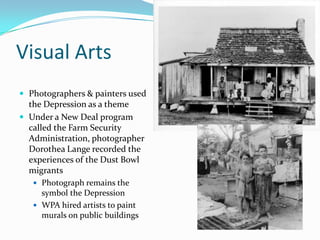
Visual Arts
 Photographers & painters used
  the Depression as a theme
 Under a New Deal program
  called the Farm Security
  Administration, photographer
  Dorothea Lange recorded the
  experiences of the Dust Bowl
  migrants
    Photograph remains the
     symbol the Depression
    WPA hired artists to paint
     murals on public buildings
Movies & Radio
 During the Depression
   Movies: dealt realistically w/ social problems
        The Grapes of Wrath & The Public Enemy
        Also helped people forget about their problems
          Mickey Mouse, King Kong, & Shirley Temple

    Radio: used to broadcast FDR’s fireside chats
        Popular bands & comedians, continuing dramas sponsored by
         soap companies (soap operas)
Legacy of the New Deal
Social Security
 1935
    FDR signs Social Security Act
        Provided federal gov’t a major & lasting role in providing for
         the needy
 Social Security Act
    Old-Age Insurance: key part of SSA
        Guaranteed retired people a pension
          Funded by a payroll tax (a tax that removes money directly
           from workers’ paychecks
          Matching contributions were required by employers

        Business leaders opposed Old-Age Insurance
 SSA included Aid to Dependent Children (ADC)
    Helped children whose father s were dead, unemployed,
     or not living w/ the family
    Granted federal $ to states to help mothers stay home to
     raise their children
 SSA also provided for disabled & gave states $ to make
  temporary payments to the unemployed
 At SSA excluded some categories of labor
    Agriculture & domestic workers not required to pay
      Many African Americans, migrant workers, & poor rural
       whites did not benefit from SS
Lasting Labor Reforms
 Frances Perkins
    Member of FDR’s committee who drafted the SSA
    1st woman to serve in the Cabinet
    Back major labor reform
New Laws Favor Workers
 1935
    Congress passed the National Labor Relations Act
       Became known as Wagner Act
       Guaranteed workers’ rights to organize into unions &
        prohibited unfair business practices
       Upheld collective bargaining (right of a union to negotiate
        wages & benefits for all its members)
   National Labor Relations Board
       Required employers to participate in collective bargaining w/
        unions
 1938
    Fair Labor Standards Act
       Set minimu wages at $.25 per hour & max weekly work hours
        at 44
       Established time and a half payment for overtime work & put
        an end to child labor in some businesses
A Powerful New Union
 John L. Lewis
    Head of the United Mine Workers
       Formed Industrial Organization renamed later the Congress
        of Industrial Organizations (CIO
 CIO
    Umbrella organization consisting of many other unions
       Differed from the older American Federation of Labor (AFL)
         AFL combined workers based on skills

         CIO combined all workers in particular industry (skilled &
          non-skilled)
            Opened union membership to more women & African
             Americans
 1936
    United Auto Workers
       Members of CIO
       Launched sit-down strike (workers stay in the factory but stop
        production) @ nation’s largest auto factory
       After 6 weeks the strikers won their demands for higher wages
        & shorter hours
         Supreme Court later ruled sit-down strikes illegal
Scorecard on the New Deal
 SSA & other reforms permanently enlarged the role of
 the federal gov’t
   Not everyone agreed gov’t should take such an active
    approach to social problems
Arguments Against the New Deal
 Critics say New Deal gave too much power to the
  federal gov’t
 Federal gov’t threaten individual freedom & free
  enterprise
   Favor a return to the tradition of laissez faire
     Gov’t should interfere w/ the economy as little as possible

 Worried about a massive increase in the nation’s debt
 New Deal failed to fulfill its most fundamental goal
   Did not end the Great Depression
   Full recovery would not come until 1941 when the U.S.
    began producing goods in preparation for WWII
Arguments for the New Deal
 Employed millions of jobless people
 Ended banking crisis
 Reformed stock market
 Save poor families from losing their homes
 Improved working conditions
 Built dams & bridges, preserved 12 million acres of national
  parkland, brought electricity to rural America, & sponsored
  the creation of lasting works of art
 For many the New Deal also restored peoples faith in the
  gov’t

Chapter 23

  • 1.
    The Great Depressionand the New Deal
  • 2.
  • 3.
    Signs of Weakness Older industries declining  Coal mining, railroads, & clothing manufactures  Agriculture in prolonged downturn  Stock prices soared  Margin buying: people bought stocks at ta fraction of the cost at the outset & owing the balance  Gambled that prices would be higher when they were ready to sell
  • 4.
    The Stock MarketCrashes  May 1928-September 1929  Industrial stocks doubled  Wednesday October 23rd  6 million shares of stock changed hands  Falling prices caused losses of $4 billion  Brokers who lent $ for people to buy on margin now recalled their loans  Investors who could not pay had to sell their stocks  Caused prices to drop even more  October 29, 1929  Black Tuesday  Stock market crumbled completely  Panicked traders rushed to sell (there were no buyers)  Investors who thought they had valuable stock had worthless pieces of paper (millionaires lost their fortunes overnight)  Stock prices plunged over the next 2 weeks
  • 5.
    The Great DepressionBegins  Stock markets crash marked the start of a 12-year economic & social disaster
  • 6.
    Troubled Industries  Majorcause of the Great Depression  Overproduction: a situation in which the supply of manufactured goods exceeds the demand  Factories produced more than people bought (prices for goods increased)  Housing & automobile manufacture were in decline  Supports prosperity during 1920s  Between 1926-1929 spending on construction fell from $11 billion to $9 billion  1st nine months of 1929 car sales dropped by more than 1/3
  • 7.
    Crisis in Banking Nationwide banking crisis contributed to depression  Struggling farmers could not repay loans  When farms failed, banks also went out of business  City banks also invested in the stock market or loaned $ to speculators  When market crashed people rushed to banks to withdraw their savings  More than 5,500 banks closed between 1930 & 1933  Many depositors were left penniless
  • 8.
    The Downward Spiral W/ people unable to buy factory products, many factory workers lost their jobs  Had less $ to make purchases  Led to declining sales, which led to more factories closings & layoffs  Many companies forced into bankruptcy (financial failure caused by a company’s inability to pay its debts)  These caused even more layoffs  Worldwide Issue  European countries defaulted on their loans owed to the U.S. from WWI due to decline in international trade  As crisis worsened, investors cut back loans to Europe  Process of production cuts, layoffs, & bankruptcies repeated in Europe
  • 9.
    The Unemployed  1929-1933  Unemployment went from 3% to 25%  13 million people nationwide  Toledo, Ohio: 4 out of 5 workers had no work  Those that had jobs had hours & wages cut
  • 10.
    Growing Poverty  Spiritscrushed because of poverty  Jobless waited in long lines for food  Communities of rundowns shack built on outskirts of big cities  Called Hoovervilles (blamed President Hoover for failing to solve the crisis)
  • 11.
    Impact on Families Many fathers left families in search of work  Others were too ashamed to be apart of the family & left  Marriages were less common  Also had fewer children if married  Children faced hardships & uncertainty  Suffered lifelong health problems  Education suffered  1 million rural children under the age of 13 did not attend school
  • 12.
    Hoover Responds  Hoover’sadvisers wanted him to do nothing  Hoover disagreed  Government Aid  Hoover wanted business leaders & local gov’t to take the lead  Encouraged city & state gov’t to create public works projects  Urged private charities to et up soup kitchens  1932  Voluntary action was not enough  Reconstruction Finance Corporation formed  RFC gave $ to local gov’ts to fund public –works projects  Economic situation did not improve
  • 13.
    The Bonus Army June 1932  Protest began that would end Hoover’s career  8 years earlier Congress approved a bonus of $1,000 for every vet of WWI  Vets demanded payment as Depression grew worse  Was not paid until 1945  Hoover refused & 20,000 vets marched to Washington  Congress also refused (many marchers left)  2,000 stubbornly remained in tents or abandoned buildings  Gov’t forces used tear gas, tanks, & machine guns  1 killed, 100 injured (Americans were outraged)
  • 14.
  • 15.
    Franklin D. Roosevelt Nominated by Democrats to run against Hoover in 1932  known as FDR  was a wealthy New Yorker & distant relative of Theodore Roosevelt  had served as assistant secretary of the navy & nominated as VP in 1920  got polio in 1921 & relied on steel leg braces to help him stand  never allowed photographers to take his picture in a wheel chair  1928 elected governor of New York  selected to run for President 4 years later
  • 16.
    A Voice ofHope  Pledged “a new deal for the American people”  Later it would describe his entire political program  FDR beat Hoover by a margin of 472 electoral votes to 59  Received 57.4% of the popular vote  On March 4, 1933w/ the help of his son, he took the oath of office
  • 17.
    Bank Holiday  Dayafter taking office  Declared a bank holiday (4 day closing of the nation’s banks)  Goal was to halt nationwide epidemic of bank failures  Gave FDR time to propose an Emergency Banking Relief Act (provided more careful gov’t regulations of banks)  FDR restored Americans’ confidence in their banks by delivering a fireside chat (radio talks; gave many during his presidency)  When banks reopened many Americans re-deposited money
  • 18.
    Relief for theJobless  FDR conferred w/ his advisors over what legislation to send to Congress  They were nicknamed the “brain trust” because many of them were college professors  During the 1st 100 days of FDR’s administration Congress passed & the President signed 15 new bills  New Deal measures had 3 goals  Relief for the jobless  Economic recovery  Reforms to prevent futures depressions
  • 19.
    Unemployment Relief  Somemeasures provided financial assistance  Federal Emergency Relief Administration  Granted funds to states so they could reopen shuttered relief agencies
  • 20.
    Providing jobs  CivilianConservation Corps (CCC)  Hired city dwellers to work in America’s national parks, forests, wilderness areas, & countryside  Planted trees, built reservoirs, constructed parks, & dug irrigation canals  CCC created jobs & protected the nation’s natural resources  The Works Progress Administration (WPA)  Put people to work building or repairing public buildings  Schools, post offices, & gov’t offices  Paved 650,000 miles of roads, raised more than 75,000 bridges, & built more than 800 airports  Paid artists to paint murals in post offices & gov’t buildings  Hired writers to write stories, state guides, & histories
  • 21.
    Promoting Economic Recovery FDR needed to help industry & agriculture recover  National Recovery Administration  Aimed to keep prices stable while boosting employment & buying power  Most of major industries agreed to pay workers a minimum wage, to stop hiring young children, & to keep wages and prices from falling too low  NRA succeeded in raising prices  Some critics charged them w/ favoring large businesses  Also failed to improve the economy
  • 22.
    Public Works Administration PWA  Was granted more than $3 billion to build large public- works projects  Improved the nation’s infrastructure & employed many people  New York’s Lincoln Tunnel, Florida’s Key West Hwy, & the Grand Coulee Dam in Washington  Nearly every county in the nation could boast at least one PWA project  Even so, the Great Depression continued
  • 23.
    Tennessee Valley Authority Formed in 1933  TVA  Built giant dams along Tennessee River  Dams could control flooding, provided cheap electricity, & increase jobs and prosperity in one of nation’s poorest rural areas  1945  Power from TVA plants lit thousands of farms that never had electricity  Failed to relieve region’s poverty  Conservatives criticized TVA for driving some property owners off their land  Also argued it was unfair for gov’t to compete w/ private power companies  Other argued TVA disrupted the natural environment (increased air pollution)
  • 24.
    Reforming the EconomicSystem  Truth-in-Securities Act  Required corporations to inform the public fully about their stocks  Corrected one condition that caused stock market to crash  Federal Deposit Insurance Corporation (FDIC)  Protected bank depositors  Guaranteed individual deposits up to $2,500.00  Other agencies set fairness & safety standards for various industries  Federal Power Commission (FDC)  Helped control the oil & gas industries  Food & Drug Administration powers were also increased
  • 25.
    Obstacles to theNew Deal  FDR was re-elected in 1936  Americans were enthusiastic about the New Deal  New deal faced challenges in the Supreme court
  • 26.
    Supreme Court  1935& 1936  Supreme Court declared several New Deal measures, including NRA, to be unconstitutional  FDR proposed appointing up to six new Supreme Court justices  Was opposed by conservatives (saw FDR’s plan to gain a majority of justices)  Congress defeated FDR’s plan  He was able to win backdoor way  1937 a conservative justice resigned & FDR appointed a liberal one in his place
  • 27.
    New Deal Critics Conservatives  Thought New Deal went too far in regulating businesses & restricting individual freedom  Liberals  Some thought New Deal did not go far enough in helping the poor  Biggest critics  Huey Long: Democratic senator from Louisiana; argue d gov’t could end Depression immediately; proposed to tax the wealthy & distribute their wealth to the poor (Share Our Wealth plan)  Francis Townsend: called for a system of gov’t pensions (retirement payments); retired Americans over the age of 60 would receive $200 each month as long as they pledged to spend all the money; plan was never approved by Congress, but later helped set the stage for the Social Security system  Charles Coughlin: used radio to attract followers; Catholic priest from Michigan; distrusted FDR’s policies on banking & money; called for gov’t to take over banks  Supporters of the “Big Critics” joined forces to back a third-party candidate in 1936 (were not strong enough to combat FDR’s popularity
  • 28.
    Life in theGreat Depression
  • 29.
    Women in theDepression  Many Americans felt women should stay at home  During the Depression women had to help support their families  By the end of the Depression more women were working outside of the home than before the Depression
  • 30.
    Women in theWorkplace  2 advantages for women in the workplace  Female salesclerks & secretaries faced little competition from men  Jobs of women less likely to disappear, unlike factory jobs  Most women w/ jobs still struggled  Women trained in certain professions (teachers, librarians, etc.) had to compete against men who had lost their jobs  Women factory workers were more likely to lose their jobs or have wages cut  Maids, seamstresses, & housekeepers lost their jobs because people could not afford their services  African American women suffered the most because they held the majority of domestic jobs  To save money more women found themselves sewing clothes, canning fruits & vegetables, & baking bread instead of buying
  • 31.
    An Active FirstLady  Eleanor Roosevelt  Most famous working lady  After FDR was stricken w/ polio she began to speak & travel on his behalf  Transformed the role of First Lady  She served as the Presidents eyes & ears  In 1933 alone she logged 40,000 miles including a trip down into a WV coal mine  Also made frequent radio speeches & wrote a daily newspaper column  Used her position to fight for women’s rights
  • 32.
    African Americans inthe Depression  Hit hard by the depression  Suffered more unemployment, homelessness, illness, & hunger than whites
  • 33.
    South & North South  Plunging cotton prices forced African American sharecroppers off their land  Move to southern cities (found traditional jobs done by blacks (i.e. cleaning streets) were now done by jobless whites)  1932 more than ½ African Americans in South were unemployed  North  African Americans migrated north  Still hard to find work  Were last hired & first fired from jobs  In New York 50% of blacks were jobless
  • 34.
    FDR’s Mixed Record Most blacks backed FDR despite his mixed record on civil rights  Example: FDR failed to support a federal antilynching bill  W/ his wife’s prodding, FDR appointed at least 100 blacks to gov’t posts  Mary McLeod Bethune, a friend of Eleanor’s, became top ranking African American in gov’t  Member of FDR’s “Black Cabinet”; advised FDR on African American issues (William Hastie also a member of cabinet, later became 1st black federal judge)
  • 35.
    A Symbolic Moment 1939  Daughters of the American revolution (DAR) refused to allow African American singer Marian Anderson to perform at their hall  Eleanor resigned as a member of DAR in protest  Arranged for Anderson to sing on the steps of the Lincoln Memorial on Easter Sunday (drew crowd of 75,000; became a symbol of the struggle for civil rights)
  • 36.
    Mexican Immigrants AreDeported  Mexican immigrants  Lived in SW as migrant workers  Welcomed during good time by farmers (worked for low pay & harsh conditions)  Whites flooded the area during the Depression looking for work  American wanted gov’t to force Mexican out of the country  They rounded up 100s of thousands of people & deported them (some were actual U.S. citizens born in the U.S.)
  • 37.
    The Indian NewDeal  1924  Native Americans were granted citizenship  When Depression hit, 170,000 Indians lived in poverty on reservations administered by the gov’t  John Collier  Commissioner of Indian Affairs  A white man who lived among Pueblo Indians of New Mexico  Developed a program called Indian New Deal  w/ federal agency funding: NA hired to build schools, hospitals, & irrigation systems  Also wanted reservations under Indian control, stop sales of their lands, & encouraged schools to teach Native American history & the arts  1934  Congress approved part of the Indian Reorganization Act (IRA)  Did restrict tribal land sales, but failed to bring self-gov’t or education promotion
  • 38.
    The Dust Bowl 1930  Little rain fell, drought caused crop failure & dust storms  Lasted 5 years, 100 million acres of farmland became a wasteland
  • 39.
    Black Blizzards  Modernfarming contributed to Dust Bowl  Large plots of land containing native grasses & sod was removed by farmers (this held the soil in place)  Little rain caused rootless soil to blow away like powder  Dust Storms were called Black Blizzards  Made noon seem like midnight, buried fences, houses, & killed people and animals
  • 40.
    Okies Head West Ruined farm families abandoned their dusty homes to seek work elsewhere  In some areas 1 in 3 families left  Became known as Okies because many came from Oklahoma  Conditions not better in California  Not able to buy land, they had to compete w/ local workers to pick crops  Police closed some roads into California, but migrants kept coming
  • 41.
    Arts & Mediaof the Depression  John Steinbeck  Captured miseries of the Dust Bowl in The Grapes of Wrath  Tells the story of the Joads, Okies who seek a better life in California
  • 42.
    Visual Arts  Photographers& painters used the Depression as a theme  Under a New Deal program called the Farm Security Administration, photographer Dorothea Lange recorded the experiences of the Dust Bowl migrants  Photograph remains the symbol the Depression  WPA hired artists to paint murals on public buildings
  • 43.
    Movies & Radio During the Depression  Movies: dealt realistically w/ social problems  The Grapes of Wrath & The Public Enemy  Also helped people forget about their problems  Mickey Mouse, King Kong, & Shirley Temple  Radio: used to broadcast FDR’s fireside chats  Popular bands & comedians, continuing dramas sponsored by soap companies (soap operas)
  • 44.
    Legacy of theNew Deal
  • 45.
    Social Security  1935  FDR signs Social Security Act  Provided federal gov’t a major & lasting role in providing for the needy  Social Security Act  Old-Age Insurance: key part of SSA  Guaranteed retired people a pension  Funded by a payroll tax (a tax that removes money directly from workers’ paychecks  Matching contributions were required by employers  Business leaders opposed Old-Age Insurance
  • 46.
     SSA includedAid to Dependent Children (ADC)  Helped children whose father s were dead, unemployed, or not living w/ the family  Granted federal $ to states to help mothers stay home to raise their children  SSA also provided for disabled & gave states $ to make temporary payments to the unemployed  At SSA excluded some categories of labor  Agriculture & domestic workers not required to pay  Many African Americans, migrant workers, & poor rural whites did not benefit from SS
  • 47.
    Lasting Labor Reforms Frances Perkins  Member of FDR’s committee who drafted the SSA  1st woman to serve in the Cabinet  Back major labor reform
  • 48.
    New Laws FavorWorkers  1935  Congress passed the National Labor Relations Act  Became known as Wagner Act  Guaranteed workers’ rights to organize into unions & prohibited unfair business practices  Upheld collective bargaining (right of a union to negotiate wages & benefits for all its members)  National Labor Relations Board  Required employers to participate in collective bargaining w/ unions
  • 50.
     1938  Fair Labor Standards Act  Set minimu wages at $.25 per hour & max weekly work hours at 44  Established time and a half payment for overtime work & put an end to child labor in some businesses
  • 51.
    A Powerful NewUnion  John L. Lewis  Head of the United Mine Workers  Formed Industrial Organization renamed later the Congress of Industrial Organizations (CIO  CIO  Umbrella organization consisting of many other unions  Differed from the older American Federation of Labor (AFL)  AFL combined workers based on skills  CIO combined all workers in particular industry (skilled & non-skilled)  Opened union membership to more women & African Americans
  • 52.
     1936  United Auto Workers  Members of CIO  Launched sit-down strike (workers stay in the factory but stop production) @ nation’s largest auto factory  After 6 weeks the strikers won their demands for higher wages & shorter hours  Supreme Court later ruled sit-down strikes illegal
  • 53.
    Scorecard on theNew Deal  SSA & other reforms permanently enlarged the role of the federal gov’t  Not everyone agreed gov’t should take such an active approach to social problems
  • 54.
    Arguments Against theNew Deal  Critics say New Deal gave too much power to the federal gov’t  Federal gov’t threaten individual freedom & free enterprise  Favor a return to the tradition of laissez faire  Gov’t should interfere w/ the economy as little as possible  Worried about a massive increase in the nation’s debt  New Deal failed to fulfill its most fundamental goal  Did not end the Great Depression  Full recovery would not come until 1941 when the U.S. began producing goods in preparation for WWII
  • 55.
    Arguments for theNew Deal  Employed millions of jobless people  Ended banking crisis  Reformed stock market  Save poor families from losing their homes  Improved working conditions  Built dams & bridges, preserved 12 million acres of national parkland, brought electricity to rural America, & sponsored the creation of lasting works of art  For many the New Deal also restored peoples faith in the gov’t