African Civilizations
I. Geography of Africa The last region that was colonized and divided by the Western powers. It was called Dark Continent It remained a region of which they had limited knowledge until the 19 th  century. The hottest and rainiest part of Africa is near the equator.
Savana- a wide and open grassland or grassy area with trees. Oasis- is a place in the desert where there is fertile soil and water to give life to plants.
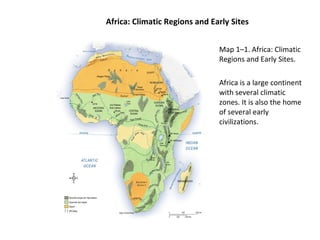
A Huge and Diverse Land Second largest continent in the world From North to South A succession of climatic zones Desert, savannah, rain forest, mountain ranges
Africa: Climatic Regions and Early Sites Map 1–1. Africa: Climatic Regions and Early Sites. Africa is a large continent with several climatic zones. It is also the home of several early civilizations.
II. Birthplace of Humanity Fossil and genetic evidence Out-of-Africa model  Modern humans emerged 200,000 years ago  Migrated to the rest of the world 100,000 years ago “ Eve” model All modern humans from a single African woman
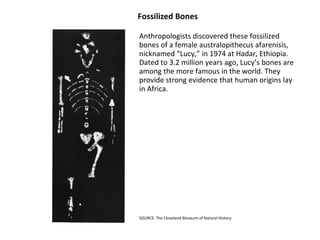
Fossilized Bones  Anthropologists discovered these fossilized bones of a female australopithecus afarenisis, nicknamed “Lucy,” in 1974 at Hadar, Ethiopia. Dated to 3.2 million years ago, Lucy’s bones are among the more famous in the world. They provide strong evidence that human origins lay in Africa.  SOURCE: The Cleveland Museum of Natural History
III. Ancient Civilizations Egypt and the Nile River Valley Mesopotamia and Sumer Race debate Martin Bernal Black Egyptians colonized ancient Greece Became the progenitors of Western civilization Mary Lefkowitz Modern racial categories irrelevant to ancient Egypt Egypt influenced Greek and Western civilization
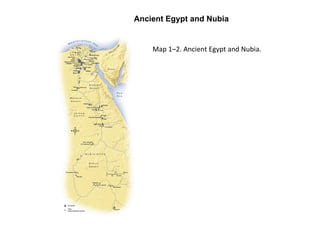
Ancient Egypt and Nubia Map 1–2. Ancient Egypt and Nubia.
Egyptian Civilization Nile River Annual flooding irrigates  River banks and deposits new  Wheat, barely, goats, sheep, and cattle Transportation and communications artery
Egyptian Society Patrilineal/patriarchal Male dominated Hierarchical Warriors, priests, merchants, artisans, peasants Comprehensive bureaucracy
Egyptian Society (cont.) Women Owned property Managed household slaves Educated their children Held public office Served as priests Operated businesses
Egyptian Society (cont.) Polytheistic religion Re (Ra): the sun god Osiris: god of the Nile Immortality Personal and state combined in kings Elaborate funerary
Kush, Mero ë  and Axum Nubia   Egyptian colony ~ copper and gold deposits Kush   Nubian independent kingdom Mero ë   Africa’s first industrial center Iron deposits and geographic location Axum First Christian state in sub-Saharan Africa Influenced by Hebrew culture
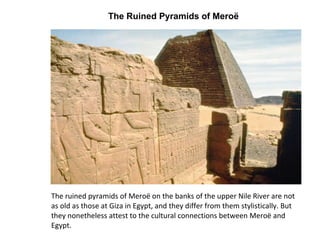
The Ruined Pyramids of Meroë  The ruined pyramids of Meroë on the banks of the upper Nile River are not as old as those at Giza in Egypt, and they differ from them stylistically. But they nonetheless attest to the cultural connections between Meroë and Egypt.
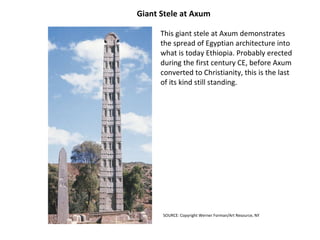
Giant Stele at Axum  This giant stele at Axum demonstrates the spread of Egyptian architecture into what is today Ethiopia. Probably erected during the first century CE, before Axum converted to Christianity, this is the last of its kind still standing. SOURCE:  Copyright Werner Forman/Art Resource, NY
IV. West Africa Physically, ethnically, and culturally diverse Savannah and forest Home to a variety of cultures and languages Cultivated crops Tended domesticated animals Produced iron tools and weapons Trade with North Africa Essential part of the economy and kingdoms
Ancient Ghana First known kingdom in the western Sudan Founded between fourth and eight centuries CE Warfare and iron weapons created an empire   Commerce Camel caravans Imported silk, cotton, glass beads, horses, mirrors, dates, and salt Exported pepper, slaves, and gold mined in another region and taxed passing through Commerce and religion destroyed Ghana in the 12th century
Empire of Mali, 1230-1468 Battle of Kirina Sundiata  Reigned 1210-1260  Led the Mandinka to victory over the Sosso in 1235 Larger than Ghana  Greater rainfall More crops  Control of Wangara gold mines Population reached eight million
Empire of Mali (cont.) Commerce, bureaucracy and scholarship Most merchants and rulers  Converted to gain stature among Arab states Timbuktu   Major trading hub Gold, slaves, and salt Center of Islamic learning ~13th century 150 Islamic schools Cosmopolitan community Religious and ethnic toleration common
Empire of Mali (cont.) Mansa Musa  Reigned 1312-1337 Pilgrimage across Africa to Mecca in Arabia Empire declined with Musa’s death
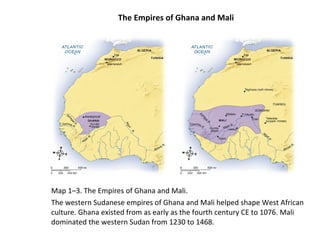
The Empires of Ghana and Mali Map 1–3. The Empires of Ghana and Mali.   The western Sudanese empires of Ghana and Mali helped shape West African culture. Ghana existed from as early as the fourth century CE to 1076. Mali dominated the western Sudan from 1230 to 1468.
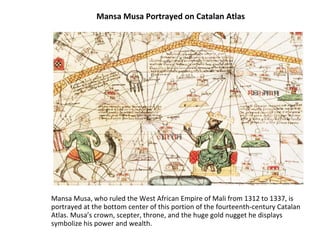
Mansa Musa Portrayed on Catalan Atlas Mansa Musa, who ruled the West African Empire of Mali from 1312 to 1337, is portrayed at the bottom center of this portion of the fourteenth-century Catalan Atlas. Musa’s crown, scepter, throne, and the huge gold nugget he displays symbolize his power and wealth.

African civilizations a

  • 1.
  • 2.
    I. Geography ofAfrica The last region that was colonized and divided by the Western powers. It was called Dark Continent It remained a region of which they had limited knowledge until the 19 th century. The hottest and rainiest part of Africa is near the equator.
  • 3.
    Savana- a wideand open grassland or grassy area with trees. Oasis- is a place in the desert where there is fertile soil and water to give life to plants.
  • 4.
    A Huge andDiverse Land Second largest continent in the world From North to South A succession of climatic zones Desert, savannah, rain forest, mountain ranges
  • 5.
    Africa: Climatic Regionsand Early Sites Map 1–1. Africa: Climatic Regions and Early Sites. Africa is a large continent with several climatic zones. It is also the home of several early civilizations.
  • 6.
    II. Birthplace ofHumanity Fossil and genetic evidence Out-of-Africa model Modern humans emerged 200,000 years ago Migrated to the rest of the world 100,000 years ago “ Eve” model All modern humans from a single African woman
  • 7.
    Fossilized Bones Anthropologists discovered these fossilized bones of a female australopithecus afarenisis, nicknamed “Lucy,” in 1974 at Hadar, Ethiopia. Dated to 3.2 million years ago, Lucy’s bones are among the more famous in the world. They provide strong evidence that human origins lay in Africa. SOURCE: The Cleveland Museum of Natural History
  • 8.
    III. Ancient CivilizationsEgypt and the Nile River Valley Mesopotamia and Sumer Race debate Martin Bernal Black Egyptians colonized ancient Greece Became the progenitors of Western civilization Mary Lefkowitz Modern racial categories irrelevant to ancient Egypt Egypt influenced Greek and Western civilization
  • 9.
    Ancient Egypt andNubia Map 1–2. Ancient Egypt and Nubia.
  • 10.
    Egyptian Civilization NileRiver Annual flooding irrigates River banks and deposits new Wheat, barely, goats, sheep, and cattle Transportation and communications artery
  • 11.
    Egyptian Society Patrilineal/patriarchalMale dominated Hierarchical Warriors, priests, merchants, artisans, peasants Comprehensive bureaucracy
  • 12.
    Egyptian Society (cont.)Women Owned property Managed household slaves Educated their children Held public office Served as priests Operated businesses
  • 13.
    Egyptian Society (cont.)Polytheistic religion Re (Ra): the sun god Osiris: god of the Nile Immortality Personal and state combined in kings Elaborate funerary
  • 14.
    Kush, Mero ë and Axum Nubia Egyptian colony ~ copper and gold deposits Kush Nubian independent kingdom Mero ë Africa’s first industrial center Iron deposits and geographic location Axum First Christian state in sub-Saharan Africa Influenced by Hebrew culture
  • 15.
    The Ruined Pyramidsof Meroë The ruined pyramids of Meroë on the banks of the upper Nile River are not as old as those at Giza in Egypt, and they differ from them stylistically. But they nonetheless attest to the cultural connections between Meroë and Egypt.
  • 16.
    Giant Stele atAxum This giant stele at Axum demonstrates the spread of Egyptian architecture into what is today Ethiopia. Probably erected during the first century CE, before Axum converted to Christianity, this is the last of its kind still standing. SOURCE: Copyright Werner Forman/Art Resource, NY
  • 17.
    IV. West AfricaPhysically, ethnically, and culturally diverse Savannah and forest Home to a variety of cultures and languages Cultivated crops Tended domesticated animals Produced iron tools and weapons Trade with North Africa Essential part of the economy and kingdoms
  • 18.
    Ancient Ghana Firstknown kingdom in the western Sudan Founded between fourth and eight centuries CE Warfare and iron weapons created an empire Commerce Camel caravans Imported silk, cotton, glass beads, horses, mirrors, dates, and salt Exported pepper, slaves, and gold mined in another region and taxed passing through Commerce and religion destroyed Ghana in the 12th century
  • 19.
    Empire of Mali,1230-1468 Battle of Kirina Sundiata Reigned 1210-1260 Led the Mandinka to victory over the Sosso in 1235 Larger than Ghana Greater rainfall More crops Control of Wangara gold mines Population reached eight million
  • 20.
    Empire of Mali(cont.) Commerce, bureaucracy and scholarship Most merchants and rulers Converted to gain stature among Arab states Timbuktu Major trading hub Gold, slaves, and salt Center of Islamic learning ~13th century 150 Islamic schools Cosmopolitan community Religious and ethnic toleration common
  • 21.
    Empire of Mali(cont.) Mansa Musa Reigned 1312-1337 Pilgrimage across Africa to Mecca in Arabia Empire declined with Musa’s death
  • 22.
    The Empires ofGhana and Mali Map 1–3. The Empires of Ghana and Mali. The western Sudanese empires of Ghana and Mali helped shape West African culture. Ghana existed from as early as the fourth century CE to 1076. Mali dominated the western Sudan from 1230 to 1468.
  • 23.
    Mansa Musa Portrayedon Catalan Atlas Mansa Musa, who ruled the West African Empire of Mali from 1312 to 1337, is portrayed at the bottom center of this portion of the fourteenth-century Catalan Atlas. Musa’s crown, scepter, throne, and the huge gold nugget he displays symbolize his power and wealth.