   Expansion of U.S. led to discovers of
    deposits of coal, iron, lead, & copper
    › Along with vast forests that could furnish
      lumber
 Land grants given by gov’t to railroads &
  other businessesses
 Tariffs were kept on imports
    › Helped American industry grow by making
      foreign goods more expensive
   Technology spurred industrial growth as
    well
    › 1850s: Bessemer process was developed
       Method of making steel stronger at lower costs
       Steel quickly replaced iron as basic building
        material
       Pittsburgh became nation’s steel making
        capital
         Due to close coal mines & good transportation
   1859
    › Titusvill, PA
       New source of energy found
       1st oil strike
       Methods to refine crude oil were developed
         Made into lubricants for machines & later into
          gasoline
       Oil became known as black gold
   Railroads fueled industrial growth
    › Carried people & goods to the west & raw
      materials to the east
    › New services added (sleeping cars) & more
      tracks were laid down
    › Big lines soon consolidated & bought up
      smaller lines
       Limited competition & kept prices high
        Higher prices angered small farmers who relied on
         railroads to get their goods to market
   Late 1800s
    › More patents issued than 10 years before
      Civil War
    › U.S. became known as a land of invention
    › Inventions made business & life easier
   1876
    › Thomas Edison created research lab in Menlo
     Park, NJ
       Here they created the light bulb, the phonograph,
        the motion picture camera, & other useful devices
   1882
    › Edison opened 1st electrical power plant in New
     York City; other soon followed all over the
     country
       Supplied electricity that lit homes, powered
        streetcars, & replaced steam engines & electric
        ones in factories
   1866 telegraph speed increased
    › Cyrus Field laid an underwater telegraph cable
      from Europe
    › Made communication faster
   1876
    › Alexander Graham Bell sent the 1st telephone
      message to his assistant in another room
    › Patent for the telephone became the most
      valuable ever issued
    › By 1885 300,000 phones were sold
    › He later organized over 100 local companies
      into the giant American Telephone & Telegraphy
      Company
   1868
    › Christopher Sholes invented the type writer
    › Made writing letters much faster
   1888
    › George Eastman introduced a lightweight camera
    › Replaced heavy chemicals & equipment
    › Sold for a low price, ordinary people could purchase
      it
   Jan Matzeliger
    › African American; invented shoe sewing machine
   Granville Woods
    › African American; invented telegraph between
      moving trains
   Late 1800s
     › European engineers developed automobile
         Only 8,000 Americans had one
     › Era of freer & faster transportation followed
   Henry Ford
     › American manufacturer made automobile available to millions
     › Created a system to mass produce cars & made them available
       at a lower price
     › 1913 Ford introduced the assembly line
         Production time was cut in half
         Lower costs to build = lower prices for consumers
         1917 4.5 million owned cars
   Cars changed the nation’s landscape
     › Roads spread across country & new cities were developed
   1903
    › Wilbur & Orville Wright tested a gas powered
      airplane @ Kitty Hawk, NC
    › Stayed in the air for 12 seconds & flew 120 feet
    › 1st flights attracted little interest
       No use for a flying machine
       Military did not starting using airplane until WWI
   1920s
    › Airplane started to alter the world by making
      travel quicker & trade easier
   Expansion led by entrepreneurs
    › Someone who sets up new businesses to
      make a profit
    › To raise more money, entrepreneurs
      adopted new ways of organizing business
   Corporations
    › Businesses owned by many investors
    › Raise money by selling stock or shares
    › Stockholders get some of the profits & pick
     who runs the company
       Limited risk of investors, only lost money they
        invested
   Huge loans were given to corporations
    › Helped industry grow quickly
    › Made huge profits for bankers
   J. Pierpont Morgan
    › Became powerful force in American economy
    › Gained control of key industries (railroads &
      steel)
       Bought stock in troubled corporations
       Ran companies by eliminating competition &
        increasing profits
   Congress did little to regulate business
    practices
    › Led to growth of “Big Business”
    › Entrepreneurs formed monopolies or
      companies that control most or all business
      in a particular industry
 Poor Scottish immigrant that worked his
  way up in the railroad business
 Entered the steel industry
    › Soon controlled every step of making steel
     (owned iron mines, steel mills, railroads, &
     shipping lines)
       1892 formed Carnegie Steel Company;
        produced more steel than all mills in England
   Carnegie believed the rich had a duty to
    improve society
    › Called Gospel of Wealth
    › Donated millions to build libraries & charities
    › Set up a foundation that funded worthy
     causes after his death
   Son of a New York peddler
   At 23 he invested in an oil refinery
    › Used profits to buy other oil companies
    › Didn’t hesitate to crush competitors
   1882 Rockefeller formed the Standard Oil
    Trust
    › Trust: group of corporations run by a single
      board of directors
   1900
    › Trusts dominated many of nation’s key industries
   Big Business good or bad?
   Critics
    › Trusts threatened free enterprise (system in which
      privately owned businesses compete freely)
    › Business leaders were “robber barons” & used
      their money to influence politicians
   Others
    › Bold “captains of industry”
    › Built up economy & created jobs
    › Made goods & services affordable for American
      consumers
 Supported trend toward trusts
 Survival of the fittest applied to human
  affairs
 Business leaders used to justify efforts to
  limit competition & harsh working
  conditions
 Close relationships between owners &
  workers ended as industries grew
 Most new workers were immigrants,
  others were African Americans who left
  southern farms
 Outnumbered men in most industries
 Many work in sweatshops (workshops
  with long hours & poor working
  conditions with low pay)
 Children had hazardous jobs as well
 Most children did not go to school &
  could not improve their lives
   Lung diseases by textile workers & miners
    › From breathing fibers & dusts
 Burns & death by steelworkers
 Employers were not required to pay
  compensation for injuries
    › Social Darwinists: harsh conditions necessary
      to cut costs, increase production, & ensure
      survival of business
   Triangle Shirtwaist Factory
    › Fire broke out
    › Within 15 minutes, upper stories were ablaze
    › Workers raced to exits to find them locked
       Doors locked to keep workers at their jobs
    › Fire truck ladders were too short to reach the fire
       Workers leaped to their deaths
       150 people, mostly young women, died
   New York & other states approved safety
   Factory workers made attempts to
    organize in early days of Industrial
    Revolution
    › Security guards were hired by companies to
      attack strikers or union organizers
    › Laws made it illegal to strike
    › Workers formed unions in secret
       Sought safer working conditions, higher wages,
        & shorter hours
   Philadelphia clothing workers
    › 1st was small & secret
   1879
    › Terence Powderly elected president of KOL
       Held public rallies
       Women, African Americans, immigrants, &
        unskilled workers were admitted
       Became biggest union in the country
 Violent labor disputes soon took
  place
 May 4th, 1886
    › Strike took place in Haymarket Square in
      Chicago
    › Bomb exploded killing seven policemen
    › Police opened fire on the crowd
    › KOL lost their influence as a result of
      protest
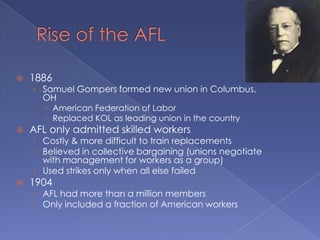
   1886
    › Samuel Gompers formed new union in Columbus,
      OH
        American Federation of Labor
        Replaced KOL as leading union in the country
   AFL only admitted skilled workers
    › Costly & more difficult to train replacements
    › Believed in collective bargaining (unions negotiate
      with management for workers as a group)
    › Used strikes only when all else failed
   1904
    › AFL had more than a million members
    › Only included a fraction of American workers
 Played leading roles in building unions
 Mary Harris Jones
    › Traveled the country campaigning for unions
    › Called attention to hard lives of children
       Called Mother Jones by many people
   1893
    › Severe economic depression
    › Owners cut production, fired workers, & slashed wages
       Violent strikes swept the country
   George Pullman
    › Cut workers pay by 25% & did not lower rent on company
      housing

    › Workers walked off their jobs
    › By July rail lines were shut down from coast to coast
    › President Grover Cleveland sent federal troops to
      Chicago to end the strike
       Shots were fired into the crowd, killing 2
   Public generally sided with owners in violent labor
    disputes
    › Striking unions were seen as radical or violent
    › By 1900 only 3% of American workers belonged to a union
   Urbanization
    › Rapid growth of city populations
   1890
    › 1 in 3 Americans lived in a city
    › U.S. had cities the sizes of London & Paris
   Reasons for urbanization
    › Cities attracted industry & industry attracted
      people
       Moved in search of jobs & excitement
       Many were near waterways, provided easier
        transport of goods
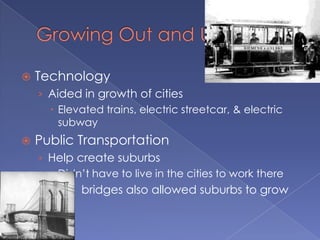
   Technology
    › Aided in growth of cities
       Elevated trains, electric streetcar, & electric
        subway
   Public Transportation
    › Help create suburbs
       Didn’t have to live in the cities to work there
    › Steel bridges also allowed suburbs to grow
   Cities expanded upward
    › 1885 1st 10 story building constructed
    › 1900 skyscrapers reached 30 stories
       Electric elevators allowed people to move up
        & down the building
   Cities grew outward from old downtown
    sections
    › Poor families crowded into these areas
 Fire
  › Constant threat to tightly packed
    neighborhoods
  › 1871
     Chicago fire leveled 3 square
      miles of downtown killing 300
      people & leaving 18,000 homeless
   Downtown slums
    › Poor living conditions
    › Tenements: buildings divided into many tiny
      apartments
       No windows (usually), heat, or indoor plumbing
       10 people lived in a single room & several families
        shared a single bathroom
    › Streets were littered w/ garbage
    › Diseases were common
    › Babies ran the greatest risk of death
       In one Chicago slum, half of all babies died by one
   1880s
    › Streetlights, fire stations, police departments,
      & sanitation stations were set up
    › Public health officials waged war on disease
    › Religious groups served the poor
       Hospitals & clinics were set up for those who
        could not afford a doctor
    › Salvation Army was founded & gave food,
     clothing & shelter to the homeless
   Jane Addams
    › 1889 opened Hull House (settlement house)
     in Chicago
       A center offering help to the urban poor
   At settlement houses
    › Taught English to immigrants, sponsored
     music & sports for young people, & provided
     nurseries for children of working women
   Addams & other house leaders fought to
    outlaw child labor
   Attractions available in the city
    › Electric lights, elevated railroads, & tall
      buildings
   Department stores
    › Developed to meet the needs of shoppers
       Could buy everything they needed in one
        store (use to buy shirts in one, shoes in one,
        pants in one)
       Goods were separated on different floors
   Entertainment provided to people in cities
    › Museums, orchestras, art galleries, & theaters
    › Circuses drew large audiences
   1850s
    › Frederick Law Olmsted planned Central Park in NY
       Others cities built parks, zoos, & gardens
   Sports
    › Pro teams developed in cities after the Civil War
    › Baseball was the most popular
       Cincinnati Red Stockings 1st pro team in 1869
       7 years later 8 cities had teams & formed the National
        League of Professional Baseball Clubs w/ crowds of
        5,000 people
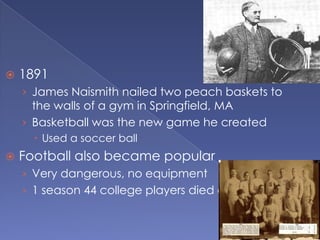
   1891
    › James Naismith nailed two peach baskets to
      the walls of a gym in Springfield, MA
    › Basketball was the new game he created
       Used a soccer ball
   Football also became popular
    › Very dangerous, no equipment
    › 1 season 44 college players died of injuries
   1865-1915
    › 25 million immigrants entered U.S.
   Reasons for Migration
    › Farmland in Europe was shrinking w/ increasing
      population & machines were replacing farmhands
    › Religious freedom
    › Political unrest
    › Job opportunities
       Steamships & railroads (profited from immigration) sent
        agents to Asia & Europe advertising cheap land &
        plentiful jobs
    › Promise of freedom drew people from lands w/o
      democracy & liberty
   Came from southern
    & eastern Europe
    (Italy, Poland, Russia,
    & Greece), Asia, &
    the Pacific
   Most were Catholic
    or Jewish
   Few understood
    English or experience
    living in a
    democracy or a city
   Difficult decision to emigrate
    › Leave home, family, & friends to start a
      strange new life
   Coming to America
    › Miserable journey
    › Crammed below decks in steerage
      (large compartments that usually held
      cattle)
    › Diseases & rough seas sickened
      travelers
   Most settled into cities after being
    admitted to U.S.
    › Near people from the same country
       Helped people feel less isolated
       Celebrated familiar holidays & cooked foods
        from homeland
       Social groups were started (Sons of Italy)
       Storefronts became places of worship
   Immigrant Aid Societies
    › Helped cloth, house, & teach immigrants
   Assimilation
    › Immigrants kept traditional modes of
      worship, family life, & community
    › Worked hard to also assimilate (process of
      becoming part of another culture)
       Children assimilated faster than parents;
        learned English faster, played baseball &
        dressed like native-born Americans
          Pained parents to see children change, but dreamed
   Labor of immigrants was essential to new
    American economy
    › Took whatever job they could find (steel
      mills, meatpacking plants, mines, garment
      sweatshops, built subways, skyscrapers, &
      bridges)
    › Chinese, Irish, & Mexican workers laid
      hundreds of miles of railroad track
   Hard work & saving allowed many to
    advance economically
    › Sometimes opened small businesses to serve
     their community
   Individual Immigrants who contributed
    › Andrew Carnegie, Alexander Graham Bell,
     Samuel Goldwyn & Louis Mayer (started
     motion picture industry), Arturo Toscanini
     (famous orchestra conductor), Leo
     Baekeland (invented 1st plastic)
   1840s
    › Increased immigration led to nativism
        Nativists sought to preserve U.S. for native born
         Americans
          Immigrants wouldn’t assimilate because their
           languages, religions, & customs were too different
          Took away jobs from Americans
          Immigrants were associated w/ violence, crime, &
           anarchy
    › West Coast
       Chinese were drove from mining camps & cities &
        sometimes killed by angry mobs
   1882
    › Congress passed Chinese Exclusion Act to
      exclude Chinese laborers from U.S.
       1st law limiting immigration based on race;
        repealed in 1943
   Before 1870
    › ½ American children attended school
    › All age levels w/ one teacher
   Industry Growth
    › Nation needed educated workforce
    › States improved public schools @ all levels
   1852
    › Compulsory education law passed
       Requirement that children attend school up to a certain
        point
    › Most states passed minimum of 10th grade
    › Schools for whites & black were built in the South
       More reluctant to pass compulsory education laws
   1918
    › Every state required children to attend school
   Higher education also expanded
    › Colleges for men & women opened
    › Universities offering free or low-cost education
      opened
   Elementary School
    › 8:00 a.m. – 4:00 p.m.
    › Learned reading, writing, & arithmetic
    › Moral values & the Christian religion
   Education for Adults
    › Libraries were built
       Offered not only books & magazines, but also
        speakers on important topics
    › 1874
       Methodist minister opened summer bible
        school along Lake Chautauqua
         Camp later opened to the public
         Chautauqua Society later began & traveling
          lectures were sent out
   Americans began to read more
    › Bestsellers were dime novels
    › Told rags-to-riches stories
   Realism
    › Writers who try to show life as it is
    › Emphasized the harsh side
    › Stephen Crane, Jack London, Kate Chopin,
      & Paul Laurence Dunbar
   Mark Twain
    › Pen name of Samuel Clemens
    › Made stories realistic by capturing the
     speech patterns of southerners who lived &
     worked along the Mississippi River
       Huckleberry Finn
   Late 1800s
    › Newspapers grew dramatically
   1900
    › Half the newspapers in the world were
      printed in the U.S.
   Causes of newspaper boom
    › Spread of education
       More could read, more newspapers &
        magazines were bought
    › Urbanization
       News was shared face to face
       People needed newspapers to stay informed
   Joseph Pulitzer
    › Created 1st modern mass circulation
      newspaper
    › 1883
       Bought New York World
       Cut the price so more people could afford it
       Added crowd pleasing features
        Color comics (the Yellow Kid a sweet slum boy), crime
         & scandalous headlines
        Critics called it yellow journalism

Blog notes

  • 3.
    Expansion of U.S. led to discovers of deposits of coal, iron, lead, & copper › Along with vast forests that could furnish lumber  Land grants given by gov’t to railroads & other businessesses  Tariffs were kept on imports › Helped American industry grow by making foreign goods more expensive
  • 4.
    Technology spurred industrial growth as well › 1850s: Bessemer process was developed  Method of making steel stronger at lower costs  Steel quickly replaced iron as basic building material  Pittsburgh became nation’s steel making capital  Due to close coal mines & good transportation
  • 5.
    1859 › Titusvill, PA  New source of energy found  1st oil strike  Methods to refine crude oil were developed  Made into lubricants for machines & later into gasoline  Oil became known as black gold
  • 6.
    Railroads fueled industrial growth › Carried people & goods to the west & raw materials to the east › New services added (sleeping cars) & more tracks were laid down › Big lines soon consolidated & bought up smaller lines  Limited competition & kept prices high  Higher prices angered small farmers who relied on railroads to get their goods to market
  • 7.
    Late 1800s › More patents issued than 10 years before Civil War › U.S. became known as a land of invention › Inventions made business & life easier
  • 8.
    1876 › Thomas Edison created research lab in Menlo Park, NJ  Here they created the light bulb, the phonograph, the motion picture camera, & other useful devices  1882 › Edison opened 1st electrical power plant in New York City; other soon followed all over the country  Supplied electricity that lit homes, powered streetcars, & replaced steam engines & electric ones in factories
  • 9.
    1866 telegraph speed increased › Cyrus Field laid an underwater telegraph cable from Europe › Made communication faster  1876 › Alexander Graham Bell sent the 1st telephone message to his assistant in another room › Patent for the telephone became the most valuable ever issued › By 1885 300,000 phones were sold › He later organized over 100 local companies into the giant American Telephone & Telegraphy Company
  • 10.
    1868 › Christopher Sholes invented the type writer › Made writing letters much faster  1888 › George Eastman introduced a lightweight camera › Replaced heavy chemicals & equipment › Sold for a low price, ordinary people could purchase it  Jan Matzeliger › African American; invented shoe sewing machine  Granville Woods › African American; invented telegraph between moving trains
  • 11.
    Late 1800s › European engineers developed automobile  Only 8,000 Americans had one › Era of freer & faster transportation followed  Henry Ford › American manufacturer made automobile available to millions › Created a system to mass produce cars & made them available at a lower price › 1913 Ford introduced the assembly line  Production time was cut in half  Lower costs to build = lower prices for consumers  1917 4.5 million owned cars  Cars changed the nation’s landscape › Roads spread across country & new cities were developed
  • 12.
    1903 › Wilbur & Orville Wright tested a gas powered airplane @ Kitty Hawk, NC › Stayed in the air for 12 seconds & flew 120 feet › 1st flights attracted little interest  No use for a flying machine  Military did not starting using airplane until WWI  1920s › Airplane started to alter the world by making travel quicker & trade easier
  • 14.
    Expansion led by entrepreneurs › Someone who sets up new businesses to make a profit › To raise more money, entrepreneurs adopted new ways of organizing business
  • 15.
    Corporations › Businesses owned by many investors › Raise money by selling stock or shares › Stockholders get some of the profits & pick who runs the company  Limited risk of investors, only lost money they invested
  • 16.
    Huge loans were given to corporations › Helped industry grow quickly › Made huge profits for bankers  J. Pierpont Morgan › Became powerful force in American economy › Gained control of key industries (railroads & steel)  Bought stock in troubled corporations  Ran companies by eliminating competition & increasing profits
  • 17.
    Congress did little to regulate business practices › Led to growth of “Big Business” › Entrepreneurs formed monopolies or companies that control most or all business in a particular industry
  • 18.
     Poor Scottishimmigrant that worked his way up in the railroad business  Entered the steel industry › Soon controlled every step of making steel (owned iron mines, steel mills, railroads, & shipping lines)  1892 formed Carnegie Steel Company; produced more steel than all mills in England
  • 19.
    Carnegie believed the rich had a duty to improve society › Called Gospel of Wealth › Donated millions to build libraries & charities › Set up a foundation that funded worthy causes after his death
  • 20.
    Son of a New York peddler  At 23 he invested in an oil refinery › Used profits to buy other oil companies › Didn’t hesitate to crush competitors  1882 Rockefeller formed the Standard Oil Trust › Trust: group of corporations run by a single board of directors  1900 › Trusts dominated many of nation’s key industries
  • 21.
    Big Business good or bad?  Critics › Trusts threatened free enterprise (system in which privately owned businesses compete freely) › Business leaders were “robber barons” & used their money to influence politicians  Others › Bold “captains of industry” › Built up economy & created jobs › Made goods & services affordable for American consumers
  • 22.
     Supported trendtoward trusts  Survival of the fittest applied to human affairs  Business leaders used to justify efforts to limit competition & harsh working conditions
  • 23.
     Close relationshipsbetween owners & workers ended as industries grew  Most new workers were immigrants, others were African Americans who left southern farms
  • 24.
     Outnumbered menin most industries  Many work in sweatshops (workshops with long hours & poor working conditions with low pay)  Children had hazardous jobs as well  Most children did not go to school & could not improve their lives
  • 25.
    Lung diseases by textile workers & miners › From breathing fibers & dusts  Burns & death by steelworkers  Employers were not required to pay compensation for injuries › Social Darwinists: harsh conditions necessary to cut costs, increase production, & ensure survival of business
  • 26.
    Triangle Shirtwaist Factory › Fire broke out › Within 15 minutes, upper stories were ablaze › Workers raced to exits to find them locked  Doors locked to keep workers at their jobs › Fire truck ladders were too short to reach the fire  Workers leaped to their deaths  150 people, mostly young women, died  New York & other states approved safety
  • 27.
    Factory workers made attempts to organize in early days of Industrial Revolution › Security guards were hired by companies to attack strikers or union organizers › Laws made it illegal to strike › Workers formed unions in secret  Sought safer working conditions, higher wages, & shorter hours
  • 28.
    Philadelphia clothing workers › 1st was small & secret  1879 › Terence Powderly elected president of KOL  Held public rallies  Women, African Americans, immigrants, & unskilled workers were admitted  Became biggest union in the country
  • 29.
     Violent labordisputes soon took place  May 4th, 1886 › Strike took place in Haymarket Square in Chicago › Bomb exploded killing seven policemen › Police opened fire on the crowd › KOL lost their influence as a result of protest
  • 30.
    1886 › Samuel Gompers formed new union in Columbus, OH  American Federation of Labor  Replaced KOL as leading union in the country  AFL only admitted skilled workers › Costly & more difficult to train replacements › Believed in collective bargaining (unions negotiate with management for workers as a group) › Used strikes only when all else failed  1904 › AFL had more than a million members › Only included a fraction of American workers
  • 31.
     Played leadingroles in building unions  Mary Harris Jones › Traveled the country campaigning for unions › Called attention to hard lives of children  Called Mother Jones by many people
  • 32.
    1893 › Severe economic depression › Owners cut production, fired workers, & slashed wages  Violent strikes swept the country  George Pullman › Cut workers pay by 25% & did not lower rent on company housing › Workers walked off their jobs › By July rail lines were shut down from coast to coast › President Grover Cleveland sent federal troops to Chicago to end the strike  Shots were fired into the crowd, killing 2  Public generally sided with owners in violent labor disputes › Striking unions were seen as radical or violent › By 1900 only 3% of American workers belonged to a union
  • 34.
    Urbanization › Rapid growth of city populations  1890 › 1 in 3 Americans lived in a city › U.S. had cities the sizes of London & Paris  Reasons for urbanization › Cities attracted industry & industry attracted people  Moved in search of jobs & excitement  Many were near waterways, provided easier transport of goods
  • 35.
    Technology › Aided in growth of cities  Elevated trains, electric streetcar, & electric subway  Public Transportation › Help create suburbs  Didn’t have to live in the cities to work there › Steel bridges also allowed suburbs to grow
  • 36.
    Cities expanded upward › 1885 1st 10 story building constructed › 1900 skyscrapers reached 30 stories  Electric elevators allowed people to move up & down the building  Cities grew outward from old downtown sections › Poor families crowded into these areas
  • 37.
     Fire › Constant threat to tightly packed neighborhoods › 1871  Chicago fire leveled 3 square miles of downtown killing 300 people & leaving 18,000 homeless
  • 38.
    Downtown slums › Poor living conditions › Tenements: buildings divided into many tiny apartments  No windows (usually), heat, or indoor plumbing  10 people lived in a single room & several families shared a single bathroom › Streets were littered w/ garbage › Diseases were common › Babies ran the greatest risk of death  In one Chicago slum, half of all babies died by one
  • 39.
    1880s › Streetlights, fire stations, police departments, & sanitation stations were set up › Public health officials waged war on disease › Religious groups served the poor  Hospitals & clinics were set up for those who could not afford a doctor › Salvation Army was founded & gave food, clothing & shelter to the homeless
  • 40.
    Jane Addams › 1889 opened Hull House (settlement house) in Chicago  A center offering help to the urban poor  At settlement houses › Taught English to immigrants, sponsored music & sports for young people, & provided nurseries for children of working women  Addams & other house leaders fought to outlaw child labor
  • 41.
    Attractions available in the city › Electric lights, elevated railroads, & tall buildings  Department stores › Developed to meet the needs of shoppers  Could buy everything they needed in one store (use to buy shirts in one, shoes in one, pants in one)  Goods were separated on different floors
  • 42.
    Entertainment provided to people in cities › Museums, orchestras, art galleries, & theaters › Circuses drew large audiences  1850s › Frederick Law Olmsted planned Central Park in NY  Others cities built parks, zoos, & gardens  Sports › Pro teams developed in cities after the Civil War › Baseball was the most popular  Cincinnati Red Stockings 1st pro team in 1869  7 years later 8 cities had teams & formed the National League of Professional Baseball Clubs w/ crowds of 5,000 people
  • 43.
    1891 › James Naismith nailed two peach baskets to the walls of a gym in Springfield, MA › Basketball was the new game he created  Used a soccer ball  Football also became popular › Very dangerous, no equipment › 1 season 44 college players died of injuries
  • 45.
    1865-1915 › 25 million immigrants entered U.S.  Reasons for Migration › Farmland in Europe was shrinking w/ increasing population & machines were replacing farmhands › Religious freedom › Political unrest › Job opportunities  Steamships & railroads (profited from immigration) sent agents to Asia & Europe advertising cheap land & plentiful jobs › Promise of freedom drew people from lands w/o democracy & liberty
  • 46.
    Came from southern & eastern Europe (Italy, Poland, Russia, & Greece), Asia, & the Pacific  Most were Catholic or Jewish  Few understood English or experience living in a democracy or a city
  • 47.
    Difficult decision to emigrate › Leave home, family, & friends to start a strange new life  Coming to America › Miserable journey › Crammed below decks in steerage (large compartments that usually held cattle) › Diseases & rough seas sickened travelers
  • 48.
    Most settled into cities after being admitted to U.S. › Near people from the same country  Helped people feel less isolated  Celebrated familiar holidays & cooked foods from homeland  Social groups were started (Sons of Italy)  Storefronts became places of worship
  • 49.
    Immigrant Aid Societies › Helped cloth, house, & teach immigrants  Assimilation › Immigrants kept traditional modes of worship, family life, & community › Worked hard to also assimilate (process of becoming part of another culture)  Children assimilated faster than parents; learned English faster, played baseball & dressed like native-born Americans  Pained parents to see children change, but dreamed
  • 50.
    Labor of immigrants was essential to new American economy › Took whatever job they could find (steel mills, meatpacking plants, mines, garment sweatshops, built subways, skyscrapers, & bridges) › Chinese, Irish, & Mexican workers laid hundreds of miles of railroad track  Hard work & saving allowed many to advance economically › Sometimes opened small businesses to serve their community
  • 51.
    Individual Immigrants who contributed › Andrew Carnegie, Alexander Graham Bell, Samuel Goldwyn & Louis Mayer (started motion picture industry), Arturo Toscanini (famous orchestra conductor), Leo Baekeland (invented 1st plastic)
  • 52.
    1840s › Increased immigration led to nativism  Nativists sought to preserve U.S. for native born Americans  Immigrants wouldn’t assimilate because their languages, religions, & customs were too different  Took away jobs from Americans  Immigrants were associated w/ violence, crime, & anarchy › West Coast  Chinese were drove from mining camps & cities & sometimes killed by angry mobs  1882 › Congress passed Chinese Exclusion Act to exclude Chinese laborers from U.S.  1st law limiting immigration based on race; repealed in 1943
  • 54.
    Before 1870 › ½ American children attended school › All age levels w/ one teacher  Industry Growth › Nation needed educated workforce › States improved public schools @ all levels
  • 55.
    1852 › Compulsory education law passed  Requirement that children attend school up to a certain point › Most states passed minimum of 10th grade › Schools for whites & black were built in the South  More reluctant to pass compulsory education laws  1918 › Every state required children to attend school  Higher education also expanded › Colleges for men & women opened › Universities offering free or low-cost education opened
  • 56.
    Elementary School › 8:00 a.m. – 4:00 p.m. › Learned reading, writing, & arithmetic › Moral values & the Christian religion  Education for Adults › Libraries were built  Offered not only books & magazines, but also speakers on important topics › 1874  Methodist minister opened summer bible school along Lake Chautauqua  Camp later opened to the public  Chautauqua Society later began & traveling lectures were sent out
  • 57.
    Americans began to read more › Bestsellers were dime novels › Told rags-to-riches stories  Realism › Writers who try to show life as it is › Emphasized the harsh side › Stephen Crane, Jack London, Kate Chopin, & Paul Laurence Dunbar
  • 58.
    Mark Twain › Pen name of Samuel Clemens › Made stories realistic by capturing the speech patterns of southerners who lived & worked along the Mississippi River  Huckleberry Finn
  • 59.
    Late 1800s › Newspapers grew dramatically  1900 › Half the newspapers in the world were printed in the U.S.  Causes of newspaper boom › Spread of education  More could read, more newspapers & magazines were bought › Urbanization  News was shared face to face  People needed newspapers to stay informed
  • 60.
    Joseph Pulitzer › Created 1st modern mass circulation newspaper › 1883  Bought New York World  Cut the price so more people could afford it  Added crowd pleasing features  Color comics (the Yellow Kid a sweet slum boy), crime & scandalous headlines  Critics called it yellow journalism