How To Build High-Performance Teams! Created and presented by: Marian Morgan Life & Business Coach www.marianmorgan.com
Workshop   Agenda Part One: Elements of Team Part Two: Who  Are  These People? Part Three: Teams In Action/Meetings
Assess Your Team Scale 1-5 We each take responsibility for the team being successful; all team members operate inside the same purpose and vision as the leader. We have agreed to specific, measurable, achievable and time bound goals; they include both business and team development objectives.  We have practices for effective meetings, integrating new team members, decision making and problem solving. We recognize and value each other’s informal roles and contributions. Our team acknowledges conflict and deals with it when it arises
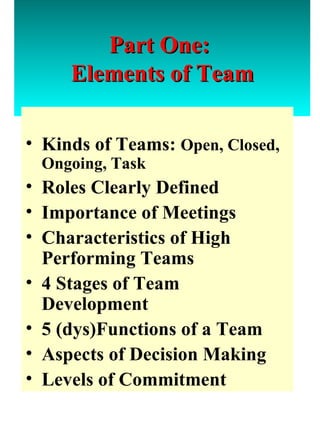
Part One:  Elements of Team Kinds of Teams:  Open, Closed, Ongoing, Task  Roles Clearly Defined Importance of Meetings Characteristics of High Performing Teams  4 Stages of Team Development 5 (dys)Functions of a Team Aspects of Decision Making Levels of Commitment
 
 
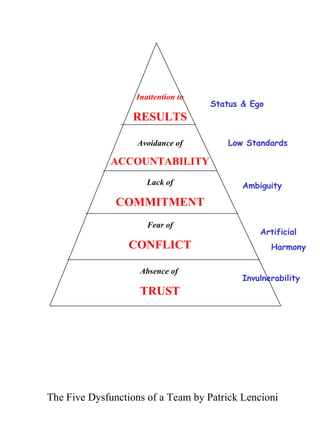
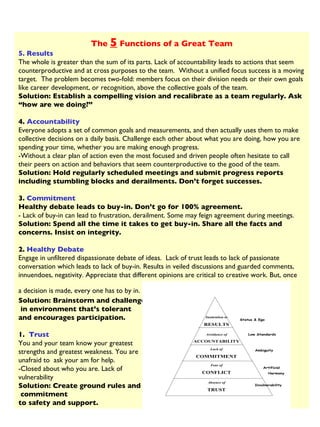
Absence of   TRUST Fear of CONFLICT Lack of COMMITMENT Avoidance of ACCOUNTABILITY Inattention to RESULTS Status & Ego Low Standards Ambiguity Artificial Harmony Invulnerability The Five Dysfunctions of a Team by Patrick Lencioni
The  5  Functions of a Great Team 5.   Results   The whole is greater than the sum of its parts. Lack of accountability leads to actions that seem counterproductive and at cross purposes to the team.  Without a unified focus success is a moving target.  The problem becomes two-fold: members focus on their division needs or their own goals like career development, or recognition, above the collective goals of the team.  Solution: Establish a compelling vision and recalibrate as a team regularly. Ask “how are we doing?” 4.  Accountability Everyone adopts a set of common goals and measurements, and then actually uses them to make collective decisions on a daily basis. Challenge each other about what you are doing, how you are spending your time, whether you are making enough progress.  -Without a clear plan of action even the most focused and driven people often hesitate to call their peers on action and behaviors that seem counterproductive to the good of the team. Solution: Hold regularly scheduled meetings and submit progress reports including stumbling blocks and derailments. Don’t forget successes. 3.  Commitment Healthy debate leads to buy-in. Don’t go for 100% agreement. - Lack of buy-in can lead to frustration, derailment. Some may feign agreement during meetings. Solution: Spend all the time it takes to get buy-in. Share all the facts and concerns. Insist on integrity. 2.   Healthy Debate Engage in unfiltered dispassionate debate of ideas.  Lack of trust leads to lack of passionate conversation which leads to lack of buy-in. Results in veiled discussions and guarded comments, innuendoes, negativity. Appreciate that different opinions are critical to creative work. But, once  a decision is made, every one has to by in.   Solution: Brainstorm and challenge in environment that’s tolerant  and encourages participation. 1.  Trust You and your team know your greatest  strengths and greatest weakness. You are  unafraid to  ask your am for help. -Closed about who you are. Lack of  vulnerability Solution: Create ground rules and commitment  to safety and support.
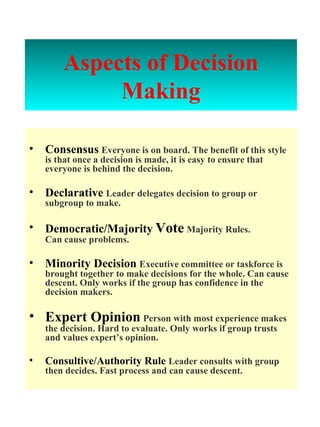
Aspects of   Decision Making Consensus   Everyone is on board. The benefit of this style is that once a decision is made, it is easy to ensure that everyone is behind the decision. Declarative   Leader delegates decision to group or subgroup to make. Democratic/Majority   Vote   Majority Rules.  Can cause problems. Minority Decision   Executive committee or taskforce is brought together to make decisions for the whole. Can cause descent. Only works if the group has confidence in the decision makers. Expert Opinion   Person with most experience makes the decision. Hard to evaluate. Only works if group trusts and values expert’s opinion. Consultive/Authority Rule  Leader consults with group then decides. Fast process and can cause descent.
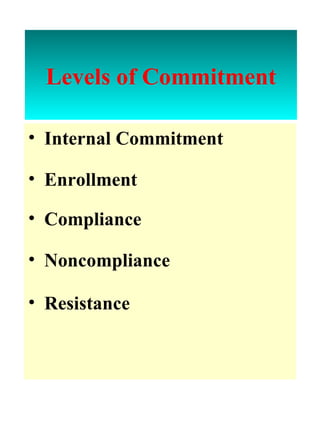
Levels of Commitment Internal Commitment Enrollment Compliance Noncompliance Resistance
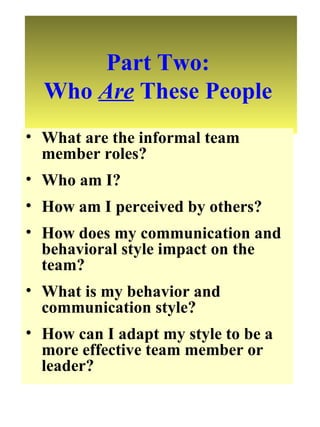
Part Two:  Who  Are  These People  What are the informal team member roles? Who am I? How am I perceived by others? How does my communication and behavioral style impact on the team? What is my behavior and communication style? How can I adapt my style to be a more effective team member or leader?
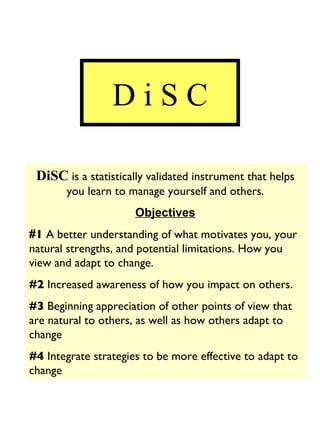
D i S C DiSC  is a statistically validated instrument that helps you learn to manage yourself and others. Objectives # 1  A better understanding of what motivates you, your natural strengths, and potential limitations. How you view and adapt to change. #2  Increased awareness of how you impact on others. #3  Beginning appreciation of other points of view that are natural to others, as well as how others adapt to change #4  Integrate strategies to be more effective to adapt to change
 
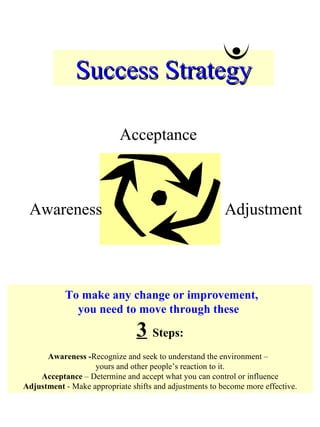
Success Strategy Acceptance Adjustment Awareness To make any change or improvement,  you need to move through these  3   Steps: Awareness - Recognize and seek to understand the environment –  yours and other people’s reaction to it. Acceptance  – Determine and accept what you can control or influence Adjustment  - Make appropriate shifts and adjustments to become more effective.
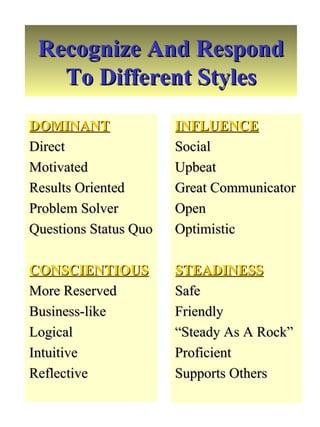
Recognize And Respond To Different Styles DOMINANT Direct Motivated Results Oriented Problem Solver Questions Status Quo CONSCIENTIOUS More Reserved Business-like Logical Intuitive Reflective INFLUENCE Social Upbeat Great Communicator Open  Optimistic STEADINESS Safe Friendly “ Steady As A Rock” Proficient Supports Others
Your Style & Preferences Check off one in each section Verbal cues ___ Let’s take one step at a time… ___ I feel good about… ___ I need some information ___ Let’s do it now… Under stress ___ Tends to become persuasive… ___ Tends to ‘clam up’… ___ May become direct, blunt… ___ Tries to smooth it over… Responding ___ Draws quick conclusions… ___ Cautious, unexpressive… ___ Spontaneous, energetic… ___ Calm, steady… Interactions ___ Social, outgoing… ___ Tries to be dominate… ___ Quiet, observant… ___ Friendly, cooperative… Questions ___ What are the results? ___ How do I fit ? ___ Why? ___ Who? Office Space ___ Papers, date organized and in sequence.  Plants and family pictures… ___ New innovative objects.  Scents, flowers,  and pictures of people… ___ Neat and tidy office.  No personal objects visible… ___ Large desk with power symbols… Appearance ___ Colorful and trendy… ___ Meticulously groomed, monochromatic… ___ Comfortable power styles.  Bold colors… ___ Traditional and conservative.  Casual… Conversations ___ Calm, friendly tone… ___ Unemotional with no small talk… ___ Speaks self assuredly and direct… ___ Loud or expressive.  Talkative… ___ Controls and directs the conversation… ___ Soft spoken and easy going… ___ Asks about details… ___ Answers quickly with lots of energy  and enthusiasm… Physical Action ___ Restless, taps objects… ___ Calm and relaxed… ___ Lots of facial and hand gestures… ___ Maintains distance.  More reserved  and businesslike…
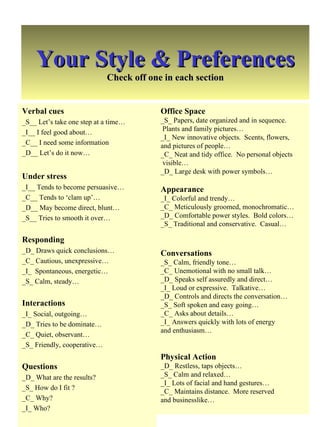
Your Style & Preferences Check off one in each section Verbal cues _S__ Let’s take one step at a time… _I__ I feel good about… _C__ I need some information _D__ Let’s do it now… Under stress _I__ Tends to become persuasive… _C__ Tends to ‘clam up’… _D__ May become direct, blunt… _S__ Tries to smooth it over… Responding _D_ Draws quick conclusions… _C_ Cautious, unexpressive… _I_  Spontaneous, energetic… _S_ Calm, steady… Interactions _I_ Social, outgoing… _D_ Tries to be dominate… _C_ Quiet, observant… _S_ Friendly, cooperative… Questions _D_ What are the results? _S_ How do I fit ? _C_ Why? _I_ Who? Office Space _S_ Papers, date organized and in sequence.  Plants and family pictures… _I_ New innovative objects.  Scents, flowers,  and pictures of people… _C_ Neat and tidy office.  No personal objects visible… _D_ Large desk with power symbols… Appearance _I_ Colorful and trendy… _C_ Meticulously groomed, monochromatic… _D_ Comfortable power styles.  Bold colors… _S_ Traditional and conservative.  Casual… Conversations _S_ Calm, friendly tone… _C_ Unemotional with no small talk… _D_ Speaks self assuredly and direct… _I_ Loud or expressive.  Talkative… _D_ Controls and directs the conversation… _S_ Soft spoken and easy going… _C_ Asks about details… _I_ Answers quickly with lots of energy  and enthusiasm… Physical Action _D_ Restless, taps objects… _S_ Calm and relaxed… _I_ Lots of facial and hand gestures… _C_ Maintains distance.  More reserved  and businesslike…
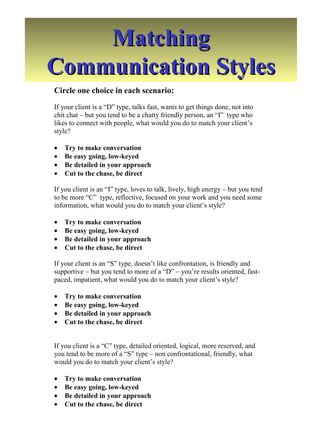
Matching Communication Styles
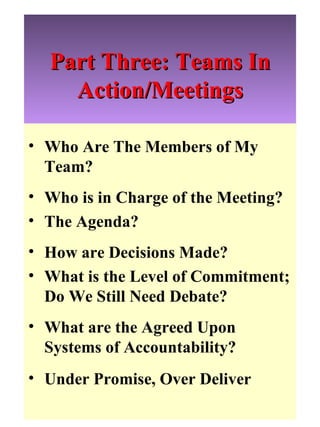
Part Three: Teams In Action/Meetings Who Are The Members of My Team?  Who is in Charge of the Meeting? The Agenda? How are Decisions Made? What is the Level of Commitment; Do We Still Need Debate? What are the Agreed Upon Systems of Accountability?  Under Promise, Over Deliver
Go Teams! Make progress everyday… Thank you!

How To Build High Performance Teams

  • 1.
    How To BuildHigh-Performance Teams! Created and presented by: Marian Morgan Life & Business Coach www.marianmorgan.com
  • 2.
    Workshop Agenda Part One: Elements of Team Part Two: Who Are These People? Part Three: Teams In Action/Meetings
  • 3.
    Assess Your TeamScale 1-5 We each take responsibility for the team being successful; all team members operate inside the same purpose and vision as the leader. We have agreed to specific, measurable, achievable and time bound goals; they include both business and team development objectives. We have practices for effective meetings, integrating new team members, decision making and problem solving. We recognize and value each other’s informal roles and contributions. Our team acknowledges conflict and deals with it when it arises
  • 4.
    Part One: Elements of Team Kinds of Teams: Open, Closed, Ongoing, Task Roles Clearly Defined Importance of Meetings Characteristics of High Performing Teams 4 Stages of Team Development 5 (dys)Functions of a Team Aspects of Decision Making Levels of Commitment
  • 5.
  • 6.
  • 7.
    Absence of TRUST Fear of CONFLICT Lack of COMMITMENT Avoidance of ACCOUNTABILITY Inattention to RESULTS Status & Ego Low Standards Ambiguity Artificial Harmony Invulnerability The Five Dysfunctions of a Team by Patrick Lencioni
  • 8.
    The 5 Functions of a Great Team 5. Results The whole is greater than the sum of its parts. Lack of accountability leads to actions that seem counterproductive and at cross purposes to the team. Without a unified focus success is a moving target. The problem becomes two-fold: members focus on their division needs or their own goals like career development, or recognition, above the collective goals of the team. Solution: Establish a compelling vision and recalibrate as a team regularly. Ask “how are we doing?” 4. Accountability Everyone adopts a set of common goals and measurements, and then actually uses them to make collective decisions on a daily basis. Challenge each other about what you are doing, how you are spending your time, whether you are making enough progress. -Without a clear plan of action even the most focused and driven people often hesitate to call their peers on action and behaviors that seem counterproductive to the good of the team. Solution: Hold regularly scheduled meetings and submit progress reports including stumbling blocks and derailments. Don’t forget successes. 3. Commitment Healthy debate leads to buy-in. Don’t go for 100% agreement. - Lack of buy-in can lead to frustration, derailment. Some may feign agreement during meetings. Solution: Spend all the time it takes to get buy-in. Share all the facts and concerns. Insist on integrity. 2. Healthy Debate Engage in unfiltered dispassionate debate of ideas. Lack of trust leads to lack of passionate conversation which leads to lack of buy-in. Results in veiled discussions and guarded comments, innuendoes, negativity. Appreciate that different opinions are critical to creative work. But, once a decision is made, every one has to by in. Solution: Brainstorm and challenge in environment that’s tolerant and encourages participation. 1. Trust You and your team know your greatest strengths and greatest weakness. You are unafraid to ask your am for help. -Closed about who you are. Lack of vulnerability Solution: Create ground rules and commitment to safety and support.
  • 9.
    Aspects of Decision Making Consensus Everyone is on board. The benefit of this style is that once a decision is made, it is easy to ensure that everyone is behind the decision. Declarative Leader delegates decision to group or subgroup to make. Democratic/Majority Vote Majority Rules. Can cause problems. Minority Decision Executive committee or taskforce is brought together to make decisions for the whole. Can cause descent. Only works if the group has confidence in the decision makers. Expert Opinion Person with most experience makes the decision. Hard to evaluate. Only works if group trusts and values expert’s opinion. Consultive/Authority Rule Leader consults with group then decides. Fast process and can cause descent.
  • 10.
    Levels of CommitmentInternal Commitment Enrollment Compliance Noncompliance Resistance
  • 11.
    Part Two: Who Are These People What are the informal team member roles? Who am I? How am I perceived by others? How does my communication and behavioral style impact on the team? What is my behavior and communication style? How can I adapt my style to be a more effective team member or leader?
  • 12.
    D i SC DiSC is a statistically validated instrument that helps you learn to manage yourself and others. Objectives # 1 A better understanding of what motivates you, your natural strengths, and potential limitations. How you view and adapt to change. #2 Increased awareness of how you impact on others. #3 Beginning appreciation of other points of view that are natural to others, as well as how others adapt to change #4 Integrate strategies to be more effective to adapt to change
  • 13.
  • 14.
    Success Strategy AcceptanceAdjustment Awareness To make any change or improvement, you need to move through these 3 Steps: Awareness - Recognize and seek to understand the environment – yours and other people’s reaction to it. Acceptance – Determine and accept what you can control or influence Adjustment - Make appropriate shifts and adjustments to become more effective.
  • 15.
    Recognize And RespondTo Different Styles DOMINANT Direct Motivated Results Oriented Problem Solver Questions Status Quo CONSCIENTIOUS More Reserved Business-like Logical Intuitive Reflective INFLUENCE Social Upbeat Great Communicator Open Optimistic STEADINESS Safe Friendly “ Steady As A Rock” Proficient Supports Others
  • 16.
    Your Style &Preferences Check off one in each section Verbal cues ___ Let’s take one step at a time… ___ I feel good about… ___ I need some information ___ Let’s do it now… Under stress ___ Tends to become persuasive… ___ Tends to ‘clam up’… ___ May become direct, blunt… ___ Tries to smooth it over… Responding ___ Draws quick conclusions… ___ Cautious, unexpressive… ___ Spontaneous, energetic… ___ Calm, steady… Interactions ___ Social, outgoing… ___ Tries to be dominate… ___ Quiet, observant… ___ Friendly, cooperative… Questions ___ What are the results? ___ How do I fit ? ___ Why? ___ Who? Office Space ___ Papers, date organized and in sequence. Plants and family pictures… ___ New innovative objects. Scents, flowers, and pictures of people… ___ Neat and tidy office. No personal objects visible… ___ Large desk with power symbols… Appearance ___ Colorful and trendy… ___ Meticulously groomed, monochromatic… ___ Comfortable power styles. Bold colors… ___ Traditional and conservative. Casual… Conversations ___ Calm, friendly tone… ___ Unemotional with no small talk… ___ Speaks self assuredly and direct… ___ Loud or expressive. Talkative… ___ Controls and directs the conversation… ___ Soft spoken and easy going… ___ Asks about details… ___ Answers quickly with lots of energy and enthusiasm… Physical Action ___ Restless, taps objects… ___ Calm and relaxed… ___ Lots of facial and hand gestures… ___ Maintains distance. More reserved and businesslike…
  • 17.
    Your Style &Preferences Check off one in each section Verbal cues _S__ Let’s take one step at a time… _I__ I feel good about… _C__ I need some information _D__ Let’s do it now… Under stress _I__ Tends to become persuasive… _C__ Tends to ‘clam up’… _D__ May become direct, blunt… _S__ Tries to smooth it over… Responding _D_ Draws quick conclusions… _C_ Cautious, unexpressive… _I_ Spontaneous, energetic… _S_ Calm, steady… Interactions _I_ Social, outgoing… _D_ Tries to be dominate… _C_ Quiet, observant… _S_ Friendly, cooperative… Questions _D_ What are the results? _S_ How do I fit ? _C_ Why? _I_ Who? Office Space _S_ Papers, date organized and in sequence. Plants and family pictures… _I_ New innovative objects. Scents, flowers, and pictures of people… _C_ Neat and tidy office. No personal objects visible… _D_ Large desk with power symbols… Appearance _I_ Colorful and trendy… _C_ Meticulously groomed, monochromatic… _D_ Comfortable power styles. Bold colors… _S_ Traditional and conservative. Casual… Conversations _S_ Calm, friendly tone… _C_ Unemotional with no small talk… _D_ Speaks self assuredly and direct… _I_ Loud or expressive. Talkative… _D_ Controls and directs the conversation… _S_ Soft spoken and easy going… _C_ Asks about details… _I_ Answers quickly with lots of energy and enthusiasm… Physical Action _D_ Restless, taps objects… _S_ Calm and relaxed… _I_ Lots of facial and hand gestures… _C_ Maintains distance. More reserved and businesslike…
  • 18.
  • 19.
    Part Three: TeamsIn Action/Meetings Who Are The Members of My Team? Who is in Charge of the Meeting? The Agenda? How are Decisions Made? What is the Level of Commitment; Do We Still Need Debate? What are the Agreed Upon Systems of Accountability? Under Promise, Over Deliver
  • 20.
    Go Teams! Makeprogress everyday… Thank you!