Fight. More. Better
#SHRM2016
@joegerstandt
#SHRM2016
@joegerstandt
#SHRM2016
@joegerstandt
#SHRM2016
@joegerstandt
#SHRM2016
@joegerstandt
No thank you.
joegerstandt.com
joe.gerstandt@gmail.com
linkedin.com/in/joegerstandt
youtube.com/joegerstandt
twitter.com/joegerstandt
slideshare.net/joeg
402.740.7081
MT
management
MT
engineers
NASA
management
Tuesday
morning
January 28th
1986
MT
management
MT
engineers
NASA
management
MT
management
NASA
management
Minority dissent, even dissent
that is wrong, stimulates
divergent thought. Issues and
problems are considered from
more perspectives and group
members find more correct
answers.
-Nemeth, Staw (1989) Advances in Experimental Social Psychology
groupthink:
mode of thinking that happens when
the desire for harmony in a decision-
making group overrides a realistic
appraisal of alternatives. Group
members try to minimize conflict and
reach a consensus decision without
critical evaluation of alternative ideas
or viewpoints.
We simply decide
without thinking
much about the
decision process.
-Jim Nightingale
Group vs. Individual Decision Making
groups individuals
accuracy
speed
creativity
degree of
acceptance
efficiency
Group vs. Individual Decision Making
groups individuals
accuracy x
speed x
creativity x
degree of
acceptance
x
efficiency x
Groups often fail to
outperform individuals
because they prematurely
move to consensus, with
dissenting opinions being
suppressed or dismissed.
-Hackman, Morris (1975) Advances in Experimental Social Psychology
Group vs. Individual Decision Making
groups individuals
accuracy x
speed x
creativity x
degree of
acceptance
x
efficiency x
Group intelligence is not
strongly tied to either the
average intelligence of the
members or the team’s
smartest member.
-Thomas Malone, MIT Center for Collective Intelligence
MBA
Harvard University
100 people
MBA
Harvard University
100 people
team #1
MBA
Harvard University
100 people
team #1
team #2
MBA
Harvard University
100 people
team #1
team #2
MBA
Harvard University
100 people
team #1
team #2
friends
with
diversity
benefits
These theorems that when solving
problems, diversity can trump ability
and that when making predictions,
diversity matters just as much as
ability are not political statements.
They are mathematical truths.
-Scott Page
but…
team #1
This team greatly
overrates its own
problem solving
capacity.
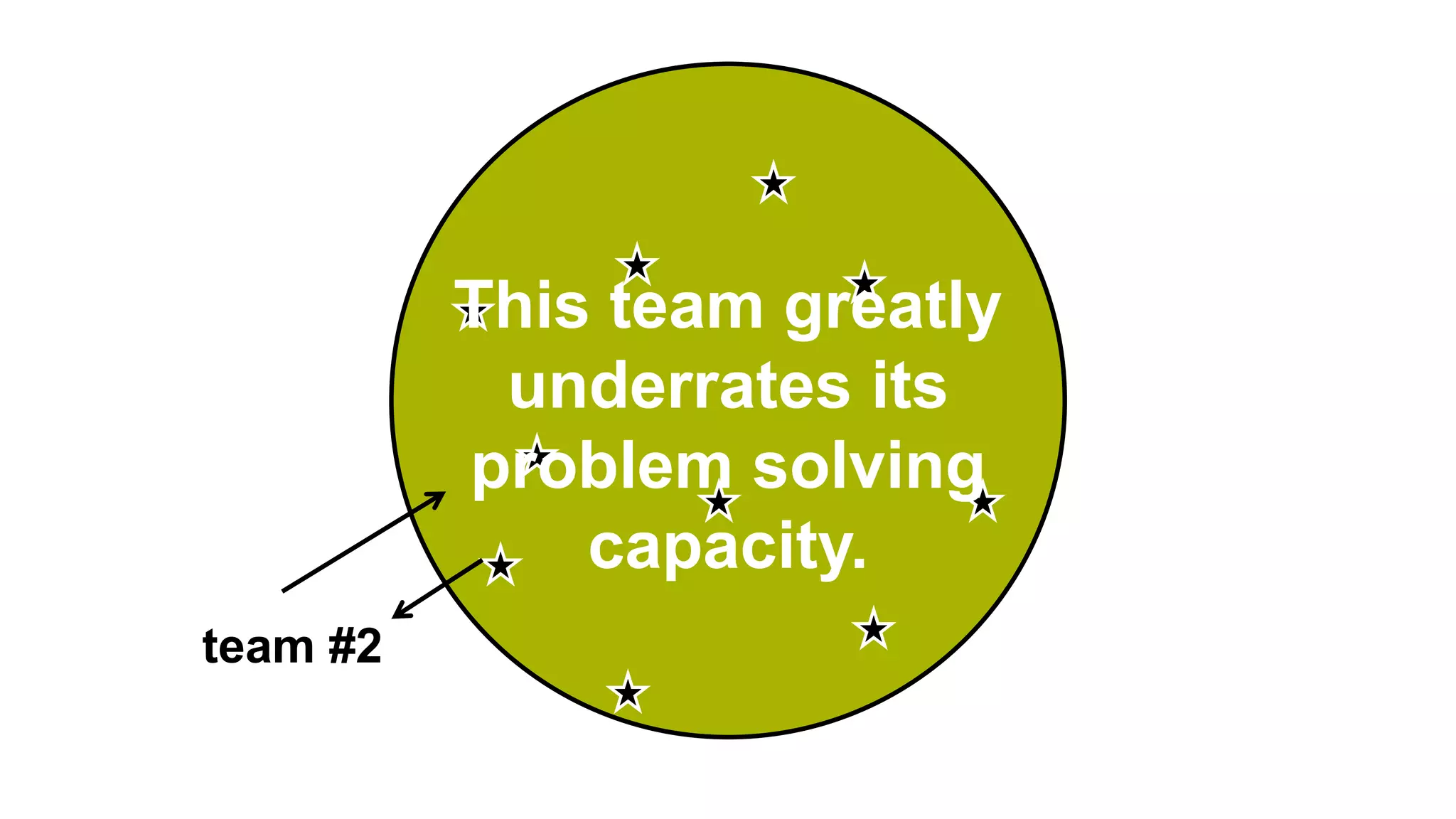
team #2
This team greatly
underrates its
problem solving
capacity.
dysfunction
dysfunctional
disagreement
dysfunctional
agreement
also
dysfunction
dysfunctional
disagreement
dysfunctional
agreement
dysfunctional
agreement
dysfunctional
disagreement
dysfunctional
agreement
dysfunctional
agreement
always
disagree lack of
trust
personal
conflict
us vs.
them
dysfunctional
disagreement
dysfunctional
agreement
dysfunctional
agreement
always
disagree lack of
trust
personal
conflict
us vs.
them
always
agree
lack of
honesty
meeting
after the
meeting
lacking
skills
dysfunctional
disagreement
dysfunctional
agreement
dysfunctional
agreement
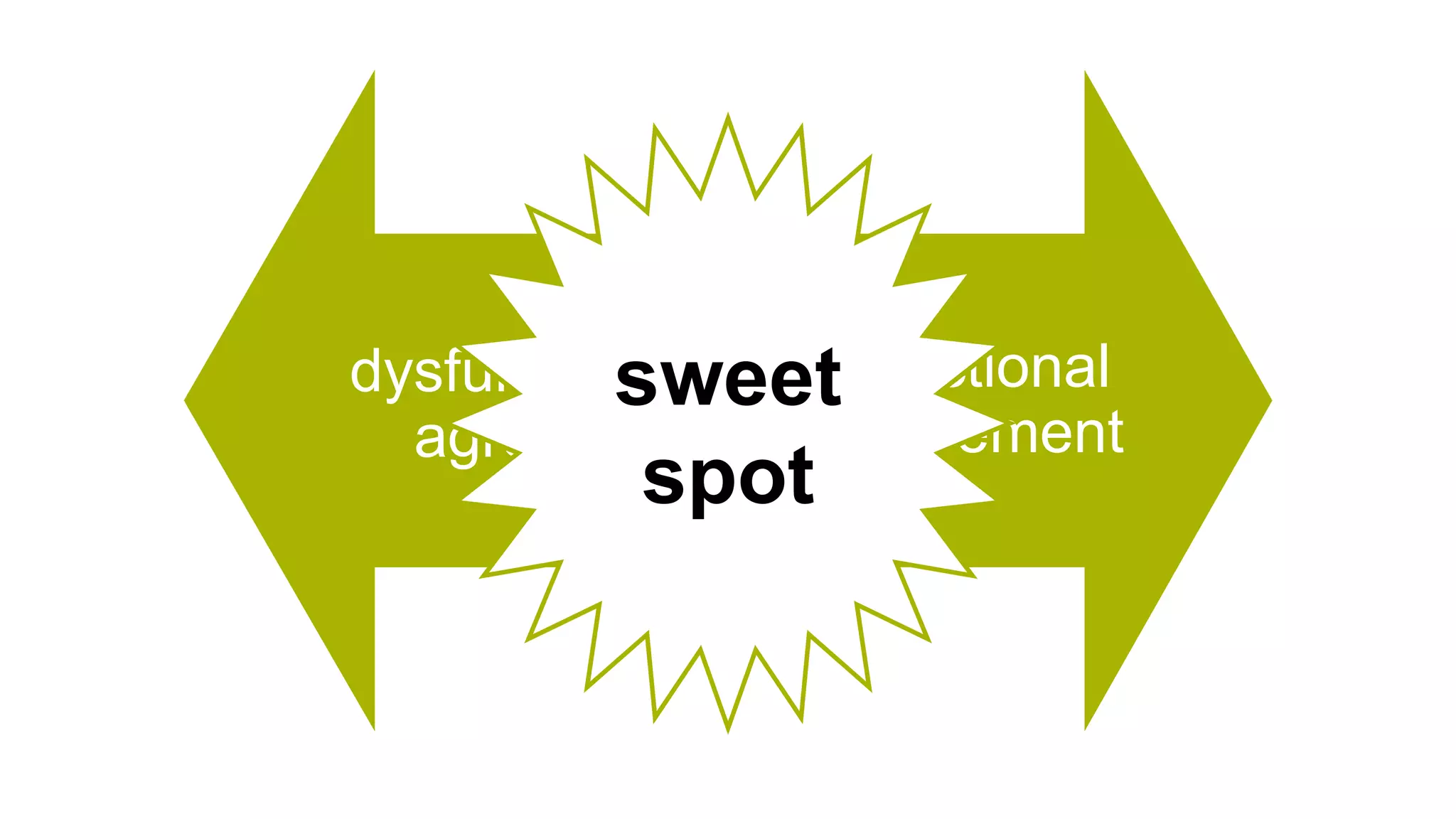
sweet
spot
1.know your own conflict style
2.clear expectations
3.focus on relationships
How is the decision going
to be made?
How are we going to
disagree?
constructive
• focus on issues
• focus on future
• focus on solutions
• inquiry
• lots of “I” and “we”
destructive
• focus on people
• focus on past
• focus on problems
• advocacy
• lots of “you” and
“they”
agreements…
agreements…
Put the phones away.
agreements…
• put phones away
• start on time
• check-in
• serial sharing
• third chair
• boss speaks last
•devils advocate
•reward & coach
•clear divisions
•protect diversity
•end with clarity
•communication
low courage high courage
low
consideration
passive
aggressive
aggressive
high
consideration
passive assertive
low courage high courage
low
consideration
passive
aggressive
aggressive
high
consideration
passive assertive
passive:
• do not assert themselves
• allow others to deliberately or
inadvertently infringe on their rights
• fail to express their feelings, needs,
or opinions
• tend to speak softly or apologetically
• exhibit poor eye contact and slumped
body posture
aggressive:
• try to dominate others
• use humiliation to control others
• criticize, blame, or attack others
• speak in a loud, overbearing voice
• not listen well
• interrupt frequently
• use “you” statements
passive-aggressive:
• mutter to themselves rather than confront
the person or issue
• have difficulty acknowledging their anger
• use facial expressions that don't match
how they feel - i.e., smiling when angry
• use sarcasm
• appear cooperative while purposely doing
things to annoy and disrupt
• use subtle sabotage to get even
assertive:
• state needs, feelings and wants
clearly and respectfully
• use “I” statements
• listen well without interrupting
• have good eye contact
• speak in a calm, clear tone of voice
• have a relaxed body posture
• not allow others to abuse them
high
difference
low
difference
high
interaction
learning
growth
self-organization
stress
conflict
exhaustion
celebration
reinforcement
energy
low productivity
wasted energy
factions
low
interaction
reflection
safety
clearing the decks
isolation
misunderstanding
frustration
comfort
belonging
rest and recovery
boredom
stagnation
death
Difference Matrix
Glenda Eoyang HSDI
high
difference
low
difference
high
interaction
learning
growth
self-organization
stress
conflict
exhaustion
celebration
reinforcement
energy
low productivity
wasted energy
factions
low
interaction
reflection
safety
clearing the decks
isolation
misunderstanding
frustration
comfort
belonging
rest and recovery
boredom
stagnation
death
Difference Matrix
Glenda Eoyang HSDI
high
difference
low
difference
high
interaction
learning
growth
self-organization
stress
conflict
exhaustion
celebration
reinforcement
energy
low productivity
wasted energy
factions
low
interaction
reflection
safety
clearing the decks
isolation
misunderstanding
frustration
comfort
belonging
rest and recovery
boredom
stagnation
death
Difference Matrix
Glenda Eoyang HSDI
high
difference
low
difference
high
interaction
learning
growth
self-organization
stress
conflict
exhaustion
celebration
reinforcement
energy
low productivity
wasted energy
factions
low
interaction
reflection
safety
clearing the decks
isolation
misunderstanding
frustration
comfort
belonging
rest and recovery
boredom
stagnation
death
Difference Matrix
Glenda Eoyang HSDI
high
difference
low
difference
high
interaction
learning
growth
self-organization
stress
conflict
exhaustion
celebration
reinforcement
energy
low productivity
wasted energy
factions
low
interaction
reflection
safety
clearing the decks
isolation
misunderstanding
frustration
comfort
belonging
rest and recovery
boredom
stagnation
death
Difference Matrix
Glenda Eoyang HSDI
high
difference
low
difference
high
interaction
move to low difference:
Tell a joke.*
State a shared value or
belief.
Share personal experience.
Pick a low difference topic.
move to low
interaction:
Stop communicating.
Leave the area.
Explain yourself.
Pick a low
communication topic.
low
interaction
move to high
interaction:
Ask a question.
Use another medium.
Listen more.
Pick a high communication
topic.
move to high
difference:
Amplify little
differences.
Play devils advocate.
Pick a high difference
topic.Difference Matrix
Glenda Eoyang HSDI
Trust
precedes the
truth.
1.know your own conflict style
2.clear expectations
3.focus on relationships
8
O
15.99
6
C
12.01
1
H
(1.01)
joegerstandt.com
linkedin.com/in/joegerstandt
youtube.com/joegerstandt
joe.gerstandt@gmail.com
twitter.com/joegerstandt
slideshare.net/joeg
402.740.7081
Thank you!

Fight. More. Better. joe gerstandt SHRM16