3/29/2015 1
WORKING CAPITAL
MANAGEMENT
PREPARED BY:
HASSAN NOOR
3/29/2015 2
SCHEME OF PRESENTATION
Working CapitalConcepts
Working capital
Significance of working capital management
Kinds of working capital
Working Capital Issues
3/29/2015 3
WORKING CAPITAL CONCEPTS
NetWorking Capital:
• Net working capital refers to the difference between current assets and
current liabilities.Current liabilities are those claims of outsider, which are
expected to mature
• For payment within an accounting year & include creditors, bills payable &
the outstanding expenses. In other words you can say that this is the excess
of current assets over current liabilities.
Current Assets – Current Liabilities
Gross Working Capital:
• It refers to the firm’s investment in current assets.
• Current assets are the assets, which can be converted into cash within an
accounting year or within an operating cycle
3/29/2015 4
CONT…..
• Cash, short-term securities, debtors (accounts receivable & book
debts), bills receivable and stock.
Working capital turnover:
• Working capital turnover= sales/working capital
Working Capital Management:
• The administration of the firm’s current assets and the financing
needed to support current assets.
3/29/2015 5
3/29/2015 6
WORKING CAPITAL
MANAGEMENT
DEFINITION:
• Working capital management involves the relationship between a
firm's short-term assets and its short-term liabilities.
• The basic goal of working capital management is to ensure that a
firm is able to continue its operations and that it has sufficient
ability to satisfy both maturing short-term debt and upcoming
operational expenses.
3/29/2015 7
3/29/2015 8
SINGNIFICANCE OF WORKING
CAPITAL MANAGEMENT
In a typical manufacturing firm, current assets exceed one-half of
total assets.
Excessive levels can result in a substandard Return on Investment
(ROI).
Current liabilities are the principal source of external financing for
small firms.
Requires continuous, day-to-day managerial supervision.
Working capital management affects the company’s risk, return,
and share price.
3/29/2015 9
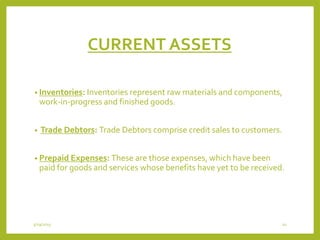
CURRENT ASSETS
• Inventories: Inventories represent raw materials and components,
work-in-progress and finished goods.
• Trade Debtors: Trade Debtors comprise credit sales to customers.
• Prepaid Expenses: These are those expenses, which have been
paid for goods and services whose benefits have yet to be received.
3/29/2015 10
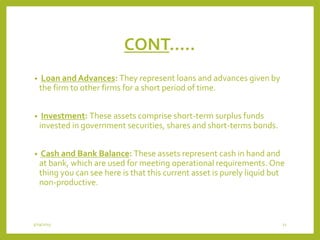
CONT…..
• Loan and Advances: They represent loans and advances given by
the firm to other firms for a short period of time.
• Investment: These assets comprise short-term surplus funds
invested in government securities, shares and short-terms bonds.
• Cash and Bank Balance: These assets represent cash in hand and
at bank, which are used for meeting operational requirements. One
thing you can see here is that this current asset is purely liquid but
non-productive.
3/29/2015 11
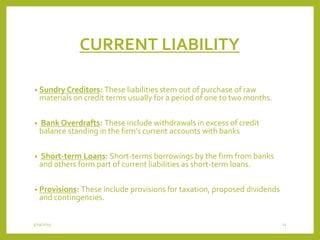
CURRENT LIABILITY
• Sundry Creditors: These liabilities stem out of purchase of raw
materials on credit terms usually for a period of one to two months.
• Bank Overdrafts: These include withdrawals in excess of credit
balance standing in the firm’s current accounts with banks
• Short-term Loans: Short-terms borrowings by the firm from banks
and others form part of current liabilities as short-term loans.
• Provisions: These include provisions for taxation, proposed dividends
and contingencies.
3/29/2015 12
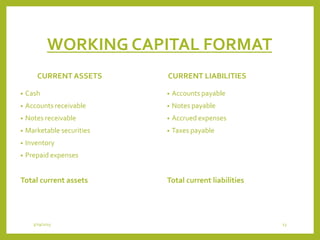
WORKING CAPITAL FORMAT
CURRENT ASSETS
• Cash
• Accounts receivable
• Notes receivable
• Marketable securities
• Inventory
• Prepaid expenses
Total current assets
CURRENT LIABILITIES
• Accounts payable
• Notes payable
• Accrued expenses
• Taxes payable
Total current liabilities
3/29/2015 13
KINDS OF WORKING CAPITAL
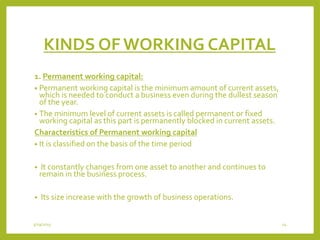
1. Permanent working capital:
• Permanent working capital is the minimum amount of current assets,
which is needed to conduct a business even during the dullest season
of the year.
• The minimum level of current assets is called permanent or fixed
working capital as this part is permanently blocked in current assets.
Characteristics of Permanent working capital
• It is classified on the basis of the time period
• It constantly changes from one asset to another and continues to
remain in the business process.
• Its size increase with the growth of business operations.
3/29/2015 14
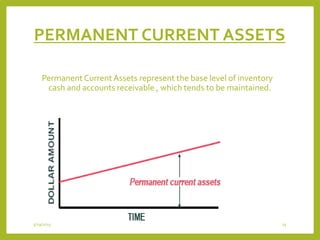
PERMANENT CURRENT ASSETS
Permanent Current Assets represent the base level of inventory
cash and accounts receivable , which tends to be maintained.
3/29/2015 15
KINDS OF WORKING CAPITAL
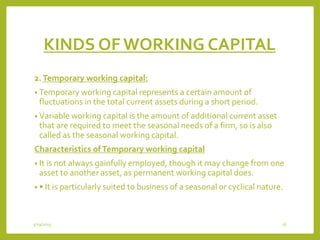
2.Temporary working capital:
• Temporary working capital represents a certain amount of
fluctuations in the total current assets during a short period.
• Variable working capital is the amount of additional current asset
that are required to meet the seasonal needs of a firm, so is also
called as the seasonal working capital.
Characteristics ofTemporary working capital
• It is not always gainfully employed, though it may change from one
asset to another asset, as permanent working capital does.
• • It is particularly suited to business of a seasonal or cyclical nature.
3/29/2015 16
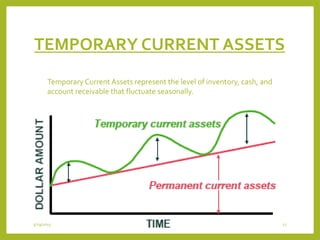
TEMPORARY CURRENT ASSETS
Temporary Current Assets represent the level of inventory, cash, and
account receivable that fluctuate seasonally.
3/29/2015 17
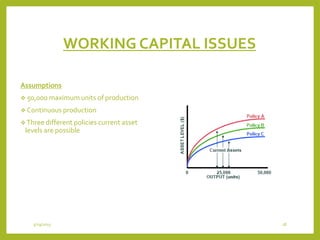
WORKING CAPITAL ISSUES
Assumptions
 50,000 maximum units of production
 Continuous production
 Three different policies current asset
levels are possible
3/29/2015 18
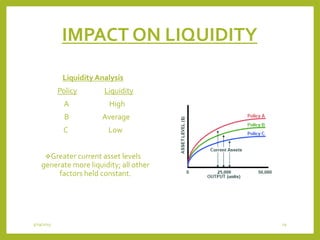
IMPACT ON LIQUIDITY
Liquidity Analysis
Policy Liquidity
A High
B Average
C Low
Greater current asset levels
generate more liquidity; all other
factors held constant.
3/29/2015 19
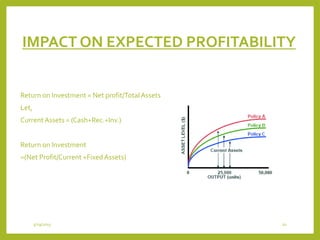
IMPACT ON EXPECTED PROFITABILITY
Return on Investment = Net profit/TotalAssets
Let,
CurrentAssets = (Cash+Rec.+Inv.)
Return on Investment
=(Net Profit/Current +FixedAssets)
3/29/2015 20
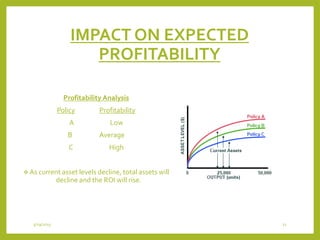
IMPACT ON EXPECTED
PROFITABILITY
Profitability Analysis
Policy Profitability
A Low
B Average
C High
 As current asset levels decline, total assets will
decline and the ROI will rise.
3/29/2015 21
IMPACT ON RISK
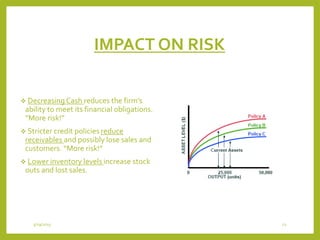
 Decreasing Cash reduces the firm’s
ability to meet its financial obligations.
“More risk!”
 Stricter credit policies reduce
receivables and possibly lose sales and
customers. “More risk!”
 Lower inventory levels increase stock
outs and lost sales.
3/29/2015 22
IMPACT ON RISK
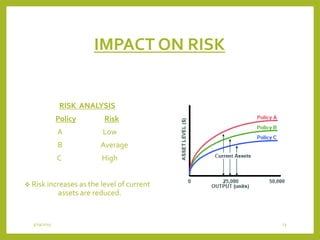
RISK ANALYSIS
Policy Risk
A Low
B Average
C High
 Risk increases as the level of current
assets are reduced.
3/29/2015 23
SUMMARY OFTHE OPTIMAL
AMOUNT OF CURRENT ASSETS
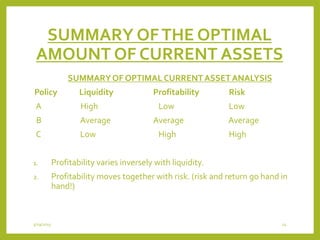
SUMMARYOF OPTIMAL CURRENTASSETANALYSIS
Policy Liquidity Profitability Risk
A High Low Low
B Average Average Average
C Low High High
1. Profitability varies inversely with liquidity.
2. Profitability moves together with risk. (risk and return go hand in
hand!)
3/29/2015 24
WORKING CAPITAL
FANANCING APPROACHES
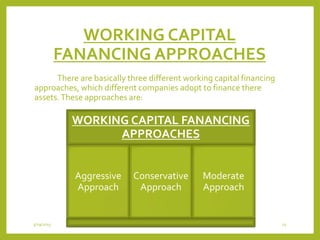
There are basically three different working capital financing
approaches, which different companies adopt to finance there
assets.These approaches are:
3/29/2015 25
WORKING CAPITAL FANANCING
APPROACHES
Aggressive
Approach
Conservative
Approach
Moderate
Approach
AGGRESSIVE APPROACH
Short-Term Financing Benefits:
Financing long-term needs with a lower interest cost than short-
term debt
Borrowing only what is necessary
Short-Term Financing Risks:
Refinancing short-term obligations in the future
Uncertain future interest costs
Result:
Manager accepts greater expected profits in exchange for taking
greater risk.
3/29/2015 26
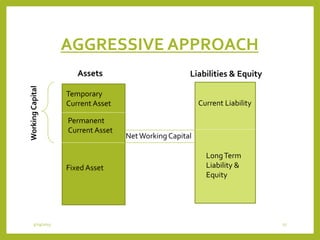
AGGRESSIVE APPROACH
Temporary
Current Asset
LongTerm
Liability &
Equity
Current Liability
Fixed Asset
Permanent
Current Asset
NetWorking Capital
Assets Liabilities & Equity
WorkingCapital
3/29/2015 27
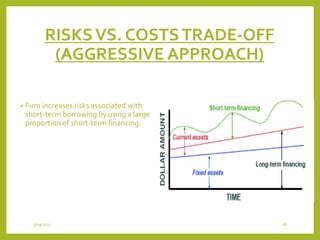
RISKSVS. COSTSTRADE-OFF
(AGGRESSIVE APPROACH)
• Firm increases risks associated with
short-term borrowing by using a larger
proportion of short-term financing.
3/29/2015 28
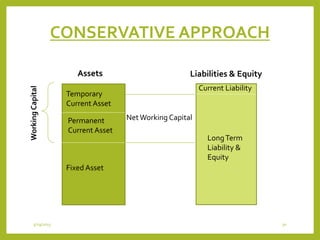
(CONSERVATIVE APPROACH)
Long-term Financing Benefits:
Less worry in refinancing short-term obligations
Less uncertainty regarding future interest costs
Short-term Financing Risks:
Borrowing more than what is necessary
Borrowing at a higher overall cost(usually)
Result:
Manager accepts less expected profits in exchange for taking less
risk.
3/29/2015 29
CONSERVATIVE APPROACH
Temporary
Current Asset
LongTerm
Liability &
Equity
Current Liability
Fixed Asset
Permanent
Current Asset
NetWorking Capital
Assets
WorkingCapital
Liabilities & Equity
3/29/2015 30
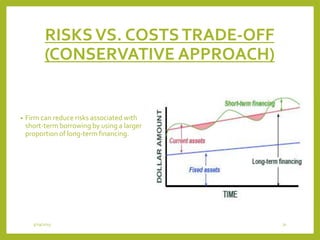
RISKSVS. COSTSTRADE-OFF
(CONSERVATIVE APPROACH)
• Firm can reduce risks associated with
short-term borrowing by using a larger
proportion of long-term financing.
3/29/2015 31
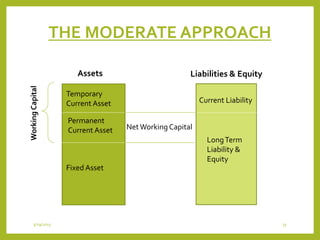
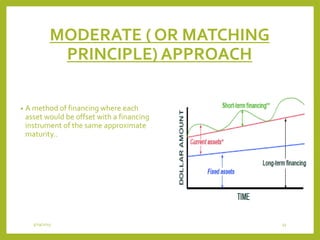
THE MODERATE APPROACH
 Fixed assets and the non-seasonal portion of current assets are
financed with long-term debt and equity(long-term profitability of
assets to cover the long-term financing costs of the firm).
 Seasonal needs are financed with short-term loans (under normal
operations sufficient cash flow is expected to cover the short-term
financing cost).
 Also known as Matching PrincipleApproach.
3/29/2015 32
THE MODERATE APPROACH
Temporary
Current Asset
LongTerm
Liability &
Equity
Current Liability
Fixed Asset
Permanent
Current Asset NetWorking Capital
Assets
WorkingCapital
Liabilities & Equity
3/29/2015 33
MODERATE ( OR MATCHING
PRINCIPLE) APPROACH
• A method of financing where each
asset would be offset with a financing
instrument of the same approximate
maturity..
3/29/2015 34
SELF-LIQUIDATING NATURE OF
SHORT-TERM LOANS
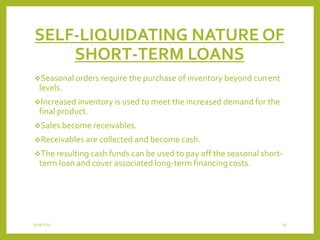
Seasonal orders require the purchase of inventory beyond current
levels.
Increased inventory is used to meet the increased demand for the
final product.
Sales become receivables.
Receivables are collected and become cash.
The resulting cash funds can be used to pay off the seasonal short-
term loan and cover associated long-term financing costs.
3/29/2015 35
COMBINING LIABILITY
STRUCTURE AND CURRENT
ASSET DECISIONS
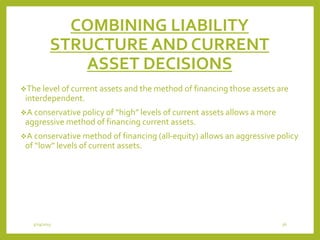
The level of current assets and the method of financing those assets are
interdependent.
A conservative policy of “high” levels of current assets allows a more
aggressive method of financing current assets.
A conservative method of financing (all-equity) allows an aggressive policy
of “low” levels of current assets.
3/29/2015 36
ANY QUESTION???
WE ENCOURAGEYOUTO ASK…
3/29/2015 37
3/29/2015 38

Wc management

  • 1.
  • 2.
  • 3.
    SCHEME OF PRESENTATION WorkingCapitalConcepts Working capital Significance of working capital management Kinds of working capital Working Capital Issues 3/29/2015 3
  • 4.
    WORKING CAPITAL CONCEPTS NetWorkingCapital: • Net working capital refers to the difference between current assets and current liabilities.Current liabilities are those claims of outsider, which are expected to mature • For payment within an accounting year & include creditors, bills payable & the outstanding expenses. In other words you can say that this is the excess of current assets over current liabilities. Current Assets – Current Liabilities Gross Working Capital: • It refers to the firm’s investment in current assets. • Current assets are the assets, which can be converted into cash within an accounting year or within an operating cycle 3/29/2015 4
  • 5.
    CONT….. • Cash, short-termsecurities, debtors (accounts receivable & book debts), bills receivable and stock. Working capital turnover: • Working capital turnover= sales/working capital Working Capital Management: • The administration of the firm’s current assets and the financing needed to support current assets. 3/29/2015 5
  • 6.
  • 7.
    WORKING CAPITAL MANAGEMENT DEFINITION: • Workingcapital management involves the relationship between a firm's short-term assets and its short-term liabilities. • The basic goal of working capital management is to ensure that a firm is able to continue its operations and that it has sufficient ability to satisfy both maturing short-term debt and upcoming operational expenses. 3/29/2015 7
  • 8.
  • 9.
    SINGNIFICANCE OF WORKING CAPITALMANAGEMENT In a typical manufacturing firm, current assets exceed one-half of total assets. Excessive levels can result in a substandard Return on Investment (ROI). Current liabilities are the principal source of external financing for small firms. Requires continuous, day-to-day managerial supervision. Working capital management affects the company’s risk, return, and share price. 3/29/2015 9
  • 10.
    CURRENT ASSETS • Inventories:Inventories represent raw materials and components, work-in-progress and finished goods. • Trade Debtors: Trade Debtors comprise credit sales to customers. • Prepaid Expenses: These are those expenses, which have been paid for goods and services whose benefits have yet to be received. 3/29/2015 10
  • 11.
    CONT….. • Loan andAdvances: They represent loans and advances given by the firm to other firms for a short period of time. • Investment: These assets comprise short-term surplus funds invested in government securities, shares and short-terms bonds. • Cash and Bank Balance: These assets represent cash in hand and at bank, which are used for meeting operational requirements. One thing you can see here is that this current asset is purely liquid but non-productive. 3/29/2015 11
  • 12.
    CURRENT LIABILITY • SundryCreditors: These liabilities stem out of purchase of raw materials on credit terms usually for a period of one to two months. • Bank Overdrafts: These include withdrawals in excess of credit balance standing in the firm’s current accounts with banks • Short-term Loans: Short-terms borrowings by the firm from banks and others form part of current liabilities as short-term loans. • Provisions: These include provisions for taxation, proposed dividends and contingencies. 3/29/2015 12
  • 13.
    WORKING CAPITAL FORMAT CURRENTASSETS • Cash • Accounts receivable • Notes receivable • Marketable securities • Inventory • Prepaid expenses Total current assets CURRENT LIABILITIES • Accounts payable • Notes payable • Accrued expenses • Taxes payable Total current liabilities 3/29/2015 13
  • 14.
    KINDS OF WORKINGCAPITAL 1. Permanent working capital: • Permanent working capital is the minimum amount of current assets, which is needed to conduct a business even during the dullest season of the year. • The minimum level of current assets is called permanent or fixed working capital as this part is permanently blocked in current assets. Characteristics of Permanent working capital • It is classified on the basis of the time period • It constantly changes from one asset to another and continues to remain in the business process. • Its size increase with the growth of business operations. 3/29/2015 14
  • 15.
    PERMANENT CURRENT ASSETS PermanentCurrent Assets represent the base level of inventory cash and accounts receivable , which tends to be maintained. 3/29/2015 15
  • 16.
    KINDS OF WORKINGCAPITAL 2.Temporary working capital: • Temporary working capital represents a certain amount of fluctuations in the total current assets during a short period. • Variable working capital is the amount of additional current asset that are required to meet the seasonal needs of a firm, so is also called as the seasonal working capital. Characteristics ofTemporary working capital • It is not always gainfully employed, though it may change from one asset to another asset, as permanent working capital does. • • It is particularly suited to business of a seasonal or cyclical nature. 3/29/2015 16
  • 17.
    TEMPORARY CURRENT ASSETS TemporaryCurrent Assets represent the level of inventory, cash, and account receivable that fluctuate seasonally. 3/29/2015 17
  • 18.
    WORKING CAPITAL ISSUES Assumptions 50,000 maximum units of production  Continuous production  Three different policies current asset levels are possible 3/29/2015 18
  • 19.
    IMPACT ON LIQUIDITY LiquidityAnalysis Policy Liquidity A High B Average C Low Greater current asset levels generate more liquidity; all other factors held constant. 3/29/2015 19
  • 20.
    IMPACT ON EXPECTEDPROFITABILITY Return on Investment = Net profit/TotalAssets Let, CurrentAssets = (Cash+Rec.+Inv.) Return on Investment =(Net Profit/Current +FixedAssets) 3/29/2015 20
  • 21.
    IMPACT ON EXPECTED PROFITABILITY ProfitabilityAnalysis Policy Profitability A Low B Average C High  As current asset levels decline, total assets will decline and the ROI will rise. 3/29/2015 21

  • 22.
    IMPACT ON RISK Decreasing Cash reduces the firm’s ability to meet its financial obligations. “More risk!”  Stricter credit policies reduce receivables and possibly lose sales and customers. “More risk!”  Lower inventory levels increase stock outs and lost sales. 3/29/2015 22
  • 23.
    IMPACT ON RISK RISKANALYSIS Policy Risk A Low B Average C High  Risk increases as the level of current assets are reduced. 3/29/2015 23
  • 24.
    SUMMARY OFTHE OPTIMAL AMOUNTOF CURRENT ASSETS SUMMARYOF OPTIMAL CURRENTASSETANALYSIS Policy Liquidity Profitability Risk A High Low Low B Average Average Average C Low High High 1. Profitability varies inversely with liquidity. 2. Profitability moves together with risk. (risk and return go hand in hand!) 3/29/2015 24
  • 25.
    WORKING CAPITAL FANANCING APPROACHES Thereare basically three different working capital financing approaches, which different companies adopt to finance there assets.These approaches are: 3/29/2015 25 WORKING CAPITAL FANANCING APPROACHES Aggressive Approach Conservative Approach Moderate Approach
  • 26.
    AGGRESSIVE APPROACH Short-Term FinancingBenefits: Financing long-term needs with a lower interest cost than short- term debt Borrowing only what is necessary Short-Term Financing Risks: Refinancing short-term obligations in the future Uncertain future interest costs Result: Manager accepts greater expected profits in exchange for taking greater risk. 3/29/2015 26
  • 27.
    AGGRESSIVE APPROACH Temporary Current Asset LongTerm Liability& Equity Current Liability Fixed Asset Permanent Current Asset NetWorking Capital Assets Liabilities & Equity WorkingCapital 3/29/2015 27
  • 28.
    RISKSVS. COSTSTRADE-OFF (AGGRESSIVE APPROACH) •Firm increases risks associated with short-term borrowing by using a larger proportion of short-term financing. 3/29/2015 28
  • 29.
    (CONSERVATIVE APPROACH) Long-term FinancingBenefits: Less worry in refinancing short-term obligations Less uncertainty regarding future interest costs Short-term Financing Risks: Borrowing more than what is necessary Borrowing at a higher overall cost(usually) Result: Manager accepts less expected profits in exchange for taking less risk. 3/29/2015 29
  • 30.
    CONSERVATIVE APPROACH Temporary Current Asset LongTerm Liability& Equity Current Liability Fixed Asset Permanent Current Asset NetWorking Capital Assets WorkingCapital Liabilities & Equity 3/29/2015 30
  • 31.
    RISKSVS. COSTSTRADE-OFF (CONSERVATIVE APPROACH) •Firm can reduce risks associated with short-term borrowing by using a larger proportion of long-term financing. 3/29/2015 31
  • 32.
    THE MODERATE APPROACH Fixed assets and the non-seasonal portion of current assets are financed with long-term debt and equity(long-term profitability of assets to cover the long-term financing costs of the firm).  Seasonal needs are financed with short-term loans (under normal operations sufficient cash flow is expected to cover the short-term financing cost).  Also known as Matching PrincipleApproach. 3/29/2015 32
  • 33.
    THE MODERATE APPROACH Temporary CurrentAsset LongTerm Liability & Equity Current Liability Fixed Asset Permanent Current Asset NetWorking Capital Assets WorkingCapital Liabilities & Equity 3/29/2015 33
  • 34.
    MODERATE ( ORMATCHING PRINCIPLE) APPROACH • A method of financing where each asset would be offset with a financing instrument of the same approximate maturity.. 3/29/2015 34
  • 35.
    SELF-LIQUIDATING NATURE OF SHORT-TERMLOANS Seasonal orders require the purchase of inventory beyond current levels. Increased inventory is used to meet the increased demand for the final product. Sales become receivables. Receivables are collected and become cash. The resulting cash funds can be used to pay off the seasonal short- term loan and cover associated long-term financing costs. 3/29/2015 35
  • 36.
    COMBINING LIABILITY STRUCTURE ANDCURRENT ASSET DECISIONS The level of current assets and the method of financing those assets are interdependent. A conservative policy of “high” levels of current assets allows a more aggressive method of financing current assets. A conservative method of financing (all-equity) allows an aggressive policy of “low” levels of current assets. 3/29/2015 36
  • 37.
  • 38.