Working Capital Introduction
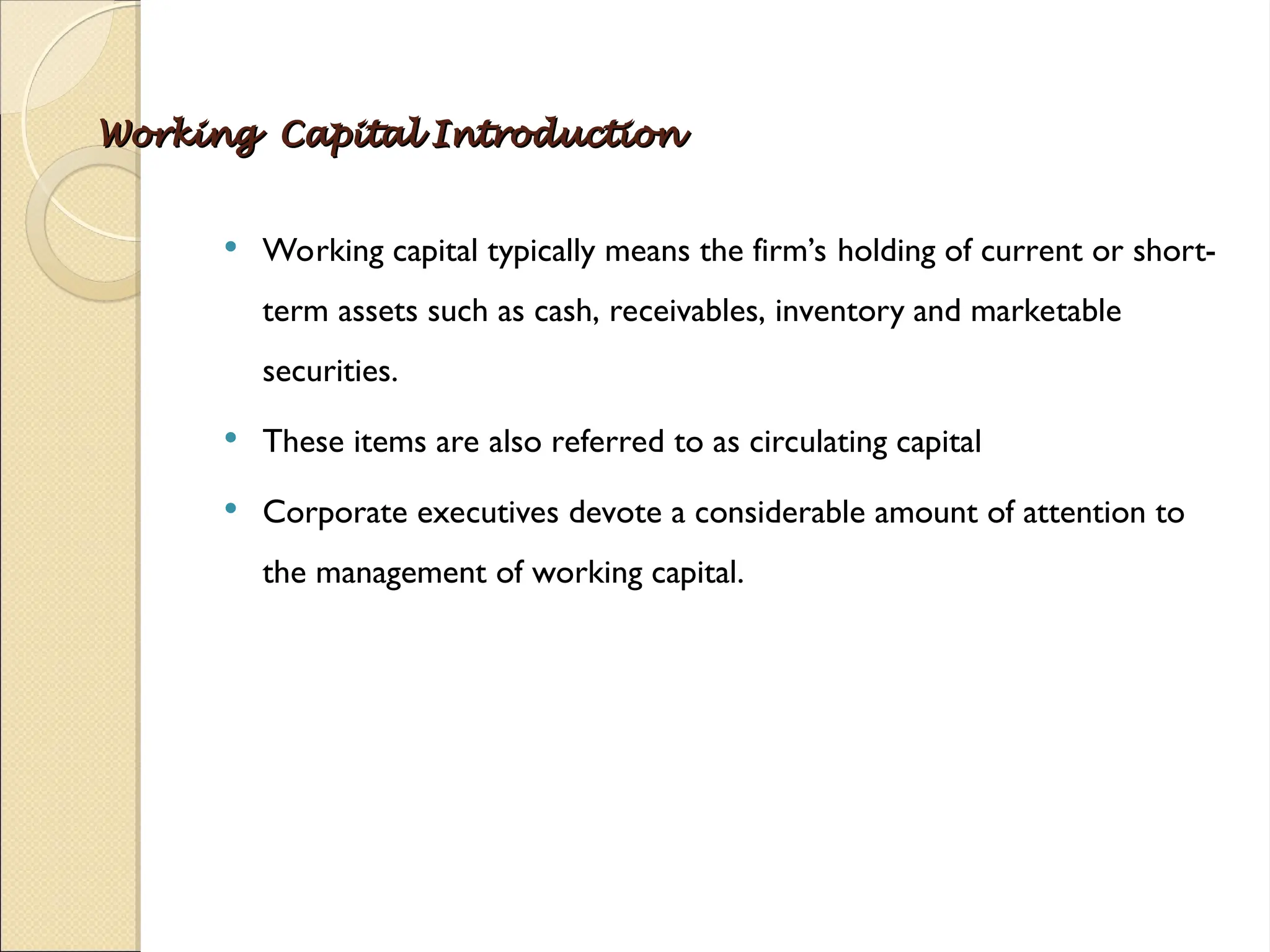
WorkingCapital Introduction
Working capital typically means the firm’s holding of current or short-
term assets such as cash, receivables, inventory and marketable
securities.
These items are also referred to as circulating capital
Corporate executives devote a considerable amount of attention to
the management of working capital.
3.
Definition of WorkingCapital
Definition of Working Capital
Working Capital refers to that part of the firm’s capital, which is
required for financing short-term or current assets such a cash
marketable securities, debtors and inventories. Funds thus, invested in
current assets keep revolving fast and are constantly converted into
cash and this cash flow out again in exchange for other current assets.
Working Capital is also known as revolving or circulating capital or
short-term capital.
4.
Concept of workingcapital
Concept of working capital
There are two possible interpretations of working capital concept:
1. Balance sheet concept
2. Operating cycle concept
Balance sheet concept
There are two interpretations of working capital under the balance sheet
concept.
Excess of current assets over current liabilities
Gross or total current assets.
5.
Excess ofcurrent assets over current liabilities are called the net working
capital or net current assets.
Working capital is really what a part of long term finance is locked in and used
for supporting current activities.
The balance sheet definition of working capital is meaningful only as an
indication of the firm’s current solvency in repaying its creditors.
When firms speak of shortage of working capital they in fact possibly imply
scarcity of cash resources.
In fund flow analysis an increase in working capital, as conventionally defined,
represents employment or application of funds.
6.
Operating cycleconcept
A company’s operating cycle typically consists of three primary activities:
◦ Purchasing resources,
◦ Producing the product and
◦ Distributing (selling) the product.
These activities create funds flows that are both unsynchronized and
uncertain.
Unsynchronized because cash disbursements (for example, payments for
resource purchases) usually take place before cash receipts (for example
collection of receivables).
They are uncertain because future sales and costs, which generate the respective
receipts and disbursements, cannot be forecasted with complete accuracy.
7.
“ Circulating capitalmeans current assets of a company that are
changed in the ordinary course of business from one form to
another, as for example, from cash to inventories, inventories to
receivables, receivable to cash”
……Genestenbreg
8.
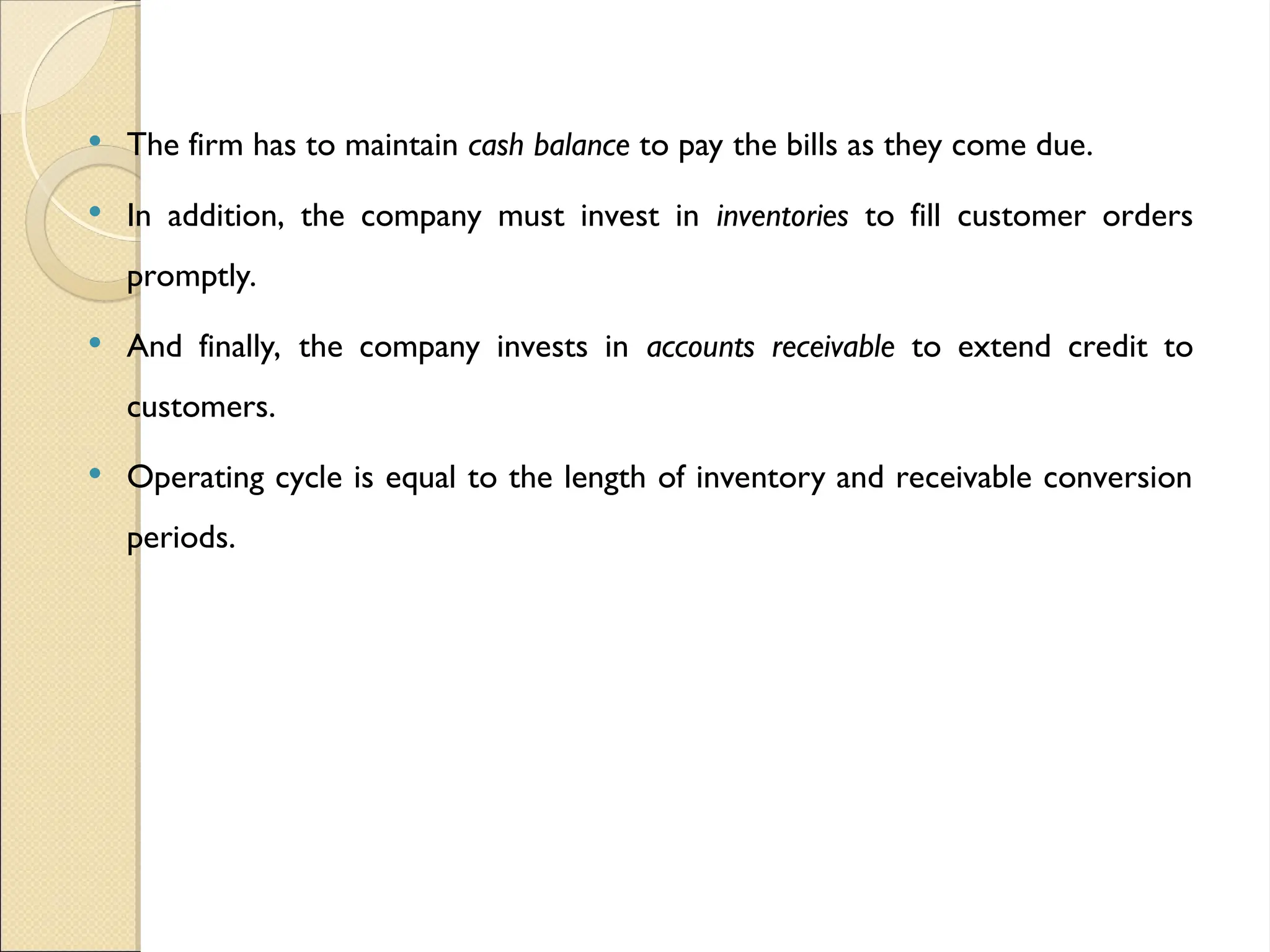
The firmhas to maintain cash balance to pay the bills as they come due.
In addition, the company must invest in inventories to fill customer orders
promptly.
And finally, the company invests in accounts receivable to extend credit to
customers.
Operating cycle is equal to the length of inventory and receivable conversion
periods.
9.
TYPES OF WORKINGCAPITAL
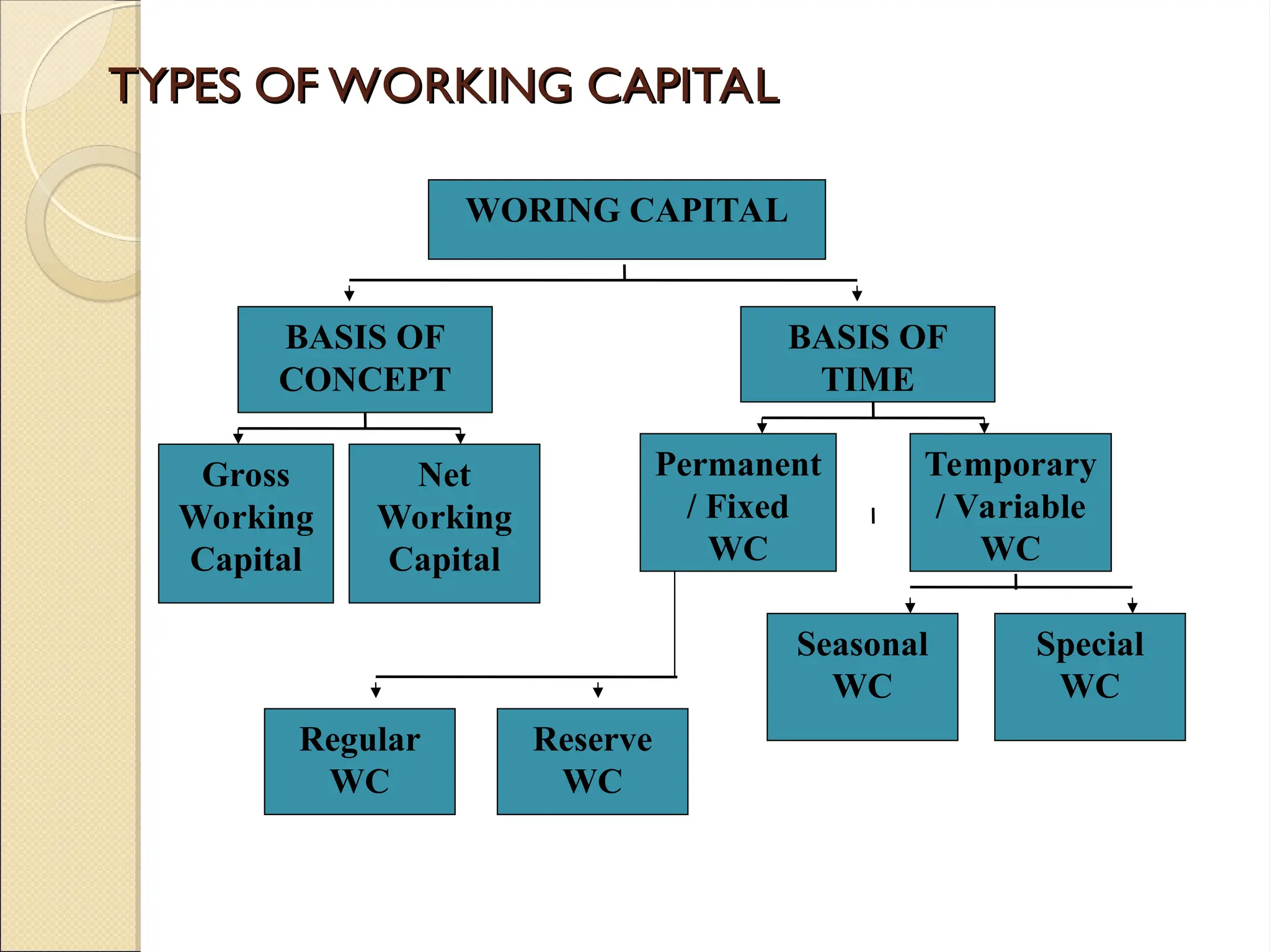
TYPES OF WORKING CAPITAL
WORING CAPITAL
BASIS OF
CONCEPT
BASIS OF
TIME
Gross
Working
Capital
Net
Working
Capital
Permanent
/ Fixed
WC
Temporary
/ Variable
WC
Regular
WC
Reserve
WC
Special
WC
Seasonal
WC
10.
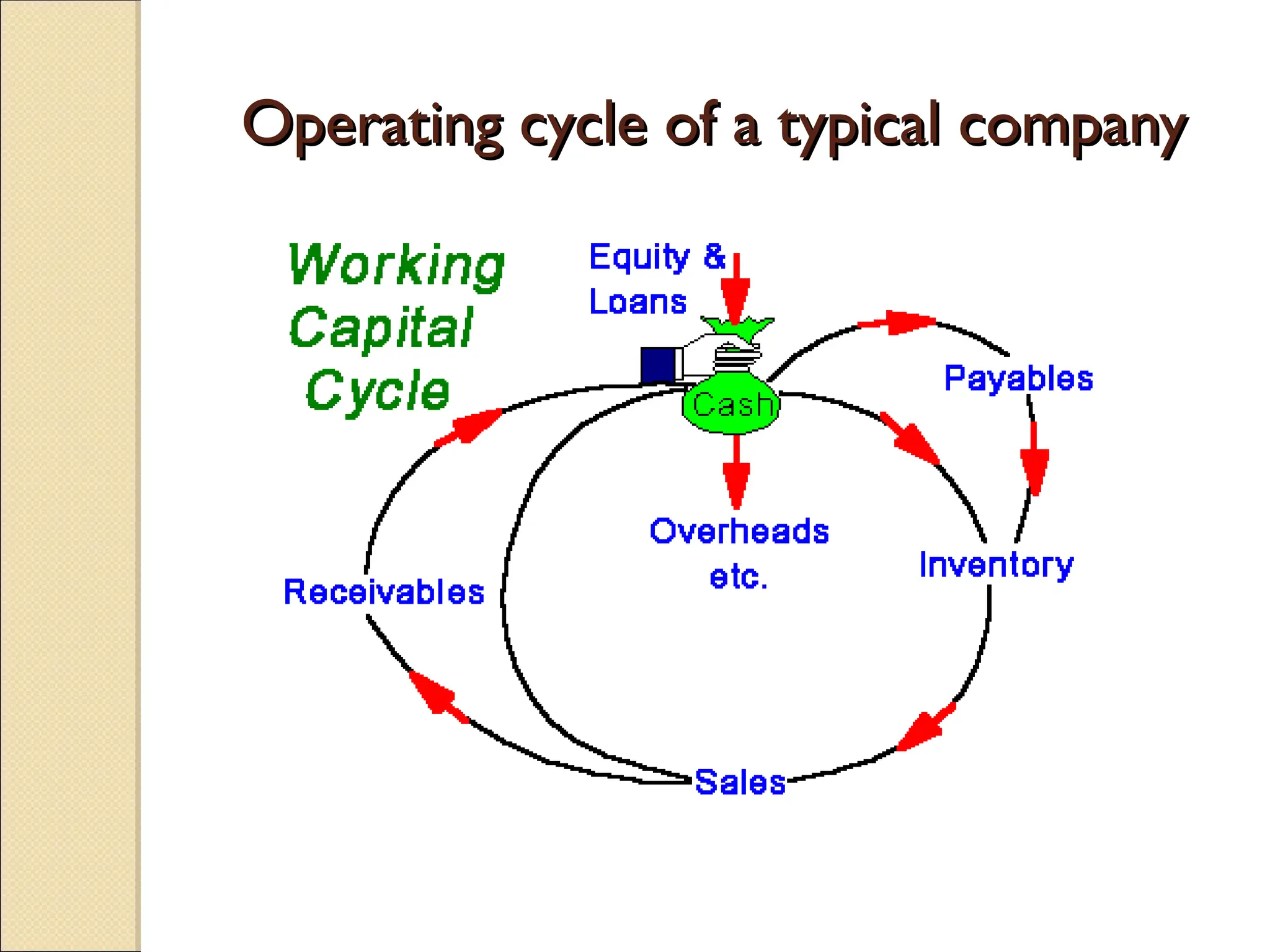
Operating cycle ofa typical company
Operating cycle of a typical company
11.
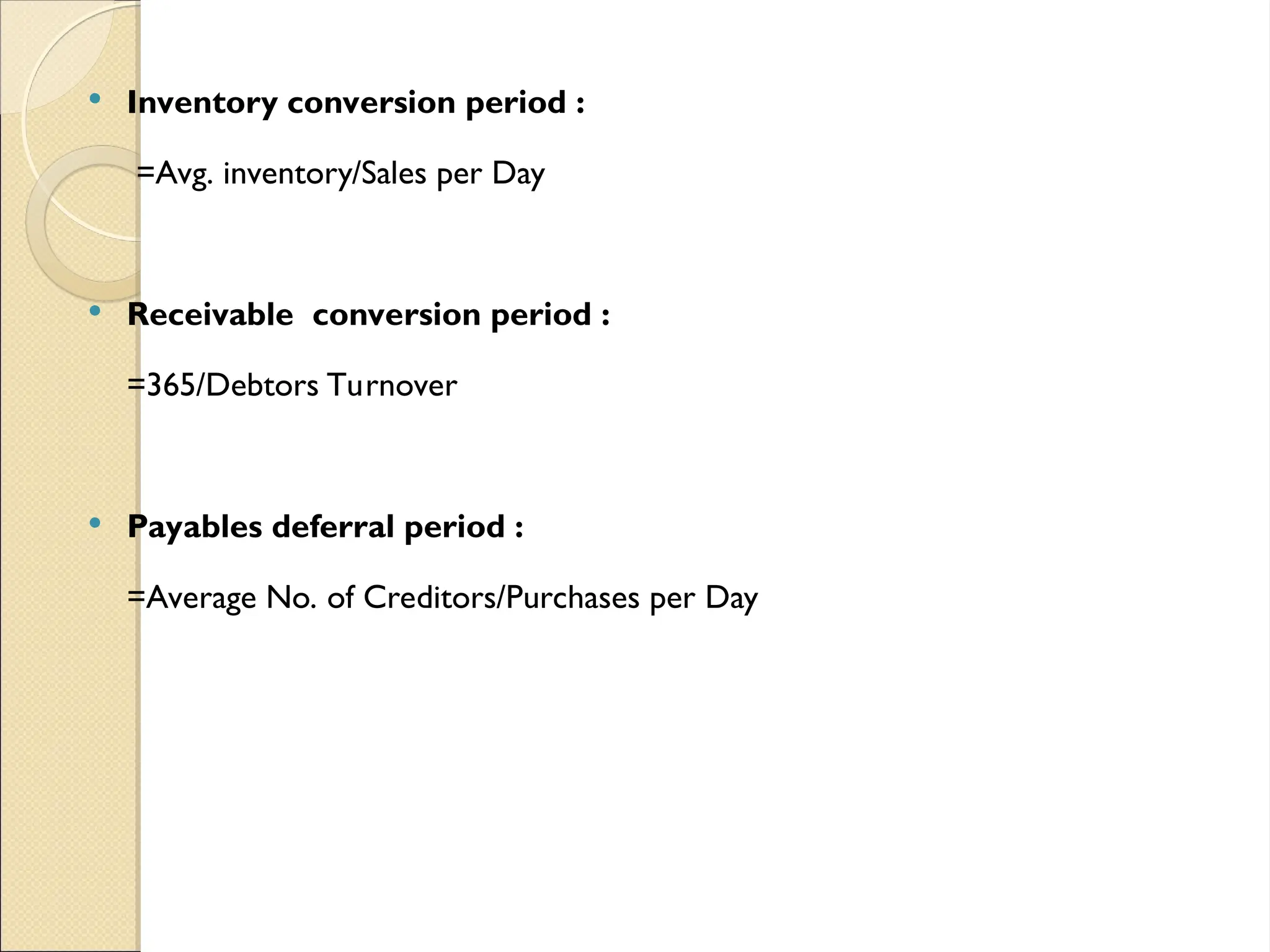
Inventory conversionperiod :
=Avg. inventory/Sales per Day
Receivable conversion period :
=365/Debtors Turnover
Payables deferral period :
=Average No. of Creditors/Purchases per Day
12.
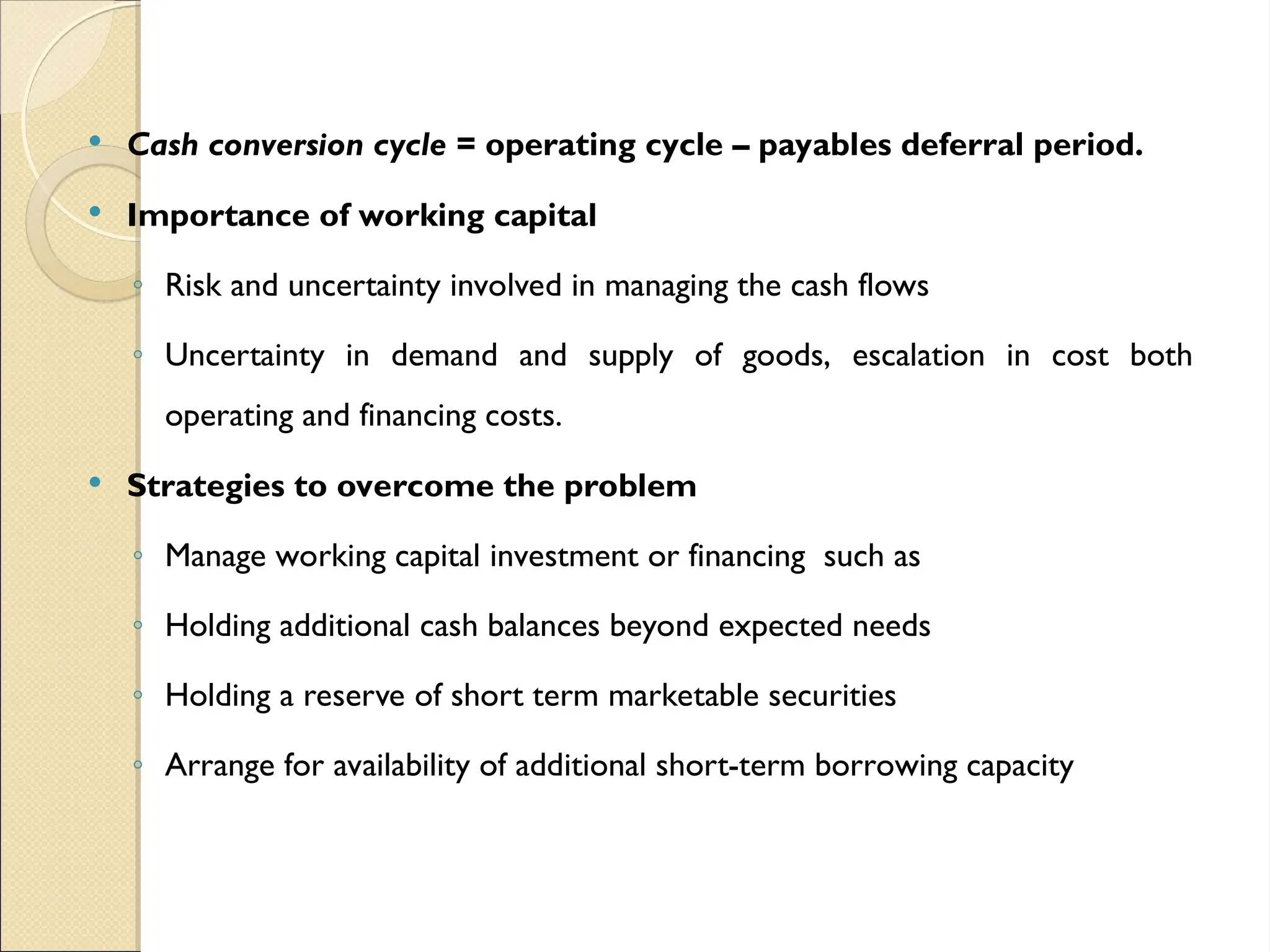
Cash conversioncycle = operating cycle – payables deferral period.
Importance of working capital
◦ Risk and uncertainty involved in managing the cash flows
◦ Uncertainty in demand and supply of goods, escalation in cost both
operating and financing costs.
Strategies to overcome the problem
◦ Manage working capital investment or financing such as
◦ Holding additional cash balances beyond expected needs
◦ Holding a reserve of short term marketable securities
◦ Arrange for availability of additional short-term borrowing capacity
13.
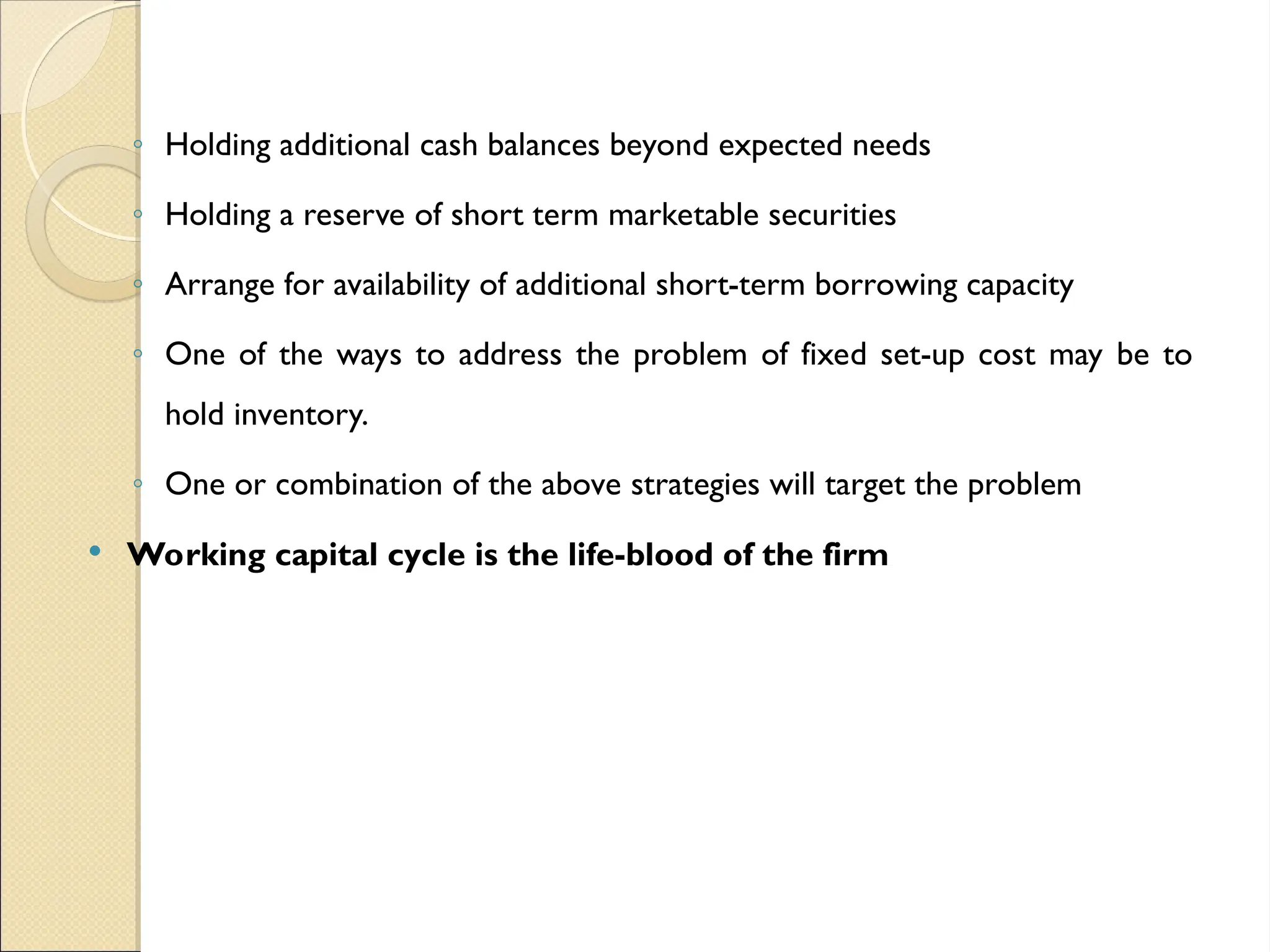
◦ Holding additionalcash balances beyond expected needs
◦ Holding a reserve of short term marketable securities
◦ Arrange for availability of additional short-term borrowing capacity
◦ One of the ways to address the problem of fixed set-up cost may be to
hold inventory.
◦ One or combination of the above strategies will target the problem
Working capital cycle is the life-blood of the firm
14.
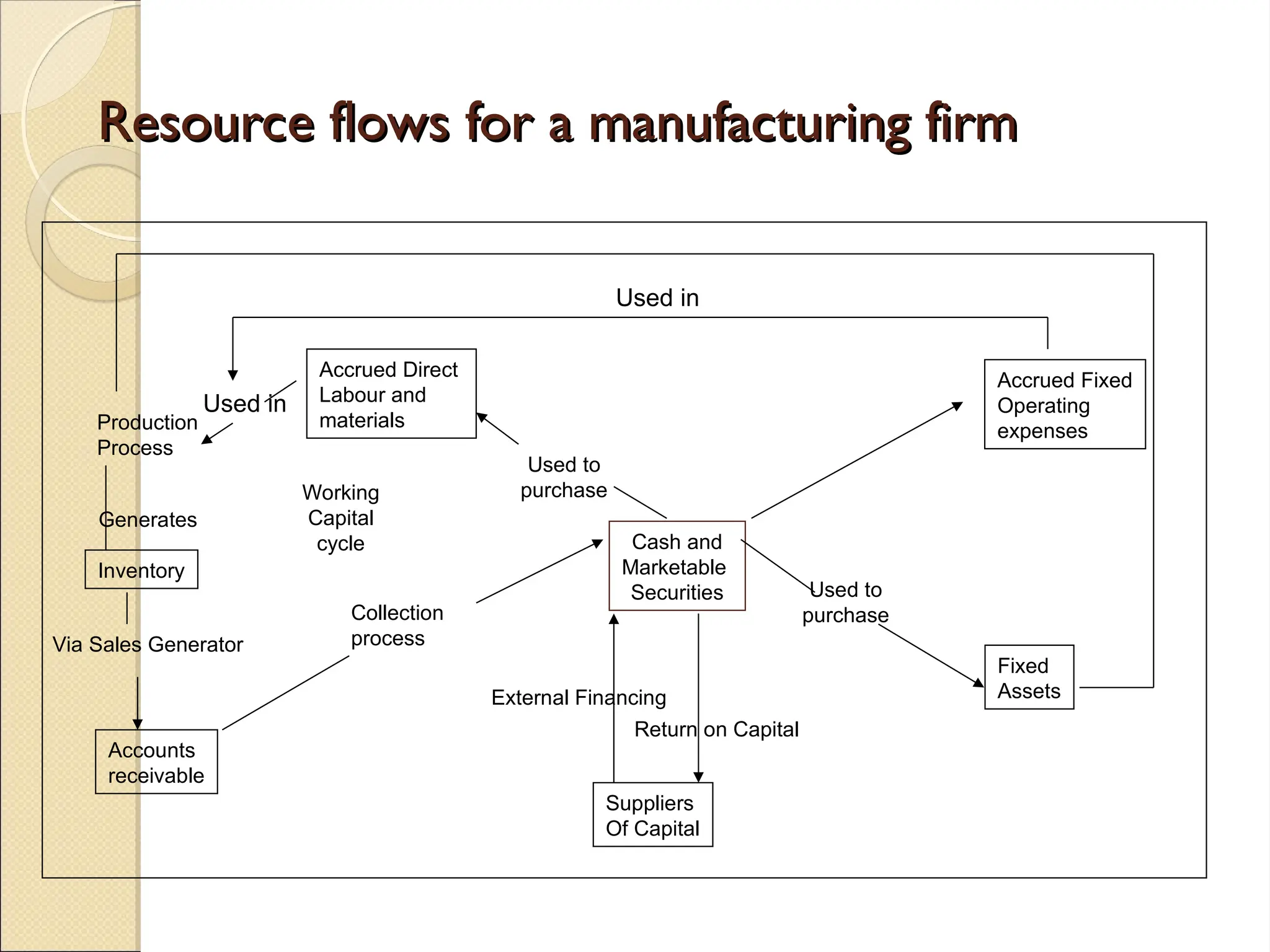
Resource flows fora manufacturing firm
Resource flows for a manufacturing firm
Fixed
Assets
Production
Process
Generates
Inventory
Via Sales Generator
Accounts
receivable
Used in
Accrued Direct
Labour and
materials
Accrued Fixed
Operating
expenses
Cash and
Marketable
Securities
Suppliers
Of Capital
External Financing
Return on Capital
Collection
process
Used to
purchase
Used to
purchase
Used in
Working
Capital
cycle
15.
Working capital investment
Workingcapital investment
The size and nature of investment in current assets is a function of
different factors such as type of products manufactured, the length of
operating cycle, the sales level, inventory policies, unexpected demand
and unanticipated delays in obtaining new inventories, credit policies
and current assets.
16.
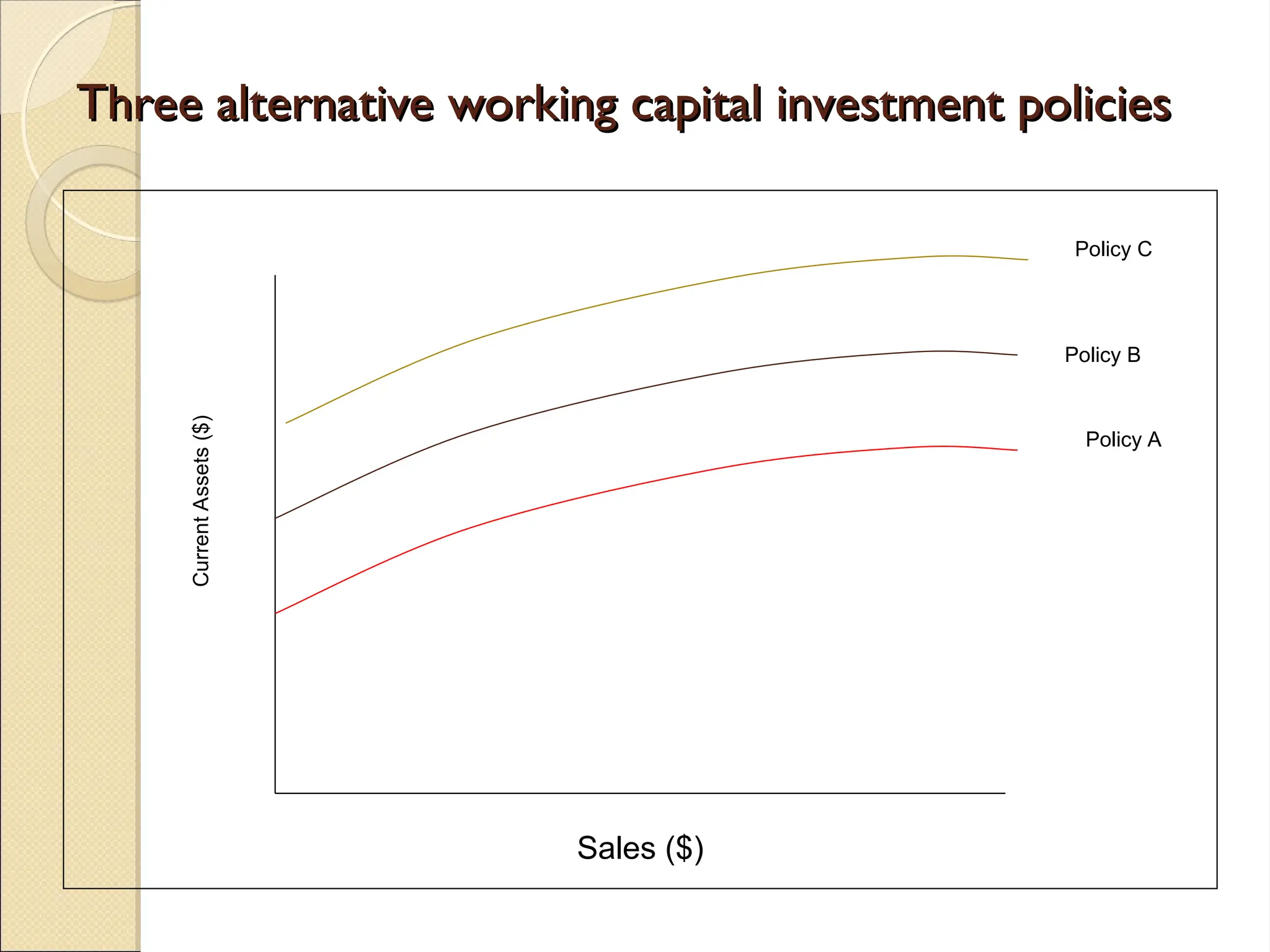
Three alternative workingcapital investment policies
Three alternative working capital investment policies
Sales ($)
Current
Assets
($)
Policy C
Policy A
Policy B
17.
Policy Crepresents conservative approach
Policy A represents aggressive approach
Policy B represents a moderate approach
Optimal level of working capital investment
Risk of long-term versus short-term debt
18.
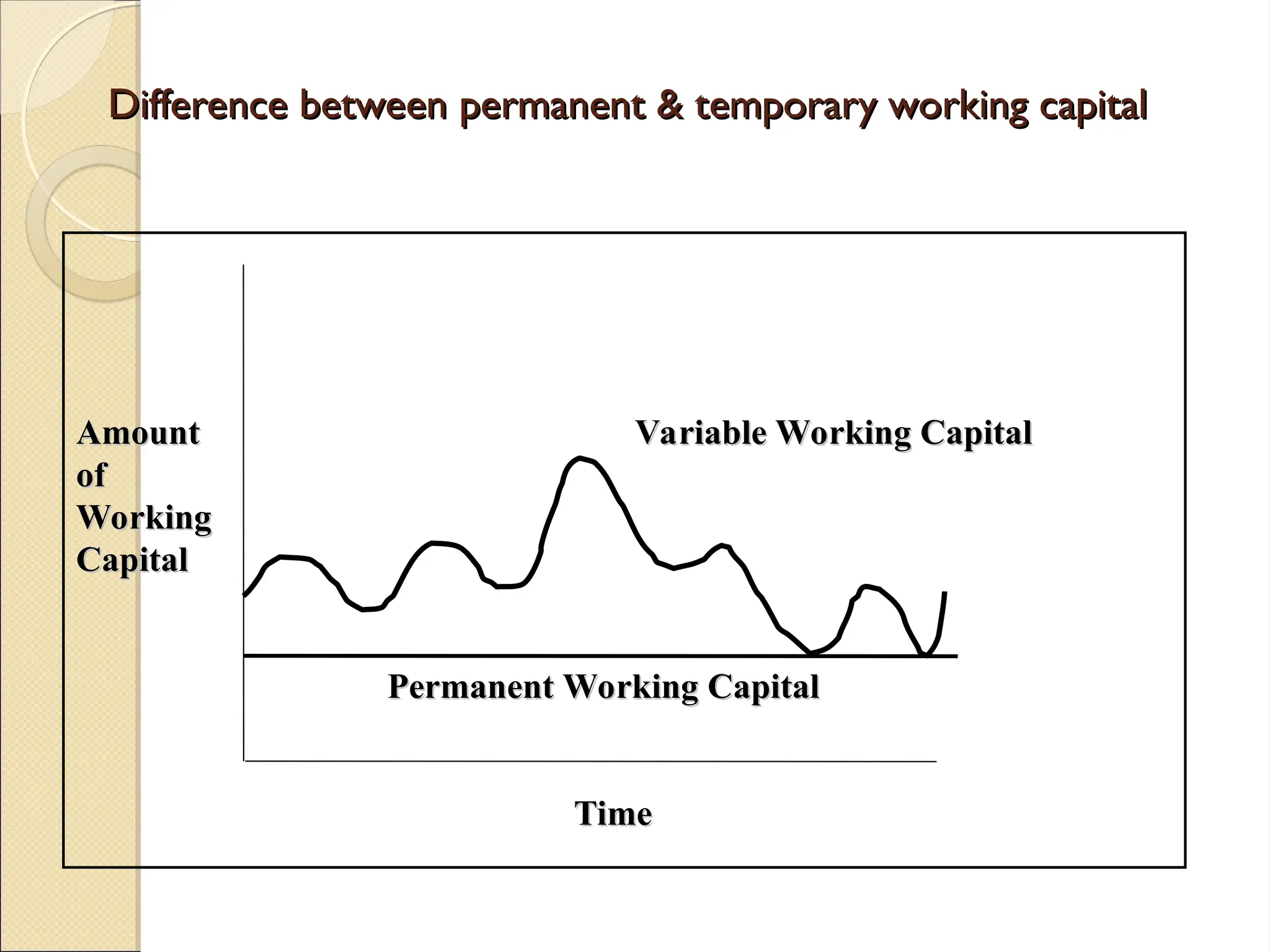
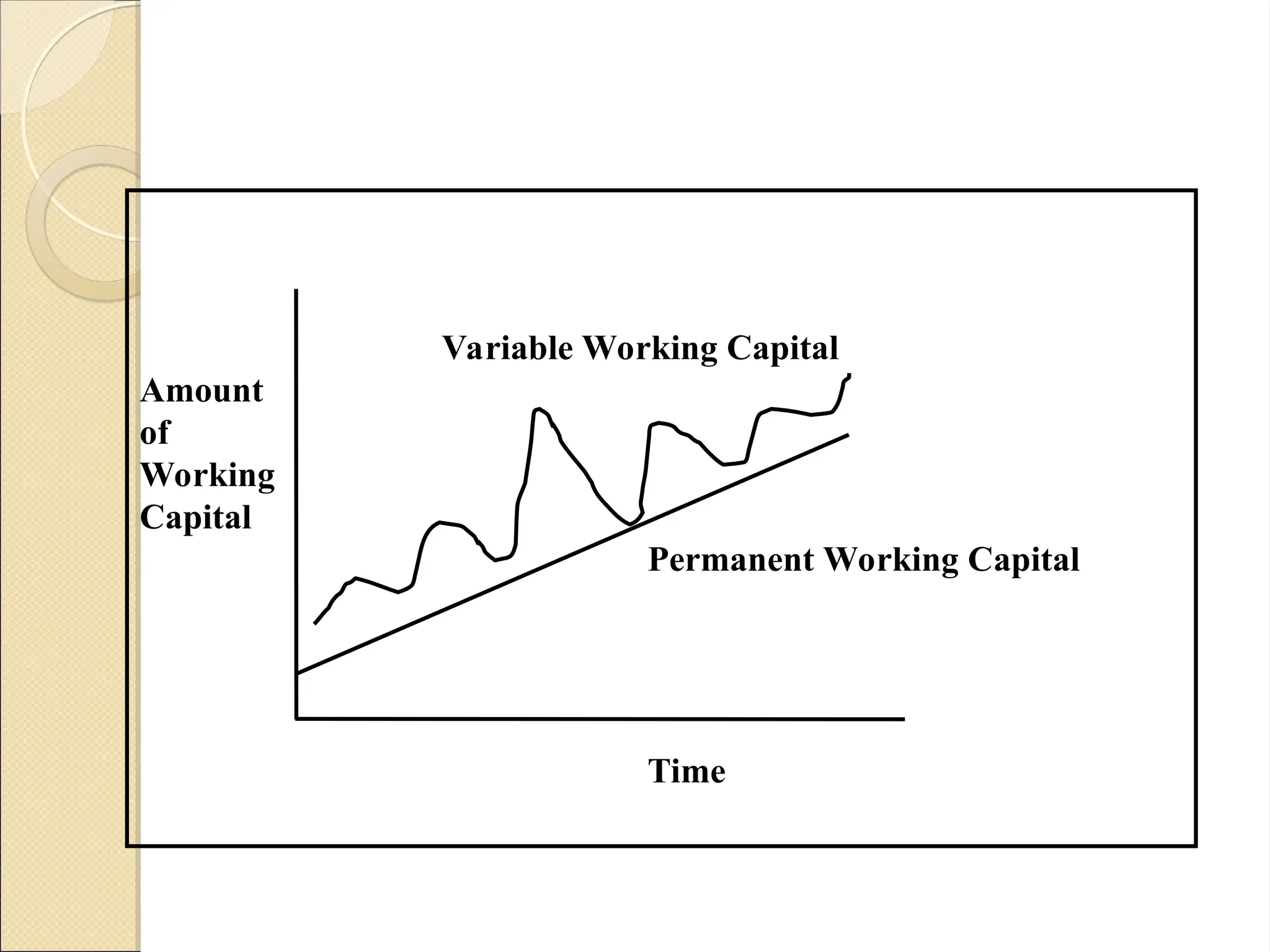
Difference between permanent& temporary working capital
Difference between permanent & temporary working capital
Amount Variable Working Capital
Amount Variable Working Capital
of
of
Working
Working
Capital
Capital
Permanent Working Capital
Permanent Working Capital
Time
Time
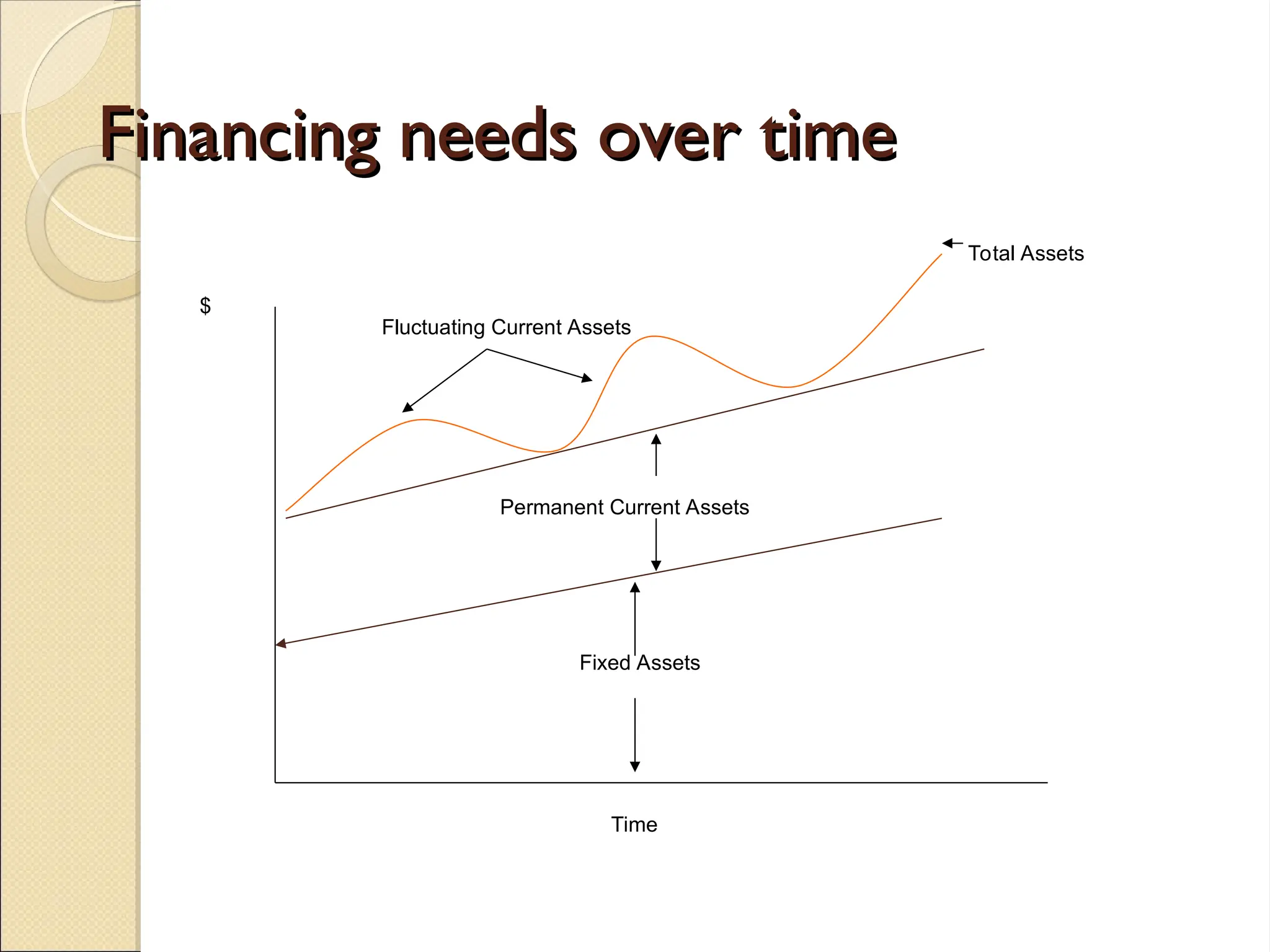
Financing needs overtime
Financing needs over time
Fixed Assets
Permanent Current Assets
Total Assets
Fluctuating Current Assets
Time
$
21.
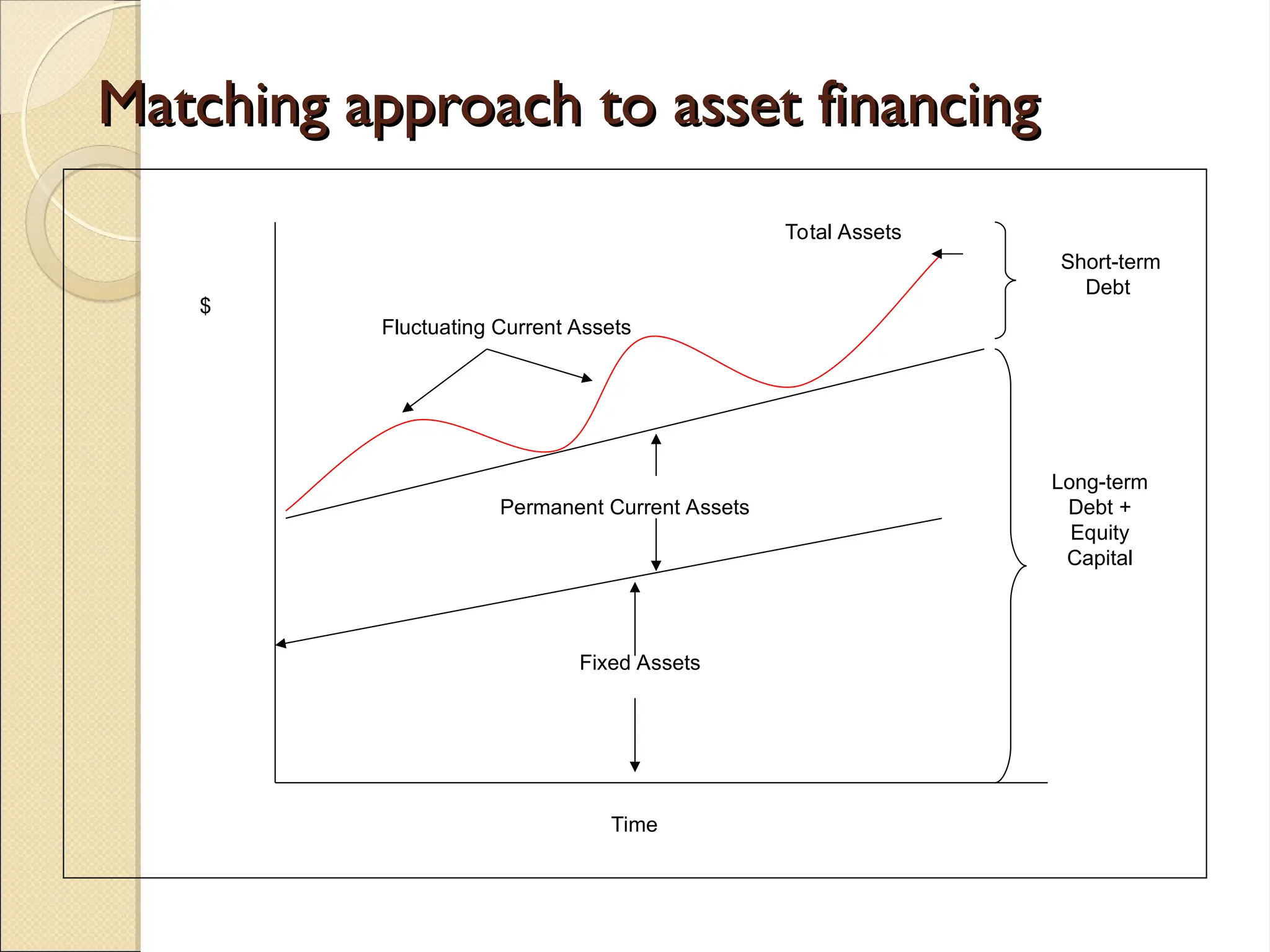
Matching approach toasset financing
Matching approach to asset financing
Fixed Assets
Permanent Current Assets
Total Assets
Fluctuating Current Assets
Time
$
Short-term
Debt
Long-term
Debt +
Equity
Capital
22.
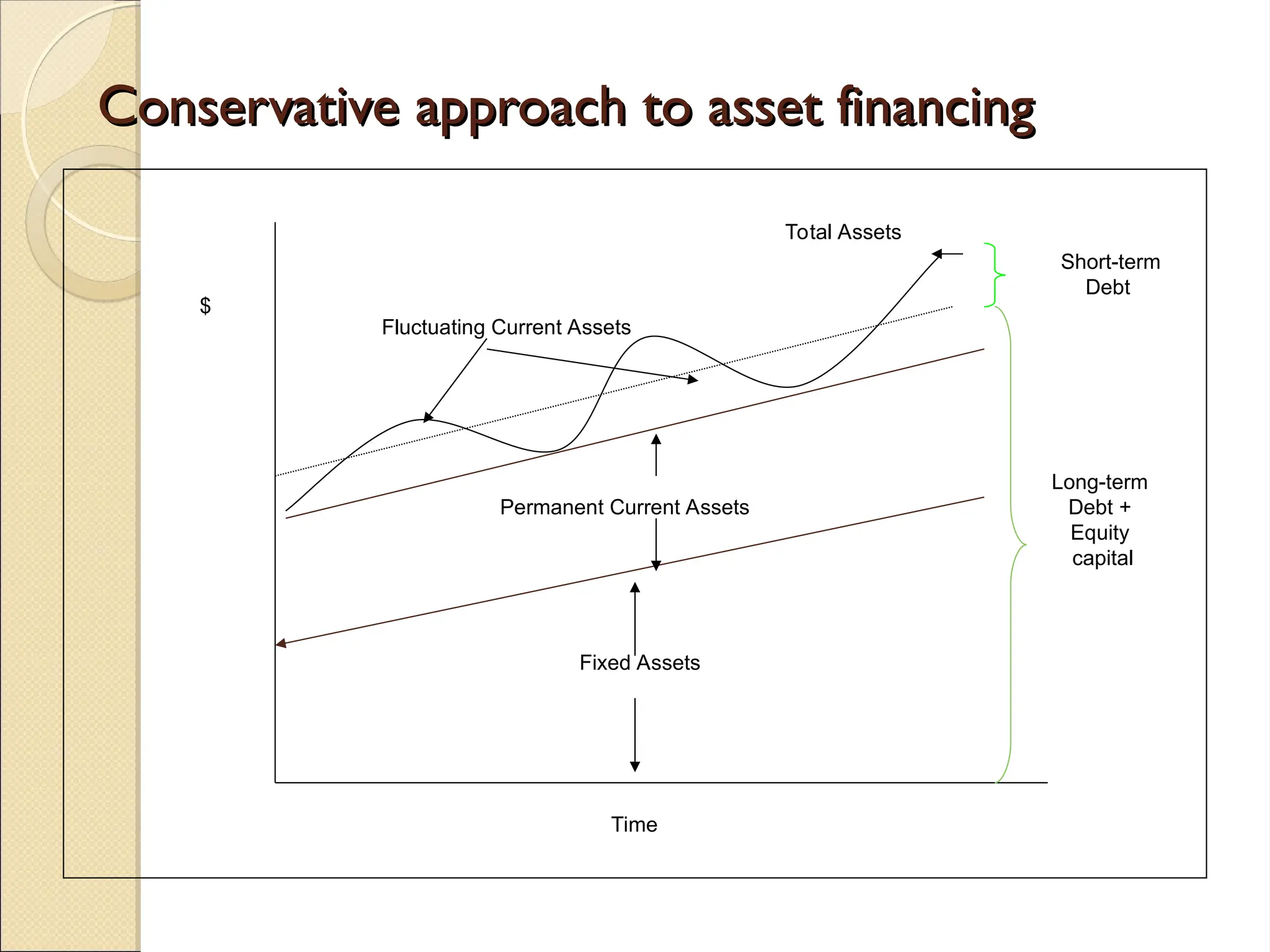
Conservative approach toasset financing
Conservative approach to asset financing
Fixed Assets
Permanent Current Assets
Total Assets
Fluctuating Current Assets
Time
$
Short-term
Debt
Long-term
Debt +
Equity
capital
23.
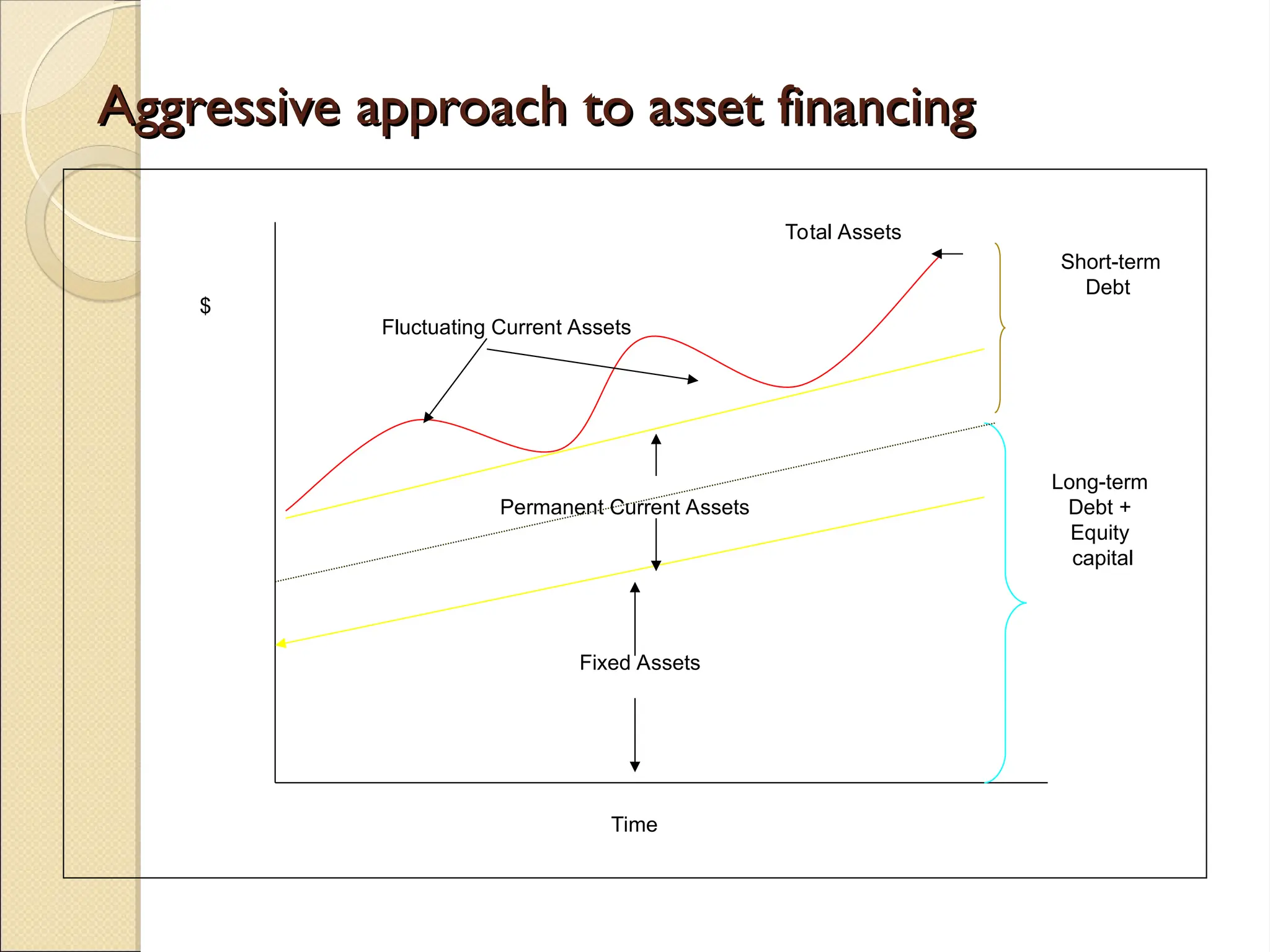
Aggressive approach toasset financing
Aggressive approach to asset financing
Fixed Assets
Permanent Current Assets
Total Assets
Fluctuating Current Assets
Time
$
Short-term
Debt
Long-term
Debt +
Equity
capital
24.
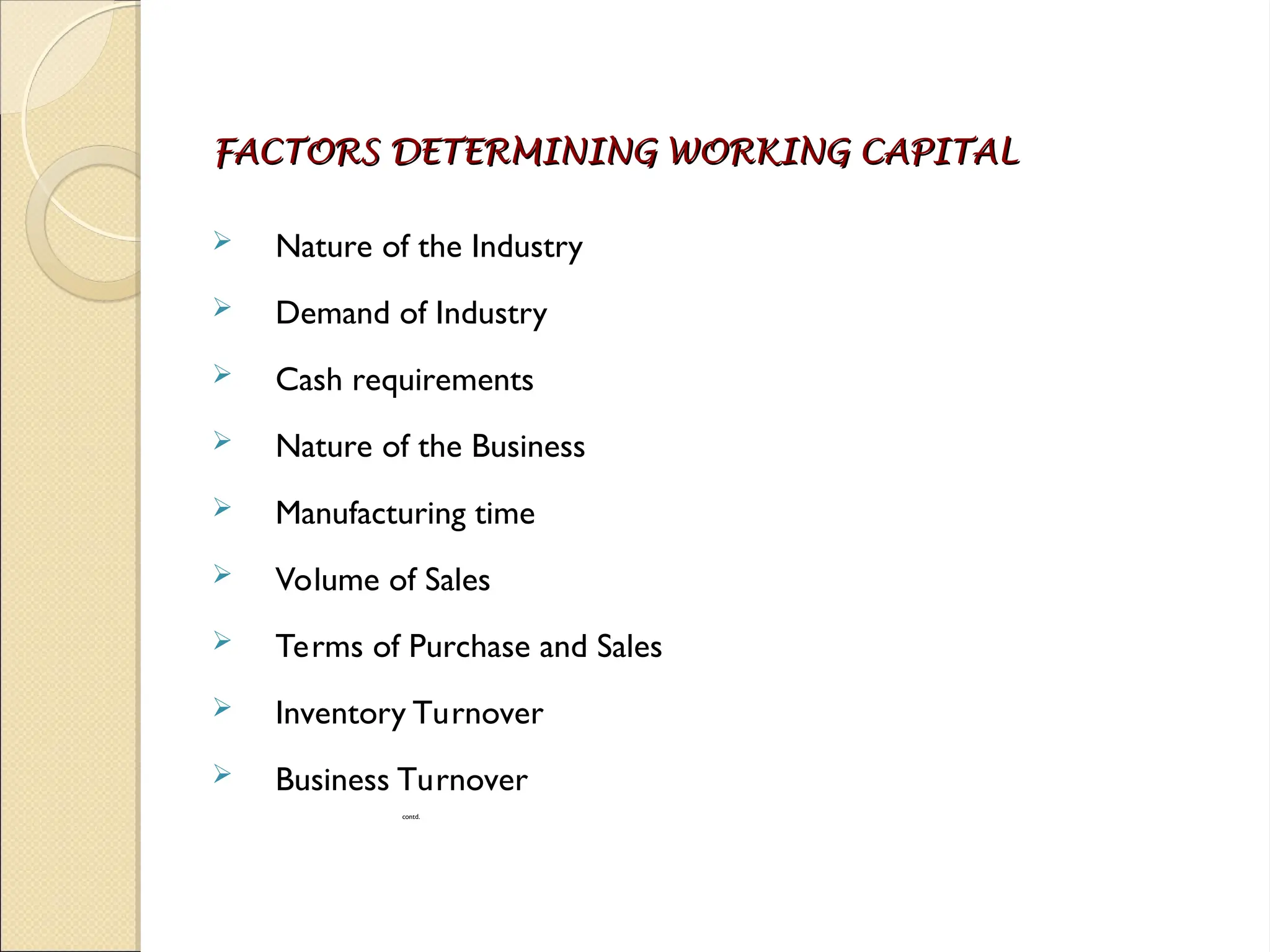
FACTORS DETERMINING WORKINGCAPITAL
FACTORS DETERMINING WORKING CAPITAL
Nature of the Industry
Demand of Industry
Cash requirements
Nature of the Business
Manufacturing time
Volume of Sales
Terms of Purchase and Sales
Inventory Turnover
Business Turnover
contd.
25.
.
.
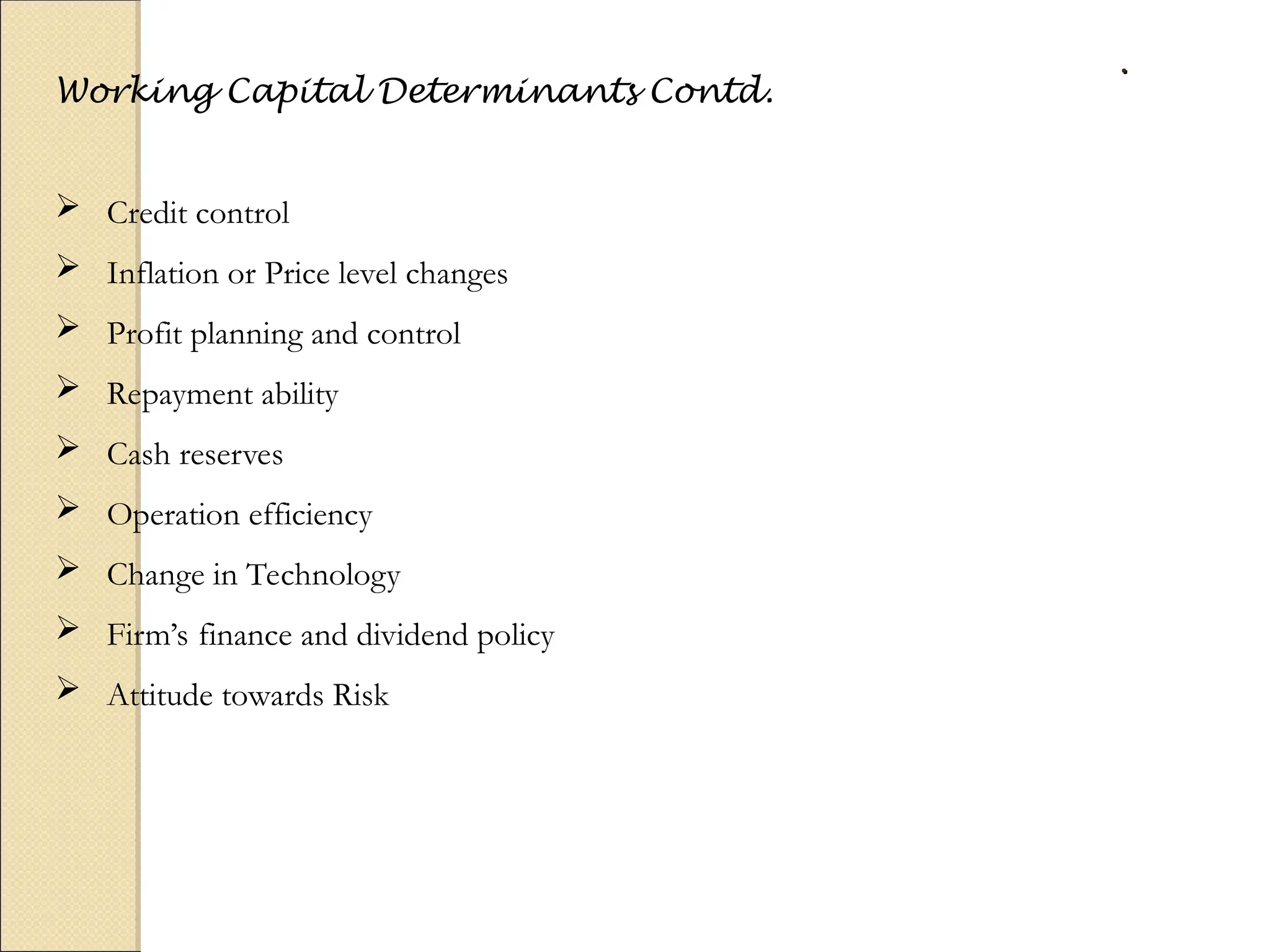
Working Capital DeterminantsContd.
Credit control
Inflation or Price level changes
Profit planning and control
Repayment ability
Cash reserves
Operation efficiency
Change in Technology
Firm’s finance and dividend policy
Attitude towards Risk
26.
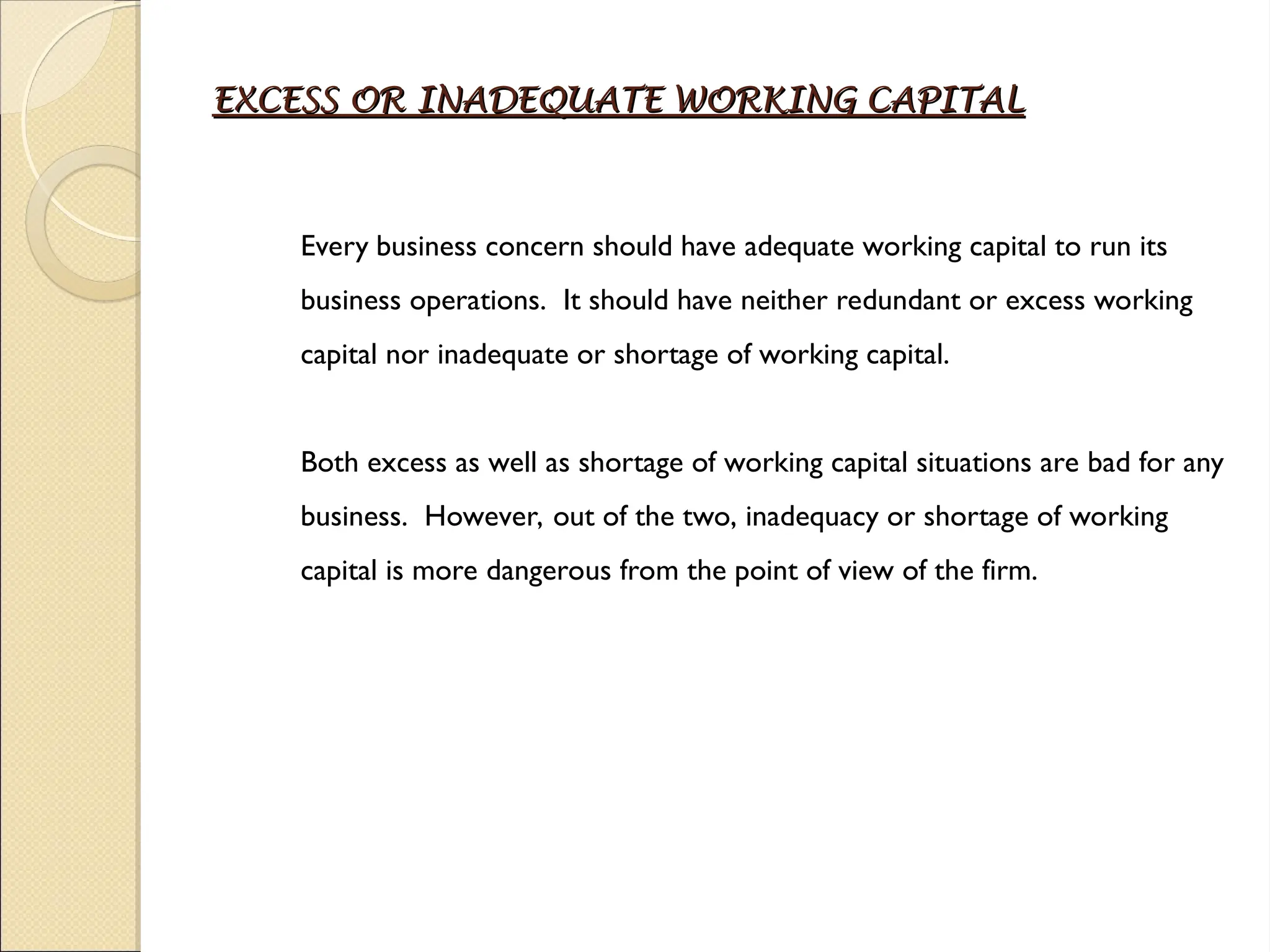
EXCESS OR INADEQUATEWORKING CAPITAL
EXCESS OR INADEQUATE WORKING CAPITAL
Every business concern should have adequate working capital to run its
business operations. It should have neither redundant or excess working
capital nor inadequate or shortage of working capital.
Both excess as well as shortage of working capital situations are bad for any
business. However, out of the two, inadequacy or shortage of working
capital is more dangerous from the point of view of the firm.
27.
Disadvantages of Redundantor Excess Working
Disadvantages of Redundant or Excess Working
Capital
Capital
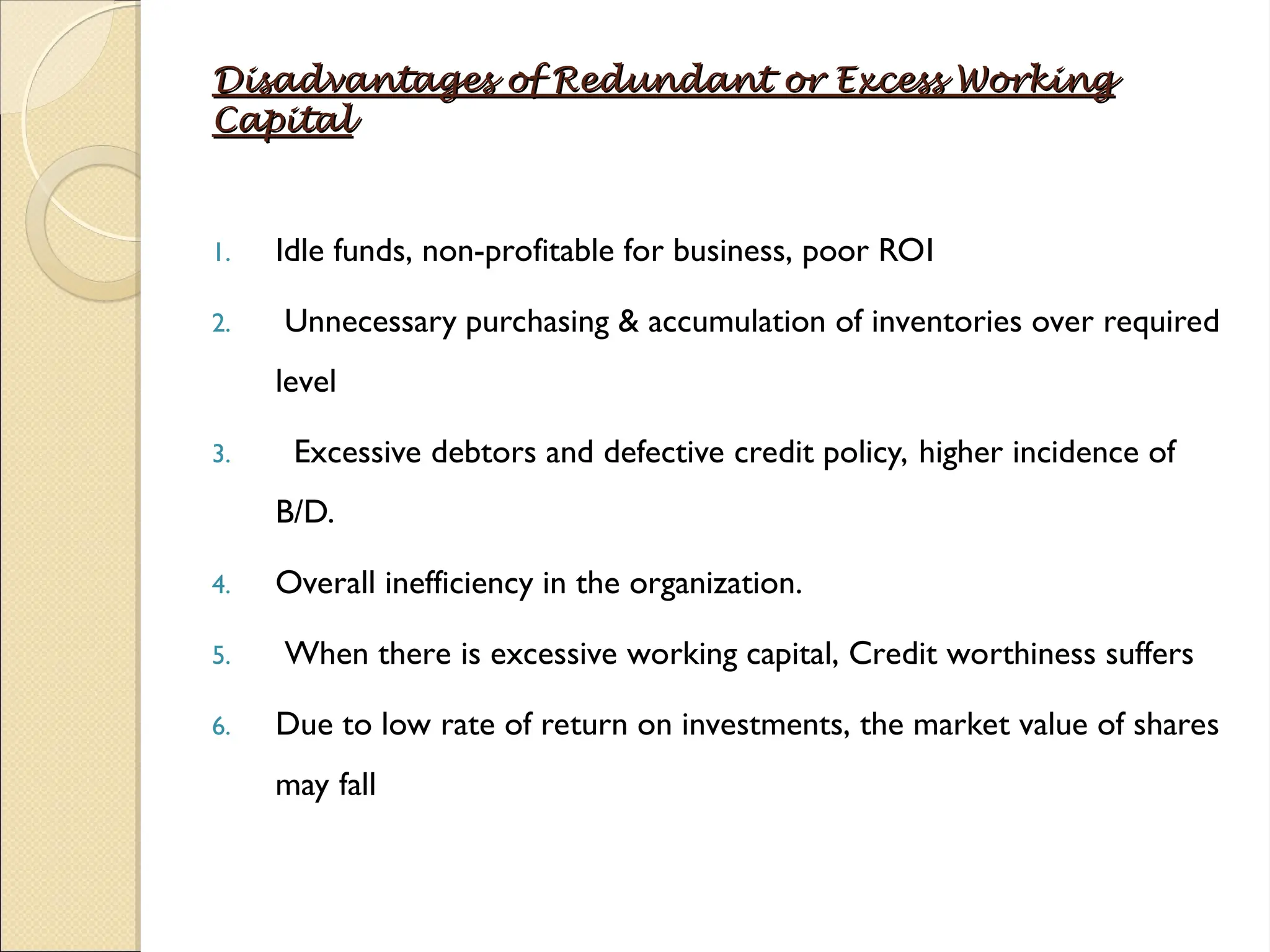
1. Idle funds, non-profitable for business, poor ROI
2. Unnecessary purchasing & accumulation of inventories over required
level
3. Excessive debtors and defective credit policy, higher incidence of
B/D.
4. Overall inefficiency in the organization.
5. When there is excessive working capital, Credit worthiness suffers
6. Due to low rate of return on investments, the market value of shares
may fall
28.
Disadvantages or Dangersof Inadequate or Short
Disadvantages or Dangers of Inadequate or Short
Working Capital
Working Capital
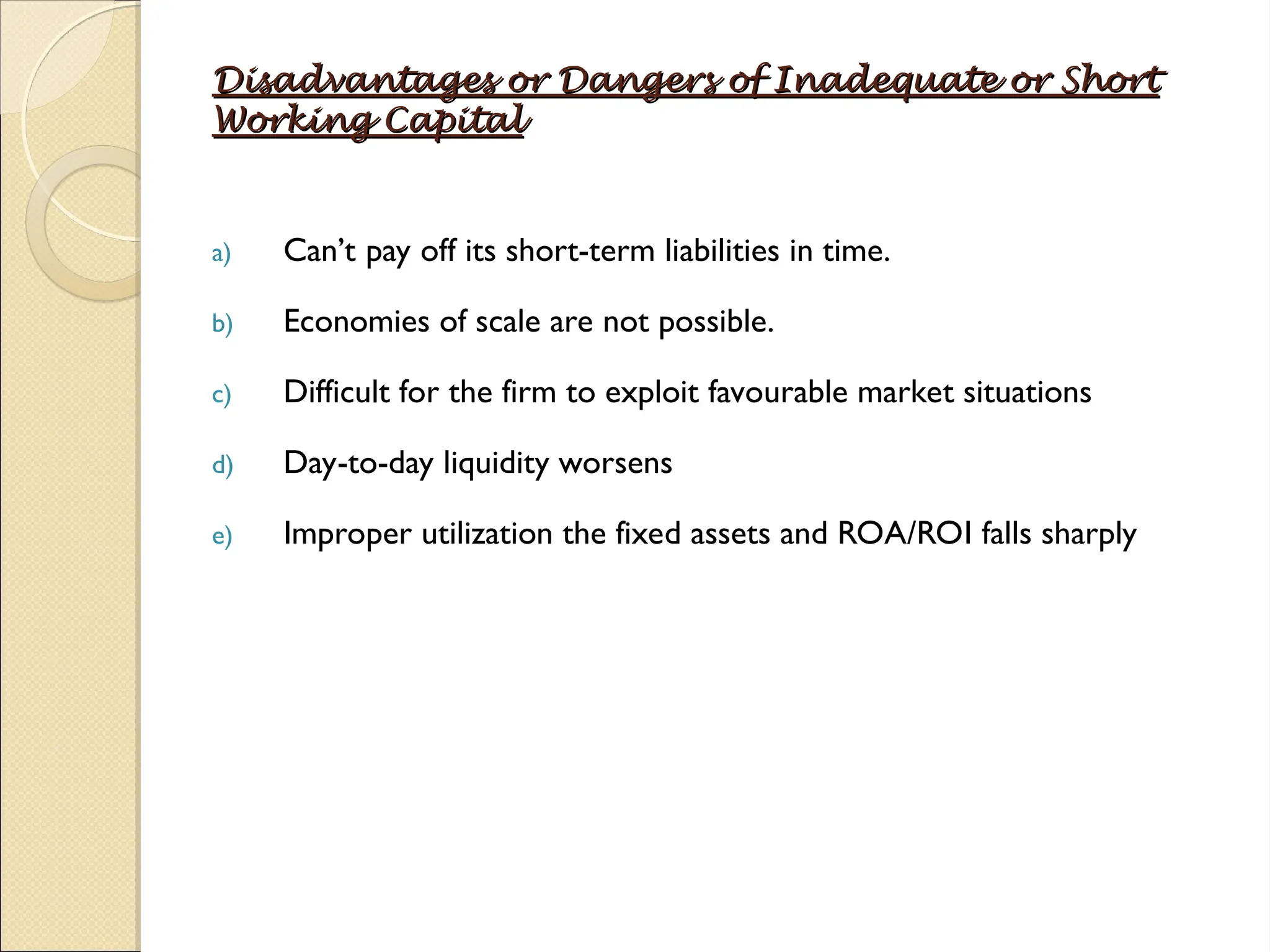
a) Can’t pay off its short-term liabilities in time.
b) Economies of scale are not possible.
c) Difficult for the firm to exploit favourable market situations
d) Day-to-day liquidity worsens
e) Improper utilization the fixed assets and ROA/ROI falls sharply
29.
MANAGEMENT OF WORKINGCAPITAL ( WCM )
MANAGEMENT OF WORKING CAPITAL ( WCM )
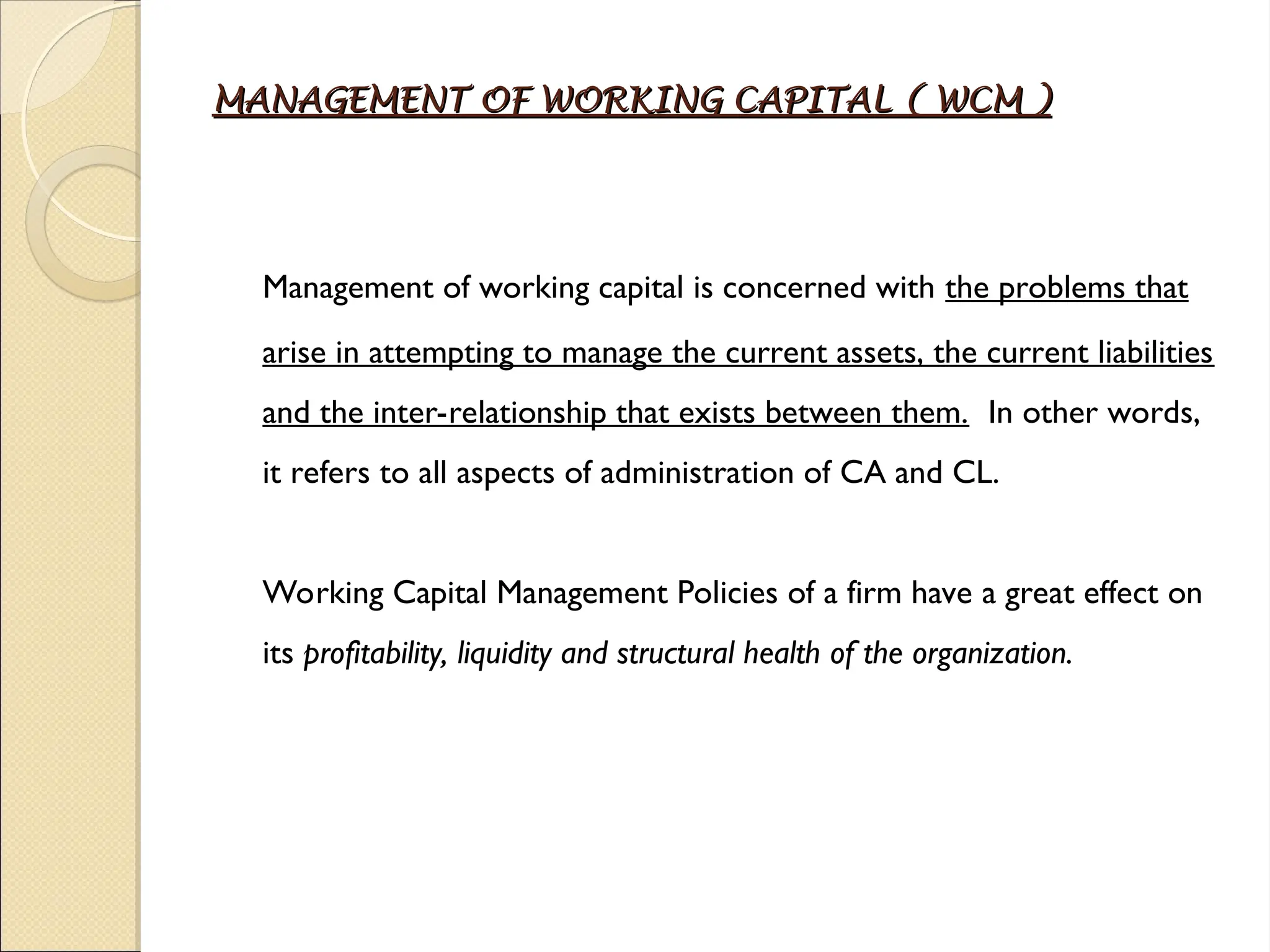
Management of working capital is concerned with the problems that
arise in attempting to manage the current assets, the current liabilities
and the inter-relationship that exists between them. In other words,
it refers to all aspects of administration of CA and CL.
Working Capital Management Policies of a firm have a great effect on
its profitability, liquidity and structural health of the organization.
30.
3D Nature ofWorking Capital Management
3D Nature of Working Capital Management
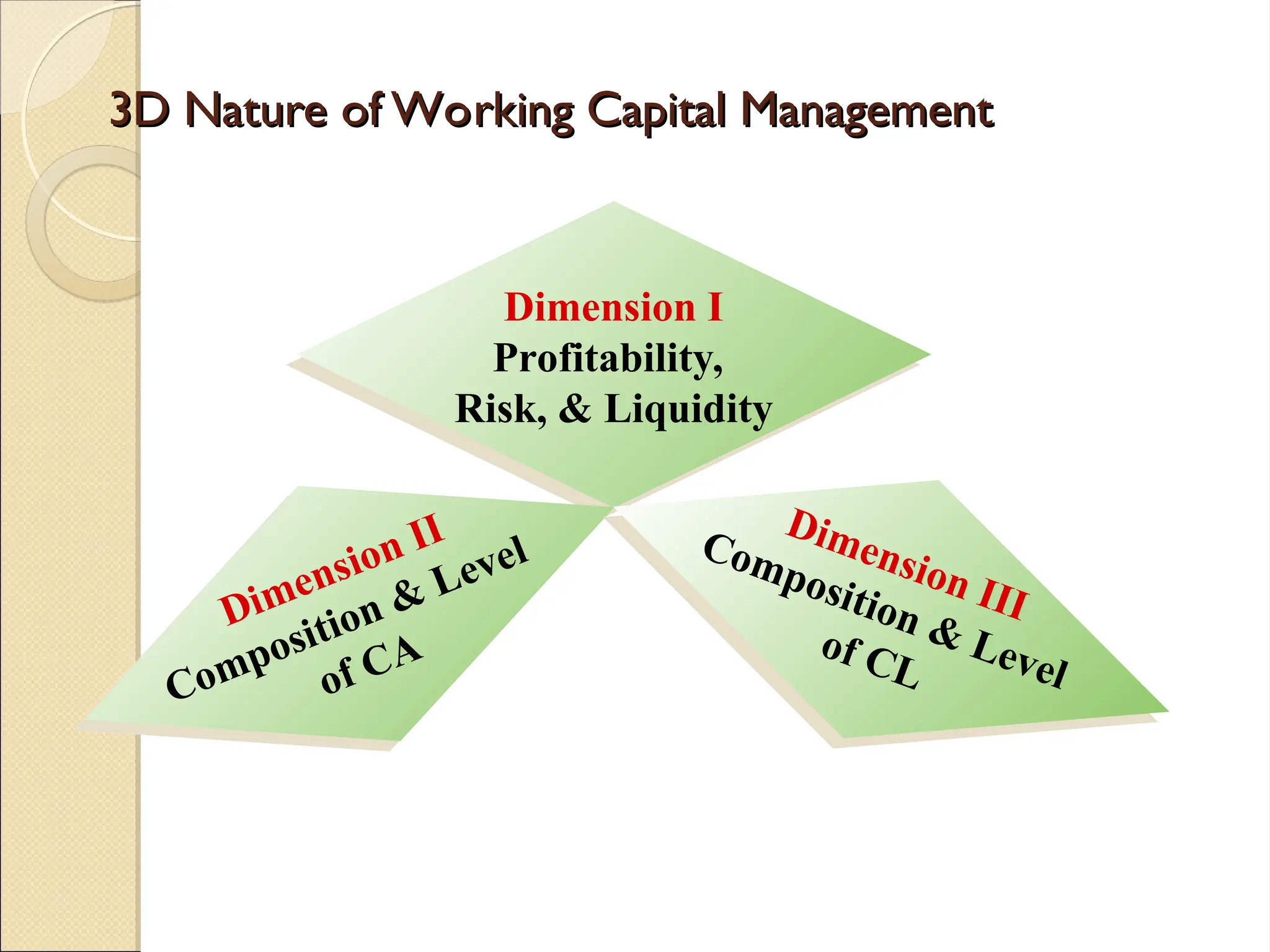
Dimension I
Profitability,
Risk, & Liquidity
Dimension II
Composition & Level
of CA
Dimension III
Composition & Level
of CL
31.
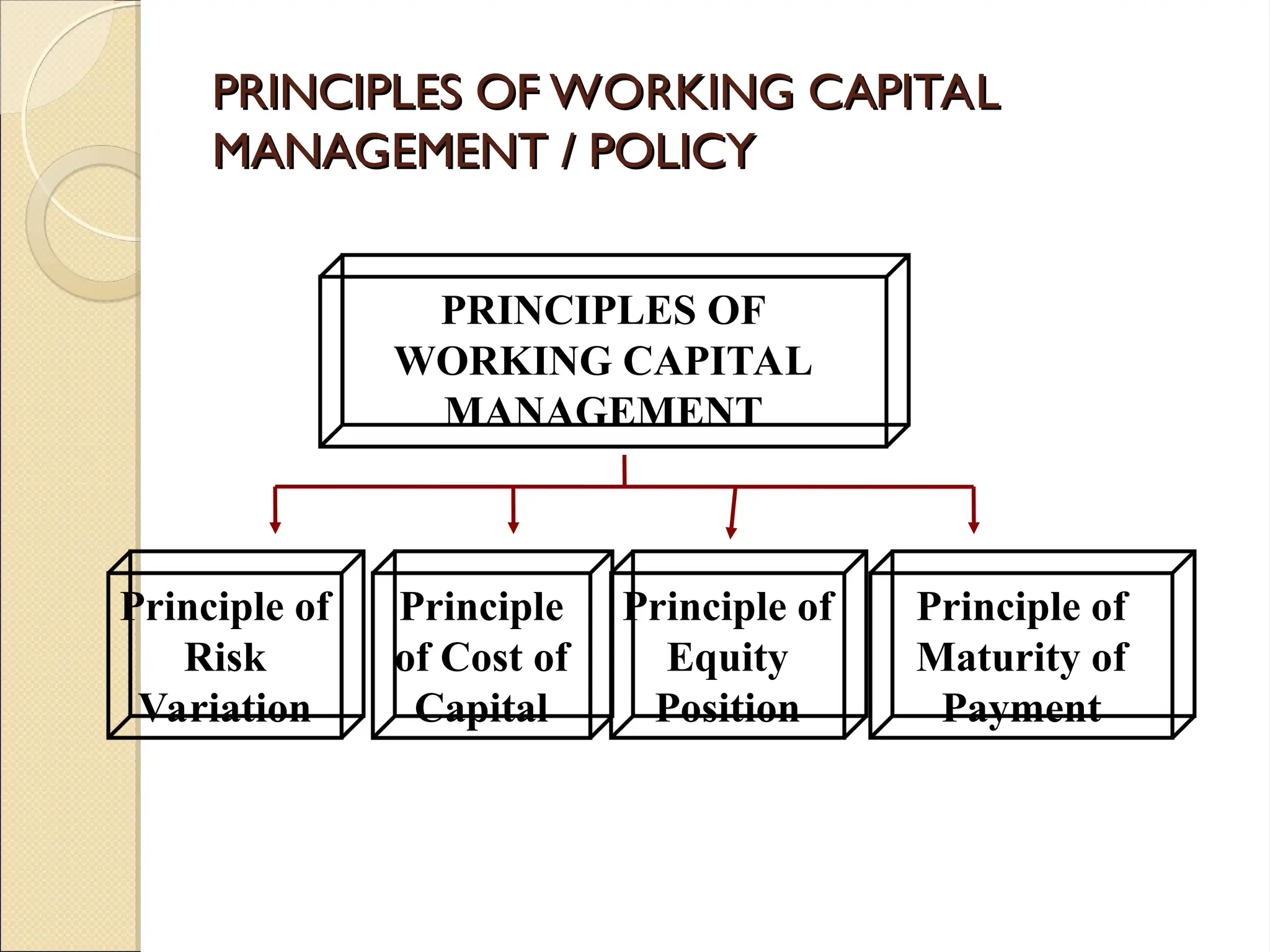
PRINCIPLES OF WORKINGCAPITAL
PRINCIPLES OF WORKING CAPITAL
MANAGEMENT / POLICY
MANAGEMENT / POLICY
PRINCIPLES OF
WORKING CAPITAL
MANAGEMENT
Principle of
Risk
Variation
Principle
of Cost of
Capital
Principle of
Equity
Position
Principle of
Maturity of
Payment
32.
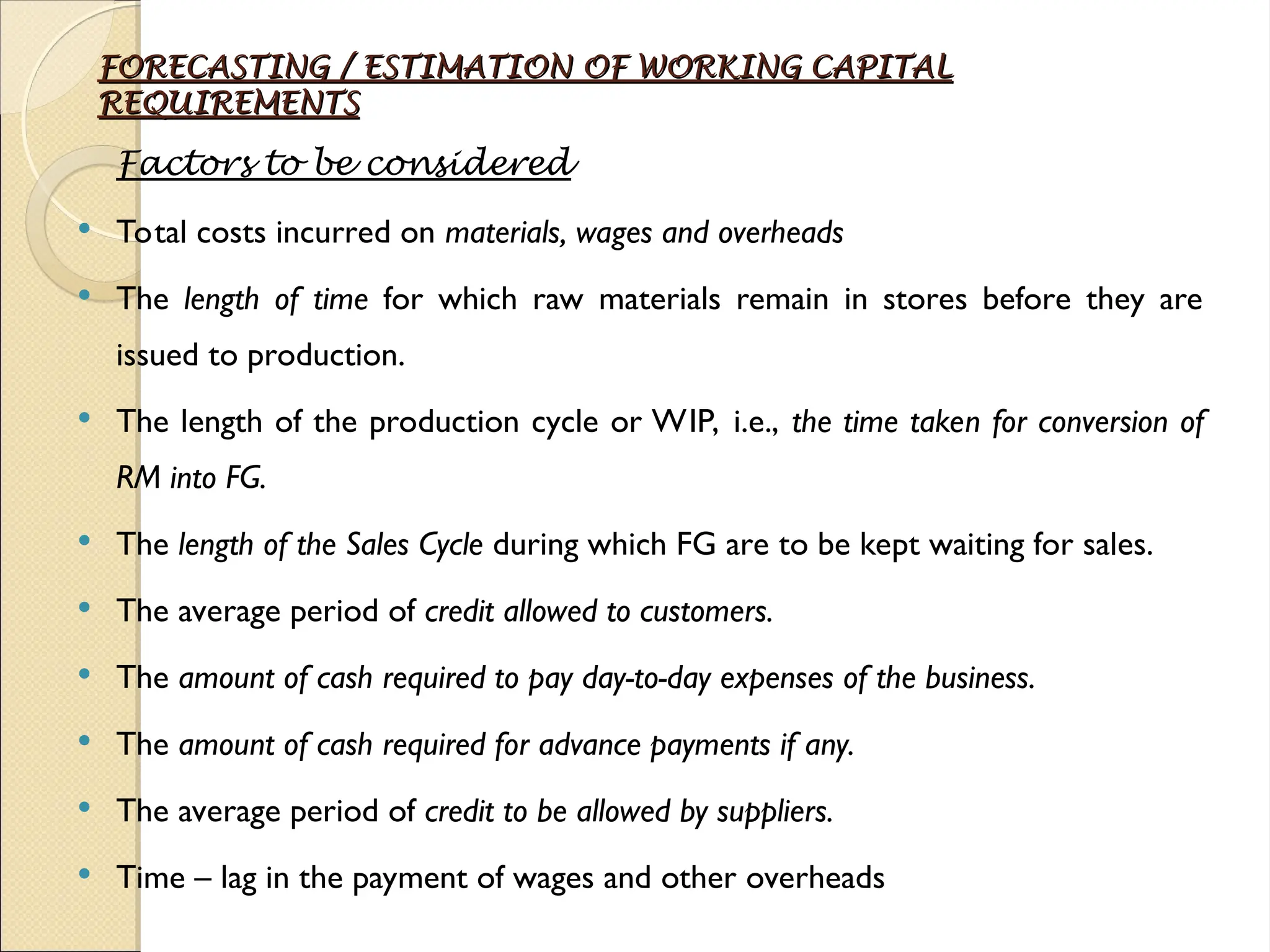
FORECASTING / ESTIMATIONOF WORKING CAPITAL
FORECASTING / ESTIMATION OF WORKING CAPITAL
REQUIREMENTS
REQUIREMENTS
Factors to be considered
Total costs incurred on materials, wages and overheads
The length of time for which raw materials remain in stores before they are
issued to production.
The length of the production cycle or WIP, i.e., the time taken for conversion of
RM into FG.
The length of the Sales Cycle during which FG are to be kept waiting for sales.
The average period of credit allowed to customers.
The amount of cash required to pay day-to-day expenses of the business.
The amount of cash required for advance payments if any.
The average period of credit to be allowed by suppliers.
Time – lag in the payment of wages and other overheads
33.
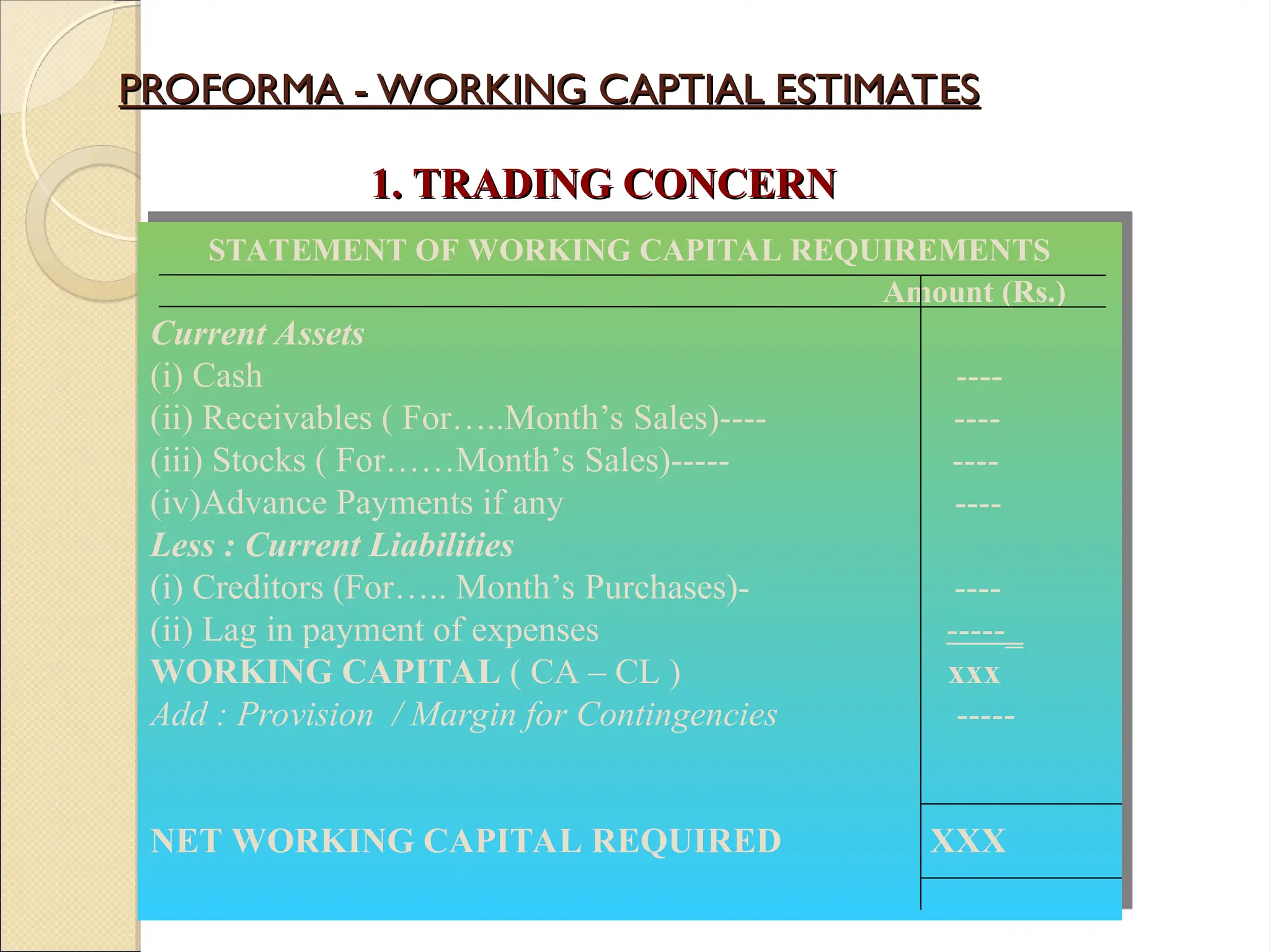
PROFORMA - WORKINGCAPTIAL ESTIMATES
PROFORMA - WORKING CAPTIAL ESTIMATES
1. TRADING CONCERN
1. TRADING CONCERN
STATEMENT OF WORKING CAPITAL REQUIREMENTS
Amount (Rs.)
Current Assets
(i) Cash ----
(ii) Receivables ( For…..Month’s Sales)---- ----
(iii) Stocks ( For……Month’s Sales)----- ----
(iv)Advance Payments if any ----
Less : Current Liabilities
(i) Creditors (For….. Month’s Purchases)- ----
(ii) Lag in payment of expenses -----_
WORKING CAPITAL ( CA – CL ) xxx
Add : Provision / Margin for Contingencies -----
NET WORKING CAPITAL REQUIRED XXX
34.
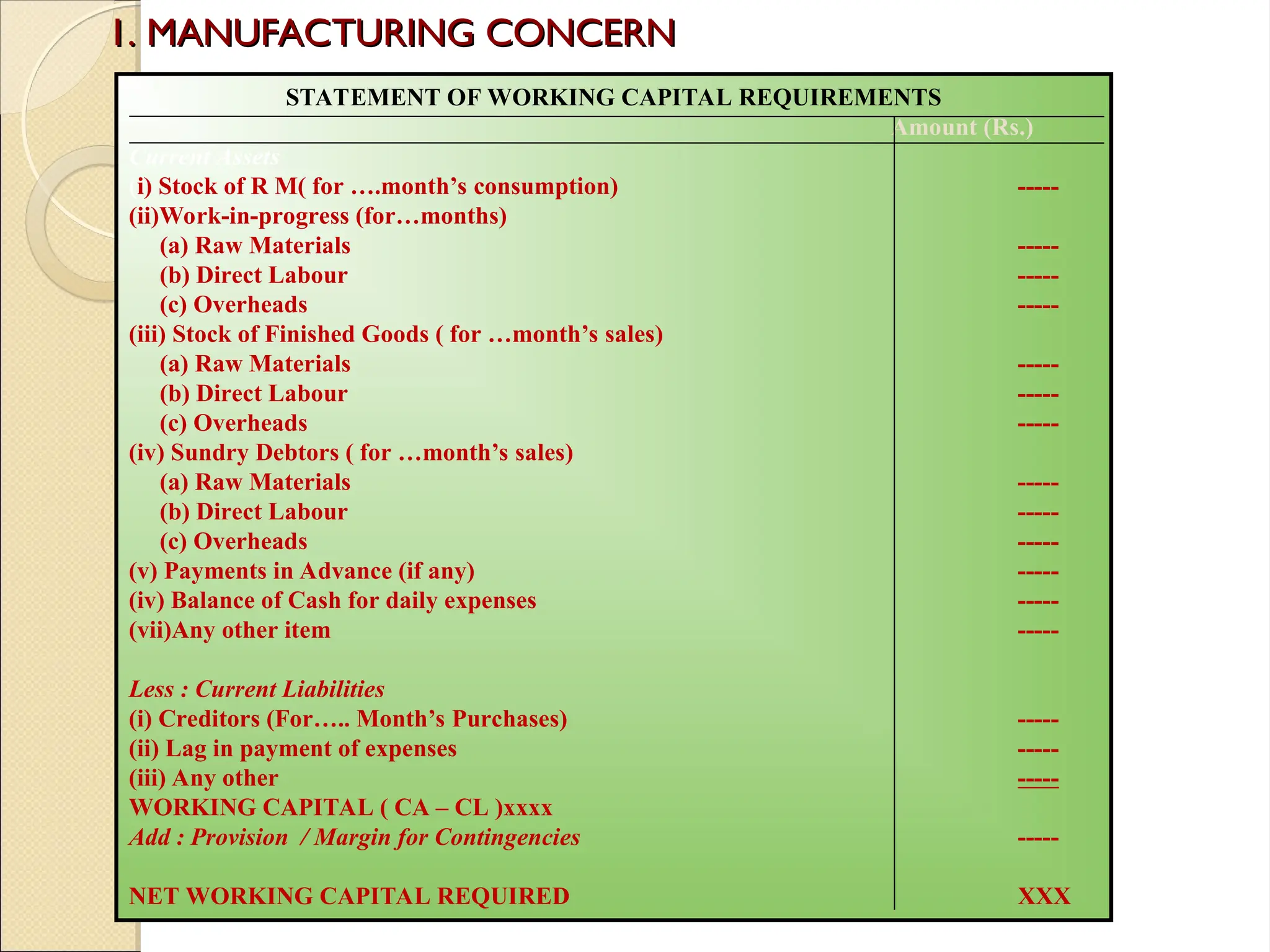
1. MANUFACTURING CONCERN
1.MANUFACTURING CONCERN
STATEMENT OF WORKING CAPITAL REQUIREMENTS
Amount (Rs.)
Current Assets
(i) Stock of R M( for ….month’s consumption) -----
(ii)Work-in-progress (for…months)
(a) Raw Materials -----
(b) Direct Labour -----
(c) Overheads -----
(iii) Stock of Finished Goods ( for …month’s sales)
(a) Raw Materials -----
(b) Direct Labour -----
(c) Overheads -----
(iv) Sundry Debtors ( for …month’s sales)
(a) Raw Materials -----
(b) Direct Labour -----
(c) Overheads -----
(v) Payments in Advance (if any) -----
(iv) Balance of Cash for daily expenses -----
(vii)Any other item -----
Less : Current Liabilities
(i) Creditors (For….. Month’s Purchases) -----
(ii) Lag in payment of expenses -----
(iii) Any other -----
WORKING CAPITAL ( CA – CL )xxxx
Add : Provision / Margin for Contingencies -----
NET WORKING CAPITAL REQUIRED XXX
35.
Points to beremembered while estimating WC
Points to be remembered while estimating WC
(1) Profits should be ignored while calculating working capital requirements
for the following reasons.
(a) Profits may or may not be used as working capital
(b) Even if it is used, it may be reduced by the amount of Income tax,
Drawings, Dividend paid etc.
(2) Calculation of WIP depends on the degree of completion as regards to
materials, labour and overheads. However, if nothing is mentioned in the
problem, take 100% of the value as WIP. Because in such a case, the average
period of WIP must have been calculated as equivalent period of completed
units.
(3) Calculation of Stocks of Finished Goods and Debtors should be made at
cost unless otherwise asked in the question.
36.
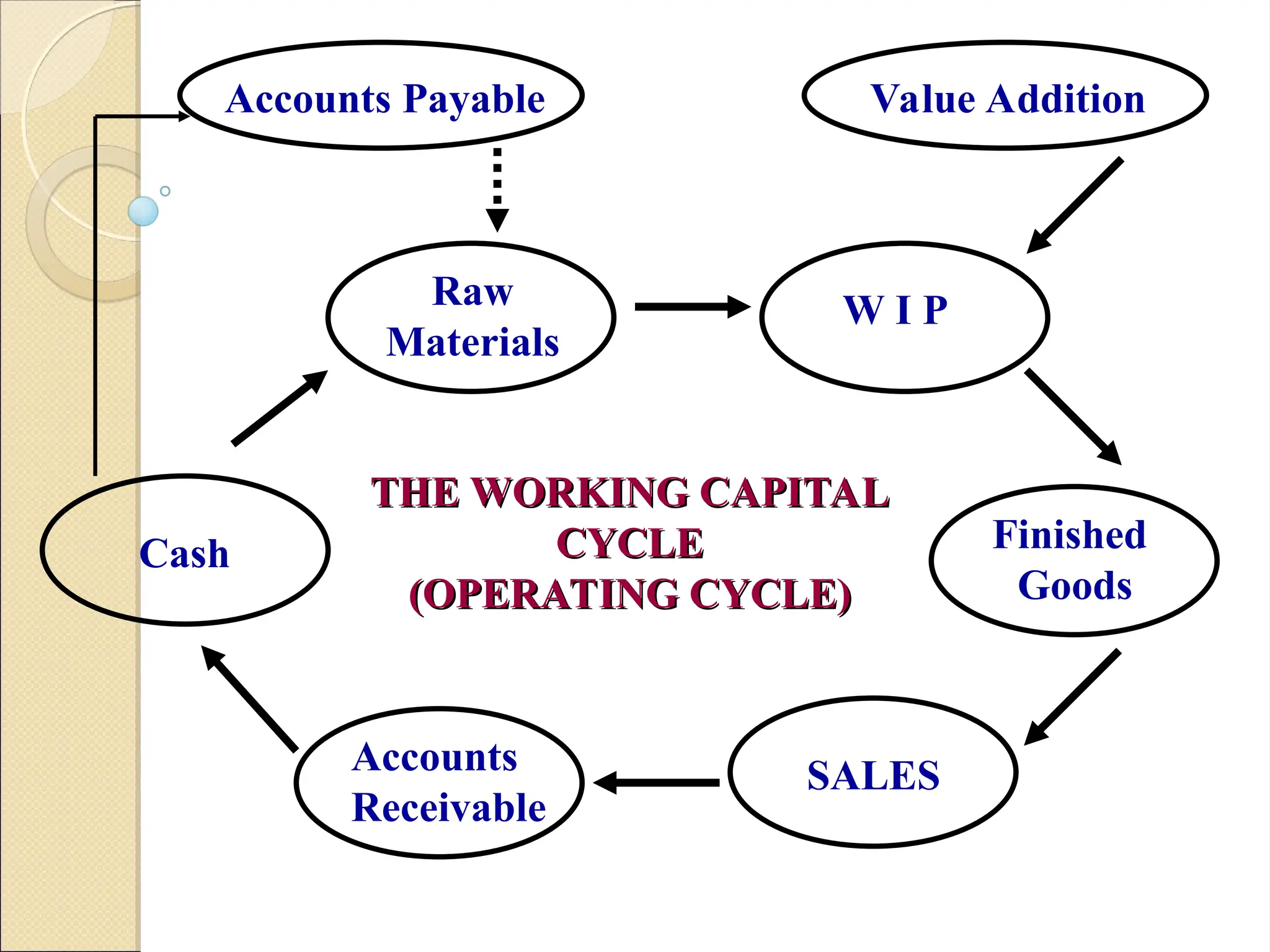
THE WORKING CAPITAL
THEWORKING CAPITAL
CYCLE
CYCLE
(OPERATING CYCLE)
(OPERATING CYCLE)
Accounts Payable
Cash
Raw
Materials
W I P
Finished
Goods
Value Addition
Accounts
Receivable
SALES
37.
Time & MoneyConcepts in Working Capital Cycle
Time & Money Concepts in Working Capital Cycle
Each component of working capital (namely inventory, receivables and
payables) has two dimensions ........TIME ......... and MONEY, when it
comes to managing working capital
38.
You canget money to move faster around the cycle or reduce the
amount of money tied up. Then, business will generate more cash or it
will need to borrow less money to fund working capital.
As a consequence, you could reduce the cost of bank interest or
you'll have additional free money available to support additional sales
growth or investment.
Similarly, if you can negotiate improved terms with suppliers e.g. get
longer credit or an increased credit limit, you effectively create free
finance to help fund future sales.
39.
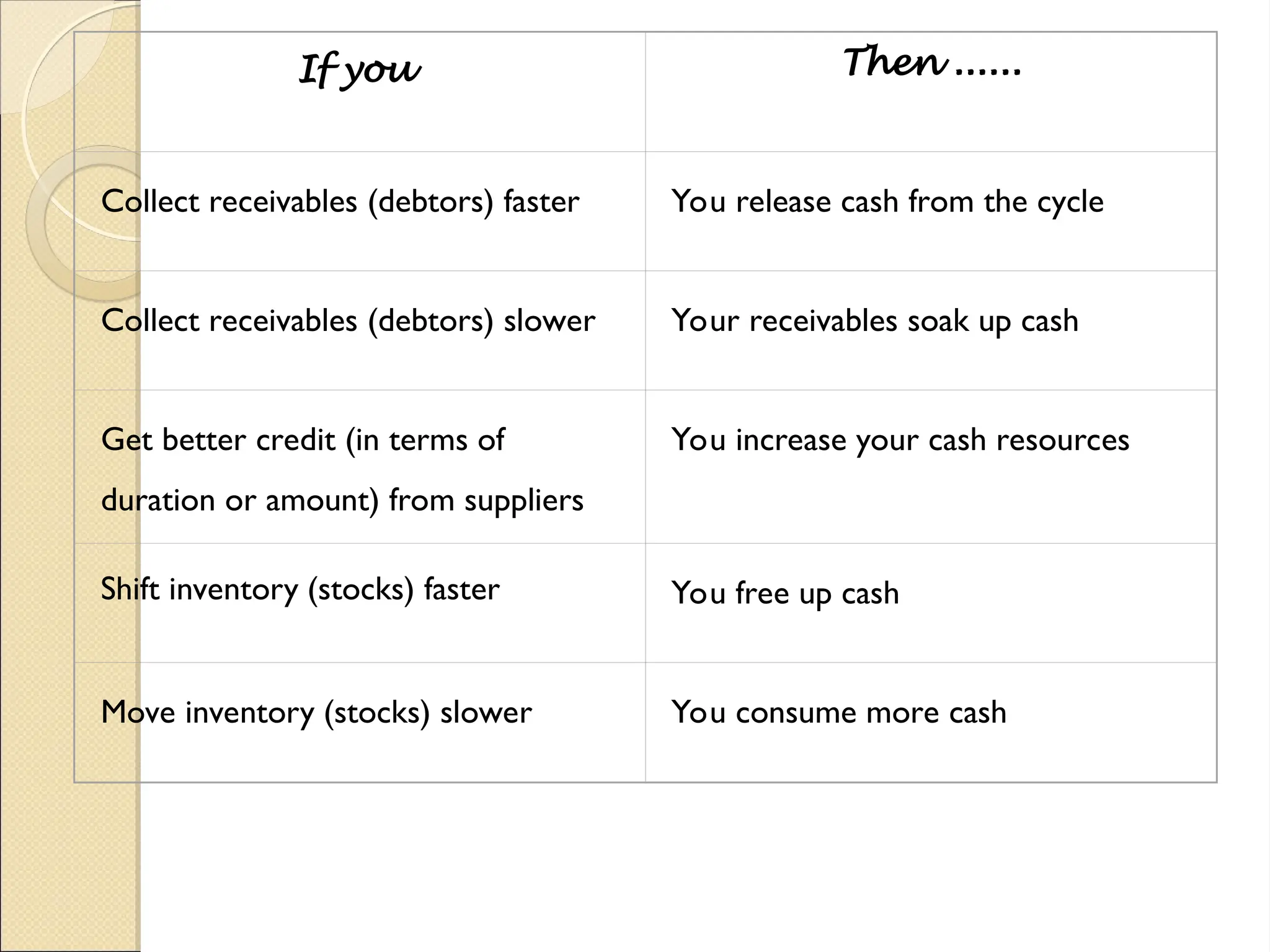
If you Then......
Collect receivables (debtors) faster You release cash from the cycle
Collect receivables (debtors) slower Your receivables soak up cash
Get better credit (in terms of
duration or amount) from suppliers
You increase your cash resources
Shift inventory (stocks) faster You free up cash
Move inventory (stocks) slower You consume more cash
40.
MANAGEMENT OF CASH
MANAGEMENTOF CASH
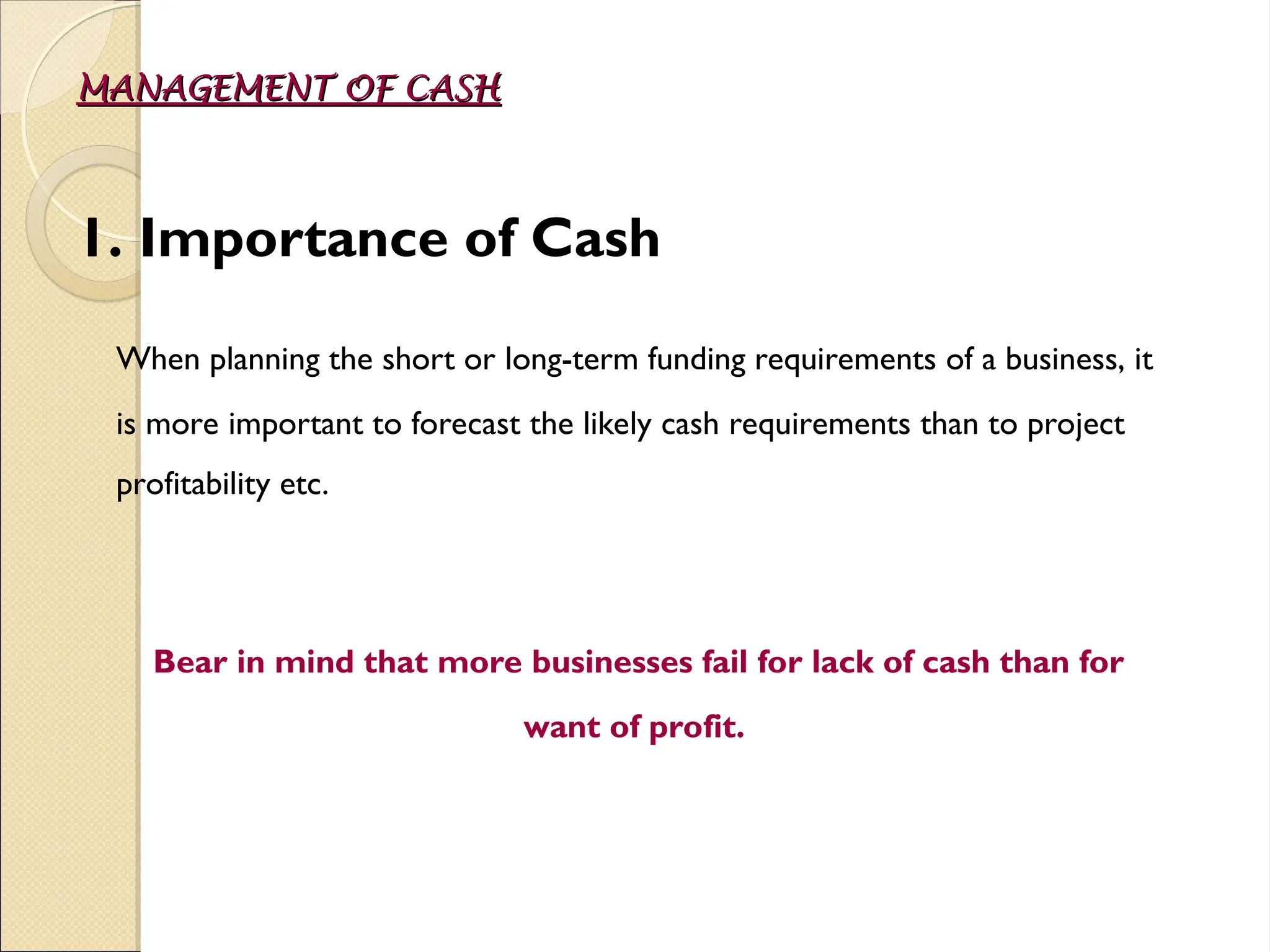
1. Importance of Cash
When planning the short or long-term funding requirements of a business, it
is more important to forecast the likely cash requirements than to project
profitability etc.
Bear in mind that more businesses fail for lack of cash than for
want of profit.
41.
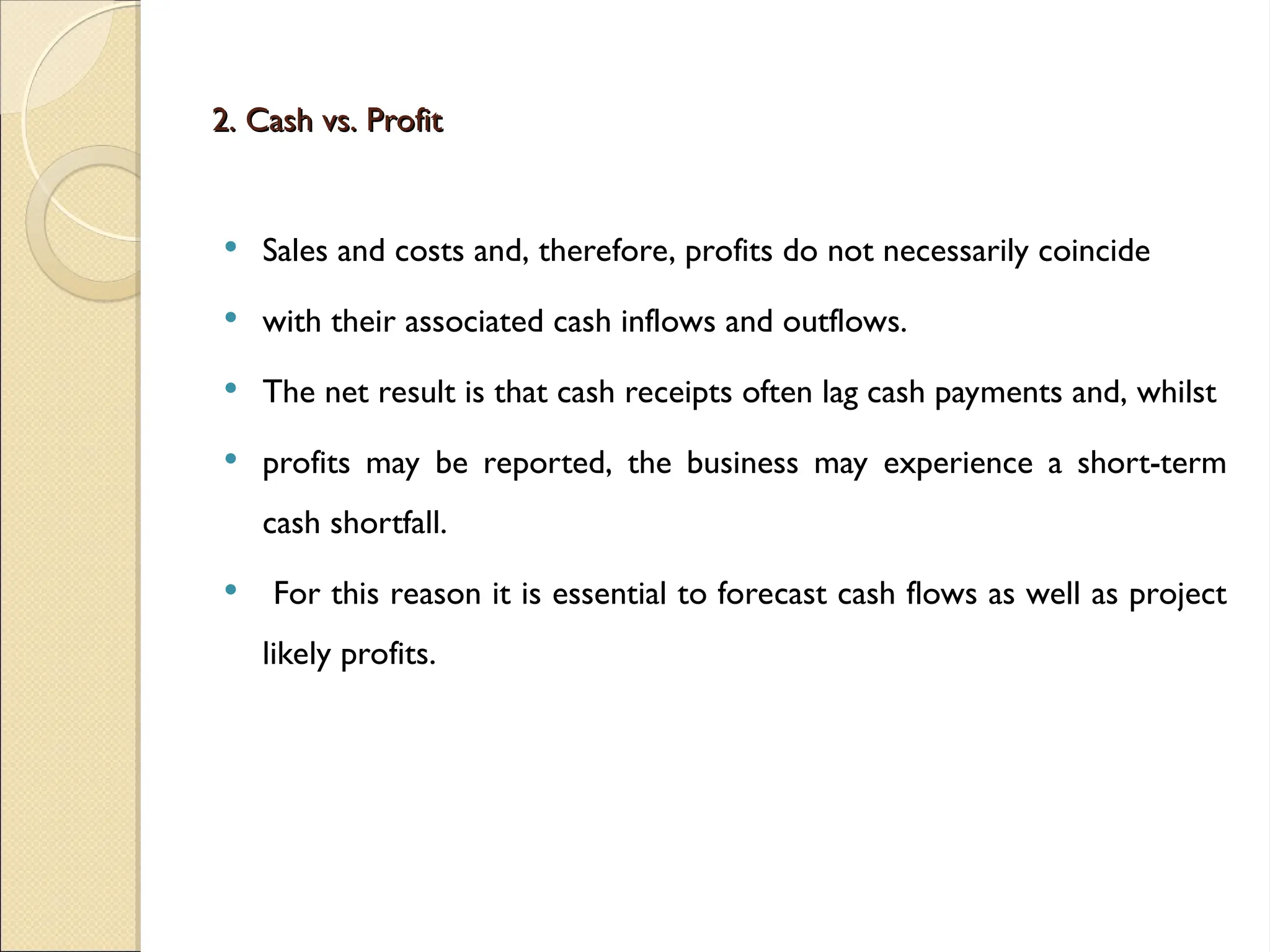
2. Cash vs.Profit
2. Cash vs. Profit
Sales and costs and, therefore, profits do not necessarily coincide
with their associated cash inflows and outflows.
The net result is that cash receipts often lag cash payments and, whilst
profits may be reported, the business may experience a short-term
cash shortfall.
For this reason it is essential to forecast cash flows as well as project
likely profits.
42.
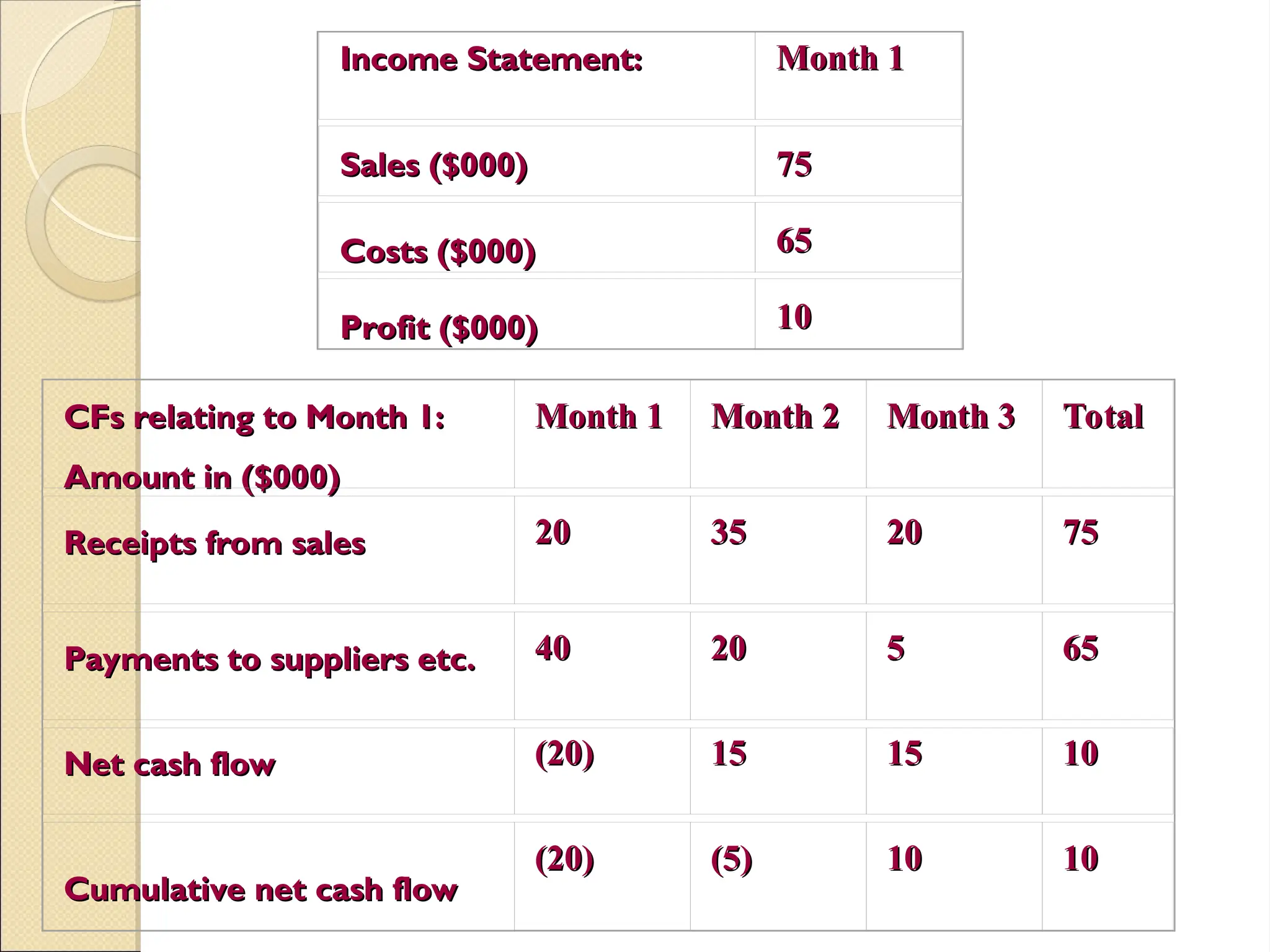
Income Statement:
Income Statement:Month 1
Month 1
Sales ($000)
Sales ($000) 75
75
Costs ($000)
Costs ($000) 65
65
Profit ($000)
Profit ($000) 10
10
CFs relating to Month 1:
CFs relating to Month 1:
Amount in ($000)
Amount in ($000)
Month 1
Month 1 Month 2
Month 2 Month 3
Month 3 Total
Total
Receipts from sales
Receipts from sales 20
20 35
35 20
20 75
75
Payments to suppliers etc.
Payments to suppliers etc. 40
40 20
20 5
5 65
65
Net cash flow
Net cash flow (20)
(20) 15
15 15
15 10
10
Cumulative net cash flow
Cumulative net cash flow
(20)
(20) (5)
(5) 10
10 10
10
43.
Calculating Cash Flows
CalculatingCash Flows
Project cumulative positive net cash flow over several periods and,
conversely, a cumulative negative cash flow
Cash flow planning entails forecasting and tabulating all significant
cash inflows relating to sales, new loans, interest received etc., and then
analyzing in detail the timing of expected payments relating to
suppliers, wages, other expenses, capital expenditure, loan repayments,
dividends, tax, interest payments etc.
44.
CASH MANAGEMENT STRATEGIES
CASHMANAGEMENT STRATEGIES
Cash Planning
Cash Forecasts and Budgeting
Receipts and Disbursements Method
Adjusted Net Income Method (Sources and Uses of
Cash)
45.
MANAGING CASH FLOWS
MANAGINGCASH FLOWS
After estimating cash flows, efforts should be made to adhere to the
estimates of receipts and payments of cash.
Cash Management will be successful only if cash collections are
accelerated and cash payments (disbursements), as far as possible, are
delayed.
46.
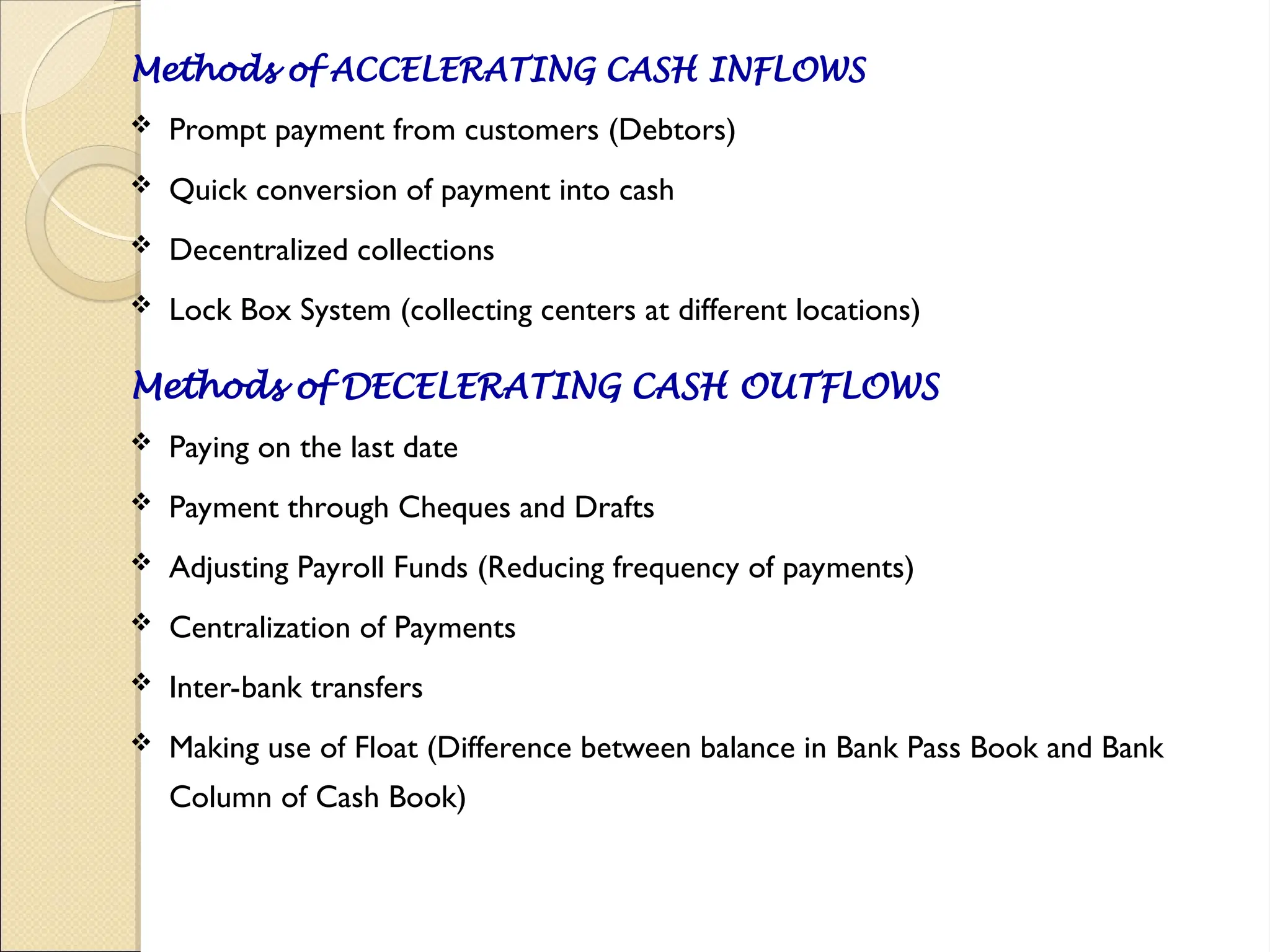
Methods of ACCELERATINGCASH INFLOWS
Prompt payment from customers (Debtors)
Quick conversion of payment into cash
Decentralized collections
Lock Box System (collecting centers at different locations)
Methods of DECELERATING CASH OUTFLOWS
Paying on the last date
Payment through Cheques and Drafts
Adjusting Payroll Funds (Reducing frequency of payments)
Centralization of Payments
Inter-bank transfers
Making use of Float (Difference between balance in Bank Pass Book and Bank
Column of Cash Book)
47.
MANAGEMENT OF RECEVABLES
MANAGEMENTOF RECEVABLES
Receivables ( Sundry Debtors ) result from CREDIT SALES.
A concern is required to allow credit in order to expand its sales volume.
Receivables contribute a significant portion of current assets.
But for investment in receivables the firm has to incur certain costs (opportunity
cost and time value )
Further, there is a risk of BAD DEBTS also.
It is, therefore very necessary to have a proper control and management of
receivables.
48.
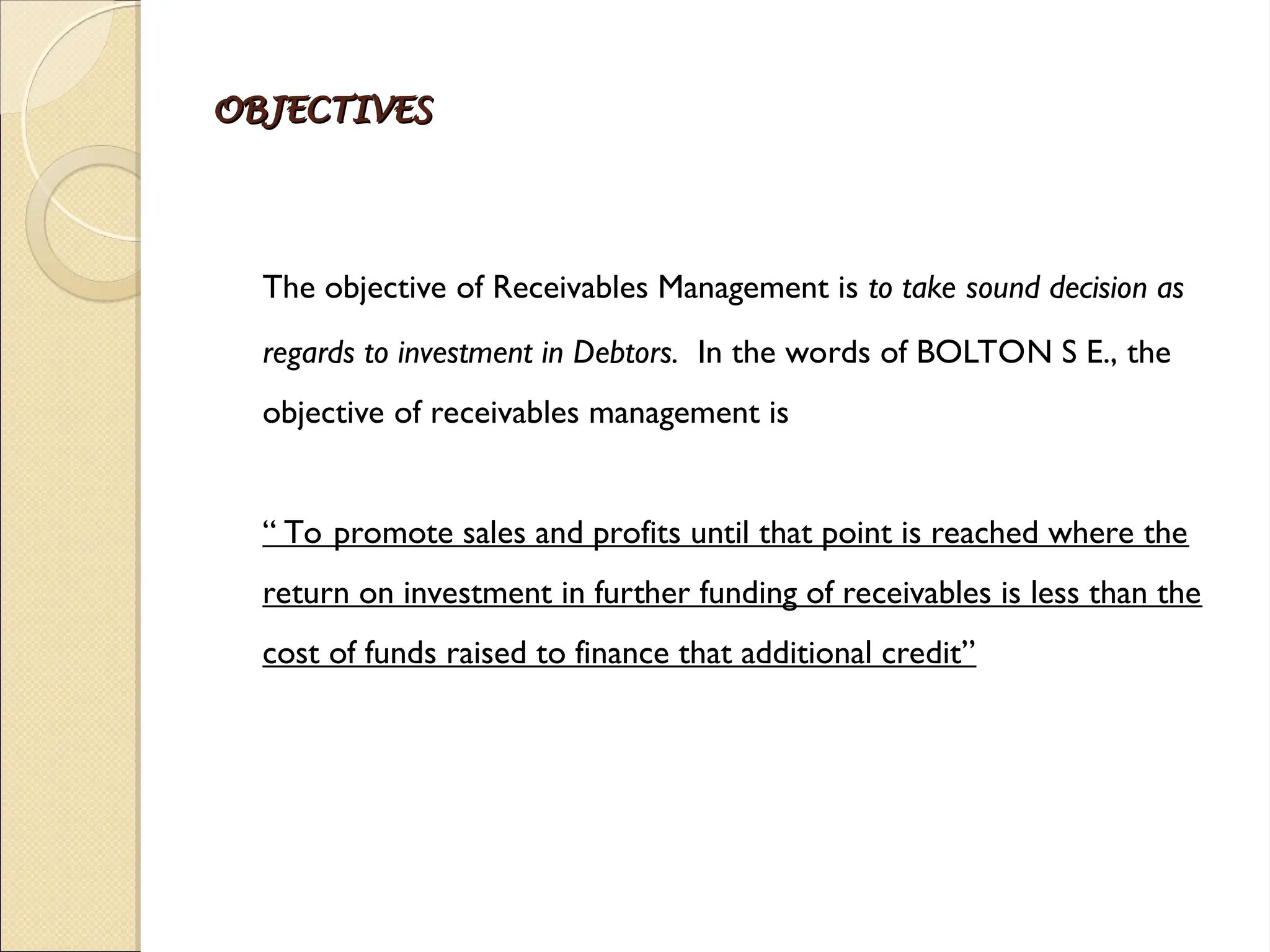
OBJECTIVES
OBJECTIVES
The objective ofReceivables Management is to take sound decision as
regards to investment in Debtors. In the words of BOLTON S E., the
objective of receivables management is
“ To promote sales and profits until that point is reached where the
return on investment in further funding of receivables is less than the
cost of funds raised to finance that additional credit”
49.
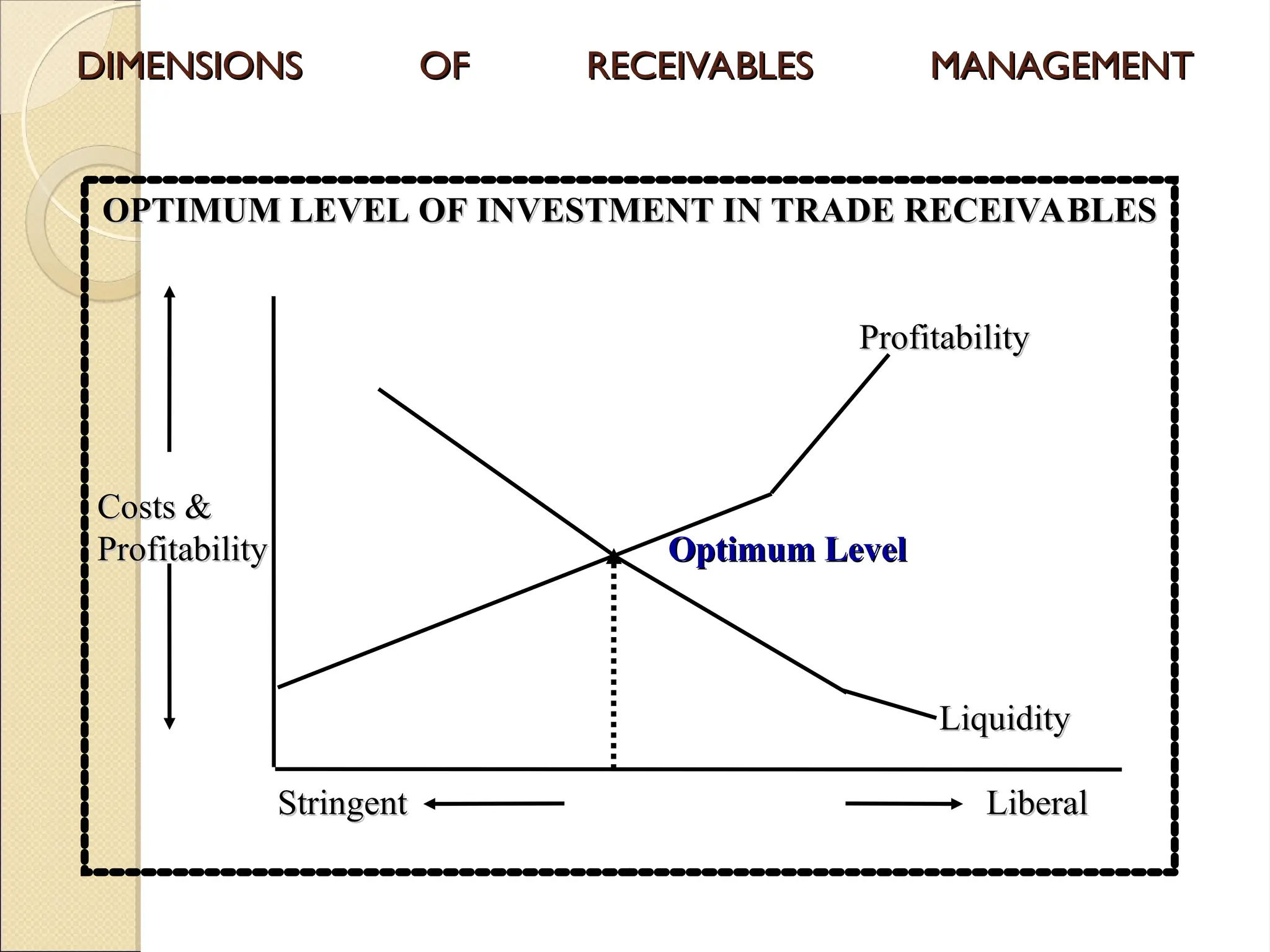
DIMENSIONS OF RECEIVABLESMANAGEMENT
DIMENSIONS OF RECEIVABLES MANAGEMENT
OPTIMUM LEVEL OF INVESTMENT IN TRADE RECEIVABLES
OPTIMUM LEVEL OF INVESTMENT IN TRADE RECEIVABLES
Profitability
Profitability
Costs &
Costs &
Profitability
Profitability Optimum Level
Optimum Level
Liquidity
Liquidity
Stringent
Stringent Liberal
Liberal
50.
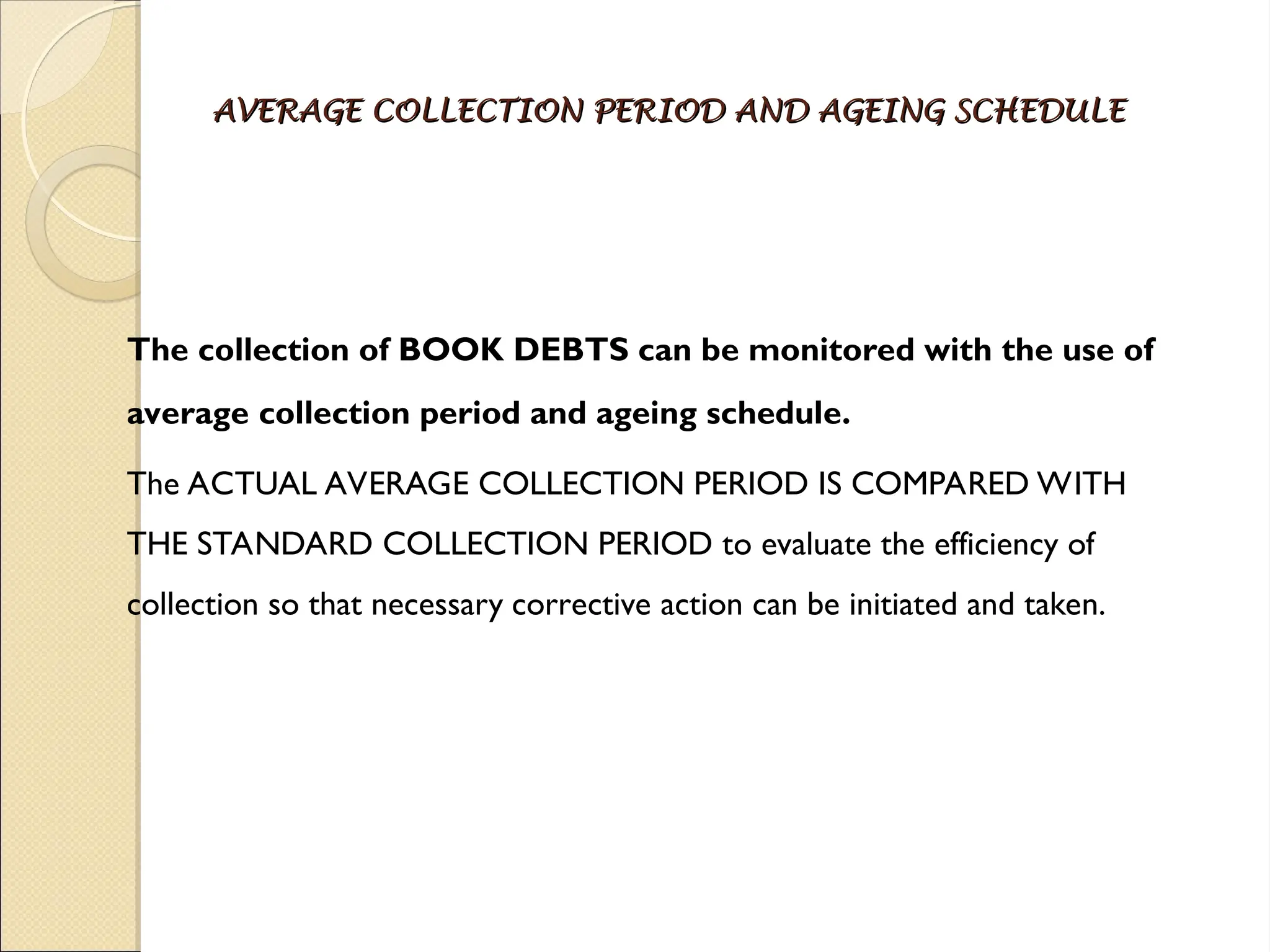
AVERAGE COLLECTION PERIODAND AGEING SCHEDULE
AVERAGE COLLECTION PERIOD AND AGEING SCHEDULE
The collection of BOOK DEBTS can be monitored with the use of
average collection period and ageing schedule.
The ACTUAL AVERAGE COLLECTION PERIOD IS COMPARED WITH
THE STANDARD COLLECTION PERIOD to evaluate the efficiency of
collection so that necessary corrective action can be initiated and taken.
51.
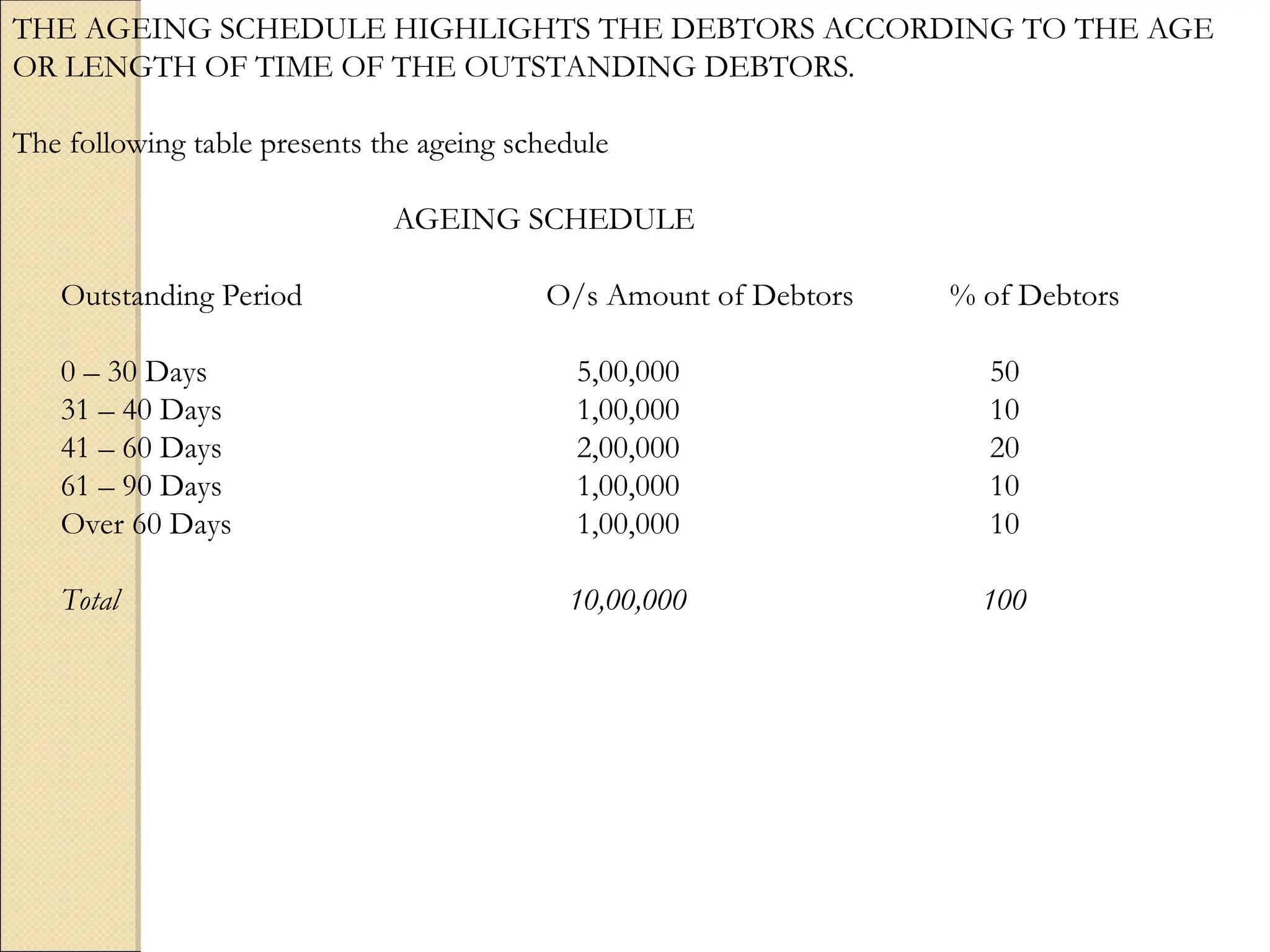
THE AGEING SCHEDULEHIGHLIGHTS THE DEBTORS ACCORDING TO THE AGE
OR LENGTH OF TIME OF THE OUTSTANDING DEBTORS.
The following table presents the ageing schedule
AGEING SCHEDULE
Outstanding Period O/s Amount of Debtors % of Debtors
0 – 30 Days 5,00,000 50
31 – 40 Days 1,00,000 10
41 – 60 Days 2,00,000 20
61 – 90 Days 1,00,000 10
Over 60 Days 1,00,000 10
Total 10,00,000 100
52.
Guidelines for EffectiveReceivables Management
Guidelines for Effective Receivables Management
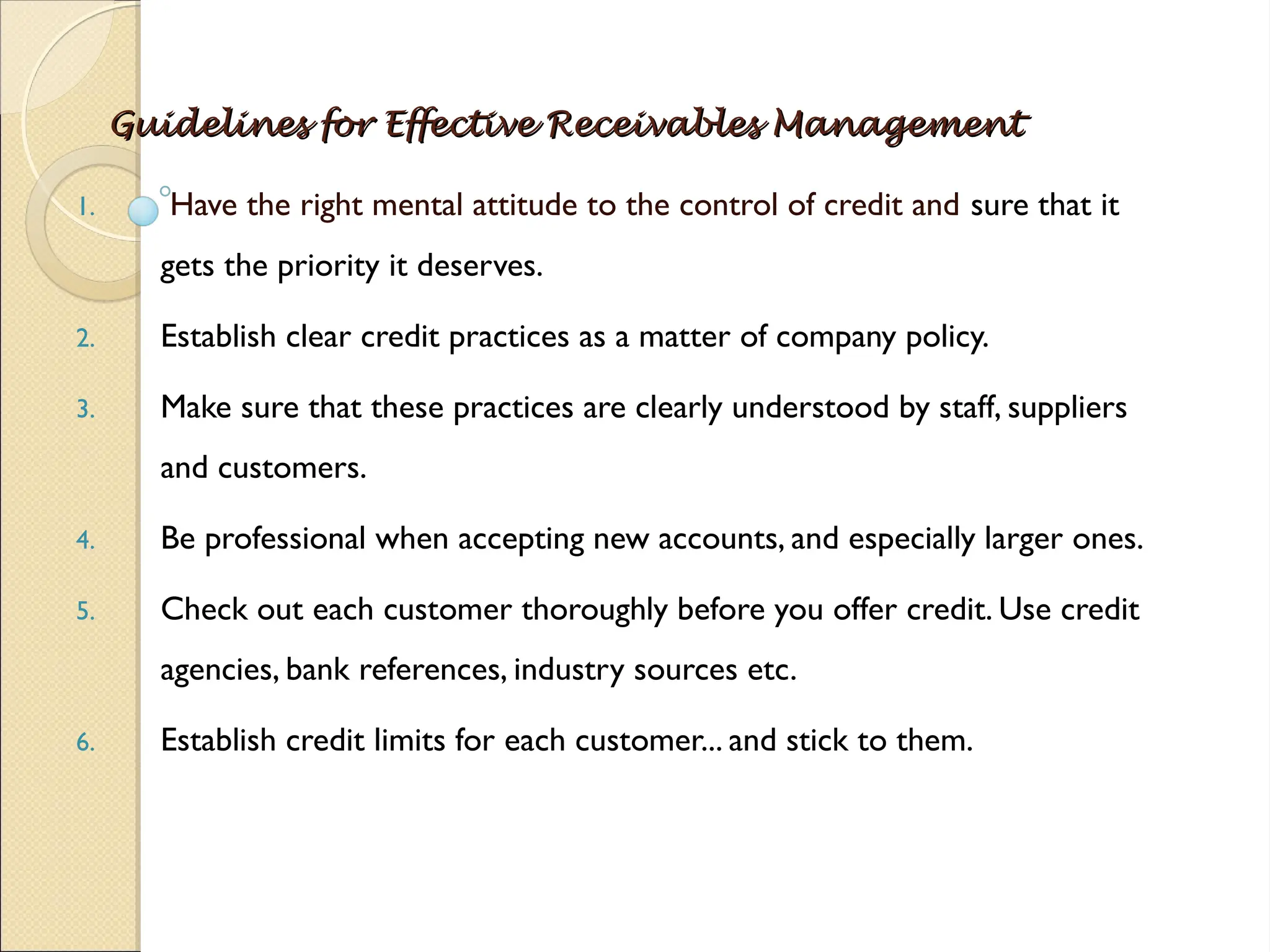
1. Have the right mental attitude to the control of credit and sure that it
gets the priority it deserves.
2. Establish clear credit practices as a matter of company policy.
3. Make sure that these practices are clearly understood by staff, suppliers
and customers.
4. Be professional when accepting new accounts, and especially larger ones.
5. Check out each customer thoroughly before you offer credit. Use credit
agencies, bank references, industry sources etc.
6. Establish credit limits for each customer... and stick to them.
53.
7.
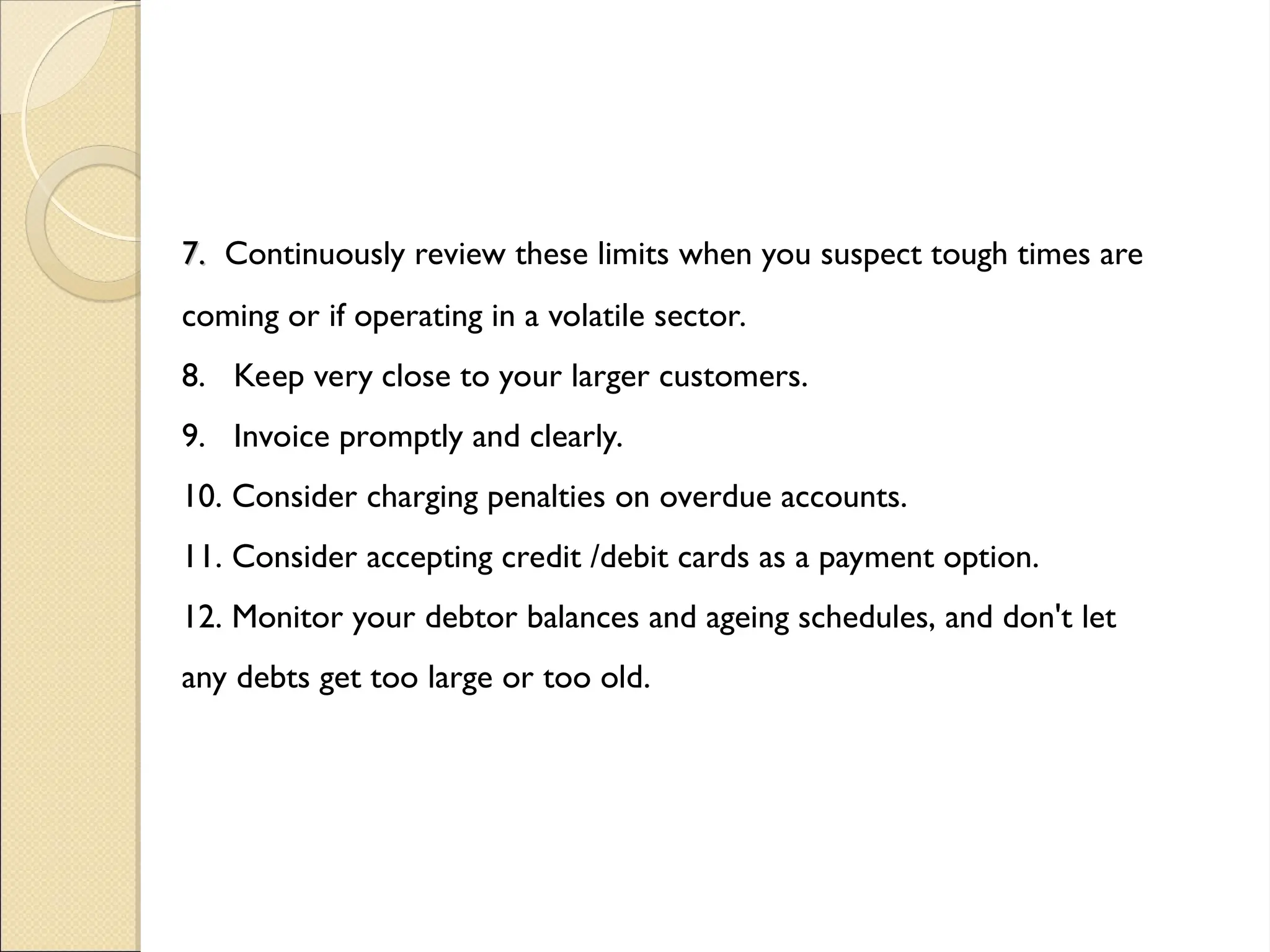
7. Continuously reviewthese limits when you suspect tough times are
coming or if operating in a volatile sector.
8. Keep very close to your larger customers.
9. Invoice promptly and clearly.
10. Consider charging penalties on overdue accounts.
11. Consider accepting credit /debit cards as a payment option.
12. Monitor your debtor balances and ageing schedules, and don't let
any debts get too large or too old.
54.
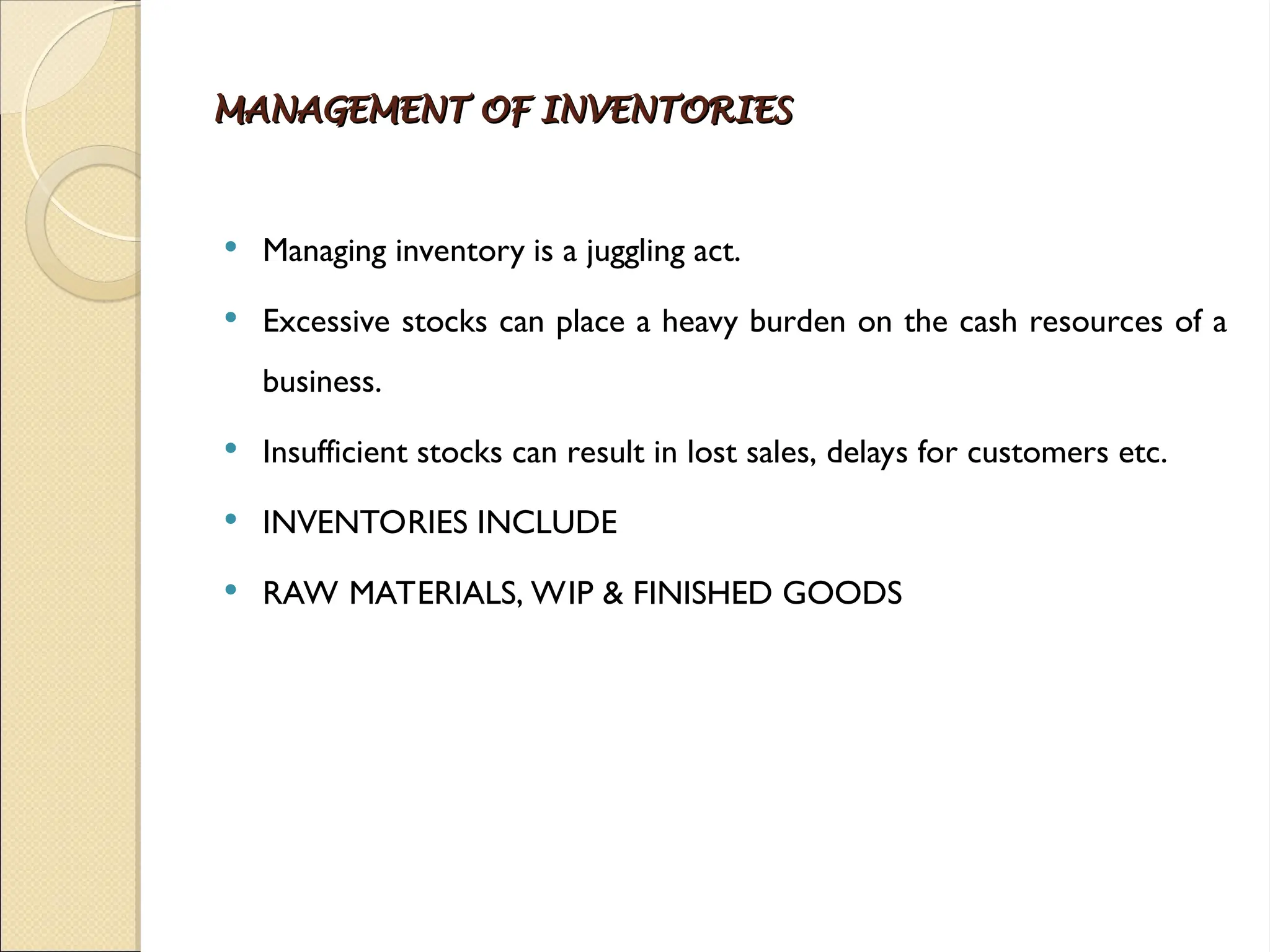
MANAGEMENT OF INVENTORIES
MANAGEMENTOF INVENTORIES
Managing inventory is a juggling act.
Excessive stocks can place a heavy burden on the cash resources of a
business.
Insufficient stocks can result in lost sales, delays for customers etc.
INVENTORIES INCLUDE
RAW MATERIALS, WIP & FINISHED GOODS
55.
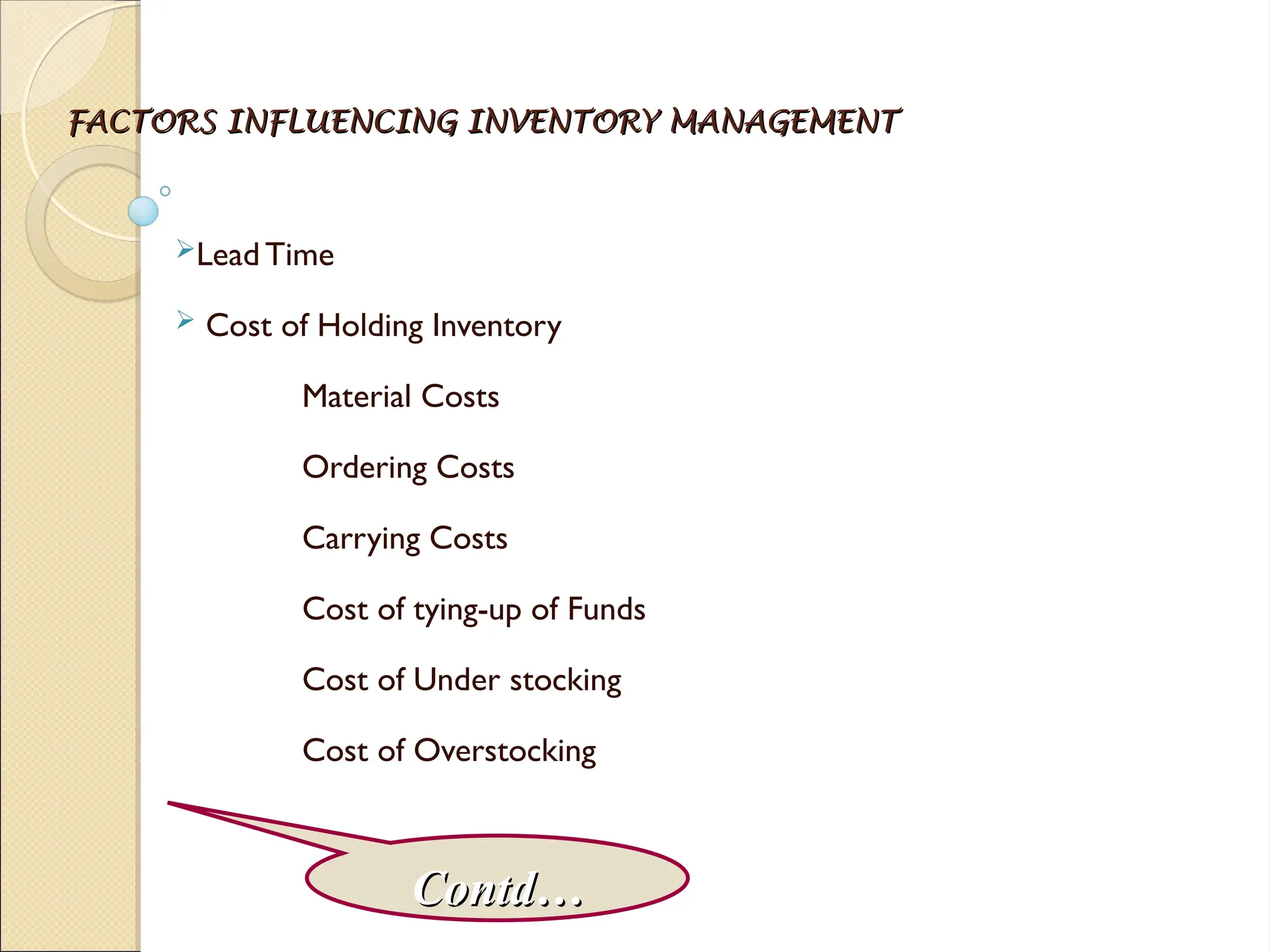
FACTORS INFLUENCING INVENTORYMANAGEMENT
FACTORS INFLUENCING INVENTORY MANAGEMENT
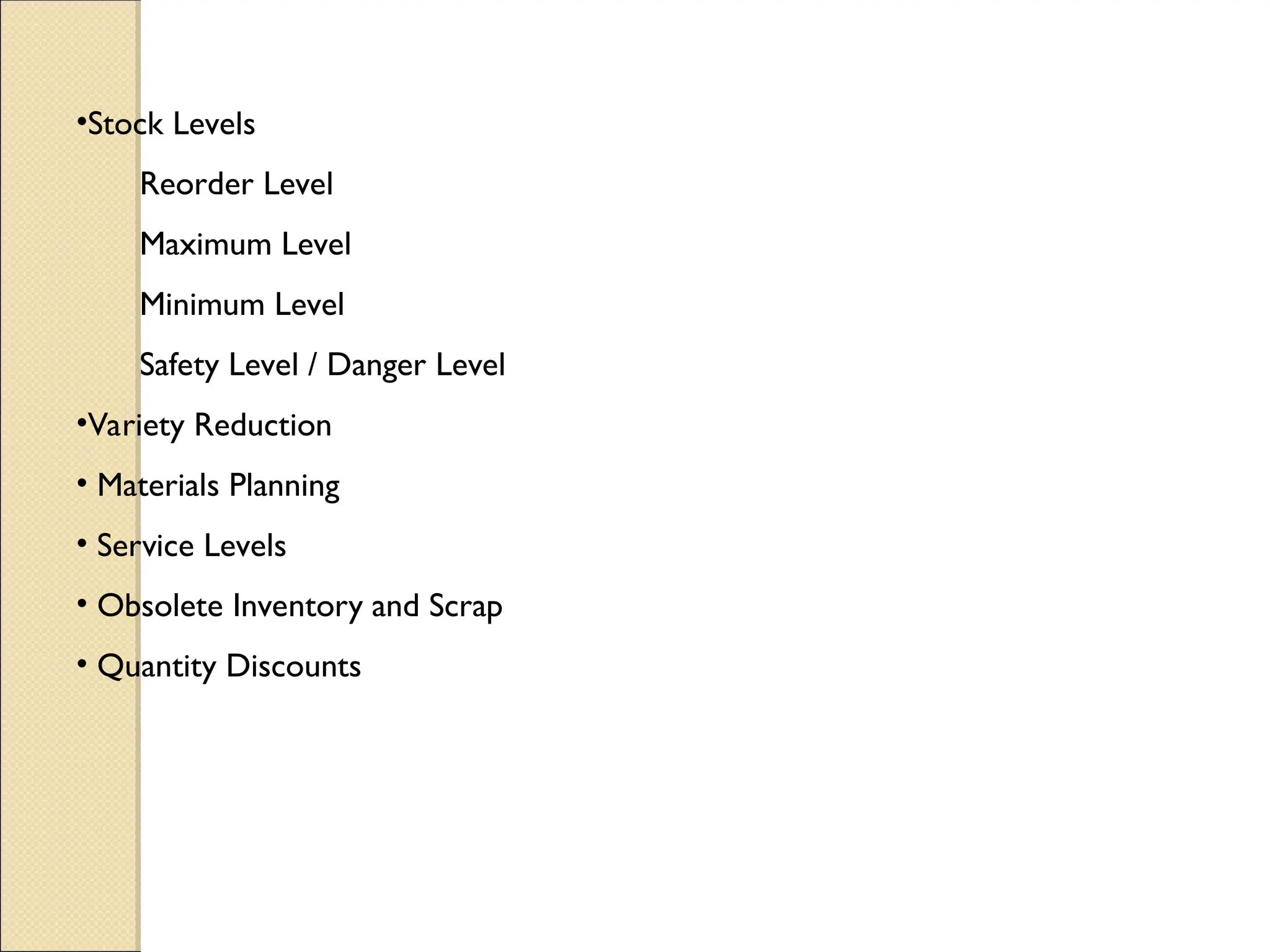
Lead Time
Cost of Holding Inventory
Material Costs
Ordering Costs
Carrying Costs
Cost of tying-up of Funds
Cost of Under stocking
Cost of Overstocking
Contd…
Contd…
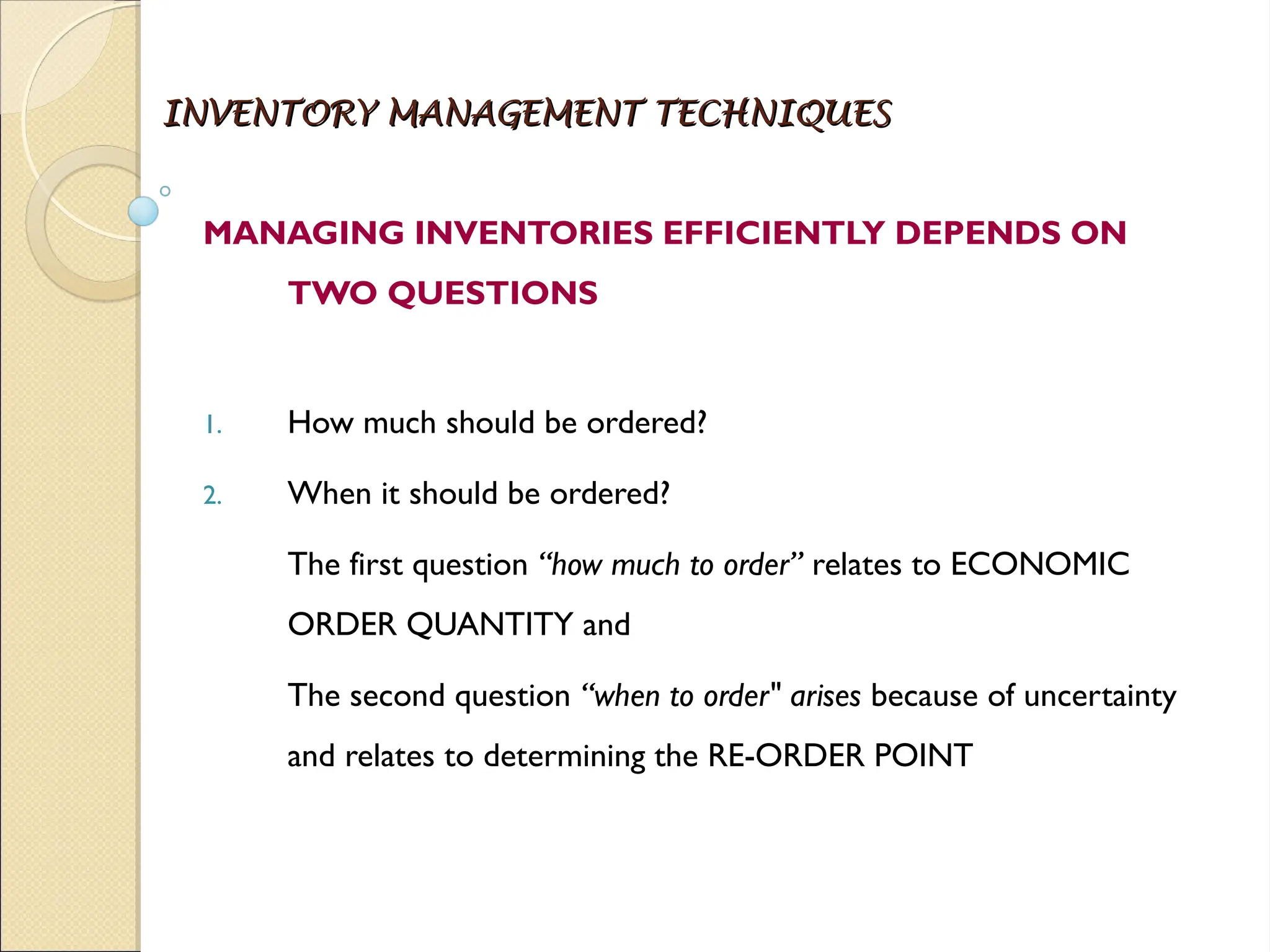
INVENTORY MANAGEMENT TECHNIQUES
INVENTORYMANAGEMENT TECHNIQUES
MANAGING INVENTORIES EFFICIENTLY DEPENDS ON
TWO QUESTIONS
1. How much should be ordered?
2. When it should be ordered?
The first question “how much to order” relates to ECONOMIC
ORDER QUANTITY and
The second question “when to order" arises because of uncertainty
and relates to determining the RE-ORDER POINT
58.
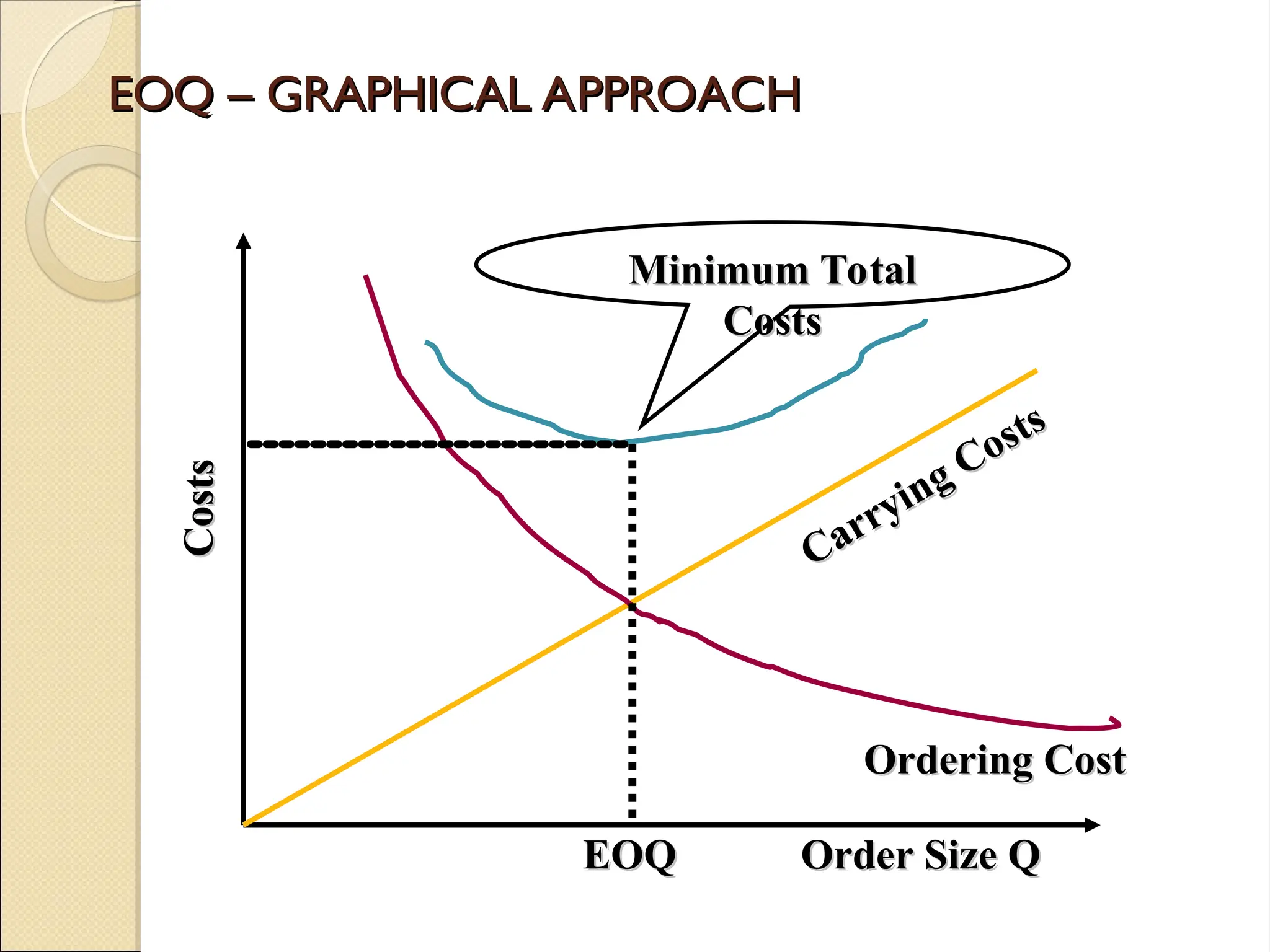
ECONOMIC ORDER QUANTITY[ EOQ ]
ECONOMIC ORDER QUANTITY [ EOQ ]
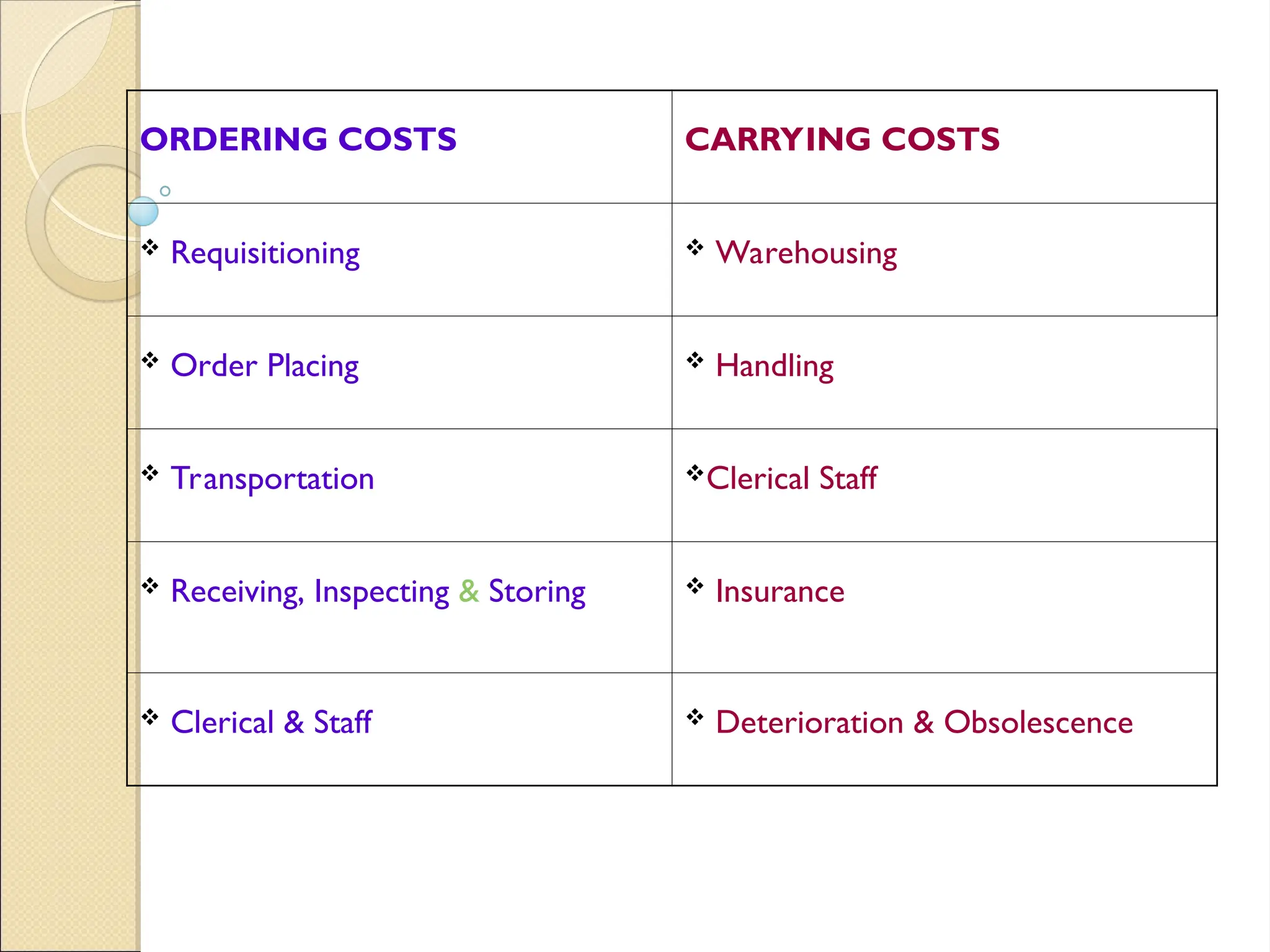
The ordering quantity problems are solved by the firm by determining the
EOQ ( or the Economic Lot Size ) that is the optimum level of inventory.
There are two types of costs involved in this model.
Ordering costs
Carrying costs
The EOQ is that level of inventory which MINIMIZES the total of ordering
and carrying costs.
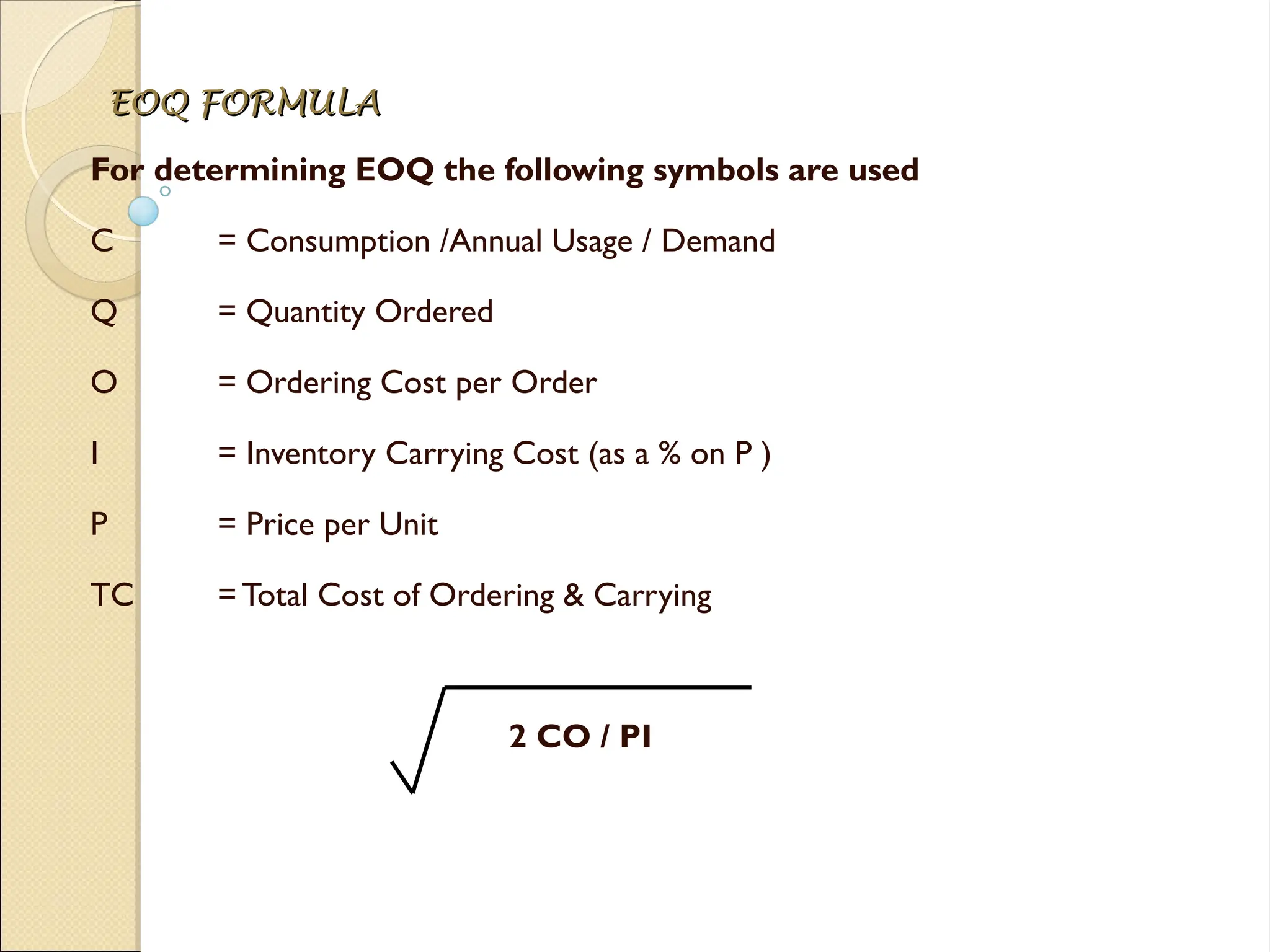
EOQ FORMULA
EOQ FORMULA
Fordetermining EOQ the following symbols are used
C = Consumption /Annual Usage / Demand
Q = Quantity Ordered
O = Ordering Cost per Order
I = Inventory Carrying Cost (as a % on P )
P = Price per Unit
TC =Total Cost of Ordering & Carrying
2 CO / PI
61.
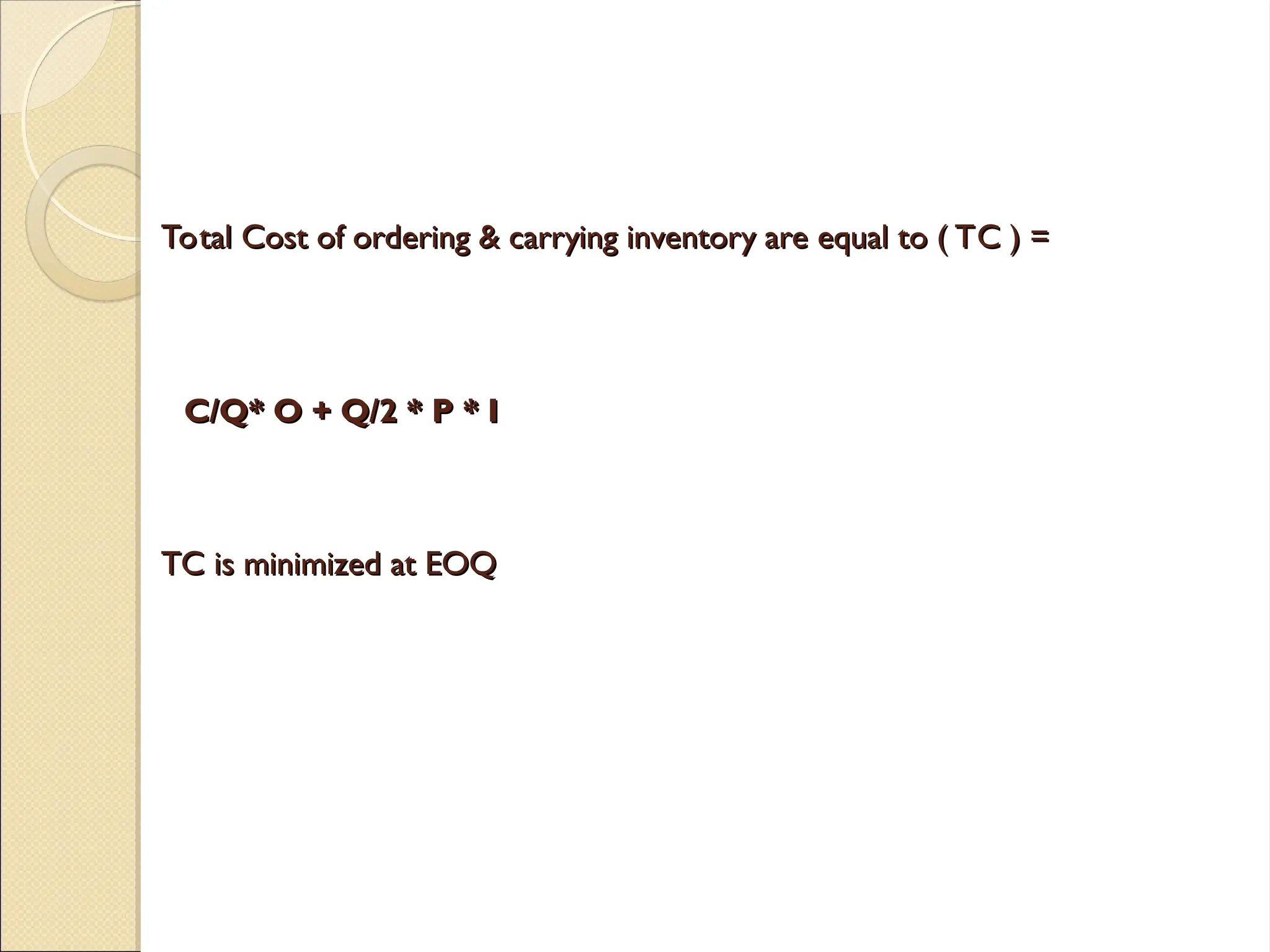
Total Cost ofordering & carrying inventory are equal to ( TC ) =
Total Cost of ordering & carrying inventory are equal to ( TC ) =
C/Q* O + Q/2 * P * I
C/Q* O + Q/2 * P * I
TC is minimized at EOQ
TC is minimized at EOQ
62.
EOQ – GRAPHICALAPPROACH
EOQ – GRAPHICAL APPROACH
Costs
Costs
Carrying Costs
Carrying Costs
Ordering Cost
Ordering Cost
Order Size Q
Order Size Q
EOQ
EOQ
Minimum Total
Minimum Total
Costs
Costs
63.
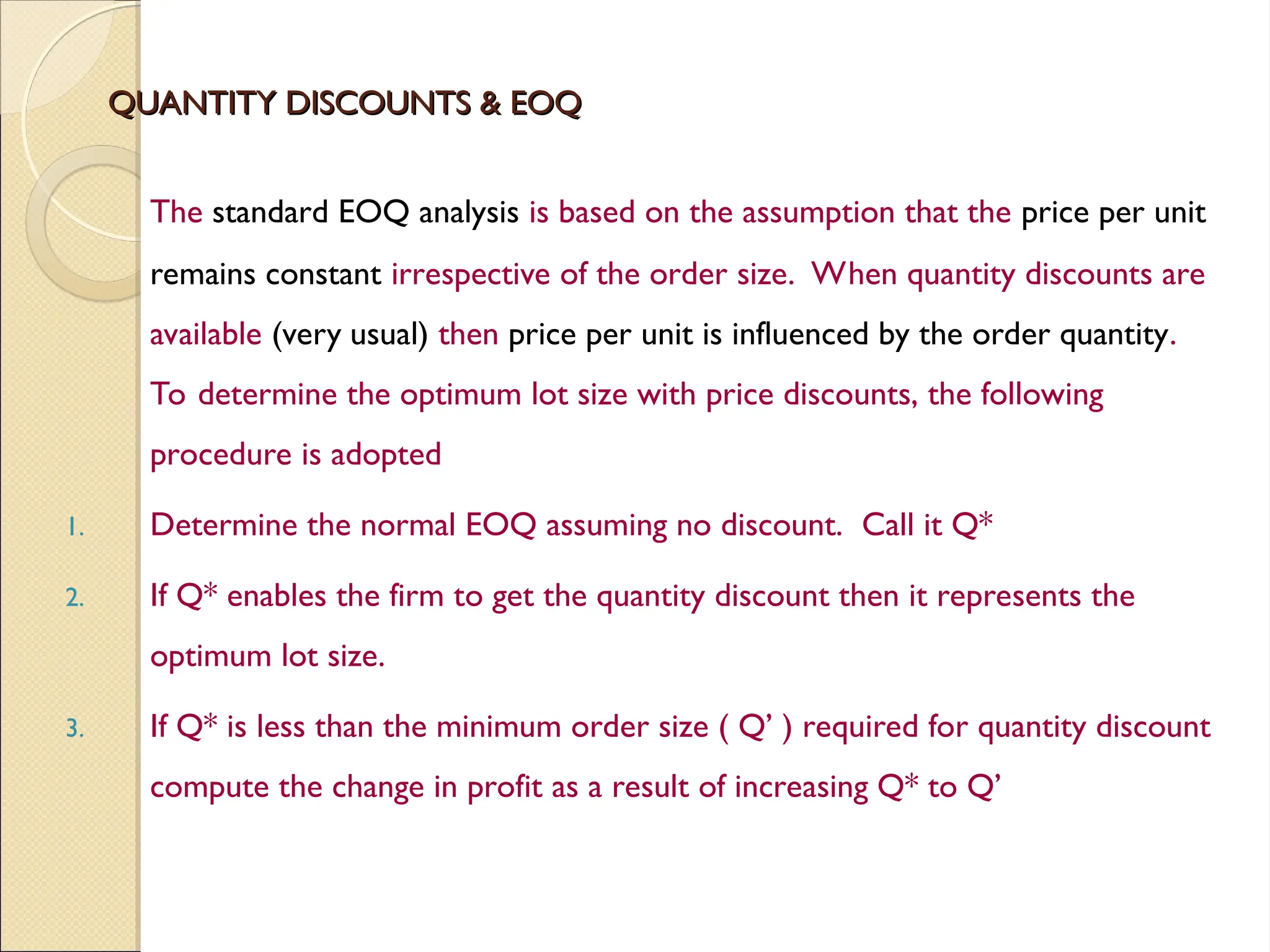
QUANTITY DISCOUNTS &EOQ
QUANTITY DISCOUNTS & EOQ
The standard EOQ analysis is based on the assumption that the price per unit
remains constant irrespective of the order size. When quantity discounts are
available (very usual) then price per unit is influenced by the order quantity.
To determine the optimum lot size with price discounts, the following
procedure is adopted
1. Determine the normal EOQ assuming no discount. Call it Q*
2. If Q* enables the firm to get the quantity discount then it represents the
optimum lot size.
3. If Q* is less than the minimum order size ( Q’ ) required for quantity discount
compute the change in profit as a result of increasing Q* to Q’
64.
The formula forchange in profit is given as
The formula for change in profit is given as
Dl = CD + [C/Q*-C/Q’] O [Q’ (P-D) I/2-Q*PI/2]
Where
Dl = change in profit
C = Annual Consumption / Usage / Demand
D = Discount per unit when available
Q* = EOQ without Quantity Discount
Q’ = Min order size required for Discount
O = Fixed Ordering Cost
P = Purchase price per unit without discount
I = Inventory carrying cost (% on Price)
65.
SELECTIVE CONTROL OFINVENTORY
SELECTIVE CONTROL OF INVENTORY
Different classification methods
Different classification methods
Classification Basis
ABC
[Always Better Control ]
Value of items consumed
VED
[ Vital, Essential, Desirable ]
The importance or criticality
FSN
[ Fast-moving, Slow-moving, Non-moving ]
The pace at which the material moves
HML
[ High, Medium, Low ]
Unit price of materials
SDE
[ Scarce, Difficult, Easy ]
Procurement Difficulties
XYZ Value of items in storage
66.
An eye-opener toInventory Management
An eye-opener to Inventory Management
For better stock/inventory control, try the following:
Review the effectiveness of existing purchasing and inventory systems.
Know the stock turn for all major items of inventory.
Apply tight controls to the significant few items and simplify controls for the
trivial many.
Sell off outdated or slow moving merchandise - it gets more difficult to sell the
longer you keep it.
Consider having part of your product outsourced to another manufacturer
rather than make it yourself.
Review your security procedures to ensure that no stock "is going out the back
door !"
67.
MANAGEMENT OF ACCOUNTSPAYABLE
MANAGEMENT OF ACCOUNTS PAYABLE
1. Creditors are a vital part of effective cash management and
should be managed carefully to enhance the cash position.
2. Purchasing initiates cash outflows and an over-zealous purchasing
function can create liquidity problems.
68.
Guidelines for effectivemanagement of Accounts Payable……
Who authorizes purchasing in your company - is it tightly managed or spread among
a number of (junior) people?
Are purchase quantities geared to demand forecasts?
Do you use order quantities which take account of stock-holding and purchasing
costs?
Do you know the cost to the company of carrying stock ?
Do you have alternative sources of supply ? If not, get quotes from major suppliers
and shop around for the best discounts, credit terms, and reduce dependence on a
single supplier.
69.
How many ofyour suppliers have a returns policy ?
Are you in a position to pass on cost increases quickly through price
increases to your customers ?
If a supplier of goods or services lets you down can you charge back
the cost of the delay ?
Can you arrange (with confidence !) to have delivery of supplies
staggered or on a just-in-time basis
70.
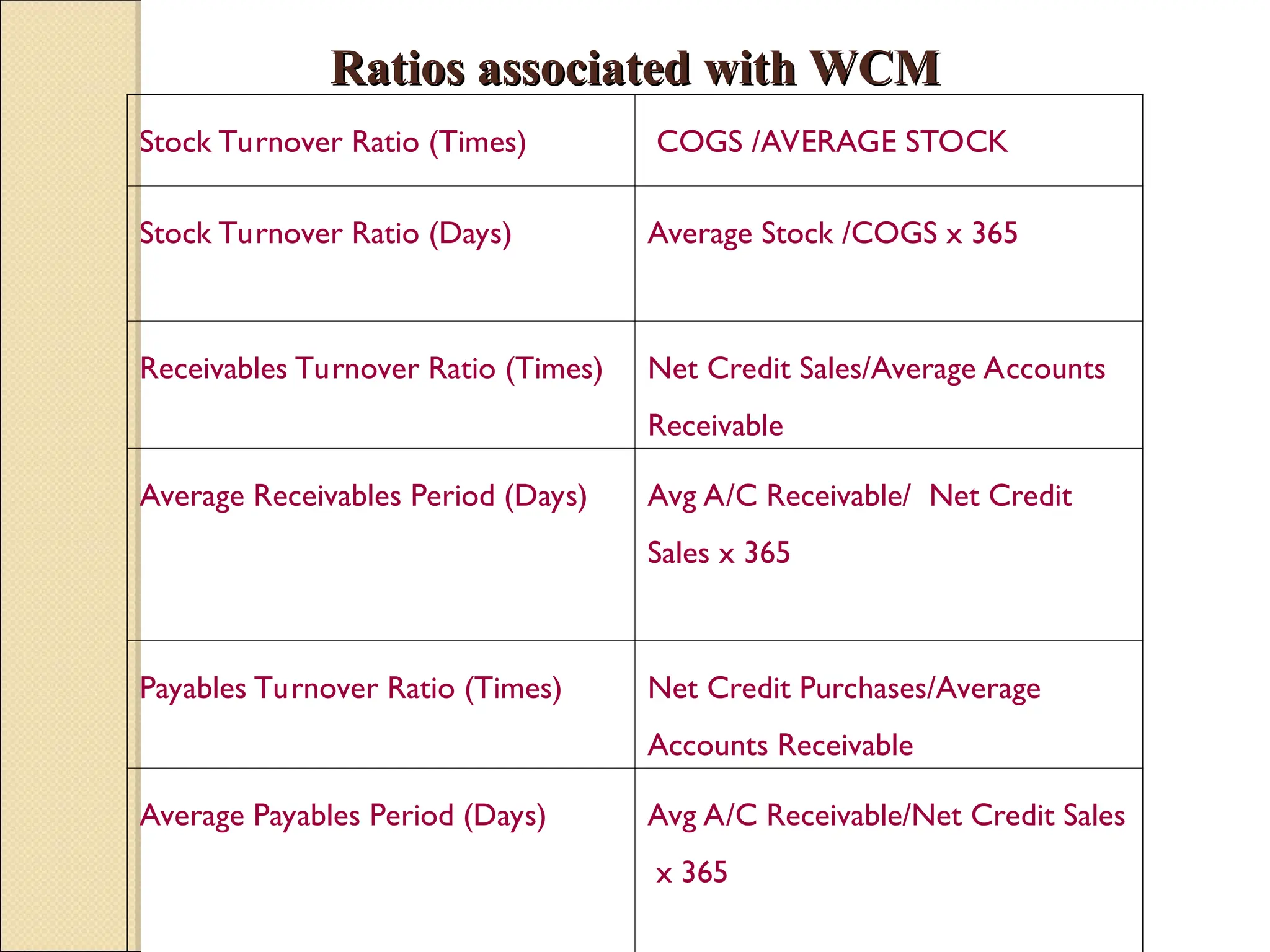
Ratios associated withWCM
Ratios associated with WCM
Stock Turnover Ratio (Times) COGS /AVERAGE STOCK
Stock Turnover Ratio (Days) Average Stock /COGS x 365
Receivables Turnover Ratio (Times) Net Credit Sales/Average Accounts
Receivable
Average Receivables Period (Days) Avg A/C Receivable/ Net Credit
Sales x 365
Payables Turnover Ratio (Times) Net Credit Purchases/Average
Accounts Receivable
Average Payables Period (Days) Avg A/C Receivable/Net Credit Sales
x 365
71.
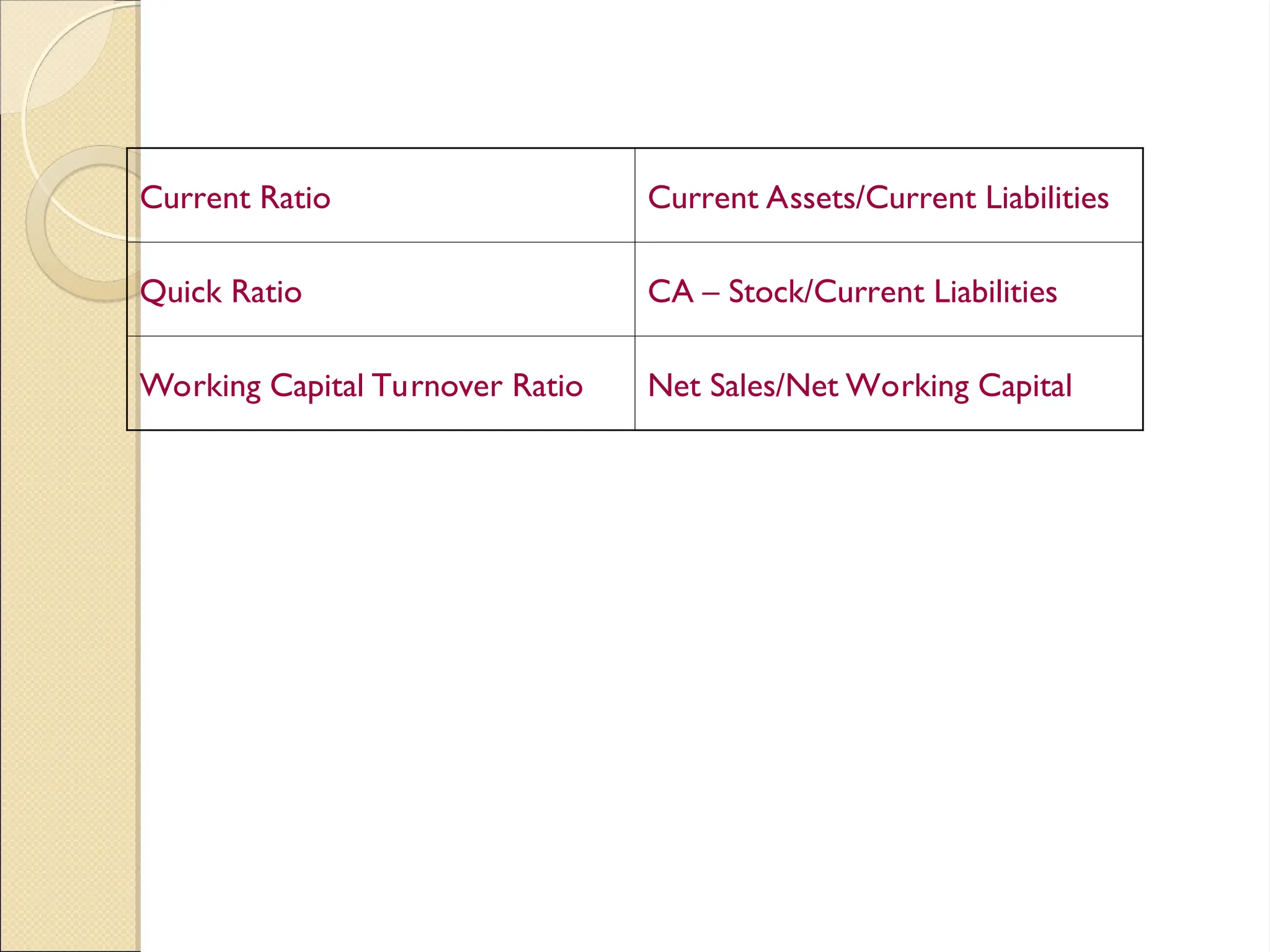
Current Ratio CurrentAssets/Current Liabilities
Quick Ratio CA – Stock/Current Liabilities
Working Capital Turnover Ratio Net Sales/Net Working Capital
![ECONOMIC ORDER QUANTITY [ EOQ ]
ECONOMIC ORDER QUANTITY [ EOQ ]
The ordering quantity problems are solved by the firm by determining the
EOQ ( or the Economic Lot Size ) that is the optimum level of inventory.
There are two types of costs involved in this model.
Ordering costs
Carrying costs
The EOQ is that level of inventory which MINIMIZES the total of ordering
and carrying costs.](https://image.slidesharecdn.com/182277147-power-point-working-capital-ppt-250320135551-2948a773/75/182277147-power-point-working-Capital-ppt-ppt-58-2048.jpg)
![The formula for change in profit is given as
The formula for change in profit is given as
Dl = CD + [C/Q*-C/Q’] O [Q’ (P-D) I/2-Q*PI/2]
Where
Dl = change in profit
C = Annual Consumption / Usage / Demand
D = Discount per unit when available
Q* = EOQ without Quantity Discount
Q’ = Min order size required for Discount
O = Fixed Ordering Cost
P = Purchase price per unit without discount
I = Inventory carrying cost (% on Price)](https://image.slidesharecdn.com/182277147-power-point-working-capital-ppt-250320135551-2948a773/75/182277147-power-point-working-Capital-ppt-ppt-64-2048.jpg)
![SELECTIVE CONTROL OF INVENTORY
SELECTIVE CONTROL OF INVENTORY
Different classification methods
Different classification methods
Classification Basis
ABC
[Always Better Control ]
Value of items consumed
VED
[ Vital, Essential, Desirable ]
The importance or criticality
FSN
[ Fast-moving, Slow-moving, Non-moving ]
The pace at which the material moves
HML
[ High, Medium, Low ]
Unit price of materials
SDE
[ Scarce, Difficult, Easy ]
Procurement Difficulties
XYZ Value of items in storage](https://image.slidesharecdn.com/182277147-power-point-working-capital-ppt-250320135551-2948a773/75/182277147-power-point-working-Capital-ppt-ppt-65-2048.jpg)