

WORKING CAPITAL
MANAGEMENT
PRESENTED BY:
AHAD FAROOQI
MARIUM QURESHI
OMER USMAN PEERJI
NOAM KHAN
SABA SALMAN
Introduction
 Working capital typically means
the firm’s holding of current or
short-term assets such as cash,
receivables, inventory and
marketable securities.
 These items are also referred to
as circulating capital
 Corporate executives devote a
considerable amount of attention
to the management of working
Definition
 Working Capital refers to that part of the
firm’s capital, which is required for financing
short-term or current assets such a cash
marketable securities, debtors and
inventories. Funds thus, invested in current
assets keep revolving fast and are constantly
converted into cash and this cash flow out
again in exchange for other current assets.
Working Capital is also known as revolving
or circulating capital or short-term
capital.
Nature Of Working Capital
 Working capital management is concerned with the
problems that arise in attempting to manage the
current assets, the current liabilities and the
interrelations that exist between them.
 Current assets refer to those assets which in the
ordinary course of business can be, or will be,
converted into cash within one year without
undergoing a diminution in value and without
disrupting the operations of the firm.
Examples- cash, marketable securities, accounts
receivable and inventory.
 Current liabilities are those liabilities which are
intended, at their inception, to be paid in the ordinary
course of business, within a year, out of the current
assets or the earnings of the concern.
Examples- accounts payable, bills payable, bank
overdraft and outstanding expenses.
Concept of working capital
There are two possible interpretations of
working capital concept:
1.Balance sheet concept
2.Operating cycle concept
Balance Sheet Concept
Balance sheet concept
There are two interpretations of
working capital under the balance
sheet concept.
a. Excess of current assets over
current liabilities
b. gross or total current assets.
 Excess of current assets over current
liabilities are called the net working
capital or net current assets.
 Working capital is really what a part of
long term finance is locked in and used
for supporting current activities.
 The balance sheet definition of working
capital is meaningful only as an
indication of the firm’s current solvency
in repaying its creditors.
 When firms speak of shortage of
working capital they in fact possibly
imply scarcity of cash resources.
 In fund flow analysis an increase in
working capital, as conventionally
defined, represents employment or
application of funds.
Operating Cycle Concept
 Operating cycle concept
 A company’s operating cycle typically
consists of three primary activities:
◦ Purchasing resources,
◦ Producing the product and
◦ Distributing (selling) the product.
These activities create funds flows that are both
unsynchronized and uncertain.
Unsynchronized because cash disbursements (for
example, payments for resource purchases)
usually take place before cash receipts (for
example collection of receivables).
They are uncertain because future sales and costs,
which generate the respective receipts and
disbursements, cannot be forecasted with complete
accuracy.
Manage and Measuring
Liquidity Liquidity:The degree to which an asset or security can be bought or sold
in the market without affecting the asset's price. Liquidity is characterized
by a high level of trading activity. Assets that can be easily bought or
sold.
OR
The ability to convert an asset to cash quickly. Also known as
"marketability.“
Liquidity Management:Liquidity management is the ability of the firm
to generate enough cash required to meet the firm’s needs.
 Drags are delay and slowing in cash inflows
 While pulls are accelerating cash outflows.
Sources of Liquidity
 The primary sources of liquidity include the
sources that a firm uses for its regular daily
operations. This includes:
 Cash
◦ Cash received from sales
◦ Collection of receivables
◦ Short-term investment, and others
 Short-term Funding
◦ Trade credit from suppliers
◦ Working capital loans from banks
 Cash flow management
◦ The firm can also generate working capital by
effectively managing its cash.
 Secondary Sources of Liquidity
 These are the sources of liquidity that are
not normally a part of the regular operations.
However, in times of need, the firm may use
these sources. These include:
 Renegotiating existing debt contracts
 Liquidating short-term and/or long-term
assets
 Filing for bankruptcy
 Utilizing the secondary sources of funding
can impact the company’s financial structure
and may even affect its operations. This also
indicates that the firm’s financial condition is
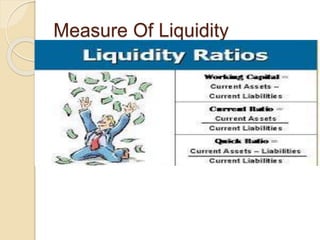
Measure Of Liquidity
Cash Conversion Cycle
 A metric that expresses the length of time, in
days, that it takes for a company to convert
resource inputs into cash flows. The cash
conversion cycle attempts to measure the
amount of time each net input dollar is tied up in
the production and sales process before it is
converted into cash through sales to customers.
This metric looks at the amount of time needed
to sell inventory, the amount of time needed to
collect receivables and the length of time the
company is afforded to pay its bills without
incurring penalties.
 Also known as "cash cycle."
Operating Cycle
 Expressed as an indicator (days) of
management performance efficiency, the
operating cycle is a "twin" of the cash
conversion cycle. While the parts are the
same - receivables, inventory and
payables - in the operating cycle, they are
analyzed from the perspective of how well
the company is managing these critical
operational capital assets, as opposed to
their impact on cash.
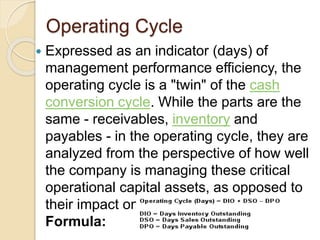
Formula:
DIFFERENCES
OPERATING CYCLE CASH CONVERSION CYCLE
 An operating cycle is the average
time period between the acquisition
of inventory and the receipt of cash
from the inventory's sale. A short
operating cycle means a more
prompt return on investment for the
firm's inventory. During an
economic downtown, an operating
cycle typically lasts longer than in
periods of economic growth.
 The cash conversion cycle is the number of
days required for a company to convert
resources to cash flows. This measure
calculates the time period during which
each input dollar is committed to production
and sales processes before it is converted to
cash through the accounts receivable
process. The cash conversion process gives
insight into the financial stability of a
company because it reflects the time period
during which assets are committed to
business processes and therefore are not
available to invest to achieve even greater
returns. As a result, the shorter the cash
conversion cycle, the better.
CALCULATION
OPERATING CYCLE CASH CONVERSION CYCLE
 To calculate the operating cycle,
determine the duration of each
element of the operating cycle
including raw materials, work-in-
process, finished goods and bills
receivable. Next, calculate the
aggregate duration of the cycle by
adding together each of these
elements. The greater the operating
cycle, the greater the business
requirement for working capital. The
greater the working-capital
requirement, the higher the inventory-
carrying cost, including interest
payments, and the greater the
opportunity cost due to the inability to
invest funds in a higher use. In
addition, the lower the operating cycle,
the greater the number of completed
cycles per year, and the greater the
annual gross and net profits.
 The cash conversion cycle calculation
uses elements of the operating cycle
equation, including raw materials, work-
in-process, finished goods and bills
receivable, in addition to the days'
payables outstanding. The days'
payables outstanding is the average
time required by the company to pay its
vendors. First, calculate the accounts
payable turnover by dividing the cost of
goods sold by accounts payable. Next,
divide 365 days by the accounts payable
turnover to determine the days' payables
outstanding. To determine the cash
conversion cycle, first add the days'
sales outstanding and the days' sales in
inventory, and then subtract the days'
payables outstanding. The resulting
cash conversion cycle measures the
time period between the cash outflow for
materials required for the production of a
product or service and the cash inflow
from sales. A decrease in the cash
Managing Cash Position
 The amount of cash that a company,
investment fund or bank has on its books
at a specific point in time. The cash
position is a sign of financial strength
and liquidity. In addition to cash itself, it
will often take into consideration highly
liquid assets such as certificates of
deposit, short-term government debt and
other cash equivalents.
Short Term Investment Funds
 A type of fund that invests in short-
term investments of high quality and
low risk. The goal of this type of fund
is to protect capital with low-risk
investments while achieving a return
that beats a relevant benchmark such
as a Treasury bill index.
THANKYOU

Working capital management

  • 1.
    WORKING CAPITAL MANAGEMENT PRESENTED BY: AHADFAROOQI MARIUM QURESHI OMER USMAN PEERJI NOAM KHAN SABA SALMAN
  • 2.
    Introduction  Working capitaltypically means the firm’s holding of current or short-term assets such as cash, receivables, inventory and marketable securities.  These items are also referred to as circulating capital  Corporate executives devote a considerable amount of attention to the management of working
  • 3.
    Definition  Working Capitalrefers to that part of the firm’s capital, which is required for financing short-term or current assets such a cash marketable securities, debtors and inventories. Funds thus, invested in current assets keep revolving fast and are constantly converted into cash and this cash flow out again in exchange for other current assets. Working Capital is also known as revolving or circulating capital or short-term capital.
  • 4.
    Nature Of WorkingCapital  Working capital management is concerned with the problems that arise in attempting to manage the current assets, the current liabilities and the interrelations that exist between them.  Current assets refer to those assets which in the ordinary course of business can be, or will be, converted into cash within one year without undergoing a diminution in value and without disrupting the operations of the firm. Examples- cash, marketable securities, accounts receivable and inventory.  Current liabilities are those liabilities which are intended, at their inception, to be paid in the ordinary course of business, within a year, out of the current assets or the earnings of the concern. Examples- accounts payable, bills payable, bank overdraft and outstanding expenses.
  • 5.
    Concept of workingcapital There are two possible interpretations of working capital concept: 1.Balance sheet concept 2.Operating cycle concept
  • 6.
    Balance Sheet Concept Balancesheet concept There are two interpretations of working capital under the balance sheet concept. a. Excess of current assets over current liabilities b. gross or total current assets.
  • 7.
     Excess ofcurrent assets over current liabilities are called the net working capital or net current assets.  Working capital is really what a part of long term finance is locked in and used for supporting current activities.  The balance sheet definition of working capital is meaningful only as an indication of the firm’s current solvency in repaying its creditors.  When firms speak of shortage of working capital they in fact possibly imply scarcity of cash resources.  In fund flow analysis an increase in working capital, as conventionally defined, represents employment or application of funds.
  • 8.
    Operating Cycle Concept Operating cycle concept  A company’s operating cycle typically consists of three primary activities: ◦ Purchasing resources, ◦ Producing the product and ◦ Distributing (selling) the product. These activities create funds flows that are both unsynchronized and uncertain. Unsynchronized because cash disbursements (for example, payments for resource purchases) usually take place before cash receipts (for example collection of receivables). They are uncertain because future sales and costs, which generate the respective receipts and disbursements, cannot be forecasted with complete accuracy.
  • 9.
    Manage and Measuring LiquidityLiquidity:The degree to which an asset or security can be bought or sold in the market without affecting the asset's price. Liquidity is characterized by a high level of trading activity. Assets that can be easily bought or sold. OR The ability to convert an asset to cash quickly. Also known as "marketability.“ Liquidity Management:Liquidity management is the ability of the firm to generate enough cash required to meet the firm’s needs.  Drags are delay and slowing in cash inflows  While pulls are accelerating cash outflows.
  • 10.
    Sources of Liquidity The primary sources of liquidity include the sources that a firm uses for its regular daily operations. This includes:  Cash ◦ Cash received from sales ◦ Collection of receivables ◦ Short-term investment, and others  Short-term Funding ◦ Trade credit from suppliers ◦ Working capital loans from banks  Cash flow management ◦ The firm can also generate working capital by effectively managing its cash.
  • 11.
     Secondary Sourcesof Liquidity  These are the sources of liquidity that are not normally a part of the regular operations. However, in times of need, the firm may use these sources. These include:  Renegotiating existing debt contracts  Liquidating short-term and/or long-term assets  Filing for bankruptcy  Utilizing the secondary sources of funding can impact the company’s financial structure and may even affect its operations. This also indicates that the firm’s financial condition is
  • 12.
  • 13.
    Cash Conversion Cycle A metric that expresses the length of time, in days, that it takes for a company to convert resource inputs into cash flows. The cash conversion cycle attempts to measure the amount of time each net input dollar is tied up in the production and sales process before it is converted into cash through sales to customers. This metric looks at the amount of time needed to sell inventory, the amount of time needed to collect receivables and the length of time the company is afforded to pay its bills without incurring penalties.  Also known as "cash cycle."
  • 14.
    Operating Cycle  Expressedas an indicator (days) of management performance efficiency, the operating cycle is a "twin" of the cash conversion cycle. While the parts are the same - receivables, inventory and payables - in the operating cycle, they are analyzed from the perspective of how well the company is managing these critical operational capital assets, as opposed to their impact on cash. Formula:
  • 15.
    DIFFERENCES OPERATING CYCLE CASHCONVERSION CYCLE  An operating cycle is the average time period between the acquisition of inventory and the receipt of cash from the inventory's sale. A short operating cycle means a more prompt return on investment for the firm's inventory. During an economic downtown, an operating cycle typically lasts longer than in periods of economic growth.  The cash conversion cycle is the number of days required for a company to convert resources to cash flows. This measure calculates the time period during which each input dollar is committed to production and sales processes before it is converted to cash through the accounts receivable process. The cash conversion process gives insight into the financial stability of a company because it reflects the time period during which assets are committed to business processes and therefore are not available to invest to achieve even greater returns. As a result, the shorter the cash conversion cycle, the better.
  • 16.
    CALCULATION OPERATING CYCLE CASHCONVERSION CYCLE  To calculate the operating cycle, determine the duration of each element of the operating cycle including raw materials, work-in- process, finished goods and bills receivable. Next, calculate the aggregate duration of the cycle by adding together each of these elements. The greater the operating cycle, the greater the business requirement for working capital. The greater the working-capital requirement, the higher the inventory- carrying cost, including interest payments, and the greater the opportunity cost due to the inability to invest funds in a higher use. In addition, the lower the operating cycle, the greater the number of completed cycles per year, and the greater the annual gross and net profits.  The cash conversion cycle calculation uses elements of the operating cycle equation, including raw materials, work- in-process, finished goods and bills receivable, in addition to the days' payables outstanding. The days' payables outstanding is the average time required by the company to pay its vendors. First, calculate the accounts payable turnover by dividing the cost of goods sold by accounts payable. Next, divide 365 days by the accounts payable turnover to determine the days' payables outstanding. To determine the cash conversion cycle, first add the days' sales outstanding and the days' sales in inventory, and then subtract the days' payables outstanding. The resulting cash conversion cycle measures the time period between the cash outflow for materials required for the production of a product or service and the cash inflow from sales. A decrease in the cash
  • 17.
    Managing Cash Position The amount of cash that a company, investment fund or bank has on its books at a specific point in time. The cash position is a sign of financial strength and liquidity. In addition to cash itself, it will often take into consideration highly liquid assets such as certificates of deposit, short-term government debt and other cash equivalents.
  • 18.
    Short Term InvestmentFunds  A type of fund that invests in short- term investments of high quality and low risk. The goal of this type of fund is to protect capital with low-risk investments while achieving a return that beats a relevant benchmark such as a Treasury bill index.
  • 19.