WORKING CAPITAL
  ASSESSMENT

          -Umang Soni
         -WRO0276669
Funds required to fulfill short term
 obligations & smoothly conduct
  routine business operations.


Gross WC                     Net WC
WHAT ARE CURRENT ASSETS ?

Assets which are normally converted into
cash during the operating cycle of the entity.
 Cash & Bank balances
 Inventory
 Receivables
 Advances to suppliers/others
 Marketable Securities
 Other Current assets
OPERATING CYCLE
It begins with acquisition of raw materials
and ends with collection of receivables.

Raw Materials (RM/RM Consumption)
Add: Work-In-Process (WIP/COP)
Add: Finished Goods (FG/COS)
Add: Receivables (Debtors/Credit sales)
Less: Creditors (Creditors/Purchases)
Operating Cycle
FACTORS INFLUENCING WORKING
         CAPITAL REQUIREMENT

   Nature of Business & Operations
   Production Policy
   Market conditions
   Conditions of supply of RM / stores &
    spares, etc.
   Level of activity & Operating Cycle
WORKING CAPITAL FINANCE

A) Fund Based

Cash Credit / Overdraft Packing Credit

Demand Loan            Bill Finance

B) Non Fund Based

Letter of Credit       Bank Guarantee
WORKING CAPITAL ASSESSMENT
           METHODS
 Operating   Cycle Method
 Drawing Power   Method
 Turnover   Method
 MPBF   Method
 Cash Budget   Method
OPERATING CYCLE METHOD
A. Length of Operating Cycle
a. Procurement of Raw Material
b. Conversion / Process time
c. Average Finished Goods Holding Period
d. Average Collection Period
e. Average Supplier’s Credit Period
f. Operating Cycle (a + b + c + d - e)
g. No. of Operating Cycles in a year
(365 days / f)
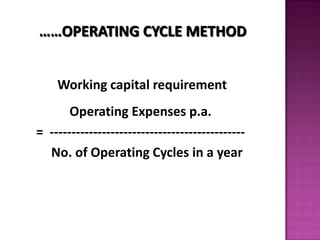
……OPERATING CYCLE METHOD


    Working capital requirement
       Operating Expenses p.a.
= ---------------------------------------------
  No. of Operating Cycles in a year
DRAWING POWER (DP) METHOD
Particulars       Security Margin     DP
Paid Raw Material    (a)    (e) [a * (1-e)]
(RM-Creditors)
Semi Finished        (b)    (f)   [b * (1-f)]
goods
Finished goods       (c)    (g)   [c * (1-g)]
Book debts           (d)    (h) [d * (1-h)]
               Total
TURNOVER METHOD
(originally suggested by NAYAK Committee)
 A   Sales Turnover
 B   25% of Sales Turnover
 C   5% of Sales Turnover projected as Margin
 D   Actual NWC existing as per Last Financial
     Statement
 E   B–C
 F   B–D
 G   MPBF (E or F whichever is less)
 H   Additional margin to be brought in (C-D)
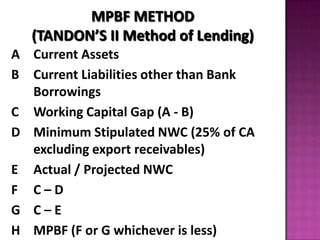
MPBF METHOD
   (TANDON’S II Method of Lending)
A Current Assets
B Current Liabilities other than Bank
  Borrowings
C Working Capital Gap (A - B)
D Minimum Stipulated NWC (25% of CA
  excluding export receivables)
E Actual / Projected NWC
F C–D
G C–E
H MPBF (F or G whichever is less)
CASH BUDGET METHOD
 Forecasted    Cash Flow Statement showing
 estimates of cash receipts, cash payments
 and net cash balance over the project term.
 Peak   deficit is financed.
 Banks   & Financial Institutions supervise the
 end use of the funds sanctioned through
 actual Cash Flow.
BILL FINANCE

   For genuine trade & manufacturing
    transaction
   Various Types:
      Discounting / Purchase of Bills of
        Exchange
      Cheque Purchase
      Advance against delivery
      Advance against acceptance
      Packing Credit
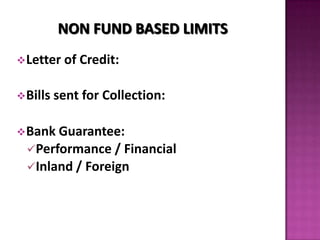
NON FUND BASED LIMITS
 Letter   of Credit:

 Bills   sent for Collection:

 Bank Guarantee:
  Performance / Financial
  Inland / Foreign
JUSTIFICATION OF THE PERFORMANCE
             PROJECTION
For Existing Units:
 Intra-Firm Comparison (i.e. Trend Analysis)
 Inter-Firm Comparison
 Evidences (Orders in Hand, Orders in
 Pipeline)
For New Units:
 Pure Play Technique

Note: Higher projections should be justified.
Working Capital Assessment

Working Capital Assessment

  • 1.
    WORKING CAPITAL ASSESSMENT -Umang Soni -WRO0276669
  • 2.
    Funds required tofulfill short term obligations & smoothly conduct routine business operations. Gross WC Net WC
  • 3.
    WHAT ARE CURRENTASSETS ? Assets which are normally converted into cash during the operating cycle of the entity.  Cash & Bank balances  Inventory  Receivables  Advances to suppliers/others  Marketable Securities  Other Current assets
  • 4.
    OPERATING CYCLE It beginswith acquisition of raw materials and ends with collection of receivables. Raw Materials (RM/RM Consumption) Add: Work-In-Process (WIP/COP) Add: Finished Goods (FG/COS) Add: Receivables (Debtors/Credit sales) Less: Creditors (Creditors/Purchases) Operating Cycle
  • 5.
    FACTORS INFLUENCING WORKING CAPITAL REQUIREMENT  Nature of Business & Operations  Production Policy  Market conditions  Conditions of supply of RM / stores & spares, etc.  Level of activity & Operating Cycle
  • 6.
    WORKING CAPITAL FINANCE A)Fund Based Cash Credit / Overdraft Packing Credit Demand Loan Bill Finance B) Non Fund Based Letter of Credit Bank Guarantee
  • 7.
    WORKING CAPITAL ASSESSMENT METHODS  Operating Cycle Method  Drawing Power Method  Turnover Method  MPBF Method  Cash Budget Method
  • 8.
    OPERATING CYCLE METHOD A.Length of Operating Cycle a. Procurement of Raw Material b. Conversion / Process time c. Average Finished Goods Holding Period d. Average Collection Period e. Average Supplier’s Credit Period f. Operating Cycle (a + b + c + d - e) g. No. of Operating Cycles in a year (365 days / f)
  • 9.
    ……OPERATING CYCLE METHOD Working capital requirement Operating Expenses p.a. = --------------------------------------------- No. of Operating Cycles in a year
  • 10.
    DRAWING POWER (DP)METHOD Particulars Security Margin DP Paid Raw Material (a) (e) [a * (1-e)] (RM-Creditors) Semi Finished (b) (f) [b * (1-f)] goods Finished goods (c) (g) [c * (1-g)] Book debts (d) (h) [d * (1-h)] Total
  • 11.
    TURNOVER METHOD (originally suggestedby NAYAK Committee) A Sales Turnover B 25% of Sales Turnover C 5% of Sales Turnover projected as Margin D Actual NWC existing as per Last Financial Statement E B–C F B–D G MPBF (E or F whichever is less) H Additional margin to be brought in (C-D)
  • 12.
    MPBF METHOD (TANDON’S II Method of Lending) A Current Assets B Current Liabilities other than Bank Borrowings C Working Capital Gap (A - B) D Minimum Stipulated NWC (25% of CA excluding export receivables) E Actual / Projected NWC F C–D G C–E H MPBF (F or G whichever is less)
  • 13.
    CASH BUDGET METHOD Forecasted Cash Flow Statement showing estimates of cash receipts, cash payments and net cash balance over the project term.  Peak deficit is financed.  Banks & Financial Institutions supervise the end use of the funds sanctioned through actual Cash Flow.
  • 14.
    BILL FINANCE  For genuine trade & manufacturing transaction  Various Types:  Discounting / Purchase of Bills of Exchange  Cheque Purchase  Advance against delivery  Advance against acceptance  Packing Credit
  • 15.
    NON FUND BASEDLIMITS  Letter of Credit:  Bills sent for Collection:  Bank Guarantee: Performance / Financial Inland / Foreign
  • 16.
    JUSTIFICATION OF THEPERFORMANCE PROJECTION For Existing Units:  Intra-Firm Comparison (i.e. Trend Analysis)  Inter-Firm Comparison  Evidences (Orders in Hand, Orders in Pipeline) For New Units:  Pure Play Technique Note: Higher projections should be justified.