Working Capital Assessment
CA Rajesh D
rajeshd@sbsandco.com
Date: 16/03/2016
by
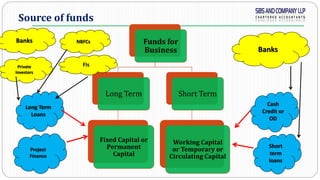
Source of funds
Funds for
Business
Long Term
Fixed Capital or
Permanent
Capital
Short Term
Working Capital
or Temporary or
Circulating Capital
Long Term
Loans
Project
Finance
Cash
Credit or
OD
Short
term
loans
Banks
Banks
Private
Investors
NBFCs
FIs
www.sbsandco.com3
 Objective:
1. Concept of Working Capital
2. Gross Working Capital , Working capital Gap, Net Working Capital
3. Components of working capital
4. Working capital operating cycle
5. Various methods of working capital assessment viz
i. Turnover method
ii. MPBF method
iii. Cash Budget Method
6. CMA Data.
Working Capital
www.sbsandco.com4
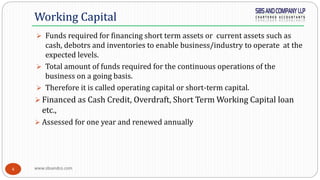
 Funds required for financing short term assets or current assets such as
cash, debotrs and inventories to enable business/industry to operate at the
expected levels.
 Total amount of funds required for the continuous operations of the
business on a going basis.
 Therefore it is called operating capital or short-term capital.
 Financed as Cash Credit, Overdraft, Short Term Working Capital loan
etc.,
 Assessed for one year and renewed annually
Working Capital
www.sbsandco.com5
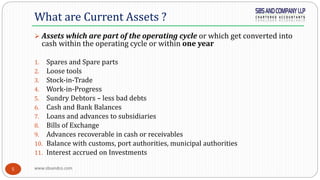
 Assets which are part of the operating cycle or which get converted into
cash within the operating cycle or within one year
1. Spares and Spare parts
2. Loose tools
3. Stock-in-Trade
4. Work-in-Progress
5. Sundry Debtors – less bad debts
6. Cash and Bank Balances
7. Loans and advances to subsidiaries
8. Bills of Exchange
9. Advances recoverable in cash or receivables
10. Balance with customs, port authorities, municipal authorities
11. Interest accrued on Investments
What are Current Assets ?
www.sbsandco.com6
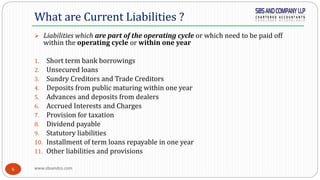
 Liabilities which are part of the operating cycle or which need to be paid off
within the operating cycle or within one year
1. Short term bank borrowings
2. Unsecured loans
3. Sundry Creditors and Trade Creditors
4. Deposits from public maturing within one year
5. Advances and deposits from dealers
6. Accrued Interests and Charges
7. Provision for taxation
8. Dividend payable
9. Statutory liabilities
10. Installment of term loans repayable in one year
11. Other liabilities and provisions
What are Current Liabilities ?
www.sbsandco.com7
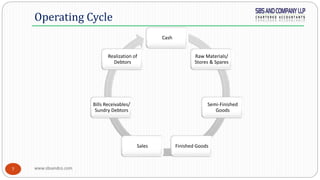
Operating Cycle
Cash
Raw Materials/
Stores & Spares
Semi-Finished
Goods
Finished GoodsSales
Bills Receivables/
Sundry Debtors
Realization of
Debtors
www.sbsandco.com8
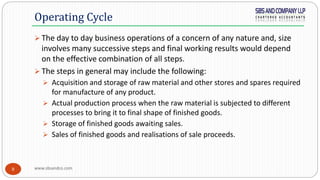
 The day to day business operations of a concern of any nature and, size
involves many successive steps and final working results would depend
on the effective combination of all steps.
 The steps in general may include the following:
 Acquisition and storage of raw material and other stores and spares required
for manufacture of any product.
 Actual production process when the raw material is subjected to different
processes to bring it to final shape of finished goods.
 Storage of finished goods awaiting sales.
 Sales of finished goods and realisations of sale proceeds.
Operating Cycle
www.sbsandco.com9
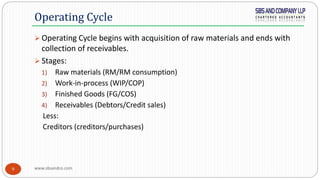
 Operating Cycle begins with acquisition of raw materials and ends with
collection of receivables.
 Stages:
1) Raw materials (RM/RM consumption)
2) Work-in-process (WIP/COP)
3) Finished Goods (FG/COS)
4) Receivables (Debtors/Credit sales)
Less:
Creditors (creditors/purchases)
Operating Cycle
www.sbsandco.com10
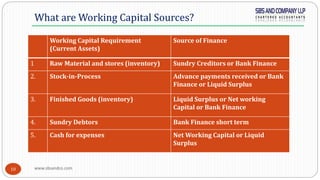
What are Working Capital Sources?
Working Capital Requirement
(Current Assets)
Source of Finance
1 Raw Material and stores (inventory) Sundry Creditors or Bank Finance
2. Stock-in-Process Advance payments received or Bank
Finance or Liquid Surplus
3. Finished Goods (inventory) Liquid Surplus or Net working
Capital or Bank Finance
4. Sundry Debtors Bank Finance short term
5. Cash for expenses Net Working Capital or Liquid
Surplus
www.sbsandco.com11
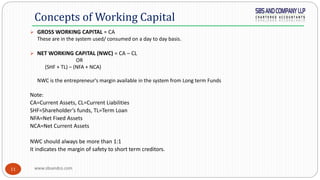
 GROSS WORKING CAPITAL = CA
These are in the system used/ consumed on a day to day basis.
 NET WORKING CAPITAL (NWC) = CA – CL
OR
(SHF + TL) – (NFA + NCA)
NWC is the entrepreneur's margin available in the system from Long term Funds
Note:
CA=Current Assets, CL=Current Liabilities
SHF=Shareholder’s funds, TL=Term Loan
NFA=Net Fixed Assets
NCA=Net Current Assets
NWC should always be more than 1:1
It indicates the margin of safety to short term creditors.
Concepts of Working Capital
www.sbsandco.com
12
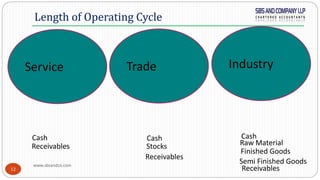
Length of Operating Cycle
Cash CashCash
Service Trade Industry
Receivables Stocks
Semi Finished Goods
Receivables
Receivables
Finished Goods
Raw Material
www.sbsandco.com13
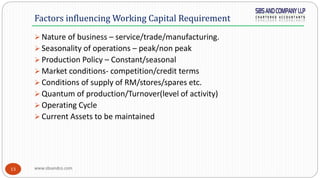
 Nature of business – service/trade/manufacturing.
 Seasonality of operations – peak/non peak
 Production Policy – Constant/seasonal
 Market conditions- competition/credit terms
 Conditions of supply of RM/stores/spares etc.
 Quantum of production/Turnover(level of activity)
 Operating Cycle
 Current Assets to be maintained
Factors influencing Working Capital Requirement
www.sbsandco.com14
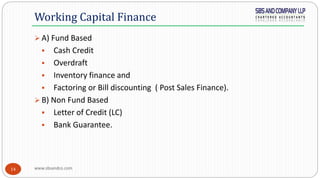
 A) Fund Based
 Cash Credit
 Overdraft
 Inventory finance and
 Factoring or Bill discounting ( Post Sales Finance).
 B) Non Fund Based
 Letter of Credit (LC)
 Bank Guarantee.
Working Capital Finance
www.sbsandco.com15
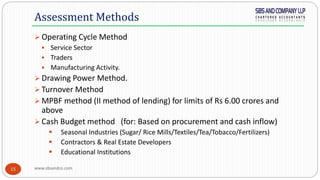
 Operating Cycle Method
 Service Sector
 Traders
 Manufacturing Activity.
 Drawing Power Method.
 Turnover Method
 MPBF method (II method of lending) for limits of Rs 6.00 crores and
above
 Cash Budget method (for: Based on procurement and cash inflow)
 Seasonal Industries (Sugar/ Rice Mills/Textiles/Tea/Tobacco/Fertilizers)
 Contractors & Real Estate Developers
 Educational Institutions
Assessment Methods
www.sbsandco.com16
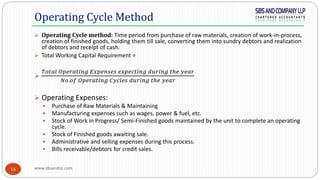
 Operating Cycle method: Time period from purchase of raw materials, creation of work-in-process,
creation of finished goods, holding them till sale, converting them into sundry debtors and realization
of debtors and receipt of cash.
 Total Working Capital Requirement =

𝑇𝑜𝑡𝑎𝑙 𝑂𝑝𝑒𝑟𝑎𝑡𝑖𝑛𝑔 𝐸𝑥𝑝𝑒𝑛𝑠𝑒𝑠 𝑒𝑥𝑝𝑒𝑐𝑡𝑖𝑛𝑔 𝑑𝑢𝑟𝑖𝑛𝑔 𝑡ℎ𝑒 𝑦𝑒𝑎𝑟
𝑁𝑜.𝑜𝑓 𝑂𝑝𝑒𝑟𝑎𝑡𝑖𝑛𝑔 𝐶𝑦𝑐𝑙𝑒𝑠 𝑑𝑢𝑟𝑖𝑛𝑔 𝑡ℎ𝑒 𝑦𝑒𝑎𝑟
 Operating Expenses:
 Purchase of Raw Materials & Maintaining
 Manufacturing expenses such as wages, power & fuel, etc.
 Stock of Work in Progress/ Semi-Finished goods maintained by the unit to complete an operating
cycle.
 Stock of Finished goods awaiting sale.
 Administrative and selling expenses during this process.
 Bills receivable/debtors for credit sales.
Operating Cycle Method
www.sbsandco.com17
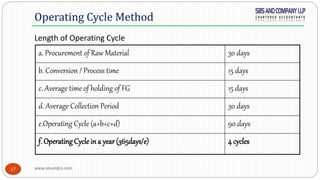
Length of Operating Cycle
Operating Cycle Method
a. Procurement of Raw Material 30 days
b. Conversion / Process time 15 days
c. Average time of holding of FG 15 days
d. Average Collection Period 30 days
e.Operating Cycle (a+b+c+d) 90 days
f. Operating Cycle in a year (365days/e) 4 cycles
www.sbsandco.com18
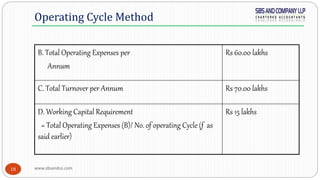
Operating Cycle Method
B. Total Operating Expenses per
Annum
Rs 60.00 lakhs
C. Total Turnover per Annum Rs 70.00 lakhs
D. Working Capital Requirement
= Total Operating Expenses (B)/ No. of operating Cycle (f as
said earlier)
Rs 15 lakhs
www.sbsandco.com19
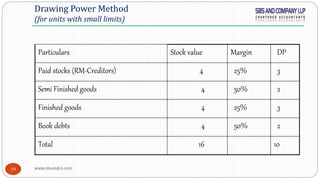
Drawing Power Method
(for units with small limits)
Particulars Stock value Margin DP
Paid stocks (RM-Creditors) 4 25% 3
Semi Finished goods 4 50% 2
Finished goods 4 25% 3
Book debts 4 50% 2
Total 16 10
www.sbsandco.com20
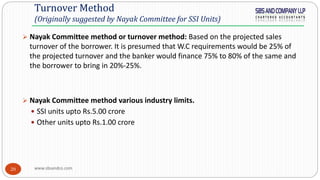
Turnover Method
(Originally suggested by Nayak Committee for SSI Units)
 Nayak Committee method or turnover method: Based on the projected sales
turnover of the borrower. It is presumed that W.C requirements would be 25% of
the projected turnover and the banker would finance 75% to 80% of the same and
the borrower to bring in 20%-25%.
 Nayak Committee method various industry limits.
 SSI units upto Rs.5.00 crore
 Other units upto Rs.1.00 crore
www.sbsandco.com21
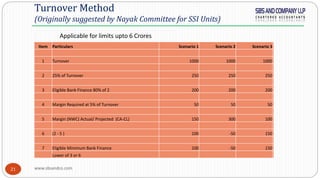
Turnover Method
(Originally suggested by Nayak Committee for SSI Units)
Applicable for limits upto 6 Crores
Item Particulars Scenario 1 Scenario 2 Scenario 3
1 Turnover 1000 1000 1000
2 25% of Turnover 250 250 250
3 Eligible Bank Finance 80% of 2 200 200 200
4 Margin Required at 5% of Turnover 50 50 50
5 Margin (NWC) Actual/ Projected (CA-CL) 150 300 100
6 (2 - 5 ) 100 -50 150
7 Eligible Minimum Bank Finance 100 -50 150
Lower of 3 or 6
www.sbsandco.com22
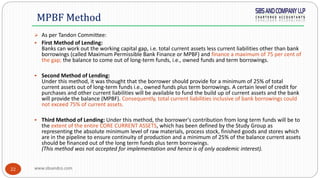
MPBF Method
 As per Tandon Committee:
 First Method of Lending:
Banks can work out the working capital gap, i.e. total current assets less current liabilities other than bank
borrowings (called Maximum Permissible Bank Finance or MPBF) and finance a maximum of 75 per cent of
the gap; the balance to come out of long-term funds, i.e., owned funds and term borrowings.
 Second Method of Lending:
Under this method, it was thought that the borrower should provide for a minimum of 25% of total
current assets out of long-term funds i.e., owned funds plus term borrowings. A certain level of credit for
purchases and other current liabilities will be available to fund the build up of current assets and the bank
will provide the balance (MPBF). Consequently, total current liabilities inclusive of bank borrowings could
not exceed 75% of current assets.
 Third Method of Lending: Under this method, the borrower's contribution from long term funds will be to
the extent of the entire CORE CURRENT ASSETS, which has been defined by the Study Group as
representing the absolute minimum level of raw materials, process stock, finished goods and stores which
are in the pipeline to ensure continuity of production and a minimum of 25% of the balance current assets
should be financed out of the long term funds plus term borrowings.
(This method was not accepted for implementation and hence is of only academic interest).
www.sbsandco.com23
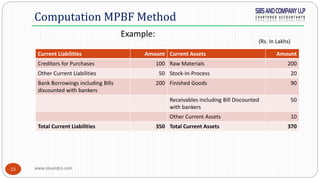
Computation MPBF Method
Current Liabilities Amount Current Assets Amount
Creditors for Purchases 100 Raw Materials 200
Other Current Liabilities 50 Stock-In-Process 20
Bank Borrowings including Bills
discounted with bankers
200 Finished Goods 90
Receivables including Bill Discounted
with bankers
50
Other Current Assets 10
Total Current Liabilities 350 Total Current Assets 370
Example:
(Rs. In Lakhs)
www.sbsandco.com24
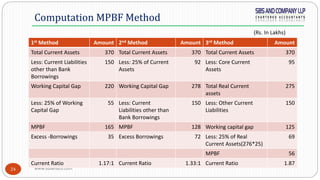
Computation MPBF Method
1st Method Amount 2nd Method Amount 3rd Method Amount
Total Current Assets 370 Total Current Assets 370 Total Current Assets 370
Less: Current Liabilities
other than Bank
Borrowings
150 Less: 25% of Current
Assets
92 Less: Core Current
Assets
95
Working Capital Gap 220 Working Capital Gap 278 Total Real Current
assets
275
Less: 25% of Working
Capital Gap
55 Less: Current
Liabilities other than
Bank Borrowings
150 Less: Other Current
Liabilities
150
MPBF 165 MPBF 128 Working capital gap 125
Excess -Borrowings 35 Excess Borrowings 72 Less: 25% of Real
Current Assets(276*25)
69
MPBF 56
Current Ratio 1.17:1 Current Ratio 1.33:1 Current Ratio 1.87
(Rs. In Lakhs)
www.sbsandco.com25
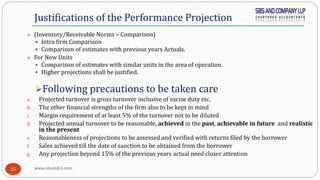
 (Inventory/Receivable Norms – Comparison)
 Intra firm Comparison
 Comparison of estimates with previous years Actuals.
 For New Units
 Comparison of estimates with similar units in the area of operation.
 Higher projections shall be justified.
Following precautions to be taken care
a. Projected turnover is gross turnover inclusive of excise duty etc.
b. The other financial strengths of the firm also to be kept in mind
c. Margin requirement of at least 5% of the turnover not to be diluted
d. Projected annual turnover to be reasonable, achieved in the past, achievable in future and realistic
in the present
e. Reasonableness of projections to be assessed and verified with returns filed by the borrower
f. Sales achieved till the date of sanction to be obtained from the borrower
g. Any projection beyond 15% of the previous years actual need closer attention
Justifications of the Performance Projection
www.sbsandco.com26
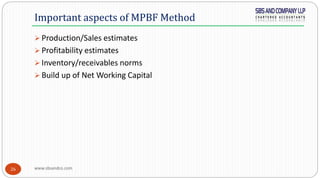
 Production/Sales estimates
 Profitability estimates
 Inventory/receivables norms
 Build up of Net Working Capital
Important aspects of MPBF Method
www.sbsandco.com27
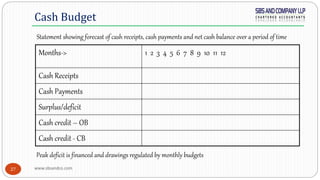
Cash Budget
Statement showing forecast of cash receipts, cash payments and net cash balance over a period of time
Months-> 1 2 3 4 5 6 7 8 9 10 11 12
Cash Receipts
Cash Payments
Surplus/deficit
Cash credit – OB
Cash credit - CB
Peak deficit is financed and drawings regulated by monthly budgets
www.sbsandco.com28
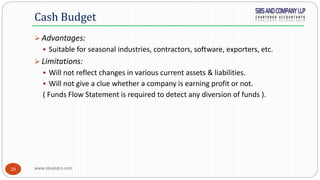
 Advantages:
 Suitable for seasonal industries, contractors, software, exporters, etc.
 Limitations:
 Will not reflect changes in various current assets & liabilities.
 Will not give a clue whether a company is earning profit or not.
( Funds Flow Statement is required to detect any diversion of funds ).
Cash Budget
www.sbsandco.com29
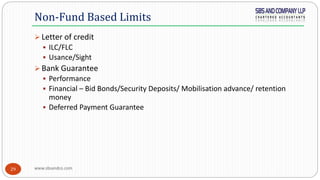
 Letter of credit
 ILC/FLC
 Usance/Sight
 Bank Guarantee
 Performance
 Financial – Bid Bonds/Security Deposits/ Mobilisation advance/ retention
money
 Deferred Payment Guarantee
Non-Fund Based Limits
www.sbsandco.com30
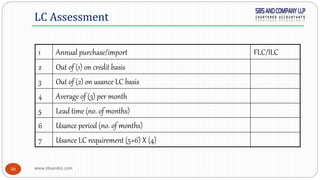
LC Assessment
1 Annual purchase/import FLC/ILC
2 Out of (1) on credit basis
3 Out of (2) on usance LC basis
4 Average of (3) per month
5 Lead time (no. of months)
6 Usance period (no. of months)
7 Usance LC requirement (5+6) X (4)
www.sbsandco.com31
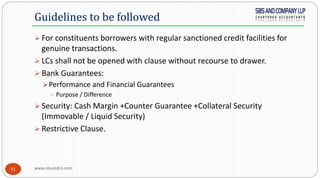
 For constituents borrowers with regular sanctioned credit facilities for
genuine transactions.
 LCs shall not be opened with clause without recourse to drawer.
 Bank Guarantees:
Performance and Financial Guarantees
 Purpose / Difference
 Security: Cash Margin +Counter Guarantee +Collateral Security
(Immovable / Liquid Security)
 Restrictive Clause.
Guidelines to be followed
www.sbsandco.com32
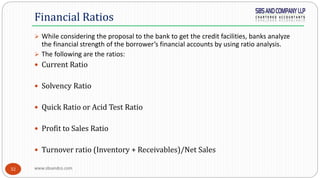
 While considering the proposal to the bank to get the credit facilities, banks analyze
the financial strength of the borrower’s financial accounts by using ratio analysis.
 The following are the ratios:
 Current Ratio
 Solvency Ratio
 Quick Ratio or Acid Test Ratio
 Profit to Sales Ratio
 Turnover ratio (Inventory + Receivables)/Net Sales
Financial Ratios
www.sbsandco.com33
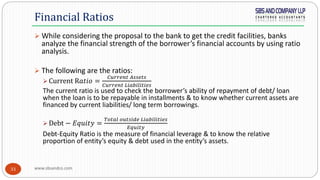
 While considering the proposal to the bank to get the credit facilities, banks
analyze the financial strength of the borrower’s financial accounts by using ratio
analysis.
 The following are the ratios:
 Current R𝑎𝑡𝑖𝑜 =
𝐶𝑢𝑟𝑟𝑒𝑛𝑡 𝐴𝑠𝑠𝑒𝑡𝑠
𝐶𝑢𝑟𝑟𝑒𝑛𝑡 𝐿𝑖𝑎𝑏𝑖𝑙𝑖𝑡𝑖𝑒𝑠
The current ratio is used to check the borrower’s ability of repayment of debt/ loan
when the loan is to be repayable in installments & to know whether current assets are
financed by current liabilities/ long term borrowings.
 Debt − 𝐸𝑞𝑢𝑖𝑡𝑦 =
𝑇𝑜𝑡𝑎𝑙 𝑜𝑢𝑡𝑠𝑖𝑑𝑒 𝐿𝑖𝑎𝑏𝑖𝑙𝑖𝑡𝑖𝑒𝑠
𝐸𝑞𝑢𝑖𝑡𝑦
Debt-Equity Ratio is the measure of financial leverage & to know the relative
proportion of entity’s equity & debt used in the entity’s assets.
Financial Ratios
www.sbsandco.com34
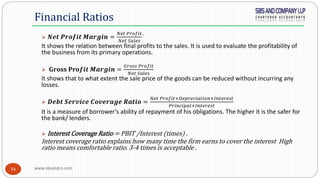
 𝑵𝒆𝒕 𝑷𝒓𝒐𝒇𝒊𝒕 𝑴𝒂𝒓𝒈𝒊𝒏 =
𝑁𝑒𝑡 𝑃𝑟𝑜𝑓𝑖𝑡
𝑁𝑒𝑡 𝑆𝑎𝑙𝑒𝑠
`
It shows the relation between final profits to the sales. It is used to evaluate the profitability of
the business from its primary operations.
 𝐆𝐫𝐨𝐬𝐬 𝐏𝐫𝐨𝒇𝒊𝒕 𝑴𝒂𝒓𝒈𝒊𝒏 =
𝐺𝑟𝑜𝑠𝑠 𝑃𝑟𝑜𝑓𝑖𝑡
𝑁𝑒𝑡 𝑆𝑎𝑙𝑒𝑠
It shows that to what extent the sale price of the goods can be reduced without incurring any
losses.
 𝑫𝒆𝒃𝒕 𝑺𝒆𝒓𝒗𝒊𝒄𝒆 𝑪𝒐𝒗𝒆𝒓𝒂𝒈𝒆 𝑹𝒂𝒕𝒊𝒐 =
𝑁𝑒𝑡 𝑃𝑟𝑜𝑓𝑖𝑡+𝐷𝑒𝑝𝑟𝑒𝑐𝑖𝑎𝑡𝑖𝑜𝑛+𝐼𝑛𝑡𝑒𝑟𝑒𝑠𝑡
𝑃𝑟𝑖𝑛𝑐𝑖𝑝𝑎𝑙+𝐼𝑛𝑡𝑒𝑟𝑒𝑠𝑡
It is a measure of borrower’s ability of repayment of his obligations. The higher it is the safer for
the bank/ lenders.
 Interest Coverage Ratio = PBIT /Interest (times) .
Interest coverage ratio explains how many time the firm earns to cover the interest High
ratio means comfortable ratio. 3-4 times is acceptable .
Financial Ratios
www.sbsandco.com35
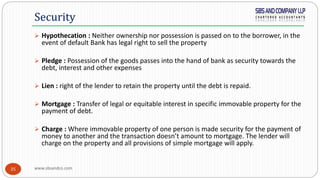
 Hypothecation : Neither ownership nor possession is passed on to the borrower, in the
event of default Bank has legal right to sell the property
 Pledge : Possession of the goods passes into the hand of bank as security towards the
debt, interest and other expenses
 Lien : right of the lender to retain the property until the debt is repaid.
 Mortgage : Transfer of legal or equitable interest in specific immovable property for the
payment of debt.
 Charge : Where immovable property of one person is made security for the payment of
money to another and the transaction doesn’t amount to mortgage. The lender will
charge on the property and all provisions of simple mortgage will apply.
Security
www.sbsandco.com36
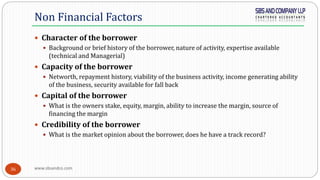
 Character of the borrower
 Background or brief history of the borrower, nature of activity, expertise available
(technical and Managerial)
 Capacity of the borrower
 Networth, repayment history, viability of the business activity, income generating ability
of the business, security available for fall back
 Capital of the borrower
 What is the owners stake, equity, margin, ability to increase the margin, source of
financing the margin
 Credibility of the borrower
 What is the market opinion about the borrower, does he have a track record?
Non Financial Factors
www.sbsandco.com37
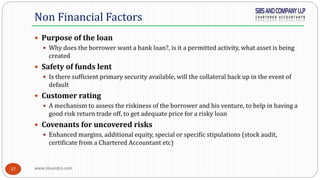
 Purpose of the loan
 Why does the borrower want a bank loan?, is it a permitted activity, what asset is being
created
 Safety of funds lent
 Is there sufficient primary security available, will the collateral back up in the event of
default
 Customer rating
 A mechanism to assess the riskiness of the borrower and his venture, to help in having a
good risk return trade off, to get adequate price for a risky loan
 Covenants for uncovered risks
 Enhanced margins, additional equity, special or specific stipulations (stock audit,
certificate from a Chartered Accountant etc)
Non Financial Factors
www.sbsandco.com38
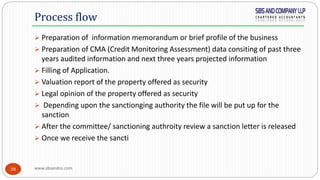
 Preparation of information memorandum or brief profile of the business
 Preparation of CMA (Credit Monitoring Assessment) data consiting of past three
years audited information and next three years projected information
 Filling of Application.
 Valuation report of the property offered as security
 Legal opinion of the property offered as security
 Depending upon the sanctionging authority the file will be put up for the
sanction
 After the committee/ sanctioning authroity review a sanction letter is released
 Once we receive the sancti
Process flow
www.sbsandco.com39
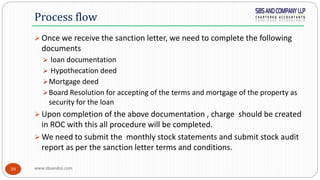
 Once we receive the sanction letter, we need to complete the following
documents
 loan documentation
 Hypothecation deed
Mortgage deed
Board Resolution for accepting of the terms and mortgage of the property as
security for the loan
 Upon completion of the above documentation , charge should be created
in ROC with this all procedure will be completed.
 We need to submit the monthly stock statements and submit stock audit
report as per the sanction letter terms and conditions.
Process flow
www.sbsandco.com/wiki
Read our monthly e-Journal
SBS And Company LLP
Chartered Accountants
6-3-900/6-9, Flat No. 103 & 104, Veeru Castle
Durga Nagar Colony,
Panjagutta, Hyderabad - 500 082
Telangana, India.
Our Presence in
Telangana: Hyderabad (HO)
Andhra Pradesh: Nellore, Kurnool, TADA (near Sri
City), Vizag
Karnataka: Bangalore
+91-40-40183366 / +91-40-64584494 / +91-9246883366
CA Rajesh D
PH: XXXXX
rajeshd@sbsandco.com
Thanks for your patient hearing!!!

Working capital assessment

  • 1.
    Working Capital Assessment CARajesh D rajeshd@sbsandco.com Date: 16/03/2016 by
  • 2.
    Source of funds Fundsfor Business Long Term Fixed Capital or Permanent Capital Short Term Working Capital or Temporary or Circulating Capital Long Term Loans Project Finance Cash Credit or OD Short term loans Banks Banks Private Investors NBFCs FIs
  • 3.
    www.sbsandco.com3  Objective: 1. Conceptof Working Capital 2. Gross Working Capital , Working capital Gap, Net Working Capital 3. Components of working capital 4. Working capital operating cycle 5. Various methods of working capital assessment viz i. Turnover method ii. MPBF method iii. Cash Budget Method 6. CMA Data. Working Capital
  • 4.
    www.sbsandco.com4  Funds requiredfor financing short term assets or current assets such as cash, debotrs and inventories to enable business/industry to operate at the expected levels.  Total amount of funds required for the continuous operations of the business on a going basis.  Therefore it is called operating capital or short-term capital.  Financed as Cash Credit, Overdraft, Short Term Working Capital loan etc.,  Assessed for one year and renewed annually Working Capital
  • 5.
    www.sbsandco.com5  Assets whichare part of the operating cycle or which get converted into cash within the operating cycle or within one year 1. Spares and Spare parts 2. Loose tools 3. Stock-in-Trade 4. Work-in-Progress 5. Sundry Debtors – less bad debts 6. Cash and Bank Balances 7. Loans and advances to subsidiaries 8. Bills of Exchange 9. Advances recoverable in cash or receivables 10. Balance with customs, port authorities, municipal authorities 11. Interest accrued on Investments What are Current Assets ?
  • 6.
    www.sbsandco.com6  Liabilities whichare part of the operating cycle or which need to be paid off within the operating cycle or within one year 1. Short term bank borrowings 2. Unsecured loans 3. Sundry Creditors and Trade Creditors 4. Deposits from public maturing within one year 5. Advances and deposits from dealers 6. Accrued Interests and Charges 7. Provision for taxation 8. Dividend payable 9. Statutory liabilities 10. Installment of term loans repayable in one year 11. Other liabilities and provisions What are Current Liabilities ?
  • 7.
    www.sbsandco.com7 Operating Cycle Cash Raw Materials/ Stores& Spares Semi-Finished Goods Finished GoodsSales Bills Receivables/ Sundry Debtors Realization of Debtors
  • 8.
    www.sbsandco.com8  The dayto day business operations of a concern of any nature and, size involves many successive steps and final working results would depend on the effective combination of all steps.  The steps in general may include the following:  Acquisition and storage of raw material and other stores and spares required for manufacture of any product.  Actual production process when the raw material is subjected to different processes to bring it to final shape of finished goods.  Storage of finished goods awaiting sales.  Sales of finished goods and realisations of sale proceeds. Operating Cycle
  • 9.
    www.sbsandco.com9  Operating Cyclebegins with acquisition of raw materials and ends with collection of receivables.  Stages: 1) Raw materials (RM/RM consumption) 2) Work-in-process (WIP/COP) 3) Finished Goods (FG/COS) 4) Receivables (Debtors/Credit sales) Less: Creditors (creditors/purchases) Operating Cycle
  • 10.
    www.sbsandco.com10 What are WorkingCapital Sources? Working Capital Requirement (Current Assets) Source of Finance 1 Raw Material and stores (inventory) Sundry Creditors or Bank Finance 2. Stock-in-Process Advance payments received or Bank Finance or Liquid Surplus 3. Finished Goods (inventory) Liquid Surplus or Net working Capital or Bank Finance 4. Sundry Debtors Bank Finance short term 5. Cash for expenses Net Working Capital or Liquid Surplus
  • 11.
    www.sbsandco.com11  GROSS WORKINGCAPITAL = CA These are in the system used/ consumed on a day to day basis.  NET WORKING CAPITAL (NWC) = CA – CL OR (SHF + TL) – (NFA + NCA) NWC is the entrepreneur's margin available in the system from Long term Funds Note: CA=Current Assets, CL=Current Liabilities SHF=Shareholder’s funds, TL=Term Loan NFA=Net Fixed Assets NCA=Net Current Assets NWC should always be more than 1:1 It indicates the margin of safety to short term creditors. Concepts of Working Capital
  • 12.
    www.sbsandco.com 12 Length of OperatingCycle Cash CashCash Service Trade Industry Receivables Stocks Semi Finished Goods Receivables Receivables Finished Goods Raw Material
  • 13.
    www.sbsandco.com13  Nature ofbusiness – service/trade/manufacturing.  Seasonality of operations – peak/non peak  Production Policy – Constant/seasonal  Market conditions- competition/credit terms  Conditions of supply of RM/stores/spares etc.  Quantum of production/Turnover(level of activity)  Operating Cycle  Current Assets to be maintained Factors influencing Working Capital Requirement
  • 14.
    www.sbsandco.com14  A) FundBased  Cash Credit  Overdraft  Inventory finance and  Factoring or Bill discounting ( Post Sales Finance).  B) Non Fund Based  Letter of Credit (LC)  Bank Guarantee. Working Capital Finance
  • 15.
    www.sbsandco.com15  Operating CycleMethod  Service Sector  Traders  Manufacturing Activity.  Drawing Power Method.  Turnover Method  MPBF method (II method of lending) for limits of Rs 6.00 crores and above  Cash Budget method (for: Based on procurement and cash inflow)  Seasonal Industries (Sugar/ Rice Mills/Textiles/Tea/Tobacco/Fertilizers)  Contractors & Real Estate Developers  Educational Institutions Assessment Methods
  • 16.
    www.sbsandco.com16  Operating Cyclemethod: Time period from purchase of raw materials, creation of work-in-process, creation of finished goods, holding them till sale, converting them into sundry debtors and realization of debtors and receipt of cash.  Total Working Capital Requirement =  𝑇𝑜𝑡𝑎𝑙 𝑂𝑝𝑒𝑟𝑎𝑡𝑖𝑛𝑔 𝐸𝑥𝑝𝑒𝑛𝑠𝑒𝑠 𝑒𝑥𝑝𝑒𝑐𝑡𝑖𝑛𝑔 𝑑𝑢𝑟𝑖𝑛𝑔 𝑡ℎ𝑒 𝑦𝑒𝑎𝑟 𝑁𝑜.𝑜𝑓 𝑂𝑝𝑒𝑟𝑎𝑡𝑖𝑛𝑔 𝐶𝑦𝑐𝑙𝑒𝑠 𝑑𝑢𝑟𝑖𝑛𝑔 𝑡ℎ𝑒 𝑦𝑒𝑎𝑟  Operating Expenses:  Purchase of Raw Materials & Maintaining  Manufacturing expenses such as wages, power & fuel, etc.  Stock of Work in Progress/ Semi-Finished goods maintained by the unit to complete an operating cycle.  Stock of Finished goods awaiting sale.  Administrative and selling expenses during this process.  Bills receivable/debtors for credit sales. Operating Cycle Method
  • 17.
    www.sbsandco.com17 Length of OperatingCycle Operating Cycle Method a. Procurement of Raw Material 30 days b. Conversion / Process time 15 days c. Average time of holding of FG 15 days d. Average Collection Period 30 days e.Operating Cycle (a+b+c+d) 90 days f. Operating Cycle in a year (365days/e) 4 cycles
  • 18.
    www.sbsandco.com18 Operating Cycle Method B.Total Operating Expenses per Annum Rs 60.00 lakhs C. Total Turnover per Annum Rs 70.00 lakhs D. Working Capital Requirement = Total Operating Expenses (B)/ No. of operating Cycle (f as said earlier) Rs 15 lakhs
  • 19.
    www.sbsandco.com19 Drawing Power Method (forunits with small limits) Particulars Stock value Margin DP Paid stocks (RM-Creditors) 4 25% 3 Semi Finished goods 4 50% 2 Finished goods 4 25% 3 Book debts 4 50% 2 Total 16 10
  • 20.
    www.sbsandco.com20 Turnover Method (Originally suggestedby Nayak Committee for SSI Units)  Nayak Committee method or turnover method: Based on the projected sales turnover of the borrower. It is presumed that W.C requirements would be 25% of the projected turnover and the banker would finance 75% to 80% of the same and the borrower to bring in 20%-25%.  Nayak Committee method various industry limits.  SSI units upto Rs.5.00 crore  Other units upto Rs.1.00 crore
  • 21.
    www.sbsandco.com21 Turnover Method (Originally suggestedby Nayak Committee for SSI Units) Applicable for limits upto 6 Crores Item Particulars Scenario 1 Scenario 2 Scenario 3 1 Turnover 1000 1000 1000 2 25% of Turnover 250 250 250 3 Eligible Bank Finance 80% of 2 200 200 200 4 Margin Required at 5% of Turnover 50 50 50 5 Margin (NWC) Actual/ Projected (CA-CL) 150 300 100 6 (2 - 5 ) 100 -50 150 7 Eligible Minimum Bank Finance 100 -50 150 Lower of 3 or 6
  • 22.
    www.sbsandco.com22 MPBF Method  Asper Tandon Committee:  First Method of Lending: Banks can work out the working capital gap, i.e. total current assets less current liabilities other than bank borrowings (called Maximum Permissible Bank Finance or MPBF) and finance a maximum of 75 per cent of the gap; the balance to come out of long-term funds, i.e., owned funds and term borrowings.  Second Method of Lending: Under this method, it was thought that the borrower should provide for a minimum of 25% of total current assets out of long-term funds i.e., owned funds plus term borrowings. A certain level of credit for purchases and other current liabilities will be available to fund the build up of current assets and the bank will provide the balance (MPBF). Consequently, total current liabilities inclusive of bank borrowings could not exceed 75% of current assets.  Third Method of Lending: Under this method, the borrower's contribution from long term funds will be to the extent of the entire CORE CURRENT ASSETS, which has been defined by the Study Group as representing the absolute minimum level of raw materials, process stock, finished goods and stores which are in the pipeline to ensure continuity of production and a minimum of 25% of the balance current assets should be financed out of the long term funds plus term borrowings. (This method was not accepted for implementation and hence is of only academic interest).
  • 23.
    www.sbsandco.com23 Computation MPBF Method CurrentLiabilities Amount Current Assets Amount Creditors for Purchases 100 Raw Materials 200 Other Current Liabilities 50 Stock-In-Process 20 Bank Borrowings including Bills discounted with bankers 200 Finished Goods 90 Receivables including Bill Discounted with bankers 50 Other Current Assets 10 Total Current Liabilities 350 Total Current Assets 370 Example: (Rs. In Lakhs)
  • 24.
    www.sbsandco.com24 Computation MPBF Method 1stMethod Amount 2nd Method Amount 3rd Method Amount Total Current Assets 370 Total Current Assets 370 Total Current Assets 370 Less: Current Liabilities other than Bank Borrowings 150 Less: 25% of Current Assets 92 Less: Core Current Assets 95 Working Capital Gap 220 Working Capital Gap 278 Total Real Current assets 275 Less: 25% of Working Capital Gap 55 Less: Current Liabilities other than Bank Borrowings 150 Less: Other Current Liabilities 150 MPBF 165 MPBF 128 Working capital gap 125 Excess -Borrowings 35 Excess Borrowings 72 Less: 25% of Real Current Assets(276*25) 69 MPBF 56 Current Ratio 1.17:1 Current Ratio 1.33:1 Current Ratio 1.87 (Rs. In Lakhs)
  • 25.
    www.sbsandco.com25  (Inventory/Receivable Norms– Comparison)  Intra firm Comparison  Comparison of estimates with previous years Actuals.  For New Units  Comparison of estimates with similar units in the area of operation.  Higher projections shall be justified. Following precautions to be taken care a. Projected turnover is gross turnover inclusive of excise duty etc. b. The other financial strengths of the firm also to be kept in mind c. Margin requirement of at least 5% of the turnover not to be diluted d. Projected annual turnover to be reasonable, achieved in the past, achievable in future and realistic in the present e. Reasonableness of projections to be assessed and verified with returns filed by the borrower f. Sales achieved till the date of sanction to be obtained from the borrower g. Any projection beyond 15% of the previous years actual need closer attention Justifications of the Performance Projection
  • 26.
    www.sbsandco.com26  Production/Sales estimates Profitability estimates  Inventory/receivables norms  Build up of Net Working Capital Important aspects of MPBF Method
  • 27.
    www.sbsandco.com27 Cash Budget Statement showingforecast of cash receipts, cash payments and net cash balance over a period of time Months-> 1 2 3 4 5 6 7 8 9 10 11 12 Cash Receipts Cash Payments Surplus/deficit Cash credit – OB Cash credit - CB Peak deficit is financed and drawings regulated by monthly budgets
  • 28.
    www.sbsandco.com28  Advantages:  Suitablefor seasonal industries, contractors, software, exporters, etc.  Limitations:  Will not reflect changes in various current assets & liabilities.  Will not give a clue whether a company is earning profit or not. ( Funds Flow Statement is required to detect any diversion of funds ). Cash Budget
  • 29.
    www.sbsandco.com29  Letter ofcredit  ILC/FLC  Usance/Sight  Bank Guarantee  Performance  Financial – Bid Bonds/Security Deposits/ Mobilisation advance/ retention money  Deferred Payment Guarantee Non-Fund Based Limits
  • 30.
    www.sbsandco.com30 LC Assessment 1 Annualpurchase/import FLC/ILC 2 Out of (1) on credit basis 3 Out of (2) on usance LC basis 4 Average of (3) per month 5 Lead time (no. of months) 6 Usance period (no. of months) 7 Usance LC requirement (5+6) X (4)
  • 31.
    www.sbsandco.com31  For constituentsborrowers with regular sanctioned credit facilities for genuine transactions.  LCs shall not be opened with clause without recourse to drawer.  Bank Guarantees: Performance and Financial Guarantees  Purpose / Difference  Security: Cash Margin +Counter Guarantee +Collateral Security (Immovable / Liquid Security)  Restrictive Clause. Guidelines to be followed
  • 32.
    www.sbsandco.com32  While consideringthe proposal to the bank to get the credit facilities, banks analyze the financial strength of the borrower’s financial accounts by using ratio analysis.  The following are the ratios:  Current Ratio  Solvency Ratio  Quick Ratio or Acid Test Ratio  Profit to Sales Ratio  Turnover ratio (Inventory + Receivables)/Net Sales Financial Ratios
  • 33.
    www.sbsandco.com33  While consideringthe proposal to the bank to get the credit facilities, banks analyze the financial strength of the borrower’s financial accounts by using ratio analysis.  The following are the ratios:  Current R𝑎𝑡𝑖𝑜 = 𝐶𝑢𝑟𝑟𝑒𝑛𝑡 𝐴𝑠𝑠𝑒𝑡𝑠 𝐶𝑢𝑟𝑟𝑒𝑛𝑡 𝐿𝑖𝑎𝑏𝑖𝑙𝑖𝑡𝑖𝑒𝑠 The current ratio is used to check the borrower’s ability of repayment of debt/ loan when the loan is to be repayable in installments & to know whether current assets are financed by current liabilities/ long term borrowings.  Debt − 𝐸𝑞𝑢𝑖𝑡𝑦 = 𝑇𝑜𝑡𝑎𝑙 𝑜𝑢𝑡𝑠𝑖𝑑𝑒 𝐿𝑖𝑎𝑏𝑖𝑙𝑖𝑡𝑖𝑒𝑠 𝐸𝑞𝑢𝑖𝑡𝑦 Debt-Equity Ratio is the measure of financial leverage & to know the relative proportion of entity’s equity & debt used in the entity’s assets. Financial Ratios
  • 34.
    www.sbsandco.com34  𝑵𝒆𝒕 𝑷𝒓𝒐𝒇𝒊𝒕𝑴𝒂𝒓𝒈𝒊𝒏 = 𝑁𝑒𝑡 𝑃𝑟𝑜𝑓𝑖𝑡 𝑁𝑒𝑡 𝑆𝑎𝑙𝑒𝑠 ` It shows the relation between final profits to the sales. It is used to evaluate the profitability of the business from its primary operations.  𝐆𝐫𝐨𝐬𝐬 𝐏𝐫𝐨𝒇𝒊𝒕 𝑴𝒂𝒓𝒈𝒊𝒏 = 𝐺𝑟𝑜𝑠𝑠 𝑃𝑟𝑜𝑓𝑖𝑡 𝑁𝑒𝑡 𝑆𝑎𝑙𝑒𝑠 It shows that to what extent the sale price of the goods can be reduced without incurring any losses.  𝑫𝒆𝒃𝒕 𝑺𝒆𝒓𝒗𝒊𝒄𝒆 𝑪𝒐𝒗𝒆𝒓𝒂𝒈𝒆 𝑹𝒂𝒕𝒊𝒐 = 𝑁𝑒𝑡 𝑃𝑟𝑜𝑓𝑖𝑡+𝐷𝑒𝑝𝑟𝑒𝑐𝑖𝑎𝑡𝑖𝑜𝑛+𝐼𝑛𝑡𝑒𝑟𝑒𝑠𝑡 𝑃𝑟𝑖𝑛𝑐𝑖𝑝𝑎𝑙+𝐼𝑛𝑡𝑒𝑟𝑒𝑠𝑡 It is a measure of borrower’s ability of repayment of his obligations. The higher it is the safer for the bank/ lenders.  Interest Coverage Ratio = PBIT /Interest (times) . Interest coverage ratio explains how many time the firm earns to cover the interest High ratio means comfortable ratio. 3-4 times is acceptable . Financial Ratios
  • 35.
    www.sbsandco.com35  Hypothecation :Neither ownership nor possession is passed on to the borrower, in the event of default Bank has legal right to sell the property  Pledge : Possession of the goods passes into the hand of bank as security towards the debt, interest and other expenses  Lien : right of the lender to retain the property until the debt is repaid.  Mortgage : Transfer of legal or equitable interest in specific immovable property for the payment of debt.  Charge : Where immovable property of one person is made security for the payment of money to another and the transaction doesn’t amount to mortgage. The lender will charge on the property and all provisions of simple mortgage will apply. Security
  • 36.
    www.sbsandco.com36  Character ofthe borrower  Background or brief history of the borrower, nature of activity, expertise available (technical and Managerial)  Capacity of the borrower  Networth, repayment history, viability of the business activity, income generating ability of the business, security available for fall back  Capital of the borrower  What is the owners stake, equity, margin, ability to increase the margin, source of financing the margin  Credibility of the borrower  What is the market opinion about the borrower, does he have a track record? Non Financial Factors
  • 37.
    www.sbsandco.com37  Purpose ofthe loan  Why does the borrower want a bank loan?, is it a permitted activity, what asset is being created  Safety of funds lent  Is there sufficient primary security available, will the collateral back up in the event of default  Customer rating  A mechanism to assess the riskiness of the borrower and his venture, to help in having a good risk return trade off, to get adequate price for a risky loan  Covenants for uncovered risks  Enhanced margins, additional equity, special or specific stipulations (stock audit, certificate from a Chartered Accountant etc) Non Financial Factors
  • 38.
    www.sbsandco.com38  Preparation ofinformation memorandum or brief profile of the business  Preparation of CMA (Credit Monitoring Assessment) data consiting of past three years audited information and next three years projected information  Filling of Application.  Valuation report of the property offered as security  Legal opinion of the property offered as security  Depending upon the sanctionging authority the file will be put up for the sanction  After the committee/ sanctioning authroity review a sanction letter is released  Once we receive the sancti Process flow
  • 39.
    www.sbsandco.com39  Once wereceive the sanction letter, we need to complete the following documents  loan documentation  Hypothecation deed Mortgage deed Board Resolution for accepting of the terms and mortgage of the property as security for the loan  Upon completion of the above documentation , charge should be created in ROC with this all procedure will be completed.  We need to submit the monthly stock statements and submit stock audit report as per the sanction letter terms and conditions. Process flow
  • 40.
    www.sbsandco.com/wiki Read our monthlye-Journal SBS And Company LLP Chartered Accountants 6-3-900/6-9, Flat No. 103 & 104, Veeru Castle Durga Nagar Colony, Panjagutta, Hyderabad - 500 082 Telangana, India. Our Presence in Telangana: Hyderabad (HO) Andhra Pradesh: Nellore, Kurnool, TADA (near Sri City), Vizag Karnataka: Bangalore +91-40-40183366 / +91-40-64584494 / +91-9246883366 CA Rajesh D PH: XXXXX rajeshd@sbsandco.com Thanks for your patient hearing!!!