FINANCING MICRO AND SMALL
       ENTERPRISES
    -PROBLEMS AND PROSPECTS

                 Made By:
                 Group 18

                 Anshal Chaturvedi
                 Riya Chhabria
                 Apurva Kulkarni
Introduction
MSME stands for Micro, Small and Medium
 Enterprises also known as ‘Town and Village’
 Enterprises.

SME’s are mainly skill oriented.


This sector contains an element of “Welfare of
 Masses”.

Different parameters in Different countries,
 like Man power, Turn over, Working
 Hours….etc.
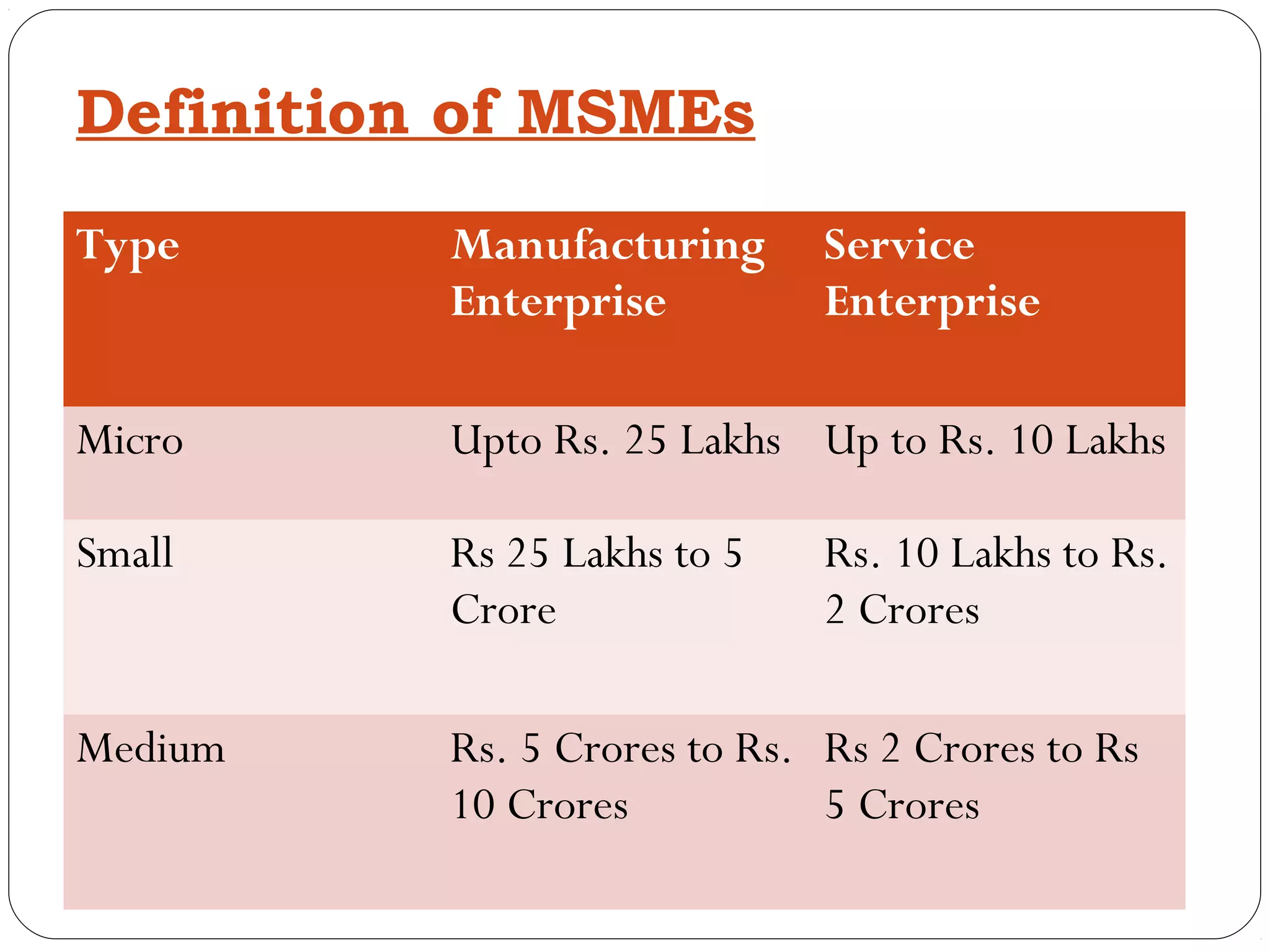
Definition of MSMEs
Type      Manufacturing       Service
          Enterprise          Enterprise

Micro     Upto Rs. 25 Lakhs Up to Rs. 10 Lakhs

Small     Rs 25 Lakhs to 5    Rs. 10 Lakhs to Rs.
          Crore               2 Crores

Medium    Rs. 5 Crores to Rs. Rs 2 Crores to Rs
          10 Crores           5 Crores
Classification Of MSME Within
The Priority Sector
The    Micro and Small Enterprises
 (manufacturing and service) will be
 Classified under Priority Sector.
The Micro and Small (Service) enterprises
 shall include Small Road and Water
 Transport Operator, Small Business,
 Professional and Self-employed Persons
 and all other service enterprises. Retail
 Trade will not be classified under Micro
 and Small enterprises (service sector).
Classification Of MSME Within
The Priority Sector
Small Road and Water Transport
 Operator (SRWTO), Small Business,
 Professional and Self Employed Persons
 (PSEP) will be classified as per the
 original cost of equipments either under
 Micro or Small Enterprises (service)
 sector instead of earlier classification/
 definition of 10 vehicles in case of
 SRWTO and working capital and /or
 Term loan limits in case of
 SmallBusiness/ Professional and Self
Classification Of MSME Within
The Priority Sector

If the following Storage Units, registered
 as SSI Unit/Micro or Small Enterprises,
 the loans granted to such units may be
 classified as Small Enterprises Sector
“Loans for construction and running of
 storage facilities (warehouse, market
 yards, godowns and silos), including Cold
 Storage    Units     designed   to   store
 agriculture       produce/       products,
 irrespective of location”.
Lending to Medium Enterprises will not
 be included under Priority Sector.
Manufacturing Activities
   Medical Equipment and Ayurvedic Product

   Composite unit of Bacon Processing and
    Piggery Farm

   Tobacco Processing

   Beedi/Cigarette manufacturing and other
    tobacco Products

   Extraction of Agave Spirit from Agave
    juice;   (imported  medicinal plant )
    extraction of Agave
Manufacturing Activities
   Manufacture of Bio-Fertilizer

   Piggery Farm without bacon processing
    as this is a farming activity.

   The activity of “Bee-Keeping” being
    farming allied activity.
DIRECT FINANACE:
1.   All loans granted to Small Enterprises including
Micro Enterprises (both Manufacturing and Services)
will be classified under Direct Finance to Micro and
Small Enterprises Sector.

2. Khadi and Village Industries Sector (KVI):

All advances granted to units in the KVI sector,
Irrespective of Sector their size of operation, location
and amount of original investment in Plant and
Machinery, will be eligible for
consideration under the Sub Target (60 percent) of the
Small Enterprises segment within the Priority Sector.
INDIRECT FINANCE
1. Indirect Finance to the Small (manufacturing
  as well as service) Enterprises sector will include
  credit to:-
  i. Persons involved in assisting the decentralized
  sector in the supply of inputs to and marketing
  of outputs of artisans, village and cottage
  industries.

 ii. Advances to cooperatives of producers in the
 decentralized sector viz., artisans, village and
 cottage industries.
INDIRECT FINANCE
3. Existing investments as on 31st March, 2007, made
by banks in special bonds issued by NABARD with the
objective of financing exclusively non-farm sector may
be classified as Indirect fiancé to Small Enterprise
sector till the date of maturity of such bonds of March
31, 2010, whichever is earlier. Investment in such
special bonds made subsequent to March 31, 2007
will, however, not be eligible for such classification .

4. Loans granted by banks to NBFCs for on
lending to Small and Micro enterprises
(manufacturing as well as service).
MSMED Act 2006
       In India, the MSMED Act 2006 has
        come into force on 02nd Oct. 2006 which
        facilitates:

(i)     Promotion and Development of SMEs
(ii)    Enhancing their competitiveness.
(iii)   Generation of Employment.
(iv)    Generation of income/profit to boost
        GDP.
(v)     Increasing Exports.
Overview
The world over there has been a significant
 thrust for growth of Micro and Small
 Enterprises mainly due to sector’s ability to
 deliver quality products /services at cheaper
 and to provide large scale employment.
CALCULATION OF INVESTMENT
 FOR PLANT & MACHINERY
 In case of MSME advances, if the branches are unable to
  assess original investment criteria, a certificate with regard
  to investment in plant and machinery / equipment should
  be obtained from a Chartered Accountant.
 In calculating the value of plant and machinery for
  the purpose of calculating investment limit, the original
    price thereof, irrespective of whether the plant and
  machinery are new or second hand shall be taken into
  account. In case the Branch is unable to assess the
  original investment criteria, a certificate with regard to
  investment in plant/machinery/equipment etc. would be
  obtained from a Chartered Accountant.
 The investment in establishing of wind mill/s to
  generate electricity for captive consumption or partly
  for captive consumption and remaining power to sell
  to Electricity Boards/others are to be included in the
  investment in plant and machinery.
Processing of Loan Application
    Application Format:
   Revised Simplified Loan Application Form
    prescribed by IBA alongwih check list and
    undertaking of the applicant, will be
    applicable for Micro and Small Enterprises
    (MSEs)
   For loan beyond Rs.25Lacs, branches may
    obtain additional information from the
    borrower, as deemed necessary, as
    incorporated in the checklist enclosed to the
    loan application form.
   Loan Application Form (ADV-Comm) and
    Checklist enclosed will be applicable for
    Medium Enterprises only.
Processing of Loan Application
 Fair Practice Code for Lenders Liabilities

 Before handing over the Application Forms to
 applicant, the modification / addition as
 applicable under guidelines on Fair Practice
 Code for Lender’s Liabilities will be complied as
 under:
 (a) Information regarding Processing Fee,
 Service Charges, and Refund etc. will be
 annexed as a part of application form.

 (b) An undertaking to be obtained from the
 prospective borrower while accepting
 application that he has been briefed about and
 convinced about the charges, bank will levy on
 pre/post sanction of the loan.
Processing of Loan Application
 Issue of Acknowledgement of Loan
 Applications :
 Each branch will issue an acknowledgement for
 loan applications received from the borrowers
 towards financing under this sector and
 maintain the record of the same.
Processing of Loan Application
   Disposal of Applications:
    In case of Loans up to Rs.25000/-       :
    Within 2 weeks
    In case of Loans above Rs.25000/-       :
    Within 4 Weeks
    (Provided the loan applications are complete
    in all respects and accompanied by a 'check
    list' enclosed to the application form)
Processing of Loan Application
 Register of Receipt/Sanction/Rejection of
 Applications:
 a. A register should be maintained at branch
 wherein the date of            receipt, sanction /
 disbursement ,rejection with reasons , should be
 recorded. The register should be made available to
 facilitate   verification by the Bank’s officials
 including Zonal Manager during visit to the branch.
 b. Branch Manager may reject application (except in
 respect of SC/ST). In the case of proposals from
 SC/ST, rejection should be done at a level higher
 than Branch Manager.
 c. The reason for rejection will be communicated to
 the borrower in line with stipulation mentioned in
 the Fair Practice Lenders Code.
Processing of Loan Application

 Photographs of Borrowers
 While there is no objection to take photographs
 of the borrowers, for          the purpose of
 identification, branches themselves should make
 arrangements for the photographs and also bear
 the cost of photographs of borrowers falling in
 the category of Weaker Sections. It should also
 be ensured that the procedure does not involve
 any delay in loan disbursement.
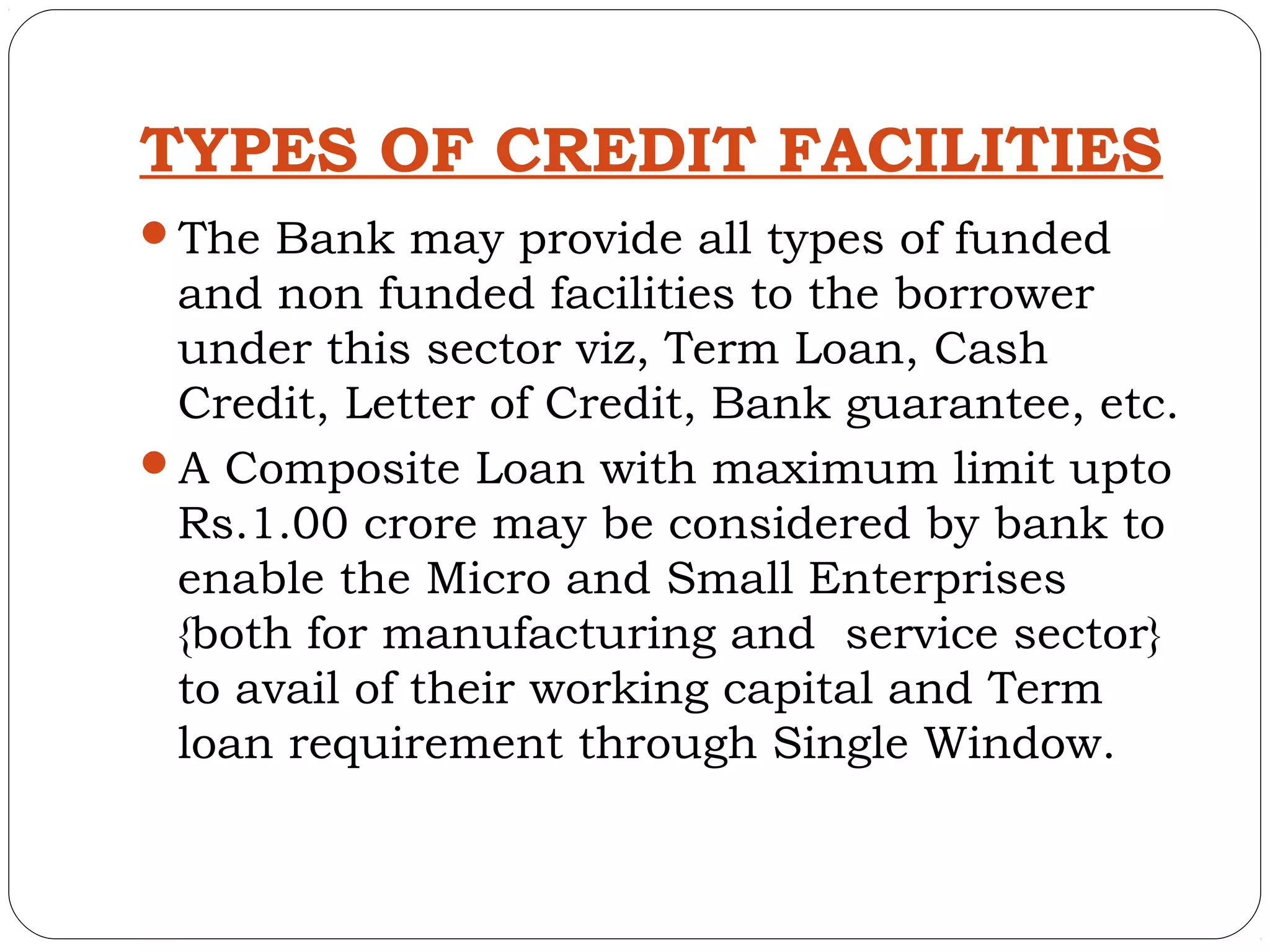
TYPES OF CREDIT FACILITIES
The Bank may provide all types of funded
 and non funded facilities to the borrower
 under this sector viz, Term Loan, Cash
 Credit, Letter of Credit, Bank guarantee, etc.
A Composite Loan with maximum limit upto
 Rs.1.00 crore may be considered by bank to
 enable the Micro and Small Enterprises
 {both for manufacturing and service sector}
 to avail of their working capital and Term
 loan requirement through Single Window.
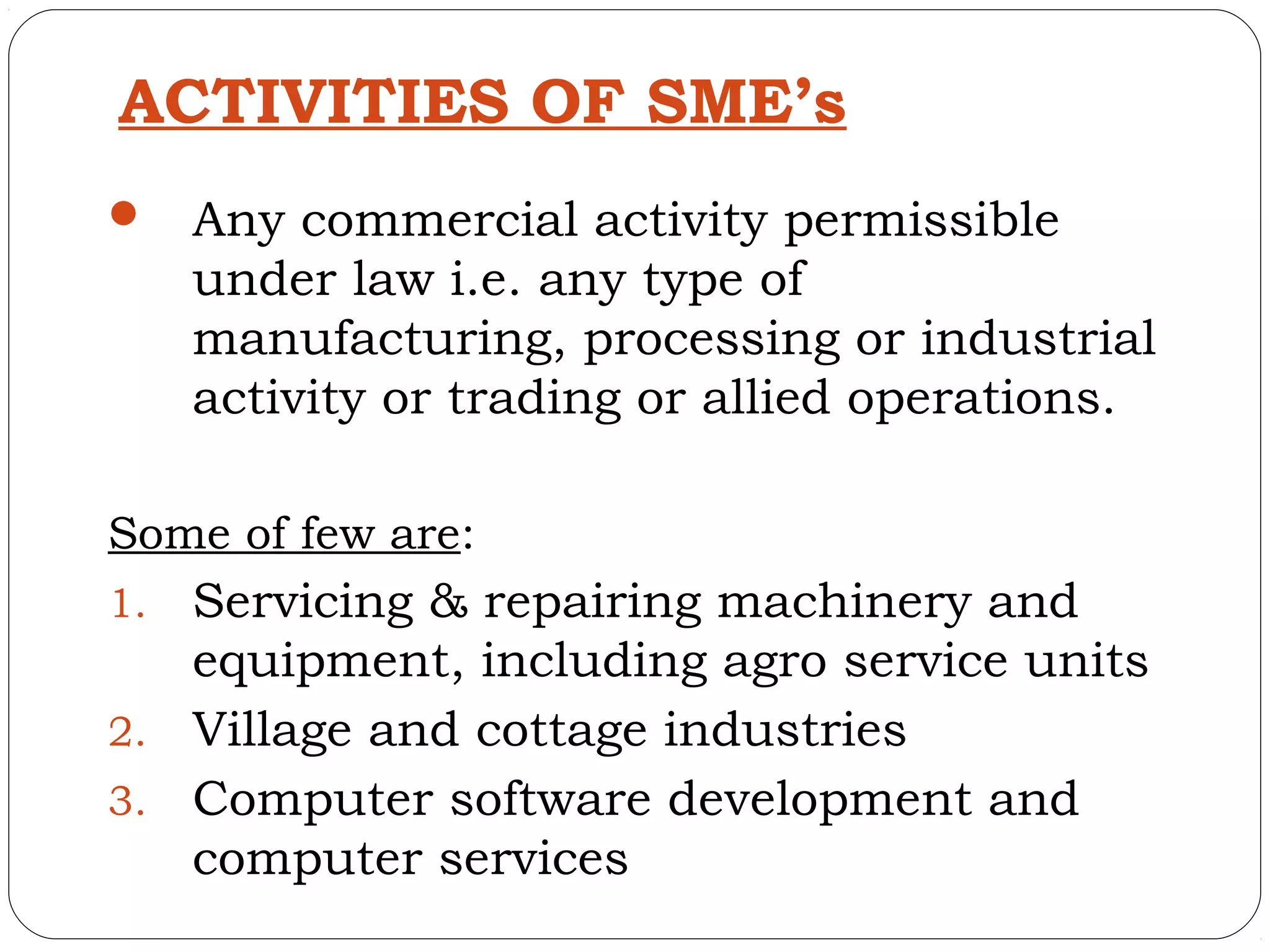
ACTIVITIES OF SME’s
    Any commercial activity permissible
     under law i.e. any type of
     manufacturing, processing or industrial
     activity or trading or allied operations.

Some of few are:
1. Servicing & repairing machinery and
   equipment, including agro service units
2. Village and cottage industries
3. Computer software development and
   computer services
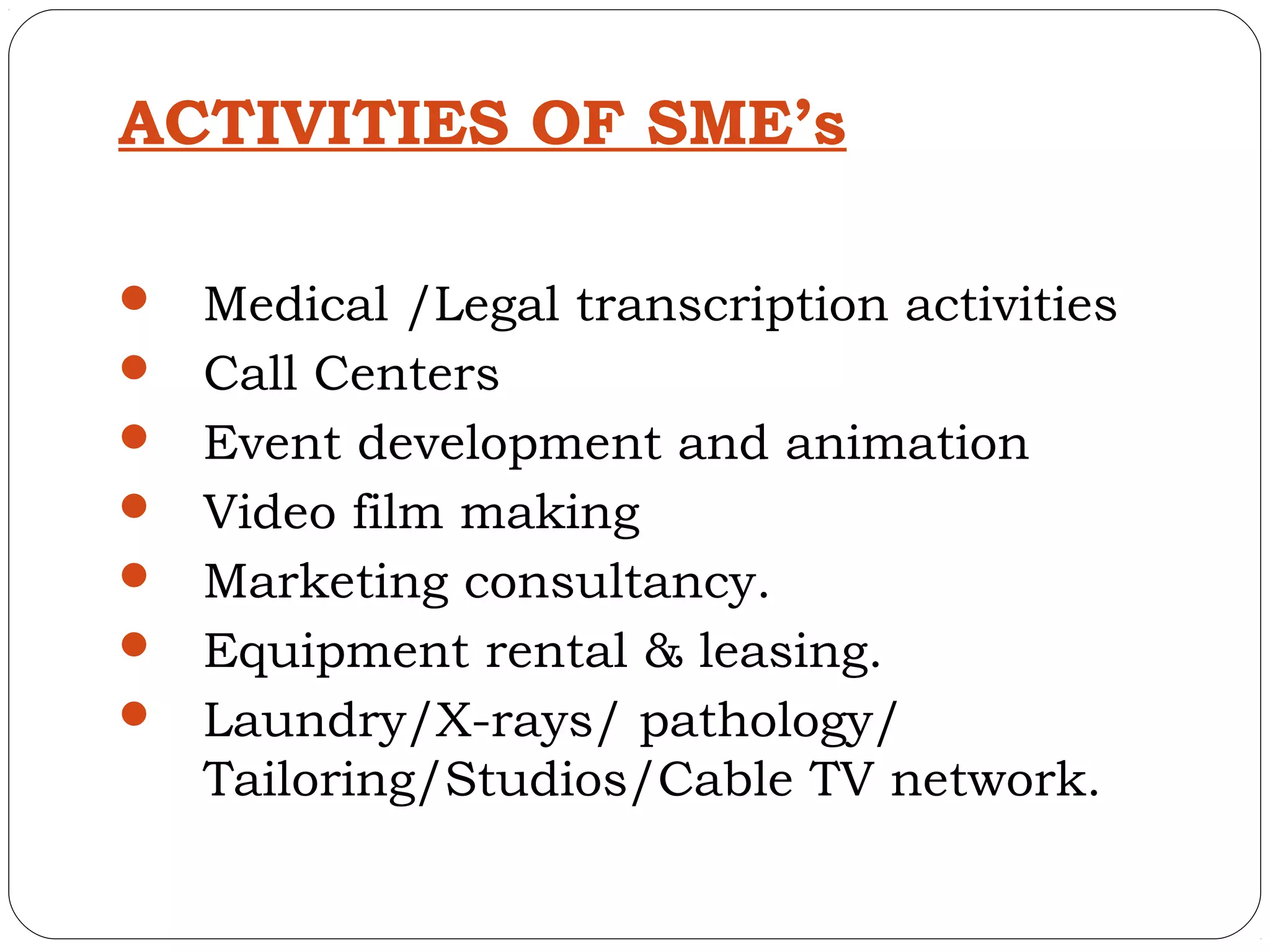
ACTIVITIES OF SME’s

   Medical /Legal transcription activities
   Call Centers
   Event development and animation
   Video film making
   Marketing consultancy.
   Equipment rental & leasing.
   Laundry/X-rays/ pathology/
    Tailoring/Studios/Cable TV network.
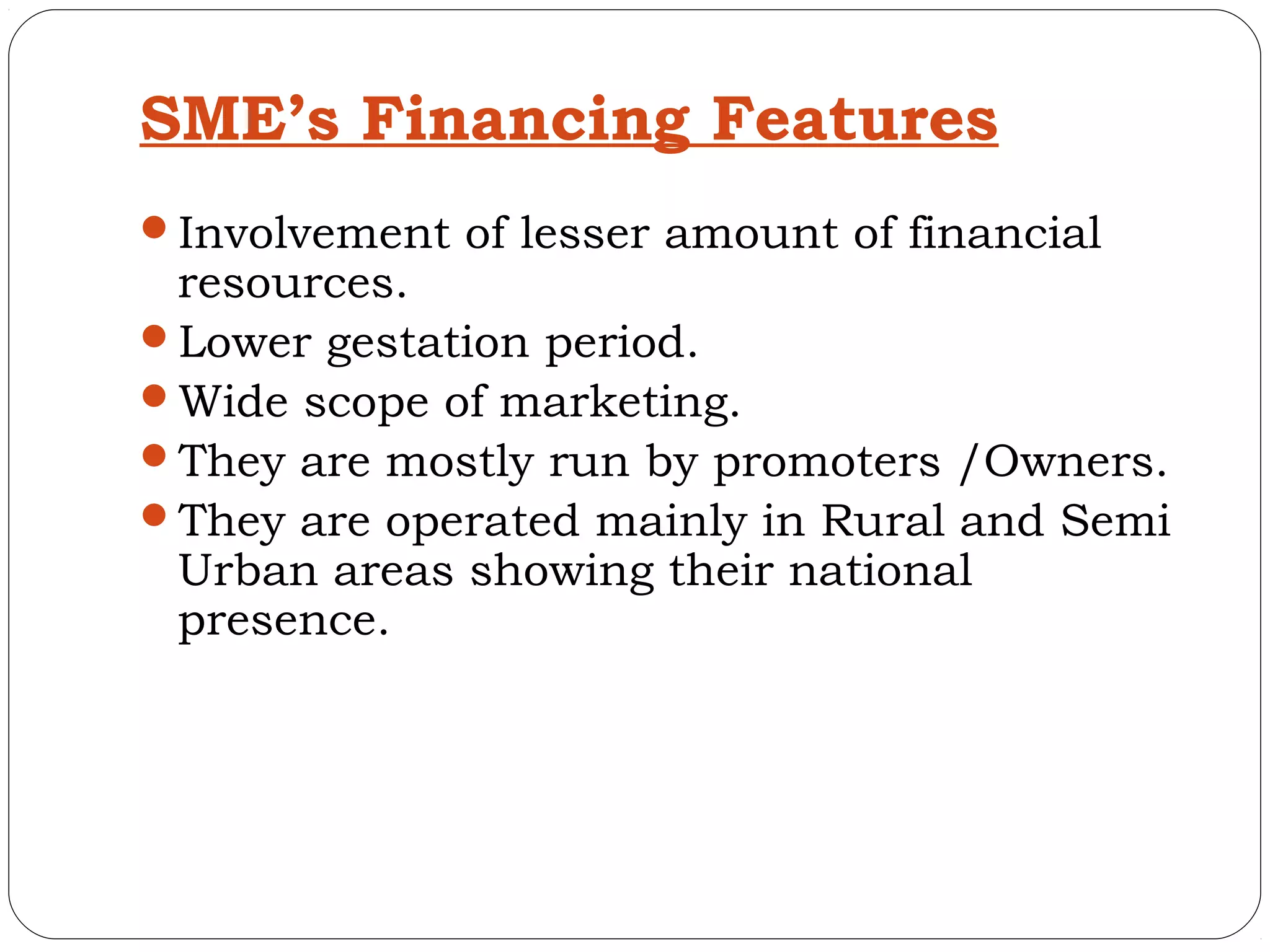
SME’s Financing Features
Involvement of lesser amount of financial
 resources.
Lower gestation period.
Wide scope of marketing.
They are mostly run by promoters /Owners.
They are operated mainly in Rural and Semi
 Urban areas showing their national
 presence.
Importance of SME’s

Large-scale generation of wage employment.


Growth in GDP. MSME’s not only account
 for 80% of the total number of Industrial
 Enterprises in the country but are also the
 second largest employment providing sectors
 in the country after agriculture.
Importance of SME’s
This sector is a growth-driver in the
 economy.

It is possible to set up SMEs in large
 numbers in a country in order to usher in
 rapid progress and growth.

40/50% of output/services originated from
 this sector.
30% of Indian Exports are on account of
 SMEs.
Ganguly Committee
The “Ganguly Committee’ has thoroughly
examined the issues confronting SMEs and
suggested the following:
   Institutional Finance should be made
    available on suitable terms.
   Units having linkages with large
    corporate as vendors/suppliers should
    be extended credit, with an appropriate
    tie up to facilitate recovery.
   Cluster of SMES based on Trade record.

   SIDBI/Banks to promote national level SME
    development fund.

   SIDBI to provide technical support.

   To promote a specific SME Rating Agency to
    provide comfort to the banks financing
    SMES

   Setting up of Micro Finance Intermediaries
    to accelerate the growth of SMEs.
Govt. Initiatives
Government of India has initiated the
 following steps for the speedy growth of
 SMEs.

Ministry of Finance has announced a policy
 for doubling of outstanding credit to Micro
 and Small Enterprise Sector by the year
 2009-10.

A minimum of year-to-year growth of 20% is
 to be achieved under outstanding in this
 sector.
Introduced credit linked capital subsidy
 scheme for SME sector

In lines with SME sector introduced various
 employment generation schemes to cater to
 the needy people from Rural and Urban.

A Technology bureau for SMEs has been set
 up as a starting process for promoting
 SMEs.
Provision for composite Loan limit.

Ensuring that banks extend loan at a lower
 rate of interest as against Benchmark rate.

Opening of specialized SME Branches.

Introduced LUCC (Laghu Udyami Credit Card)

A credit guarantee fund trust (CGFT) has
 been promoted
Concessions to SME’s
Delayed payments to micro and small
 enterprises:

Where MSME supply goods or render services,
 the buyer shall make payment on or before the
 date agreed upon between them in writing
 (where not agreed in writing with in 45 days),
 else should pay compound interest with
 monthly rests from the due date at 3 times the
 Bank rate.

Where the buyer contravenes the provision, he
 shall be punishable with a fine of not less than
 Rs.10,000/-
PNB Schemes for SME’s

In PNB there is 20% discount in
 processing/upfront fee in case of
 applications received on-line in respect of
 SME borrowers.

Introduced simplified common loan
 application forms

PNB SME Sahayog Scheme

SME borrowers – Employees accounts.
Under PNB Mahila Sashtikaran Yojana,
 bank is providing loans to women for their
 upliftment.
PNB Green Card Facility.
Small Road Transport Operations Scheme
 (SRTO).
Credit Linked Capital Subsidy Scheme for
 Technology Up-Gradations (CLCSS).
Prime Minister Rural Employment
 Generation Programme (PMEGP).
BCSBI (Banking Codes and Standards
 Board of India) has introduced ‘Code of
 Bank’s Commitment to SME in short as
 SME Code.

Bank has adopted SME code to give a
 positive trust to the SME sector by
 providing easy access to banking
 services; promote good and fair banking
 practices by setting minimum standards
 and increase transparency.
Besides the above promoters of MSMEs may
 be provided necessary training or awareness
 programmes on business measurement on
 an ongoing basis at industrial training
 institute of the government or at the
 training centres of public sector banks.
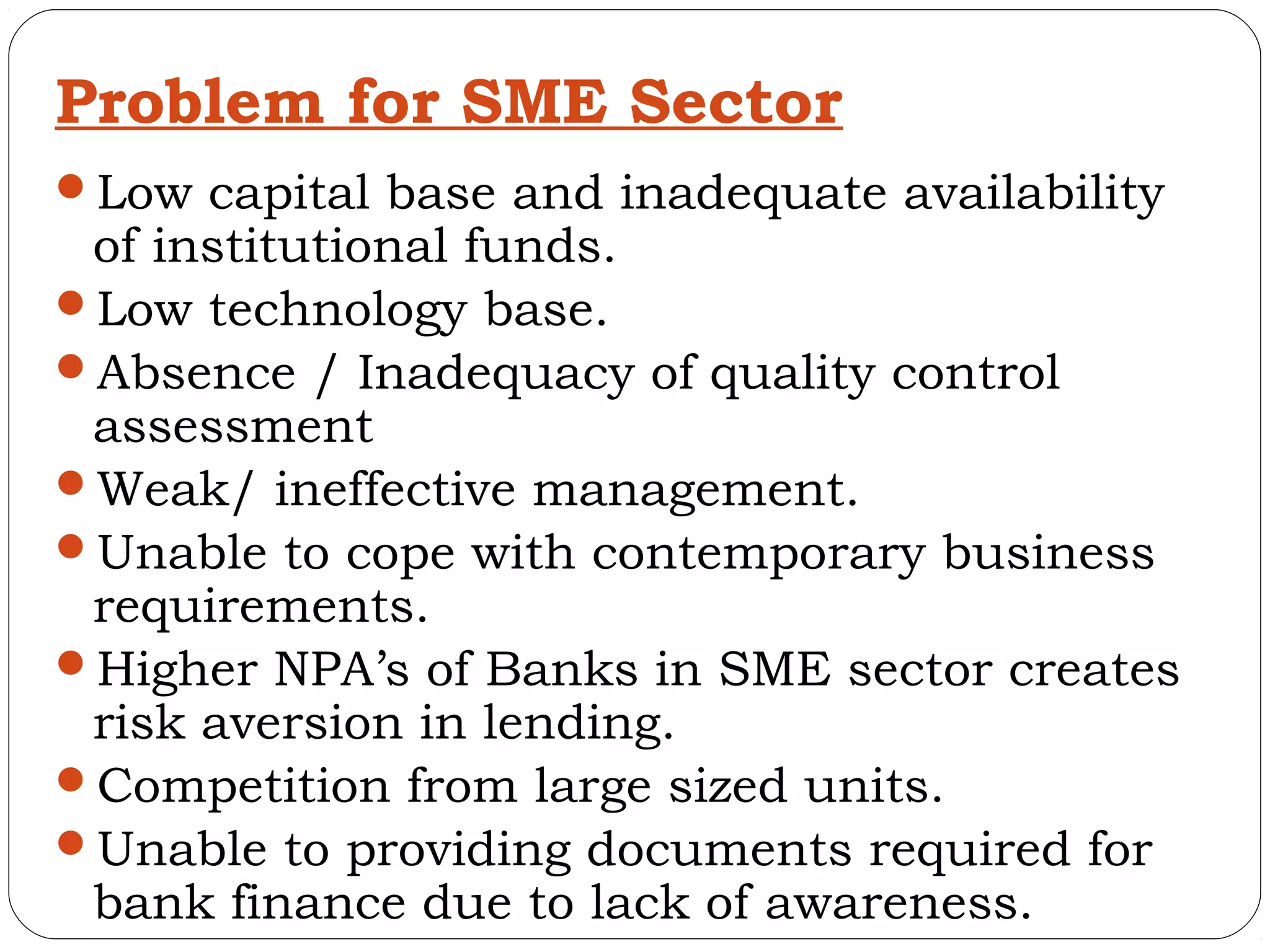
Problem for SME Sector
Low capital base and inadequate availability
 of institutional funds.
Low technology base.
Absence / Inadequacy of quality control
 assessment
Weak/ ineffective management.
Unable to cope with contemporary business
 requirements.
Higher NPA’s of Banks in SME sector creates
 risk aversion in lending.
Competition from large sized units.
Unable to providing documents required for
 bank finance due to lack of awareness.
THANK YOU

Lending to msme

  • 1.
    FINANCING MICRO ANDSMALL ENTERPRISES -PROBLEMS AND PROSPECTS Made By: Group 18 Anshal Chaturvedi Riya Chhabria Apurva Kulkarni
  • 2.
    Introduction MSME stands forMicro, Small and Medium Enterprises also known as ‘Town and Village’ Enterprises. SME’s are mainly skill oriented. This sector contains an element of “Welfare of Masses”. Different parameters in Different countries, like Man power, Turn over, Working Hours….etc.
  • 3.
    Definition of MSMEs Type Manufacturing Service Enterprise Enterprise Micro Upto Rs. 25 Lakhs Up to Rs. 10 Lakhs Small Rs 25 Lakhs to 5 Rs. 10 Lakhs to Rs. Crore 2 Crores Medium Rs. 5 Crores to Rs. Rs 2 Crores to Rs 10 Crores 5 Crores
  • 4.
    Classification Of MSMEWithin The Priority Sector The Micro and Small Enterprises (manufacturing and service) will be Classified under Priority Sector. The Micro and Small (Service) enterprises shall include Small Road and Water Transport Operator, Small Business, Professional and Self-employed Persons and all other service enterprises. Retail Trade will not be classified under Micro and Small enterprises (service sector).
  • 5.
    Classification Of MSMEWithin The Priority Sector Small Road and Water Transport Operator (SRWTO), Small Business, Professional and Self Employed Persons (PSEP) will be classified as per the original cost of equipments either under Micro or Small Enterprises (service) sector instead of earlier classification/ definition of 10 vehicles in case of SRWTO and working capital and /or Term loan limits in case of SmallBusiness/ Professional and Self
  • 6.
    Classification Of MSMEWithin The Priority Sector If the following Storage Units, registered as SSI Unit/Micro or Small Enterprises, the loans granted to such units may be classified as Small Enterprises Sector “Loans for construction and running of storage facilities (warehouse, market yards, godowns and silos), including Cold Storage Units designed to store agriculture produce/ products, irrespective of location”. Lending to Medium Enterprises will not be included under Priority Sector.
  • 7.
    Manufacturing Activities  Medical Equipment and Ayurvedic Product  Composite unit of Bacon Processing and Piggery Farm  Tobacco Processing  Beedi/Cigarette manufacturing and other tobacco Products  Extraction of Agave Spirit from Agave juice; (imported medicinal plant ) extraction of Agave
  • 8.
    Manufacturing Activities  Manufacture of Bio-Fertilizer  Piggery Farm without bacon processing as this is a farming activity.  The activity of “Bee-Keeping” being farming allied activity.
  • 9.
    DIRECT FINANACE: 1. All loans granted to Small Enterprises including Micro Enterprises (both Manufacturing and Services) will be classified under Direct Finance to Micro and Small Enterprises Sector. 2. Khadi and Village Industries Sector (KVI): All advances granted to units in the KVI sector, Irrespective of Sector their size of operation, location and amount of original investment in Plant and Machinery, will be eligible for consideration under the Sub Target (60 percent) of the Small Enterprises segment within the Priority Sector.
  • 10.
    INDIRECT FINANCE 1. IndirectFinance to the Small (manufacturing as well as service) Enterprises sector will include credit to:- i. Persons involved in assisting the decentralized sector in the supply of inputs to and marketing of outputs of artisans, village and cottage industries. ii. Advances to cooperatives of producers in the decentralized sector viz., artisans, village and cottage industries.
  • 11.
    INDIRECT FINANCE 3. Existinginvestments as on 31st March, 2007, made by banks in special bonds issued by NABARD with the objective of financing exclusively non-farm sector may be classified as Indirect fiancé to Small Enterprise sector till the date of maturity of such bonds of March 31, 2010, whichever is earlier. Investment in such special bonds made subsequent to March 31, 2007 will, however, not be eligible for such classification . 4. Loans granted by banks to NBFCs for on lending to Small and Micro enterprises (manufacturing as well as service).
  • 12.
    MSMED Act 2006  In India, the MSMED Act 2006 has come into force on 02nd Oct. 2006 which facilitates: (i) Promotion and Development of SMEs (ii) Enhancing their competitiveness. (iii) Generation of Employment. (iv) Generation of income/profit to boost GDP. (v) Increasing Exports.
  • 13.
    Overview The world overthere has been a significant thrust for growth of Micro and Small Enterprises mainly due to sector’s ability to deliver quality products /services at cheaper and to provide large scale employment.
  • 14.
    CALCULATION OF INVESTMENT FOR PLANT & MACHINERY  In case of MSME advances, if the branches are unable to assess original investment criteria, a certificate with regard to investment in plant and machinery / equipment should be obtained from a Chartered Accountant.  In calculating the value of plant and machinery for the purpose of calculating investment limit, the original price thereof, irrespective of whether the plant and machinery are new or second hand shall be taken into account. In case the Branch is unable to assess the original investment criteria, a certificate with regard to investment in plant/machinery/equipment etc. would be obtained from a Chartered Accountant.  The investment in establishing of wind mill/s to generate electricity for captive consumption or partly for captive consumption and remaining power to sell to Electricity Boards/others are to be included in the investment in plant and machinery.
  • 15.
    Processing of LoanApplication Application Format:  Revised Simplified Loan Application Form prescribed by IBA alongwih check list and undertaking of the applicant, will be applicable for Micro and Small Enterprises (MSEs)  For loan beyond Rs.25Lacs, branches may obtain additional information from the borrower, as deemed necessary, as incorporated in the checklist enclosed to the loan application form.  Loan Application Form (ADV-Comm) and Checklist enclosed will be applicable for Medium Enterprises only.
  • 16.
    Processing of LoanApplication  Fair Practice Code for Lenders Liabilities  Before handing over the Application Forms to applicant, the modification / addition as applicable under guidelines on Fair Practice Code for Lender’s Liabilities will be complied as under: (a) Information regarding Processing Fee, Service Charges, and Refund etc. will be annexed as a part of application form. (b) An undertaking to be obtained from the prospective borrower while accepting application that he has been briefed about and convinced about the charges, bank will levy on pre/post sanction of the loan.
  • 17.
    Processing of LoanApplication  Issue of Acknowledgement of Loan Applications : Each branch will issue an acknowledgement for loan applications received from the borrowers towards financing under this sector and maintain the record of the same.
  • 18.
    Processing of LoanApplication  Disposal of Applications: In case of Loans up to Rs.25000/- : Within 2 weeks In case of Loans above Rs.25000/- : Within 4 Weeks (Provided the loan applications are complete in all respects and accompanied by a 'check list' enclosed to the application form)
  • 19.
    Processing of LoanApplication  Register of Receipt/Sanction/Rejection of Applications: a. A register should be maintained at branch wherein the date of receipt, sanction / disbursement ,rejection with reasons , should be recorded. The register should be made available to facilitate verification by the Bank’s officials including Zonal Manager during visit to the branch. b. Branch Manager may reject application (except in respect of SC/ST). In the case of proposals from SC/ST, rejection should be done at a level higher than Branch Manager. c. The reason for rejection will be communicated to the borrower in line with stipulation mentioned in the Fair Practice Lenders Code.
  • 20.
    Processing of LoanApplication  Photographs of Borrowers While there is no objection to take photographs of the borrowers, for the purpose of identification, branches themselves should make arrangements for the photographs and also bear the cost of photographs of borrowers falling in the category of Weaker Sections. It should also be ensured that the procedure does not involve any delay in loan disbursement.
  • 21.
    TYPES OF CREDITFACILITIES The Bank may provide all types of funded and non funded facilities to the borrower under this sector viz, Term Loan, Cash Credit, Letter of Credit, Bank guarantee, etc. A Composite Loan with maximum limit upto Rs.1.00 crore may be considered by bank to enable the Micro and Small Enterprises {both for manufacturing and service sector} to avail of their working capital and Term loan requirement through Single Window.
  • 22.
    ACTIVITIES OF SME’s  Any commercial activity permissible under law i.e. any type of manufacturing, processing or industrial activity or trading or allied operations. Some of few are: 1. Servicing & repairing machinery and equipment, including agro service units 2. Village and cottage industries 3. Computer software development and computer services
  • 23.
    ACTIVITIES OF SME’s  Medical /Legal transcription activities  Call Centers  Event development and animation  Video film making  Marketing consultancy.  Equipment rental & leasing.  Laundry/X-rays/ pathology/ Tailoring/Studios/Cable TV network.
  • 24.
    SME’s Financing Features Involvementof lesser amount of financial resources. Lower gestation period. Wide scope of marketing. They are mostly run by promoters /Owners. They are operated mainly in Rural and Semi Urban areas showing their national presence.
  • 25.
    Importance of SME’s Large-scalegeneration of wage employment. Growth in GDP. MSME’s not only account for 80% of the total number of Industrial Enterprises in the country but are also the second largest employment providing sectors in the country after agriculture.
  • 26.
    Importance of SME’s Thissector is a growth-driver in the economy. It is possible to set up SMEs in large numbers in a country in order to usher in rapid progress and growth. 40/50% of output/services originated from this sector. 30% of Indian Exports are on account of SMEs.
  • 27.
    Ganguly Committee The “GangulyCommittee’ has thoroughly examined the issues confronting SMEs and suggested the following:  Institutional Finance should be made available on suitable terms.  Units having linkages with large corporate as vendors/suppliers should be extended credit, with an appropriate tie up to facilitate recovery.
  • 28.
    Cluster of SMES based on Trade record.  SIDBI/Banks to promote national level SME development fund.  SIDBI to provide technical support.  To promote a specific SME Rating Agency to provide comfort to the banks financing SMES  Setting up of Micro Finance Intermediaries to accelerate the growth of SMEs.
  • 29.
    Govt. Initiatives Government ofIndia has initiated the following steps for the speedy growth of SMEs. Ministry of Finance has announced a policy for doubling of outstanding credit to Micro and Small Enterprise Sector by the year 2009-10. A minimum of year-to-year growth of 20% is to be achieved under outstanding in this sector.
  • 30.
    Introduced credit linkedcapital subsidy scheme for SME sector In lines with SME sector introduced various employment generation schemes to cater to the needy people from Rural and Urban. A Technology bureau for SMEs has been set up as a starting process for promoting SMEs.
  • 31.
    Provision for compositeLoan limit. Ensuring that banks extend loan at a lower rate of interest as against Benchmark rate. Opening of specialized SME Branches. Introduced LUCC (Laghu Udyami Credit Card) A credit guarantee fund trust (CGFT) has been promoted
  • 32.
    Concessions to SME’s Delayedpayments to micro and small enterprises: Where MSME supply goods or render services, the buyer shall make payment on or before the date agreed upon between them in writing (where not agreed in writing with in 45 days), else should pay compound interest with monthly rests from the due date at 3 times the Bank rate. Where the buyer contravenes the provision, he shall be punishable with a fine of not less than Rs.10,000/-
  • 33.
    PNB Schemes forSME’s In PNB there is 20% discount in processing/upfront fee in case of applications received on-line in respect of SME borrowers. Introduced simplified common loan application forms PNB SME Sahayog Scheme SME borrowers – Employees accounts.

  • 34.
    Under PNB MahilaSashtikaran Yojana, bank is providing loans to women for their upliftment. PNB Green Card Facility. Small Road Transport Operations Scheme (SRTO). Credit Linked Capital Subsidy Scheme for Technology Up-Gradations (CLCSS). Prime Minister Rural Employment Generation Programme (PMEGP).
  • 35.
    BCSBI (Banking Codesand Standards Board of India) has introduced ‘Code of Bank’s Commitment to SME in short as SME Code. Bank has adopted SME code to give a positive trust to the SME sector by providing easy access to banking services; promote good and fair banking practices by setting minimum standards and increase transparency.
  • 36.
    Besides the abovepromoters of MSMEs may be provided necessary training or awareness programmes on business measurement on an ongoing basis at industrial training institute of the government or at the training centres of public sector banks.
  • 37.
    Problem for SMESector Low capital base and inadequate availability of institutional funds. Low technology base. Absence / Inadequacy of quality control assessment Weak/ ineffective management. Unable to cope with contemporary business requirements. Higher NPA’s of Banks in SME sector creates risk aversion in lending. Competition from large sized units. Unable to providing documents required for bank finance due to lack of awareness.
  • 38.