State Bank of India
State Bank of India
WORKING CAPITAL
WC Assessment is outcome of two variables:
The volume of activity – Production & Sales
Required level of current assets (Inventory &
Receivables) to enable the unit to carry on
operations without interruptions
State Bank of India
What are Working Capital Sources?
 Own funds
 Bank borrowings
 Sundry Creditors
 Advances from customers
 Deposits due in a year
 Other current liabilities
State Bank of India
Working Capital Limit
Generally for 12 months,
or
Seasonal industry – short duration / Peak & Non-
peak level,
or
Subject to specific repayment schedule, viz EPC
Renewal necessary (within 180 days to avoid its becoming NPA)
State Bank of India
For Renewals/Enhancements:
(Put a clause in the sanction letter itself)
Send an intimation 2 months prior to renewal.
Call for:
Audited Financial Statements for 2 years (for non-
corporate T.O. Rs. 60 lac & above / G P < 8% of T.O.)
Break up of various items
Projected Balance Sheet and P&L A/c
Funds Flow Statement
Renewal of Limits
State Bank of India
 A note containing major developments in :
Ø Production facilities
Ø Marketing
Ø Expansion Plan
Ø Industrial Relations
Ø Prospects of the Industry
Ø Management set-up
Ø Major shareholders etc.
 Assumptions & assessment of Credit Requirement
WORKING CAPITAL LIMIT
State Bank of India
WORKING CAPITAL ASSESSMENT
Working Capital Assessment Methods:
 Operating Cycle Method
 Traditional method
 Projected Balance Sheet method
 Cash Budget method
 Projected Annual Turnover method
(Nayak Committee)
State Bank of India
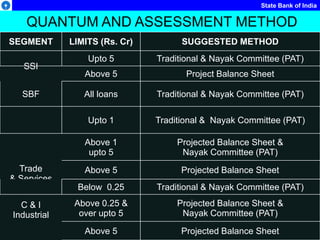
QUANTUM AND ASSESSMENT METHOD
SEGMENT LIMITS (Rs. Cr) SUGGESTED METHOD
SSI
Upto 5 Traditional & Nayak Committee (PAT)
Above 5 Project Balance Sheet
SBF All loans Traditional & Nayak Committee (PAT)
Trade
& Services
Upto 1 Traditional & Nayak Committee (PAT)
Above 1
upto 5
Projected Balance Sheet &
Nayak Committee (PAT)
Above 5 Projected Balance Sheet
C & I
Industrial
Below 0.25 Traditional & Nayak Committee (PAT)
Above 0.25 &
over upto 5
Projected Balance Sheet &
Nayak Committee (PAT)
Above 5 Projected Balance Sheet
State Bank of India
OPERATING CYCLE
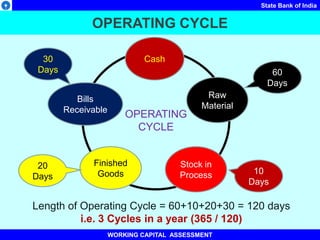
Length of Operating Cycle = 60+10+20+30 = 120 days
i.e. 3 Cycles in a year (365 / 120)
WORKING CAPITAL ASSESSMENT
OPERATING
CYCLE
Raw
Material
Stock in
Process
Finished
Goods
Bills
Receivable
Cash
60
Days
10
Days
20
Days
30
Days
State Bank of India
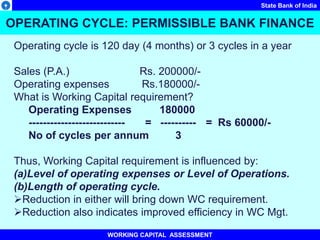
OPERATING CYCLE: PERMISSIBLE BANK FINANCE
WORKING CAPITAL ASSESSMENT
Operating cycle is 120 day (4 months) or 3 cycles in a year
Sales (P.A.) Rs. 200000/-
Operating expenses Rs.180000/-
What is Working Capital requirement?
Operating Expenses 180000
--------------------------- = ---------- = Rs 60000/-
No of cycles per annum 3
Thus, Working Capital requirement is influenced by:
(a)Level of operating expenses or Level of Operations.
(b)Length of operating cycle.
Reduction in either will bring down WC requirement.
Reduction also indicates improved efficiency in WC Mgt.
State Bank of India
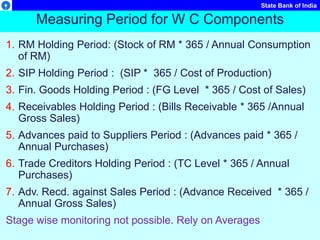
Measuring Period for W C Components
1. RM Holding Period: (Stock of RM * 365 / Annual Consumption
of RM)
2. SIP Holding Period : (SIP * 365 / Cost of Production)
3. Fin. Goods Holding Period : (FG Level * 365 / Cost of Sales)
4. Receivables Holding Period : (Bills Receivable * 365 /Annual
Gross Sales)
5. Advances paid to Suppliers Period : (Advances paid * 365 /
Annual Purchases)
6. Trade Creditors Holding Period : (TC Level * 365 / Annual
Purchases)
7. Adv. Recd. against Sales Period : (Advance Received * 365 /
Annual Gross Sales)
Stage wise monitoring not possible. Rely on Averages
State Bank of India
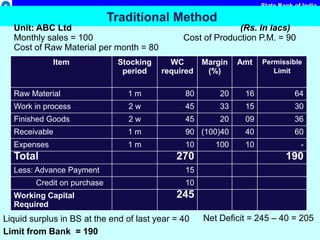
Traditional Method
Item Stocking
period
WC
required
Margin
(%)
Amt Permissible
Limit
Raw Material 1 m 80 20 16 64
Work in process 2 w 45 33 15 30
Finished Goods 2 w 45 20 09 36
Receivable 1 m 90 (100)40 40 60
Expenses 1 m 10 100 10 -
Total 270 190
Less: Advance Payment 15
Credit on purchase 10
Working Capital
Required
245
Unit: ABC Ltd (Rs. In lacs)
Monthly sales = 100 Cost of Production P.M. = 90
Cost of Raw Material per month = 80
Liquid surplus in BS at the end of last year = 40
Limit from Bank = 190
Net Deficit = 245 – 40 = 205
State Bank of India
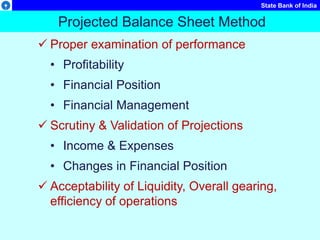
Projected Balance Sheet Method
 Proper examination of performance
• Profitability
• Financial Position
• Financial Management
 Scrutiny & Validation of Projections
• Income & Expenses
• Changes in Financial Position
 Acceptability of Liquidity, Overall gearing,
efficiency of operations
State Bank of India
Projected Balance Sheet Method
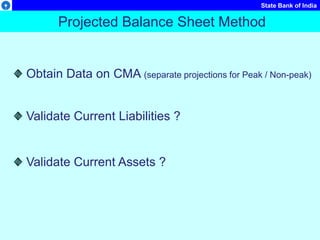
Obtain Data on CMA (separate projections for Peak / Non-peak)
Validate Current Liabilities ?
Validate Current Assets ?
State Bank of India
Projected Balance Sheet Method
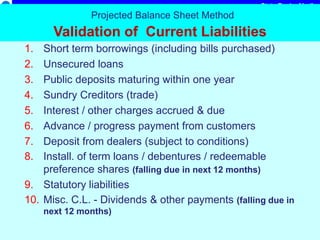
Validation of Current Liabilities
1. Short term borrowings (including bills purchased)
2. Unsecured loans
3. Public deposits maturing within one year
4. Sundry Creditors (trade)
5. Interest / other charges accrued & due
6. Advance / progress payment from customers
7. Deposit from dealers (subject to conditions)
8. Install. of term loans / debentures / redeemable
preference shares (falling due in next 12 months)
9. Statutory liabilities
10. Misc. C.L. - Dividends & other payments (falling due in
next 12 months)
State Bank of India
Projected Balance Sheet Method
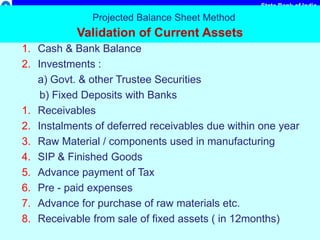
Validation of Current Assets
1. Cash & Bank Balance
2. Investments :
a) Govt. & other Trustee Securities
b) Fixed Deposits with Banks
1. Receivables
2. Instalments of deferred receivables due within one year
3. Raw Material / components used in manufacturing
4. SIP & Finished Goods
5. Advance payment of Tax
6. Pre - paid expenses
7. Advance for purchase of raw materials etc.
8. Receivable from sale of fixed assets ( in 12months)
State Bank of India
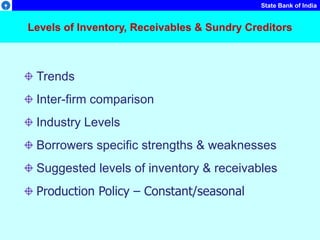
Levels of Inventory, Receivables & Sundry Creditors
Trends
Inter-firm comparison
Industry Levels
Borrowers specific strengths & weaknesses
Suggested levels of inventory & receivables
Production Policy – Constant/seasonal
State Bank of India
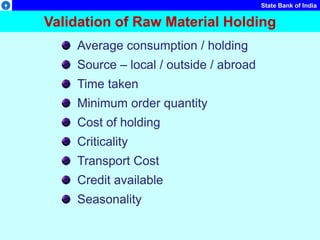
Validation of Raw Material Holding
Average consumption / holding
Source – local / outside / abroad
Time taken
Minimum order quantity
Cost of holding
Criticality
Transport Cost
Credit available
Seasonality
State Bank of India
Validation of SIP Holding
Processing time
Processing technology
No. of shifts
State Bank of India
Validation of Finished Goods Holding
Firm order or anticipated order
Minimum despatch quantity
Transport availability / cost
Seasonality
Marketing arrangement
State Bank of India
Sundry Debtors
Trade practices
Market conditions
Bulk sales - benefits
Price advantage
Seasonality (vis. rain coats, woollen garments)
State Bank of India
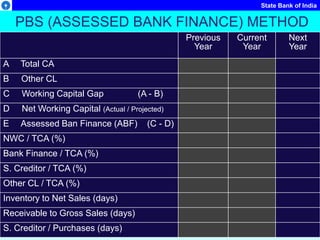
PBS (ASSESSED BANK FINANCE) METHOD
Previous
Year
Current
Year
Next
Year
A Total CA
B Other CL
C Working Capital Gap (A - B)
D Net Working Capital (Actual / Projected)
E Assessed Ban Finance (ABF) (C - D)
NWC / TCA (%)
Bank Finance / TCA (%)
S. Creditor / TCA (%)
Other CL / TCA (%)
Inventory to Net Sales (days)
Receivable to Gross Sales (days)
S. Creditor / Purchases (days)
State Bank of India
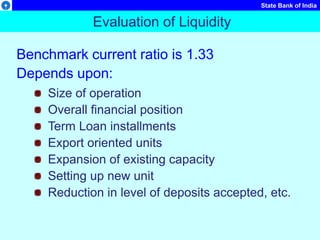
Evaluation of Liquidity
Benchmark current ratio is 1.33
Depends upon:
Size of operation
Overall financial position
Term Loan installments
Export oriented units
Expansion of existing capacity
Setting up new unit
Reduction in level of deposits accepted, etc.
State Bank of India
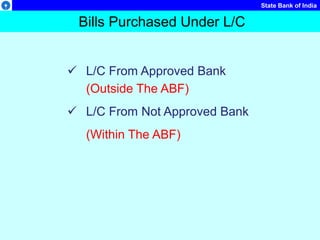
Bills Purchased Under L/C
 L/C From Approved Bank
(Outside The ABF)
 L/C From Not Approved Bank
(Within The ABF)
State Bank of India
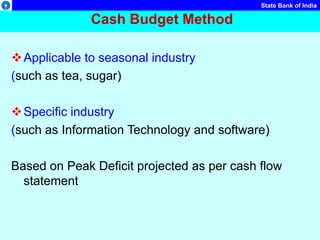
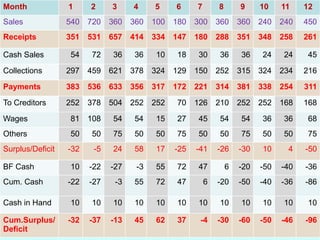
Cash Budget Method
Applicable to seasonal industry
(such as tea, sugar)
Specific industry
(such as Information Technology and software)
Based on Peak Deficit projected as per cash flow
statement
State Bank of IndiaMonth 1 2 3 4 5 6 7 8 9 10 11 12
Sales 540 720 360 360 100 180 300 360 360 240 240 450
Receipts 351 531 657 414 334 147 180 288 351 348 258 261
Cash Sales 54 72 36 36 10 18 30 36 36 24 24 45
Collections 297 459 621 378 324 129 150 252 315 324 234 216
Payments 383 536 633 356 317 172 221 314 381 338 254 311
To Creditors 252 378 504 252 252 70 126 210 252 252 168 168
Wages 81 108 54 54 15 27 45 54 54 36 36 68
Others 50 50 75 50 50 75 50 50 75 50 50 75
Surplus/Deficit -32 -5 24 58 17 -25 -41 -26 -30 10 4 -50
BF Cash 10 -22 -27 -3 55 72 47 6 -20 -50 -40 -36
Cum. Cash -22 -27 -3 55 72 47 6 -20 -50 -40 -36 -86
Cash in Hand 10 10 10 10 10 10 10 10 10 10 10 10
Cum.Surplus/
Deficit
-32 -37 -13 45 62 37 -4 -30 -60 -50 -46 -96
State Bank of India
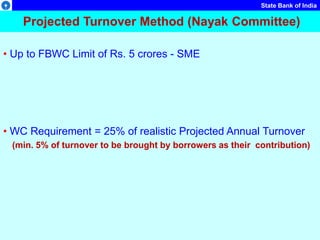
Projected Turnover Method (Nayak Committee)
• Up to FBWC Limit of Rs. 5 crores - SME
• WC Requirement = 25% of realistic Projected Annual Turnover
(min. 5% of turnover to be brought by borrowers as their contribution)
State Bank of India
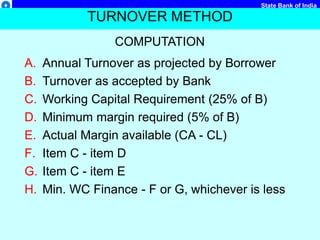
TURNOVER METHOD
A. Annual Turnover as projected by Borrower
B. Turnover as accepted by Bank
C. Working Capital Requirement (25% of B)
D. Minimum margin required (5% of B)
E. Actual Margin available (CA - CL)
F. Item C - item D
G. Item C - item E
H. Min. WC Finance - F or G, whichever is less
COMPUTATION
State Bank of India
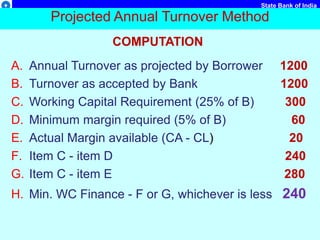
Projected Annual Turnover Method
A. Annual Turnover as projected by Borrower 1200
B. Turnover as accepted by Bank 1200
C. Working Capital Requirement (25% of B) 300
D. Minimum margin required (5% of B) 60
E. Actual Margin available (CA - CL) 20
F. Item C - item D 240
G. Item C - item E 280
H. Min. WC Finance - F or G, whichever is less 240
COMPUTATION
State Bank of India
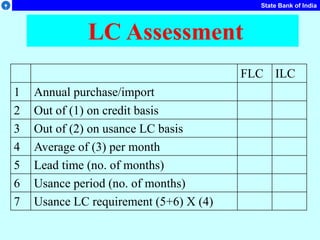
LC Assessment
FLC ILC
1 Annual purchase/import
2 Out of (1) on credit basis
3 Out of (2) on usance LC basis
4 Average of (3) per month
5 Lead time (no. of months)
6 Usance period (no. of months)
7 Usance LC requirement (5+6) X (4)
State Bank of India
Thank You
State Bank of India
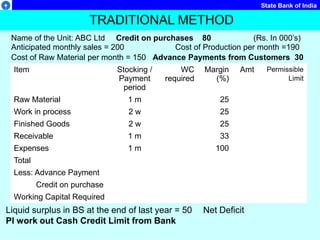
TRADITIONAL METHOD
Item Stocking /
Payment
period
WC
required
Margin
(%)
Amt Permissible
Limit
Raw Material 1 m 25
Work in process 2 w 25
Finished Goods 2 w 25
Receivable 1 m 33
Expenses 1 m 100
Total
Less: Advance Payment
Credit on purchase
Working Capital Required
Name of the Unit: ABC Ltd Credit on purchases 80 (Rs. In 000’s)
Anticipated monthly sales = 200 Cost of Production per month =190
Cost of Raw Material per month = 150 Advance Payments from Customers 30
Liquid surplus in BS at the end of last year = 50
Pl work out Cash Credit Limit from Bank
Net Deficit
State Bank of India
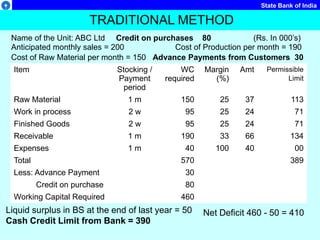
TRADITIONAL METHOD
Item Stocking /
Payment
period
WC
required
Margin
(%)
Amt Permissible
Limit
Raw Material 1 m 150 25 37 113
Work in process 2 w 95 25 24 71
Finished Goods 2 w 95 25 24 71
Receivable 1 m 190 33 66 134
Expenses 1 m 40 100 40 00
Total 570 389
Less: Advance Payment 30
Credit on purchase 80
Working Capital Required 460
Name of the Unit: ABC Ltd Credit on purchases 80 (Rs. In 000’s)
Anticipated monthly sales = 200 Cost of Production per month = 190
Cost of Raw Material per month = 150 Advance Payments from Customers 30
Liquid surplus in BS at the end of last year = 50
Cash Credit Limit from Bank = 390
Net Deficit 460 - 50 = 410

Working capital assessment

  • 1.
  • 2.
    State Bank ofIndia WORKING CAPITAL WC Assessment is outcome of two variables: The volume of activity – Production & Sales Required level of current assets (Inventory & Receivables) to enable the unit to carry on operations without interruptions
  • 3.
    State Bank ofIndia What are Working Capital Sources?  Own funds  Bank borrowings  Sundry Creditors  Advances from customers  Deposits due in a year  Other current liabilities
  • 4.
    State Bank ofIndia Working Capital Limit Generally for 12 months, or Seasonal industry – short duration / Peak & Non- peak level, or Subject to specific repayment schedule, viz EPC Renewal necessary (within 180 days to avoid its becoming NPA)
  • 5.
    State Bank ofIndia For Renewals/Enhancements: (Put a clause in the sanction letter itself) Send an intimation 2 months prior to renewal. Call for: Audited Financial Statements for 2 years (for non- corporate T.O. Rs. 60 lac & above / G P < 8% of T.O.) Break up of various items Projected Balance Sheet and P&L A/c Funds Flow Statement Renewal of Limits
  • 6.
    State Bank ofIndia  A note containing major developments in : Ø Production facilities Ø Marketing Ø Expansion Plan Ø Industrial Relations Ø Prospects of the Industry Ø Management set-up Ø Major shareholders etc.  Assumptions & assessment of Credit Requirement WORKING CAPITAL LIMIT
  • 7.
    State Bank ofIndia WORKING CAPITAL ASSESSMENT Working Capital Assessment Methods:  Operating Cycle Method  Traditional method  Projected Balance Sheet method  Cash Budget method  Projected Annual Turnover method (Nayak Committee)
  • 8.
    State Bank ofIndia QUANTUM AND ASSESSMENT METHOD SEGMENT LIMITS (Rs. Cr) SUGGESTED METHOD SSI Upto 5 Traditional & Nayak Committee (PAT) Above 5 Project Balance Sheet SBF All loans Traditional & Nayak Committee (PAT) Trade & Services Upto 1 Traditional & Nayak Committee (PAT) Above 1 upto 5 Projected Balance Sheet & Nayak Committee (PAT) Above 5 Projected Balance Sheet C & I Industrial Below 0.25 Traditional & Nayak Committee (PAT) Above 0.25 & over upto 5 Projected Balance Sheet & Nayak Committee (PAT) Above 5 Projected Balance Sheet
  • 9.
    State Bank ofIndia OPERATING CYCLE Length of Operating Cycle = 60+10+20+30 = 120 days i.e. 3 Cycles in a year (365 / 120) WORKING CAPITAL ASSESSMENT OPERATING CYCLE Raw Material Stock in Process Finished Goods Bills Receivable Cash 60 Days 10 Days 20 Days 30 Days
  • 10.
    State Bank ofIndia OPERATING CYCLE: PERMISSIBLE BANK FINANCE WORKING CAPITAL ASSESSMENT Operating cycle is 120 day (4 months) or 3 cycles in a year Sales (P.A.) Rs. 200000/- Operating expenses Rs.180000/- What is Working Capital requirement? Operating Expenses 180000 --------------------------- = ---------- = Rs 60000/- No of cycles per annum 3 Thus, Working Capital requirement is influenced by: (a)Level of operating expenses or Level of Operations. (b)Length of operating cycle. Reduction in either will bring down WC requirement. Reduction also indicates improved efficiency in WC Mgt.
  • 11.
    State Bank ofIndia Measuring Period for W C Components 1. RM Holding Period: (Stock of RM * 365 / Annual Consumption of RM) 2. SIP Holding Period : (SIP * 365 / Cost of Production) 3. Fin. Goods Holding Period : (FG Level * 365 / Cost of Sales) 4. Receivables Holding Period : (Bills Receivable * 365 /Annual Gross Sales) 5. Advances paid to Suppliers Period : (Advances paid * 365 / Annual Purchases) 6. Trade Creditors Holding Period : (TC Level * 365 / Annual Purchases) 7. Adv. Recd. against Sales Period : (Advance Received * 365 / Annual Gross Sales) Stage wise monitoring not possible. Rely on Averages
  • 12.
    State Bank ofIndia Traditional Method Item Stocking period WC required Margin (%) Amt Permissible Limit Raw Material 1 m 80 20 16 64 Work in process 2 w 45 33 15 30 Finished Goods 2 w 45 20 09 36 Receivable 1 m 90 (100)40 40 60 Expenses 1 m 10 100 10 - Total 270 190 Less: Advance Payment 15 Credit on purchase 10 Working Capital Required 245 Unit: ABC Ltd (Rs. In lacs) Monthly sales = 100 Cost of Production P.M. = 90 Cost of Raw Material per month = 80 Liquid surplus in BS at the end of last year = 40 Limit from Bank = 190 Net Deficit = 245 – 40 = 205
  • 13.
    State Bank ofIndia Projected Balance Sheet Method  Proper examination of performance • Profitability • Financial Position • Financial Management  Scrutiny & Validation of Projections • Income & Expenses • Changes in Financial Position  Acceptability of Liquidity, Overall gearing, efficiency of operations
  • 14.
    State Bank ofIndia Projected Balance Sheet Method Obtain Data on CMA (separate projections for Peak / Non-peak) Validate Current Liabilities ? Validate Current Assets ?
  • 15.
    State Bank ofIndia Projected Balance Sheet Method Validation of Current Liabilities 1. Short term borrowings (including bills purchased) 2. Unsecured loans 3. Public deposits maturing within one year 4. Sundry Creditors (trade) 5. Interest / other charges accrued & due 6. Advance / progress payment from customers 7. Deposit from dealers (subject to conditions) 8. Install. of term loans / debentures / redeemable preference shares (falling due in next 12 months) 9. Statutory liabilities 10. Misc. C.L. - Dividends & other payments (falling due in next 12 months)
  • 16.
    State Bank ofIndia Projected Balance Sheet Method Validation of Current Assets 1. Cash & Bank Balance 2. Investments : a) Govt. & other Trustee Securities b) Fixed Deposits with Banks 1. Receivables 2. Instalments of deferred receivables due within one year 3. Raw Material / components used in manufacturing 4. SIP & Finished Goods 5. Advance payment of Tax 6. Pre - paid expenses 7. Advance for purchase of raw materials etc. 8. Receivable from sale of fixed assets ( in 12months)
  • 17.
    State Bank ofIndia Levels of Inventory, Receivables & Sundry Creditors Trends Inter-firm comparison Industry Levels Borrowers specific strengths & weaknesses Suggested levels of inventory & receivables Production Policy – Constant/seasonal
  • 18.
    State Bank ofIndia Validation of Raw Material Holding Average consumption / holding Source – local / outside / abroad Time taken Minimum order quantity Cost of holding Criticality Transport Cost Credit available Seasonality
  • 19.
    State Bank ofIndia Validation of SIP Holding Processing time Processing technology No. of shifts
  • 20.
    State Bank ofIndia Validation of Finished Goods Holding Firm order or anticipated order Minimum despatch quantity Transport availability / cost Seasonality Marketing arrangement
  • 21.
    State Bank ofIndia Sundry Debtors Trade practices Market conditions Bulk sales - benefits Price advantage Seasonality (vis. rain coats, woollen garments)
  • 22.
    State Bank ofIndia PBS (ASSESSED BANK FINANCE) METHOD Previous Year Current Year Next Year A Total CA B Other CL C Working Capital Gap (A - B) D Net Working Capital (Actual / Projected) E Assessed Ban Finance (ABF) (C - D) NWC / TCA (%) Bank Finance / TCA (%) S. Creditor / TCA (%) Other CL / TCA (%) Inventory to Net Sales (days) Receivable to Gross Sales (days) S. Creditor / Purchases (days)
  • 23.
    State Bank ofIndia Evaluation of Liquidity Benchmark current ratio is 1.33 Depends upon: Size of operation Overall financial position Term Loan installments Export oriented units Expansion of existing capacity Setting up new unit Reduction in level of deposits accepted, etc.
  • 24.
    State Bank ofIndia Bills Purchased Under L/C  L/C From Approved Bank (Outside The ABF)  L/C From Not Approved Bank (Within The ABF)
  • 25.
    State Bank ofIndia Cash Budget Method Applicable to seasonal industry (such as tea, sugar) Specific industry (such as Information Technology and software) Based on Peak Deficit projected as per cash flow statement
  • 26.
    State Bank ofIndiaMonth 1 2 3 4 5 6 7 8 9 10 11 12 Sales 540 720 360 360 100 180 300 360 360 240 240 450 Receipts 351 531 657 414 334 147 180 288 351 348 258 261 Cash Sales 54 72 36 36 10 18 30 36 36 24 24 45 Collections 297 459 621 378 324 129 150 252 315 324 234 216 Payments 383 536 633 356 317 172 221 314 381 338 254 311 To Creditors 252 378 504 252 252 70 126 210 252 252 168 168 Wages 81 108 54 54 15 27 45 54 54 36 36 68 Others 50 50 75 50 50 75 50 50 75 50 50 75 Surplus/Deficit -32 -5 24 58 17 -25 -41 -26 -30 10 4 -50 BF Cash 10 -22 -27 -3 55 72 47 6 -20 -50 -40 -36 Cum. Cash -22 -27 -3 55 72 47 6 -20 -50 -40 -36 -86 Cash in Hand 10 10 10 10 10 10 10 10 10 10 10 10 Cum.Surplus/ Deficit -32 -37 -13 45 62 37 -4 -30 -60 -50 -46 -96
  • 27.
    State Bank ofIndia Projected Turnover Method (Nayak Committee) • Up to FBWC Limit of Rs. 5 crores - SME • WC Requirement = 25% of realistic Projected Annual Turnover (min. 5% of turnover to be brought by borrowers as their contribution)
  • 28.
    State Bank ofIndia TURNOVER METHOD A. Annual Turnover as projected by Borrower B. Turnover as accepted by Bank C. Working Capital Requirement (25% of B) D. Minimum margin required (5% of B) E. Actual Margin available (CA - CL) F. Item C - item D G. Item C - item E H. Min. WC Finance - F or G, whichever is less COMPUTATION
  • 29.
    State Bank ofIndia Projected Annual Turnover Method A. Annual Turnover as projected by Borrower 1200 B. Turnover as accepted by Bank 1200 C. Working Capital Requirement (25% of B) 300 D. Minimum margin required (5% of B) 60 E. Actual Margin available (CA - CL) 20 F. Item C - item D 240 G. Item C - item E 280 H. Min. WC Finance - F or G, whichever is less 240 COMPUTATION
  • 30.
    State Bank ofIndia LC Assessment FLC ILC 1 Annual purchase/import 2 Out of (1) on credit basis 3 Out of (2) on usance LC basis 4 Average of (3) per month 5 Lead time (no. of months) 6 Usance period (no. of months) 7 Usance LC requirement (5+6) X (4)
  • 31.
    State Bank ofIndia Thank You
  • 32.
    State Bank ofIndia TRADITIONAL METHOD Item Stocking / Payment period WC required Margin (%) Amt Permissible Limit Raw Material 1 m 25 Work in process 2 w 25 Finished Goods 2 w 25 Receivable 1 m 33 Expenses 1 m 100 Total Less: Advance Payment Credit on purchase Working Capital Required Name of the Unit: ABC Ltd Credit on purchases 80 (Rs. In 000’s) Anticipated monthly sales = 200 Cost of Production per month =190 Cost of Raw Material per month = 150 Advance Payments from Customers 30 Liquid surplus in BS at the end of last year = 50 Pl work out Cash Credit Limit from Bank Net Deficit
  • 33.
    State Bank ofIndia TRADITIONAL METHOD Item Stocking / Payment period WC required Margin (%) Amt Permissible Limit Raw Material 1 m 150 25 37 113 Work in process 2 w 95 25 24 71 Finished Goods 2 w 95 25 24 71 Receivable 1 m 190 33 66 134 Expenses 1 m 40 100 40 00 Total 570 389 Less: Advance Payment 30 Credit on purchase 80 Working Capital Required 460 Name of the Unit: ABC Ltd Credit on purchases 80 (Rs. In 000’s) Anticipated monthly sales = 200 Cost of Production per month = 190 Cost of Raw Material per month = 150 Advance Payments from Customers 30 Liquid surplus in BS at the end of last year = 50 Cash Credit Limit from Bank = 390 Net Deficit 460 - 50 = 410