WORKING CAPITAL
ASSESSMENT
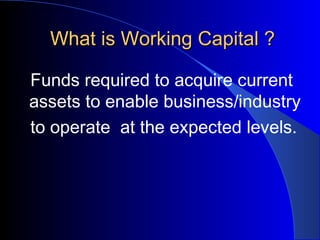
What is Working Capital ?
Funds required to acquire current
assets to enable business/industry
to operate at the expected levels.
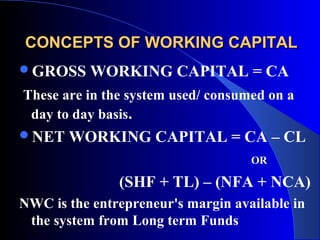
CONCEPTS OF WORKING CAPITAL
GROSS

WORKING CAPITAL = CA

These are in the system used/ consumed on a
day to day basis.
NET

WORKING CAPITAL = CA – CL
OR

(SHF + TL) – (NFA + NCA)
NWC is the entrepreneur's margin available in
the system from Long term Funds
What are Current Assets ?
Assets which normally get converted
into cash during the operating cycle
of the firm.
 Cash & Bank balances
 Inventory
 Receivables
 Advances to suppliers/others
Other Current assets
What are Working Capital Sources?
Own

funds
Bank borrowings
Sundry Creditors
Advances from customers
Deposits due in a year
Other current liabilities
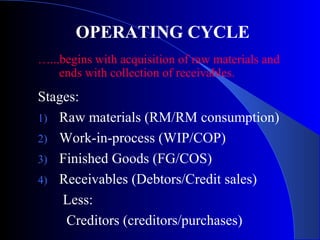
OPERATING CYCLE
…...begins with acquisition of raw materials and
ends with collection of receivables.

Stages:
1) Raw materials (RM/RM consumption)
2) Work-in-process (WIP/COP)
3) Finished Goods (FG/COS)
4) Receivables (Debtors/Credit sales)
Less:
Creditors (creditors/purchases)
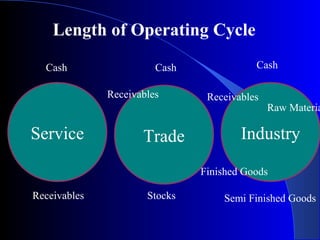
Length of Operating Cycle
Cash

Cash
Receivables

Service

Trade

Cash
Receivables

Raw Materia

Industry
Finished Goods

Receivables

Stocks

Semi Finished Goods
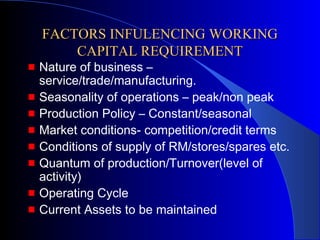
FACTORS INFULENCING WORKING
CAPITAL REQUIREMENT

Nature of business –
service/trade/manufacturing.
Seasonality of operations – peak/non peak
Production Policy – Constant/seasonal
Market conditions- competition/credit terms
Conditions of supply of RM/stores/spares etc.
Quantum of production/Turnover(level of
activity)
Operating Cycle
Current Assets to be maintained
DATA TO BE OBTAINED
Application.
Financial Statements of Previous
years
Estimates/ Projections (with
quantitative details)
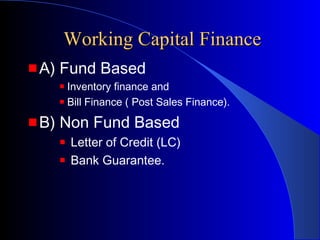
Working Capital Finance
A) Fund Based
Inventory finance and
Bill Finance ( Post Sales Finance).

B) Non Fund Based
Letter of Credit (LC)
Bank Guarantee.
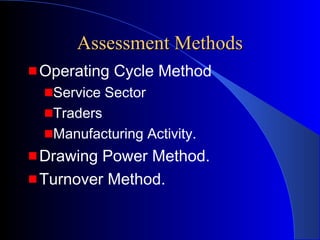
Assessment Methods
Operating Cycle Method
Service Sector
Traders
Manufacturing Activity.

Drawing Power Method.
Turnover Method.
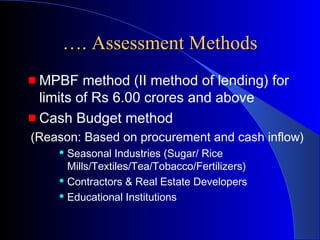
…. Assessment Methods
MPBF method (II method of lending) for
limits of Rs 6.00 crores and above
Cash Budget method
(Reason: Based on procurement and cash inflow)
Seasonal Industries (Sugar/ Rice
Mills/Textiles/Tea/Tobacco/Fertilizers)
 Contractors & Real Estate Developers
 Educational Institutions

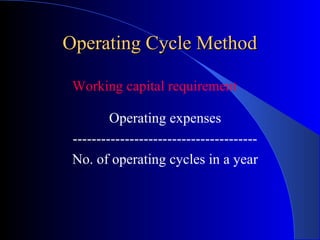
Operating Cycle Method
Working capital requirement
Operating expenses
--------------------------------------No. of operating cycles in a year
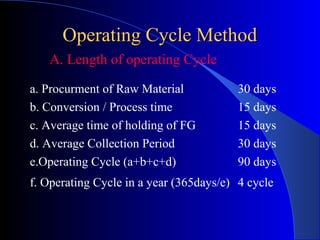
Operating Cycle Method
A. Length of operating Cycle
a. Procurment of Raw Material
b. Conversion / Process time
c. Average time of holding of FG
d. Average Collection Period
e.Operating Cycle (a+b+c+d)

30 days
15 days
15 days
30 days
90 days

f. Operating Cycle in a year (365days/e) 4 cycle
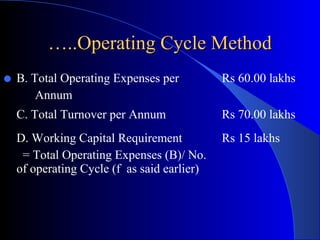
…..Operating Cycle Method
 B. Total Operating Expenses per

Rs 60.00 lakhs

Annum
C. Total Turnover per Annum

Rs 70.00 lakhs

D. Working Capital Requirement
= Total Operating Expenses (B)/ No.
of operating Cycle (f as said earlier)

Rs 15 lakhs
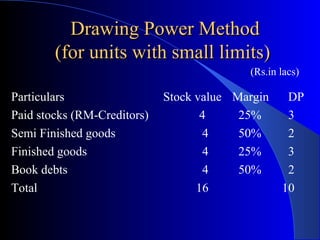
Drawing Power Method
(for units with small limits)
(Rs.in lacs)

Particulars
Paid stocks (RM-Creditors)
Semi Finished goods
Finished goods
Book debts
Total

Stock value Margin
4
25%
4
50%
4
25%
4
50%
16

DP
3
2
3
2
10
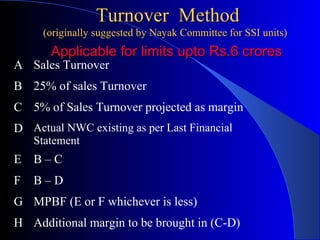
Turnover Method

(originally suggested by Nayak Committee for SSI units)

Applicable for limits upto Rs.6 crores

A Sales Turnover

B 25% of sales Turnover
C 5% of Sales Turnover projected as margin
D Actual NWC existing as per Last Financial
Statement

E B–C
F

B–D

G MPBF (E or F whichever is less)
H Additional margin to be brought in (C-D)
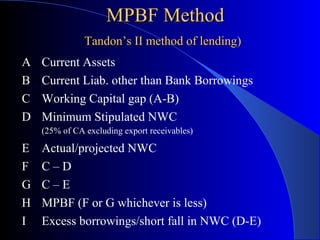
MPBF Method
Tandon’s II method of lending)
A
B
C
D

Current Assets
Current Liab. other than Bank Borrowings
Working Capital gap (A-B)
Minimum Stipulated NWC
(25% of CA excluding export receivables)

E
F
G
H
I

Actual/projected NWC
C–D
C–E
MPBF (F or G whichever is less)
Excess borrowings/short fall in NWC (D-E)
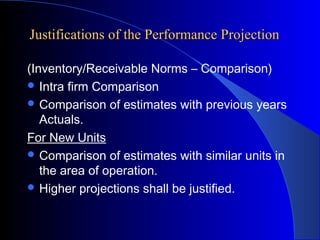
Justifications of the Performance Projection
(Inventory/Receivable Norms – Comparison)
 Intra firm Comparison
 Comparison of estimates with previous years
Actuals.
For New Units
 Comparison of estimates with similar units in
the area of operation.
 Higher projections shall be justified.
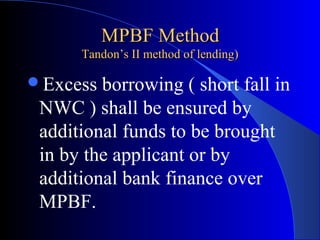
MPBF Method
Tandon’s II method of lending)

Excess

borrowing ( short fall in
NWC ) shall be ensured by
additional funds to be brought
in by the applicant or by
additional bank finance over
MPBF.
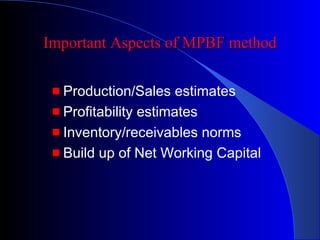
Important Aspects of MPBF method
Production/Sales estimates
Profitability estimates
Inventory/receivables norms
Build up of Net Working Capital
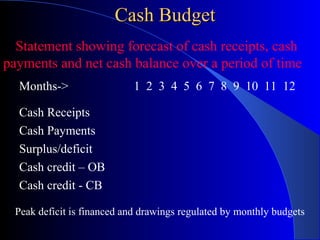
Cash Budget
Statement showing forecast of cash receipts, cash
payments and net cash balance over a period of time
Months->

1 2 3 4 5 6 7 8 9 10 11 12

Cash Receipts
Cash Payments
Surplus/deficit
Cash credit – OB
Cash credit - CB
Peak deficit is financed and drawings regulated by monthly budgets
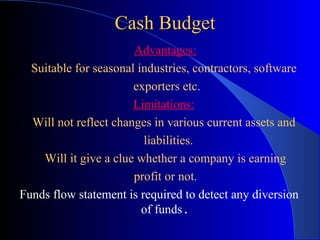
Cash Budget
Advantages:
•Suitable for seasonal industries, contractors, software
exporters etc.
Limitations:
•Will not reflect changes in various current assets and
liabilities.
•Will it give a clue whether a company is earning
•profit or not.
Funds flow statement is required to detect any diversion
of funds.
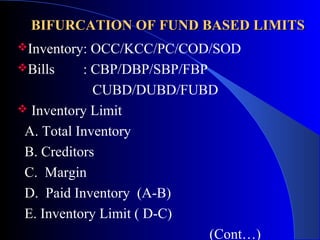
BIFURCATION OF FUND BASED LIMITS
Inventory:

OCC/KCC/PC/COD/SOD
Bills
: CBP/DBP/SBP/FBP
CUBD/DUBD/FUBD
 Inventory Limit
A. Total Inventory
B. Creditors
C. Margin
D. Paid Inventory (A-B)
E. Inventory Limit ( D-C)
(Cont…)
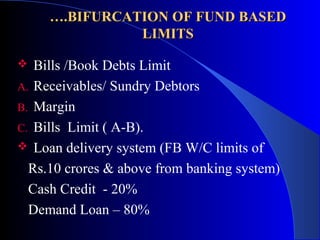
….BIFURCATION OF FUND BASED
LIMITS
Bills /Book Debts Limit
A. Receivables/ Sundry Debtors
B. Margin
C. Bills Limit ( A-B).
 Loan delivery system (FB W/C limits of
Rs.10 crores & above from banking system)
Cash Credit - 20%
Demand Loan – 80%

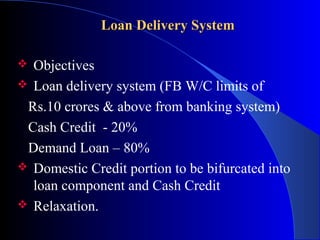
Loan Delivery System
Objectives
 Loan delivery system (FB W/C limits of
Rs.10 crores & above from banking system)
Cash Credit - 20%
Demand Loan – 80%
 Domestic Credit portion to be bifurcated into
loan component and Cash Credit
 Relaxation.

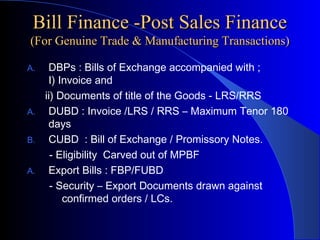
Bill Finance -Post Sales Finance
(For Genuine Trade & Manufacturing Transactions)
A.

A.
B.
A.

DBPs : Bills of Exchange accompanied with ;
I) Invoice and
ii) Documents of title of the Goods - LRS/RRS
DUBD : Invoice /LRS / RRS – Maximum Tenor 180
days
CUBD : Bill of Exchange / Promissory Notes.
- Eligibility Carved out of MPBF
Export Bills : FBP/FUBD
- Security – Export Documents drawn against
confirmed orders / LCs.
…Bill Finance -Post Sales Finance
(For Genuine Trade & Manufacturing Transactions)
A.

Book Debts Finance :
A. Service Industry / Contractors
B. Margin 50%
C. Age not more than 90 days
D. Collateral Security – 200% Urban / Semi

Urban Security.
Non Fund Based Limits
Letter of credit
ILC/FLC
Usance/Sight

Bank Guarantee
Performance
Financial – Bid Bonds/Security Deposits/
Mobilisation advance/retention money

Deferred Payment Guarantee
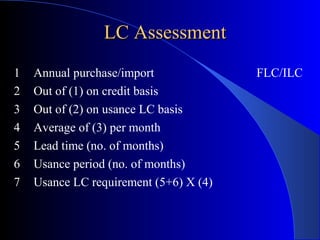
LC Assessment
1
2
3
4
5
6
7

Annual purchase/import
Out of (1) on credit basis
Out of (2) on usance LC basis
Average of (3) per month
Lead time (no. of months)
Usance period (no. of months)
Usance LC requirement (5+6) X (4)

FLC/ILC
Guidelines to be followed
For constituents borrowers with regular
sanctioned credit facilities for genuine
transactions.
LCs shall not be opened with clause without
recourse to drawer.

Bank Guarantees:
Performance and Financial Guarantees
Purpose / Difference
Security: Cash Margin +Counter Guarantee
+Collateral Security (Immovable / Liquid Security)
Restrictive Clause.
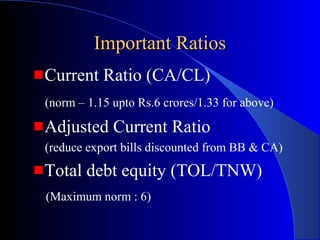
Important Ratios
Current Ratio (CA/CL)
(norm – 1.15 upto Rs.6 crores/1.33 for above)

Adjusted Current Ratio
(reduce export bills discounted from BB & CA)

Total debt equity (TOL/TNW)
(Maximum norm : 6)
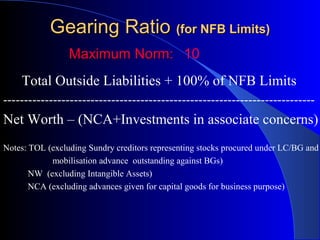
Gearing Ratio (for NFB Limits)
Maximum Norm: 10
Total Outside Liabilities + 100% of NFB Limits
---------------------------------------------------------------------------

Net Worth – (NCA+Investments in associate concerns)
Notes: TOL (excluding Sundry creditors representing stocks procured under LC/BG and
mobilisation advance outstanding against BGs)
NW (excluding Intangible Assets)
NCA (excluding advances given for capital goods for business purpose)
Exposure Norms for some Categories
Category
Constructions
contractors

Ceiling on borrowings
FB + NFB limits shall
not exceed 15 times
net owned funds

Housing Finance Borrowings shall be
Institutions
restricted to 3 times
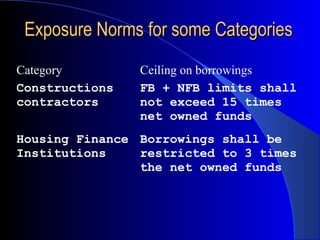
the net owned funds

How to assess working capital requirement

  • 1.
  • 2.
    What is WorkingCapital ? Funds required to acquire current assets to enable business/industry to operate at the expected levels.
  • 3.
    CONCEPTS OF WORKINGCAPITAL GROSS WORKING CAPITAL = CA These are in the system used/ consumed on a day to day basis. NET WORKING CAPITAL = CA – CL OR (SHF + TL) – (NFA + NCA) NWC is the entrepreneur's margin available in the system from Long term Funds
  • 4.
    What are CurrentAssets ? Assets which normally get converted into cash during the operating cycle of the firm.  Cash & Bank balances  Inventory  Receivables  Advances to suppliers/others Other Current assets
  • 5.
    What are WorkingCapital Sources? Own funds Bank borrowings Sundry Creditors Advances from customers Deposits due in a year Other current liabilities
  • 6.
    OPERATING CYCLE …...begins withacquisition of raw materials and ends with collection of receivables. Stages: 1) Raw materials (RM/RM consumption) 2) Work-in-process (WIP/COP) 3) Finished Goods (FG/COS) 4) Receivables (Debtors/Credit sales) Less: Creditors (creditors/purchases)
  • 7.
    Length of OperatingCycle Cash Cash Receivables Service Trade Cash Receivables Raw Materia Industry Finished Goods Receivables Stocks Semi Finished Goods
  • 8.
    FACTORS INFULENCING WORKING CAPITALREQUIREMENT Nature of business – service/trade/manufacturing. Seasonality of operations – peak/non peak Production Policy – Constant/seasonal Market conditions- competition/credit terms Conditions of supply of RM/stores/spares etc. Quantum of production/Turnover(level of activity) Operating Cycle Current Assets to be maintained
  • 9.
    DATA TO BEOBTAINED Application. Financial Statements of Previous years Estimates/ Projections (with quantitative details)
  • 10.
    Working Capital Finance A)Fund Based Inventory finance and Bill Finance ( Post Sales Finance). B) Non Fund Based Letter of Credit (LC) Bank Guarantee.
  • 11.
    Assessment Methods Operating CycleMethod Service Sector Traders Manufacturing Activity. Drawing Power Method. Turnover Method.
  • 12.
    …. Assessment Methods MPBFmethod (II method of lending) for limits of Rs 6.00 crores and above Cash Budget method (Reason: Based on procurement and cash inflow) Seasonal Industries (Sugar/ Rice Mills/Textiles/Tea/Tobacco/Fertilizers)  Contractors & Real Estate Developers  Educational Institutions 
  • 13.
    Operating Cycle Method Workingcapital requirement Operating expenses --------------------------------------No. of operating cycles in a year
  • 14.
    Operating Cycle Method A.Length of operating Cycle a. Procurment of Raw Material b. Conversion / Process time c. Average time of holding of FG d. Average Collection Period e.Operating Cycle (a+b+c+d) 30 days 15 days 15 days 30 days 90 days f. Operating Cycle in a year (365days/e) 4 cycle
  • 15.
    …..Operating Cycle Method B. Total Operating Expenses per Rs 60.00 lakhs Annum C. Total Turnover per Annum Rs 70.00 lakhs D. Working Capital Requirement = Total Operating Expenses (B)/ No. of operating Cycle (f as said earlier) Rs 15 lakhs
  • 16.
    Drawing Power Method (forunits with small limits) (Rs.in lacs) Particulars Paid stocks (RM-Creditors) Semi Finished goods Finished goods Book debts Total Stock value Margin 4 25% 4 50% 4 25% 4 50% 16 DP 3 2 3 2 10
  • 17.
    Turnover Method (originally suggestedby Nayak Committee for SSI units) Applicable for limits upto Rs.6 crores A Sales Turnover B 25% of sales Turnover C 5% of Sales Turnover projected as margin D Actual NWC existing as per Last Financial Statement E B–C F B–D G MPBF (E or F whichever is less) H Additional margin to be brought in (C-D)
  • 18.
    MPBF Method Tandon’s IImethod of lending) A B C D Current Assets Current Liab. other than Bank Borrowings Working Capital gap (A-B) Minimum Stipulated NWC (25% of CA excluding export receivables) E F G H I Actual/projected NWC C–D C–E MPBF (F or G whichever is less) Excess borrowings/short fall in NWC (D-E)
  • 19.
    Justifications of thePerformance Projection (Inventory/Receivable Norms – Comparison)  Intra firm Comparison  Comparison of estimates with previous years Actuals. For New Units  Comparison of estimates with similar units in the area of operation.  Higher projections shall be justified.
  • 20.
    MPBF Method Tandon’s IImethod of lending) Excess borrowing ( short fall in NWC ) shall be ensured by additional funds to be brought in by the applicant or by additional bank finance over MPBF.
  • 21.
    Important Aspects ofMPBF method Production/Sales estimates Profitability estimates Inventory/receivables norms Build up of Net Working Capital
  • 22.
    Cash Budget Statement showingforecast of cash receipts, cash payments and net cash balance over a period of time Months-> 1 2 3 4 5 6 7 8 9 10 11 12 Cash Receipts Cash Payments Surplus/deficit Cash credit – OB Cash credit - CB Peak deficit is financed and drawings regulated by monthly budgets
  • 23.
    Cash Budget Advantages: •Suitable forseasonal industries, contractors, software exporters etc. Limitations: •Will not reflect changes in various current assets and liabilities. •Will it give a clue whether a company is earning •profit or not. Funds flow statement is required to detect any diversion of funds.
  • 24.
    BIFURCATION OF FUNDBASED LIMITS Inventory: OCC/KCC/PC/COD/SOD Bills : CBP/DBP/SBP/FBP CUBD/DUBD/FUBD  Inventory Limit A. Total Inventory B. Creditors C. Margin D. Paid Inventory (A-B) E. Inventory Limit ( D-C) (Cont…)
  • 25.
    ….BIFURCATION OF FUNDBASED LIMITS Bills /Book Debts Limit A. Receivables/ Sundry Debtors B. Margin C. Bills Limit ( A-B).  Loan delivery system (FB W/C limits of Rs.10 crores & above from banking system) Cash Credit - 20% Demand Loan – 80% 
  • 26.
    Loan Delivery System Objectives Loan delivery system (FB W/C limits of Rs.10 crores & above from banking system) Cash Credit - 20% Demand Loan – 80%  Domestic Credit portion to be bifurcated into loan component and Cash Credit  Relaxation. 
  • 27.
    Bill Finance -PostSales Finance (For Genuine Trade & Manufacturing Transactions) A. A. B. A. DBPs : Bills of Exchange accompanied with ; I) Invoice and ii) Documents of title of the Goods - LRS/RRS DUBD : Invoice /LRS / RRS – Maximum Tenor 180 days CUBD : Bill of Exchange / Promissory Notes. - Eligibility Carved out of MPBF Export Bills : FBP/FUBD - Security – Export Documents drawn against confirmed orders / LCs.
  • 28.
    …Bill Finance -PostSales Finance (For Genuine Trade & Manufacturing Transactions) A. Book Debts Finance : A. Service Industry / Contractors B. Margin 50% C. Age not more than 90 days D. Collateral Security – 200% Urban / Semi Urban Security.
  • 29.
    Non Fund BasedLimits Letter of credit ILC/FLC Usance/Sight Bank Guarantee Performance Financial – Bid Bonds/Security Deposits/ Mobilisation advance/retention money Deferred Payment Guarantee
  • 30.
    LC Assessment 1 2 3 4 5 6 7 Annual purchase/import Outof (1) on credit basis Out of (2) on usance LC basis Average of (3) per month Lead time (no. of months) Usance period (no. of months) Usance LC requirement (5+6) X (4) FLC/ILC
  • 31.
    Guidelines to befollowed For constituents borrowers with regular sanctioned credit facilities for genuine transactions. LCs shall not be opened with clause without recourse to drawer. Bank Guarantees: Performance and Financial Guarantees Purpose / Difference Security: Cash Margin +Counter Guarantee +Collateral Security (Immovable / Liquid Security) Restrictive Clause.
  • 32.
    Important Ratios Current Ratio(CA/CL) (norm – 1.15 upto Rs.6 crores/1.33 for above) Adjusted Current Ratio (reduce export bills discounted from BB & CA) Total debt equity (TOL/TNW) (Maximum norm : 6)
  • 33.
    Gearing Ratio (forNFB Limits) Maximum Norm: 10 Total Outside Liabilities + 100% of NFB Limits --------------------------------------------------------------------------- Net Worth – (NCA+Investments in associate concerns) Notes: TOL (excluding Sundry creditors representing stocks procured under LC/BG and mobilisation advance outstanding against BGs) NW (excluding Intangible Assets) NCA (excluding advances given for capital goods for business purpose)
  • 34.
    Exposure Norms forsome Categories Category Constructions contractors Ceiling on borrowings FB + NFB limits shall not exceed 15 times net owned funds Housing Finance Borrowings shall be Institutions restricted to 3 times the net owned funds