Business Process Modeling Sandy Kemsley Kemsley Design Ltd. www.column2.com
Agenda What’s in your processes? Process modeling notation/standards Modeling for ROI Changing processes = changing job roles
What’s in your processes?
Kicking it off Human intervention Scanned document External event Invoked as web service
Types of steps/tasks Human-facing: Transactional heads-down Occasional participant Collaboration System: Web service orchestration Legacy application integration Content management integration
Other considerations External participants Process monitoring Collecting analytics data Frequency of process/rule/staff changes
A short segue on BPM/SOA BPM: Management practice Tools for automating processes SOA: Architectural philosophy Design standards-based services to access system functionality
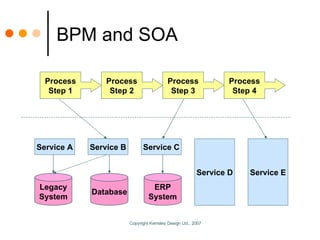
BPM and SOA Service A Service B Service C Service D Service E Legacy System Database ERP System Process Step 1 Process Step 2 Process Step 3 Process Step 4
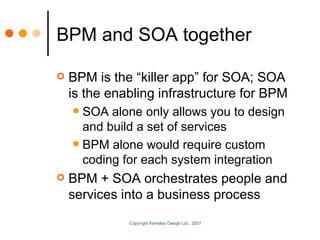
BPM and SOA together BPM is the “killer app” for SOA; SOA is the enabling infrastructure for BPM SOA alone only allows you to design and build a set of services BPM alone would require custom coding for each system integration BPM + SOA orchestrates people and services into a business process
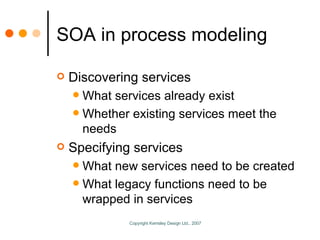
SOA in process modeling Discovering services What services already exist Whether existing services meet the needs Specifying services What new services need to be created What legacy functions need to be wrapped in services
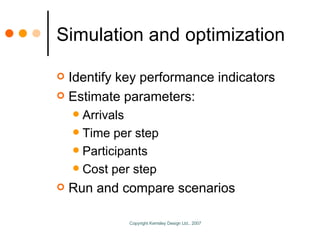
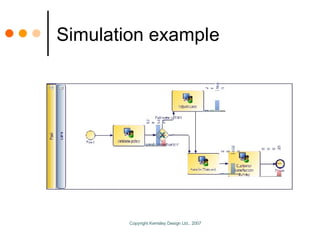
Simulation and optimization Identify key performance indicators Estimate parameters: Arrivals Time per step Participants Cost per step Run and compare scenarios
Simulation example
Process modeling standards
Graphical notation standard BPMN (Business Process Modeling Notation) = diagramming standard for drawing business processes Method of communicating processes: Understandable by business users and unambiguous Reduces translation errors between business and IT Easy transition between tools
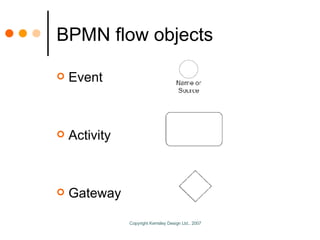
BPMN flow objects Event Activity Gateway
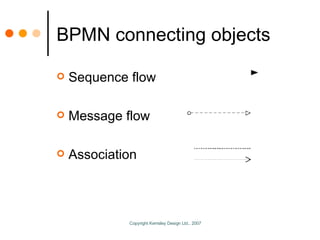
BPMN connecting objects Sequence flow Message flow Association
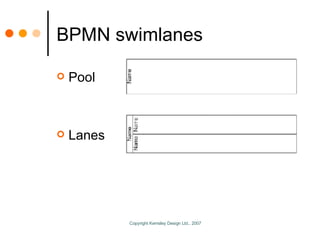
BPMN swimlanes Pool Lanes
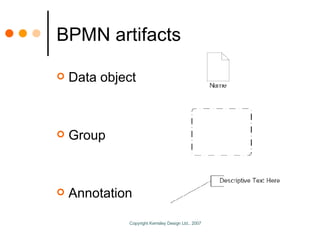
BPMN artifacts Data object Group Annotation
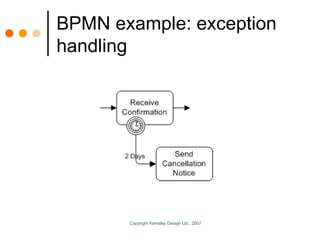
BPMN example: exception handling
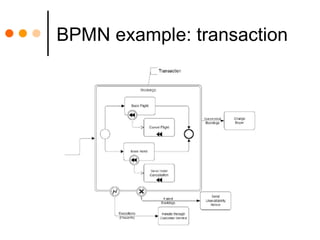
BPMN example: transaction
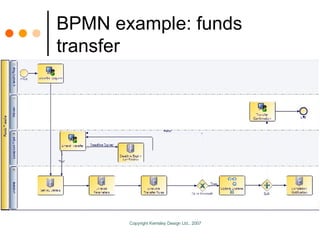
BPMN example: funds transfer
Modeling for ROI
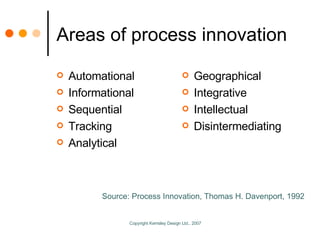
Areas of process innovation Automational Informational Sequential Tracking Analytical Geographical Integrative Intellectual Disintermediating Source: Process Innovation, Thomas H. Davenport, 1992
Improve efficiencies Automate manual work steps Directly integrate data between systems Provide process monitoring and control Automate process statistics gathering and analysis
Cut out the middle man Provide customer self-service to initiate processes Provide process visibility to customer
Location, location, location Share redundant processes between business units Identify steps that can be completed in isolation Automate escalation and handoffs Allow remote work
ROI: reduce costs Reduce manual tasks Reduce error rates Allow customer self-service Reduce compliance costs Reduce time to implement changes Reduce functional redundancy Allow outsourcing
ROI: increase competitive advantage Reduce time to market Reduce end-to-end cycle time Improve customer service Increase capacity Improve decision-making
Calculating ROI Baseline the “as-is” process Model and simulate “to-be” process Select relevant ROI metrics Select ROI calculation method Calculate best and worst case scenarios
Common ROI pitfalls Increased capacity does not guarantee increased revenue Cost reduction may require FTE reductions Providing self-service does not guarantee that customers will use it Remote work and outsourcing can have hidden costs
Classify BPM ROI potential Increased agility to business changes Optimized operational efficiency Process standards compliance Shortened process cycle times Better information for decision-making Reduced complexity of integrating people, processes and existing systems
Changing job roles
BPM supports changing roles Support for change management initiatives Model the new organization Simulate and optimize changes Measure results Enabling more rapid changes Overarching process orchestration and governance Real-time view of organizational processes Agile, business-driven changes
BPM causes role changes Business function concerns and benefits: Workers Concerns: job loss Benefits: better job and training Supervisors Concerns: loss of control Benefits: improved team and work management Managers Concerns: failure to achieve ROI Benefits: improved visibility and performance
Overcoming change resistance Communication of plans and impacts Involvement in process modeling Demonstration of new technologies Smaller “quick hit” before tackling radical reengineering
Summary Dissecting your process BPMN ROI BPM and role changes
Questions? Sandy Kemsley Kemsley Design Ltd. www.column2.com

Business Process Modeling

  • 1.
    Business Process ModelingSandy Kemsley Kemsley Design Ltd. www.column2.com
  • 2.
    Agenda What’s inyour processes? Process modeling notation/standards Modeling for ROI Changing processes = changing job roles
  • 3.
    What’s in yourprocesses?
  • 4.
    Kicking it offHuman intervention Scanned document External event Invoked as web service
  • 5.
    Types of steps/tasksHuman-facing: Transactional heads-down Occasional participant Collaboration System: Web service orchestration Legacy application integration Content management integration
  • 6.
    Other considerations Externalparticipants Process monitoring Collecting analytics data Frequency of process/rule/staff changes
  • 7.
    A short segueon BPM/SOA BPM: Management practice Tools for automating processes SOA: Architectural philosophy Design standards-based services to access system functionality
  • 8.
    BPM and SOAService A Service B Service C Service D Service E Legacy System Database ERP System Process Step 1 Process Step 2 Process Step 3 Process Step 4
  • 9.
    BPM and SOAtogether BPM is the “killer app” for SOA; SOA is the enabling infrastructure for BPM SOA alone only allows you to design and build a set of services BPM alone would require custom coding for each system integration BPM + SOA orchestrates people and services into a business process
  • 10.
    SOA in processmodeling Discovering services What services already exist Whether existing services meet the needs Specifying services What new services need to be created What legacy functions need to be wrapped in services
  • 11.
    Simulation and optimizationIdentify key performance indicators Estimate parameters: Arrivals Time per step Participants Cost per step Run and compare scenarios
  • 12.
  • 13.
  • 14.
    Graphical notation standardBPMN (Business Process Modeling Notation) = diagramming standard for drawing business processes Method of communicating processes: Understandable by business users and unambiguous Reduces translation errors between business and IT Easy transition between tools
  • 15.
    BPMN flow objectsEvent Activity Gateway
  • 16.
    BPMN connecting objectsSequence flow Message flow Association
  • 17.
  • 18.
    BPMN artifacts Dataobject Group Annotation
  • 19.
  • 20.
  • 21.
  • 22.
  • 23.
    Areas of processinnovation Automational Informational Sequential Tracking Analytical Geographical Integrative Intellectual Disintermediating Source: Process Innovation, Thomas H. Davenport, 1992
  • 24.
    Improve efficiencies Automatemanual work steps Directly integrate data between systems Provide process monitoring and control Automate process statistics gathering and analysis
  • 25.
    Cut out themiddle man Provide customer self-service to initiate processes Provide process visibility to customer
  • 26.
    Location, location, locationShare redundant processes between business units Identify steps that can be completed in isolation Automate escalation and handoffs Allow remote work
  • 27.
    ROI: reduce costsReduce manual tasks Reduce error rates Allow customer self-service Reduce compliance costs Reduce time to implement changes Reduce functional redundancy Allow outsourcing
  • 28.
    ROI: increase competitiveadvantage Reduce time to market Reduce end-to-end cycle time Improve customer service Increase capacity Improve decision-making
  • 29.
    Calculating ROI Baselinethe “as-is” process Model and simulate “to-be” process Select relevant ROI metrics Select ROI calculation method Calculate best and worst case scenarios
  • 30.
    Common ROI pitfallsIncreased capacity does not guarantee increased revenue Cost reduction may require FTE reductions Providing self-service does not guarantee that customers will use it Remote work and outsourcing can have hidden costs
  • 31.
    Classify BPM ROIpotential Increased agility to business changes Optimized operational efficiency Process standards compliance Shortened process cycle times Better information for decision-making Reduced complexity of integrating people, processes and existing systems

  • 32.
  • 33.
    BPM supports changingroles Support for change management initiatives Model the new organization Simulate and optimize changes Measure results Enabling more rapid changes Overarching process orchestration and governance Real-time view of organizational processes Agile, business-driven changes
  • 34.
    BPM causes rolechanges Business function concerns and benefits: Workers Concerns: job loss Benefits: better job and training Supervisors Concerns: loss of control Benefits: improved team and work management Managers Concerns: failure to achieve ROI Benefits: improved visibility and performance
  • 35.
    Overcoming change resistanceCommunication of plans and impacts Involvement in process modeling Demonstration of new technologies Smaller “quick hit” before tackling radical reengineering
  • 36.
    Summary Dissecting yourprocess BPMN ROI BPM and role changes
  • 37.
    Questions? Sandy KemsleyKemsley Design Ltd. www.column2.com