

PROJECT
IMPLEMENTATION
MPA 207 – PLANNING PROCESS
Engr. Truman T. Tesoro
What is Project
Implementation? • This is the logical conclusion, after
evaluating, deciding, visioning,
planning, applying for finances, and
finding the monetary resources of
a challenge.
• A task has to be implemented
successfully while the allocation of
undertaking obligations to the
assignment team in the
organization.
• Project implementation is the segment
wherein visions and plans come to be a
reality.
• The implementation degree of the
project cycle is in many approaches the
most critical, as it’s miles in the course of
this stage that planned advantages are
delivered.
2
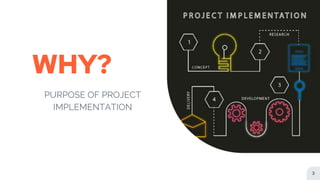
WHY?
PURPOSE OF PROJECT
IMPLEMENTATION
3
PURPOSE of
Project
Implementation
• To put the action plan into operation;
• To deliver the results, achieve the purpose(s) and
contribute effectively to the overall objective of
the project;
• To manage the available resources efficiently; and
• To monitor and report on progress
4
Things we must do
during Project
Implementation
• Update the
stakeholder
analysis to ensure
that all the
needful
stakeholders
(primary and
secondary) are
invited
• Reassess the risks
to the project. • Monitor and
review the
progress that the
project is making
towards achieving
its objectives.
5
• Feed the learning
from monitoring
and reviewing
returned into the
project design.
PROJECT
IMPLEMETATION PLAN
An implementation plan for a
project refers to a detailed
description of actions that
demonstrate a way to enforce an
activity in the project inside the
context of achieving project
objectives, addressing
requirements, and meeting
expectations.
What is Project
Implementation Plan?
The motive of the project
implementation plan is to provide
stakeholders with the self-belief
that accomplishment of a modern-
day challenge has been properly
considered and to list the tasks,
activities, and processes worried in
producing deliverable.
.
7
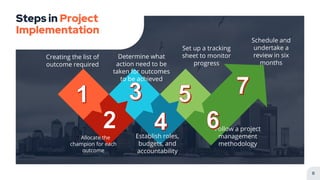
Steps in Project
Implementation
8
Creating the list of
outcome required
Set up a tracking
sheet to monitor
progress
1.Allocate the
champion for each
outcome
Establish roles,
budgets, and
accountability
Follow a project
management
methodology
Schedule and
undertake a
review in six
months
Determine what
action need to be
taken for outcomes
to be achieved
CREATING LIST OF
OUTCOME REQUIRED
• First of all, a project implementation plan must ensure what
we want to achieve by the end of the project.
• To decide the actions and the priorities of tasks, we need to
list the outcomes that we want to reap via this
implementation exercise.
9
ALLOCATE THE
CHAMPION FOR EACH
OUTCOME
• We need to allocate a champion to head everyone, a champion who could be
encouraged to attain the outcome and hold the entire undertaking team
responsible for accomplishing it.
• Look for those contributors of a team who have a vested interest in attaining
these final results, or whose passionate and devoted to a successful
implementation.
• Share those roles around the team (give chance to every team member) so
that the responsibility is not limited to a single person.
10
DETERMINE WHAT ACTION
NEED TO BE TAKEN FOR
OUTCOMES TO BE ACHIEVED
• In this phase of the implementation plan, we need to write down all the
actions that will help the team to successfully achieve the outcomes. For this,
we can discuss ‘what are the steps needed to do to reap this outcome?’
• Make sure that these actions are doable, feasible and relevant as per your
available resources and goals
11
ESTABLISH ROLES, BUDGETS
AND ACCOUNTABILITY
• Once we’ve got the listing of actions that will make certain of the entirety of
implementation activities, we need to decide the jobs and obligations of the
implementation team.
• We may also want to define:
• When do we want each action to be carried out?
• What is the budget is required?
• Who is accountable and responsible for it (each action)?
12
SET UP A TRACKING SHEET TO
MONITOR PROGRESS
• A tracking sheet will provide you with a quick at-a-glance replacement of
where implementation plan is and what moves are complete, in
development, or late.
• This allows us to quickly address any issues to get the project back on track.
13
FOLLOW A PROJECT
MANAGEMENT METHODOLOGY
• A project management method is a series of various governance controls,
shape, and processes which are designed to help you manage your activities,
time, and sources more efficaciously and handle problems proactively once
they arise.
• While there are many existing project management methodologies you could
implement, different mission control methodologies, combining the right
amount of documentation, communication, governance, and control, is one
of the highly used methods to complete projects on time and budget whilst
creating effective outcomes even in challenging environments.
14
SCHEDULE AND UNDERTAKE A
REVIEW IN SIX MONTHS
• Every time you enforce a project in your organization, it must be regularly
reviewed.
• Through the evaluation process, it’s critical to take a look at what labored and
what didn’t to identify areas for improvement.
• It is also important to take a look at the setbacks you encountered along the
way and how they may have potentially been avoided or reduced to take this
understanding into your subsequent set of implementation activities.
• This review will also help you to plan the activities better next time.
15
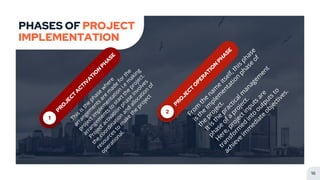
PHASES OF PROJECT
IMPLEMENTATION
16
1
2
APPROACHES TO
PROJECT
IMPLEMENTATION
The top-down approach to
management is when company-wide
decisions are made solely by
leadership at the top, while the
bottom-up approach gives all teams a
voice in these types of decisions.
17
TOP DOWN AND BOTTOM UP
APPROACH
METHODS
to TRACK / PLAN Project Implementation
18
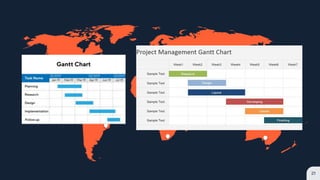
GANTT chart
19
•GANTT chart is also known as the development chart.
•It is a simple chart showing the timing allocated for each
project activity.
•It displays the frequency and period for implementation.
WAYS TO CONSTRUCT
A GANTT CHART
1
List the activities that to be
executed/implemented
2
Determine the associated
activities that can be carried
out at the same time and
identify those to be carried
out sequentially
3
Estimate the quantity of time
required for each activity
20
4
Keep the time represented
on the horizontal axis, and
activities on the vertical axis.
5
Highlight or color-code the
time required for each
activity
21
CRITICAL PATH METHOD OR
NETWORK ANALYSIS
• This approach is an algorithm for scheduling and planning project works.
• This is regularly used alongside the Program Evaluation and Review Technique (PERT).
• This approach involves detecting the longest path (sequence of duties) from the start to
the end of a project and defining the critical responsibilities.
• Critical are tasks that impact the cut-off dates of the entire project and require closer
attention and thorough control.
• Critical Path approach is used for complex projects where delivery terms and deadlines
are vital, in such regions as construction, defense, software development, and others.
22
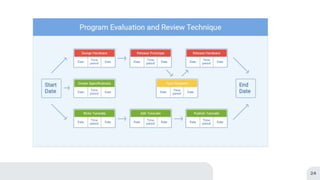
PROJECT EVALUATION AND REVIEW
TECHNIQUES (PERT)
• Program Evaluation and Review Technique (PERT) is one in every of the broadly used approaches in
diverse areas.
• It involves complicated and specific planning and visual tracking of labor effects on PERT charts.
• Its core element is the evaluation of tasks performed within the project.
• Originally, this approach was developed by using the USA Navy for the duration of the Cold War to
boom the performance of labor on new technologies.
• This method suits exceptionally for large and long-time period initiatives with non-ordinary obligations
and tough requirements.
23
24
SIMPLE FORMAT
25
26
Thank
You!

Project Implementation.pptx

  • 1.
    PROJECT IMPLEMENTATION MPA 207 –PLANNING PROCESS Engr. Truman T. Tesoro
  • 2.
    What is Project Implementation?• This is the logical conclusion, after evaluating, deciding, visioning, planning, applying for finances, and finding the monetary resources of a challenge. • A task has to be implemented successfully while the allocation of undertaking obligations to the assignment team in the organization. • Project implementation is the segment wherein visions and plans come to be a reality. • The implementation degree of the project cycle is in many approaches the most critical, as it’s miles in the course of this stage that planned advantages are delivered. 2
  • 3.
  • 4.
    PURPOSE of Project Implementation • Toput the action plan into operation; • To deliver the results, achieve the purpose(s) and contribute effectively to the overall objective of the project; • To manage the available resources efficiently; and • To monitor and report on progress 4
  • 5.
    Things we mustdo during Project Implementation • Update the stakeholder analysis to ensure that all the needful stakeholders (primary and secondary) are invited • Reassess the risks to the project. • Monitor and review the progress that the project is making towards achieving its objectives. 5 • Feed the learning from monitoring and reviewing returned into the project design.
  • 6.
  • 7.
    An implementation planfor a project refers to a detailed description of actions that demonstrate a way to enforce an activity in the project inside the context of achieving project objectives, addressing requirements, and meeting expectations. What is Project Implementation Plan? The motive of the project implementation plan is to provide stakeholders with the self-belief that accomplishment of a modern- day challenge has been properly considered and to list the tasks, activities, and processes worried in producing deliverable. . 7
  • 8.
    Steps in Project Implementation 8 Creatingthe list of outcome required Set up a tracking sheet to monitor progress 1.Allocate the champion for each outcome Establish roles, budgets, and accountability Follow a project management methodology Schedule and undertake a review in six months Determine what action need to be taken for outcomes to be achieved
  • 9.
    CREATING LIST OF OUTCOMEREQUIRED • First of all, a project implementation plan must ensure what we want to achieve by the end of the project. • To decide the actions and the priorities of tasks, we need to list the outcomes that we want to reap via this implementation exercise. 9
  • 10.
    ALLOCATE THE CHAMPION FOREACH OUTCOME • We need to allocate a champion to head everyone, a champion who could be encouraged to attain the outcome and hold the entire undertaking team responsible for accomplishing it. • Look for those contributors of a team who have a vested interest in attaining these final results, or whose passionate and devoted to a successful implementation. • Share those roles around the team (give chance to every team member) so that the responsibility is not limited to a single person. 10
  • 11.
    DETERMINE WHAT ACTION NEEDTO BE TAKEN FOR OUTCOMES TO BE ACHIEVED • In this phase of the implementation plan, we need to write down all the actions that will help the team to successfully achieve the outcomes. For this, we can discuss ‘what are the steps needed to do to reap this outcome?’ • Make sure that these actions are doable, feasible and relevant as per your available resources and goals 11
  • 12.
    ESTABLISH ROLES, BUDGETS ANDACCOUNTABILITY • Once we’ve got the listing of actions that will make certain of the entirety of implementation activities, we need to decide the jobs and obligations of the implementation team. • We may also want to define: • When do we want each action to be carried out? • What is the budget is required? • Who is accountable and responsible for it (each action)? 12
  • 13.
    SET UP ATRACKING SHEET TO MONITOR PROGRESS • A tracking sheet will provide you with a quick at-a-glance replacement of where implementation plan is and what moves are complete, in development, or late. • This allows us to quickly address any issues to get the project back on track. 13
  • 14.
    FOLLOW A PROJECT MANAGEMENTMETHODOLOGY • A project management method is a series of various governance controls, shape, and processes which are designed to help you manage your activities, time, and sources more efficaciously and handle problems proactively once they arise. • While there are many existing project management methodologies you could implement, different mission control methodologies, combining the right amount of documentation, communication, governance, and control, is one of the highly used methods to complete projects on time and budget whilst creating effective outcomes even in challenging environments. 14
  • 15.
    SCHEDULE AND UNDERTAKEA REVIEW IN SIX MONTHS • Every time you enforce a project in your organization, it must be regularly reviewed. • Through the evaluation process, it’s critical to take a look at what labored and what didn’t to identify areas for improvement. • It is also important to take a look at the setbacks you encountered along the way and how they may have potentially been avoided or reduced to take this understanding into your subsequent set of implementation activities. • This review will also help you to plan the activities better next time. 15
  • 16.
  • 17.
    APPROACHES TO PROJECT IMPLEMENTATION The top-downapproach to management is when company-wide decisions are made solely by leadership at the top, while the bottom-up approach gives all teams a voice in these types of decisions. 17 TOP DOWN AND BOTTOM UP APPROACH
  • 18.
    METHODS to TRACK /PLAN Project Implementation 18
  • 19.
    GANTT chart 19 •GANTT chartis also known as the development chart. •It is a simple chart showing the timing allocated for each project activity. •It displays the frequency and period for implementation.
  • 20.
    WAYS TO CONSTRUCT AGANTT CHART 1 List the activities that to be executed/implemented 2 Determine the associated activities that can be carried out at the same time and identify those to be carried out sequentially 3 Estimate the quantity of time required for each activity 20 4 Keep the time represented on the horizontal axis, and activities on the vertical axis. 5 Highlight or color-code the time required for each activity
  • 21.
  • 22.
    CRITICAL PATH METHODOR NETWORK ANALYSIS • This approach is an algorithm for scheduling and planning project works. • This is regularly used alongside the Program Evaluation and Review Technique (PERT). • This approach involves detecting the longest path (sequence of duties) from the start to the end of a project and defining the critical responsibilities. • Critical are tasks that impact the cut-off dates of the entire project and require closer attention and thorough control. • Critical Path approach is used for complex projects where delivery terms and deadlines are vital, in such regions as construction, defense, software development, and others. 22
  • 23.
    PROJECT EVALUATION ANDREVIEW TECHNIQUES (PERT) • Program Evaluation and Review Technique (PERT) is one in every of the broadly used approaches in diverse areas. • It involves complicated and specific planning and visual tracking of labor effects on PERT charts. • Its core element is the evaluation of tasks performed within the project. • Originally, this approach was developed by using the USA Navy for the duration of the Cold War to boom the performance of labor on new technologies. • This method suits exceptionally for large and long-time period initiatives with non-ordinary obligations and tough requirements. 23
  • 24.
  • 25.
  • 26.