Delivered by Mr. Ashwin  S. Ghonmode  Mr. Sachin Gayakawad    Mr. Anup Jose  Mr. Sachit Rawale   Mr. Gopal Malu  Mr. Saurabh Singh   Mr. Kalim Khan  Mr. Shishir  Damke   Mr. Srinivas Rebbawar Guided by Prof. N.R. Gandlewar Department of Mechanical Engg. R.C.E.R.T. Chandrapur
Abstract Introduction Classification of Solar Dryers Solar lumber drying technology Design & Construction Working of Solar lumber dryer  Analysis & Calculation  Advantages and disadvantages Applications Conclusion
Abstract   -  Mr. SRINIWAS REBBAWAR
The production of high quality lumber from hardwood requires a gentle and controlled drying to a low wood moisture content. While ambient air drying depends on the weather conditions, conventional high temperature dryers cause high investments and energy costs.
The investigations showed that investments, drying costs and energy consumption could be reduced by 50 % compared to conventional high-temperature drying systems. At the same time the quality of the timber was improved considerably .
Introduction -  Mr. SRINIWAS REBBAWAR
Solar energy is a very large inexhaustible source of energy. The power from the Sun intercepted by the  earth is approx. 1.8 x 10^11. The daily averages solar energy incident in the country varies from 5 to 7 KWh/Sq.meter
In India the traditional open sun drying is mostly utilized in rural areas , which incorporates problems like , -  inadequate drying -  fungal attacks , insects & birds etc attacks. -  other weathering effects etc.  -  Hence application of  solar dryers is incorporated to reduce or minimize the difficulties mentioned above.
What is wood drying? Wood drying is a process to come out moisture from the wood. It also deals with: To reduce moisture level Make the wood lighter Painting on the wood more beautiful Work on the wood will be more easy
For lumber, the reasons can be briefly summarized as below,   To allow the lumber to shrink before it is used   as a product.    There is an increase in most strength properties   of lumber after it has been dried.   Drying minimizes the development of mould,   stain and decay.   Drying improves lumber finishing characteristics   properties such as the electrical resistance and   thermal insulation behavior are enhanced by   drying.
Classification of Solar  Lumber Dryer’s -  Mr.  ANUP  JOSE
Depending upon how the product is heated by solar radiation, solar dryers are generally classified into three types, Direct type. Indirect type. Mixed mode type.
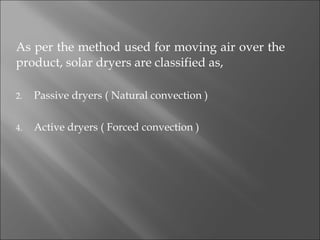
As per the method used for moving air over the product, solar dryers are classified as, Passive dryers ( Natural convection ) Active dryers ( Forced convection )
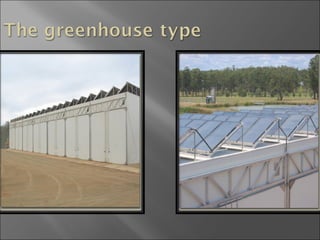
Basically a solar timber dryer is a structure that makes use of trapped solar energy to increase the temperature of the circulating air for drying. The greenhouse type. The external collector type.
 
 
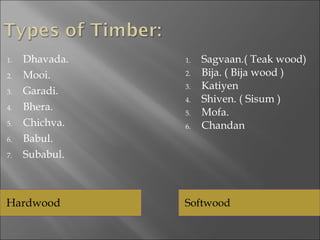
Hardwood Softwood Dhavada. Mooi. Garadi. Bhera. Chichva. Babul. Subabul. Sagvaan.( Teak wood) Bija. ( Bija wood ) Katiyen Shiven. ( Sisum ) Mofa. Chandan
 
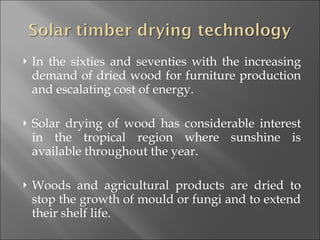
In the sixties and seventies with the increasing demand of dried wood for furniture production and escalating cost of energy. Solar drying of wood has considerable interest in the tropical region where sunshine is available throughout the year. Woods and agricultural products are dried to stop the growth of mould or fungi and to extend their shelf life.
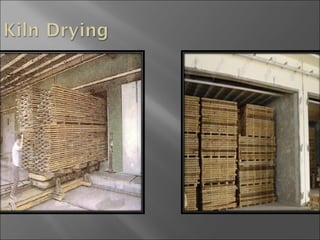
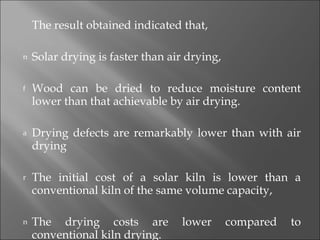
The result obtained indicated that, Solar drying is faster than air drying, Wood can be dried to reduce moisture content lower than that achievable by air drying. Drying defects are remarkably lower than with air drying The initial cost of a solar kiln is lower than a conventional kiln of the same volume capacity, The drying costs are lower compared to conventional kiln drying.
- Mr  SHISHIR DAMKE  &  -  Mr   SACHIN GAYAKWADE
Mr  -  KALIM KHAN
The Solar lumber dryer works on the principle of  ‘ Green House Effect.’  The solar dryer captures a part of the solar radiation and uses it to dry the lumber. The solar radiation passes through the glazing and a portion of the available heat is absorbed by the absorber plate.  The absorber plate in turn heats the air space within.
Some air is admitted and vented in the process through the floor slots, the necessary amount depending on the moisture content in the dryer. The purpose of venting is to keep the relative humidity of the air in the dryer as low as possible while maintaining a high dry-bulb temperature.
Calculation  &  Analysis  Mr. Ashwin  S. Ghonmode & Mr. Saurabh  Singh
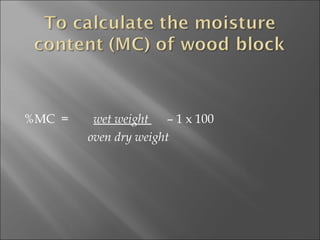
%MC  =  wet weight  – 1 x 100   oven dry weight
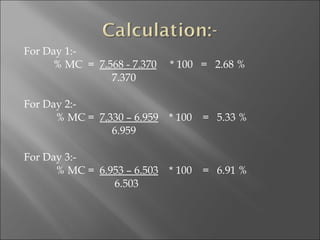
For Day 1:-  % MC  =  7.568 - 7.370   * 100  =  2.68 % 7.370 For Day 2:- % MC =  7.330 – 6.959   * 100  =  5.33 % 6.959 For Day 3:- % MC =  6.953 – 6.503   * 100  =  6.91 % 6.503
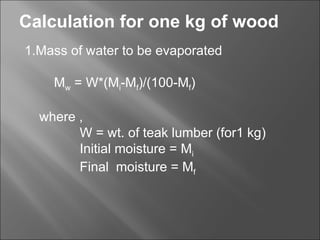
Calculation for one kg of wood 1.Mass of water to be evaporated M w  = W*(M i -M f )/(100-M f ) where , W = wt. of teak lumber (for1 kg) Initial moisture = M i  Final  moisture = M f
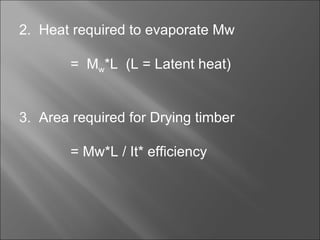
2.  Heat required to evaporate Mw =  M w *L  (L = Latent heat) 3.  Area required for Drying timber = Mw*L / It* efficiency
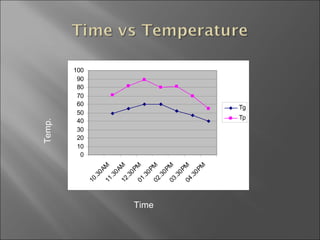
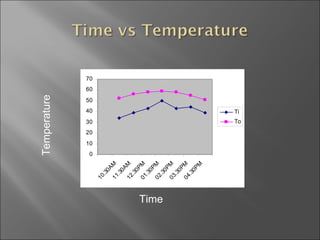
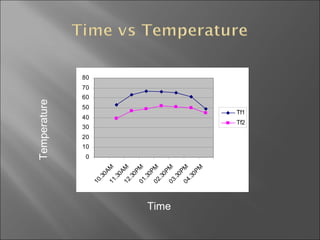
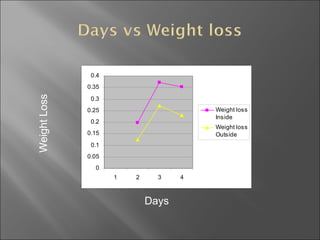
For proper analysis a specific time period is chosen. Readings i.e. different temperatures for different time periods are noted. The analysis done can be shown up by the graphs obtained.
Time Temp.
Time Temperature
Time Temperature
Days Weight Loss
MR .  SACHIT  RAWALE
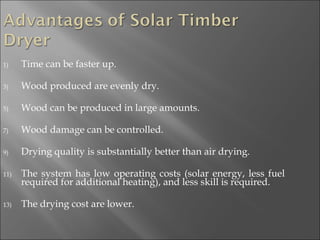
Time can be faster up. Wood produced are evenly dry. Wood can be produced in large amounts. Wood damage can be controlled. Drying quality is substantially better than air drying. The system has low operating costs (solar energy, less fuel required for additional heating), and less skill is required. The drying cost are lower.
Solar kilns depend on weather conditions (affected by rain, cloudy days), resulting in less controllability by the operator, and less predictable outcomes. Experimentally solar timber drying is time consuming and costly exercise.
Application Of Solar drying MR .  GOPAL  MALU
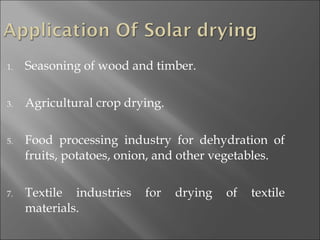
Seasoning of wood and timber. Agricultural crop drying. Food processing industry for dehydration of fruits, potatoes, onion, and other vegetables. Textile industries for drying of textile materials.
Spices Drying:                Chillies, Coriander, Pepper, Turmeric, etc, Fruits Dehydration:                Mango, Sapota, Grapes, Banana, Papaya, Amla, etc. Vegetables Dehydration:              Carrot, Beetroot, potato,  Bitter guard, Bell pepper,etc.,
Herbs Drying:                 Tulsi, Aloevera, Neem, Sweet Neem, etc., Medicinal plants Drying. Dal Drying. Cashew Drying. Paddy Drying. Mushroom Drying
Tea leaves Drying. Coffee Beans Drying. Marine Foods ( Fish ) Drying. Leather Drying. Tobacco Drying. Ceramic Drying. Chemical Drying
Screen print Drying. Fabric drying. And many more applications Wherever hot air is required  
After detailed examination & proper evaluation it is observed that , the solar dryer achieves higher drying rates than normal sun drying. Hence we can conclude for tropical areas (like Chandrapur) solar drying is one of the best , cheap & effective option for the purpose of drying lumber.
 

Lumber ppt

  • 1.
  • 2.
    Delivered by Mr.Ashwin S. Ghonmode Mr. Sachin Gayakawad Mr. Anup Jose Mr. Sachit Rawale Mr. Gopal Malu Mr. Saurabh Singh Mr. Kalim Khan Mr. Shishir Damke Mr. Srinivas Rebbawar Guided by Prof. N.R. Gandlewar Department of Mechanical Engg. R.C.E.R.T. Chandrapur
  • 3.
    Abstract Introduction Classificationof Solar Dryers Solar lumber drying technology Design & Construction Working of Solar lumber dryer Analysis & Calculation Advantages and disadvantages Applications Conclusion
  • 4.
    Abstract - Mr. SRINIWAS REBBAWAR
  • 5.
    The production ofhigh quality lumber from hardwood requires a gentle and controlled drying to a low wood moisture content. While ambient air drying depends on the weather conditions, conventional high temperature dryers cause high investments and energy costs.
  • 6.
    The investigations showedthat investments, drying costs and energy consumption could be reduced by 50 % compared to conventional high-temperature drying systems. At the same time the quality of the timber was improved considerably .
  • 7.
    Introduction - Mr. SRINIWAS REBBAWAR
  • 8.
    Solar energy isa very large inexhaustible source of energy. The power from the Sun intercepted by the earth is approx. 1.8 x 10^11. The daily averages solar energy incident in the country varies from 5 to 7 KWh/Sq.meter
  • 9.
    In India thetraditional open sun drying is mostly utilized in rural areas , which incorporates problems like , - inadequate drying - fungal attacks , insects & birds etc attacks. - other weathering effects etc. - Hence application of solar dryers is incorporated to reduce or minimize the difficulties mentioned above.
  • 10.
    What is wooddrying? Wood drying is a process to come out moisture from the wood. It also deals with: To reduce moisture level Make the wood lighter Painting on the wood more beautiful Work on the wood will be more easy
  • 11.
    For lumber, thereasons can be briefly summarized as below, To allow the lumber to shrink before it is used as a product. There is an increase in most strength properties of lumber after it has been dried. Drying minimizes the development of mould, stain and decay. Drying improves lumber finishing characteristics properties such as the electrical resistance and thermal insulation behavior are enhanced by drying.
  • 12.
    Classification of Solar Lumber Dryer’s - Mr. ANUP JOSE
  • 13.
    Depending upon howthe product is heated by solar radiation, solar dryers are generally classified into three types, Direct type. Indirect type. Mixed mode type.
  • 14.
    As per themethod used for moving air over the product, solar dryers are classified as, Passive dryers ( Natural convection ) Active dryers ( Forced convection )
  • 15.
    Basically a solartimber dryer is a structure that makes use of trapped solar energy to increase the temperature of the circulating air for drying. The greenhouse type. The external collector type.
  • 16.
  • 17.
  • 18.
    Hardwood Softwood Dhavada.Mooi. Garadi. Bhera. Chichva. Babul. Subabul. Sagvaan.( Teak wood) Bija. ( Bija wood ) Katiyen Shiven. ( Sisum ) Mofa. Chandan
  • 19.
  • 20.
    In the sixtiesand seventies with the increasing demand of dried wood for furniture production and escalating cost of energy. Solar drying of wood has considerable interest in the tropical region where sunshine is available throughout the year. Woods and agricultural products are dried to stop the growth of mould or fungi and to extend their shelf life.
  • 21.
    The result obtainedindicated that, Solar drying is faster than air drying, Wood can be dried to reduce moisture content lower than that achievable by air drying. Drying defects are remarkably lower than with air drying The initial cost of a solar kiln is lower than a conventional kiln of the same volume capacity, The drying costs are lower compared to conventional kiln drying.
  • 22.
    - Mr SHISHIR DAMKE & - Mr SACHIN GAYAKWADE
  • 23.
    Mr - KALIM KHAN
  • 24.
    The Solar lumberdryer works on the principle of ‘ Green House Effect.’ The solar dryer captures a part of the solar radiation and uses it to dry the lumber. The solar radiation passes through the glazing and a portion of the available heat is absorbed by the absorber plate. The absorber plate in turn heats the air space within.
  • 25.
    Some air isadmitted and vented in the process through the floor slots, the necessary amount depending on the moisture content in the dryer. The purpose of venting is to keep the relative humidity of the air in the dryer as low as possible while maintaining a high dry-bulb temperature.
  • 26.
    Calculation & Analysis Mr. Ashwin S. Ghonmode & Mr. Saurabh Singh
  • 27.
    %MC = wet weight – 1 x 100 oven dry weight
  • 28.
    For Day 1:- % MC = 7.568 - 7.370 * 100 = 2.68 % 7.370 For Day 2:- % MC = 7.330 – 6.959 * 100 = 5.33 % 6.959 For Day 3:- % MC = 6.953 – 6.503 * 100 = 6.91 % 6.503
  • 29.
    Calculation for onekg of wood 1.Mass of water to be evaporated M w = W*(M i -M f )/(100-M f ) where , W = wt. of teak lumber (for1 kg) Initial moisture = M i Final moisture = M f
  • 30.
    2. Heatrequired to evaporate Mw = M w *L (L = Latent heat) 3. Area required for Drying timber = Mw*L / It* efficiency
  • 31.
    For proper analysisa specific time period is chosen. Readings i.e. different temperatures for different time periods are noted. The analysis done can be shown up by the graphs obtained.
  • 32.
  • 33.
  • 34.
  • 35.
  • 36.
    MR . SACHIT RAWALE
  • 37.
    Time can befaster up. Wood produced are evenly dry. Wood can be produced in large amounts. Wood damage can be controlled. Drying quality is substantially better than air drying. The system has low operating costs (solar energy, less fuel required for additional heating), and less skill is required. The drying cost are lower.
  • 38.
    Solar kilns dependon weather conditions (affected by rain, cloudy days), resulting in less controllability by the operator, and less predictable outcomes. Experimentally solar timber drying is time consuming and costly exercise.
  • 39.
    Application Of Solardrying MR . GOPAL MALU
  • 40.
    Seasoning of woodand timber. Agricultural crop drying. Food processing industry for dehydration of fruits, potatoes, onion, and other vegetables. Textile industries for drying of textile materials.
  • 41.
    Spices Drying:            Chillies, Coriander, Pepper, Turmeric, etc, Fruits Dehydration:            Mango, Sapota, Grapes, Banana, Papaya, Amla, etc. Vegetables Dehydration:            Carrot, Beetroot, potato,  Bitter guard, Bell pepper,etc.,
  • 42.
    Herbs Drying:             Tulsi, Aloevera, Neem, Sweet Neem, etc., Medicinal plants Drying. Dal Drying. Cashew Drying. Paddy Drying. Mushroom Drying
  • 43.
    Tea leaves Drying.Coffee Beans Drying. Marine Foods ( Fish ) Drying. Leather Drying. Tobacco Drying. Ceramic Drying. Chemical Drying
  • 44.
    Screen print Drying.Fabric drying. And many more applications Wherever hot air is required  
  • 45.
    After detailed examination& proper evaluation it is observed that , the solar dryer achieves higher drying rates than normal sun drying. Hence we can conclude for tropical areas (like Chandrapur) solar drying is one of the best , cheap & effective option for the purpose of drying lumber.
  • 46.

Editor's Notes

  • #30 Mass of water to be evaporated M w =W(M i -M f )/(100-M f ) where W- wt. of mahagony timber (for1 kg) M w =1*(35-11)/(100-11) M w =0.2696 kg
  • #31 2. Heat required to evaporate M w = M w *L(L = Latent heat) =0.2696*2.8*10 6 =754880 MJ