Materials for Technical
      Use : Wood
Technology Department
    I.E.S. El Molinillo
         Guillena
Historical Introduction:

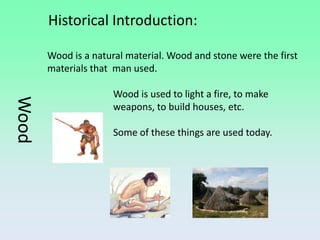
       Wood is a natural material. Wood and stone were the first
       materials that man used.

                      Wood is used to light a fire, to make
Wood


                      weapons, to build houses, etc.

                      Some of these things are used today.
The Tree’s Trunk
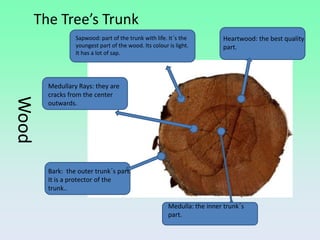
                  Sapwood: part of the trunk with life. It´s the          Heartwood: the best quality
                  youngest part of the wood. Its colour is light.         part.
                  It has a lot of sap.


         Medullary Rays: they are
         cracks from the center
Wood


         outwards.


         Bark: the outer trunk´s part.
         It is a protector of the
         trunk..

                                                        Medulla: the inner trunk´s
                                                        part.
Obtaining Wood
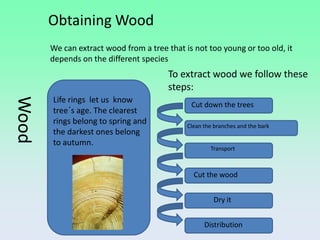
       We can extract wood from a tree that is not too young or too old, it
       depends on the different species
                                        To extract wood we follow these
                                        steps:
       Life rings let us know
Wood


                                              Cut down the trees
       tree´s age. The clearest
       rings belong to spring and            Clean the branches and the bark
       the darkest ones belong
       to autumn.
                                                     Transport


                                               Cut the wood


                                                      Dry it


                                                   Distribution
To Cut Trees.
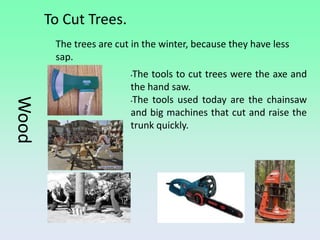
        The trees are cut in the winter, because they have less
        sap.
                         •The tools to cut trees were the axe and
                         the hand saw.
                         •The tools used today are the chainsaw
Wood


                         and big machines that cut and raise the
                         trunk quickly.
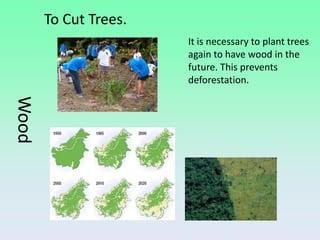
To Cut Trees.
                       It is necessary to plant trees
                       again to have wood in the
                       future. This prevents
                       deforestation.
Wood
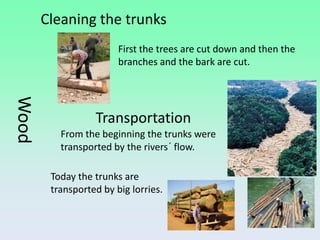
Cleaning the trunks
                        First the trees are cut down and then the
                        branches and the bark are cut.
Wood


                  Transportation
          From the beginning the trunks were
          transported by the rivers´ flow.

        Today the trunks are
        transported by big lorries.
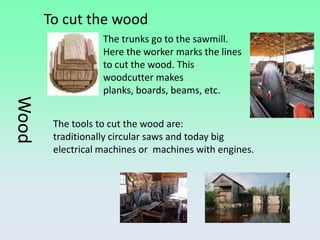
To cut the wood
                   The trunks go to the sawmill.
                   Here the worker marks the lines
                   to cut the wood. This
                   woodcutter makes
                   planks, boards, beams, etc.
Wood


        The tools to cut the wood are:
        traditionally circular saws and today big
        electrical machines or machines with engines.
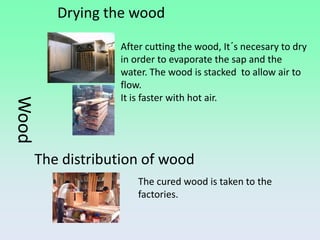
Drying the wood

                   After cutting the wood, It´s necesary to dry
                   in order to evaporate the sap and the
                   water. The wood is stacked to allow air to
                   flow.
                   It is faster with hot air.
Wood


       The distribution of wood
                       The cured wood is taken to the
                       factories.
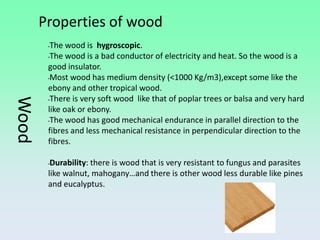
Properties of wood
        •The wood is hygroscopic.
        •The wood is a bad conductor of electricity and heat. So the wood is a

        good insulator.
        •Most wood has medium density (<1000 Kg/m3),except some like the

        ebony and other tropical wood.
        •There is very soft wood like that of poplar trees or balsa and very hard
Wood


        like oak or ebony.
        •The wood has good mechanical endurance in parallel direction to the

        fibres and less mechanical resistance in perpendicular direction to the
        fibres.

        •Durability: there is wood that is very resistant to fungus and parasites
        like walnut, mahogany…and there is other wood less durable like pines
        and eucalyptus.
Types of wood:
       The most common classification of wood is :
       •Soft wood: resinous and evergreen trees, they are easy to

       work with (pine, fir, poplar…)
       •Hard wood: deciduous trees like oak , walnut, ebony,…
Wood


          Some interesting web links:
          • Wood´s Web (ES)
          • Wood´s Kinds (ES)
          • Wood in Kalipedia (ES)
          • Wood´s Kinds 2 (EN)
          • Wood´s Kinds 3 (EN)
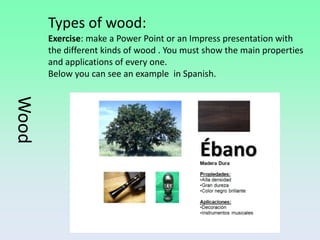
Types of wood:
       Exercise: make a Power Point or an Impress presentation with
       the different kinds of wood . You must show the main properties
       and applications of every one.
       Below you can see an example in Spanish.
Wood
Wood Derivatives
          Artificial Boards:
       • Cheaper than natural wood.
       • Completely flat and smooth.

       • Bigger size than natural wood.
Wood


       • Will not rot and it´s termite resistant.


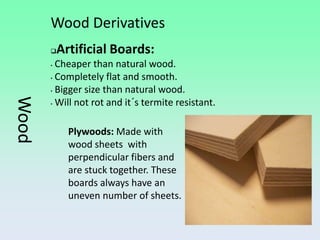
             Plywoods: Made with
             wood sheets with
             perpendicular fibers and
             are stuck together. These
             boards always have an
             uneven number of sheets.
Wood Derivatives
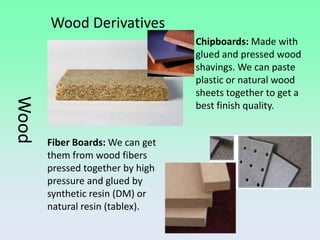
                                  Chipboards: Made with
                                  glued and pressed wood
                                  shavings. We can paste
                                  plastic or natural wood
                                  sheets together to get a
Wood


                                  best finish quality.


       Fiber Boards: We can get
       them from wood fibers
       pressed together by high
       pressure and glued by
       synthetic resin (DM) or
       natural resin (tablex).
Wood Derivatives
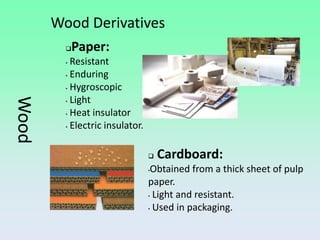
            Paper:
         • Resistant
         • Enduring

         • Hygroscopic

         • Light
Wood


         • Heat insulator

         • Electric insulator.


                                    Cardboard:
                                 •Obtained from a thick sheet of pulp
                                 paper.
                                 • Light and resistant.

                                 • Used in packaging.
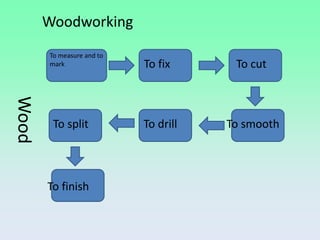
Woodworking
       To measure and to
       mark                To fix      To cut
Wood


        To split           To drill   To smooth


       To finish
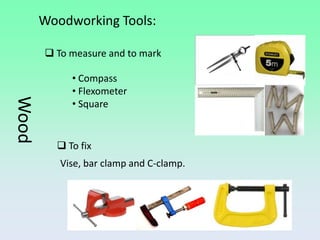
Woodworking Tools:

        To measure and to mark

            • Compass
            • Flexometer
Wood


            • Square


          To fix
          Vise, bar clamp and C-clamp.
Woodworking : Tools

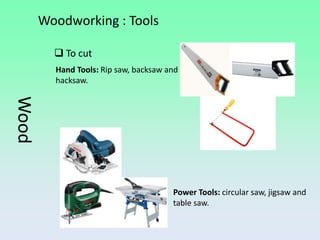
          To cut
         Hand Tools: Rip saw, backsaw and
         hacksaw.
Wood


                                       Power Tools: circular saw, jigsaw and
                                       table saw.
Woodworking : Tools

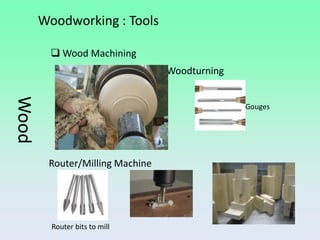
          Wood Machining
                                 Woodturning
Wood


                                               Gouges


        Router/Milling Machine


         Router bits to mill
Woodworking : Tools

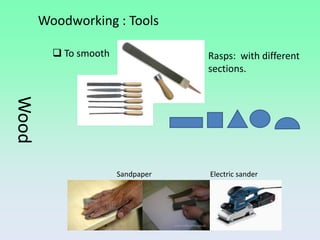
          To smooth               Rasps: with different
                                   sections.
Wood


                       Sandpaper   Electric sander
Woodworking : Tools

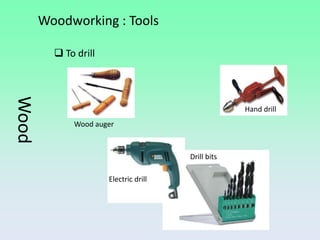
          To drill
Wood


                                                    Hand drill
             Wood auger


                                       Drill bits

                      Electric drill
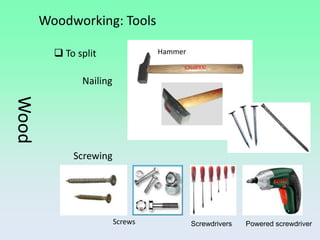
Woodworking: Tools

          To split               Hammer


               Nailing
Wood


             Screwing


                         Screws            Screwdrivers   Powered screwdriver
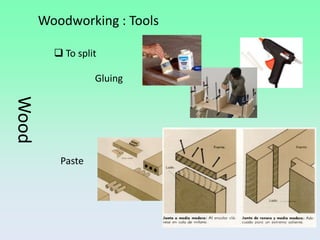
Woodworking : Tools

          To split

                  Gluing
Wood


          Paste
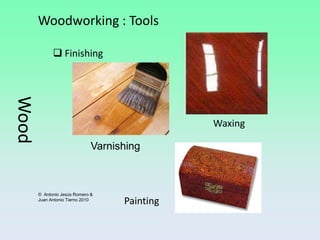
Woodworking : Tools

              Finishing
Wood


                                               Waxing

                              Varnishing


       © Antonio Jesús Romero &
       Juan Antonio Tierno 2010
                                    Painting

Materials For Technical Use Wood

  • 1.
    Materials for Technical Use : Wood Technology Department I.E.S. El Molinillo Guillena
  • 2.
    Historical Introduction: Wood is a natural material. Wood and stone were the first materials that man used. Wood is used to light a fire, to make Wood weapons, to build houses, etc. Some of these things are used today.
  • 3.
    The Tree’s Trunk Sapwood: part of the trunk with life. It´s the Heartwood: the best quality youngest part of the wood. Its colour is light. part. It has a lot of sap. Medullary Rays: they are cracks from the center Wood outwards. Bark: the outer trunk´s part. It is a protector of the trunk.. Medulla: the inner trunk´s part.
  • 4.
    Obtaining Wood We can extract wood from a tree that is not too young or too old, it depends on the different species To extract wood we follow these steps: Life rings let us know Wood Cut down the trees tree´s age. The clearest rings belong to spring and Clean the branches and the bark the darkest ones belong to autumn. Transport Cut the wood Dry it Distribution
  • 5.
    To Cut Trees. The trees are cut in the winter, because they have less sap. •The tools to cut trees were the axe and the hand saw. •The tools used today are the chainsaw Wood and big machines that cut and raise the trunk quickly.
  • 6.
    To Cut Trees. It is necessary to plant trees again to have wood in the future. This prevents deforestation. Wood
  • 7.
    Cleaning the trunks First the trees are cut down and then the branches and the bark are cut. Wood Transportation From the beginning the trunks were transported by the rivers´ flow. Today the trunks are transported by big lorries.
  • 8.
    To cut thewood The trunks go to the sawmill. Here the worker marks the lines to cut the wood. This woodcutter makes planks, boards, beams, etc. Wood The tools to cut the wood are: traditionally circular saws and today big electrical machines or machines with engines.
  • 9.
    Drying the wood After cutting the wood, It´s necesary to dry in order to evaporate the sap and the water. The wood is stacked to allow air to flow. It is faster with hot air. Wood The distribution of wood The cured wood is taken to the factories.
  • 10.
    Properties of wood •The wood is hygroscopic. •The wood is a bad conductor of electricity and heat. So the wood is a good insulator. •Most wood has medium density (<1000 Kg/m3),except some like the ebony and other tropical wood. •There is very soft wood like that of poplar trees or balsa and very hard Wood like oak or ebony. •The wood has good mechanical endurance in parallel direction to the fibres and less mechanical resistance in perpendicular direction to the fibres. •Durability: there is wood that is very resistant to fungus and parasites like walnut, mahogany…and there is other wood less durable like pines and eucalyptus.
  • 11.
    Types of wood: The most common classification of wood is : •Soft wood: resinous and evergreen trees, they are easy to work with (pine, fir, poplar…) •Hard wood: deciduous trees like oak , walnut, ebony,… Wood Some interesting web links: • Wood´s Web (ES) • Wood´s Kinds (ES) • Wood in Kalipedia (ES) • Wood´s Kinds 2 (EN) • Wood´s Kinds 3 (EN)
  • 12.
    Types of wood: Exercise: make a Power Point or an Impress presentation with the different kinds of wood . You must show the main properties and applications of every one. Below you can see an example in Spanish. Wood
  • 13.
    Wood Derivatives  Artificial Boards: • Cheaper than natural wood. • Completely flat and smooth. • Bigger size than natural wood. Wood • Will not rot and it´s termite resistant. Plywoods: Made with wood sheets with perpendicular fibers and are stuck together. These boards always have an uneven number of sheets.
  • 14.
    Wood Derivatives Chipboards: Made with glued and pressed wood shavings. We can paste plastic or natural wood sheets together to get a Wood best finish quality. Fiber Boards: We can get them from wood fibers pressed together by high pressure and glued by synthetic resin (DM) or natural resin (tablex).
  • 15.
    Wood Derivatives  Paper: • Resistant • Enduring • Hygroscopic • Light Wood • Heat insulator • Electric insulator.  Cardboard: •Obtained from a thick sheet of pulp paper. • Light and resistant. • Used in packaging.
  • 16.
    Woodworking To measure and to mark To fix To cut Wood To split To drill To smooth To finish
  • 17.
    Woodworking Tools:  To measure and to mark • Compass • Flexometer Wood • Square  To fix Vise, bar clamp and C-clamp.
  • 18.
    Woodworking : Tools  To cut Hand Tools: Rip saw, backsaw and hacksaw. Wood Power Tools: circular saw, jigsaw and table saw.
  • 19.
    Woodworking : Tools  Wood Machining Woodturning Wood Gouges Router/Milling Machine Router bits to mill
  • 20.
    Woodworking : Tools  To smooth Rasps: with different sections. Wood Sandpaper Electric sander
  • 21.
    Woodworking : Tools  To drill Wood Hand drill Wood auger Drill bits Electric drill
  • 22.
    Woodworking: Tools  To split Hammer Nailing Wood Screwing Screws Screwdrivers Powered screwdriver
  • 23.
    Woodworking : Tools  To split Gluing Wood Paste
  • 24.
    Woodworking : Tools  Finishing Wood Waxing Varnishing © Antonio Jesús Romero & Juan Antonio Tierno 2010 Painting