Welcome
Match manufacture
Alex.K.George
BSF-10-002
FSC 301 Logging,utilization of timber and non timber forest
products (2+1)
Contents
 Match production in India
Species used in India
Types of matches
Match manufacturing process
Utilization of waste wood and residues.
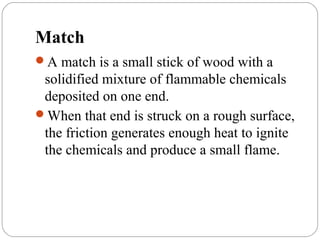
Match
A match is a small stick of wood with a
solidified mixture of flammable chemicals
deposited on one end.
When that end is struck on a rough surface,
the friction generates enough heat to ignite
the chemicals and produce a small flame.
History
The first known use of matches was in 577
AD northern China.
1826 AD, John Walker of England
invented the first friction matches.
In 1831, Charles Sauria of France
developed a match that used white
phosphorus.
These matches were strike-anywhere
matches and were much easier to ignite.
.
In 1844, Gustaf Pasch of Sweden proposed
placing some of the match's combustion
ingredients on a separate striking surface.
J. E. Lundstrom of Sweden to introduce safety
matches in 1855.
First automatic match machine was patented by
Ebenezer Beecher in 1888.
Match in India
Around 1910 immigrant Japanese families
who settled in Calcutta began making matches
with simple hand- and power-operated
machines.
Import matches from Sweden and Japan.
The first sulphur match that would produced
in South India in 1923, and the first safety
match in the form we know today, in 1932.
.
Mechanization came to the Indian match
industry in 1924 .
First mechanized large scale sector in India
started by wimco.
There are now 17,000 units in India from
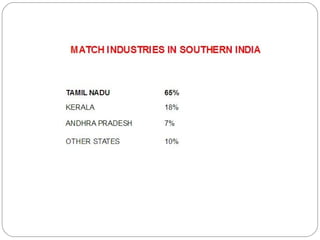
that 12,000 in Southern India,
75% to 90% are situated in Southern India.
Match in Tamil nadu
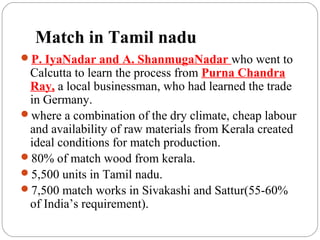
P. IyaNadar and A. ShanmugaNadar who went to
Calcutta to learn the process from Purna Chandra
Ray, a local businessman, who had learned the trade
in Germany.
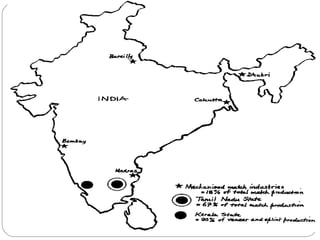
where a combination of the dry climate, cheap labour
and availability of raw materials from Kerala created
ideal conditions for match production.
80% of match wood from kerala.
5,500 units in Tamil nadu.
7,500 match works in Sivakashi and Sattur(55-60%
of India’s requirement).
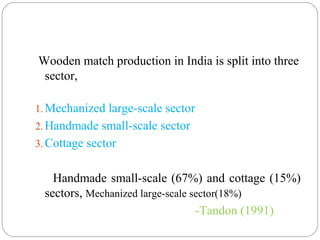
Wooden match production in India is split into three
sector,
1. Mechanized large-scale sector
2. Handmade small-scale sector
3. Cottage sector
Handmade small-scale (67%) and cottage (15%)
sectors, Mechanized large-scale sector(18%)
-Tandon (1991)
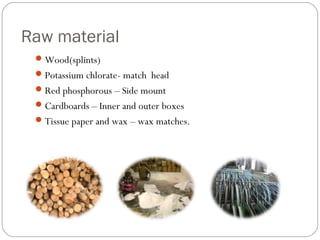
Raw material
Wood(splints)
Potassium chlorate- match head
Red phosphorous – Side mount
Cardboards – Inner and outer boxes
Tissue paper and wax – wax matches.
Qualities of a Matchwood
Straightness of the grain
Good fissility
Strength and toughness
Good white colour
Freedom from knots
Easily peelable
Capacity to absorb paraffin
Round
Light weight
Major species..
 Ailanthus excelsa (yellow mutty)
 Ailanthus triphysa, (white mutty)
 Ailanthus malabarica (mysore mutty),
 Populus deltoides (cotton wood),
 Populus tremula (Aspen),
 Populus balsamifera (balsam poplar)
 Albizia falcataria,
 Boswallia serrata,
 Alnus nephalensis,
 Erithrina indica,
 Pinus,
 Havea brasillensis
Alternate species..
 Lania coromandelia
 Ceiba pendandra
 Melia dubia
 Bamboo
 Simarouba glauca
 Sterculia vilosa
 Gmelina arborea.
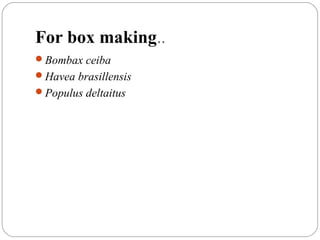
For box making..
Bombax ceiba
Havea brasillensis
Populus deltaitus
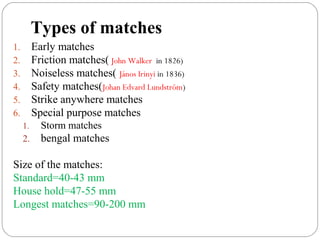
Types of matches
1. Early matches
2. Friction matches( John Walker in 1826)
3. Noiseless matches( János Irinyi in 1836)
4. Safety matches(Johan Edvard Lundström)
5. Strike anywhere matches
6. Special purpose matches
1. Storm matches
2. bengal matches
Size of the matches:
Standard=40-43 mm
House hold=47-55 mm
Longest matches=90-200 mm
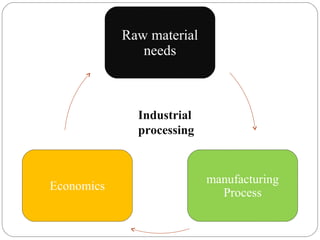
Raw material
needs
manufacturing
Process
Economics
Industrial
processing
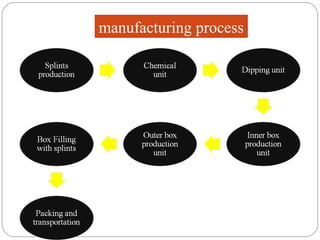
manufacturing process
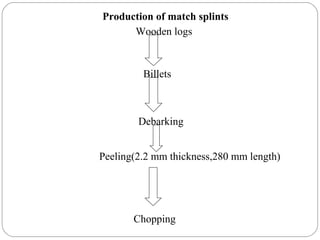
Production of match splints
Wooden logs
Billets
Debarking
Peeling(2.2 mm thickness,280 mm length)
Chopping
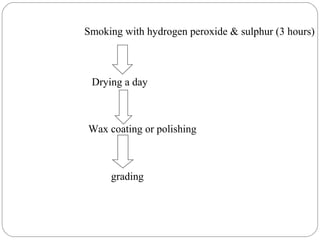
Drying a day
Wax coating or polishing
grading
Smoking with hydrogen peroxide & sulphur (3 hours)
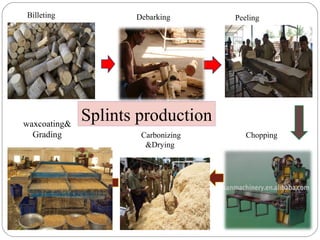
Splints production
Billeting Peeling
waxcoating&
Grading Carbonizing
&Drying
Chopping
Debarking
Billeting
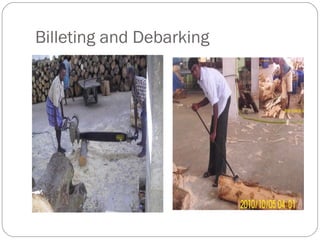
The logs are converted into small billets,the
size of which ranges from 25-40 cm/1ft
length.
Debarking:
The billets are manually debarked.
Billeting and Debarking
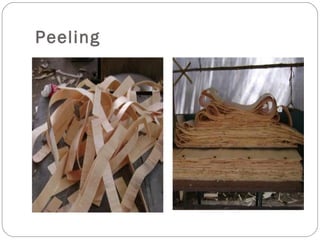
Peeling:
There are three types of peeling machine used
viz.
1.Indian peeling machine-manual debarking
2.sweden peeling machine-manual
debarking
3.chinese peeling machine-no debarking is
needed
The moisture content is 40-50%
Peeling
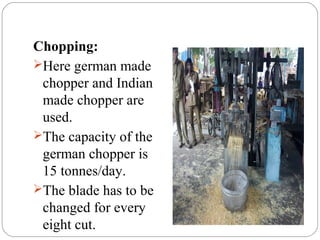
Chopping:
Here german made
chopper and Indian
made chopper are
used.
The capacity of the
german chopper is
15 tonnes/day.
The blade has to be
changed for every
eight cut.
.Carbonizing:
The chopped splints are carbonized by
setting up in a yard for 3 hours under the
vapours of hydrogen peroxide & sulphur in
order to enhance the color of the splints.
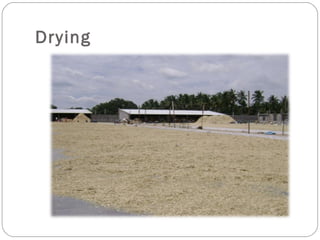
Drying :
After carbonizing ,the splints are dried in
the presence of sunlight in courtyard for a
period of eight hours. Incase of rainy days,
the splints are dried using steam driers.
Drying
Wax coating :
 This is more important for any stick to get fire and keep up
the fire for a long time.
 The sticks are poured over a wax coating machine which
coats wax over the stick and also polishes the stick that
gives quality cum attraction.
 The sticks become more strength than the normal stick after
this application.
Grading:
 After that the splints are grated by grading machine.
 In small scale industries graded by hand
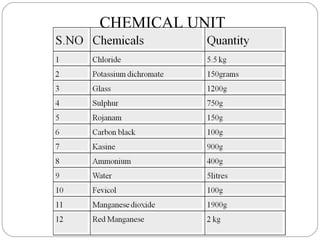
CHEMICAL UNIT
Strike Anywhere matches
phosphorus sesquisulfide
potassium chlorat
zinc oxide
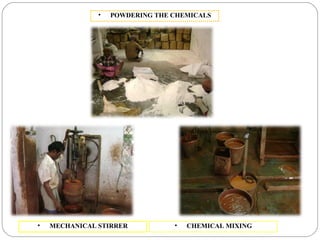
• MECHANICAL STIRRER
• POWDERING THE CHEMICALS
• CHEMICAL MIXING
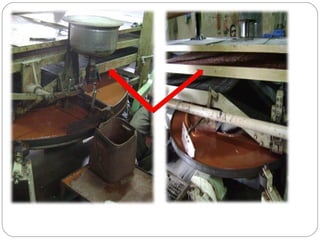
The dried match sticks are poured over the stick holder
where it fixes the sticks to a metal belt.
The metal belt with the attached sticks runs over the
chemical liquid and dips it at the base level.
 Then it runs continuously till the top storey where it gets
completely dried by the fans provided by the side ways.
Then the dried sticks are collected and are passed on to the
packing unit.
Dipping and filling unit
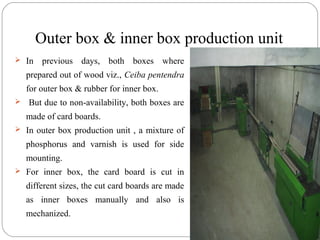
Outer box & inner box production unit
 In previous days, both boxes where
prepared out of wood viz., Ceiba pentendra
for outer box & rubber for inner box.
 But due to non-availability, both boxes are
made of card boards.
 In outer box production unit , a mixture of
phosphorus and varnish is used for side
mounting.
 For inner box, the card board is cut in
different sizes, the cut card boards are made
as inner boxes manually and also is
mechanized.
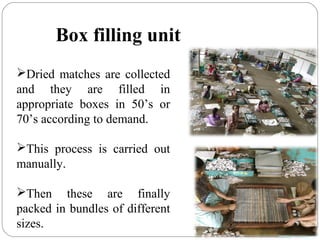
Dried matches are collected
and they are filled in
appropriate boxes in 50’s or
70’s according to demand.
This process is carried out
manually.
Then these are finally
packed in bundles of different
sizes.
Box filling unit
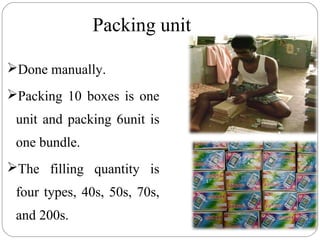
Packing unit
Done manually.
Packing 10 boxes is one
unit and packing 6unit is
one bundle.
The filling quantity is
four types, 40s, 50s, 70s,
and 200s.
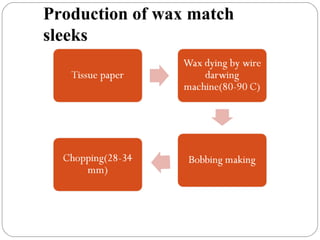
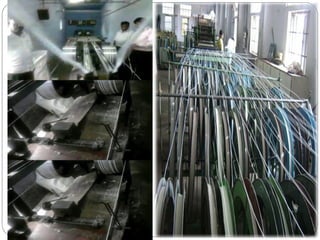
Production of wax match
sleeks
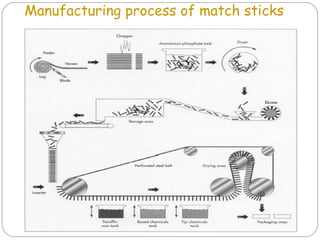
Manufacturing process of match sticks
Economics.
Annual requirement of wood in India is
200000 Cu.m
For the production of one bundle(i.e.600
match boxes) 2 kg of wood is required.
Yellow mutty=Rs.5,200/tonne
White mutty=1 cft=Rs.250-300
Current supply of match wood from Tamil
Nadu 100-250 tonnes/month.
Sticks per kg
Ailanthus excelsa -13,227/kg
Ailanthus tryphysa-14,320/kg
Ceiba pentandra-13,297/kg
Nearly 80 per cent of the matchwood is now
supplied by kerala
For making 2 to 2.5 lakh match bundles, nearly
4,000 tones of wood per month is required.
For producing one crore bundles per month, match
wood requirement is around 10,000-12,000 tonnes
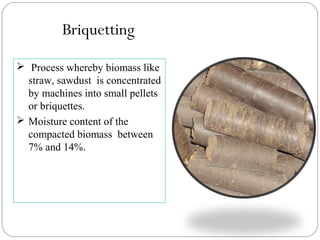
 Process whereby biomass like
straw, sawdust is concentrated
by machines into small pellets
or briquettes.
 Moisture content of the
compacted biomass between
7% and 14%.
Briquetting
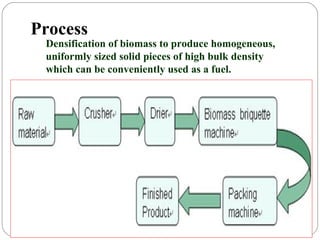
Densification of biomass to produce homogeneous,
uniformly sized solid pieces of high bulk density
which can be conveniently used as a fuel.
Process
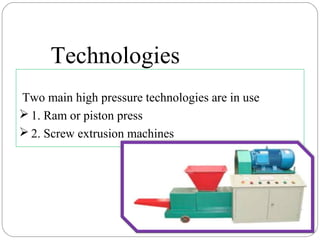
Two main high pressure technologies are in use
 1. Ram or piston press
 2. Screw extrusion machines
Technologies
ISSUES AND
CONSTRAINTS
 Shortages of raw materials, particularly match quality soft
woods, chemicals, match wax and wax paper ( Samachar.in,
2008)
 Geographical distribution of the industry in one region and
resulting labour shortages
 Monopoly of the 18 “Match Kings”
 Exploitation of women and child labour by these monopolists
 Failure of the cottage sector
 Introduction of new technology in the hand made sector
 Unique problems of the veneer and splint making industry.
 Mechanization and causes Excess production (ie 38% surplus
than demand).
References
Project report on vason makwin –match industry
Case study on the saftey match industries in India by:
J.C. Tandon
T. Mehta, 1981. A Hand Book Of Forest Utilization.
International book distributors, Dehra Dun, India.
http://en.Wikipedia.Org/wiki/match
Thanks

Match manufacture - alex

  • 1.
  • 2.
    Match manufacture Alex.K.George BSF-10-002 FSC 301Logging,utilization of timber and non timber forest products (2+1)
  • 3.
    Contents  Match productionin India Species used in India Types of matches Match manufacturing process Utilization of waste wood and residues.
  • 4.
    Match A match isa small stick of wood with a solidified mixture of flammable chemicals deposited on one end. When that end is struck on a rough surface, the friction generates enough heat to ignite the chemicals and produce a small flame.
  • 5.
    History The first knownuse of matches was in 577 AD northern China. 1826 AD, John Walker of England invented the first friction matches. In 1831, Charles Sauria of France developed a match that used white phosphorus. These matches were strike-anywhere matches and were much easier to ignite.
  • 6.
    . In 1844, GustafPasch of Sweden proposed placing some of the match's combustion ingredients on a separate striking surface. J. E. Lundstrom of Sweden to introduce safety matches in 1855. First automatic match machine was patented by Ebenezer Beecher in 1888.
  • 7.
    Match in India Around1910 immigrant Japanese families who settled in Calcutta began making matches with simple hand- and power-operated machines. Import matches from Sweden and Japan. The first sulphur match that would produced in South India in 1923, and the first safety match in the form we know today, in 1932.
  • 8.
    . Mechanization came tothe Indian match industry in 1924 . First mechanized large scale sector in India started by wimco. There are now 17,000 units in India from that 12,000 in Southern India, 75% to 90% are situated in Southern India.
  • 10.
    Match in Tamilnadu P. IyaNadar and A. ShanmugaNadar who went to Calcutta to learn the process from Purna Chandra Ray, a local businessman, who had learned the trade in Germany. where a combination of the dry climate, cheap labour and availability of raw materials from Kerala created ideal conditions for match production. 80% of match wood from kerala. 5,500 units in Tamil nadu. 7,500 match works in Sivakashi and Sattur(55-60% of India’s requirement).
  • 11.
    Wooden match productionin India is split into three sector, 1. Mechanized large-scale sector 2. Handmade small-scale sector 3. Cottage sector Handmade small-scale (67%) and cottage (15%) sectors, Mechanized large-scale sector(18%) -Tandon (1991)
  • 13.
    Raw material Wood(splints) Potassium chlorate-match head Red phosphorous – Side mount Cardboards – Inner and outer boxes Tissue paper and wax – wax matches.
  • 14.
    Qualities of aMatchwood Straightness of the grain Good fissility Strength and toughness Good white colour Freedom from knots Easily peelable Capacity to absorb paraffin Round Light weight
  • 15.
    Major species..  Ailanthusexcelsa (yellow mutty)  Ailanthus triphysa, (white mutty)  Ailanthus malabarica (mysore mutty),  Populus deltoides (cotton wood),  Populus tremula (Aspen),  Populus balsamifera (balsam poplar)  Albizia falcataria,  Boswallia serrata,  Alnus nephalensis,  Erithrina indica,  Pinus,  Havea brasillensis
  • 16.
    Alternate species..  Laniacoromandelia  Ceiba pendandra  Melia dubia  Bamboo  Simarouba glauca  Sterculia vilosa  Gmelina arborea.
  • 17.
    For box making.. Bombaxceiba Havea brasillensis Populus deltaitus
  • 18.
    Types of matches 1.Early matches 2. Friction matches( John Walker in 1826) 3. Noiseless matches( János Irinyi in 1836) 4. Safety matches(Johan Edvard Lundström) 5. Strike anywhere matches 6. Special purpose matches 1. Storm matches 2. bengal matches Size of the matches: Standard=40-43 mm House hold=47-55 mm Longest matches=90-200 mm
  • 19.
  • 20.
  • 21.
    Production of matchsplints Wooden logs Billets Debarking Peeling(2.2 mm thickness,280 mm length) Chopping
  • 22.
    Drying a day Waxcoating or polishing grading Smoking with hydrogen peroxide & sulphur (3 hours)
  • 23.
    Splints production Billeting Peeling waxcoating& GradingCarbonizing &Drying Chopping Debarking
  • 24.
    Billeting The logs areconverted into small billets,the size of which ranges from 25-40 cm/1ft length. Debarking: The billets are manually debarked.
  • 25.
  • 26.
    Peeling: There are threetypes of peeling machine used viz. 1.Indian peeling machine-manual debarking 2.sweden peeling machine-manual debarking 3.chinese peeling machine-no debarking is needed The moisture content is 40-50%
  • 27.
  • 28.
    Chopping: Here german made chopperand Indian made chopper are used. The capacity of the german chopper is 15 tonnes/day. The blade has to be changed for every eight cut.
  • 29.
    .Carbonizing: The chopped splintsare carbonized by setting up in a yard for 3 hours under the vapours of hydrogen peroxide & sulphur in order to enhance the color of the splints. Drying : After carbonizing ,the splints are dried in the presence of sunlight in courtyard for a period of eight hours. Incase of rainy days, the splints are dried using steam driers.
  • 30.
  • 31.
    Wax coating : This is more important for any stick to get fire and keep up the fire for a long time.  The sticks are poured over a wax coating machine which coats wax over the stick and also polishes the stick that gives quality cum attraction.  The sticks become more strength than the normal stick after this application. Grading:  After that the splints are grated by grading machine.  In small scale industries graded by hand
  • 32.
  • 33.
    Strike Anywhere matches phosphorussesquisulfide potassium chlorat zinc oxide
  • 34.
    • MECHANICAL STIRRER •POWDERING THE CHEMICALS • CHEMICAL MIXING
  • 35.
    The dried matchsticks are poured over the stick holder where it fixes the sticks to a metal belt. The metal belt with the attached sticks runs over the chemical liquid and dips it at the base level.  Then it runs continuously till the top storey where it gets completely dried by the fans provided by the side ways. Then the dried sticks are collected and are passed on to the packing unit. Dipping and filling unit
  • 37.
    Outer box &inner box production unit  In previous days, both boxes where prepared out of wood viz., Ceiba pentendra for outer box & rubber for inner box.  But due to non-availability, both boxes are made of card boards.  In outer box production unit , a mixture of phosphorus and varnish is used for side mounting.  For inner box, the card board is cut in different sizes, the cut card boards are made as inner boxes manually and also is mechanized.
  • 38.
    Dried matches arecollected and they are filled in appropriate boxes in 50’s or 70’s according to demand. This process is carried out manually. Then these are finally packed in bundles of different sizes. Box filling unit
  • 39.
    Packing unit Done manually. Packing10 boxes is one unit and packing 6unit is one bundle. The filling quantity is four types, 40s, 50s, 70s, and 200s.
  • 40.
    Production of waxmatch sleeks
  • 42.
  • 43.
    Economics. Annual requirement ofwood in India is 200000 Cu.m For the production of one bundle(i.e.600 match boxes) 2 kg of wood is required. Yellow mutty=Rs.5,200/tonne White mutty=1 cft=Rs.250-300
  • 44.
    Current supply ofmatch wood from Tamil Nadu 100-250 tonnes/month. Sticks per kg Ailanthus excelsa -13,227/kg Ailanthus tryphysa-14,320/kg Ceiba pentandra-13,297/kg
  • 45.
    Nearly 80 percent of the matchwood is now supplied by kerala For making 2 to 2.5 lakh match bundles, nearly 4,000 tones of wood per month is required. For producing one crore bundles per month, match wood requirement is around 10,000-12,000 tonnes
  • 46.
     Process wherebybiomass like straw, sawdust is concentrated by machines into small pellets or briquettes.  Moisture content of the compacted biomass between 7% and 14%. Briquetting
  • 47.
    Densification of biomassto produce homogeneous, uniformly sized solid pieces of high bulk density which can be conveniently used as a fuel. Process
  • 48.
    Two main highpressure technologies are in use  1. Ram or piston press  2. Screw extrusion machines Technologies
  • 49.
    ISSUES AND CONSTRAINTS  Shortagesof raw materials, particularly match quality soft woods, chemicals, match wax and wax paper ( Samachar.in, 2008)  Geographical distribution of the industry in one region and resulting labour shortages  Monopoly of the 18 “Match Kings”  Exploitation of women and child labour by these monopolists  Failure of the cottage sector  Introduction of new technology in the hand made sector  Unique problems of the veneer and splint making industry.  Mechanization and causes Excess production (ie 38% surplus than demand).
  • 50.
    References Project report onvason makwin –match industry Case study on the saftey match industries in India by: J.C. Tandon T. Mehta, 1981. A Hand Book Of Forest Utilization. International book distributors, Dehra Dun, India. http://en.Wikipedia.Org/wiki/match
  • 51.