FURNITURE
The Expression of a House
FURNITURE
Furniture refers to movable objects
intended to support various human
activities such as seating
(e.g., chairs, stools, tables and sofa
s) and sleeping (e.g., beds).
Furniture is also used to hold
objects at a convenient height for
work (as horizontal surfaces above
the ground, such as tables
and desks), or to store things
(e.g., cupboards and shelves).
HISTORY OF FURNITURE
•People have been using natural objects, such as
tree stumps, rocks and moss, as furniture since
the beginning of human civilization.
•Archaeological research shows that from around
30,000 years ago, people began constructing and
carving their own furniture, using wood, stone,
and animal bones.
•Early furniture from this period is known from
artwork such as a Venus figurine found in Russia,
depicting the goddess on a throne.
•The first surviving furniture is in the homes
of Skara Brae in Scotland, and includes
cupboards, dressers and beds all constructed
from stone.
DEFINITION OF FURNITURE
Furniture may be defined as
the movable article that make a
room suitable for living or
working.
ADDING DÉCOR
• Achieving latest design in
addition to cost incurred.
• Huge comfort provides
aesthetic value creates a
great ambience at work
place.
CLASSIFICATION OF FURNITURE
There are generally four types
of furniture:
• Free standing
• Cantilevered
• Built-in
• Fitted-in
 FREE STANDING FURNITURE- This
type of furniture can be re arranged
anywhere but the disadvantage is
that they accumulate dust behind,
above & beneath them.
 CANTILEVERED FURNITURE- These
furniture’s are fitted to the bracket
fitted on the wall hence there are no
legs to get in the way of cleaning.
CLASSIFICATION OF FURNITURE
 BUILT-IN FURNITURE’S- These
pieces of furniture’s are fitted and
fixed into architectural spaces set
aside from them in the construction
of the building. Usually their cost is
incorporated into the building cost.
 FITTED FURNITURE’S- Fitted
furniture is made to fit into existing
alcoves and niches, there-by saving
space but is essentially a standalone
items with its own sides, base and
top apart from the room walls ceiling
and floors.
CLASSIFICATION OF FURNITURE
• UPHOLSTERED FURNITURE- Good
upholstered furniture consists of a webbed
base, coiled springs, two layers of filling
materials, hessian, webbing, calico covering
and a decorative outer covering of fabric.
Leather may be an alternative to a big fabric
covering and if well maintained can last 4
times as long as a fabric covering.
• MODULAR FURNITURE- Different pieces can
be joined together in a variety of ways to suit
individual requirements. Modular furniture is
usually built against a wall, and thus makes
the most economical use of space within a
room and simplifies floor cleaning.
CLASSIFICATION OF FURNITURE
• ANTIQUE FURNITURE- Actual antique
furniture will belong to a period before 1840
though now a days any furniture more than
a 100 years old is considered antique. Good
antiques are valuable and expensive.
CLASSIFICATION OF FURNITURE
Wooden furniture
• Hardwood like Mahogany, Walnut,
Oak, Rosewood, Teak and Shesham.
• Softwood like Pine, Fir and Redwood.
Metal furniture
Upholstered furniture
Glass furniture
Cane and wicker furniture
TYPES OF MATERIAL THAT CAN BE USED TO MAKE FURNITURE
WOOD JOINTS
• Every place that two separate pieces of wood meet each
other is considered to be a joint. Joints may be as simple as
one end of a piece of wood placed on another, or they may be
as elaborate as several interlocking slots. Most joints are held
together with some sort of outside force, such as glue, nails,
staples, or screws.
TYPES OF JOINTS
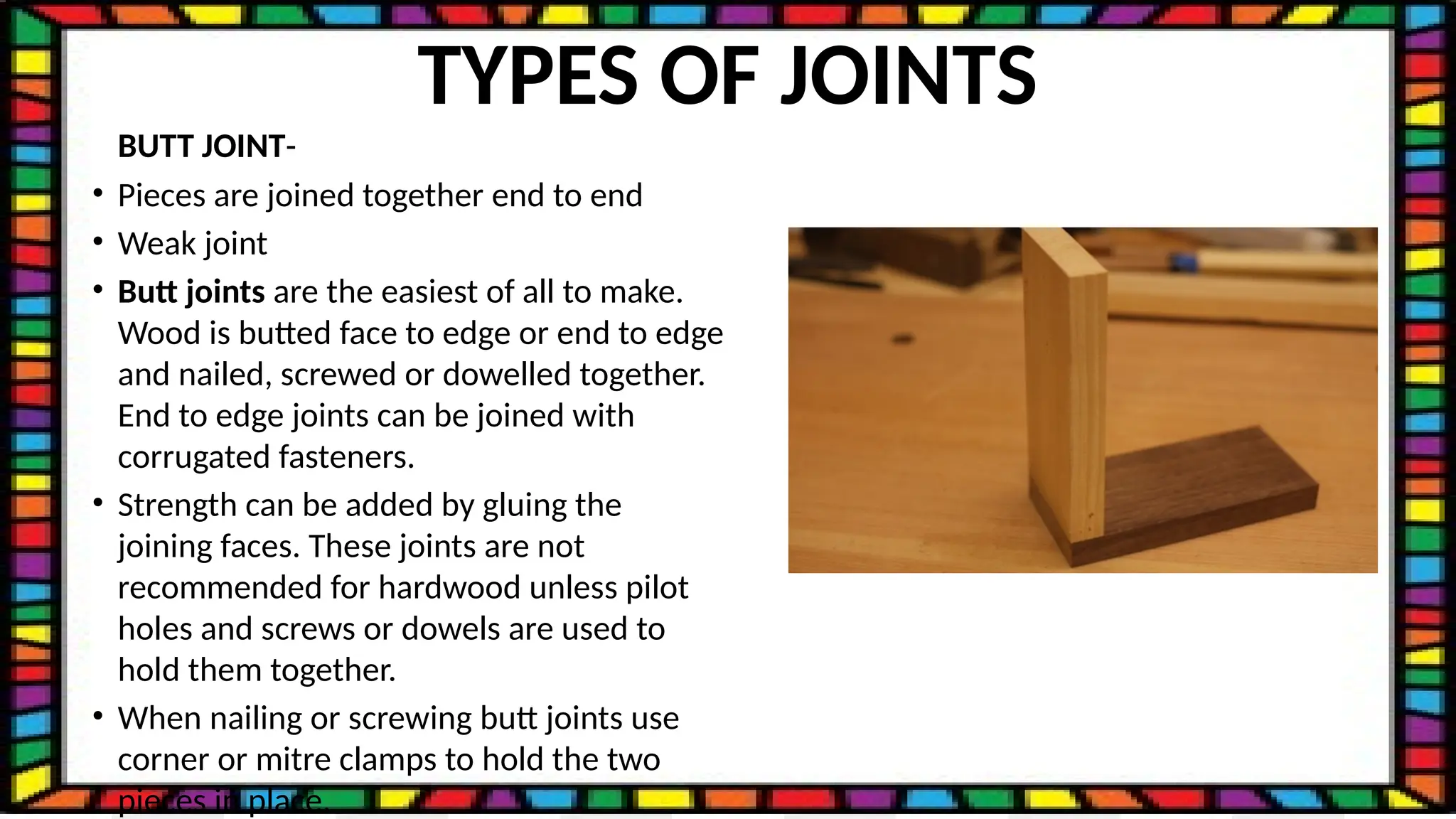
BUTT JOINT-
• Pieces are joined together end to end
• Weak joint
• Butt joints are the easiest of all to make.
Wood is butted face to edge or end to edge
and nailed, screwed or dowelled together.
End to edge joints can be joined with
corrugated fasteners.
• Strength can be added by gluing the
joining faces. These joints are not
recommended for hardwood unless pilot
holes and screws or dowels are used to
hold them together.
• When nailing or screwing butt joints use
corner or mitre clamps to hold the two
pieces in place.
TYPES OF JOINTS
MITRE JOINT –
• Used at corner of tables
• Two surfaces meet to form a right angle
• Mitre joints are always cut to 45° in a
mitre box so that they will form a 90°
corner when joined. As no end wood is
ever seen these are very neat joints but
they are weak. Normally used for picture
frames where they are nailed with panel
pins. When used for other purposes they
must be strengthened with glue blocks,
angle braces or loose tongues. Mitre
joints should always be glued.
TYPES OF JOINTS
DOUBLE DOWEL JOINTS-
• Two dowels are used to peg the joint
together.
• Dowel joints are very strong and
attractive if they are, like all other joints
constructive well. Dowel is also very
useful for greatly increasing the strength
of weaker woodwork joints such as the
butt joint.
• This type of joint is secured with an
adhesive and a small piece of dowel.
Construction also requires nothing more
than a drill and some accurate markings.
TYPES OF JOINTS
Dado Joint- The dado is a simple joint
often used in carpentry. Like the
tongue and groove joint, it involves a
notch cut into one board where the
other board will fit. Unlike the tongue
and groove, however, this type of
joint joins the edge or end of one
board to the center of another. It’s
often used in joining two pieces of
plywood together, or for putting
together the backs and sides of
cabinets and dressers with the top.
TYPES OF JOINTS
LAP JOINT-
• Made by overlapping two ends & joining
them
• Two types- Full lap & half lap
Halved joints or lap joints are mostly used
to assemble light frames which are going to
be covered with hardboard or plywood.
Half the thickness of each piece of wood to
be joined is cut away with a tenon saw and
the joint is glued and screwed or nailed.
Halved lap joints are also used to join long
lengths of timber as for fencing.
TYPES OF JOINTS
DOVETAIL JOINT- Dovetail joints are very
strong and neat joints used primarily to
make drawers and boxes. It needs a lot of
practice to make a good dovetail joint.
•Lapped dovetails are mostly used for
drawer fronts as they give a very neat,
strong joint with only one side showing
end wood. Marking is the same as for
open dovetails but the cutting out
between the pins needs a fair amount of
chiseling. Special dovetailing bits are
available for routers, which are ideal for
this job.
TYPES OF JOINTS
MORTISE & TENON JOINT-
• Mortise is a round rectangular cavity
• It accommodates a Tenon inside it.
• Tenon and mortise joints are very strong
joints mostly used in furniture making and
for heavy doors and gates. The secret of
making a good tenon joint lies in, accurate
marking. The tenon’s width should not be
less than a third of the thickness of the wood
especially if wood of the same thickness is
joined. The shoulders may be of any width
and may also be offset when the mortise is
made in rebated wood. Make the mortise
before rebating the wood.
TYPES OF JOINTS
TONGUE & GROOVE JOINT-
Loose tongued joints are
used to join planks edge to
edge to form a larger board
like a table top in which case
they are always glued only.
• Bare faced tongue and
groove or loose tongue and
groove joints can be used to
join chair rails to chair legs.
TYPES OF JOINTS
• Rabbet Joint- The rabbet joint is
a dado cut along the edge of a
board, rather than into the
center of it. It’s also used for
joining cabinets or for making
boxes where two edges need to
fit together tightly.
• Corner Block-These are used at
corner joints as screwed
reinforcements, to provide extra
support in quality furniture.
FURNITURE ARRANGEMENT IN GUEST AREAS
• Entrance: These areas should have a
furniture arrangements that express
warmth, cheer and pleasantness .these
are ideal places to use cane, wicker or
painted wrought furniture.
• Living room: it usually contains
upholstered furniture to seat the
maximum number of people who may
occupy the room. Tables and chairs
should harmonize in weight, size and
style. Tall pieces of furniture should be
placed a parallel to wall, either parallel
or right angles.
FURNITURE ARRANGEMENT IN GUEST AREAS
• Dining area: In these rooms, a large
coffee table and a few chairs suffice for
any meal served in the guest rooms.
• Bed room: The usual set of furniture in
a guest bed room is two bed side tables,
a dressing table , a chest of drawers ,a
coffee table, a chairs, a luggage rack
and a writing table.
• Kitchen: Some hotel guest rooms have
a small kitchen, where usually modular
cabinets are utilized as furniture.
CERTAIN POINTS TO CONSIDER FURNITURE ARRANGEMENT
• Keeping accessories in proportion to the
furniture.
• Keep furniture in proportion to the
space.
• Use a blend of symmetrical and
asymmetrical arrangements.
• Place furniture with due regard for
keeping ‘traffic spaces’ free. Consider
placing larger pieces against a wall rather
than in the middle. One can also place
furniture around a focal point of interest
for e.g. fireplace.
Checklist whether the furniture-
• Is free from coarse , unfinished edges
• Is sturdy and stands firm on the floor
• Is free from surplus adhesive
• Is reinforced with suitable well fitted joints
• Is well balanced, whether empty or full(especially for case woods)
• Type of guest expected and standard of accommodation, guest’ length of
stay.
• Atmosphere to be achieved, e.g. Modern /old degree of comfort.
• Shape and size of article with relation to human body.
• Versatility and mobility.
• Ease of cleaning
• Standardization so that items can move to room to room, as required.
SIZES OF FURNITURES
• ARMCHAIR 85X85 CMS
• TWO SEATER SOFA 125X85 CMS
• EASYCHAIR 70X75 CMS
• DINING CHAIR 45X45 CMS
• OBLONG COFEE TABLE 105X50 CMS
• ROUND COFFEE TABLE 75 CMS DIAMETER
• BOOK CASE 105X30 CMS
• FOUR SEATER DINING 90X90 CMS
• DRESSING/WRITING TABLE 170X45 CMS
• LUGGAGE RACK 95X50 CMS
• DOUBLE BED 150X200 CMS
• SINGLE BED 90X200 CMS
• BEDSIDE TABLE 40X40 COMS
• WARDROBE FOR TWO 100X55 CMS
FUTURISTIC FURNITURE DESIGNS
History and Types of Furniture with furniture joints .pptx

History and Types of Furniture with furniture joints .pptx

  • 1.
  • 2.
    FURNITURE Furniture refers tomovable objects intended to support various human activities such as seating (e.g., chairs, stools, tables and sofa s) and sleeping (e.g., beds). Furniture is also used to hold objects at a convenient height for work (as horizontal surfaces above the ground, such as tables and desks), or to store things (e.g., cupboards and shelves).
  • 3.
    HISTORY OF FURNITURE •Peoplehave been using natural objects, such as tree stumps, rocks and moss, as furniture since the beginning of human civilization. •Archaeological research shows that from around 30,000 years ago, people began constructing and carving their own furniture, using wood, stone, and animal bones. •Early furniture from this period is known from artwork such as a Venus figurine found in Russia, depicting the goddess on a throne. •The first surviving furniture is in the homes of Skara Brae in Scotland, and includes cupboards, dressers and beds all constructed from stone.
  • 4.
    DEFINITION OF FURNITURE Furnituremay be defined as the movable article that make a room suitable for living or working. ADDING DÉCOR • Achieving latest design in addition to cost incurred. • Huge comfort provides aesthetic value creates a great ambience at work place.
  • 5.
    CLASSIFICATION OF FURNITURE Thereare generally four types of furniture: • Free standing • Cantilevered • Built-in • Fitted-in
  • 6.
     FREE STANDINGFURNITURE- This type of furniture can be re arranged anywhere but the disadvantage is that they accumulate dust behind, above & beneath them.  CANTILEVERED FURNITURE- These furniture’s are fitted to the bracket fitted on the wall hence there are no legs to get in the way of cleaning. CLASSIFICATION OF FURNITURE
  • 7.
     BUILT-IN FURNITURE’S-These pieces of furniture’s are fitted and fixed into architectural spaces set aside from them in the construction of the building. Usually their cost is incorporated into the building cost.  FITTED FURNITURE’S- Fitted furniture is made to fit into existing alcoves and niches, there-by saving space but is essentially a standalone items with its own sides, base and top apart from the room walls ceiling and floors. CLASSIFICATION OF FURNITURE
  • 8.
    • UPHOLSTERED FURNITURE-Good upholstered furniture consists of a webbed base, coiled springs, two layers of filling materials, hessian, webbing, calico covering and a decorative outer covering of fabric. Leather may be an alternative to a big fabric covering and if well maintained can last 4 times as long as a fabric covering. • MODULAR FURNITURE- Different pieces can be joined together in a variety of ways to suit individual requirements. Modular furniture is usually built against a wall, and thus makes the most economical use of space within a room and simplifies floor cleaning. CLASSIFICATION OF FURNITURE
  • 9.
    • ANTIQUE FURNITURE-Actual antique furniture will belong to a period before 1840 though now a days any furniture more than a 100 years old is considered antique. Good antiques are valuable and expensive. CLASSIFICATION OF FURNITURE
  • 10.
    Wooden furniture • Hardwoodlike Mahogany, Walnut, Oak, Rosewood, Teak and Shesham. • Softwood like Pine, Fir and Redwood. Metal furniture Upholstered furniture Glass furniture Cane and wicker furniture TYPES OF MATERIAL THAT CAN BE USED TO MAKE FURNITURE
  • 11.
    WOOD JOINTS • Everyplace that two separate pieces of wood meet each other is considered to be a joint. Joints may be as simple as one end of a piece of wood placed on another, or they may be as elaborate as several interlocking slots. Most joints are held together with some sort of outside force, such as glue, nails, staples, or screws.
  • 12.
    TYPES OF JOINTS BUTTJOINT- • Pieces are joined together end to end • Weak joint • Butt joints are the easiest of all to make. Wood is butted face to edge or end to edge and nailed, screwed or dowelled together. End to edge joints can be joined with corrugated fasteners. • Strength can be added by gluing the joining faces. These joints are not recommended for hardwood unless pilot holes and screws or dowels are used to hold them together. • When nailing or screwing butt joints use corner or mitre clamps to hold the two pieces in place.
  • 14.
    TYPES OF JOINTS MITREJOINT – • Used at corner of tables • Two surfaces meet to form a right angle • Mitre joints are always cut to 45° in a mitre box so that they will form a 90° corner when joined. As no end wood is ever seen these are very neat joints but they are weak. Normally used for picture frames where they are nailed with panel pins. When used for other purposes they must be strengthened with glue blocks, angle braces or loose tongues. Mitre joints should always be glued.
  • 16.
    TYPES OF JOINTS DOUBLEDOWEL JOINTS- • Two dowels are used to peg the joint together. • Dowel joints are very strong and attractive if they are, like all other joints constructive well. Dowel is also very useful for greatly increasing the strength of weaker woodwork joints such as the butt joint. • This type of joint is secured with an adhesive and a small piece of dowel. Construction also requires nothing more than a drill and some accurate markings.
  • 18.
    TYPES OF JOINTS DadoJoint- The dado is a simple joint often used in carpentry. Like the tongue and groove joint, it involves a notch cut into one board where the other board will fit. Unlike the tongue and groove, however, this type of joint joins the edge or end of one board to the center of another. It’s often used in joining two pieces of plywood together, or for putting together the backs and sides of cabinets and dressers with the top.
  • 20.
    TYPES OF JOINTS LAPJOINT- • Made by overlapping two ends & joining them • Two types- Full lap & half lap Halved joints or lap joints are mostly used to assemble light frames which are going to be covered with hardboard or plywood. Half the thickness of each piece of wood to be joined is cut away with a tenon saw and the joint is glued and screwed or nailed. Halved lap joints are also used to join long lengths of timber as for fencing.
  • 22.
    TYPES OF JOINTS DOVETAILJOINT- Dovetail joints are very strong and neat joints used primarily to make drawers and boxes. It needs a lot of practice to make a good dovetail joint. •Lapped dovetails are mostly used for drawer fronts as they give a very neat, strong joint with only one side showing end wood. Marking is the same as for open dovetails but the cutting out between the pins needs a fair amount of chiseling. Special dovetailing bits are available for routers, which are ideal for this job.
  • 24.
    TYPES OF JOINTS MORTISE& TENON JOINT- • Mortise is a round rectangular cavity • It accommodates a Tenon inside it. • Tenon and mortise joints are very strong joints mostly used in furniture making and for heavy doors and gates. The secret of making a good tenon joint lies in, accurate marking. The tenon’s width should not be less than a third of the thickness of the wood especially if wood of the same thickness is joined. The shoulders may be of any width and may also be offset when the mortise is made in rebated wood. Make the mortise before rebating the wood.
  • 26.
    TYPES OF JOINTS TONGUE& GROOVE JOINT- Loose tongued joints are used to join planks edge to edge to form a larger board like a table top in which case they are always glued only. • Bare faced tongue and groove or loose tongue and groove joints can be used to join chair rails to chair legs.
  • 28.
    TYPES OF JOINTS •Rabbet Joint- The rabbet joint is a dado cut along the edge of a board, rather than into the center of it. It’s also used for joining cabinets or for making boxes where two edges need to fit together tightly. • Corner Block-These are used at corner joints as screwed reinforcements, to provide extra support in quality furniture.
  • 29.
    FURNITURE ARRANGEMENT INGUEST AREAS • Entrance: These areas should have a furniture arrangements that express warmth, cheer and pleasantness .these are ideal places to use cane, wicker or painted wrought furniture. • Living room: it usually contains upholstered furniture to seat the maximum number of people who may occupy the room. Tables and chairs should harmonize in weight, size and style. Tall pieces of furniture should be placed a parallel to wall, either parallel or right angles.
  • 30.
    FURNITURE ARRANGEMENT INGUEST AREAS • Dining area: In these rooms, a large coffee table and a few chairs suffice for any meal served in the guest rooms. • Bed room: The usual set of furniture in a guest bed room is two bed side tables, a dressing table , a chest of drawers ,a coffee table, a chairs, a luggage rack and a writing table. • Kitchen: Some hotel guest rooms have a small kitchen, where usually modular cabinets are utilized as furniture.
  • 31.
    CERTAIN POINTS TOCONSIDER FURNITURE ARRANGEMENT • Keeping accessories in proportion to the furniture. • Keep furniture in proportion to the space. • Use a blend of symmetrical and asymmetrical arrangements. • Place furniture with due regard for keeping ‘traffic spaces’ free. Consider placing larger pieces against a wall rather than in the middle. One can also place furniture around a focal point of interest for e.g. fireplace.
  • 32.
    Checklist whether thefurniture- • Is free from coarse , unfinished edges • Is sturdy and stands firm on the floor • Is free from surplus adhesive • Is reinforced with suitable well fitted joints • Is well balanced, whether empty or full(especially for case woods) • Type of guest expected and standard of accommodation, guest’ length of stay. • Atmosphere to be achieved, e.g. Modern /old degree of comfort. • Shape and size of article with relation to human body. • Versatility and mobility. • Ease of cleaning • Standardization so that items can move to room to room, as required.
  • 33.
    SIZES OF FURNITURES •ARMCHAIR 85X85 CMS • TWO SEATER SOFA 125X85 CMS • EASYCHAIR 70X75 CMS • DINING CHAIR 45X45 CMS • OBLONG COFEE TABLE 105X50 CMS • ROUND COFFEE TABLE 75 CMS DIAMETER • BOOK CASE 105X30 CMS • FOUR SEATER DINING 90X90 CMS • DRESSING/WRITING TABLE 170X45 CMS • LUGGAGE RACK 95X50 CMS • DOUBLE BED 150X200 CMS • SINGLE BED 90X200 CMS • BEDSIDE TABLE 40X40 COMS • WARDROBE FOR TWO 100X55 CMS
  • 34.