Chapter Three Developing a Healthy Lifestyle ©  2008 McGraw-Hill Higher Education. All rights reserved.
What is Healthy? Your health is dependent upon personal lifestyle choices as well as the following uncontrollable elements: Genetics Environmental conditions Technological developments of your country Gender Ethnicity Cultural issues Age-specific risks Potential for accidents ©  2008 McGraw-Hill Higher Education. All rights reserved.
Life Expectancy Many factors determine how long you live Life expectancy provide researchers with statistical averages for tracking health concerns, but  does not consider the “individual” The average life expectancy for a person living in the U.S. is 77.5 years The average life expectancy for women is 80.1 years This average is 5.3 years more than men ©  2008 McGraw-Hill Higher Education. All rights reserved.  Reference: http://www.census.gov/
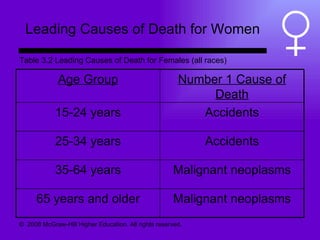
Leading Causes of Death for Women ©  2008 McGraw-Hill Higher Education. All rights reserved.  Table 3.2 Leading Causes of Death for Females (all races) Age Group Number 1 Cause of Death 15-24 years Accidents 25-34 years Accidents 35-64 years Malignant neoplasms 65 years and older Malignant neoplasms
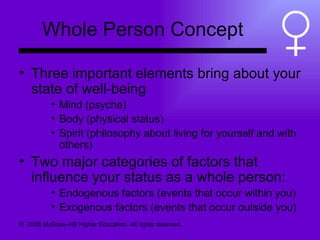
Whole Person Concept Three important elements bring about your state of well-being Mind (psyche) Body (physical status) Spirit (philosophy about living for yourself and with others) Two major categories of factors that influence your status as a whole person: Endogenous factors (events that occur within you) Exogenous factors (events that occur outside you) ©  2008 McGraw-Hill Higher Education. All rights reserved.
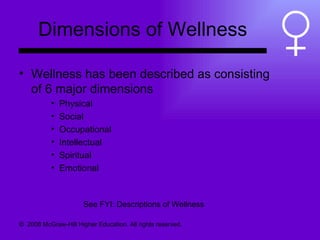
Dimensions of Wellness Wellness has been described as consisting of 6 major dimensions Physical Social Occupational Intellectual Spiritual Emotional ©  2008 McGraw-Hill Higher Education. All rights reserved.  See FYI: Descriptions of Wellness
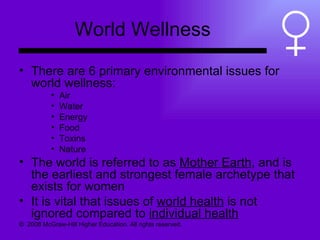
World Wellness There are 6 primary environmental issues for world wellness: Air Water Energy Food  Toxins Nature The world is referred to as  Mother Earth , and is the earliest and strongest female archetype that exists for women It is vital that issues of  world health  is not ignored compared to  individual health ©  2008 McGraw-Hill Higher Education. All rights reserved.
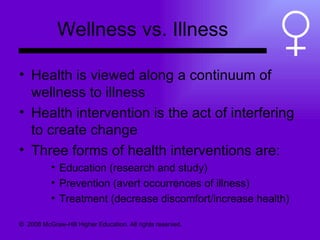
Wellness vs. Illness Health is viewed along a continuum of wellness to illness Health intervention is the act of interfering to create change Three forms of health interventions are: Education (research and study) Prevention (avert occurrences of illness) Treatment (decrease discomfort/increase health) ©  2008 McGraw-Hill Higher Education. All rights reserved.
Learning and Behavior Primary reinforcers can be positive, negative, and punishment A  Positive Reinforcer  is rewarding the behavior A  Negative Reinforcer  is the removal of something uncomfortable A  Punishment  involves the presentation of something uncomfortable Resistance to change is often a result of the existence of  secondary reinforcers  (interfering belief or value) ©  2008 McGraw-Hill Higher Education. All rights reserved.
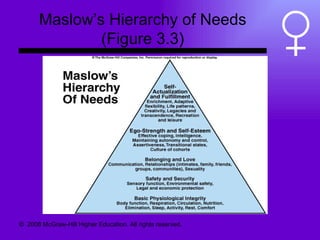
Maslow’s Hierarchy of Needs (Figure 3.3) ©  2008 McGraw-Hill Higher Education. All rights reserved.
Theories and Models of Health Behavior Change The Transtheoretical Model Multicomponent stage model consisting of 5 stages Theories of Reasoned Action and Planned Action 3 primary concepts that can affect behavior change Self-Efficacy Conviction that you can change behavior based on your actions ©  2008 McGraw-Hill Higher Education. All rights reserved.  The preceding are theories or models that suggest ways to change health behaviors
Planning Your Lifestyle Change Managing lifestyle changes can occur through a self-help plan which involves 3 steps: Personal Inventory (evaluation of personal health) Helpful Attitude (consider this a permanent change that promotes realism) Plan of Action  Assessing behavior Setting specific goals (behavioral contract) Formulating intervention strategies Evaluating progress ©  2008 McGraw-Hill Higher Education. All rights reserved.
Chapter Three Developing a Healthy Lifestyle ©  2008 McGraw-Hill Higher Education. All rights reserved.

Womens Health 3

  • 1.
    Chapter Three Developinga Healthy Lifestyle © 2008 McGraw-Hill Higher Education. All rights reserved.
  • 2.
    What is Healthy?Your health is dependent upon personal lifestyle choices as well as the following uncontrollable elements: Genetics Environmental conditions Technological developments of your country Gender Ethnicity Cultural issues Age-specific risks Potential for accidents © 2008 McGraw-Hill Higher Education. All rights reserved.
  • 3.
    Life Expectancy Manyfactors determine how long you live Life expectancy provide researchers with statistical averages for tracking health concerns, but does not consider the “individual” The average life expectancy for a person living in the U.S. is 77.5 years The average life expectancy for women is 80.1 years This average is 5.3 years more than men © 2008 McGraw-Hill Higher Education. All rights reserved. Reference: http://www.census.gov/
  • 4.
    Leading Causes ofDeath for Women © 2008 McGraw-Hill Higher Education. All rights reserved. Table 3.2 Leading Causes of Death for Females (all races) Age Group Number 1 Cause of Death 15-24 years Accidents 25-34 years Accidents 35-64 years Malignant neoplasms 65 years and older Malignant neoplasms
  • 5.
    Whole Person ConceptThree important elements bring about your state of well-being Mind (psyche) Body (physical status) Spirit (philosophy about living for yourself and with others) Two major categories of factors that influence your status as a whole person: Endogenous factors (events that occur within you) Exogenous factors (events that occur outside you) © 2008 McGraw-Hill Higher Education. All rights reserved.
  • 6.
    Dimensions of WellnessWellness has been described as consisting of 6 major dimensions Physical Social Occupational Intellectual Spiritual Emotional © 2008 McGraw-Hill Higher Education. All rights reserved. See FYI: Descriptions of Wellness
  • 7.
    World Wellness Thereare 6 primary environmental issues for world wellness: Air Water Energy Food Toxins Nature The world is referred to as Mother Earth , and is the earliest and strongest female archetype that exists for women It is vital that issues of world health is not ignored compared to individual health © 2008 McGraw-Hill Higher Education. All rights reserved.
  • 8.
    Wellness vs. IllnessHealth is viewed along a continuum of wellness to illness Health intervention is the act of interfering to create change Three forms of health interventions are: Education (research and study) Prevention (avert occurrences of illness) Treatment (decrease discomfort/increase health) © 2008 McGraw-Hill Higher Education. All rights reserved.
  • 9.
    Learning and BehaviorPrimary reinforcers can be positive, negative, and punishment A Positive Reinforcer is rewarding the behavior A Negative Reinforcer is the removal of something uncomfortable A Punishment involves the presentation of something uncomfortable Resistance to change is often a result of the existence of secondary reinforcers (interfering belief or value) © 2008 McGraw-Hill Higher Education. All rights reserved.
  • 10.
    Maslow’s Hierarchy ofNeeds (Figure 3.3) © 2008 McGraw-Hill Higher Education. All rights reserved.
  • 11.
    Theories and Modelsof Health Behavior Change The Transtheoretical Model Multicomponent stage model consisting of 5 stages Theories of Reasoned Action and Planned Action 3 primary concepts that can affect behavior change Self-Efficacy Conviction that you can change behavior based on your actions © 2008 McGraw-Hill Higher Education. All rights reserved. The preceding are theories or models that suggest ways to change health behaviors
  • 12.
    Planning Your LifestyleChange Managing lifestyle changes can occur through a self-help plan which involves 3 steps: Personal Inventory (evaluation of personal health) Helpful Attitude (consider this a permanent change that promotes realism) Plan of Action Assessing behavior Setting specific goals (behavioral contract) Formulating intervention strategies Evaluating progress © 2008 McGraw-Hill Higher Education. All rights reserved.
  • 13.
    Chapter Three Developinga Healthy Lifestyle © 2008 McGraw-Hill Higher Education. All rights reserved.