Chapter Four Enhancing Emotional Well-Being
The Emerging Self How do you develop your values, beliefs, feelings, thoughts, and ideas about yourself? Personal development and emotional health of women have been tied to possible explanations or theories by well-known behaviorists These theories will help in differentiating behaviors of women vs. men
Theories of Development Until 1979, the psychology profession supported the long-held belief that women were inferior to men As early as 1905, Sigmund Freud developed the theory of psychosexual development around the experiences of the male child Freud viewed differences between men vs. women as the result from women’s developmental failure to meet the male standard In 1968, Erikson did recognize gender differences with regards to  intimacy development,  however, depicted the male pattern as the “standard” for healthy psychosocial development
Theories of Cognitive Development   Piaget (1932) equated normal child development with male development.  Considered females to be far less developed in capacities that would allow  normal legal sense , essential to moral development Piaget failed to recognize the approach girls took to conflict resolution vs. boys, was equal or sometimes favorable to resolving conflict, depending upon the circumstances
Theories of Moral Development Kohlberg (1969) developed a scale of moral development theory based on a male subject group It excluded women, since he felt girls played games that are less likely to involve strict rules, based upon his observations By using the Kohlberg Scale, women were deficient in this area Gilligan proposed to the psychology profession that a new psychology for women be developed, independent of male standards, which allowed changes to eventually occur
Women’s Relational Model of Development Traditional male models of development emphasize  separation and individuation process  for psychological well-being A woman’s self concept (identity, self-esteem) is strongly associated with her  relationship to others The ability to relate to others is considered  a strength This relational approach is called  “self-in-relation theory”  (Stone Center/Wellesley College) This has now emerged to be referred to as  “gender-relations theory”,  emphasizing separation and individuation, but neglects the intricacies of human interconnection
Sociocultural Influences Sociocultural influences may significantly impact your emotional health in many different ways They can lead you to either life satisfaction or dysfunction It is important to be in touch with yourself and know when you need to make adjustments, based upon your level of satisfaction by allowing one to perform the following: Integration and  ongoing mindfulness  (self-exploration) See Figure 4.1
Life Skill Development Life is suppose to be a fun and challenging job Having life skills makes it easier to cope with the demands of life These skills can be taught to anyone at any age Examples of such skills are as follows: Recognizing emotions (Emotional Intelligence) Assertiveness training Effective communication Problem solving Maintaining a healthy self-image Having good self-esteem Resolving grief over loss
Emotional Intelligence This is the ability to recognize your emotions and those of the people around you The classic two step approach involves becoming aware of your own emotions and developing an action plan An action plan is used to resolve troubling emotions It may require changing the way you speak to someone or developing better listening skills
Assertiveness Standing up for personal rights and expressing thoughts or feelings that do not violate another person’s rights Involves respect, not deference A need for assertion training  is more prevalent for women since the American culture teaches males to be aggressive Adventure based activities can have a positive influence on assertiveness for women
Effective Communication The following are components of effective communication Body language Encouraging responses Paraphrasing Clarification Summarization
Effective Problem Solving Effective problem solving is a step-by-step approach of planning and negotiating and involves all parties to be effected A common model involves 6 steps: Defining the problem Generating possible solutions Evaluating the solutions Making the decision Determining how to implement the decision Assessing the success of the solution
Self-Esteem Enhancement Based on the distance between the  perceived self  and the  ideal self Self-Esteem Enhancement  is the process of reducing the distance between the two points Once the ideal self is more realistic, you can have a healthier opinion about yourself and greater self-esteem Maintaining or enhancing self-esteem in women varies across cultures
Image Building The key element to building and maintaining a positive self image is to focus on being what you want to be Build your image from the inside out Every woman has something unique to offer on the 6 levels of health dimensions To enhance self image, start by loving yourself and accepting yourself as you are right now Body dysmorphic disorder  (BDD) is a body image disturbance which can lead into unhealthy behaviors
Image and the Media Glamorization of women in the media started in the 1830s Glamorous images projected by the media have contributed to harsh self-criticism by women Technology has advanced how unrealistic women are perceived by the media Public efforts have been placed on hiding a woman’s natural body image than in accepting the nature of a woman’s uniqueness There have been some instances in the past where the media have benefited women’s issues
Eating Disorders Poor body image is the central factor in the development of eating disorders 99% of people with eating disorders are women Eating disorders include: Anorexia nervosa  (starving oneself) Bulimia nervosa  (eating-vomiting) Binge eating disorder  (binge eating w/o purging) It is difficult for women to lose weight due to the designation of body fat factor Treatment requires a combination of mental health counseling and nutritional guidance
Resolving Grief over Loss During your lifetime, you will lose someone very important to you Grief is a normal response to a loss There is are several ways to grieve Sorrow, despair, and depression are natural and healthy ways to express sadness from a loss It is important to mourn the loss since un-reconciled or poorly reconciled grief experiences can lead to unhealthy behaviors
Depression A common emotional health concern for women Depression  is an emotional state of persistent dejection, from mild discouragement to extreme despair Women are twice as likely as men to be diagnosed with clinical depression A chemical imbalance of the neurotransmitter,  serotonin , is thought to be the precursor to depression Causes of this imbalance may be the experience of stress or trauma, or a genetic disposition towards depression
Types of Depression Clinical depression requires intervention by a trained mental health professional The common types of clinical depression are:  Major depressive episode Dysthymic disorder Major depressive disorder Bipolar disorder (manic depression)
Psychosocial Stressors and Depression Experts believe that the reason behind the higher incidence of depression compared to men is due differences in women’s responses to depressing events Other researchers hypothesize the higher incidences of stress could be based upon having more stress and discrimination Childhood trauma can also impair interpersonal and psychological functioning in women
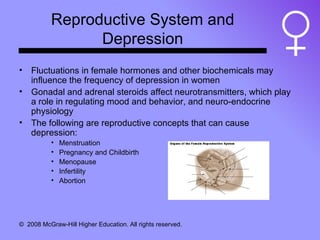
Reproductive System and Depression Fluctuations in female hormones and other biochemicals may influence the frequency of depression in women Gonadal and adrenal steroids affect neurotransmitters, which play a role in regulating mood and behavior, and neuro-endocrine physiology The following are reproductive concepts that can cause depression: Menstruation Pregnancy and Childbirth Menopause Infertility Abortion
Depression and Genetic Liability Research with female twins determined that there is a genetic liability for the onset of major depression in women who experience stressful events (Kendler et al. 1995) The tendency to develop depression may be inherited Major depressive disorder is 1.5 to 3 times more common among first degree biological relatives of persons with this disorder than among the general population
Positive Experiences vs. Depression Women who have positive experiences can enhance their self esteem and decrease depression Studies show a negative relationship between depression and a sense of humor As humor increases, depression decreases Increased quality of personal relationships and work status have demonstrated improvements to self esteem and evaluation in women over a 7 year period
Developmental Issues and Depression There are no consistent gender differences in rates of depression for pre-pubescent However, by age 13-15, girls show significantly higher rates of depressive disorders and symptoms than boys Besides the physical differences, girls respond to distress differently than boys Girls exhibit more passive and introspective coping styles Girls and women eventually face more negative life events than males
Multicultural Issues of Depression and Suicide African American women may experience racism as an additional stressor that contributes to depression Hispanic women may experience economic deprivation, migration, and political discrimination, leading to depression Low self-esteem are significant problems for many Asian women which contribute to depression Native American women have higher mortality rates than other groups, which poverty, lack of education, and their existing environment contribute to suicide and major illnesses The strongest risk factors for suicide are depression, alcohol and drug abuse, and separation or divorce
The Counseling Option Feminist therapy  (gender equity therapy) specifically assists women by empowering them via a egalitarian relationship (equity-based) with the therapist Assists in rebuilding and reinforcing a woman’s inner strength and ability to survive in the face of emotional burdens Mental health professionals are required to be licensed or certified by a health board in order to practice in most states It is important to explore the background and training of any counselor
Chapter Four Enhancing Emotional Well-Being

Womens Health 4

  • 1.
    Chapter Four EnhancingEmotional Well-Being
  • 2.
    The Emerging SelfHow do you develop your values, beliefs, feelings, thoughts, and ideas about yourself? Personal development and emotional health of women have been tied to possible explanations or theories by well-known behaviorists These theories will help in differentiating behaviors of women vs. men
  • 3.
    Theories of DevelopmentUntil 1979, the psychology profession supported the long-held belief that women were inferior to men As early as 1905, Sigmund Freud developed the theory of psychosexual development around the experiences of the male child Freud viewed differences between men vs. women as the result from women’s developmental failure to meet the male standard In 1968, Erikson did recognize gender differences with regards to intimacy development, however, depicted the male pattern as the “standard” for healthy psychosocial development
  • 4.
    Theories of CognitiveDevelopment Piaget (1932) equated normal child development with male development. Considered females to be far less developed in capacities that would allow normal legal sense , essential to moral development Piaget failed to recognize the approach girls took to conflict resolution vs. boys, was equal or sometimes favorable to resolving conflict, depending upon the circumstances
  • 5.
    Theories of MoralDevelopment Kohlberg (1969) developed a scale of moral development theory based on a male subject group It excluded women, since he felt girls played games that are less likely to involve strict rules, based upon his observations By using the Kohlberg Scale, women were deficient in this area Gilligan proposed to the psychology profession that a new psychology for women be developed, independent of male standards, which allowed changes to eventually occur
  • 6.
    Women’s Relational Modelof Development Traditional male models of development emphasize separation and individuation process for psychological well-being A woman’s self concept (identity, self-esteem) is strongly associated with her relationship to others The ability to relate to others is considered a strength This relational approach is called “self-in-relation theory” (Stone Center/Wellesley College) This has now emerged to be referred to as “gender-relations theory”, emphasizing separation and individuation, but neglects the intricacies of human interconnection
  • 7.
    Sociocultural Influences Socioculturalinfluences may significantly impact your emotional health in many different ways They can lead you to either life satisfaction or dysfunction It is important to be in touch with yourself and know when you need to make adjustments, based upon your level of satisfaction by allowing one to perform the following: Integration and ongoing mindfulness (self-exploration) See Figure 4.1
  • 8.
    Life Skill DevelopmentLife is suppose to be a fun and challenging job Having life skills makes it easier to cope with the demands of life These skills can be taught to anyone at any age Examples of such skills are as follows: Recognizing emotions (Emotional Intelligence) Assertiveness training Effective communication Problem solving Maintaining a healthy self-image Having good self-esteem Resolving grief over loss
  • 9.
    Emotional Intelligence Thisis the ability to recognize your emotions and those of the people around you The classic two step approach involves becoming aware of your own emotions and developing an action plan An action plan is used to resolve troubling emotions It may require changing the way you speak to someone or developing better listening skills
  • 10.
    Assertiveness Standing upfor personal rights and expressing thoughts or feelings that do not violate another person’s rights Involves respect, not deference A need for assertion training is more prevalent for women since the American culture teaches males to be aggressive Adventure based activities can have a positive influence on assertiveness for women
  • 11.
    Effective Communication Thefollowing are components of effective communication Body language Encouraging responses Paraphrasing Clarification Summarization
  • 12.
    Effective Problem SolvingEffective problem solving is a step-by-step approach of planning and negotiating and involves all parties to be effected A common model involves 6 steps: Defining the problem Generating possible solutions Evaluating the solutions Making the decision Determining how to implement the decision Assessing the success of the solution
  • 13.
    Self-Esteem Enhancement Basedon the distance between the perceived self and the ideal self Self-Esteem Enhancement is the process of reducing the distance between the two points Once the ideal self is more realistic, you can have a healthier opinion about yourself and greater self-esteem Maintaining or enhancing self-esteem in women varies across cultures
  • 14.
    Image Building Thekey element to building and maintaining a positive self image is to focus on being what you want to be Build your image from the inside out Every woman has something unique to offer on the 6 levels of health dimensions To enhance self image, start by loving yourself and accepting yourself as you are right now Body dysmorphic disorder (BDD) is a body image disturbance which can lead into unhealthy behaviors
  • 15.
    Image and theMedia Glamorization of women in the media started in the 1830s Glamorous images projected by the media have contributed to harsh self-criticism by women Technology has advanced how unrealistic women are perceived by the media Public efforts have been placed on hiding a woman’s natural body image than in accepting the nature of a woman’s uniqueness There have been some instances in the past where the media have benefited women’s issues
  • 16.
    Eating Disorders Poorbody image is the central factor in the development of eating disorders 99% of people with eating disorders are women Eating disorders include: Anorexia nervosa (starving oneself) Bulimia nervosa (eating-vomiting) Binge eating disorder (binge eating w/o purging) It is difficult for women to lose weight due to the designation of body fat factor Treatment requires a combination of mental health counseling and nutritional guidance
  • 17.
    Resolving Grief overLoss During your lifetime, you will lose someone very important to you Grief is a normal response to a loss There is are several ways to grieve Sorrow, despair, and depression are natural and healthy ways to express sadness from a loss It is important to mourn the loss since un-reconciled or poorly reconciled grief experiences can lead to unhealthy behaviors
  • 18.
    Depression A commonemotional health concern for women Depression is an emotional state of persistent dejection, from mild discouragement to extreme despair Women are twice as likely as men to be diagnosed with clinical depression A chemical imbalance of the neurotransmitter, serotonin , is thought to be the precursor to depression Causes of this imbalance may be the experience of stress or trauma, or a genetic disposition towards depression
  • 19.
    Types of DepressionClinical depression requires intervention by a trained mental health professional The common types of clinical depression are: Major depressive episode Dysthymic disorder Major depressive disorder Bipolar disorder (manic depression)
  • 20.
    Psychosocial Stressors andDepression Experts believe that the reason behind the higher incidence of depression compared to men is due differences in women’s responses to depressing events Other researchers hypothesize the higher incidences of stress could be based upon having more stress and discrimination Childhood trauma can also impair interpersonal and psychological functioning in women
  • 21.
    Reproductive System andDepression Fluctuations in female hormones and other biochemicals may influence the frequency of depression in women Gonadal and adrenal steroids affect neurotransmitters, which play a role in regulating mood and behavior, and neuro-endocrine physiology The following are reproductive concepts that can cause depression: Menstruation Pregnancy and Childbirth Menopause Infertility Abortion
  • 22.
    Depression and GeneticLiability Research with female twins determined that there is a genetic liability for the onset of major depression in women who experience stressful events (Kendler et al. 1995) The tendency to develop depression may be inherited Major depressive disorder is 1.5 to 3 times more common among first degree biological relatives of persons with this disorder than among the general population
  • 23.
    Positive Experiences vs.Depression Women who have positive experiences can enhance their self esteem and decrease depression Studies show a negative relationship between depression and a sense of humor As humor increases, depression decreases Increased quality of personal relationships and work status have demonstrated improvements to self esteem and evaluation in women over a 7 year period
  • 24.
    Developmental Issues andDepression There are no consistent gender differences in rates of depression for pre-pubescent However, by age 13-15, girls show significantly higher rates of depressive disorders and symptoms than boys Besides the physical differences, girls respond to distress differently than boys Girls exhibit more passive and introspective coping styles Girls and women eventually face more negative life events than males
  • 25.
    Multicultural Issues ofDepression and Suicide African American women may experience racism as an additional stressor that contributes to depression Hispanic women may experience economic deprivation, migration, and political discrimination, leading to depression Low self-esteem are significant problems for many Asian women which contribute to depression Native American women have higher mortality rates than other groups, which poverty, lack of education, and their existing environment contribute to suicide and major illnesses The strongest risk factors for suicide are depression, alcohol and drug abuse, and separation or divorce
  • 26.
    The Counseling OptionFeminist therapy (gender equity therapy) specifically assists women by empowering them via a egalitarian relationship (equity-based) with the therapist Assists in rebuilding and reinforcing a woman’s inner strength and ability to survive in the face of emotional burdens Mental health professionals are required to be licensed or certified by a health board in order to practice in most states It is important to explore the background and training of any counselor
  • 27.
    Chapter Four EnhancingEmotional Well-Being