NATIONAL CANCER AWARENESS DAY 
7TH NOVEMBER 2014
•Cancer is currently the cause of 12% of all 
deaths 
•It is increasing 
•Potential causes: 
• Increasing elderly population 
•Decrease in deaths from communicable 
diseases 
• Increasing incidence in certain cancers like 
lung cancer, breast cancer
Impact of cancer 
Diagnosis of cancer is perceived by many as 
“Life- threatening” 
1/3 rd face anxiety and depression 
Family’s daily functioning is affected 
Loss of income/ expenses
National Cancer Control Program (NCCP) 
•Initiated in 1984 
•Four major goals 
•Primary prevention of tobacco related cancers 
•Early detection of cancers of accessible sites 
•Augmentation of treatment facilities 
•Establishment of palliative care network
4th February is observed as 
World Cancer awareness day 
7th November is observed as 
National Cancer Awareness Day
T 
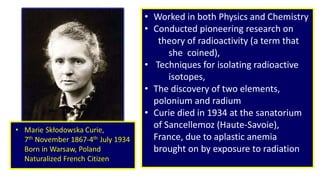
• Worked in both Physics and Chemistry 
• Conducted pioneering research on 
theory of radioactivity (a term that 
she coined), 
• Techniques for isolating radioactive 
isotopes, 
• The discovery of two elements, 
polonium and radium 
• Curie died in 1934 at the sanatorium 
of Sancellemoz (Haute-Savoie), 
France, due to aplastic anemia 
brought on by exposure to radiation 
.
• First woman to win the 
Nobel Prize 
• First person and the 
only woman to win it 
twice in 
• Different sciences 
•Part of Curie family 
legacy of 5 Nobel 
prizes 
•1903 – Shared the 
Nobel prize with 
Pierre Curie and 
Henri Becquerel 
for Physics 
•1911 – Won the Nobel 
prize in Chemistry 
•1936 - Irene & Joliet 
won the Nobel prize in 
Chemistry
•Under her direction the world's first studies were 
conducted into the treatment of neoplasms, using 
radioactive isotopes. 
•She also defined an international standard for 
radioactive emissions that was eventually named for 
her and Pierre: the “curie” 
•She founded the Curie Institutes in Paris and in 
Warsaw, which remain major centers of medical 
research today.
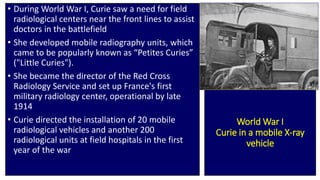
World War I 
Curie in a mobile X-ray 
vehicle 
• During World War I, Curie saw a need for field 
radiological centers near the front lines to assist 
doctors in the battlefield 
• She developed mobile radiography units, which 
came to be popularly known as “Petites Curies” 
("Little Curies"). 
• She became the director of the Red Cross 
Radiology Service and set up France's first 
military radiology center, operational by late 
1914 
• Curie directed the installation of 20 mobile 
radiological vehicles and another 200 
radiological units at field hospitals in the first 
year of the war
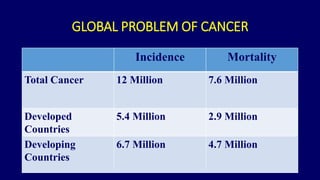
GLOBAL PROBLEM OF CANCER 
Incidence Mortality 
Total Cancer 12 Million 7.6 Million 
Developed 
Countries 
5.4 Million 2.9 Million 
Developing 
Countries 
6.7 Million 4.7 Million
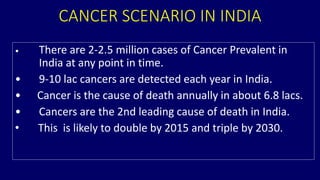
CANCER SCENARIO IN INDIA 
• There are 2-2.5 million cases of Cancer Prevalent in 
India at any point in time. 
• 9-10 lac cancers are detected each year in India. 
• Cancer is the cause of death annually in about 6.8 lacs. 
• Cancers are the 2nd leading cause of death in India. 
• This is likely to double by 2015 and triple by 2030.
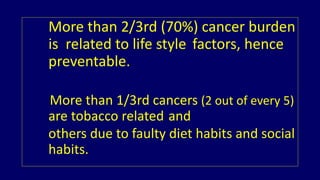
More than 2/3rd (70%) cancer burden 
is related to life style factors, hence 
preventable. 
More than 1/3rd cancers (2 out of every 5) 
are tobacco related and 
others due to faulty diet habits and social 
habits.
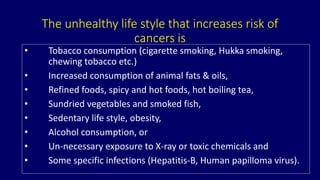
The unhealthy life style that increases risk of 
cancers is 
• Tobacco consumption (cigarette smoking, Hukka smoking, 
chewing tobacco etc.) 
• Increased consumption of animal fats & oils, 
• Refined foods, spicy and hot foods, hot boiling tea, 
• Sundried vegetables and smoked fish, 
• Sedentary life style, obesity, 
• Alcohol consumption, or 
• Un-necessary exposure to X-ray or toxic chemicals and 
• Some specific infections (Hepatitis-B, Human papilloma virus).
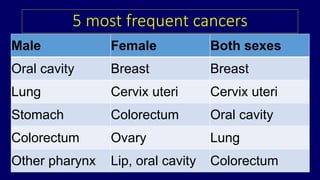
5 most frequent cancers 
Male Female Both sexes 
Oral cavity Breast Breast 
Lung Cervix uteri Cervix uteri 
Stomach Colorectum Oral cavity 
Colorectum Ovary Lung 
Other pharynx Lip, oral cavity Colorectum
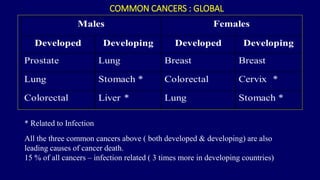
COMMON CANCERS : GLOBAL 
* Related to Infection 
All the three common cancers above ( both developed & developing) are also 
leading causes of cancer death. 
15 % of all cancers – infection related ( 3 times more in developing countries)
GLOBOCAN - 2012
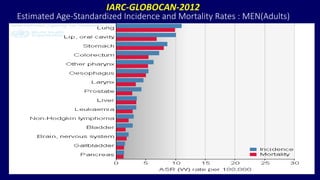
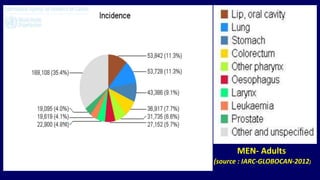
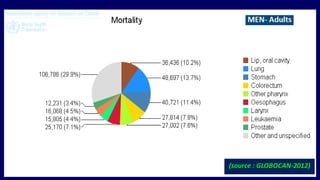
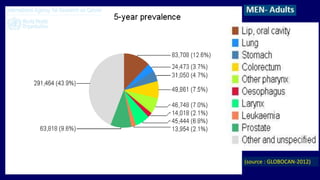
Estimated Age-Standardized Incidence and Mortality Rates : MEN(Adults)
MEN- Adults 
(source : IARC-GLOBOCAN-2012)
(source : GLOBOCAN-2012)
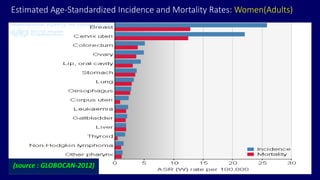
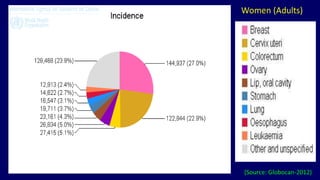
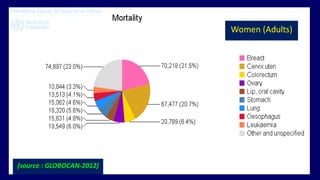
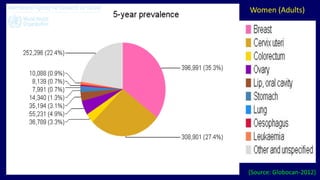
Estimated Age-Standardized Incidence and Mortality Rates: Women(Adults)
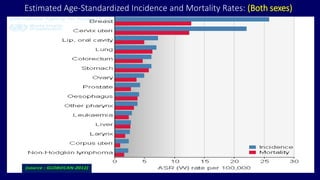
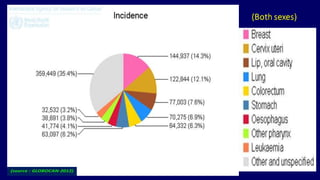
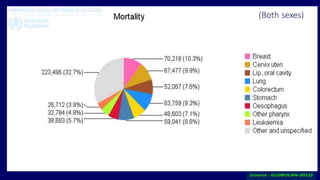
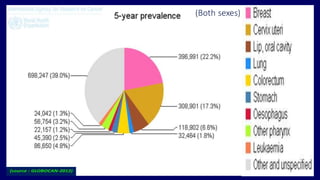
Estimated Age-Standardized Incidence and Mortality Rates: (Both sexes)
Summary statistics (2012)-INDIA 
Male Female Both sexes 
Population (thousands) 649474 608876 1258350 
Number of new cancer cases (thousands) 477.5 537.5 1014.9 
Age-Standardized Rate (W) 92.4 97.4 94.0 
Number of cancer deaths (thousands) 356.7 326.1 682.8 
Age-standardized rate (W) 69.7 60.2 64.5 
Risk of getting cancer before age 75 (%) 10.2 10.1 10.1 
Risk of dying from cancer [before age 75 (%)] 7.8 6.5 7.1
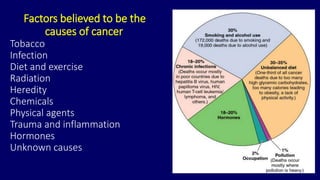
Factors believed to be the 
causes of cancer 
Tobacco 
Infection 
Diet and exercise 
Radiation 
Heredity 
Chemicals 
Physical agents 
Trauma and inflammation 
Hormones 
Unknown causes
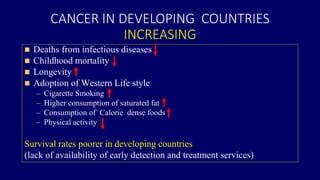
CANCER IN DEVELOPING COUNTRIES 
INCREASING 
 Deaths from infectious diseases 
 Childhood mortality 
 Longevity 
 Adoption of Western Life style 
– Cigarette Smoking 
– Higher consumption of saturated fat 
– Consumption of Calorie dense foods 
– Physical activity 
Survival rates poorer in developing countries 
(lack of availability of early detection and treatment services)
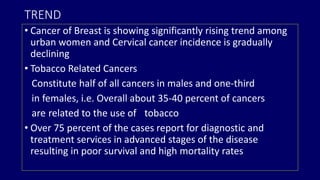
TREND 
• Cancer of Breast is showing significantly rising trend among 
urban women and Cervical cancer incidence is gradually 
declining 
• Tobacco Related Cancers 
Constitute half of all cancers in males and one-third 
in females, i.e. Overall about 35-40 percent of cancers 
are related to the use of tobacco 
• Over 75 percent of the cases report for diagnostic and 
treatment services in advanced stages of the disease 
resulting in poor survival and high mortality rates
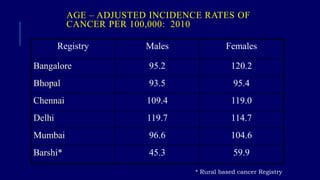
AGE – ADJUSTED INCIDENCE RATES OF 
CANCER PER 100,000: 2010 
Registry Males Females 
Bangalore 95.2 120.2 
Bhopal 93.5 95.4 
Chennai 109.4 119.0 
Delhi 119.7 114.7 
Mumbai 96.6 104.6 
Barshi* 45.3 59.9 
* Rural based cancer Registry
CANCER PREVENTION 
2/3 of all cancers may be prevented by 
•Avoiding tobacco 
•Avoiding/limiting alcohol Consumption 
• Eating adequate fruits and vegetables daily 
• Choosing healthy food 
• Eating a low fat diet 
• Regular exercising 
• Maintaining healthy weight throughout life 
• Knowing family history of cancer 
• Limiting exposure sun/radiation
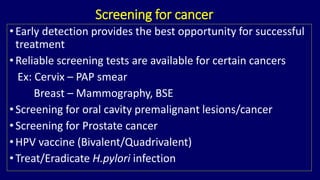
Screening for cancer 
• Early detection provides the best opportunity for successful 
treatment 
• Reliable screening tests are available for certain cancers 
Ex: Cervix – PAP smear 
Breast – Mammography, BSE 
• Screening for oral cavity premalignant lesions/cancer 
• Screening for Prostate cancer 
• HPV vaccine (Bivalent/Quadrivalent) 
• Treat/Eradicate H.pylori infection
Healthy life choices Early Detection Treatment for ALL Quality of Life 
IT’S NOT BEYOND US

Cancerday 7th nov

  • 1.
    NATIONAL CANCER AWARENESSDAY 7TH NOVEMBER 2014
  • 2.
    •Cancer is currentlythe cause of 12% of all deaths •It is increasing •Potential causes: • Increasing elderly population •Decrease in deaths from communicable diseases • Increasing incidence in certain cancers like lung cancer, breast cancer
  • 3.
    Impact of cancer Diagnosis of cancer is perceived by many as “Life- threatening” 1/3 rd face anxiety and depression Family’s daily functioning is affected Loss of income/ expenses
  • 4.
    National Cancer ControlProgram (NCCP) •Initiated in 1984 •Four major goals •Primary prevention of tobacco related cancers •Early detection of cancers of accessible sites •Augmentation of treatment facilities •Establishment of palliative care network
  • 5.
    4th February isobserved as World Cancer awareness day 7th November is observed as National Cancer Awareness Day
  • 6.
    T • Workedin both Physics and Chemistry • Conducted pioneering research on theory of radioactivity (a term that she coined), • Techniques for isolating radioactive isotopes, • The discovery of two elements, polonium and radium • Curie died in 1934 at the sanatorium of Sancellemoz (Haute-Savoie), France, due to aplastic anemia brought on by exposure to radiation .
  • 7.
    • First womanto win the Nobel Prize • First person and the only woman to win it twice in • Different sciences •Part of Curie family legacy of 5 Nobel prizes •1903 – Shared the Nobel prize with Pierre Curie and Henri Becquerel for Physics •1911 – Won the Nobel prize in Chemistry •1936 - Irene & Joliet won the Nobel prize in Chemistry
  • 8.
    •Under her directionthe world's first studies were conducted into the treatment of neoplasms, using radioactive isotopes. •She also defined an international standard for radioactive emissions that was eventually named for her and Pierre: the “curie” •She founded the Curie Institutes in Paris and in Warsaw, which remain major centers of medical research today.
  • 9.
    World War I Curie in a mobile X-ray vehicle • During World War I, Curie saw a need for field radiological centers near the front lines to assist doctors in the battlefield • She developed mobile radiography units, which came to be popularly known as “Petites Curies” ("Little Curies"). • She became the director of the Red Cross Radiology Service and set up France's first military radiology center, operational by late 1914 • Curie directed the installation of 20 mobile radiological vehicles and another 200 radiological units at field hospitals in the first year of the war
  • 10.
    GLOBAL PROBLEM OFCANCER Incidence Mortality Total Cancer 12 Million 7.6 Million Developed Countries 5.4 Million 2.9 Million Developing Countries 6.7 Million 4.7 Million
  • 11.
    CANCER SCENARIO ININDIA • There are 2-2.5 million cases of Cancer Prevalent in India at any point in time. • 9-10 lac cancers are detected each year in India. • Cancer is the cause of death annually in about 6.8 lacs. • Cancers are the 2nd leading cause of death in India. • This is likely to double by 2015 and triple by 2030.
  • 12.
    More than 2/3rd(70%) cancer burden is related to life style factors, hence preventable. More than 1/3rd cancers (2 out of every 5) are tobacco related and others due to faulty diet habits and social habits.
  • 13.
    The unhealthy lifestyle that increases risk of cancers is • Tobacco consumption (cigarette smoking, Hukka smoking, chewing tobacco etc.) • Increased consumption of animal fats & oils, • Refined foods, spicy and hot foods, hot boiling tea, • Sundried vegetables and smoked fish, • Sedentary life style, obesity, • Alcohol consumption, or • Un-necessary exposure to X-ray or toxic chemicals and • Some specific infections (Hepatitis-B, Human papilloma virus).
  • 14.
    5 most frequentcancers Male Female Both sexes Oral cavity Breast Breast Lung Cervix uteri Cervix uteri Stomach Colorectum Oral cavity Colorectum Ovary Lung Other pharynx Lip, oral cavity Colorectum
  • 15.
    COMMON CANCERS :GLOBAL * Related to Infection All the three common cancers above ( both developed & developing) are also leading causes of cancer death. 15 % of all cancers – infection related ( 3 times more in developing countries)
  • 16.
  • 17.
    Estimated Age-Standardized Incidenceand Mortality Rates : MEN(Adults)
  • 18.
    MEN- Adults (source: IARC-GLOBOCAN-2012)
  • 20.
  • 21.
    Estimated Age-Standardized Incidenceand Mortality Rates: Women(Adults)
  • 25.
    Estimated Age-Standardized Incidenceand Mortality Rates: (Both sexes)
  • 29.
    Summary statistics (2012)-INDIA Male Female Both sexes Population (thousands) 649474 608876 1258350 Number of new cancer cases (thousands) 477.5 537.5 1014.9 Age-Standardized Rate (W) 92.4 97.4 94.0 Number of cancer deaths (thousands) 356.7 326.1 682.8 Age-standardized rate (W) 69.7 60.2 64.5 Risk of getting cancer before age 75 (%) 10.2 10.1 10.1 Risk of dying from cancer [before age 75 (%)] 7.8 6.5 7.1
  • 30.
    Factors believed tobe the causes of cancer Tobacco Infection Diet and exercise Radiation Heredity Chemicals Physical agents Trauma and inflammation Hormones Unknown causes
  • 31.
    CANCER IN DEVELOPINGCOUNTRIES INCREASING  Deaths from infectious diseases  Childhood mortality  Longevity  Adoption of Western Life style – Cigarette Smoking – Higher consumption of saturated fat – Consumption of Calorie dense foods – Physical activity Survival rates poorer in developing countries (lack of availability of early detection and treatment services)
  • 32.
    TREND • Cancerof Breast is showing significantly rising trend among urban women and Cervical cancer incidence is gradually declining • Tobacco Related Cancers Constitute half of all cancers in males and one-third in females, i.e. Overall about 35-40 percent of cancers are related to the use of tobacco • Over 75 percent of the cases report for diagnostic and treatment services in advanced stages of the disease resulting in poor survival and high mortality rates
  • 33.
    AGE – ADJUSTEDINCIDENCE RATES OF CANCER PER 100,000: 2010 Registry Males Females Bangalore 95.2 120.2 Bhopal 93.5 95.4 Chennai 109.4 119.0 Delhi 119.7 114.7 Mumbai 96.6 104.6 Barshi* 45.3 59.9 * Rural based cancer Registry
  • 34.
    CANCER PREVENTION 2/3of all cancers may be prevented by •Avoiding tobacco •Avoiding/limiting alcohol Consumption • Eating adequate fruits and vegetables daily • Choosing healthy food • Eating a low fat diet • Regular exercising • Maintaining healthy weight throughout life • Knowing family history of cancer • Limiting exposure sun/radiation
  • 36.
    Screening for cancer • Early detection provides the best opportunity for successful treatment • Reliable screening tests are available for certain cancers Ex: Cervix – PAP smear Breast – Mammography, BSE • Screening for oral cavity premalignant lesions/cancer • Screening for Prostate cancer • HPV vaccine (Bivalent/Quadrivalent) • Treat/Eradicate H.pylori infection
  • 37.
    Healthy life choicesEarly Detection Treatment for ALL Quality of Life IT’S NOT BEYOND US