Diversity  techniques for mobile wireless radio systems Diversity @  Dictionary  “ the presence of a wide range of variation ,  Including everyone”.   AJAL.A.J  Assistant Professor , ECE DEPARTMENT MET’S SCHOOL OF ENGINEERING - MALA BY SLIDES SHARED ON
 
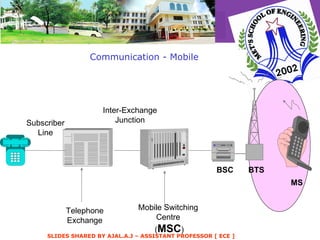
Communication - Mobile Telephone Exchange Subscriber Line Inter-Exchange Junction Mobile Switching Centre ( MSC ) BSC BTS MS
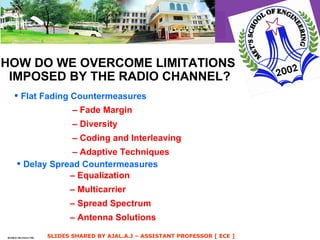
HOW DO WE OVERCOME LIMITATIONS  IMPOSED BY THE RADIO CHANNEL? •  Flat Fading Countermeasures  –  Fade Margin –  Diversity –  Coding and Interleaving –  Adaptive Techniques •  Delay Spread Countermeasures  –  Equalization –  Multicarrier –  Spread Spectrum –  Antenna Solutions  8C32810.104-Cimini-7/98
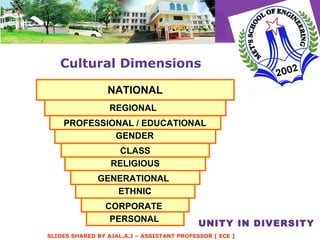
Cultural Dimensions UNITY IN DIVERSITY PERSONAL CORPORATE ETHNIC GENERATIONAL RELIGIOUS CLASS GENDER REGIONAL  NATIONAL PROFESSIONAL / EDUCATIONAL
What is Diversity? Diversity  may refer to: Multiculturalism ,  the ideology of including people of diverse cultural and religious backgrounds  Diversity (politics),  the political and social policy of encouraging tolerance for people of different backgrounds  Diversity (business),  the business tactic which encourages diversity to better serve a heterogeneous customer base  Diversity training , the process of educating employees, students or volunteers to function in a diverse environment  Biodiversity,  the variation of life forms within a given ecosystem  Diversity scheme , a method for improving the reliability of a message signal by using multiple communications channels
DIVERSITY as far as  mobile wireless radio systems are concerned   !
Common assumption: Common assumption:  signals that scatter off of different objects fade independently
How / when  diversity is created ? Diversity is created when these signals are separated in the receiver Examples: RAKE receiver - - separates paths by delay  [PATH DIVERSITY] Multi beam antenna - - separates paths by angle [ANGLE DIVERSITY]
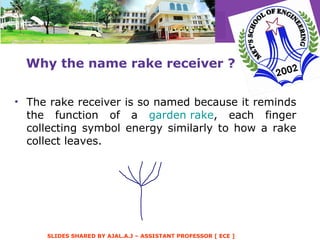
Why the name rake receiver ? The rake receiver is so named because it reminds the function of a  garden rake , each finger collecting symbol energy similarly to how a rake collect leaves.
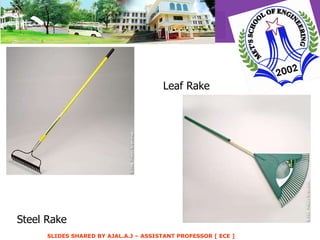
Steel Rake Leaf Rake
SNOW RAKE
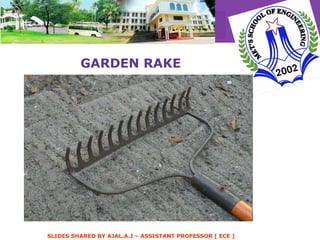
GARDEN RAKE
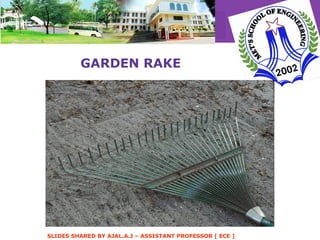
GARDEN RAKE
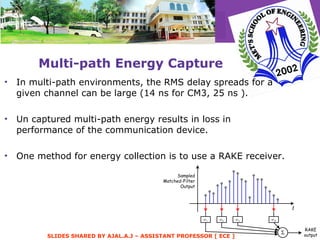
Multi-path Energy Capture In multi-path environments, the RMS delay spreads for a given channel can be large (14 ns for CM3, 25 ns ). Un captured multi-path energy results in loss in performance of the communication device. One method for energy collection is to use a RAKE receiver.
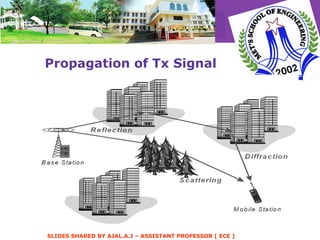
Propagation of Tx Signal
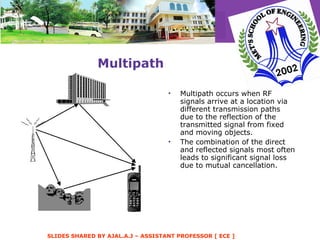
Multipath Multipath occurs when RF signals arrive at a location via different transmission paths due to the reflection of the transmitted signal from fixed and moving objects. The combination of the direct and reflected signals most often leads to significant signal loss due to mutual cancellation.
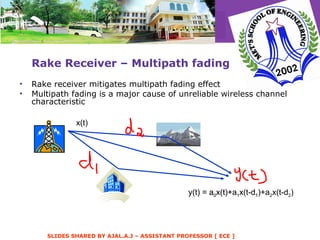
Rake Receiver – Multipath fading Rake receiver mitigates multipath fading effect Multipath fading is a major cause of unreliable wireless channel characteristic x(t) y(t) = a 0 x(t) y(t) = a 0 x(t)+a 1 x(t-d 1 ) y(t) = a 0 x(t)+a 1 x(t-d 1 )+a 2 x(t-d 2 )
RAKE Receiver: Basic Idea The RAKE receiver was designed to equalize the effects of multipath. It uses a combination of correlators, code generators, and delays, or “fingers”, to spread out the individual echo signals of the multipath. Each signal is then delayed according to peaks found in the received signal.
Overview of  Rake Receiver   A rake receiver is a radio receiver designed to counter the effects of multipath fading. It does this by using several  "sub-receivers"  each delayed slightly in order to tune in to the individual multipath components.  Each component is decoded independently, but at a later stage combined in order to make the most use of the different transmission characteristics of each transmission path.  This could very well result in higher SNR (or Eb/No) in a multipath environment than in a "clean" environment
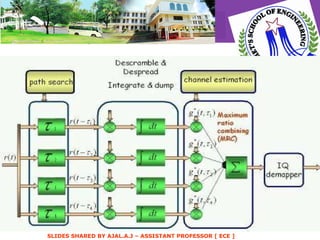
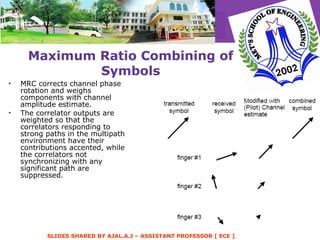
RAKE Receiver Continued The same symbols obtained via different paths are then combined together using the corresponding channel information using a combining scheme like maximum ratio combining (MRC). The combined outputs are then sent to a simple decision device to decide on the transmitted bits.
RAKE Receiver Block Diagram
Maximum Ratio Combining of Symbols MRC corrects channel phase rotation and weighs components with channel amplitude estimate. The correlator outputs are weighted so that the correlators responding to strong paths in the multipath environment have their contributions accented, while the correlators not synchronizing with any significant path are suppressed.
End Result of RAKE Receiver By simulating a multipath environment through a parallel combination of correlators and delays, the output behaves as if there existed a single propogation path between the transmitter and receiver.
Another ways to create diversity: ?
Another way to create diversity:  change the relative phases of the multi path signals Examples: Identical antennas, slightly different locations [ SPACE DIVERSITY ] Same signal received on different RF carriers [ FREQUENCY DIVERSITY ].  Required carrier separation depends inversely on delay spread
Still other ways to generate diversity: Dual polarized antennas [ POLARIZATION DIVERSITY ]
Fading VS  Diversity Fading Signal fluctuations caused by multipath propagation and shadowing effects . Diversity Receiving the same information bearing signal over 2 or more fading channels.
Introduction  (cont’d) Space Transmission using multiple transmit/receive antennas. Frequency Transmission using multiple frequency channels separated by at least the coherence bandwidth. Time  Transmission using multiple time slots separated by at least the coherence time.
Spatial diversity Single-input, single-output (SISO) channel No spatial diversity Single-input, multiple-output (SIMO) channel Receive diversity Multiple-input, single-output (MISO) channel  Transmit diversity  Multiple-input, multiple-output (MIMO) channel Combined transmit and receive diversity
The following classes of diversity schemes can be identified:  Space diversity  Polarization diversity   Frequency diversity   Time diversity   Angle or direction diversity
1] Space diversity The signal is transferred over several different propagation paths. In the case of wired transmission, this can be achieved by transmitting via multiple wires.  In the case of wireless transmission, it can be achieved by antenna diversity using multiple transmitter antennas (transmit diversity) and/or multiple receiving antennas (reception diversity).  In the latter case, a diversity combining technique is applied before further signal processing takes place.
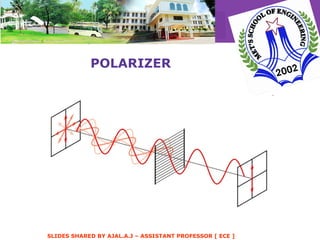
2] Polarization diversity Polarization diversity : Multiple versions of a signal are transmitted and received via antennas with different polarization.  A diversity combining technique is applied on the receiver side.
POLARIZER
3] Frequency diversity Frequency diversity: The signal is transferred using several frequency channels or spread over a wide spectrum that is affected by frequency-selective fading. Middle-late 20th century microwave radio relay lines often used several regular wideband radio channels, and one protection channel for automatic use by any faded channel. Later examples include:  OFDM modulation in combination with subcarrier interleaving and forward error correction  Spread spectrum, for example frequency hopping or DS-CDMA.
4]  Time diversity Time diversity : Multiple versions of the same signal are transmitted at different time instants.
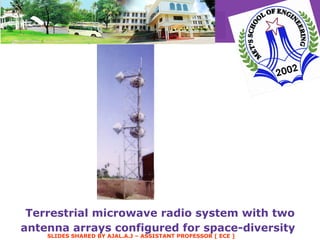
Terrestrial microwave radio system with two antenna arrays configured for space-diversity
Diversity Combining Once you have created two or more diversity channels, what do you do with them?
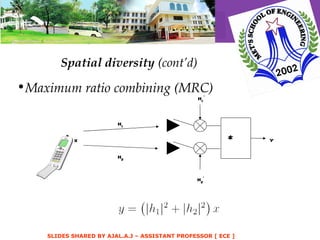
Spatial diversity  (cont’d)   Maximum ratio combining (MRC) h 1 h 2 h 1 * h 2 *  y x
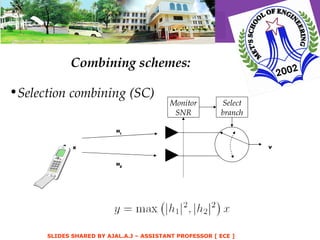
Combining schemes: Selection combining (SC) h 1 h 2 y x Monitor SNR Select branch
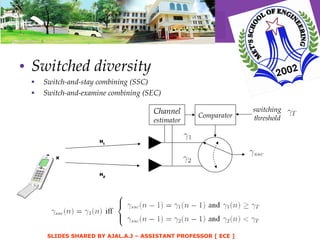
Switched diversity Switch-and-stay combining (SSC) Switch-and-examine combining (SEC) h 1 h 2 x Comparator Channel estimator switching threshold
Without excessively increasing 1. transmitting power 2. Co-channel reuse distance One of the most effective technique to solve this issue is  diversity reception technique
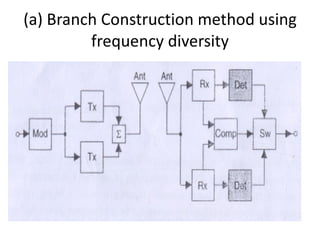
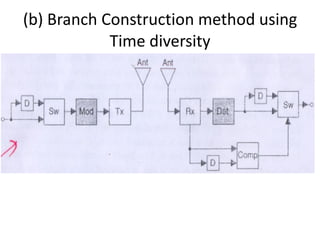
What are all the needs of diversity techniques?? 1.No. of signal transmission paths 2.A circuit to combine the received signal or select one of them
CONCEPTS OF DIVERSITY BRANCH AND SIGNAL PATH
(a) Branch Construction method using frequency diversity
(b) Branch Construction method using Time diversity
COMBINING AND SWITCHNING METHODS
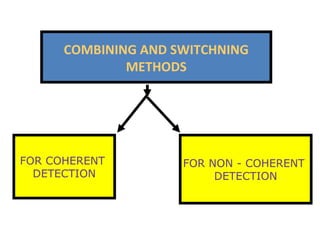
COMBINING AND SWITCHNING METHODS FOR COHERENT  DETECTION FOR NON - COHERENT  DETECTION
FOR COHERENT  DETECTION There is no difference whether the combining is carried out in the pre detection or in the post detection stage FOR NON-COHERENT  DETECTION There is a difference in performance exists between whether pre detection & post detection combining methods
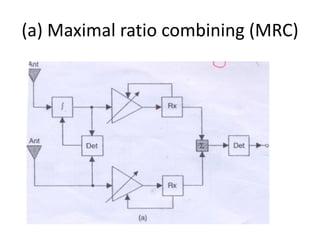
(a) Maximal ratio combining (MRC)
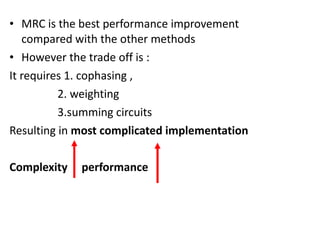
MRC is the best performance improvement compared with the other methods However the trade off is : It requires 1. cophasing ,  2. weighting  3.summing circuits Resulting in  most complicated implementation Complexity  performance
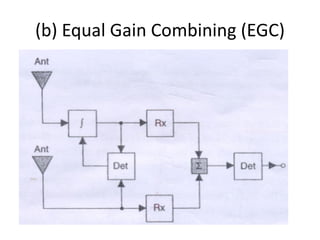
(b) Equal Gain Combining (EGC)
EGC is similar to MRC, except the weighting circuits are omitted The performance improvement obtained by equal gain combiner is slightly inferior to that of a MRC , since the interference and noise corrupted signal combined with high quality signals
For VHF, UHF and microwave wireless radio applications Both MRC and EGC methods are unsuitable Compared with MRC, EGC methods, the  selection method  is more suitable for mobile radio applications, because of its simple implementation
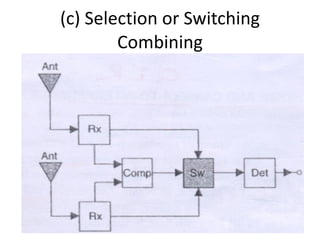
(c) Selection or Switching Combining
The diversity branch having the highest signal level (or) lowest P e  is selected  Also, in addition, stable operation is easily achieved , even in the fast multipath fading environments But the performance improvement obtained by the selection method is still only slightly inferior to that of MRC method
Disadvantage of Selection or Switching Combining:  The continuous monitoring of the signals requires the same no. of receivers as the no. of diversity branches This redundancy can be alleviated by the use of  switching or scanning receiver
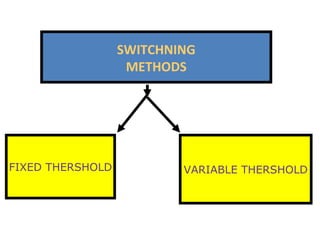
SWITCHNING METHODS FIXED THERSHOLD VARIABLE THERSHOLD
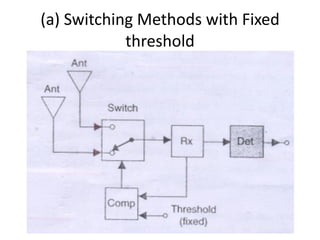
(a) Switching Methods with Fixed threshold
The switching from one branch to the other occurs when the signal level falls below a threshold value The threshold value is fixed However this threshold value is not necessarily the best over the entire service area FIXED THERSHOLD
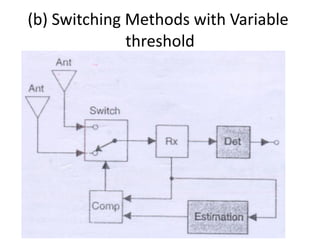
(b) Switching Methods with Variable  threshold
Here the threshold value is adjusted dynamically as the vehicle moves It includes the feedback using Estimation But it may introduce the envelope and phase transients that will reduce the performance improvement VARIABLE THERSHOLD
Conclusions   The diversity is used to provide the receiver with several replicas of the same signal Diversity techniques are used to improve the performance of the radio channel without any increase in the transmitted power As higher as the received signal replicas are decorrelated, as much as the diversity gain
Thank you for you patient attention Mail:  [email_address]

RADIATION & PROPAGATION - diversity

  • 1.
    Diversity techniquesfor mobile wireless radio systems Diversity @ Dictionary “ the presence of a wide range of variation , Including everyone”. AJAL.A.J Assistant Professor , ECE DEPARTMENT MET’S SCHOOL OF ENGINEERING - MALA BY SLIDES SHARED ON
  • 2.
  • 3.
    Communication - MobileTelephone Exchange Subscriber Line Inter-Exchange Junction Mobile Switching Centre ( MSC ) BSC BTS MS
  • 4.
    HOW DO WEOVERCOME LIMITATIONS IMPOSED BY THE RADIO CHANNEL? • Flat Fading Countermeasures – Fade Margin – Diversity – Coding and Interleaving – Adaptive Techniques • Delay Spread Countermeasures – Equalization – Multicarrier – Spread Spectrum – Antenna Solutions 8C32810.104-Cimini-7/98
  • 5.
    Cultural Dimensions UNITYIN DIVERSITY PERSONAL CORPORATE ETHNIC GENERATIONAL RELIGIOUS CLASS GENDER REGIONAL NATIONAL PROFESSIONAL / EDUCATIONAL
  • 6.
    What is Diversity?Diversity may refer to: Multiculturalism , the ideology of including people of diverse cultural and religious backgrounds Diversity (politics), the political and social policy of encouraging tolerance for people of different backgrounds Diversity (business), the business tactic which encourages diversity to better serve a heterogeneous customer base Diversity training , the process of educating employees, students or volunteers to function in a diverse environment Biodiversity, the variation of life forms within a given ecosystem Diversity scheme , a method for improving the reliability of a message signal by using multiple communications channels
  • 7.
    DIVERSITY as faras mobile wireless radio systems are concerned !
  • 8.
    Common assumption: Commonassumption: signals that scatter off of different objects fade independently
  • 9.
    How / when diversity is created ? Diversity is created when these signals are separated in the receiver Examples: RAKE receiver - - separates paths by delay [PATH DIVERSITY] Multi beam antenna - - separates paths by angle [ANGLE DIVERSITY]
  • 10.
    Why the namerake receiver ? The rake receiver is so named because it reminds the function of a garden rake , each finger collecting symbol energy similarly to how a rake collect leaves.
  • 11.
  • 12.
  • 13.
  • 14.
  • 15.
    Multi-path Energy CaptureIn multi-path environments, the RMS delay spreads for a given channel can be large (14 ns for CM3, 25 ns ). Un captured multi-path energy results in loss in performance of the communication device. One method for energy collection is to use a RAKE receiver.
  • 16.
  • 17.
    Multipath Multipath occurswhen RF signals arrive at a location via different transmission paths due to the reflection of the transmitted signal from fixed and moving objects. The combination of the direct and reflected signals most often leads to significant signal loss due to mutual cancellation.
  • 18.
    Rake Receiver –Multipath fading Rake receiver mitigates multipath fading effect Multipath fading is a major cause of unreliable wireless channel characteristic x(t) y(t) = a 0 x(t) y(t) = a 0 x(t)+a 1 x(t-d 1 ) y(t) = a 0 x(t)+a 1 x(t-d 1 )+a 2 x(t-d 2 )
  • 19.
    RAKE Receiver: BasicIdea The RAKE receiver was designed to equalize the effects of multipath. It uses a combination of correlators, code generators, and delays, or “fingers”, to spread out the individual echo signals of the multipath. Each signal is then delayed according to peaks found in the received signal.
  • 20.
    Overview of Rake Receiver A rake receiver is a radio receiver designed to counter the effects of multipath fading. It does this by using several "sub-receivers" each delayed slightly in order to tune in to the individual multipath components. Each component is decoded independently, but at a later stage combined in order to make the most use of the different transmission characteristics of each transmission path. This could very well result in higher SNR (or Eb/No) in a multipath environment than in a "clean" environment
  • 21.
    RAKE Receiver ContinuedThe same symbols obtained via different paths are then combined together using the corresponding channel information using a combining scheme like maximum ratio combining (MRC). The combined outputs are then sent to a simple decision device to decide on the transmitted bits.
  • 22.
  • 23.
    Maximum Ratio Combiningof Symbols MRC corrects channel phase rotation and weighs components with channel amplitude estimate. The correlator outputs are weighted so that the correlators responding to strong paths in the multipath environment have their contributions accented, while the correlators not synchronizing with any significant path are suppressed.
  • 24.
    End Result ofRAKE Receiver By simulating a multipath environment through a parallel combination of correlators and delays, the output behaves as if there existed a single propogation path between the transmitter and receiver.
  • 25.
    Another ways tocreate diversity: ?
  • 26.
    Another way tocreate diversity: change the relative phases of the multi path signals Examples: Identical antennas, slightly different locations [ SPACE DIVERSITY ] Same signal received on different RF carriers [ FREQUENCY DIVERSITY ]. Required carrier separation depends inversely on delay spread
  • 27.
    Still other waysto generate diversity: Dual polarized antennas [ POLARIZATION DIVERSITY ]
  • 28.
    Fading VS Diversity Fading Signal fluctuations caused by multipath propagation and shadowing effects . Diversity Receiving the same information bearing signal over 2 or more fading channels.
  • 29.
    Introduction (cont’d)Space Transmission using multiple transmit/receive antennas. Frequency Transmission using multiple frequency channels separated by at least the coherence bandwidth. Time Transmission using multiple time slots separated by at least the coherence time.
  • 30.
    Spatial diversity Single-input,single-output (SISO) channel No spatial diversity Single-input, multiple-output (SIMO) channel Receive diversity Multiple-input, single-output (MISO) channel Transmit diversity Multiple-input, multiple-output (MIMO) channel Combined transmit and receive diversity
  • 31.
    The following classesof diversity schemes can be identified: Space diversity Polarization diversity Frequency diversity Time diversity Angle or direction diversity
  • 32.
    1] Space diversityThe signal is transferred over several different propagation paths. In the case of wired transmission, this can be achieved by transmitting via multiple wires. In the case of wireless transmission, it can be achieved by antenna diversity using multiple transmitter antennas (transmit diversity) and/or multiple receiving antennas (reception diversity). In the latter case, a diversity combining technique is applied before further signal processing takes place.
  • 33.
    2] Polarization diversityPolarization diversity : Multiple versions of a signal are transmitted and received via antennas with different polarization. A diversity combining technique is applied on the receiver side.
  • 34.
  • 35.
    3] Frequency diversityFrequency diversity: The signal is transferred using several frequency channels or spread over a wide spectrum that is affected by frequency-selective fading. Middle-late 20th century microwave radio relay lines often used several regular wideband radio channels, and one protection channel for automatic use by any faded channel. Later examples include: OFDM modulation in combination with subcarrier interleaving and forward error correction Spread spectrum, for example frequency hopping or DS-CDMA.
  • 36.
    4] Timediversity Time diversity : Multiple versions of the same signal are transmitted at different time instants.
  • 37.
    Terrestrial microwave radiosystem with two antenna arrays configured for space-diversity
  • 38.
    Diversity Combining Onceyou have created two or more diversity channels, what do you do with them?
  • 39.
    Spatial diversity (cont’d) Maximum ratio combining (MRC) h 1 h 2 h 1 * h 2 *  y x
  • 40.
    Combining schemes: Selectioncombining (SC) h 1 h 2 y x Monitor SNR Select branch
  • 41.
    Switched diversity Switch-and-staycombining (SSC) Switch-and-examine combining (SEC) h 1 h 2 x Comparator Channel estimator switching threshold
  • 42.
    Without excessively increasing1. transmitting power 2. Co-channel reuse distance One of the most effective technique to solve this issue is diversity reception technique
  • 43.
    What are allthe needs of diversity techniques?? 1.No. of signal transmission paths 2.A circuit to combine the received signal or select one of them
  • 44.
    CONCEPTS OF DIVERSITYBRANCH AND SIGNAL PATH
  • 45.
    (a) Branch Constructionmethod using frequency diversity
  • 46.
    (b) Branch Constructionmethod using Time diversity
  • 47.
  • 48.
    COMBINING AND SWITCHNINGMETHODS FOR COHERENT DETECTION FOR NON - COHERENT DETECTION
  • 49.
    FOR COHERENT DETECTION There is no difference whether the combining is carried out in the pre detection or in the post detection stage FOR NON-COHERENT DETECTION There is a difference in performance exists between whether pre detection & post detection combining methods
  • 50.
    (a) Maximal ratiocombining (MRC)
  • 51.
    MRC is thebest performance improvement compared with the other methods However the trade off is : It requires 1. cophasing , 2. weighting 3.summing circuits Resulting in most complicated implementation Complexity performance
  • 52.
    (b) Equal GainCombining (EGC)
  • 53.
    EGC is similarto MRC, except the weighting circuits are omitted The performance improvement obtained by equal gain combiner is slightly inferior to that of a MRC , since the interference and noise corrupted signal combined with high quality signals
  • 54.
    For VHF, UHFand microwave wireless radio applications Both MRC and EGC methods are unsuitable Compared with MRC, EGC methods, the selection method is more suitable for mobile radio applications, because of its simple implementation
  • 55.
    (c) Selection orSwitching Combining
  • 56.
    The diversity branchhaving the highest signal level (or) lowest P e is selected Also, in addition, stable operation is easily achieved , even in the fast multipath fading environments But the performance improvement obtained by the selection method is still only slightly inferior to that of MRC method
  • 57.
    Disadvantage of Selectionor Switching Combining: The continuous monitoring of the signals requires the same no. of receivers as the no. of diversity branches This redundancy can be alleviated by the use of switching or scanning receiver
  • 58.
    SWITCHNING METHODS FIXEDTHERSHOLD VARIABLE THERSHOLD
  • 59.
    (a) Switching Methodswith Fixed threshold
  • 60.
    The switching fromone branch to the other occurs when the signal level falls below a threshold value The threshold value is fixed However this threshold value is not necessarily the best over the entire service area FIXED THERSHOLD
  • 61.
    (b) Switching Methodswith Variable threshold
  • 62.
    Here the thresholdvalue is adjusted dynamically as the vehicle moves It includes the feedback using Estimation But it may introduce the envelope and phase transients that will reduce the performance improvement VARIABLE THERSHOLD
  • 63.
    Conclusions The diversity is used to provide the receiver with several replicas of the same signal Diversity techniques are used to improve the performance of the radio channel without any increase in the transmitted power As higher as the received signal replicas are decorrelated, as much as the diversity gain
  • 64.
    Thank you foryou patient attention Mail: [email_address]