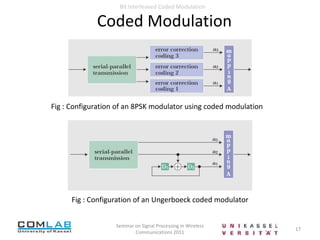
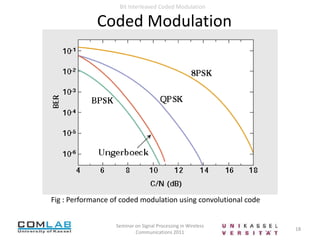
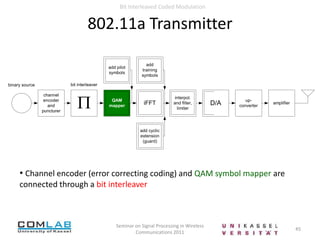
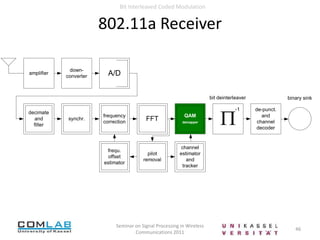
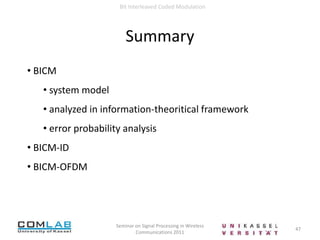
Bit Interleaved Coded Modulation1Seminar on Signal Processing in Wireless Communications 2011Bit Interleaved Coded ModulationMridula SharmaFebruary 28, 2011
2Seminar on Signal Processing in Wireless Communications 2011Bit Interleaved Coded ModulationOutline Introduction
 System Model: CM(Coded Modulation) and BICM (Bit Interleaved Coded Modulation)
Information-theoritical Framework and Results
Error Probability Analysis
BICM-ID
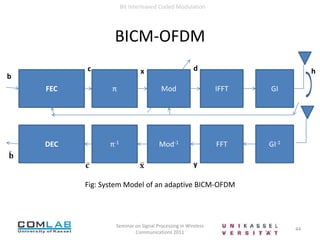
BICM-OFDM
Summary3Seminar on Signal Processing in Wireless Communications 2011Bit Interleaved Coded ModulationIntroduction 1982: Ungerboeck: landmark paper on Trellis Coded Modulation (TCM)
highly efficient transmission of information over band-limited channels such as telephone lines
  1992: Zehavi: performance of coded modulation over Rayleigh fading  channel can be improved
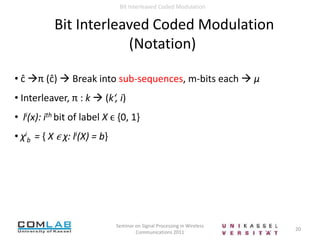
Bit-wise interleaving at the encoder output
Appropriate soft-decision metric as an input to Viterbi decoder
 Modulation + Coding: Single entity for improved performance
 Bit Interleaved Coded Modulation (BICM)
 1998: Caire: Information-theoritical view on BICM4Seminar on Signal Processing in Wireless Communications 2011Bit Interleaved Coded ModulationIntroductionWireless Fading Channels
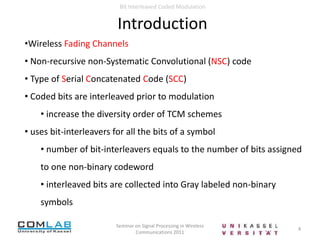
 Non-recursive non-Systematic Convolutional (NSC) code
Type of Serial Concatenated Code (SCC)
 Coded bits are interleaved prior to modulation
 increase the diversity order of TCM schemes
 uses bit-interleavers for all the bits of a symbol
 number of bit-interleavers equals to the number of bits assigned to one non-binary codeword
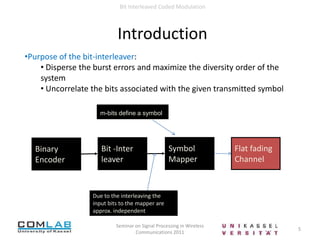
 interleaved bits are collected into Gray labeled non-binary symbols5Seminar on Signal Processing in Wireless Communications 2011Symbol MapperFlat fading ChannelBit -InterleaverBinary EncoderBit Interleaved Coded ModulationIntroductionPurpose of the bit-interleaver:
 Disperse the burst errors and maximize the diversity order of the system
Uncorrelate the bits associated with the given transmitted symbolm-bits define a symbolDue to the interleaving the input bits to the mapper are approx. independent
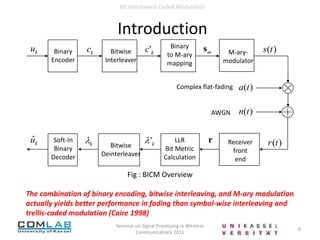
6Seminar on Signal Processing in Wireless Communications 2011Bit Interleaved Coded ModulationIntroductionBinaryto M-arymappingBinaryEncoderBitwiseInterleaverM-ary-modulatorComplex flat-fading AWGNSoft-InBinaryDecoderLLRBit MetricCalculationReceiverfrontendBitwiseDeinterleaverFig : BICM OverviewThe combination of binary encoding, bitwise interleaving, and M-ary modulationactually yields better performance in fading than symbol-wise interleaving andtrellis-coded modulation (Caire 1998)
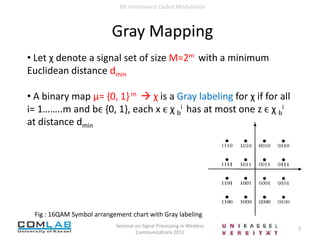
7Seminar on Signal Processing in Wireless Communications 2011Bit Interleaved Coded ModulationGray Mapping Let χ denote a signal set of size M=2m with a minimum Euclidean distance dmin
 A binary map µ= {0, 1} m  χis a Gray labeling for χ if for all i= 1……..m and bϵ {0, 1}, each x ϵχ bi  has at most one z ϵχ bi   at distance dminFig : 16QAM Symbol arrangement chart with Gray labeling
8Seminar on Signal Processing in Wireless Communications 2011Bit Interleaved Coded ModulationGray Mapping Key component of a BICM system
 Main Function: to produce an equivalent channel that has ʋ parallel, independent, memoryless binary channels
Each channel corresponds to a position in the label of a signal x ϵχ
For each codeword at the output of the binary encoder, the interleaver assigns at random a position in the label of the signals to transmit the coded bits9Seminar on Signal Processing in Wireless Communications 2011Bit Interleaved Coded ModulationSet Partitioning
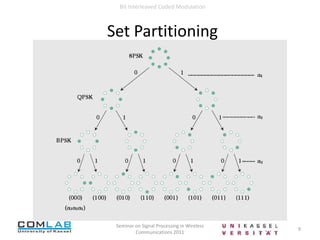
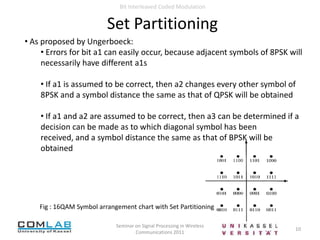
10Seminar on Signal Processing in Wireless Communications 2011Bit Interleaved Coded ModulationSet Partitioning As proposed by Ungerboeck:
 Errors for bit a1 can easily occur, because adjacent symbols of 8PSK will necessarily have different a1s
 If a1 is assumed to be correct, then a2 changes every other symbol of 8PSK and a symbol distance the same as that of QPSK will be obtained
 If a1 and a2 are assumed to be correct, then a3 can be determined if a decision can be made as to which diagonal symbol has been received, and a symbol distance the same as that of BPSK will be obtainedFig : 16QAM Symbol arrangement chart with Set Partitioning
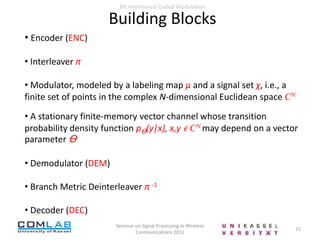
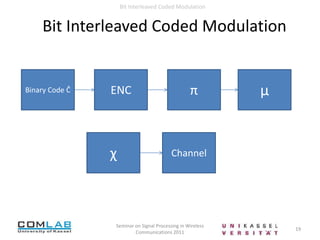
11Seminar on Signal Processing in Wireless Communications 2011Building BlocksBit Interleaved Coded ModulationEncoder (ENC)
 Interleaver π
 Modulator, modeled by a labeling map μand a signal set χ, i.e., a finite set of points in the complex N-dimensional Euclidean space CN
 A stationary finite-memory vector channel whose transition probability density function pƟ(y|x), x,y ϵCN may depend on a vector parameter Ɵ
 Demodulator (DEM)
 Branch Metric Deinterleaver π -1
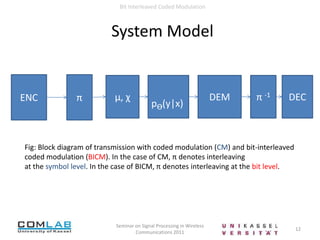
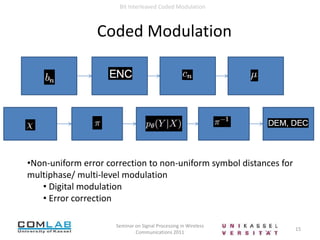
 Decoder (DEC)12Seminar on Signal Processing in Wireless Communications 2011Bit Interleaved Coded ModulationSystem ModelENCπµ, χ pƟ(y|x)DEMπ -1DECFig: Block diagram of transmission with coded modulation (CM) and bit-interleaved coded modulation (BICM). In the case of CM, πdenotes interleavingat the symbol level. In the case of BICM, π denotes interleaving at the bit level.
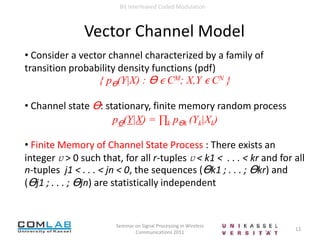
13Seminar on Signal Processing in Wireless Communications 2011Bit Interleaved Coded Modulation Vector Channel ModelConsider a vector channel characterized by a family of transition probability density functions (pdf) { pƟ(Y|X) : Ɵ ϵ CM; X,Y ϵ CN }Channel state Ɵ: stationary, finite memory random processpƟ(Y|X) = ∏k pƟk (Yk|Xk)Finite Memory of Channel State Process : There exists an integer ʋ> 0 such that, for all r-tuplesʋ < k1 <  . . . < krand for all n-tuplesj1 < . . . < jn < 0, the sequences (Ɵk1 ; . . . ; Ɵkr) and (Ɵj1 ; . . . ; Ɵjn) are statistically independent14Seminar on Signal Processing in Wireless Communications 2011Bit Interleaved Coded Modulation Vector Channel ModelLarge number of typical communication channels  can be represented
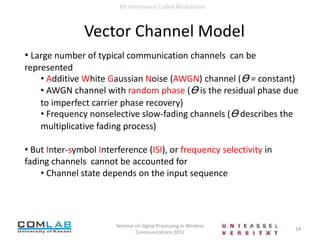
Additive White Gaussian Noise (AWGN) channel (Ɵ = constant)
 AWGN channel with random phase (Ɵ is the residual phase due to imperfect carrier phase recovery)
 Frequency nonselective slow-fading channels (Ɵ describes the multiplicative fading process)
 But Inter-symbol Interference (ISI), or frequency selectivity infading channels  cannot be accounted for  Channel state depends on the input sequence15Seminar on Signal Processing in Wireless Communications 2011Bit Interleaved Coded Modulation Coded ModulationNon-uniform error correction to non-uniform symbol distances for multiphase/ multi-level modulation
 Digital modulation
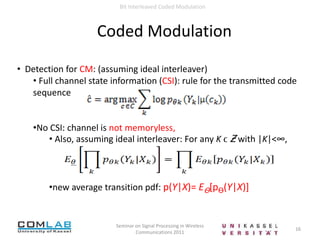
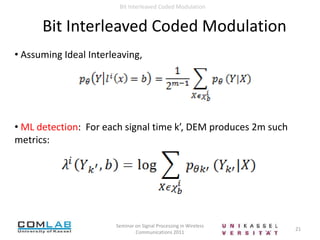
 Error correction16Seminar on Signal Processing in Wireless Communications 2011Bit Interleaved Coded Modulation Coded ModulationDetection for CM: (assuming ideal interleaver)

Bit interleaved coded modulation

  • 1.
    Bit Interleaved CodedModulation1Seminar on Signal Processing in Wireless Communications 2011Bit Interleaved Coded ModulationMridula SharmaFebruary 28, 2011
  • 2.
    2Seminar on SignalProcessing in Wireless Communications 2011Bit Interleaved Coded ModulationOutline Introduction
  • 3.
    System Model:CM(Coded Modulation) and BICM (Bit Interleaved Coded Modulation)
  • 4.
  • 5.
  • 6.
  • 7.
  • 8.
    Summary3Seminar on SignalProcessing in Wireless Communications 2011Bit Interleaved Coded ModulationIntroduction 1982: Ungerboeck: landmark paper on Trellis Coded Modulation (TCM)
  • 9.
    highly efficient transmissionof information over band-limited channels such as telephone lines
  • 10.
    1992:Zehavi: performance of coded modulation over Rayleigh fading channel can be improved
  • 11.
    Bit-wise interleaving atthe encoder output
  • 12.
    Appropriate soft-decision metricas an input to Viterbi decoder
  • 13.
    Modulation +Coding: Single entity for improved performance
  • 14.
    Bit InterleavedCoded Modulation (BICM)
  • 15.
    1998: Caire:Information-theoritical view on BICM4Seminar on Signal Processing in Wireless Communications 2011Bit Interleaved Coded ModulationIntroductionWireless Fading Channels
  • 16.
    Non-recursive non-SystematicConvolutional (NSC) code
  • 17.
    Type of SerialConcatenated Code (SCC)
  • 18.
    Coded bitsare interleaved prior to modulation
  • 19.
    increase thediversity order of TCM schemes
  • 20.
    uses bit-interleaversfor all the bits of a symbol
  • 21.
    number ofbit-interleavers equals to the number of bits assigned to one non-binary codeword
  • 22.
    interleaved bitsare collected into Gray labeled non-binary symbols5Seminar on Signal Processing in Wireless Communications 2011Symbol MapperFlat fading ChannelBit -InterleaverBinary EncoderBit Interleaved Coded ModulationIntroductionPurpose of the bit-interleaver:
  • 23.
    Disperse theburst errors and maximize the diversity order of the system
  • 24.
    Uncorrelate the bitsassociated with the given transmitted symbolm-bits define a symbolDue to the interleaving the input bits to the mapper are approx. independent
  • 25.
    6Seminar on SignalProcessing in Wireless Communications 2011Bit Interleaved Coded ModulationIntroductionBinaryto M-arymappingBinaryEncoderBitwiseInterleaverM-ary-modulatorComplex flat-fading AWGNSoft-InBinaryDecoderLLRBit MetricCalculationReceiverfrontendBitwiseDeinterleaverFig : BICM OverviewThe combination of binary encoding, bitwise interleaving, and M-ary modulationactually yields better performance in fading than symbol-wise interleaving andtrellis-coded modulation (Caire 1998)
  • 26.
    7Seminar on SignalProcessing in Wireless Communications 2011Bit Interleaved Coded ModulationGray Mapping Let χ denote a signal set of size M=2m with a minimum Euclidean distance dmin
  • 27.
    A binarymap µ= {0, 1} m  χis a Gray labeling for χ if for all i= 1……..m and bϵ {0, 1}, each x ϵχ bi has at most one z ϵχ bi at distance dminFig : 16QAM Symbol arrangement chart with Gray labeling
  • 28.
    8Seminar on SignalProcessing in Wireless Communications 2011Bit Interleaved Coded ModulationGray Mapping Key component of a BICM system
  • 29.
    Main Function:to produce an equivalent channel that has ʋ parallel, independent, memoryless binary channels
  • 30.
    Each channel correspondsto a position in the label of a signal x ϵχ
  • 31.
    For each codewordat the output of the binary encoder, the interleaver assigns at random a position in the label of the signals to transmit the coded bits9Seminar on Signal Processing in Wireless Communications 2011Bit Interleaved Coded ModulationSet Partitioning
  • 32.
    10Seminar on SignalProcessing in Wireless Communications 2011Bit Interleaved Coded ModulationSet Partitioning As proposed by Ungerboeck:
  • 33.
    Errors forbit a1 can easily occur, because adjacent symbols of 8PSK will necessarily have different a1s
  • 34.
    If a1is assumed to be correct, then a2 changes every other symbol of 8PSK and a symbol distance the same as that of QPSK will be obtained
  • 35.
    If a1and a2 are assumed to be correct, then a3 can be determined if a decision can be made as to which diagonal symbol has been received, and a symbol distance the same as that of BPSK will be obtainedFig : 16QAM Symbol arrangement chart with Set Partitioning
  • 36.
    11Seminar on SignalProcessing in Wireless Communications 2011Building BlocksBit Interleaved Coded ModulationEncoder (ENC)
  • 37.
  • 38.
    Modulator, modeledby a labeling map μand a signal set χ, i.e., a finite set of points in the complex N-dimensional Euclidean space CN
  • 39.
    A stationaryfinite-memory vector channel whose transition probability density function pƟ(y|x), x,y ϵCN may depend on a vector parameter Ɵ
  • 40.
  • 41.
    Branch MetricDeinterleaver π -1
  • 42.
    Decoder (DEC)12Seminaron Signal Processing in Wireless Communications 2011Bit Interleaved Coded ModulationSystem ModelENCπµ, χ pƟ(y|x)DEMπ -1DECFig: Block diagram of transmission with coded modulation (CM) and bit-interleaved coded modulation (BICM). In the case of CM, πdenotes interleavingat the symbol level. In the case of BICM, π denotes interleaving at the bit level.
  • 43.
    13Seminar on SignalProcessing in Wireless Communications 2011Bit Interleaved Coded Modulation Vector Channel ModelConsider a vector channel characterized by a family of transition probability density functions (pdf) { pƟ(Y|X) : Ɵ ϵ CM; X,Y ϵ CN }Channel state Ɵ: stationary, finite memory random processpƟ(Y|X) = ∏k pƟk (Yk|Xk)Finite Memory of Channel State Process : There exists an integer ʋ> 0 such that, for all r-tuplesʋ < k1 < . . . < krand for all n-tuplesj1 < . . . < jn < 0, the sequences (Ɵk1 ; . . . ; Ɵkr) and (Ɵj1 ; . . . ; Ɵjn) are statistically independent14Seminar on Signal Processing in Wireless Communications 2011Bit Interleaved Coded Modulation Vector Channel ModelLarge number of typical communication channels can be represented
  • 44.
    Additive White GaussianNoise (AWGN) channel (Ɵ = constant)
  • 45.
    AWGN channelwith random phase (Ɵ is the residual phase due to imperfect carrier phase recovery)
  • 46.
    Frequency nonselectiveslow-fading channels (Ɵ describes the multiplicative fading process)
  • 47.
    But Inter-symbolInterference (ISI), or frequency selectivity infading channels cannot be accounted for Channel state depends on the input sequence15Seminar on Signal Processing in Wireless Communications 2011Bit Interleaved Coded Modulation Coded ModulationNon-uniform error correction to non-uniform symbol distances for multiphase/ multi-level modulation
  • 48.
  • 49.
    Error correction16Seminaron Signal Processing in Wireless Communications 2011Bit Interleaved Coded Modulation Coded ModulationDetection for CM: (assuming ideal interleaver)