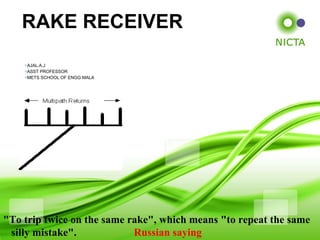
AJAL.A.J ASST PROFESSOR  METS SCHOOL OF ENGG MALA RAKE RECEIVER "To trip twice on the same rake", which means "to repeat the same  silly mistake".    Russian saying
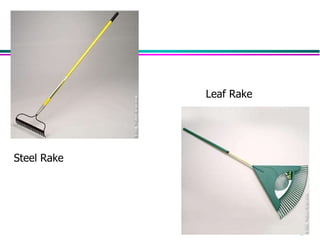
Why the name rake receiver ? The rake receiver is so named because it reminds the function of a  garden rake , each finger collecting symbol energy similarly to how a rake collect leaves.
Steel Rake Leaf Rake
SNOW RAKE
GARDEN RAKE
GARDEN RAKE
Multi-path Energy Capture In multi-path environments, the RMS delay spreads for a given channel can be large (14 ns for CM3, 25 ns ). Un captured multi-path energy results in loss in performance of the communication device. One method for energy collection is to use a RAKE receiver.
Propagation of Tx Signal
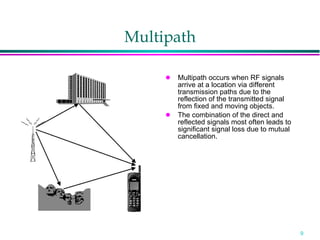
Multipath Multipath occurs when RF signals arrive at a location via different transmission paths due to the reflection of the transmitted signal from fixed and moving objects. The combination of the direct and reflected signals most often leads to significant signal loss due to mutual cancellation.
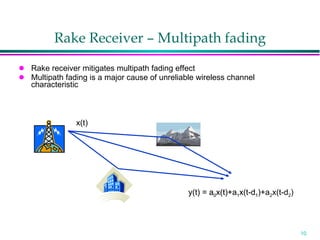
Rake Receiver – Multipath fading Rake receiver mitigates multipath fading effect Multipath fading is a major cause of unreliable wireless channel characteristic x(t) y(t) = a 0 x(t) y(t) = a 0 x(t)+a 1 x(t-d 1 ) y(t) = a 0 x(t)+a 1 x(t-d 1 )+a 2 x(t-d 2 )
RAKE Receiver: Basic Idea The RAKE receiver was designed to equalize the effects of multipath. It uses a combination of correlators, code generators, and delays, or “fingers”, to spread out the individual echo signals of the multipath. Each signal is then delayed according to peaks found in the received signal.
Overview of  Rake Receiver   A rake receiver is a radio receiver designed to counter the effects of multipath fading. It does this by using several "sub-receivers" each delayed slightly in order to tune in to the individual multipath components.  Each component is decoded independently, but at a later stage combined in order to make the most use of the different transmission characteristics of each transmission path.  This could very well result in higher SNR (or Eb/No) in a multipath environment than in a "clean" environmen
RAKE Receiver Continued The same symbols obtained via different paths are then combined together using the corresponding channel information using a combining scheme like maximum ratio combining (MRC). The combined outputs are then sent to a simple decision device to decide on the transmitted bits.
RAKE Receiver Block Diagram
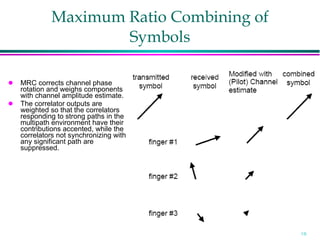
Maximum Ratio Combining of Symbols MRC corrects channel phase rotation and weighs components with channel amplitude estimate. The correlator outputs are weighted so that the correlators responding to strong paths in the multipath environment have their contributions accented, while the correlators not synchronizing with any significant path are suppressed.
End Result of RAKE Receiver By simulating a multipath environment through a parallel combination of correlators and delays, the output behaves as if there existed a single propogation path between the transmitter and receiver.
Fading in CDMA System ... Because CDMA has high time-resolution, different path delay of CDMA signals can be discriminated. Therefore, energy from all paths can be summed  by adjusting their phases and path delays. This is a principle of RAKE receiver. CDMA Receiver CDMA Receiver ••• Synchronization Adder interference from path-2 and path-3 ••• Path Delay Power path-1 path-2 path-3 Path Delay Power CODE A with timing of  path-1 path-1 Power path-1 path-2 path-3 Path Delay Power CODE A with timing of  path-2 path-2
Fading in CDMA System (continued) In CDMA system, multi-path propagation improves  the signal quality by use of RAKE receiver.  Time Power Detected Power RAKE receiver Less fluctuation of detected power, because of adding all energy . Power path-1 path-2 path-3
Rake finger selection Delay (    )  Channel estimation circuit of Rake receiver selects strongest samples (paths) to be processed in the Rake fingers: In the Rake receiver example to follow, we assume L = 3. Only one path chosen, since adjacent paths may be correlated L = 3 Only these paths are constructively utilized in Rake fingers
Received multipath signal Received signal consists of a sum of delayed (and weighted) replicas of transmitted signal. All replicas are contained in received signal and cause interference : Signal replicas: same signal at different delays, with different amplitudes and phases Summation in channel <=> “smeared” end result Blue samples (paths) indicate signal replicas detected in Rake fingers Green samples (paths) only cause interference
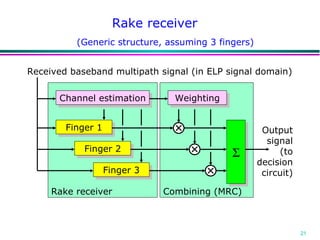
Rake receiver Finger 1 Finger 2 Channel estimation Received baseband multipath signal (in ELP signal domain) Finger 3  Output signal (to decision circuit) Rake receiver Combining (MRC) (Generic structure, assuming 3 fingers) Weighting
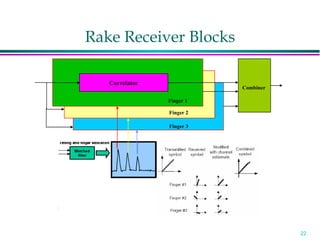
Rake Receiver Blocks Correlator Finger 1 Finger 2 Finger 3 Combiner
Delay Rake finger processing  Received signal To MRC Stored code sequence (Case 1: same code in I and Q branches) I branch Q branch I/Q Output of finger: a complex signal value for each detected bit
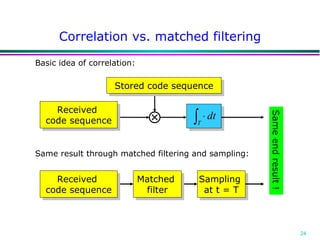
Correlation vs. matched filtering Received  code sequence Stored code sequence Basic idea of correlation: Same result through matched filtering and sampling: Received  code sequence Matched  filter Sampling  at t = T Same end result !
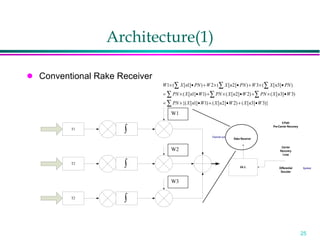
Architecture(1) Conventional Rake Receiver W1 W2 W3
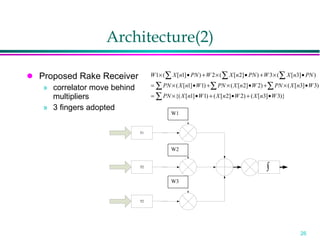
Architecture(2) Proposed Rake Receiver correlator move behind multipliers 3 fingers adopted W1 W2 W3
Rake finger processing Correlation with stored code sequence has different impact on different parts of the received signal =  desired signal component  detected in  i :th Rake finger =  other signal components  causing interference =  other codes  causing interference (+ noise ... )
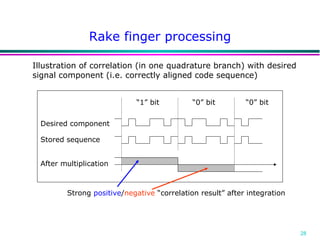
Rake finger processing Illustration of correlation (in one quadrature branch) with desired signal component (i.e. correctly aligned code sequence) Desired component Stored sequence After multiplication Strong  positive / negative  “correlation result” after integration “ 1” bit “ 0” bit “ 0” bit
Rake finger processing Illustration of correlation (in one quadrature branch) with some other signal component (i.e. non-aligned code sequence) Other component Stored sequence After multiplication Weak “correlation result” after integration “ 1” bit “ 0” bit
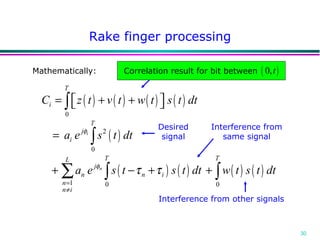
Rake finger processing Mathematically: Correlation result for bit between Interference from same signal Interference from other signals Desired signal
Rake finger processing Set of codes must have both:  - good autocorrelation properties (same code sequence)   - good cross-correlation properties (different sequences) Large Small Small
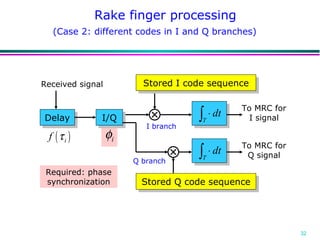
Delay Rake finger processing Received signal Stored I code sequence (Case 2: different codes in I and Q branches) I branch Q branch I/Q Stored Q code sequence To MRC for I signal To MRC for Q signal Required: phase synchronization
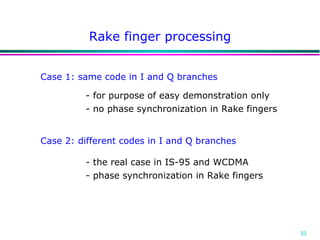
Rake finger processing Case 1: same code in I and Q branches Case 2: different codes in I and Q branches - for purpose of easy demonstration only - the real case in IS-95 and WCDMA - no phase synchronization in Rake fingers  - phase synchronization in Rake fingers
Phase synchronization I/Q When different codes are used in the quadrature branches (as in practical systems such as IS-95 or WCDMA), phase synchronization is necessary. Phase synchronization is based on information within received signal (pilot signal or pilot channel). Signal in I-branch Pilot signal Signal in Q-branch I Q Note: phase synchronization must be done for each finger separately!
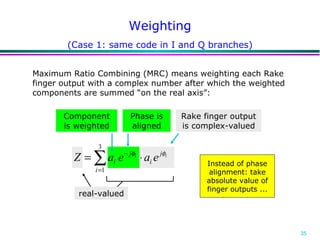
Weighting Maximum Ratio Combining (MRC) means weighting each Rake finger output with a complex number after which the weighted components are summed “on the real axis”: Component is weighted Phase is aligned Rake finger output is complex-valued real-valued (Case 1: same code in I and Q branches) Instead of phase alignment: take absolute value of finger outputs ...
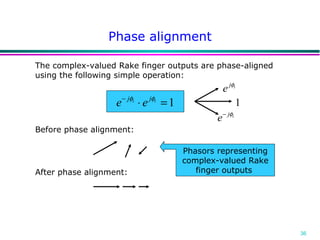
Phase alignment The complex-valued Rake finger outputs are phase-aligned using the following simple operation: Before phase alignment:  After phase alignment:  Phasors representing complex-valued Rake finger outputs
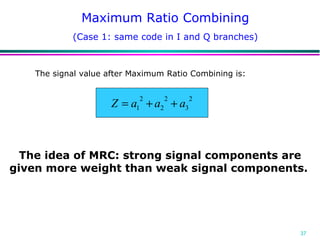
Maximum Ratio Combining The idea of MRC: strong signal components are given more weight than weak signal components.   The signal value after Maximum Ratio Combining is: (Case 1: same code in I and Q branches)
Maximum Ratio Combining of Symbols MRC corrects channel phase rotation and weighs components with channel amplitude estimate. The correlator outputs are weighted so that the correlators responding to strong paths in the multipath environment have their contributions accented, while the correlators not synchronizing with any significant path are suppressed.
Maximum Ratio Combining Output signals from the Rake fingers are already phase aligned (this is a benefit of finger-wise phase synchronization). Consequently, I and Q outputs are fed via separate MRC circuits to the quaternary decision circuit (e.g. QPSK demodulator).  (Case 2: different codes in I and Q branches) Quaternary decision circuit Finger 1 Finger 2 MRC  MRC  : I Q I Q I Q
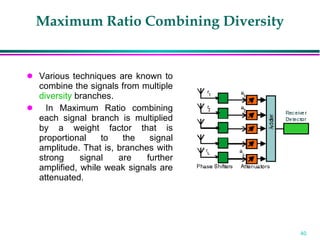
Maximum Ratio Combining Diversity Various techniques are known to combine the signals from multiple  diversity  branches. In Maximum Ratio combining each signal branch is multiplied by a weight factor that is proportional to the signal amplitude. That is, branches with strong signal are further amplified, while weak signals are attenuated.
 
Rake Receiver - Functions Ideally the function of rake receiver is to aggregate the signal terms with proper delay compensation y(t) = a 0 x(t)+a 1 x(t-d 1 )+a 2 x(t-d 2 ) r(t) = a 0 x(t-t dealy )+a 1 x(t-d 1 -d est1 )+a 2 x(t-d 2 -d est2 ) = (a 0 +a 1 +a 2 ) * x(t-t delay ) Rake receiver We need to know delay spread of received signal that randomly varies
Rake   Receiver  –  Detect Delay Spread Scan the received signal in frame buffer while computing correlation with scrambling code sequence. Received signal Correlation window Correlation Result a 0 a 1 a 2 0 d 1 d 2
Rake Receiver – Overall Architecture Detects delay spread Compensates propagation delay recombine signal terms without delay
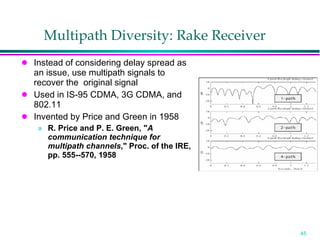
Multipath Diversity: Rake Receiver Instead of considering delay spread as an issue, use multipath signals to recover the  original signal Used in IS-95 CDMA, 3G CDMA, and 802.11 Invented by Price and Green in 1958 R. Price and P. E. Green, &quot; A communication technique for multipath channels ,&quot; Proc. of the IRE, pp. 555--570, 1958
Multipath Diversity: Rake Receiver Use several &quot;sub-receivers&quot; each delayed slightly to tune in to the individual multipath components Each component is decoded independently, but at a later stage combined LOS pulse multipath pulses This could very well result in  higher SNR in a multipath environment  than in a &quot;clean&quot; environment
Rake Receiver: Matched Filter Impulse response measurement Tracks and monitors peaks with a measurement rate depending on speeds of mobile station and on propagation environment Allocate fingers: largest peaks to RAKE fingers
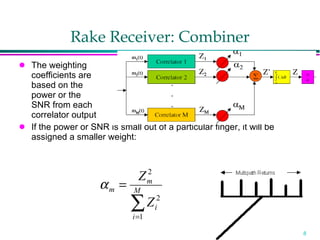
Rake Receiver: Combiner The weighting  coefficients are  based on the  power or the  SNR from each  correlator output If the power or SNR is small out of a particular finger, it will be assigned a smaller weight:
RAKE DEMODULATOR
RAKE DEMODULATOR RAKE demodulator for signal transmitted through a  frequency selective channel.
The demodulator structure shown in above Figure  is called a  RAKE demodulator .  Because this demodulator has equally spaced taps with tap coefficients that essentially collect all the signal components in the received signal, its operation has been likened to that of an ordinary garden rake.
Let us use the correlator structure that is illustrated in Figure  The received signal is passed through a tapped delay-line filter with tap spacing of 1/ W , as in the channel model  The number of taps is selected to match the total number of resolvable signal components.  At each tap, the signal is multiplied with each of the two possible transmitted signals  s 1( t ) and  s 2( t ), and, then, each multiplier output is phase corrected and weighted by multiplication with  c  ( t ),  n  = 1, 2, …,  L .
DANG YOU AJAL.A.J ASST PROFESSOR  METS SCHOOL OF ENGG MALA MOB 0-8907305642

Rake

  • 1.
    AJAL.A.J ASST PROFESSOR METS SCHOOL OF ENGG MALA RAKE RECEIVER &quot;To trip twice on the same rake&quot;, which means &quot;to repeat the same silly mistake&quot;. Russian saying
  • 2.
    Why the namerake receiver ? The rake receiver is so named because it reminds the function of a garden rake , each finger collecting symbol energy similarly to how a rake collect leaves.
  • 3.
  • 4.
  • 5.
  • 6.
  • 7.
    Multi-path Energy CaptureIn multi-path environments, the RMS delay spreads for a given channel can be large (14 ns for CM3, 25 ns ). Un captured multi-path energy results in loss in performance of the communication device. One method for energy collection is to use a RAKE receiver.
  • 8.
  • 9.
    Multipath Multipath occurswhen RF signals arrive at a location via different transmission paths due to the reflection of the transmitted signal from fixed and moving objects. The combination of the direct and reflected signals most often leads to significant signal loss due to mutual cancellation.
  • 10.
    Rake Receiver –Multipath fading Rake receiver mitigates multipath fading effect Multipath fading is a major cause of unreliable wireless channel characteristic x(t) y(t) = a 0 x(t) y(t) = a 0 x(t)+a 1 x(t-d 1 ) y(t) = a 0 x(t)+a 1 x(t-d 1 )+a 2 x(t-d 2 )
  • 11.
    RAKE Receiver: BasicIdea The RAKE receiver was designed to equalize the effects of multipath. It uses a combination of correlators, code generators, and delays, or “fingers”, to spread out the individual echo signals of the multipath. Each signal is then delayed according to peaks found in the received signal.
  • 12.
    Overview of Rake Receiver A rake receiver is a radio receiver designed to counter the effects of multipath fading. It does this by using several &quot;sub-receivers&quot; each delayed slightly in order to tune in to the individual multipath components. Each component is decoded independently, but at a later stage combined in order to make the most use of the different transmission characteristics of each transmission path. This could very well result in higher SNR (or Eb/No) in a multipath environment than in a &quot;clean&quot; environmen
  • 13.
    RAKE Receiver ContinuedThe same symbols obtained via different paths are then combined together using the corresponding channel information using a combining scheme like maximum ratio combining (MRC). The combined outputs are then sent to a simple decision device to decide on the transmitted bits.
  • 14.
  • 15.
    Maximum Ratio Combiningof Symbols MRC corrects channel phase rotation and weighs components with channel amplitude estimate. The correlator outputs are weighted so that the correlators responding to strong paths in the multipath environment have their contributions accented, while the correlators not synchronizing with any significant path are suppressed.
  • 16.
    End Result ofRAKE Receiver By simulating a multipath environment through a parallel combination of correlators and delays, the output behaves as if there existed a single propogation path between the transmitter and receiver.
  • 17.
    Fading in CDMASystem ... Because CDMA has high time-resolution, different path delay of CDMA signals can be discriminated. Therefore, energy from all paths can be summed by adjusting their phases and path delays. This is a principle of RAKE receiver. CDMA Receiver CDMA Receiver ••• Synchronization Adder interference from path-2 and path-3 ••• Path Delay Power path-1 path-2 path-3 Path Delay Power CODE A with timing of path-1 path-1 Power path-1 path-2 path-3 Path Delay Power CODE A with timing of path-2 path-2
  • 18.
    Fading in CDMASystem (continued) In CDMA system, multi-path propagation improves the signal quality by use of RAKE receiver. Time Power Detected Power RAKE receiver Less fluctuation of detected power, because of adding all energy . Power path-1 path-2 path-3
  • 19.
    Rake finger selectionDelay (  ) Channel estimation circuit of Rake receiver selects strongest samples (paths) to be processed in the Rake fingers: In the Rake receiver example to follow, we assume L = 3. Only one path chosen, since adjacent paths may be correlated L = 3 Only these paths are constructively utilized in Rake fingers
  • 20.
    Received multipath signalReceived signal consists of a sum of delayed (and weighted) replicas of transmitted signal. All replicas are contained in received signal and cause interference : Signal replicas: same signal at different delays, with different amplitudes and phases Summation in channel <=> “smeared” end result Blue samples (paths) indicate signal replicas detected in Rake fingers Green samples (paths) only cause interference
  • 21.
    Rake receiver Finger1 Finger 2 Channel estimation Received baseband multipath signal (in ELP signal domain) Finger 3  Output signal (to decision circuit) Rake receiver Combining (MRC) (Generic structure, assuming 3 fingers) Weighting
  • 22.
    Rake Receiver BlocksCorrelator Finger 1 Finger 2 Finger 3 Combiner
  • 23.
    Delay Rake fingerprocessing  Received signal To MRC Stored code sequence (Case 1: same code in I and Q branches) I branch Q branch I/Q Output of finger: a complex signal value for each detected bit
  • 24.
    Correlation vs. matchedfiltering Received code sequence Stored code sequence Basic idea of correlation: Same result through matched filtering and sampling: Received code sequence Matched filter Sampling at t = T Same end result !
  • 25.
  • 26.
    Architecture(2) Proposed RakeReceiver correlator move behind multipliers 3 fingers adopted W1 W2 W3
  • 27.
    Rake finger processingCorrelation with stored code sequence has different impact on different parts of the received signal = desired signal component detected in i :th Rake finger = other signal components causing interference = other codes causing interference (+ noise ... )
  • 28.
    Rake finger processingIllustration of correlation (in one quadrature branch) with desired signal component (i.e. correctly aligned code sequence) Desired component Stored sequence After multiplication Strong positive / negative “correlation result” after integration “ 1” bit “ 0” bit “ 0” bit
  • 29.
    Rake finger processingIllustration of correlation (in one quadrature branch) with some other signal component (i.e. non-aligned code sequence) Other component Stored sequence After multiplication Weak “correlation result” after integration “ 1” bit “ 0” bit
  • 30.
    Rake finger processingMathematically: Correlation result for bit between Interference from same signal Interference from other signals Desired signal
  • 31.
    Rake finger processingSet of codes must have both: - good autocorrelation properties (same code sequence) - good cross-correlation properties (different sequences) Large Small Small
  • 32.
    Delay Rake fingerprocessing Received signal Stored I code sequence (Case 2: different codes in I and Q branches) I branch Q branch I/Q Stored Q code sequence To MRC for I signal To MRC for Q signal Required: phase synchronization
  • 33.
    Rake finger processingCase 1: same code in I and Q branches Case 2: different codes in I and Q branches - for purpose of easy demonstration only - the real case in IS-95 and WCDMA - no phase synchronization in Rake fingers - phase synchronization in Rake fingers
  • 34.
    Phase synchronization I/QWhen different codes are used in the quadrature branches (as in practical systems such as IS-95 or WCDMA), phase synchronization is necessary. Phase synchronization is based on information within received signal (pilot signal or pilot channel). Signal in I-branch Pilot signal Signal in Q-branch I Q Note: phase synchronization must be done for each finger separately!
  • 35.
    Weighting Maximum RatioCombining (MRC) means weighting each Rake finger output with a complex number after which the weighted components are summed “on the real axis”: Component is weighted Phase is aligned Rake finger output is complex-valued real-valued (Case 1: same code in I and Q branches) Instead of phase alignment: take absolute value of finger outputs ...
  • 36.
    Phase alignment Thecomplex-valued Rake finger outputs are phase-aligned using the following simple operation: Before phase alignment: After phase alignment: Phasors representing complex-valued Rake finger outputs
  • 37.
    Maximum Ratio CombiningThe idea of MRC: strong signal components are given more weight than weak signal components. The signal value after Maximum Ratio Combining is: (Case 1: same code in I and Q branches)
  • 38.
    Maximum Ratio Combiningof Symbols MRC corrects channel phase rotation and weighs components with channel amplitude estimate. The correlator outputs are weighted so that the correlators responding to strong paths in the multipath environment have their contributions accented, while the correlators not synchronizing with any significant path are suppressed.
  • 39.
    Maximum Ratio CombiningOutput signals from the Rake fingers are already phase aligned (this is a benefit of finger-wise phase synchronization). Consequently, I and Q outputs are fed via separate MRC circuits to the quaternary decision circuit (e.g. QPSK demodulator). (Case 2: different codes in I and Q branches) Quaternary decision circuit Finger 1 Finger 2 MRC  MRC  : I Q I Q I Q
  • 40.
    Maximum Ratio CombiningDiversity Various techniques are known to combine the signals from multiple diversity branches. In Maximum Ratio combining each signal branch is multiplied by a weight factor that is proportional to the signal amplitude. That is, branches with strong signal are further amplified, while weak signals are attenuated.
  • 41.
  • 42.
    Rake Receiver -Functions Ideally the function of rake receiver is to aggregate the signal terms with proper delay compensation y(t) = a 0 x(t)+a 1 x(t-d 1 )+a 2 x(t-d 2 ) r(t) = a 0 x(t-t dealy )+a 1 x(t-d 1 -d est1 )+a 2 x(t-d 2 -d est2 ) = (a 0 +a 1 +a 2 ) * x(t-t delay ) Rake receiver We need to know delay spread of received signal that randomly varies
  • 43.
    Rake Receiver – Detect Delay Spread Scan the received signal in frame buffer while computing correlation with scrambling code sequence. Received signal Correlation window Correlation Result a 0 a 1 a 2 0 d 1 d 2
  • 44.
    Rake Receiver –Overall Architecture Detects delay spread Compensates propagation delay recombine signal terms without delay
  • 45.
    Multipath Diversity: RakeReceiver Instead of considering delay spread as an issue, use multipath signals to recover the original signal Used in IS-95 CDMA, 3G CDMA, and 802.11 Invented by Price and Green in 1958 R. Price and P. E. Green, &quot; A communication technique for multipath channels ,&quot; Proc. of the IRE, pp. 555--570, 1958
  • 46.
    Multipath Diversity: RakeReceiver Use several &quot;sub-receivers&quot; each delayed slightly to tune in to the individual multipath components Each component is decoded independently, but at a later stage combined LOS pulse multipath pulses This could very well result in higher SNR in a multipath environment than in a &quot;clean&quot; environment
  • 47.
    Rake Receiver: MatchedFilter Impulse response measurement Tracks and monitors peaks with a measurement rate depending on speeds of mobile station and on propagation environment Allocate fingers: largest peaks to RAKE fingers
  • 48.
    Rake Receiver: CombinerThe weighting coefficients are based on the power or the SNR from each correlator output If the power or SNR is small out of a particular finger, it will be assigned a smaller weight:
  • 49.
  • 50.
    RAKE DEMODULATOR RAKEdemodulator for signal transmitted through a frequency selective channel.
  • 51.
    The demodulator structureshown in above Figure is called a RAKE demodulator . Because this demodulator has equally spaced taps with tap coefficients that essentially collect all the signal components in the received signal, its operation has been likened to that of an ordinary garden rake.
  • 52.
    Let us usethe correlator structure that is illustrated in Figure The received signal is passed through a tapped delay-line filter with tap spacing of 1/ W , as in the channel model The number of taps is selected to match the total number of resolvable signal components. At each tap, the signal is multiplied with each of the two possible transmitted signals s 1( t ) and s 2( t ), and, then, each multiplier output is phase corrected and weighted by multiplication with c ( t ), n = 1, 2, …, L .
  • 53.
    DANG YOU AJAL.A.JASST PROFESSOR METS SCHOOL OF ENGG MALA MOB 0-8907305642

Editor's Notes

  • #19 この RAKE 受信機を利用することにより、フェージングによる受信信号の落ち込みを緩和させることができ、安定した通信環境が確保できるようになります。それにより、ユーザへ安定した品質を保証することが出来ます。
  • #26 The architecture of conventional rake receiver is shown here. In this figure, there are 3 fingers in the receiver, following are the correlators and the multipliers for phase compensation in each finger. The mathematical description of this receiver is given in the formulas above, where the incoming signals are first sampled by the 3 fingers at different timings, resulted in X[n1], x[n2], x[n3] and the sampled data is passed to the correlators to be despreaded by the PN code finally, the constant tap weight W1, W2, W3 are multiplied with the despreaded signals at each finger and then combine those multiplied signal. However, since the tap weights are constant and the correlation and multiplication can be exchanged, after some manipulation, we could derive at the bottom formula, where multiplication comes before correlation And that makes us to come up with the proposed architecture.
  • #27 The proposed architecture of rake receiver is shown here. We find that correlators are moved behind multipliers, resulting in one correlator in the receiver. The mapping between the bottom formula and the proposed architecture is quite straightforward since multiplication comes first and after the multiplication the combined signals are sent to the correlator, which is the same as what the bottom formula represents.