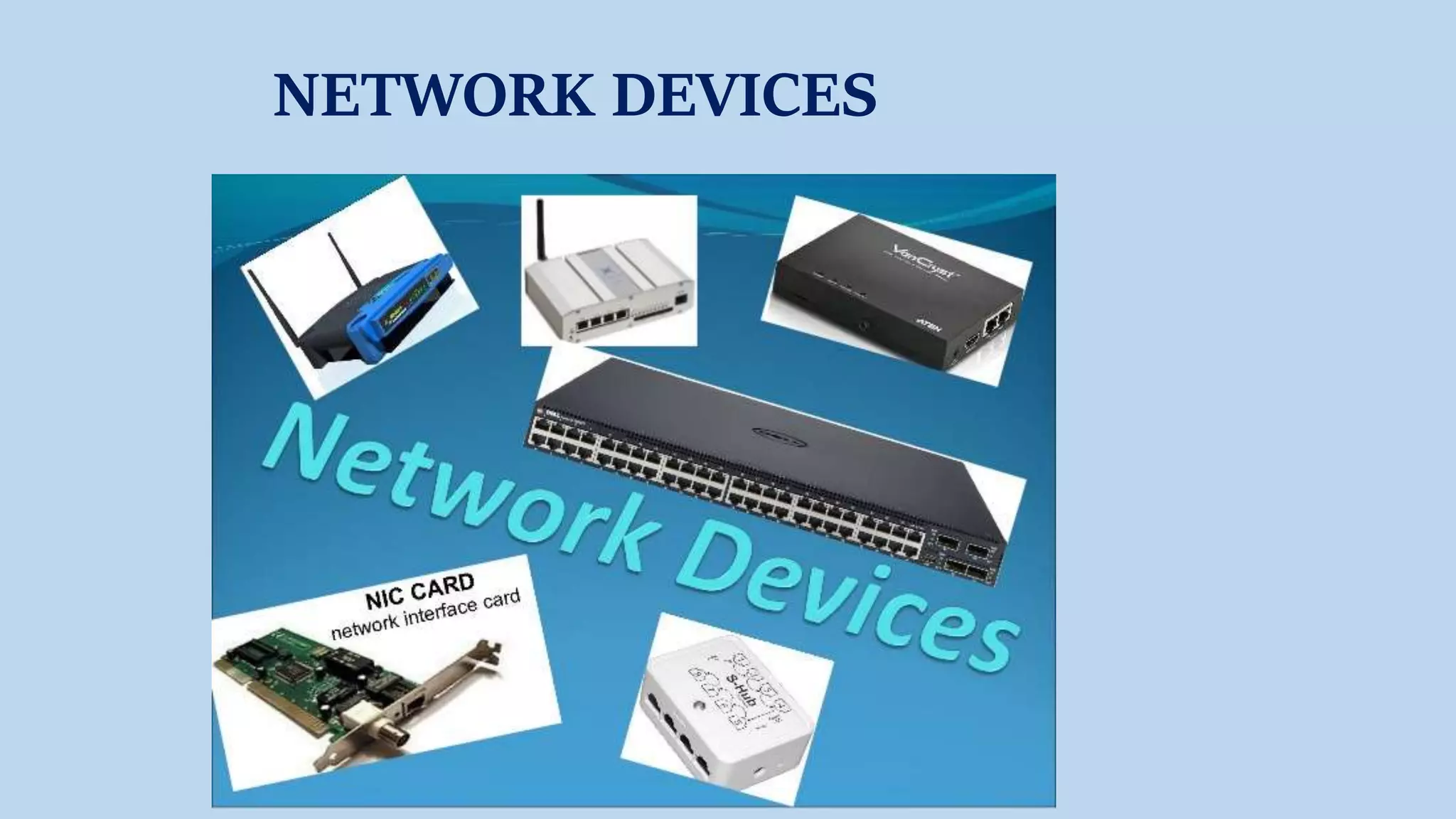
NETWORK DEVICES
 NETWORKING: Devices that help the
network to be linked to each other, with the
objective of sharing data and/or hardwares or
software.
 INTERNETWORKING: When two or more
networks or subnets connected to each other
for communication between hosts on different
types of network then it forms internetwork.
INTRODUCTION
MAC Address
• A network interface card (NIC)is that is attached to each
computer on the network.
• The NIC manufacturer assigns a unique physical
address to each NIC card this address is called as Media
Access Control Address(MAC address).
• It consist of 6 bytes each byte is separated by ’: ‘, first
three bytes are manufacturer-id and last three bytes are
the card number assigned by manufacturer to each card.
IP Address
• Every network follow some rule for
communication, such set of rules are called
PROTOCOLS.
• Common protocol and used by internet is
Transmission control protocol/Internet
protocol(TCP/IP).
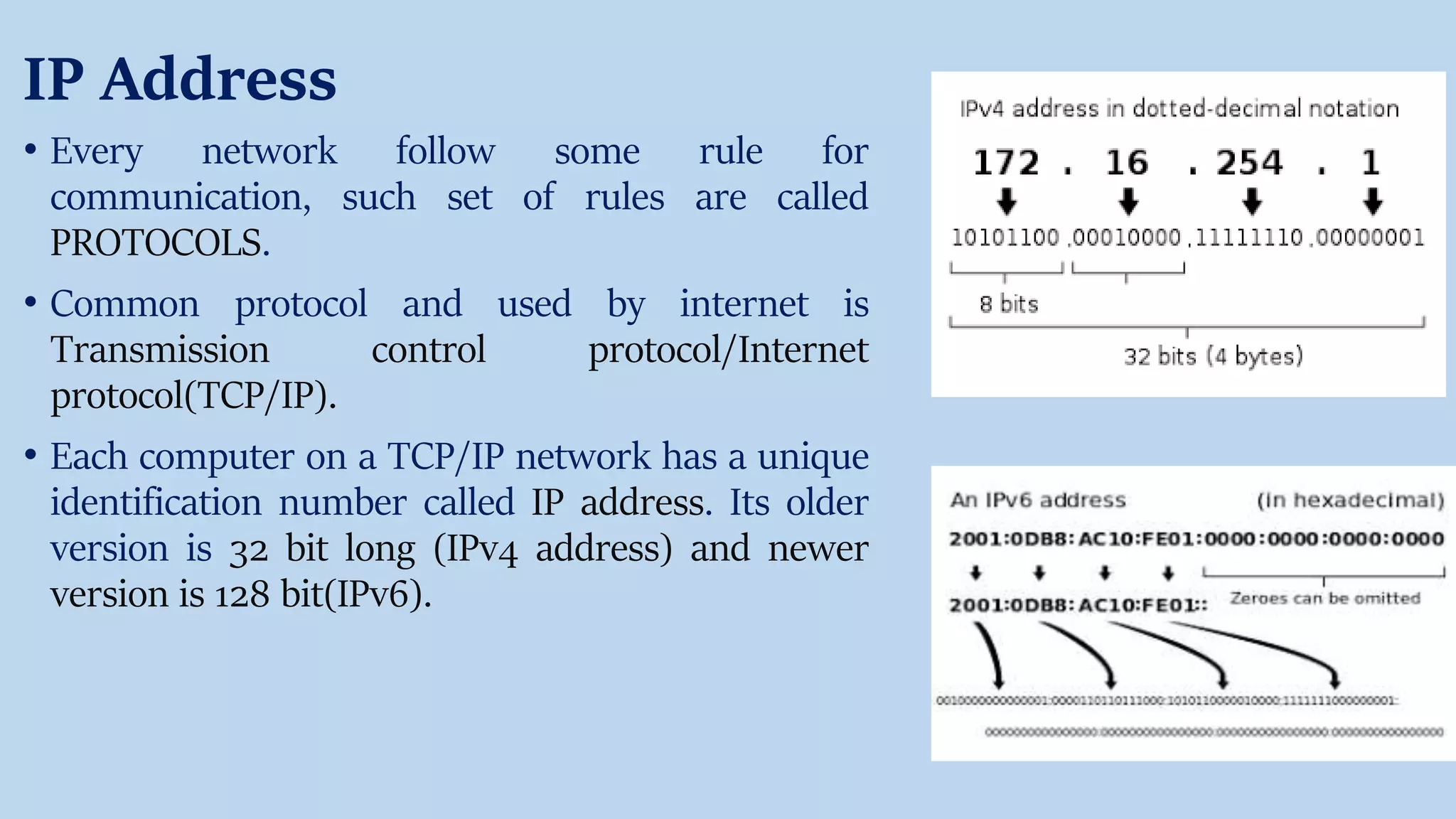
• Each computer on a TCP/IP network has a unique
identification number called IP address. Its older
version is 32 bit long (IPv4 address) and newer
version is 128 bit(IPv6).
Hub
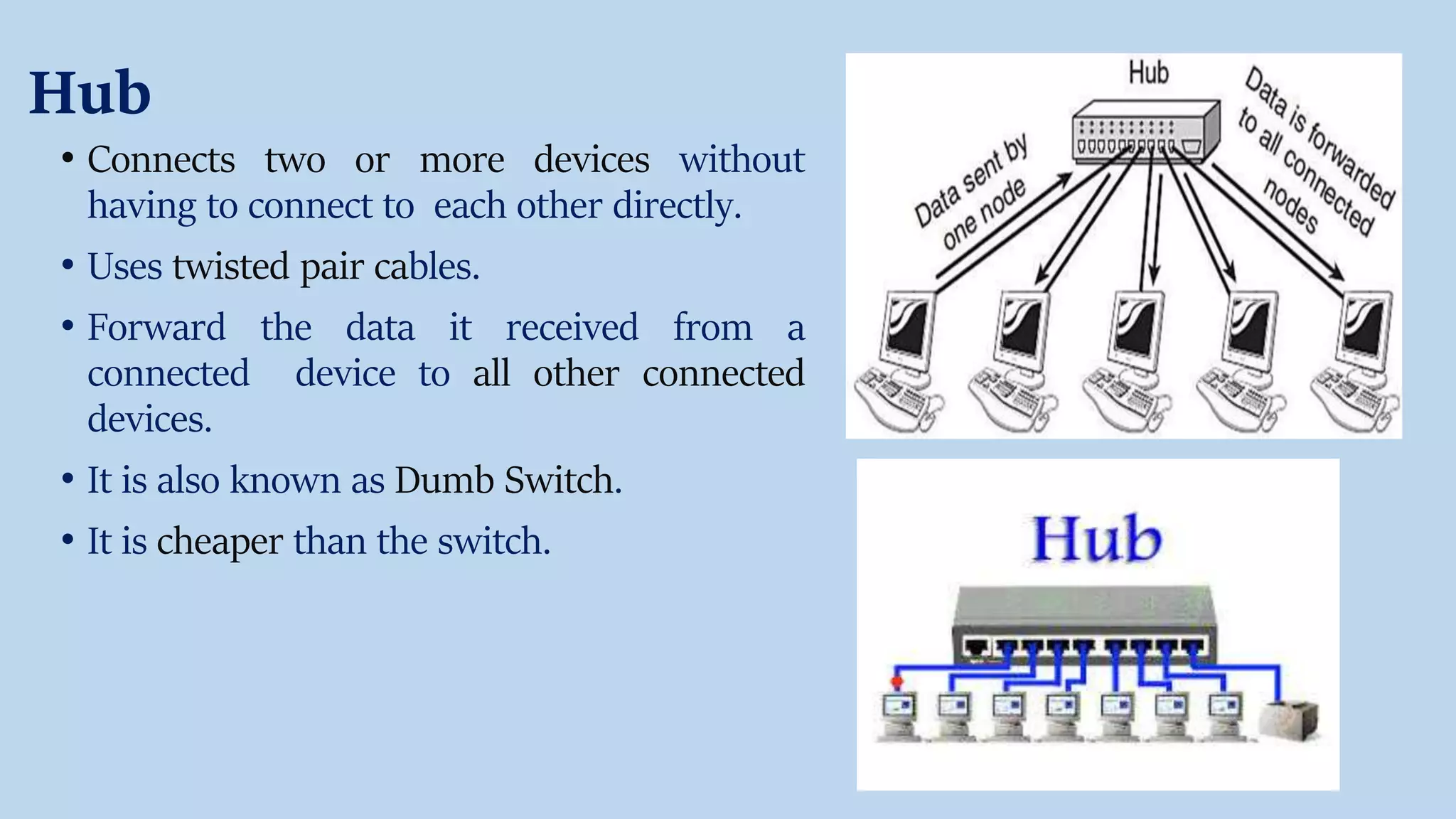
• Connects two or more devices without
having to connect to each other directly.
• Uses twisted pair cables.
• Forward the data it received from a
connected device to all other connected
devices.
• It is also known as Dumb Switch.
• It is cheaper than the switch.
Types of Hub
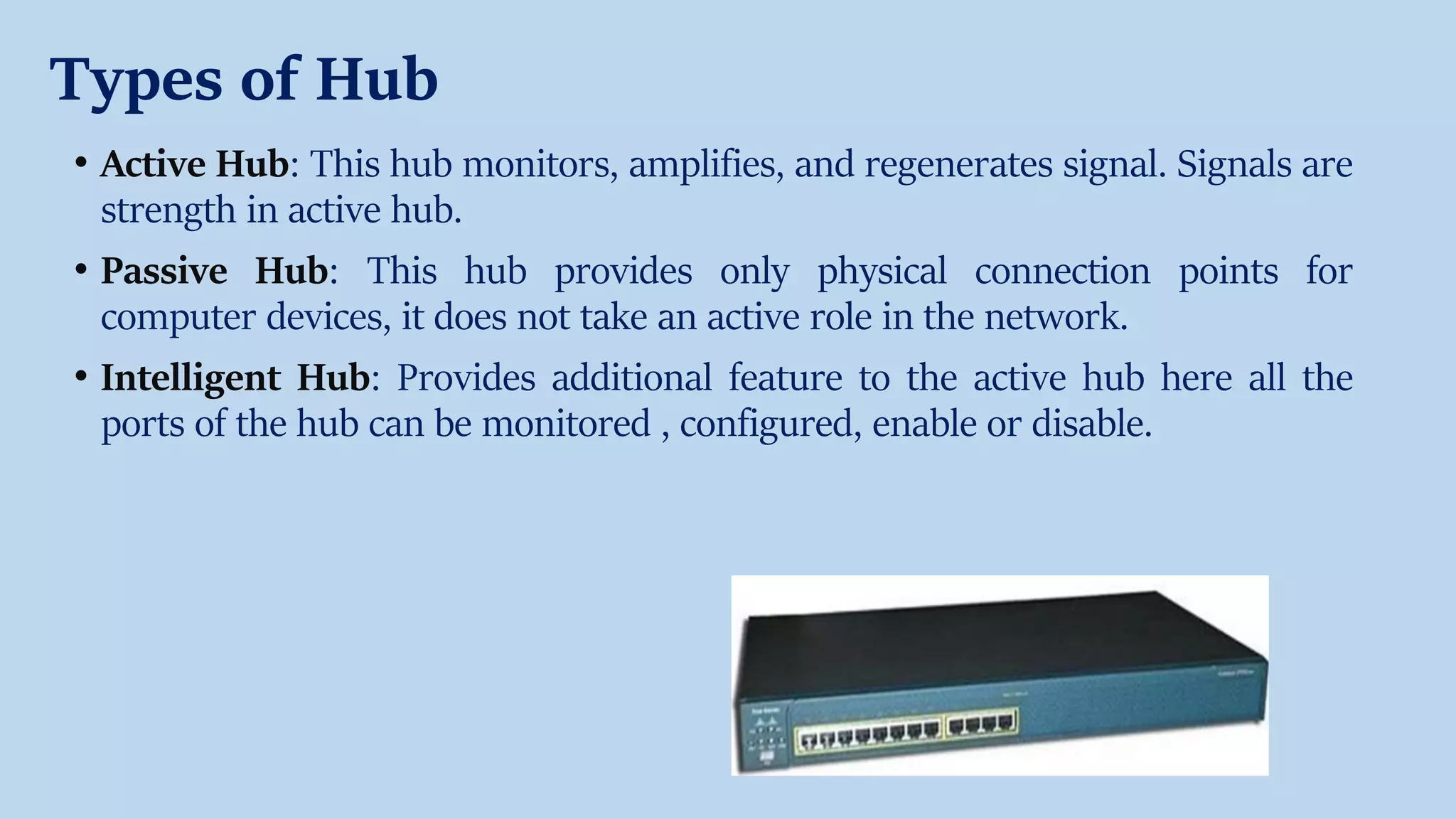
• Active Hub: This hub monitors, amplifies, and regenerates signal. Signals are
strength in active hub.
• Passive Hub: This hub provides only physical connection points for
computer devices, it does not take an active role in the network.
• Intelligent Hub: Provides additional feature to the active hub here all the
ports of the hub can be monitored , configured, enable or disable.
Switch
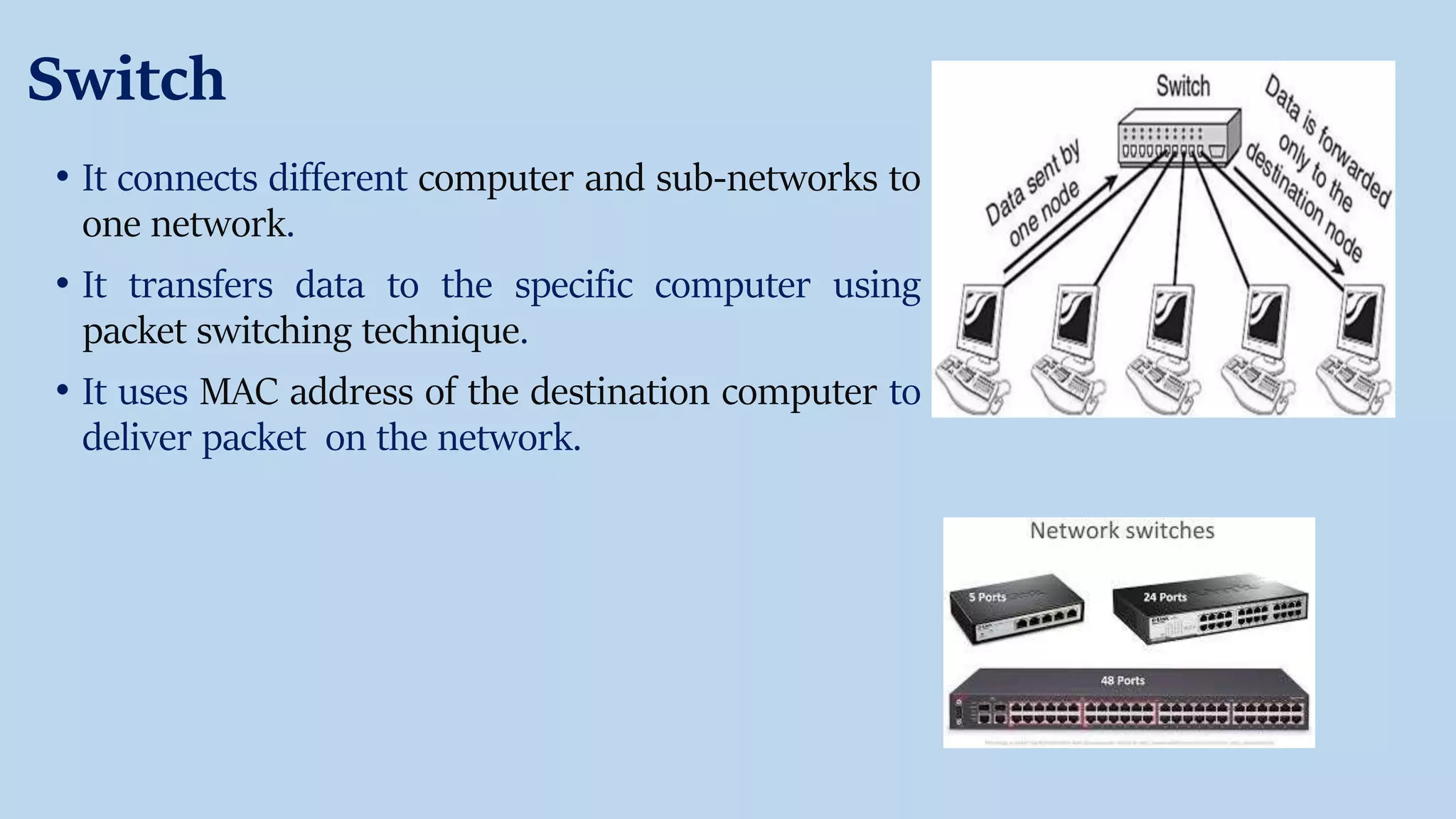
• It connects different computer and sub-networks to
one network.
• It transfers data to the specific computer using
packet switching technique.
• It uses MAC address of the destination computer to
deliver packet on the network.
Routers
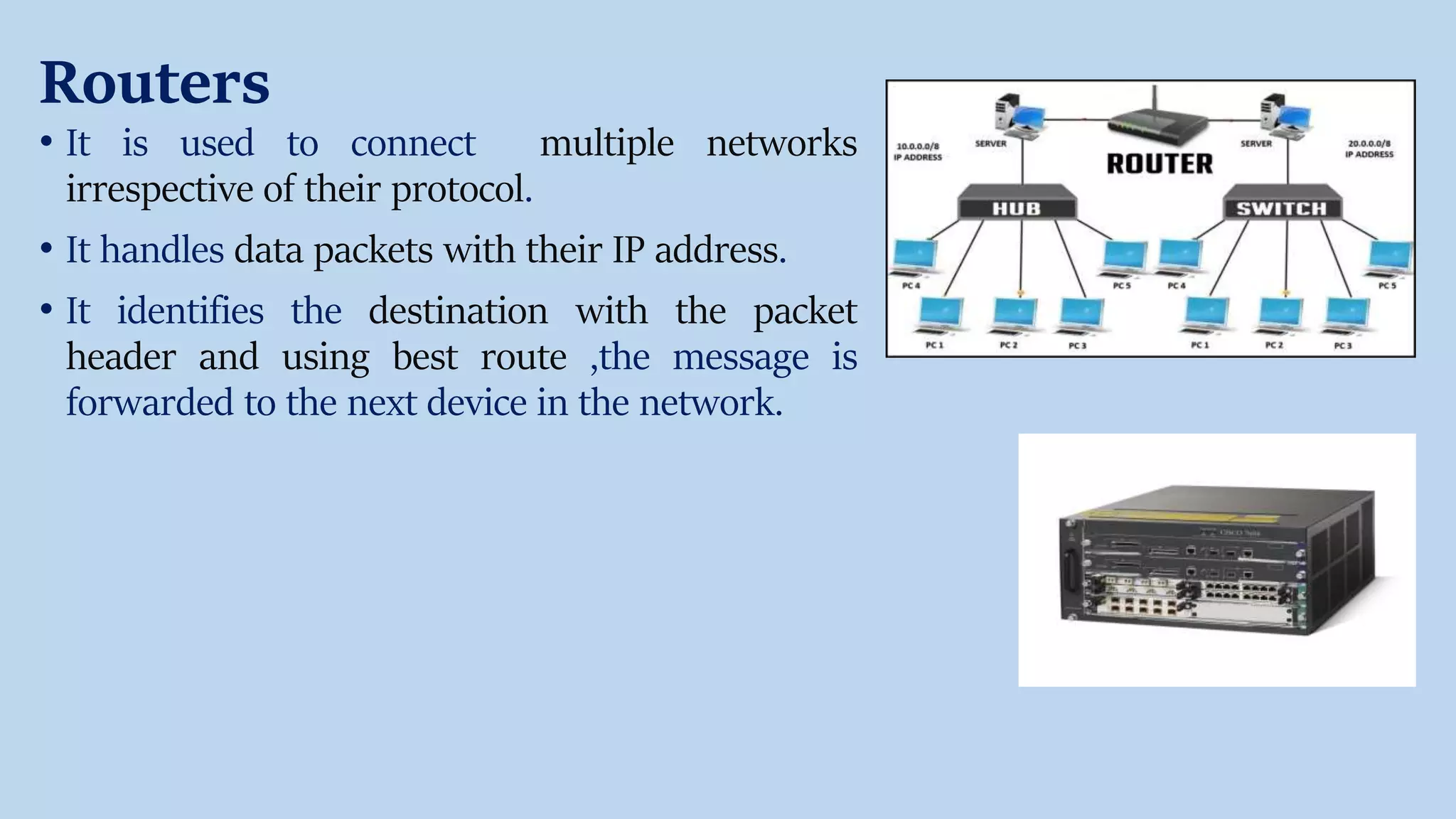
• It is used to connect multiple networks
irrespective of their protocol.
• It handles data packets with their IP address.
• It identifies the destination with the packet
header and using best route ,the message is
forwarded to the next device in the network.
Types of Routers
• Broadband Routers: It is used to connect computers or to internet. To connect
internet through phone and Voice over IP technology (VOIP), we need broadband
routers.
• Wireless Routers: They create wireless signals in our home and office, so any pc in
the range can be connected through the network and can use internet.
• Edge Routers: It is placed at the border of ISP network to connect various
BGP(Border gateway Protocol).
• Core Router: It is used as backbone of LAN network spread in large area.
Modem
 A modem is a device used to connect and communicate with other computers via phone
line.
 Modulation/Demodulation: process of sending data on a wave(analog) is modulation.
(Conversion of digital signal into analog signal) and vice versa.
 Two types of modems are : Internal modem(Fix inside the CPU ),
External modem( connected externally to the computer).
Repeater
 A repeater is a network device that amplifies
and restores signals for long-distance
transmission.
 Required when the network is weakened or
distorted over a long distance.
 Repeater ensures the delivery of the packet over
the chances of weak signals.
 Two types of Repeater: Amplifier (amplifies all
incoming signals both signals and noise),
Signal Repeaters (collects the inbound packet
and retransmit the packet as it was with source).
Bridge
 A bridge is a network device that establishes
intelligent connection between two local
network with the same standard but with
different types of cables.
 The bridge examines the physical destination
address of the packet ,and decides the
whether the packet should cross the bridge
or not.
Types of Bridges
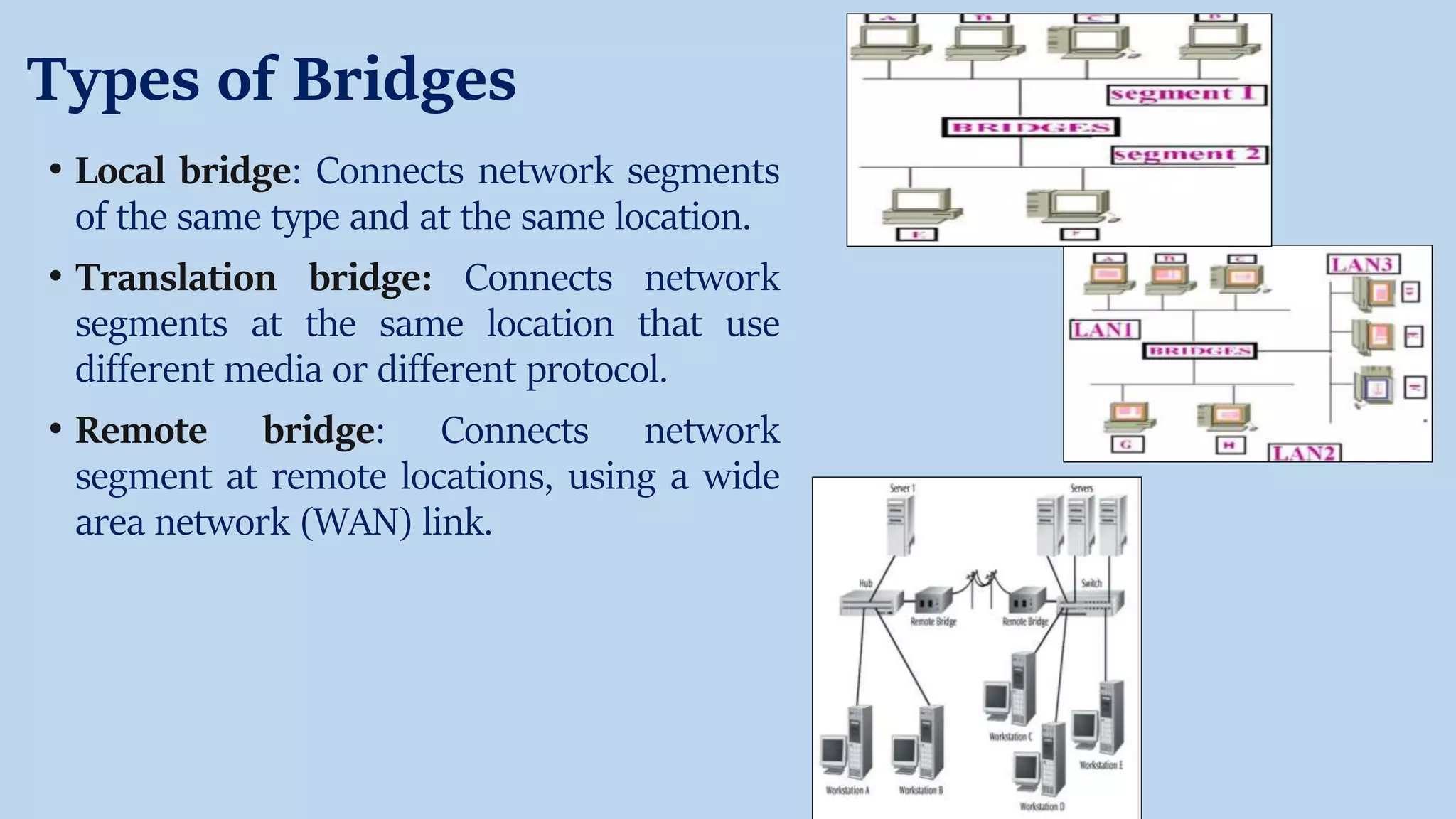
• Local bridge: Connects network segments
of the same type and at the same location.
• Translation bridge: Connects network
segments at the same location that use
different media or different protocol.
• Remote bridge: Connects network
segment at remote locations, using a wide
area network (WAN) link.
Gateways
 It is a device that connects at the highest level of
network and used to connect dissimilar networks.
 A gateway converts Ethernet traffic from the LAN to
SNA(System Network Architecture)i.e. networking
standard developed by IBM, for mainframe and
minicomputers.
 It is a node which servers as an entrance to another
network.
 It acts as a proxy server(a machine that is not a
server but appears as a server) and a firewall(a
system designed to prevent unauthorized access to or
from a private network).
Network  Devices

Network Devices

  • 1.
  • 2.
     NETWORKING: Devicesthat help the network to be linked to each other, with the objective of sharing data and/or hardwares or software.  INTERNETWORKING: When two or more networks or subnets connected to each other for communication between hosts on different types of network then it forms internetwork. INTRODUCTION
  • 3.
    MAC Address • Anetwork interface card (NIC)is that is attached to each computer on the network. • The NIC manufacturer assigns a unique physical address to each NIC card this address is called as Media Access Control Address(MAC address). • It consist of 6 bytes each byte is separated by ’: ‘, first three bytes are manufacturer-id and last three bytes are the card number assigned by manufacturer to each card.
  • 4.
    IP Address • Everynetwork follow some rule for communication, such set of rules are called PROTOCOLS. • Common protocol and used by internet is Transmission control protocol/Internet protocol(TCP/IP). • Each computer on a TCP/IP network has a unique identification number called IP address. Its older version is 32 bit long (IPv4 address) and newer version is 128 bit(IPv6).
  • 5.
    Hub • Connects twoor more devices without having to connect to each other directly. • Uses twisted pair cables. • Forward the data it received from a connected device to all other connected devices. • It is also known as Dumb Switch. • It is cheaper than the switch.
  • 6.
    Types of Hub •Active Hub: This hub monitors, amplifies, and regenerates signal. Signals are strength in active hub. • Passive Hub: This hub provides only physical connection points for computer devices, it does not take an active role in the network. • Intelligent Hub: Provides additional feature to the active hub here all the ports of the hub can be monitored , configured, enable or disable.
  • 7.
    Switch • It connectsdifferent computer and sub-networks to one network. • It transfers data to the specific computer using packet switching technique. • It uses MAC address of the destination computer to deliver packet on the network.
  • 8.
    Routers • It isused to connect multiple networks irrespective of their protocol. • It handles data packets with their IP address. • It identifies the destination with the packet header and using best route ,the message is forwarded to the next device in the network.
  • 9.
    Types of Routers •Broadband Routers: It is used to connect computers or to internet. To connect internet through phone and Voice over IP technology (VOIP), we need broadband routers. • Wireless Routers: They create wireless signals in our home and office, so any pc in the range can be connected through the network and can use internet. • Edge Routers: It is placed at the border of ISP network to connect various BGP(Border gateway Protocol). • Core Router: It is used as backbone of LAN network spread in large area.
  • 10.
    Modem  A modemis a device used to connect and communicate with other computers via phone line.  Modulation/Demodulation: process of sending data on a wave(analog) is modulation. (Conversion of digital signal into analog signal) and vice versa.  Two types of modems are : Internal modem(Fix inside the CPU ), External modem( connected externally to the computer).
  • 11.
    Repeater  A repeateris a network device that amplifies and restores signals for long-distance transmission.  Required when the network is weakened or distorted over a long distance.  Repeater ensures the delivery of the packet over the chances of weak signals.  Two types of Repeater: Amplifier (amplifies all incoming signals both signals and noise), Signal Repeaters (collects the inbound packet and retransmit the packet as it was with source).
  • 12.
    Bridge  A bridgeis a network device that establishes intelligent connection between two local network with the same standard but with different types of cables.  The bridge examines the physical destination address of the packet ,and decides the whether the packet should cross the bridge or not.
  • 13.
    Types of Bridges •Local bridge: Connects network segments of the same type and at the same location. • Translation bridge: Connects network segments at the same location that use different media or different protocol. • Remote bridge: Connects network segment at remote locations, using a wide area network (WAN) link.
  • 14.
    Gateways  It isa device that connects at the highest level of network and used to connect dissimilar networks.  A gateway converts Ethernet traffic from the LAN to SNA(System Network Architecture)i.e. networking standard developed by IBM, for mainframe and minicomputers.  It is a node which servers as an entrance to another network.  It acts as a proxy server(a machine that is not a server but appears as a server) and a firewall(a system designed to prevent unauthorized access to or from a private network).