COMMUNITYHEALTHNURSING-I
HIV/AIDS
Definition
AIDS, the acquired immuno-deficiency syndrome
(sometimes called ‘‘slim disease’’) is a fatal illness
caused by a retrovirus known as the human immuno-
deficiency-deficiency virus (HIV)
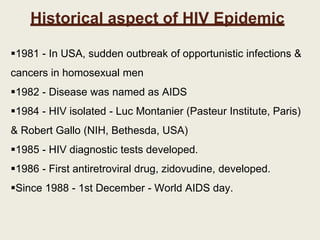
Historical aspect of HIV Epidemic
1981 - In USA, sudden outbreak of opportunistic infections &
cancers in homosexual men
1982 - Disease was named as AIDS
1984 - HIV isolated - Luc Montanier (Pasteur Institute, Paris)
& Robert Gallo (NIH, Bethesda, USA)
1985 - HIV diagnostic tests developed.
1986 - First antiretroviral drug, zidovudine, developed.
Since 1988 - 1st December - World AIDS day.
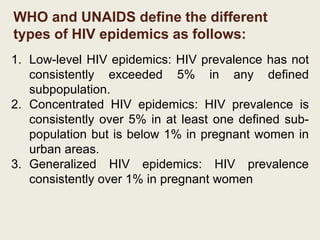
WHO and UNAIDS define the different
types of HIV epidemics as follows:
1. Low-level HIV epidemics: HIV prevalence has not
consistently exceeded 5% in any defined
subpopulation.
2. Concentrated HIV epidemics: HIV prevalence is
consistently over 5% in at least one defined sub-
population but is below 1% in pregnant women in
urban areas.
3. Generalized HIV epidemics: HIV prevalence
consistently over 1% in pregnant women
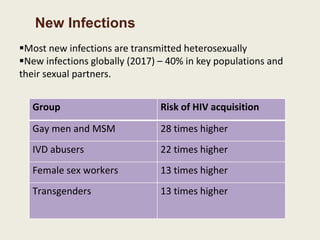
New Infections
Most new infections are transmitted heterosexually
New infections globally (2017) – 40% in key populations and
their sexual partners.
Group Risk of HIV acquisition
Gay men and MSM 28 times higher
IVD abusers 22 times higher
Female sex workers 13 times higher
Transgenders 13 times higher
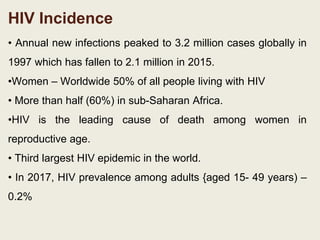
HIV Incidence
• Annual new infections peaked to 3.2 million cases globally in
1997 which has fallen to 2.1 million in 2015.
•Women – Worldwide 50% of all people living with HIV
• More than half (60%) in sub-Saharan Africa.
•HIV is the leading cause of death among women in
reproductive age.
• Third largest HIV epidemic in the world.
• In 2017, HIV prevalence among adults {aged 15- 49 years) –
0.2%
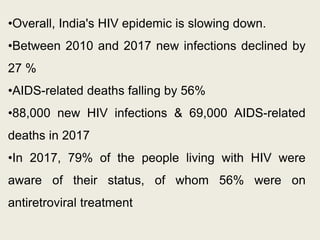
•Overall, India's HIV epidemic is slowing down.
•Between 2010 and 2017 new infections declined by
27 %
•AIDS-related deaths falling by 56%
•88,000 new HIV infections & 69,000 AIDS-related
deaths in 2017
•In 2017, 79% of the people living with HIV were
aware of their status, of whom 56% were on
antiretroviral treatment
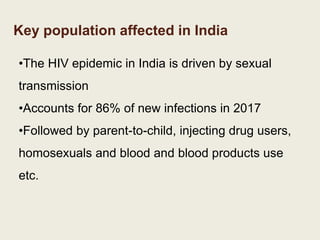
Key population affected in India
•The HIV epidemic in India is driven by sexual
transmission
•Accounts for 86% of new infections in 2017
•Followed by parent-to-child, injecting drug users,
homosexuals and blood and blood products use
etc.
Contd..
HIV prevalence among different risk groups is –
•Sex workers (FSW)
•People who inject drugs: Prevalence of HIV among
injecting drug users (IUD) is high and major route of
HIV transmission in India’s north-eastern states.
•Hijras/transgender people
•Migrant workers
•Truck drivers
Epidemiological Features
Agent factors
a)Agent
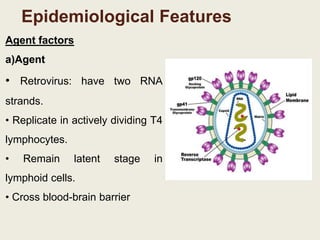
• Retrovirus: have two RNA
strands.
• Replicate in actively dividing T4
lymphocytes.
• Remain latent stage in
lymphoid cells.
• Cross blood-brain barrier
HIV type (distinguished genetically):
• HIV1: > worldwide pandemic (current ~ 40 M people).
• HIV2 : > isolated in West Africa; causes AIDS much more
slowly than HIV-1 but otherwise clinically similar.
• Rapidly killed by heat, Readily inactivated by Ether, Acitone,
20% ethanol & 1:400 dilution of beta-propiolactone. Relatively
resistant to ionizing radiation & ultraviolet.
b) Reservoir of infection: These are cases &
carriers. Once a person is infected, the virus remains
in the body life-long. The risk of developing AIDS
increases with time. Since HIV infection can take
years to manifest itself, the symptomless carrier can
infect other people for years.
c) Source of infection: the virus has been found in body
fluids;
• Greatest or high concentration in Blood, Semen, CSF
• Lower concentration - Tear, Saliva, Breast milk, Urine,
Cervical & vaginal secretion.
• Tissue - Brain tissue, Lymph nodes, Bone-marrow cells &
skin.
2. Host factors
a) AGE: 20 – 49 years
b) SEX: In North America, Europe and Australia –
51% of cases are homosexual or bisexual men.
Certain sexual practices increase the risk of infection
more than others, e.g., multiple sexual partners, anal
intercourse, and male homosexuality. Higher rate of
HIV infection is found in prostitutes.
c) High risk groups: Male homosexuals and
bisexuals, heterosexual partners (including
prostitutes), intravenous drug abusers, transfusion
recipients of blood and blood products, haemophiliacs
and clients of STD.
Modes of HIV/AIDS Transmission
Sexual transmission
•Unprotected Sexual Intercourse
• Oral
• Anal
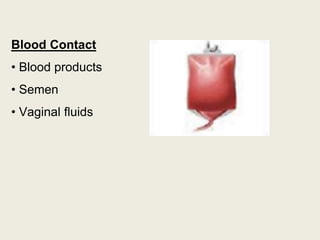
Blood Contact
• Blood products
• Semen
• Vaginal fluids
Intravenous Drug Abuse
• Sharing Needles
• Without sterilization
• Increases the chances of contracting HIV
• Unsterilized blades
• Any skin piercing (including injections. ear-piercing, tattooing,
acupuncture or scarification) can transmit the virus, if the
instruments used have not been sterilized and have previously
been used on an infected person
Maternal-fetal transmission:
mother-to child transmission
• Before Birth
• During Birth
Incubation period
• Uncertain, as natural history of HIV infection is not yet known.
• Range from a few months to 10 years or more
• The percentage of people infected with HIV, who will
developclinical disease remains uncertain : 10- 30 % will
develop AIDS & 25-30 % will develop AIDS- related
complex.
• Estimated : 75 % of those infected with HIV will develop AIDS
by the end of ten years
Clinical manifestations
The clinical features of HIV infection have been
classified into four broad categories:
1. Initial infection with the virus and development of
antibodies
2. Asymptomatic carrier state
3. AIDS-related complex (ARC)
4. AIDS
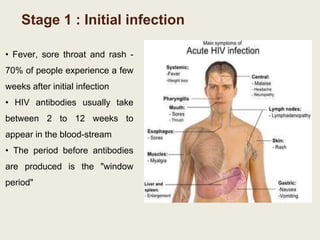
Stage 1 : Initial infection
• Fever, sore throat and rash -
70% of people experience a few
weeks after initial infection
• HIV antibodies usually take
between 2 to 12 weeks to
appear in the blood-stream
• The period before antibodies
are produced is the "window
period"
Stage 2 : Asymptomatic carrier state
• Infected people have antibodies,
•No overt signs of disease, except persistent
generalized lymphadenopathy.
•It is not clear how long the asymptomatic carrier
state lasts
Stage 3 : AIDS-related complex (ARC)
• A person with ARC has illnesses caused by damage to the
immune system, but without the opportunistic infections and
cancers associated with AIDS
• Clinical signs : unexplained diarrhoea lasting longer than a
month , fatigue, malaise, loss of more than 10% body weight,
fever, night sweats, or other milder opportunistic infections
such as oral thrush, generalized lymphadenopathy or enlarged
spleen
Stage 3 : AIDS-related complex (ARC)
• Patients from high-risk groups who have two or
more of these manifestations (typically including
generalized lymphadenopathy), and who have a
decreased number of T- helper lymphocytes are
considered to have AIDS-related complex.
Stage 4 : AIDS
• AIDS is the end-stage of HIV infection.
• A number of opportunist infections commonly occur at this
stage
• Tuberculosis and Kaposi sarcoma are usually seen relatively
early.
• Serious fungal infections such as tend to occur, when T-
helper cell count has dropped to around 100.
• People whose counts are below 50 have the late
opportunistic infections such as cytomegalouiral retinitis.
TB & HIV co-infection
TB is the most common opportunistic infection in HIV
HIV-positive individuals were 30-50 times more likely to
develop active tuberculosis than HIV-negative people.
Immunosuppression induced by HIV modifies the clinical
presentation of TB :
• Subnormal clinical and roentgen presentation
• High rate of MDR/XDR
• High rate of treatment failure and relapse (5% vs < 1% in
HIV)
Diagnosis of AIDS
WHO case definition for AIDS surveillance
For the purposes of AIDS surveillance an adult or
adolescent (> 12 years of age) is considered to have
AIDS if at least 2 of the following major signs are
present in combination with at least 1 of the minor
signs listed below, and if these signs are not known to
be due to a condition unrelated to HIV infection
Diagnosis of AIDS – Major signs
Weight loss ≥ 10% of body weight
Chronic diarrhoea for more than 1 month
Prolonged fever for more than 1 month
(intermittent or constant).
Diagnosis of AIDS - Minor signs
• Persistent cough for more than 1 month
• Generalized pruritic dermatitis
• History of Herpes Zoster B
• Oropharyngeal candidiasis
• Chronic progressive or disseminated herpes simplex
infection
• Generalized lymphadenopathy
• The clinical case definition was developed to enable
reporting of the number of people with AIDS for the
purposes of public health surveillance, rather than for
patient care.
• The case definition for AIDS is fulfilled if at least 2 major
signs and 2 minor signs are present (if there is no other known
cause of immunosuppression).
Diagnosis of AIDS – Children – Major signs
• Weight loss or abnormally slow growth
• Chronic diarrhoea for more than 1 month
• Prolonged fever for more than 1 month.
Diagnosis of AIDS – Children – Minor signs
• Generalized lymph node enlargement
• Oropharyngeal candidiasis
• Recurrent common infections, e.g. ear infection,
pharyngitis
• Persistent cough
• Generalized rash
Diagnosis of AIDS – Expanded WHO case
definition for AIDS surveillance
• For the purposes of AIDS surveillance an adult or adolescent
(> 12 years of age) is considered to have AIDS if a test for HIV
antibody gives a positive result, and one or more of the
following conditions are present
• ≥ 10% body weight loss or cachexia, with diarrhoea or fever,
or both, intermittent or constant, for at least 1 month, not
known to be due to a condition unrelated to HIV infection
• Cryptococcal meningitis
• Pulmonary or extra-pulmonary tuberculosis
• Kaposi sarcoma
• Neurological impairment that is sufficient to prevent
independent daily activities, not known to be due to a
condition unrelated to HIV infection (for example,
trauma or cerebrovascular accident)
• Candidiasis of the oesophagus (which may be
presumptively diagnosed based on the presence of
oral candidiasis accompanied by dysphagia)
• Clinically diagnosed life-threatening or recurrent
episodes of pneumonia, with or without aetiological
confirmation·
• Invasive cervical cancer.
• Major features of this expanded surveillance case
definition are that it requires an HIV serological test,
and includes a broader spectrum of clinical
manifestations of HIV such as tuberculosis,
neurological impairment, pneumonia, and invasive
cervical cancer.
• The expanded definition is simple to use and has a
higher specificity
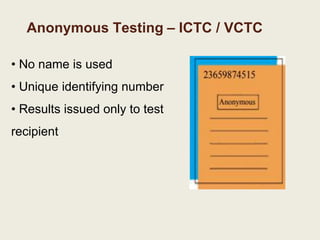
Anonymous Testing – ICTC / VCTC
• No name is used
• Unique identifying number
• Results issued only to test
recipient
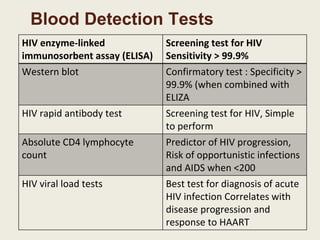
Blood Detection Tests
HIV enzyme-linked
immunosorbent assay (ELISA)
Screening test for HIV
Sensitivity > 99.9%
Western blot Confirmatory test : Specificity >
99.9% (when combined with
ELIZA
HIV rapid antibody test Screening test for HIV, Simple
to perform
Absolute CD4 lymphocyte
count
Predictor of HIV progression,
Risk of opportunistic infections
and AIDS when <200
HIV viral load tests Best test for diagnosis of acute
HIV infection Correlates with
disease progression and
response to HAART
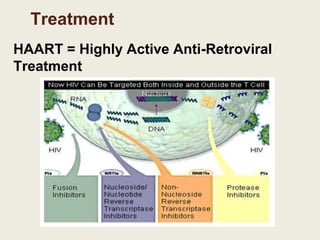
Treatment
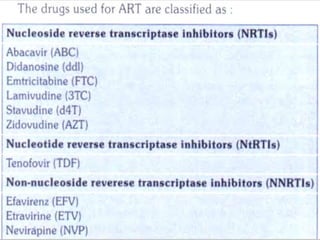
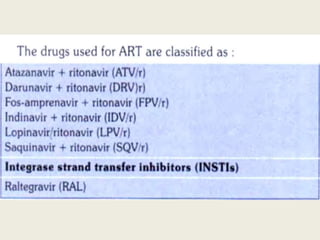
HAART = Highly Active Anti-Retroviral
Treatment
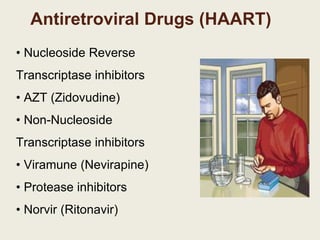
Antiretroviral Drugs (HAART)
• Nucleoside Reverse
Transcriptase inhibitors
• AZT (Zidovudine)
• Non-Nucleoside
Transcriptase inhibitors
• Viramune (Nevirapine)
• Protease inhibitors
• Norvir (Ritonavir)
Health care follow up of HIV infected
patients
• CD4 counts every 3–6 months
• Viral load tests every 3–6 months & 1 month
following a change in therapy
• PPD
• INH for those with positive PPD and normal chest
radiograph
• RPR or VDRL for syphilis
• Toxoplasma IgG serology
• CMV IgG serology
• Pneumococcal vaccine
• Influenza vaccine in season
• Hepatitis B vaccine for those who are HBsAg
- Negative
• Haemophilus influenzae type Bvaccination •
Papanicolaou smears every 6 months for
women
Prevention & control
• Health education
• Abstinence
• Monogamous Relationship
• Protected Sex
• Sterile needles
• New shaving/cutting blades
• Blood safety • Anti retroviral treatment
Post exposure prophylaxis
• First aid care;
• counseling and risk assessment;
• HIV testing and counseling; and,
• depending on the risk assessment, the short
term (28-day) provision of antiretroviral drugs,
• support and follow up.
• TDF + 3TC (or FTC) is recommended as the
preferred backbone regimen for HIV post-
exposure prophylaxis among adults and
adolescents.
• AZT -r- 3TC is recommended as the
preferred backbone regimen for HIV post-
exposure prophylaxis among children 10 years
and younger.
• A 28-days prescription
• Enhanced adherence counselling
Specific prophylaxis
• Primary prophylaxis against P. carinei
pneumonia should be offered to patients with
CD4 count below 200 cells/pl.
• The regimens available are trimethoprine -
sulfamethoxazole, aerosolized pentamidine
and dapsone.
HIV Acquired Immunno Deficiency Syn.pptx

HIV Acquired Immunno Deficiency Syn.pptx

  • 1.
  • 2.
    Definition AIDS, the acquiredimmuno-deficiency syndrome (sometimes called ‘‘slim disease’’) is a fatal illness caused by a retrovirus known as the human immuno- deficiency-deficiency virus (HIV)
  • 3.
    Historical aspect ofHIV Epidemic 1981 - In USA, sudden outbreak of opportunistic infections & cancers in homosexual men 1982 - Disease was named as AIDS 1984 - HIV isolated - Luc Montanier (Pasteur Institute, Paris) & Robert Gallo (NIH, Bethesda, USA) 1985 - HIV diagnostic tests developed. 1986 - First antiretroviral drug, zidovudine, developed. Since 1988 - 1st December - World AIDS day.
  • 4.
    WHO and UNAIDSdefine the different types of HIV epidemics as follows: 1. Low-level HIV epidemics: HIV prevalence has not consistently exceeded 5% in any defined subpopulation. 2. Concentrated HIV epidemics: HIV prevalence is consistently over 5% in at least one defined sub- population but is below 1% in pregnant women in urban areas. 3. Generalized HIV epidemics: HIV prevalence consistently over 1% in pregnant women
  • 5.
    New Infections Most newinfections are transmitted heterosexually New infections globally (2017) – 40% in key populations and their sexual partners. Group Risk of HIV acquisition Gay men and MSM 28 times higher IVD abusers 22 times higher Female sex workers 13 times higher Transgenders 13 times higher
  • 6.
    HIV Incidence • Annualnew infections peaked to 3.2 million cases globally in 1997 which has fallen to 2.1 million in 2015. •Women – Worldwide 50% of all people living with HIV • More than half (60%) in sub-Saharan Africa. •HIV is the leading cause of death among women in reproductive age. • Third largest HIV epidemic in the world. • In 2017, HIV prevalence among adults {aged 15- 49 years) – 0.2%
  • 7.
    •Overall, India's HIVepidemic is slowing down. •Between 2010 and 2017 new infections declined by 27 % •AIDS-related deaths falling by 56% •88,000 new HIV infections & 69,000 AIDS-related deaths in 2017 •In 2017, 79% of the people living with HIV were aware of their status, of whom 56% were on antiretroviral treatment
  • 8.
    Key population affectedin India •The HIV epidemic in India is driven by sexual transmission •Accounts for 86% of new infections in 2017 •Followed by parent-to-child, injecting drug users, homosexuals and blood and blood products use etc.
  • 9.
    Contd.. HIV prevalence amongdifferent risk groups is – •Sex workers (FSW) •People who inject drugs: Prevalence of HIV among injecting drug users (IUD) is high and major route of HIV transmission in India’s north-eastern states. •Hijras/transgender people •Migrant workers •Truck drivers
  • 10.
    Epidemiological Features Agent factors a)Agent •Retrovirus: have two RNA strands. • Replicate in actively dividing T4 lymphocytes. • Remain latent stage in lymphoid cells. • Cross blood-brain barrier
  • 11.
    HIV type (distinguishedgenetically): • HIV1: > worldwide pandemic (current ~ 40 M people). • HIV2 : > isolated in West Africa; causes AIDS much more slowly than HIV-1 but otherwise clinically similar. • Rapidly killed by heat, Readily inactivated by Ether, Acitone, 20% ethanol & 1:400 dilution of beta-propiolactone. Relatively resistant to ionizing radiation & ultraviolet.
  • 12.
    b) Reservoir ofinfection: These are cases & carriers. Once a person is infected, the virus remains in the body life-long. The risk of developing AIDS increases with time. Since HIV infection can take years to manifest itself, the symptomless carrier can infect other people for years.
  • 13.
    c) Source ofinfection: the virus has been found in body fluids; • Greatest or high concentration in Blood, Semen, CSF • Lower concentration - Tear, Saliva, Breast milk, Urine, Cervical & vaginal secretion. • Tissue - Brain tissue, Lymph nodes, Bone-marrow cells & skin.
  • 14.
    2. Host factors a)AGE: 20 – 49 years b) SEX: In North America, Europe and Australia – 51% of cases are homosexual or bisexual men. Certain sexual practices increase the risk of infection more than others, e.g., multiple sexual partners, anal intercourse, and male homosexuality. Higher rate of HIV infection is found in prostitutes.
  • 15.
    c) High riskgroups: Male homosexuals and bisexuals, heterosexual partners (including prostitutes), intravenous drug abusers, transfusion recipients of blood and blood products, haemophiliacs and clients of STD.
  • 16.
    Modes of HIV/AIDSTransmission Sexual transmission •Unprotected Sexual Intercourse • Oral • Anal
  • 17.
    Blood Contact • Bloodproducts • Semen • Vaginal fluids
  • 18.
    Intravenous Drug Abuse •Sharing Needles • Without sterilization • Increases the chances of contracting HIV • Unsterilized blades • Any skin piercing (including injections. ear-piercing, tattooing, acupuncture or scarification) can transmit the virus, if the instruments used have not been sterilized and have previously been used on an infected person
  • 19.
    Maternal-fetal transmission: mother-to childtransmission • Before Birth • During Birth
  • 20.
    Incubation period • Uncertain,as natural history of HIV infection is not yet known. • Range from a few months to 10 years or more • The percentage of people infected with HIV, who will developclinical disease remains uncertain : 10- 30 % will develop AIDS & 25-30 % will develop AIDS- related complex. • Estimated : 75 % of those infected with HIV will develop AIDS by the end of ten years
  • 21.
    Clinical manifestations The clinicalfeatures of HIV infection have been classified into four broad categories: 1. Initial infection with the virus and development of antibodies 2. Asymptomatic carrier state 3. AIDS-related complex (ARC) 4. AIDS
  • 22.
    Stage 1 :Initial infection • Fever, sore throat and rash - 70% of people experience a few weeks after initial infection • HIV antibodies usually take between 2 to 12 weeks to appear in the blood-stream • The period before antibodies are produced is the "window period"
  • 23.
    Stage 2 :Asymptomatic carrier state • Infected people have antibodies, •No overt signs of disease, except persistent generalized lymphadenopathy. •It is not clear how long the asymptomatic carrier state lasts
  • 24.
    Stage 3 :AIDS-related complex (ARC) • A person with ARC has illnesses caused by damage to the immune system, but without the opportunistic infections and cancers associated with AIDS • Clinical signs : unexplained diarrhoea lasting longer than a month , fatigue, malaise, loss of more than 10% body weight, fever, night sweats, or other milder opportunistic infections such as oral thrush, generalized lymphadenopathy or enlarged spleen
  • 25.
    Stage 3 :AIDS-related complex (ARC) • Patients from high-risk groups who have two or more of these manifestations (typically including generalized lymphadenopathy), and who have a decreased number of T- helper lymphocytes are considered to have AIDS-related complex.
  • 26.
    Stage 4 :AIDS • AIDS is the end-stage of HIV infection. • A number of opportunist infections commonly occur at this stage • Tuberculosis and Kaposi sarcoma are usually seen relatively early. • Serious fungal infections such as tend to occur, when T- helper cell count has dropped to around 100. • People whose counts are below 50 have the late opportunistic infections such as cytomegalouiral retinitis.
  • 27.
    TB & HIVco-infection TB is the most common opportunistic infection in HIV HIV-positive individuals were 30-50 times more likely to develop active tuberculosis than HIV-negative people. Immunosuppression induced by HIV modifies the clinical presentation of TB : • Subnormal clinical and roentgen presentation • High rate of MDR/XDR • High rate of treatment failure and relapse (5% vs < 1% in HIV)
  • 28.
    Diagnosis of AIDS WHOcase definition for AIDS surveillance For the purposes of AIDS surveillance an adult or adolescent (> 12 years of age) is considered to have AIDS if at least 2 of the following major signs are present in combination with at least 1 of the minor signs listed below, and if these signs are not known to be due to a condition unrelated to HIV infection
  • 29.
    Diagnosis of AIDS– Major signs Weight loss ≥ 10% of body weight Chronic diarrhoea for more than 1 month Prolonged fever for more than 1 month (intermittent or constant).
  • 30.
    Diagnosis of AIDS- Minor signs • Persistent cough for more than 1 month • Generalized pruritic dermatitis • History of Herpes Zoster B • Oropharyngeal candidiasis • Chronic progressive or disseminated herpes simplex infection • Generalized lymphadenopathy
  • 31.
    • The clinicalcase definition was developed to enable reporting of the number of people with AIDS for the purposes of public health surveillance, rather than for patient care.
  • 32.
    • The casedefinition for AIDS is fulfilled if at least 2 major signs and 2 minor signs are present (if there is no other known cause of immunosuppression). Diagnosis of AIDS – Children – Major signs • Weight loss or abnormally slow growth • Chronic diarrhoea for more than 1 month • Prolonged fever for more than 1 month.
  • 33.
    Diagnosis of AIDS– Children – Minor signs • Generalized lymph node enlargement • Oropharyngeal candidiasis • Recurrent common infections, e.g. ear infection, pharyngitis • Persistent cough • Generalized rash
  • 34.
    Diagnosis of AIDS– Expanded WHO case definition for AIDS surveillance • For the purposes of AIDS surveillance an adult or adolescent (> 12 years of age) is considered to have AIDS if a test for HIV antibody gives a positive result, and one or more of the following conditions are present • ≥ 10% body weight loss or cachexia, with diarrhoea or fever, or both, intermittent or constant, for at least 1 month, not known to be due to a condition unrelated to HIV infection • Cryptococcal meningitis
  • 35.
    • Pulmonary orextra-pulmonary tuberculosis • Kaposi sarcoma • Neurological impairment that is sufficient to prevent independent daily activities, not known to be due to a condition unrelated to HIV infection (for example, trauma or cerebrovascular accident) • Candidiasis of the oesophagus (which may be presumptively diagnosed based on the presence of oral candidiasis accompanied by dysphagia)
  • 36.
    • Clinically diagnosedlife-threatening or recurrent episodes of pneumonia, with or without aetiological confirmation· • Invasive cervical cancer. • Major features of this expanded surveillance case definition are that it requires an HIV serological test, and includes a broader spectrum of clinical manifestations of HIV such as tuberculosis, neurological impairment, pneumonia, and invasive cervical cancer. • The expanded definition is simple to use and has a higher specificity
  • 37.
    Anonymous Testing –ICTC / VCTC • No name is used • Unique identifying number • Results issued only to test recipient
  • 38.
    Blood Detection Tests HIVenzyme-linked immunosorbent assay (ELISA) Screening test for HIV Sensitivity > 99.9% Western blot Confirmatory test : Specificity > 99.9% (when combined with ELIZA HIV rapid antibody test Screening test for HIV, Simple to perform Absolute CD4 lymphocyte count Predictor of HIV progression, Risk of opportunistic infections and AIDS when <200 HIV viral load tests Best test for diagnosis of acute HIV infection Correlates with disease progression and response to HAART
  • 39.
    Treatment HAART = HighlyActive Anti-Retroviral Treatment
  • 40.
    Antiretroviral Drugs (HAART) •Nucleoside Reverse Transcriptase inhibitors • AZT (Zidovudine) • Non-Nucleoside Transcriptase inhibitors • Viramune (Nevirapine) • Protease inhibitors • Norvir (Ritonavir)
  • 43.
    Health care followup of HIV infected patients • CD4 counts every 3–6 months • Viral load tests every 3–6 months & 1 month following a change in therapy • PPD • INH for those with positive PPD and normal chest radiograph • RPR or VDRL for syphilis • Toxoplasma IgG serology
  • 44.
    • CMV IgGserology • Pneumococcal vaccine • Influenza vaccine in season • Hepatitis B vaccine for those who are HBsAg - Negative • Haemophilus influenzae type Bvaccination • Papanicolaou smears every 6 months for women
  • 45.
    Prevention & control •Health education • Abstinence • Monogamous Relationship • Protected Sex • Sterile needles • New shaving/cutting blades • Blood safety • Anti retroviral treatment
  • 46.
    Post exposure prophylaxis •First aid care; • counseling and risk assessment; • HIV testing and counseling; and, • depending on the risk assessment, the short term (28-day) provision of antiretroviral drugs, • support and follow up.
  • 47.
    • TDF +3TC (or FTC) is recommended as the preferred backbone regimen for HIV post- exposure prophylaxis among adults and adolescents. • AZT -r- 3TC is recommended as the preferred backbone regimen for HIV post- exposure prophylaxis among children 10 years and younger. • A 28-days prescription • Enhanced adherence counselling
  • 48.
    Specific prophylaxis • Primaryprophylaxis against P. carinei pneumonia should be offered to patients with CD4 count below 200 cells/pl. • The regimens available are trimethoprine - sulfamethoxazole, aerosolized pentamidine and dapsone.