Wireless LAN Security
■ It is also easy to interfere with wireless
communications. A simple jamming transmitter can
make communications impossible. For example,
consistently hammering an access point with access
requests, whether successful or not, will eventually
exhaust its available radio frequency spectrum and
knock it off the network.
■ Advantages of WLAN
■ Disadvantages WLAN
Introduction
WLAN Authentication
• Wireless LANs, because of their broadcast nature, require the
addition of:
User authentication
Data privacy
• Authenticating wireless LAN clients.
Client Authentication Process
WLAN Authentication
• Types Of Authentication
 Open Authentication
• The authentication request
• The authentication response
 Shared Key Authentication
• requires that the client configure a static WEP key
 Service Set Identifier (SSID)
 MAC Address Authentication
• MAC address authentication verifies the client’s MAC address
against a locally configured list of allowed addresses or against an
external authentication server
WLAN Authentication Vulnerabilities
• SSID
An eavesdropper can easily determine the SSID with the use of an
802.11 wireless LAN packet analyzer, like Sniffer Pro.
• Open Authentication
Open authentication provides no way for the access point to
determine whether a client is valid.
• Shared Key Authentication Vulnerabilities
The process of exchanging the challenge text occurs over the
wireless link and is vulnerable to a man-in-the-middle attack
• MAC Address Authentication Vulnerabilities
A protocol analyzer can be used to determine a valid MAC
address
WEP Encryption
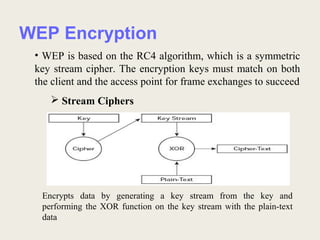
• WEP is based on the RC4 algorithm, which is a symmetric
key stream cipher. The encryption keys must match on both
the client and the access point for frame exchanges to succeed
 Stream Ciphers
Encrypts data by generating a key stream from the key and
performing the XOR function on the key stream with the plain-text
data
WEP Encryption
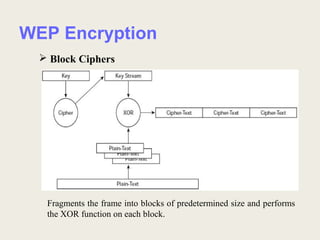
 Block Ciphers
Fragments the frame into blocks of predetermined size and performs
the XOR function on each block.
WEP Encryption Weaknesses
• There are two encryption techniques to overcome WEP
encryption weakness
Initialization vectors
Feedback modes
• Initialization vectors
WEP Encryption Weaknesses
• Feedback Modes
WEP Encryption Weaknesses
• Statistical Key Derivation—Passive Network Attacks
A WEP key could be derived by passively collecting particular frames
from a wireless LAN
• Inductive Key Derivation—Active Network Attacks
Inductive key derivation is the process of deriving a key by coercing
information from the wireless LAN
 Initialization Vector Replay Attacks
 Bit-Flipping Attacks
• Static WEP Key Management Issues
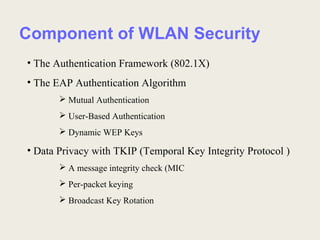
Component of WLAN Security
• The Authentication Framework (802.1X)
• The EAP Authentication Algorithm
 Mutual Authentication
 User-Based Authentication
 Dynamic WEP Keys
• Data Privacy with TKIP (Temporal Key Integrity Protocol )
 A message integrity check (MIC
 Per-packet keying
 Broadcast Key Rotation
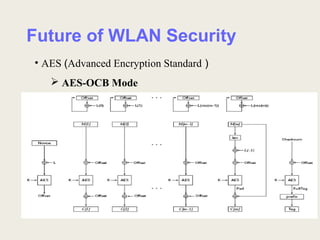
Future of WLAN Security
• AES (Advanced Encryption Standard )
 AES-OCB Mode
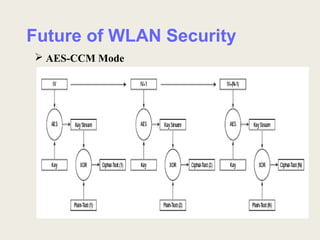
Future of WLAN Security
 AES-CCM Mode
Conclusion
Wireless LAN deployments should be made as secure
as possible. Standard 802.11 security is weak and
vulnerable to numerous network attacks. This paper has
highlighted these vulnerabilities and described how it
can be solved to create secure wireless LANs.
Some security enhancement features might not be
deployable in some situations because of device
limitations such as application specific devices (ASDs
such as 802.11 phones capable of static WEP only) or
mixed vendor environments. In such cases, it is
important that the network administrator understand the
potential WLAN security vulnerabilities.
Thank
You!!!

Wireless lan security

  • 1.
  • 2.
    ■ It isalso easy to interfere with wireless communications. A simple jamming transmitter can make communications impossible. For example, consistently hammering an access point with access requests, whether successful or not, will eventually exhaust its available radio frequency spectrum and knock it off the network. ■ Advantages of WLAN ■ Disadvantages WLAN Introduction
  • 3.
    WLAN Authentication • WirelessLANs, because of their broadcast nature, require the addition of: User authentication Data privacy • Authenticating wireless LAN clients. Client Authentication Process
  • 4.
    WLAN Authentication • TypesOf Authentication  Open Authentication • The authentication request • The authentication response  Shared Key Authentication • requires that the client configure a static WEP key  Service Set Identifier (SSID)  MAC Address Authentication • MAC address authentication verifies the client’s MAC address against a locally configured list of allowed addresses or against an external authentication server
  • 5.
    WLAN Authentication Vulnerabilities •SSID An eavesdropper can easily determine the SSID with the use of an 802.11 wireless LAN packet analyzer, like Sniffer Pro. • Open Authentication Open authentication provides no way for the access point to determine whether a client is valid. • Shared Key Authentication Vulnerabilities The process of exchanging the challenge text occurs over the wireless link and is vulnerable to a man-in-the-middle attack • MAC Address Authentication Vulnerabilities A protocol analyzer can be used to determine a valid MAC address
  • 6.
    WEP Encryption • WEPis based on the RC4 algorithm, which is a symmetric key stream cipher. The encryption keys must match on both the client and the access point for frame exchanges to succeed  Stream Ciphers Encrypts data by generating a key stream from the key and performing the XOR function on the key stream with the plain-text data
  • 7.
    WEP Encryption  BlockCiphers Fragments the frame into blocks of predetermined size and performs the XOR function on each block.
  • 8.
    WEP Encryption Weaknesses •There are two encryption techniques to overcome WEP encryption weakness Initialization vectors Feedback modes • Initialization vectors
  • 9.
  • 10.
    WEP Encryption Weaknesses •Statistical Key Derivation—Passive Network Attacks A WEP key could be derived by passively collecting particular frames from a wireless LAN • Inductive Key Derivation—Active Network Attacks Inductive key derivation is the process of deriving a key by coercing information from the wireless LAN  Initialization Vector Replay Attacks  Bit-Flipping Attacks • Static WEP Key Management Issues
  • 11.
    Component of WLANSecurity • The Authentication Framework (802.1X) • The EAP Authentication Algorithm  Mutual Authentication  User-Based Authentication  Dynamic WEP Keys • Data Privacy with TKIP (Temporal Key Integrity Protocol )  A message integrity check (MIC  Per-packet keying  Broadcast Key Rotation
  • 12.
    Future of WLANSecurity • AES (Advanced Encryption Standard )  AES-OCB Mode
  • 13.
    Future of WLANSecurity  AES-CCM Mode
  • 14.
    Conclusion Wireless LAN deploymentsshould be made as secure as possible. Standard 802.11 security is weak and vulnerable to numerous network attacks. This paper has highlighted these vulnerabilities and described how it can be solved to create secure wireless LANs. Some security enhancement features might not be deployable in some situations because of device limitations such as application specific devices (ASDs such as 802.11 phones capable of static WEP only) or mixed vendor environments. In such cases, it is important that the network administrator understand the potential WLAN security vulnerabilities.
  • 15.