
1/27Wireless LAN
Network Topologies
Geert Bracke
Acc. Manager BeLux
2/27
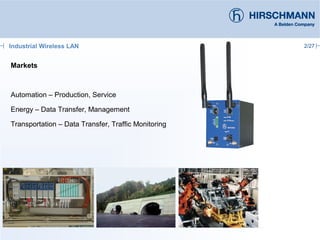
Markets
Automation – Production, Service
Energy – Data Transfer, Management
Transportation – Data Transfer, Traffic Monitoring
Industrial Wireless LAN
3/27
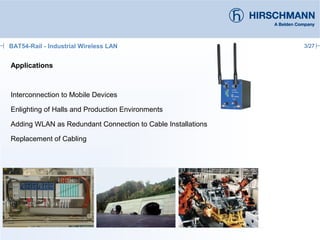
Applications
Interconnection to Mobile Devices
Enlighting of Halls and Production Environments
Adding WLAN as Redundant Connection to Cable Installations
Replacement of Cabling
BAT54-Rail - Industrial Wireless LAN
4/27
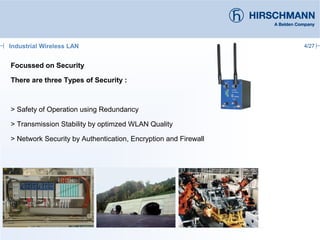
Focussed on Security
There are three Types of Security :
> Safety of Operation using Redundancy
> Transmission Stability by optimzed WLAN Quality
> Network Security by Authentication, Encryption and Firewall
Industrial Wireless LAN
5/27
 Possible topologies of networks
 Advantages of the available possibilities
 Disadvantages
 Goals for improvement of WLAN availability
 Threats to solve
 possible solutions
Today’s possibilities with WLAN in industrial environments
6/27
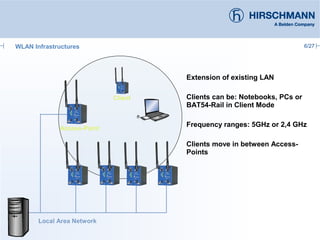
Extension of existing LAN
Clients can be: Notebooks, PCs or
BAT54-Rail in Client Mode
Frequency ranges: 5GHz or 2,4 GHz
Clients move in between Access-
Points
Local Area Network
WLAN Infrastructures
Client
Access-Point
7/27
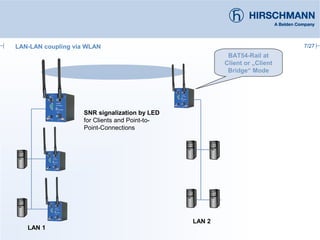
BAT54-Rail at
Client or „Client
Bridge“ Mode
LAN-LAN coupling via WLAN
LAN 1
LAN 2
SNR signalization by LED
for Clients and Point-to-
Point-Connections
8/27
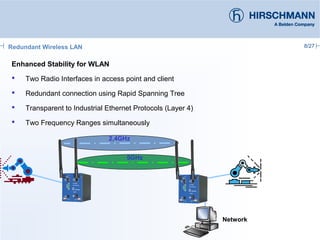
Enhanced Stability for WLAN
 Two Radio Interfaces in access point and client
 Redundant connection using Rapid Spanning Tree
 Transparent to Industrial Ethernet Protocols (Layer 4)
 Two Frequency Ranges simultaneously
Network
2,4GHz
Redundant Wireless LAN
5GHz
9/27
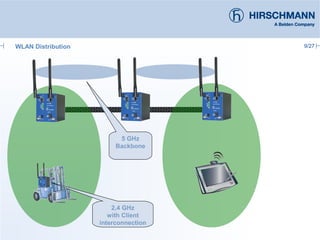
5 GHz
Backbone
2,4 GHz
with Client
interconnection
WLAN Distribution
10/27
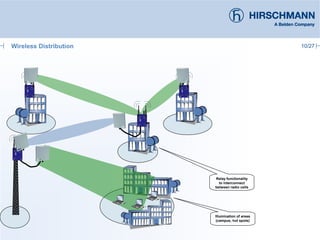
Relay functionality
to interconnect
between radio cells
Illumination of areas
(campus, hot spots)
Wireless Distribution
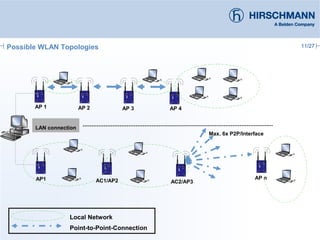
11/27Possible WLAN Topologies
LAN connection
Max. 6x P2P/Interface
AP1
AP 1
Local Network
Point-to-Point-Connection
AP 2 AP 3 AP 4
AC1/AP2 AC2/AP3
AP n
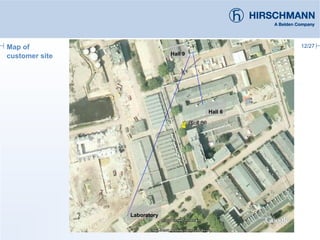
12/27Map of
customer site
Laboratory
Hall 9
Hall 6
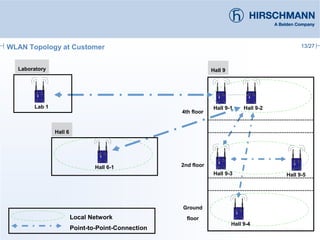
13/27WLAN Topology at Customer
Laboratory Hall 9
Hall 6
Hall 9-1
Hall 6-1
Hall 9-3
Hall 9-4
Hall 9-5
Lab 1 Hall 9-2
Local Network
Point-to-Point-Connection
4th floor
2nd floor
Ground
floor
14/27Threats for industrial WLAN networks
There are still some threats for WLAN in industrial environment:
- the connections are not stable enough
- rough environmental conditions
- Industrial Ethernet Protocols are very sensitive to packet latency and
interruptions (Profinet, Ethernet/IP)
- Safety applications need very high availability (failover < 99,999%)
- Usability should be as easy as plugging cables
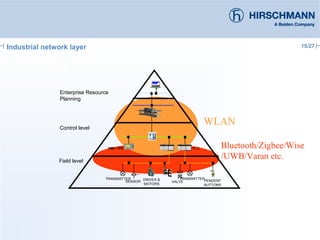
15/27
Field level
Control level
TRANSMITTER
PLC
VALVESENSOR
HMI / IPC
TRANSMITTER
PENDENT
BUTTONS
DRIVES &
MOTORS
Enterprise Resource
Planning
WLAN
Bluetooth/Zigbee/Wise
/UWB/Varan etc.
Industrial network layer
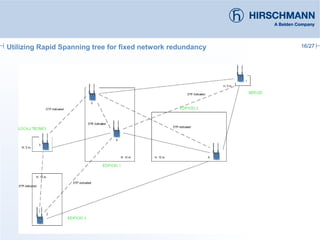
16/27Utilizing Rapid Spanning tree for fixed network redundancy
17/27Utilizing Rapid Spanning tree for fixed network redundancy
Advantages:
- Available today
- standardized protocol (802.1w)
- also used for ethernet networks
Missing:
- No automatic configuration of the topology
- fixed installation needed
- still high handover times
18/27Goals for improvement of industrial WLAN networks
Goals:
- rise the availability
- no more single points of failure
- easy-to-setup and to use
- reduce packet latency and handover times
Achieve by:
- create redundancy (which is basically controversial to 802.11 MAC functionality)
 using other topology: meshed networks
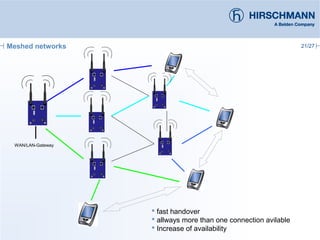
19/27Meshed network topology
History:
- Mid 1990ies created by DARPA for military applications on battlefields
- Improved by R&D companies like SRT International
- Wikipedia offers today more than 50 possible routing protocols for meshing
Features:
- Better scalability: network power increases by each hop added to it
- Automatic configuration and scalability
- very fast or even no handover times
- increase of availability of WLAN network
- quick and easy setup
- reduction of cables needed
20/27
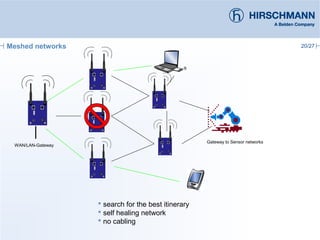
Gateway to Sensor networks
 search for the best itinerary
 self healing network
 no cabling
WAN/LAN-Gateway
Meshed networks
21/27
 fast handover
 allways more than one connection avilable
 Increase of availability
WAN/LAN-Gateway
Meshed networks
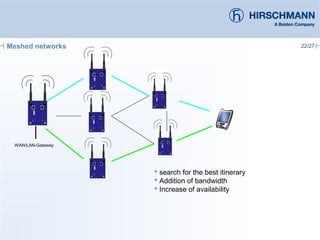
22/27
 search for the best itinerary
 Addition of bandwidth
 Increase of availability
WAN/LAN-Gateway
Meshed networks
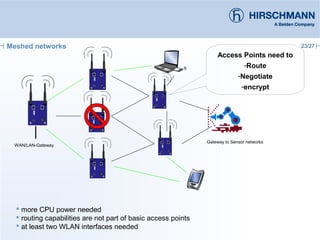
23/27
Gateway to Sensor networks
 more CPU power needed
 routing capabilities are not part of basic access points
 at least two WLAN interfaces needed
WAN/LAN-Gateway
Meshed networks
Access Points need to
-Route
-Negotiate
-encrypt
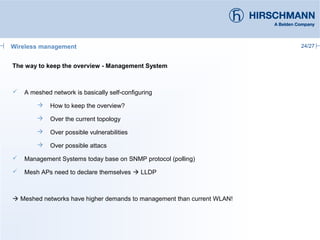
24/27
The way to keep the overview - Management System
 A meshed network is basically self-configuring
 How to keep the overview?
 Over the current topology
 Over possible vulnerabilities
 Over possible attacs
 Management Systems today base on SNMP protocol (polling)
 Mesh APs need to declare themselves  LLDP
 Meshed networks have higher demands to management than current WLAN!
Wireless management
25/27
Network Security is still a must!
 A meshed network is very flexible
 Authentication mechanisms are very static today
 802.1x needs external servers
 How to know which device may connect?
 How about Rogue APs?
 802.1x can be part of the AP already (BAT54-Rail Version 7.10)
 Meshed networks have higher demands to security functionality WLAN!
Wireless security
26/27
Hirschmann BAT54-Rail
The operating system offers many capabilities today
 IP routing is already implemented
 802.1x internal server and supplicant is available
 Equipped with two WLAN interfaces
 Equipped with powerful Intel CPU and sufficient memory
 It’s more than just a basic access point
 Meshing will be available by software update. No new hardware needed.
Roadmap:
 Find out which protocol is best (IEEE 802.11s is in discussion but maybe not
suitable for industrial applications): Q1/2008
 Implement and test: Q3/2008
The roadmap to Meshing
27/27
Thank you for your attention!

Wireless LAN Network Topologies (ENG)

  • 1.
  • 2.
    2/27 Markets Automation – Production,Service Energy – Data Transfer, Management Transportation – Data Transfer, Traffic Monitoring Industrial Wireless LAN
  • 3.
    3/27 Applications Interconnection to MobileDevices Enlighting of Halls and Production Environments Adding WLAN as Redundant Connection to Cable Installations Replacement of Cabling BAT54-Rail - Industrial Wireless LAN
  • 4.
    4/27 Focussed on Security Thereare three Types of Security : > Safety of Operation using Redundancy > Transmission Stability by optimzed WLAN Quality > Network Security by Authentication, Encryption and Firewall Industrial Wireless LAN
  • 5.
    5/27  Possible topologiesof networks  Advantages of the available possibilities  Disadvantages  Goals for improvement of WLAN availability  Threats to solve  possible solutions Today’s possibilities with WLAN in industrial environments
  • 6.
    6/27 Extension of existingLAN Clients can be: Notebooks, PCs or BAT54-Rail in Client Mode Frequency ranges: 5GHz or 2,4 GHz Clients move in between Access- Points Local Area Network WLAN Infrastructures Client Access-Point
  • 7.
    7/27 BAT54-Rail at Client or„Client Bridge“ Mode LAN-LAN coupling via WLAN LAN 1 LAN 2 SNR signalization by LED for Clients and Point-to- Point-Connections
  • 8.
    8/27 Enhanced Stability forWLAN  Two Radio Interfaces in access point and client  Redundant connection using Rapid Spanning Tree  Transparent to Industrial Ethernet Protocols (Layer 4)  Two Frequency Ranges simultaneously Network 2,4GHz Redundant Wireless LAN 5GHz
  • 9.
    9/27 5 GHz Backbone 2,4 GHz withClient interconnection WLAN Distribution
  • 10.
    10/27 Relay functionality to interconnect betweenradio cells Illumination of areas (campus, hot spots) Wireless Distribution
  • 11.
    11/27Possible WLAN Topologies LANconnection Max. 6x P2P/Interface AP1 AP 1 Local Network Point-to-Point-Connection AP 2 AP 3 AP 4 AC1/AP2 AC2/AP3 AP n
  • 12.
  • 13.
    13/27WLAN Topology atCustomer Laboratory Hall 9 Hall 6 Hall 9-1 Hall 6-1 Hall 9-3 Hall 9-4 Hall 9-5 Lab 1 Hall 9-2 Local Network Point-to-Point-Connection 4th floor 2nd floor Ground floor
  • 14.
    14/27Threats for industrialWLAN networks There are still some threats for WLAN in industrial environment: - the connections are not stable enough - rough environmental conditions - Industrial Ethernet Protocols are very sensitive to packet latency and interruptions (Profinet, Ethernet/IP) - Safety applications need very high availability (failover < 99,999%) - Usability should be as easy as plugging cables
  • 15.
    15/27 Field level Control level TRANSMITTER PLC VALVESENSOR HMI/ IPC TRANSMITTER PENDENT BUTTONS DRIVES & MOTORS Enterprise Resource Planning WLAN Bluetooth/Zigbee/Wise /UWB/Varan etc. Industrial network layer
  • 16.
    16/27Utilizing Rapid Spanningtree for fixed network redundancy
  • 17.
    17/27Utilizing Rapid Spanningtree for fixed network redundancy Advantages: - Available today - standardized protocol (802.1w) - also used for ethernet networks Missing: - No automatic configuration of the topology - fixed installation needed - still high handover times
  • 18.
    18/27Goals for improvementof industrial WLAN networks Goals: - rise the availability - no more single points of failure - easy-to-setup and to use - reduce packet latency and handover times Achieve by: - create redundancy (which is basically controversial to 802.11 MAC functionality)  using other topology: meshed networks
  • 19.
    19/27Meshed network topology History: -Mid 1990ies created by DARPA for military applications on battlefields - Improved by R&D companies like SRT International - Wikipedia offers today more than 50 possible routing protocols for meshing Features: - Better scalability: network power increases by each hop added to it - Automatic configuration and scalability - very fast or even no handover times - increase of availability of WLAN network - quick and easy setup - reduction of cables needed
  • 20.
    20/27 Gateway to Sensornetworks  search for the best itinerary  self healing network  no cabling WAN/LAN-Gateway Meshed networks
  • 21.
    21/27  fast handover allways more than one connection avilable  Increase of availability WAN/LAN-Gateway Meshed networks
  • 22.
    22/27  search forthe best itinerary  Addition of bandwidth  Increase of availability WAN/LAN-Gateway Meshed networks
  • 23.
    23/27 Gateway to Sensornetworks  more CPU power needed  routing capabilities are not part of basic access points  at least two WLAN interfaces needed WAN/LAN-Gateway Meshed networks Access Points need to -Route -Negotiate -encrypt
  • 24.
    24/27 The way tokeep the overview - Management System  A meshed network is basically self-configuring  How to keep the overview?  Over the current topology  Over possible vulnerabilities  Over possible attacs  Management Systems today base on SNMP protocol (polling)  Mesh APs need to declare themselves  LLDP  Meshed networks have higher demands to management than current WLAN! Wireless management
  • 25.
    25/27 Network Security isstill a must!  A meshed network is very flexible  Authentication mechanisms are very static today  802.1x needs external servers  How to know which device may connect?  How about Rogue APs?  802.1x can be part of the AP already (BAT54-Rail Version 7.10)  Meshed networks have higher demands to security functionality WLAN! Wireless security
  • 26.
    26/27 Hirschmann BAT54-Rail The operatingsystem offers many capabilities today  IP routing is already implemented  802.1x internal server and supplicant is available  Equipped with two WLAN interfaces  Equipped with powerful Intel CPU and sufficient memory  It’s more than just a basic access point  Meshing will be available by software update. No new hardware needed. Roadmap:  Find out which protocol is best (IEEE 802.11s is in discussion but maybe not suitable for industrial applications): Q1/2008  Implement and test: Q3/2008 The roadmap to Meshing
  • 27.
    27/27 Thank you foryour attention!

Editor's Notes

  • #12 &amp;lt;number&amp;gt; 14.04.16
  • #13 &amp;lt;number&amp;gt; 14.04.16
  • #14 &amp;lt;number&amp;gt; 14.04.16
  • #21 &amp;lt;number&amp;gt; 14.04.16
  • #22 &amp;lt;number&amp;gt; 14.04.16
  • #23 &amp;lt;number&amp;gt; 14.04.16
  • #24 &amp;lt;number&amp;gt; 14.04.16