Non-Terrestrial Networks
(NTN)
@3g4gUK
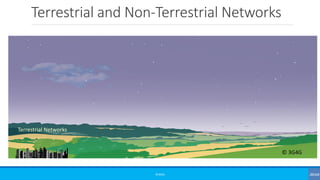
Terrestrial and Non-Terrestrial Networks
©3G4G
Terrestrial Networks
© 3G4G
Terrestrial and Non-Terrestrial Networks
©3G4G
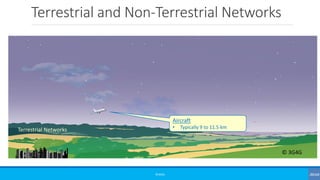
Aircraft
• Typically 9 to 11.5 kmTerrestrial Networks
© 3G4G
Terrestrial and Non-Terrestrial Networks
©3G4G
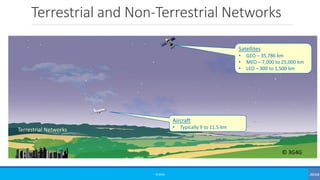
Satellites
• GEO – 35,786 km
• MEO – 7,000 to 25,000 km
• LEO – 300 to 1,500 km
Aircraft
• Typically 9 to 11.5 kmTerrestrial Networks
© 3G4G
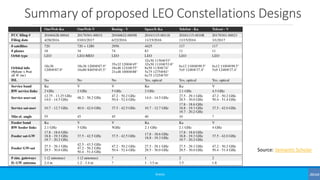
Summary of proposed LEO Constellations Designs
©3G4G
Source: Semantic Scholar
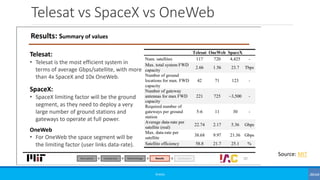
Telesat vs SpaceX vs OneWeb
©3G4G
Source: MIT
©3G4G
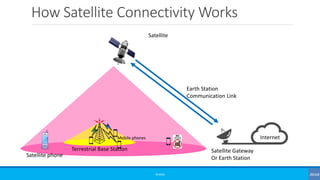
How Satellite Connectivity Works
©3G4G
Internet
Satellite Gateway
Or Earth Station
Satellite
Terrestrial Base Station
Earth Station
Communication Link
Mobile phones
Satellite phone
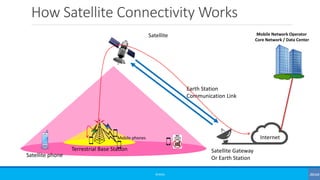
How Satellite Connectivity Works
©3G4G
Internet
Satellite Gateway
Or Earth Station
Satellite
Terrestrial Base Station
Earth Station
Communication Link
Mobile phones
Satellite phone
Mobile Network Operator
Core Network / Data Center
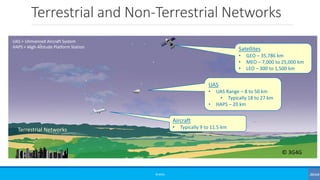
Terrestrial and Non-Terrestrial Networks
©3G4G
Satellites
• GEO – 35,786 km
• MEO – 7,000 to 25,000 km
• LEO – 300 to 1,500 km
UAS
• UAS Range – 8 to 50 km
• Typically 18 to 27 km
• HAPS – 20 km
Aircraft
• Typically 9 to 11.5 kmTerrestrial Networks
© 3G4G
UAS = Unmanned Aircraft System
HAPS = High-Altitude Platform Station
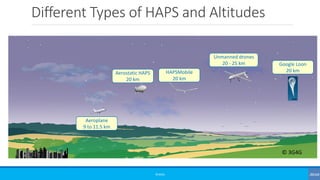
Different Types of HAPS and Altitudes
©3G4G
© 3G4G
Aeroplane
9 to 11.5 km
Google Loon
20 km
Unmanned drones
20 - 25 km
Aerostatic HAPS
20 km
HAPSMobile
20 km
©3G4G
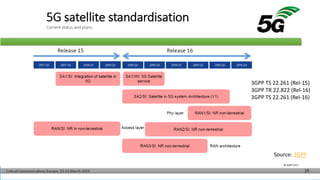
Source: 3GPP
3GPP TS 22.261 (Rel-15)
3GPP TR 22.822 (Rel-16)
3GPP TS 22.261 (Rel-16)
©3G4G
Source: 3GPP
NTN Characterization [3GPP TR 38.821]
©3G4G
Platforms Altitude range Orbit
Typical beam
footprint size
Low-Earth Orbit (LEO) satellite 300 – 1500 km
Circular around the earth
100 – 500 km
Medium-Earth Orbit (MEO)
satellite
7000 – 25000 km 100 – 500 km
Geostationary Earth Orbit
(GEO) satellite
35 786 km notional station keeping position fixed in
terms of elevation/azimuth with respect
to a given earth point
200 – 1000 km
UAS platform (including
HAPS)
8 – 50 km (20 km for HAPS) 5 - 200 km
High Elliptical Orbit (HEO)
satellite
400 – 50000 km Elliptical around the earth 200 – 1000 km
UAS - Unmanned Aircraft Systems
LTA - Lighter than Air UAS
HTA - Heavier than Air UAS
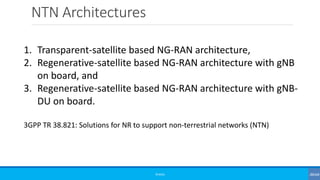
NTN Architectures
©3G4G
1. Transparent-satellite based NG-RAN architecture,
2. Regenerative-satellite based NG-RAN architecture with gNB
on board, and
3. Regenerative-satellite based NG-RAN architecture with gNB-
DU on board.
3GPP TR 38.821: Solutions for NR to support non-terrestrial networks (NTN)
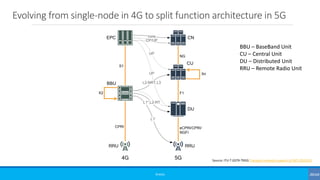
Evolving from single-node in 4G to split function architecture in 5G
©3G4G
Source: ITU-T GSTR-TN5G Transport network support of IMT-2020/5G
UPUP
L1'L1'
RRU
BBU
EPC
S1
CPRI
CN
CU
DU
RRU
F1
NG
eCPRI/CPRI/
NGFI
L1",L2-RTL1",L2-RT
L2-NRT,L3L2-NRT,L3
UPUP
CPCP/UP
corecore
4G 5G
Xn
X2
BBU – BaseBand Unit
CU – Central Unit
DU – Distributed Unit
RRU – Remote Radio Unit
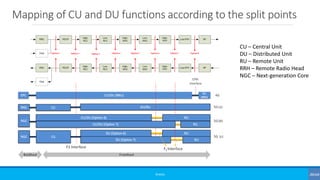
Mapping of CU and DU functions according to the split points
©3G4G
CU – Central Unit
DU – Distributed Unit
RU – Remote Unit
RRH – Remote Radio Head
NGC – Next-generation Core
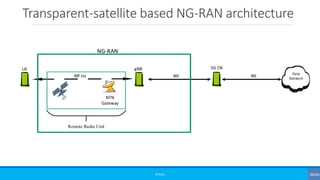
Transparent-satellite based NG-RAN architecture
©3G4G
UE gNB
NR Uu NG N6
5G CN
Data
Network
NTN
Gateway
NG-RAN
Remote Radio Unit
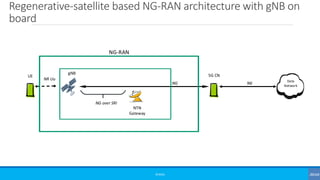
Regenerative-satellite based NG-RAN architecture with gNB on
board
©3G4G
UE
gNB
NR Uu
NG N6
5G CN
Data
Network
NTN
Gateway
NG-RAN
NG over SRI
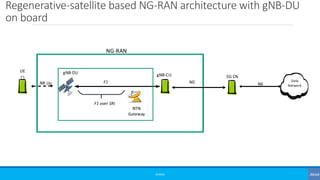
Regenerative-satellite based NG-RAN architecture with gNB-DU
on board
©3G4G
UE gNB-DU
NR Uu NG N6
5G CN
Data
Network
NTN
Gateway
NG-RAN
F1 over SRI
F1
gNB-CU
©3G4G
Use-Cases and Applications
©3G4G
• Continuity in connection over trains, boats, planes, etc.
• Connectivity for ships out in the ocean
• Service availability everywhere, especially for emergency
communications
• Connectivity for rural, remote, unserved and underserved areas
• Connectivity for M2M/IoT devices
• 3GPP TR 38.811, section 4.2 provides a lot more use cases for anyone
interested
3GPP References
©3G4G
• 3GPP TS 22.261: Service requirements for the 5G system;
Stage 1
• 3GPP TR 22.822: Study on using Satellite Access in 5G; Stage 1
• 3GPP TR 38.811: Study on New Radio (NR) to support non
terrestrial networks
• 3GPP TSG RAN meeting #83 RP-190710: Revised SID for Study
on solutions for NR to support non-terrestrial networks (NTN)
• 3GPP TR 38.821: Solutions for NR to support non-terrestrial
networks (NTN)
• 3GPP TS 38.401: NG-RAN; Architecture description
Thank You
To learn more, visit:
3G4G Website – https://www.3g4g.co.uk/
3G4G Blog – https://blog.3g4g.co.uk/
Operator Watch – https://operatorwatch.3g4g.co.uk/
Connectivity Technology Blog – https://www.connectivity.technology/
3G4G Small Cells Blog – https://smallcells.3g4g.co.uk/
Follow us on Twitter: https://twitter.com/3g4gUK
Follow us on Facebook: https://www.facebook.com/3g4gUK/
Follow us on LinkedIn: https://www.linkedin.com/company/3g4g
Follow us on SlideShare: https://www.slideshare.net/3G4GLtd
Follow us on YouTube: https://www.youtube.com/3G4G5G
©3G4G

Beginners: Non Terrestrial Networks (NTN)

  • 1.
  • 2.
    Terrestrial and Non-TerrestrialNetworks ©3G4G Terrestrial Networks © 3G4G
  • 3.
    Terrestrial and Non-TerrestrialNetworks ©3G4G Aircraft • Typically 9 to 11.5 kmTerrestrial Networks © 3G4G
  • 4.
    Terrestrial and Non-TerrestrialNetworks ©3G4G Satellites • GEO – 35,786 km • MEO – 7,000 to 25,000 km • LEO – 300 to 1,500 km Aircraft • Typically 9 to 11.5 kmTerrestrial Networks © 3G4G
  • 5.
    Summary of proposedLEO Constellations Designs ©3G4G Source: Semantic Scholar
  • 6.
    Telesat vs SpaceXvs OneWeb ©3G4G Source: MIT
  • 7.
  • 8.
    How Satellite ConnectivityWorks ©3G4G Internet Satellite Gateway Or Earth Station Satellite Terrestrial Base Station Earth Station Communication Link Mobile phones Satellite phone
  • 9.
    How Satellite ConnectivityWorks ©3G4G Internet Satellite Gateway Or Earth Station Satellite Terrestrial Base Station Earth Station Communication Link Mobile phones Satellite phone Mobile Network Operator Core Network / Data Center
  • 10.
    Terrestrial and Non-TerrestrialNetworks ©3G4G Satellites • GEO – 35,786 km • MEO – 7,000 to 25,000 km • LEO – 300 to 1,500 km UAS • UAS Range – 8 to 50 km • Typically 18 to 27 km • HAPS – 20 km Aircraft • Typically 9 to 11.5 kmTerrestrial Networks © 3G4G UAS = Unmanned Aircraft System HAPS = High-Altitude Platform Station
  • 11.
    Different Types ofHAPS and Altitudes ©3G4G © 3G4G Aeroplane 9 to 11.5 km Google Loon 20 km Unmanned drones 20 - 25 km Aerostatic HAPS 20 km HAPSMobile 20 km
  • 12.
    ©3G4G Source: 3GPP 3GPP TS22.261 (Rel-15) 3GPP TR 22.822 (Rel-16) 3GPP TS 22.261 (Rel-16)
  • 13.
  • 14.
    NTN Characterization [3GPPTR 38.821] ©3G4G Platforms Altitude range Orbit Typical beam footprint size Low-Earth Orbit (LEO) satellite 300 – 1500 km Circular around the earth 100 – 500 km Medium-Earth Orbit (MEO) satellite 7000 – 25000 km 100 – 500 km Geostationary Earth Orbit (GEO) satellite 35 786 km notional station keeping position fixed in terms of elevation/azimuth with respect to a given earth point 200 – 1000 km UAS platform (including HAPS) 8 – 50 km (20 km for HAPS) 5 - 200 km High Elliptical Orbit (HEO) satellite 400 – 50000 km Elliptical around the earth 200 – 1000 km UAS - Unmanned Aircraft Systems LTA - Lighter than Air UAS HTA - Heavier than Air UAS
  • 15.
    NTN Architectures ©3G4G 1. Transparent-satellitebased NG-RAN architecture, 2. Regenerative-satellite based NG-RAN architecture with gNB on board, and 3. Regenerative-satellite based NG-RAN architecture with gNB- DU on board. 3GPP TR 38.821: Solutions for NR to support non-terrestrial networks (NTN)
  • 16.
    Evolving from single-nodein 4G to split function architecture in 5G ©3G4G Source: ITU-T GSTR-TN5G Transport network support of IMT-2020/5G UPUP L1'L1' RRU BBU EPC S1 CPRI CN CU DU RRU F1 NG eCPRI/CPRI/ NGFI L1",L2-RTL1",L2-RT L2-NRT,L3L2-NRT,L3 UPUP CPCP/UP corecore 4G 5G Xn X2 BBU – BaseBand Unit CU – Central Unit DU – Distributed Unit RRU – Remote Radio Unit
  • 17.
    Mapping of CUand DU functions according to the split points ©3G4G CU – Central Unit DU – Distributed Unit RU – Remote Unit RRH – Remote Radio Head NGC – Next-generation Core
  • 18.
    Transparent-satellite based NG-RANarchitecture ©3G4G UE gNB NR Uu NG N6 5G CN Data Network NTN Gateway NG-RAN Remote Radio Unit
  • 19.
    Regenerative-satellite based NG-RANarchitecture with gNB on board ©3G4G UE gNB NR Uu NG N6 5G CN Data Network NTN Gateway NG-RAN NG over SRI
  • 20.
    Regenerative-satellite based NG-RANarchitecture with gNB-DU on board ©3G4G UE gNB-DU NR Uu NG N6 5G CN Data Network NTN Gateway NG-RAN F1 over SRI F1 gNB-CU
  • 21.
  • 22.
    Use-Cases and Applications ©3G4G •Continuity in connection over trains, boats, planes, etc. • Connectivity for ships out in the ocean • Service availability everywhere, especially for emergency communications • Connectivity for rural, remote, unserved and underserved areas • Connectivity for M2M/IoT devices • 3GPP TR 38.811, section 4.2 provides a lot more use cases for anyone interested
  • 23.
    3GPP References ©3G4G • 3GPPTS 22.261: Service requirements for the 5G system; Stage 1 • 3GPP TR 22.822: Study on using Satellite Access in 5G; Stage 1 • 3GPP TR 38.811: Study on New Radio (NR) to support non terrestrial networks • 3GPP TSG RAN meeting #83 RP-190710: Revised SID for Study on solutions for NR to support non-terrestrial networks (NTN) • 3GPP TR 38.821: Solutions for NR to support non-terrestrial networks (NTN) • 3GPP TS 38.401: NG-RAN; Architecture description
  • 24.
    Thank You To learnmore, visit: 3G4G Website – https://www.3g4g.co.uk/ 3G4G Blog – https://blog.3g4g.co.uk/ Operator Watch – https://operatorwatch.3g4g.co.uk/ Connectivity Technology Blog – https://www.connectivity.technology/ 3G4G Small Cells Blog – https://smallcells.3g4g.co.uk/ Follow us on Twitter: https://twitter.com/3g4gUK Follow us on Facebook: https://www.facebook.com/3g4gUK/ Follow us on LinkedIn: https://www.linkedin.com/company/3g4g Follow us on SlideShare: https://www.slideshare.net/3G4GLtd Follow us on YouTube: https://www.youtube.com/3G4G5G ©3G4G