Presented By : xxxxxx
Roll No: 12xxxxxxx
 LANs provide connectivity for
interconnecting computing resources
at the local levels of an organization
 Wired LANs
Limitations because of physical,
hard-wired infrastructure
 Wireless LANs provide
Flexibility
Portability
Mobility
Ease of Installation
Medical Professionals
Education
Temporary Situations
Airlines
Security Staff
Emergency Centers
In response to lacking standards, IEEE
developed the first internationally
recognized wireless LAN standard – IEEE
802.11
IEEE published 802.11 in 1997, after seven
years of work
Most prominent specification for WLANs
Scope of IEEE 802.11 is limited to Physical
and Data Link Layers.
Appliance Interoperability
Fast Product Development
Stable Future Migration
Price Reductions
The 802.11 standard takes into account
the following significant differences
between wireless and wired LANs:
Power Management
Security
Bandwidth
WLAN TopologyWLAN Topology
InfrastructureInfrastructure
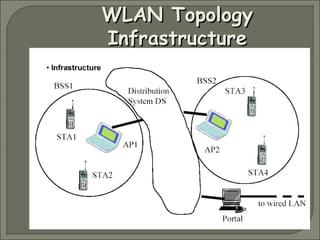
Distribution service (DS)
Used to exchange MAC frames from station in
one BSS to station in another BSS
Integration service
Transfer of data between station on IEEE
802.11 LAN and station on integrated IEEE
802.x LAN
Association
Establishes initial association between station
and AP
Re-association
Enables transfer of association from one AP to
another, allowing station to move from one BSS
to another
Disassociation
Association termination notice from station or
AP
Authentication
Establishes identity of stations to each other
De-authentication
Invoked when existing authentication is
terminated
Privacy
Prevents message contents from being read by
unintended recipient
MAC layer covers three functional
areas:
Reliable data delivery
Access control
Security
 Loss of frames due to noise, interference, and
propagation effects
 Frame exchange protocol
Source station transmits data
Destination responds with acknowledgment (ACK)
If source doesn’t receive ACK, it retransmits frame
 Four frame exchange for enhanced reliability
Source issues request to send (RTS)
Destination responds with clear to send (CTS)
Source transmits data
Destination responds with ACK
 Distributed Coordination Function (DCF)
Distributed access protocol
Contention-Based
Makes use of CSMA/CA rather than CSMA/CD
Suited for ad hoc network and ordinary asynchronous
traffic
 Point Coordination Function (PCF)
Alternative access method on top of DCF
Centralized access protocol
Contention-Free
Works like polling
Suited for time bound services like voice or
multimedia
Data Frames
Control Frames
RTS,CTS,ACK and PS-POLL
Management Frames
Authentication and De-Authentication
Association, Re-Association, and Disassociation
Beacon and Probe frames
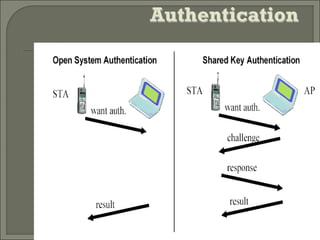
Authentication provided by
open system or shared key
authentication (Authentication
is used instead of wired media
physical connection)
Privacy provided by WEP
(Privacy is used to provide the
confidential aspects of closed
wired media)
An Integrity check is
performed using a 32-bit CRC
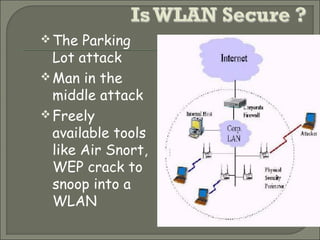
The Parking
Lot attack
Man in the
middle attack
Freely
available tools
like Air Snort,
WEP crack to
snoop into a
WLAN
Japan has introduced Millimeter Wave
Wireless LAN (MWWL).
Europe has introduced HIPERLAN (High
Performance Radio Local Area Network)
Features,capabilities, and technology similar to
those of IEEE 802.11 used in US
Developed by ETSI (European
Telecommunications standards institute)
Provides high speed communications (20Mbps)
Has technical advantages such as inclusion of
Quality of Service
WLANs move to maturity
Higher Speeds
Improved Security
Seamless end-to-end protocols
Better Error control
Long distances
New vendors
Better interoperability
Global networking
Anywhere, anytime,any-form connectivity…
 Wireless LANs very useful and
convenient, but current security state not
ideal for sensitive environments.
 Growing use and popularity require
increased focus on security

Wireless LAN By SAIKIRAN PANJALA

  • 1.
    Presented By :xxxxxx Roll No: 12xxxxxxx
  • 2.
     LANs provideconnectivity for interconnecting computing resources at the local levels of an organization  Wired LANs Limitations because of physical, hard-wired infrastructure  Wireless LANs provide Flexibility Portability Mobility Ease of Installation
  • 3.
  • 4.
    In response tolacking standards, IEEE developed the first internationally recognized wireless LAN standard – IEEE 802.11 IEEE published 802.11 in 1997, after seven years of work Most prominent specification for WLANs Scope of IEEE 802.11 is limited to Physical and Data Link Layers.
  • 5.
    Appliance Interoperability Fast ProductDevelopment Stable Future Migration Price Reductions The 802.11 standard takes into account the following significant differences between wireless and wired LANs: Power Management Security Bandwidth
  • 7.
  • 8.
    Distribution service (DS) Usedto exchange MAC frames from station in one BSS to station in another BSS Integration service Transfer of data between station on IEEE 802.11 LAN and station on integrated IEEE 802.x LAN
  • 9.
    Association Establishes initial associationbetween station and AP Re-association Enables transfer of association from one AP to another, allowing station to move from one BSS to another Disassociation Association termination notice from station or AP
  • 11.
    Authentication Establishes identity ofstations to each other De-authentication Invoked when existing authentication is terminated Privacy Prevents message contents from being read by unintended recipient
  • 12.
    MAC layer coversthree functional areas: Reliable data delivery Access control Security
  • 13.
     Loss offrames due to noise, interference, and propagation effects  Frame exchange protocol Source station transmits data Destination responds with acknowledgment (ACK) If source doesn’t receive ACK, it retransmits frame  Four frame exchange for enhanced reliability Source issues request to send (RTS) Destination responds with clear to send (CTS) Source transmits data Destination responds with ACK
  • 14.
     Distributed CoordinationFunction (DCF) Distributed access protocol Contention-Based Makes use of CSMA/CA rather than CSMA/CD Suited for ad hoc network and ordinary asynchronous traffic  Point Coordination Function (PCF) Alternative access method on top of DCF Centralized access protocol Contention-Free Works like polling Suited for time bound services like voice or multimedia
  • 15.
    Data Frames Control Frames RTS,CTS,ACKand PS-POLL Management Frames Authentication and De-Authentication Association, Re-Association, and Disassociation Beacon and Probe frames
  • 16.
    Authentication provided by opensystem or shared key authentication (Authentication is used instead of wired media physical connection) Privacy provided by WEP (Privacy is used to provide the confidential aspects of closed wired media) An Integrity check is performed using a 32-bit CRC
  • 18.
    The Parking Lot attack Manin the middle attack Freely available tools like Air Snort, WEP crack to snoop into a WLAN
  • 19.
    Japan has introducedMillimeter Wave Wireless LAN (MWWL). Europe has introduced HIPERLAN (High Performance Radio Local Area Network) Features,capabilities, and technology similar to those of IEEE 802.11 used in US Developed by ETSI (European Telecommunications standards institute) Provides high speed communications (20Mbps) Has technical advantages such as inclusion of Quality of Service
  • 20.
    WLANs move tomaturity Higher Speeds Improved Security Seamless end-to-end protocols Better Error control Long distances New vendors Better interoperability Global networking Anywhere, anytime,any-form connectivity…
  • 21.
     Wireless LANsvery useful and convenient, but current security state not ideal for sensitive environments.  Growing use and popularity require increased focus on security