Wireless LAN ?
A WLAN ( for wireless local area network, sometime is said to be LAWN, for local
area wireless network) is one in which a mobile user can connect to a local area network (LAN)
through a wireless (radio) connection. The IEEE 802.11 group of standards specify the
technologies for wireless LANs.
A definition of WLAN by Bradley Mitchell
A wireless local area network (WLAN) provides wireless network communication over
short distances using radio or infrared signals instead of traditional network cabling. A
WLAN is a type of local area network (LAN).
Types of Wireless Local Networks
A WLAN can be built using any of several different wireless network protocols, most
commonly either Wi-Fi or Bluetooth. Wireless LANs can contain many different kinds of
devices including
 mobile phones
 laptop and tablet computers
 Internet audio systems
 game consoles
 Internet-enabled home appliances
A WLAN can contain as few as two devices up to one hundred and more (although
wireless networks become increasingly difficult to manage as the number of devices
increases).
Wireless LAN
From Wikipedia, the free encyclopedia
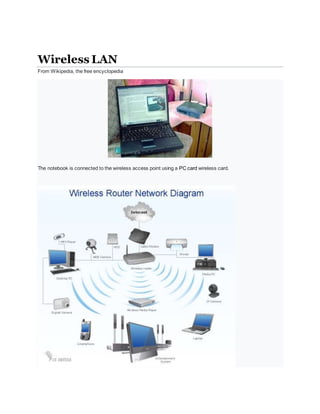
The notebook is connected to the wireless access point using a PC card wireless card.
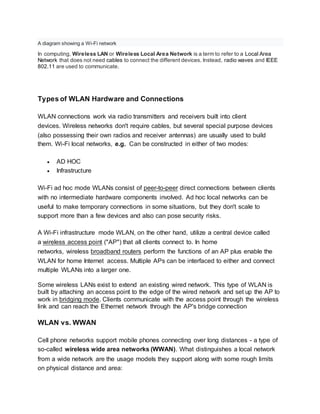
A diagram showing a Wi-Fi network
In computing, Wireless LAN or Wireless Local Area Network is a term to refer to a Local Area
Network that does not need cables to connect the different devices. Instead, radio waves and IEEE
802.11 are used to communicate.
Types of WLAN Hardware and Connections
WLAN connections work via radio transmitters and receivers built into client
devices. Wireless networks don't require cables, but several special purpose devices
(also possessing their own radios and receiver antennas) are usually used to build
them. Wi-Fi local networks, e.g. Can be constructed in either of two modes:
 AD HOC
 Infrastructure
Wi-Fi ad hoc mode WLANs consist of peer-to-peer direct connections between clients
with no intermediate hardware components involved. Ad hoc local networks can be
useful to make temporary connections in some situations, but they don't scale to
support more than a few devices and also can pose security risks.
A Wi-Fi infrastructure mode WLAN, on the other hand, utilize a central device called
a wireless access point ("AP") that all clients connect to. In home
networks, wireless broadband routers perform the functions of an AP plus enable the
WLAN for home Internet access. Multiple APs can be interfaced to either and connect
multiple WLANs into a larger one.
Some wireless LANs exist to extend an existing wired network. This type of WLAN is
built by attaching an access point to the edge of the wired network and set up the AP to
work in bridging mode. Clients communicate with the access point through the wireless
link and can reach the Ethernet network through the AP's bridge connection
WLAN vs. WWAN
Cell phone networks support mobile phones connecting over long distances - a type of
so-called wireless wide area networks (WWAN). What distinguishes a local network
from a wide network are the usage models they support along with some rough limits
on physical distance and area:
 local area networks cover individual buildings or public hotspots - spanning
hundreds or thousands of square feet (meters)
 wide area networks cover cities or geographic regions - spanning miles or
kilometers
Wireless LAN Security
Network security remains an important issue for WLANs. Wireless clients usually must
have their identity verified (a process called authentication) when joining a wireless
LAN. Technologies like WPA raise the level of security on wireless networks to rival that
of traditional wired networks
Advantages of Wireless LANs
 People can access the network from where they want; they are no longer limited by the length of
the cable
 Some places and vehicles have Wireless LANs. This means that people can access the internet
even outside their normal work environment, for example when they ride a train.
 Setting up a wireless LAN can be done with one box called wireless access point or wireless
router. This box can handle many connections at the same time. Wired networks require cables
to be laid. This can be difficult for certain places.
Disadvantages of Wireless LANs
 Wireless LANs use radio waves to communicate. Special care needs to be taken
to encrypt information.
 The signal is noisier than on wires, and more bandwidth needs to be spent on error correction
 A typical IEEE 802.11 access point has a range of meters from where devices can connect. To
extend the range more access points are needed.
 There are many reliability problems, especially those connected to interference from other
devices.
 Wireless LANs are much slower than wired ones; this may not matter for most users though,
because the bottleneck in a home network is usually the speed of the ADSL line or other Internet
connection.
References of websites used for data collection
https://simple.wikipedia.org/wiki/Wireless_LAN
https://www.lifewire.com/wlan-816565
http://searchmobilecomputing.techtarget.com/definition/wireless-LAN
Wireless lan

Wireless lan

  • 1.
    Wireless LAN ? AWLAN ( for wireless local area network, sometime is said to be LAWN, for local area wireless network) is one in which a mobile user can connect to a local area network (LAN) through a wireless (radio) connection. The IEEE 802.11 group of standards specify the technologies for wireless LANs. A definition of WLAN by Bradley Mitchell A wireless local area network (WLAN) provides wireless network communication over short distances using radio or infrared signals instead of traditional network cabling. A WLAN is a type of local area network (LAN). Types of Wireless Local Networks A WLAN can be built using any of several different wireless network protocols, most commonly either Wi-Fi or Bluetooth. Wireless LANs can contain many different kinds of devices including  mobile phones  laptop and tablet computers  Internet audio systems  game consoles  Internet-enabled home appliances A WLAN can contain as few as two devices up to one hundred and more (although wireless networks become increasingly difficult to manage as the number of devices increases).
  • 2.
    Wireless LAN From Wikipedia,the free encyclopedia The notebook is connected to the wireless access point using a PC card wireless card.
  • 3.
    A diagram showinga Wi-Fi network In computing, Wireless LAN or Wireless Local Area Network is a term to refer to a Local Area Network that does not need cables to connect the different devices. Instead, radio waves and IEEE 802.11 are used to communicate. Types of WLAN Hardware and Connections WLAN connections work via radio transmitters and receivers built into client devices. Wireless networks don't require cables, but several special purpose devices (also possessing their own radios and receiver antennas) are usually used to build them. Wi-Fi local networks, e.g. Can be constructed in either of two modes:  AD HOC  Infrastructure Wi-Fi ad hoc mode WLANs consist of peer-to-peer direct connections between clients with no intermediate hardware components involved. Ad hoc local networks can be useful to make temporary connections in some situations, but they don't scale to support more than a few devices and also can pose security risks. A Wi-Fi infrastructure mode WLAN, on the other hand, utilize a central device called a wireless access point ("AP") that all clients connect to. In home networks, wireless broadband routers perform the functions of an AP plus enable the WLAN for home Internet access. Multiple APs can be interfaced to either and connect multiple WLANs into a larger one. Some wireless LANs exist to extend an existing wired network. This type of WLAN is built by attaching an access point to the edge of the wired network and set up the AP to work in bridging mode. Clients communicate with the access point through the wireless link and can reach the Ethernet network through the AP's bridge connection WLAN vs. WWAN Cell phone networks support mobile phones connecting over long distances - a type of so-called wireless wide area networks (WWAN). What distinguishes a local network from a wide network are the usage models they support along with some rough limits on physical distance and area:
  • 4.
     local areanetworks cover individual buildings or public hotspots - spanning hundreds or thousands of square feet (meters)  wide area networks cover cities or geographic regions - spanning miles or kilometers Wireless LAN Security Network security remains an important issue for WLANs. Wireless clients usually must have their identity verified (a process called authentication) when joining a wireless LAN. Technologies like WPA raise the level of security on wireless networks to rival that of traditional wired networks Advantages of Wireless LANs  People can access the network from where they want; they are no longer limited by the length of the cable  Some places and vehicles have Wireless LANs. This means that people can access the internet even outside their normal work environment, for example when they ride a train.  Setting up a wireless LAN can be done with one box called wireless access point or wireless router. This box can handle many connections at the same time. Wired networks require cables to be laid. This can be difficult for certain places. Disadvantages of Wireless LANs  Wireless LANs use radio waves to communicate. Special care needs to be taken to encrypt information.  The signal is noisier than on wires, and more bandwidth needs to be spent on error correction  A typical IEEE 802.11 access point has a range of meters from where devices can connect. To extend the range more access points are needed.  There are many reliability problems, especially those connected to interference from other devices.  Wireless LANs are much slower than wired ones; this may not matter for most users though, because the bottleneck in a home network is usually the speed of the ADSL line or other Internet connection. References of websites used for data collection https://simple.wikipedia.org/wiki/Wireless_LAN https://www.lifewire.com/wlan-816565 http://searchmobilecomputing.techtarget.com/definition/wireless-LAN