Network-based Wireless for
Remote Monitoring Lead Acid
Battery
Present by:
Oka Danil Saputra (okadanil@kumoh.ac.kr)
Soo Young Shin (wdragon@kumoh.ac.kr)
Wireless & Emerging Network System (WENS)
Dept. of IT Convergence
School of Electronic
Kumoh National Institute of Technology
Published in Fall Conference of Korea Information and Communication Society (KICS) 2014.
DOC ID
 Introduction
 Related Works
 Contributions
 Proposed Scheme
 Test Bed
 Experimental Result
 Conclusion and Future Works
DOC ID
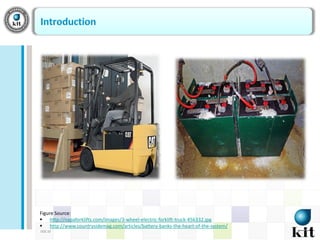
Figure Source:
 http://napaforklifts.com/images/3-wheel-electric-forklift-truck-456332.jpg
 http://www.countrysidemag.com/articles/battery-banks-the-heart-of-the-system/
DOC ID
Paper Lead Acid System Technology
[1] Electric Vehicle (Mobile)
GPRS
[2] Stationary (Fixed)
DOC ID
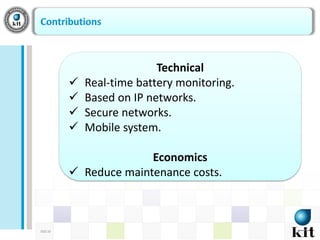
Technical
 Real-time battery monitoring.
 Based on IP networks.
 Secure networks.
 Mobile system.
Economics
 Reduce maintenance costs.
DOC ID
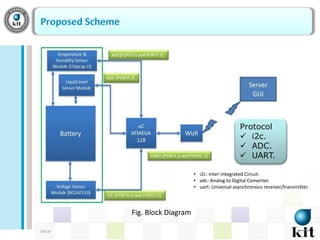
Fig. Block Diagram
Protocol
 i2c.
 ADC.
 UART.
• i2c: Inter-Integrated Circuit.
• adc: Analog to Digital Converter.
• uart: Universal asynchronous receiver/transmitter.
DOC ID
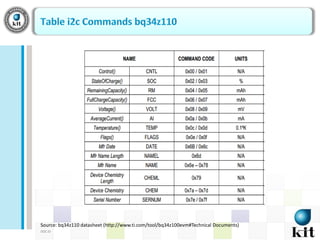
Source: bq34z110 datasheet (http://www.ti.com/tool/bq34z100evm#Technical Documents)
DOC ID
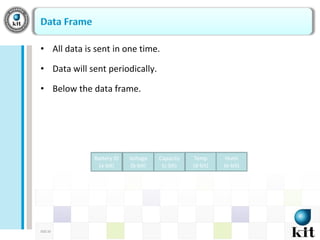
• All data is sent in one time.
• Data will sent periodically.
• Below the data frame.
Temp
(d-bit)
Humi
(e-bit)
Battery ID
(a-bit)
Voltage
(b-bit)
Capacity
(c-bit)
DOC ID
DOC ID
DOC ID
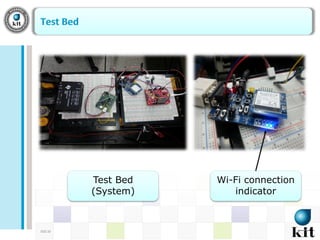
Wi-Fi connection
indicator
Test Bed
(System)
DOC ID
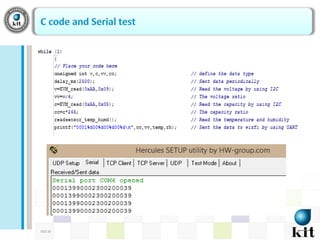
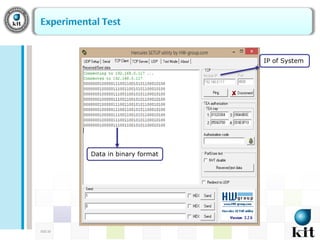
IP of System
Data in binary format
DOC ID
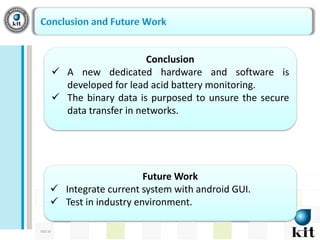
Conclusion
 A new dedicated hardware and software is
developed for lead acid battery monitoring.
 The binary data is purposed to unsure the secure
data transfer in networks.
Future Work
 Integrate current system with android GUI.
 Test in industry environment.
DOC ID
DOC ID

Network-based Wireless for Remote Monitoring Lead-Acid Battery

  • 1.
    Network-based Wireless for RemoteMonitoring Lead Acid Battery Present by: Oka Danil Saputra (okadanil@kumoh.ac.kr) Soo Young Shin (wdragon@kumoh.ac.kr) Wireless & Emerging Network System (WENS) Dept. of IT Convergence School of Electronic Kumoh National Institute of Technology Published in Fall Conference of Korea Information and Communication Society (KICS) 2014.
  • 2.
    DOC ID  Introduction Related Works  Contributions  Proposed Scheme  Test Bed  Experimental Result  Conclusion and Future Works
  • 3.
    DOC ID Figure Source: http://napaforklifts.com/images/3-wheel-electric-forklift-truck-456332.jpg  http://www.countrysidemag.com/articles/battery-banks-the-heart-of-the-system/
  • 4.
    DOC ID Paper LeadAcid System Technology [1] Electric Vehicle (Mobile) GPRS [2] Stationary (Fixed)
  • 5.
    DOC ID Technical  Real-timebattery monitoring.  Based on IP networks.  Secure networks.  Mobile system. Economics  Reduce maintenance costs.
  • 6.
    DOC ID Fig. BlockDiagram Protocol  i2c.  ADC.  UART. • i2c: Inter-Integrated Circuit. • adc: Analog to Digital Converter. • uart: Universal asynchronous receiver/transmitter.
  • 7.
    DOC ID Source: bq34z110datasheet (http://www.ti.com/tool/bq34z100evm#Technical Documents)
  • 8.
    DOC ID • Alldata is sent in one time. • Data will sent periodically. • Below the data frame. Temp (d-bit) Humi (e-bit) Battery ID (a-bit) Voltage (b-bit) Capacity (c-bit)
  • 9.
  • 10.
  • 11.
  • 12.
    DOC ID IP ofSystem Data in binary format
  • 13.
    DOC ID Conclusion  Anew dedicated hardware and software is developed for lead acid battery monitoring.  The binary data is purposed to unsure the secure data transfer in networks. Future Work  Integrate current system with android GUI.  Test in industry environment.
  • 14.
  • 15.