The Power-Bandwidth Tradeoff in
        MIMO Systems

     Marwan A. Hammouda


          August 15, 2012
The Purpose of this Presentation ..
 The purpose of this presentation is to highlight the concept of
 power-bandwidth trade-off in MIMO systems.
 Methods/techniques might be used to optimize/deal with
 this trade-off are out of the scope.
Agenda
  MIMO Systems
   Background
   System Structure
   Performance Improvements
• Power-Bandwidth Trade-off
    The Concept
   Example: SISO AWGN-Channel
   EE-SE Trade-off for MIMO System
• EE-ES Trade-off for MIMO Systems
    MIMO Capacity
   EE-SE Approximations – 1
   EE-SE Approximations – 2
   Simulation Results
   Discussion
• Conclusions
• References
MIMO Systems
Background
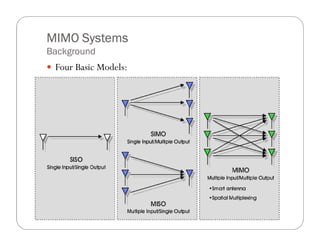
 Four Basic Models:
MIMO Systems
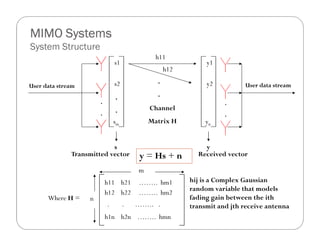
System Structure
                                              h11
                               s1                            y1
                                                  h12
                               s2             .              y2
User data stream                                                         User data stream
                               .              .
                       .                                           .
                               .            Channel
                       .                                           .
                               sm           Matrix H         yn


                           s                                y
              Transmitted vector         y = Hs + n       Received vector

                                        m
                           h11 h21      …….. hm1        hij is a Complex Gaussian
                                                        random variable that models
                           h12 h22      …….. hm2
      Where H =    n                                    fading gain between the ith
                           .        .   …….. .          transmit and jth receive antenna
                           h1n h2n …….. hmn
MIMO Systems
Performance Improvements

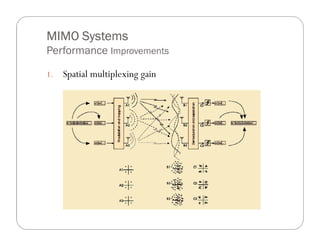
1.      Spatial multiplexing gain               spectral efficiency
     Yields a linear (in the minimum of the number of transmit
     and receive antennas) increase in capacity for no additional
     power or bandwidth expenditure
     The corresponding gain is realized by simultaneously
     transmitting independent data streams in the same frequency
     band.
      In rich scattering environments, the receiver exploits
     differences in the spatial signatures of the multiplexed
     streams to separate the different signals, thereby realizing a
     capacity gain.
MIMO Systems
Performance Improvements

1.   Spatial multiplexing gain
MIMO Systems
Performance Improvements

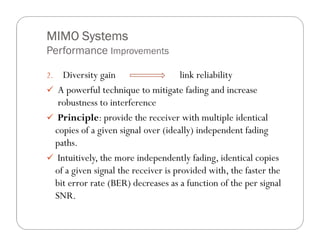
2.      Diversity gain                   link reliability
      A powerful technique to mitigate fading and increase
      robustness to interference
      Principle: provide the receiver with multiple identical
     copies of a given signal over (ideally) independent fading
     paths.
      Intuitively, the more independently fading, identical copies
     of a given signal the receiver is provided with, the faster the
     bit error rate (BER) decreases as a function of the per signal
     SNR.
MIMO Systems
Performance Improvements

2.    Diversity gain
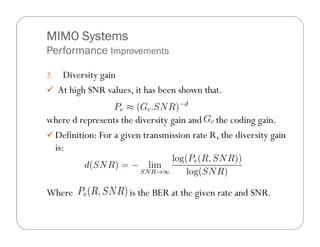
     At high SNR values, it has been shown that.

where d represents the diversity gain and the coding gain.
 Definition: For a given transmission rate R, the diversity gain
 is:


Where                  is the BER at the given rate and SNR.
MIMO Systems
Performance Improvements

3.     Array gain                 power efficiency
     Achieved in MIMO systems through the enhancement of
     average signal-to-noise ratio (SNR) due to the transmission
     and reception by multiple antennas.
     Availability of channel state information (CSI) at the
     transmitter/receiver is necessary to realize transmit/receive
     array gains.
     Principle: To obtain the full array gain, one should transmit
     using the maximum eigenmode of the channel
MIMO Systems
Performance Improvements

3.  Array gain
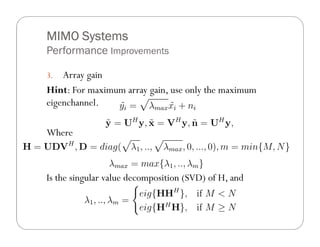
Hint: For maximum array gain, use only the maximum
eigenchannel.

Where


Is the singular value decomposition (SVD) of H, and
Power-
 Power-Bandwidth Trade-off
                 Trade-
 The concept
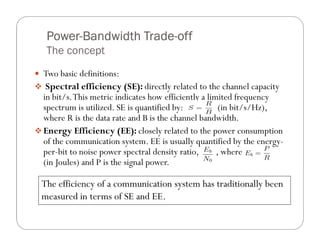
Two basic definitions:
 Spectral efficiency (SE): directly related to the channel capacity
in bit/s. This metric indicates how efficiently a limited frequency
spectrum is utilized. SE is quantified by:            (in bit/s/Hz),
where R is the data rate and B is the channel bandwidth.
Energy Efficiency (EE): closely related to the power consumption
of the communication system. EE is usually quantified by the energy-
per-bit to noise power spectral density ratio,       , where
(in Joules) and P is the signal power.

The efficiency of a communication system has traditionally been
measured in terms of SE and EE.
For any communication systems, it is desired to minimize the
 consumed power, and minimize the required bandwidth as
 well for a given R, or equivalently maximizing both SE and
 EE.
 However, this is not possible!
 As a simple example, for AWGN channel, any achievable data
 rate is upper bounded by

The power-bandwidth trade-off is commonly known
as EE-SE trade-off, where maximizing both EE and SE is
Equivalent to maximizing one and minimizing the other.
Power-
   Power-Bandwidth Trade-off
                   Trade-
   The concept

To mathematically formulate the EE-SE trade-off, lets follow the
following steps:
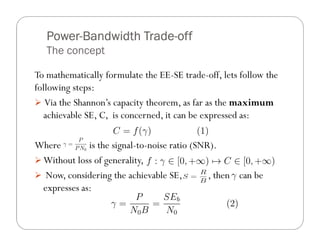
   Via the Shannon’s capacity theorem, as far as the maximum
  achievable SE, C, is concerned, it can be expressed as:

Where        is the signal-to-noise ratio (SNR).
 Without loss of generality,
  Now, considering the achievable SE,         , then can be
 expresses as:
Power-
   Power-Bandwidth Trade-off
                   Trade-
   The concept

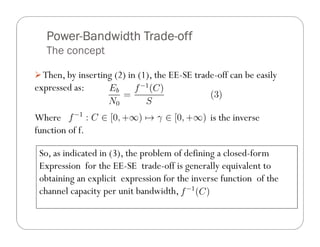
  Then, by inserting (2) in (1), the EE-SE trade-off can be easily
expressed as:

Where                                          is the inverse
function of f.

 So, as indicated in (3), the problem of defining a closed-form
 Expression for the EE-SE trade-off is generally equivalent to
 obtaining an explicit expression for the inverse function of the
 channel capacity per unit bandwidth,
Power-
Power-Bandwidth Trade-off
                Trade-
Example: SISO AWGN-Channel

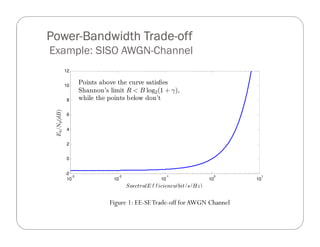
  As a simple example, consider a simple additive white
  Gaussian noise (AWGN) channel. In this case,


And hence,         is directly given by

Substituting this formula in (3), and using C instead of S, EE-
SE trade-off for AWGN channel can be expressed as:
Power-
Power-Bandwidth Trade-off
                Trade-
Example: SISO AWGN-Channel
               12


               10
                       Points above the curve satisfies
                       Shannon’s limit R < B log2 (1 + γ),
               8       while the points below don’t
 Eb /N0 (dB)


               6
     N


               4


               2


               0


               -2
                  -3                -2                  -1                 0    1
                10                 10                 10                  10   10
                                         SpectralEf f iciency(bit/s/Hz)


                                 Figure 1: EE-SE Trade-off for AWGN Channel
Power-
Power-Bandwidth Trade-off
                Trade-
EE-SE Trade-off for MIMO System

 In MIMO systems, the closed form of EE-SE trade-off is
 more complicated since         doesn’t have a straightforward
 formulation. In this case, approximations of          can
 provide an acceptable solution.
 As known, capacity expression for MIMO differs according
 to the channel model used. In this presentation, the channel
 is assumed to be a Rayleigh Fading channel with Gaussian
 noise, which is a general case and other cases can be
 considered as special cases.
EE- Trade-
EE-ES Trade-off for MIMO Systems
MIMO Capacity

Consider the MIMO-system model
                             y = Hx + n
With:
o The signal             is transmitted over M transmit antennas
  and received over N received antennas,
o                   , is a random matrix having independent and
  identically distributed (i.i.d.) complex circular Gaussian
  entries with zero-mean and unit variance.
o n: zero–mean complex Gaussian noise. Independent and
  equal variance real and imaginary parts. E[nn†] = IN
EE- Trade-
EE-ES Trade-off for MIMO Systems
MIMO Capacity

o Also consider                       , where
is the total transmitted power.
o Then, the ergodic channel capacity per unit bandwidth of the
   MIMO Rayleigh fading channel is accordingly expressed as:


  H matrix is assumed to be unknown at the transmitter.
  Considering the special case when the channel is a deterministic
  Gaussian and H still Unknown at the transmitter, (4) can be
  re-expressed as:
EE- Trade-
EE-ES Trade-off for MIMO Systems
MIMO Capacity

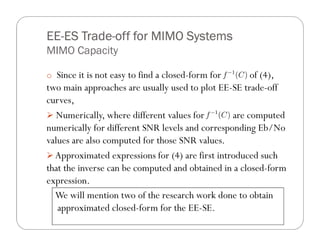
o Since it is not easy to find a closed-form for      of (4),
two main approaches are usually used to plot EE-SE trade-off
curves,
   Numerically, where different values for       are computed
numerically for different SNR levels and corresponding Eb/No
values are also computed for those SNR values.
  Approximated expressions for (4) are first introduced such
that the inverse can be computed and obtained in a closed-form
expression.
  We will mention two of the research work done to obtain
   approximated closed-form for the EE-SE.
EE- Trade-
EE-ES Trade-off for MIMO Systems
EE-SE Approximations - 1

o In [1], they approximated the EE-SE trade-off for the
situation of low SE and low EE.
o The approximated EE-SE trade-off is expressed as:

                                              (5)


  Where         donates the minimum required for reliable
  communication, and denotes the slope of spectral
  efficiency in b/s/Hz/(3 dB) at the point
EE- Trade-
EE-ES Trade-off for MIMO Systems
EE-SE Approximations - 1


Where                  are the first and second derivatives of
                  , respectively.
For our assumed channel model,
EE- Trade-
EE-ES Trade-off for MIMO Systems
EE-SE Approximations - 2

o In [2], a closed-form approximation is provided for (4), as
follow:

Where


And            is the ratio between receive and transmit
antennas
o This approximation was approved to have an acceptable
accuracy for M or N >2
EE- Trade-
 EE-ES Trade-off for MIMO Systems
 EE-SE Approximations - 2

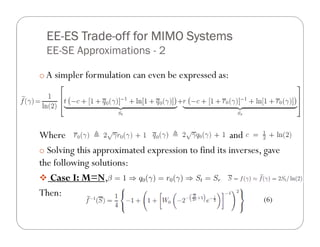
o A simpler formulation can even be expressed as:


Where                     ,                         and
o Solving this approximated expression to find its inverses, gave
the following solutions:
   Case I: M=N,                                   ,
Then:
                                                            (6)
EE- Trade-
  EE-ES Trade-off for MIMO Systems
  EE-SE Approximations - 2

   Case II: M≠N,                        , then
                                                              (7)

Where:                           ,
and


             are values depending on the value of   (see table I
in [2])
EE- Trade-
 EE-ES Trade-off for MIMO Systems
 EE-SE Approximations - 2

In (6) and (7),    is the real branch of the Lambert W function
which is the inverse of the function              and thus it
satisfies                         , and then,
EE- Trade-
 EE-ES Trade-off for MIMO Systems
 Simulation Results

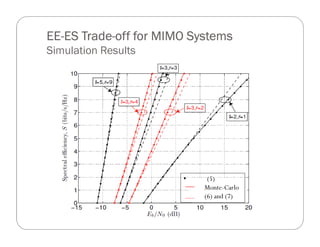
The following simulation result presented in [2], where the EE-
SE trade-offs is plotted for three methods:
   Numerical computation: as mentioned previously using Monte
Carlo simulation to get the inverse of (4).
   Using approximation-1 as described in (5), and detailed in [1].
   Using approximation-2 as described in (6) and (7) and detailed
in [2].

Results are simulated for different number of transmit (t) and
receive (r) antennas.
EE- Trade-
EE-ES Trade-off for MIMO Systems
Simulation Results


                       •    (5)
                           Monte-Carlo
                           (6) and (7)
EE- Trade-
 EE-ES Trade-off for MIMO Systems
 Discussion

Simulation results show a good fit between the exact expression
in (4) and the approximated ones in (6) and (7) for wide range of
SE and different values of transmit and receive antennas, while
the fit is not that accurate with the approximated expression in
(5) when the SE is getting higher specially for small number of
transmit and receive antennas.
Conclusions
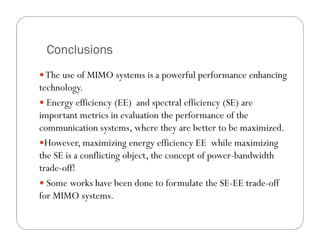
  The use of MIMO systems is a powerful performance enhancing
technology.
  Energy efficiency (EE) and spectral efficiency (SE) are
important metrics in evaluation the performance of the
communication systems, where they are better to be maximized.
  However, maximizing energy efficiency EE while maximizing
the SE is a conflicting object, the concept of power-bandwidth
trade-off!
  Some works have been done to formulate the SE-EE trade-off
for MIMO systems.
References
[1] S. Verdu, "Spectral efficiency in the wideband regime", IEEE Trans. Inf. Theory,,
   vol. 48, no. 6, pp. 13191343, June 2002
[2] F. Hliot, M. Imran, and R. Tafazolli, "On the Energy efficiency -Spectral efficiency
   Trade-o over the MIMO Rayleigh Fading Channel“ ,IEEE Trans. Communications,
   VOL. 60, NO. 5, MAY 2012.
[3] I. E. Telatar, "Capacity of multi-antenna Gaussian channels“ ,Europe. Trans.
   Telecomm. Related Techno, vol. 10, no. 6, pp. 585596, Nov. 1999.
[4] F. Hliot, M. Imran, and R. Tafazolli, "An accurate closed-form approximation of
   the energy efficiency -spectral efficiency trade-o over the MIMO Rayleigh fading
   channel“ ,in Proc. 2011 IEEE ICC, 4th Int. Workshop Green Comm..,
[5] O. Oyman and A. J. Paulraj, "Spectral efficiency of relay networks in the power
   limited regime",in Proc. 2004 Allerton Conf. Commun., Control Computing.
[6] S. de la Kethulle, "An Overview of MIMO Systems in Wireless
   communications," Lecture in Communication Theory for Wireless Channels,
   September 27, 2004.

The Power-Bandwidth Tradeoff in MIMO Systems

  • 1.
    The Power-Bandwidth Tradeoffin MIMO Systems Marwan A. Hammouda August 15, 2012
  • 2.
    The Purpose ofthis Presentation .. The purpose of this presentation is to highlight the concept of power-bandwidth trade-off in MIMO systems. Methods/techniques might be used to optimize/deal with this trade-off are out of the scope.
  • 3.
    Agenda MIMOSystems Background System Structure Performance Improvements • Power-Bandwidth Trade-off The Concept Example: SISO AWGN-Channel EE-SE Trade-off for MIMO System • EE-ES Trade-off for MIMO Systems MIMO Capacity EE-SE Approximations – 1 EE-SE Approximations – 2 Simulation Results Discussion • Conclusions • References
  • 4.
  • 5.
    MIMO Systems System Structure h11 s1 y1 h12 s2 . y2 User data stream User data stream . . . . . Channel . . sm Matrix H yn s y Transmitted vector y = Hs + n Received vector m h11 h21 …….. hm1 hij is a Complex Gaussian random variable that models h12 h22 …….. hm2 Where H = n fading gain between the ith . . …….. . transmit and jth receive antenna h1n h2n …….. hmn
  • 6.
    MIMO Systems Performance Improvements 1. Spatial multiplexing gain spectral efficiency Yields a linear (in the minimum of the number of transmit and receive antennas) increase in capacity for no additional power or bandwidth expenditure The corresponding gain is realized by simultaneously transmitting independent data streams in the same frequency band. In rich scattering environments, the receiver exploits differences in the spatial signatures of the multiplexed streams to separate the different signals, thereby realizing a capacity gain.
  • 7.
    MIMO Systems Performance Improvements 1. Spatial multiplexing gain
  • 8.
    MIMO Systems Performance Improvements 2. Diversity gain link reliability A powerful technique to mitigate fading and increase robustness to interference Principle: provide the receiver with multiple identical copies of a given signal over (ideally) independent fading paths. Intuitively, the more independently fading, identical copies of a given signal the receiver is provided with, the faster the bit error rate (BER) decreases as a function of the per signal SNR.
  • 9.
    MIMO Systems Performance Improvements 2. Diversity gain At high SNR values, it has been shown that. where d represents the diversity gain and the coding gain. Definition: For a given transmission rate R, the diversity gain is: Where is the BER at the given rate and SNR.
  • 10.
    MIMO Systems Performance Improvements 3. Array gain power efficiency Achieved in MIMO systems through the enhancement of average signal-to-noise ratio (SNR) due to the transmission and reception by multiple antennas. Availability of channel state information (CSI) at the transmitter/receiver is necessary to realize transmit/receive array gains. Principle: To obtain the full array gain, one should transmit using the maximum eigenmode of the channel
  • 11.
    MIMO Systems Performance Improvements 3. Array gain Hint: For maximum array gain, use only the maximum eigenchannel. Where Is the singular value decomposition (SVD) of H, and
  • 12.
    Power- Power-Bandwidth Trade-off Trade- The concept Two basic definitions: Spectral efficiency (SE): directly related to the channel capacity in bit/s. This metric indicates how efficiently a limited frequency spectrum is utilized. SE is quantified by: (in bit/s/Hz), where R is the data rate and B is the channel bandwidth. Energy Efficiency (EE): closely related to the power consumption of the communication system. EE is usually quantified by the energy- per-bit to noise power spectral density ratio, , where (in Joules) and P is the signal power. The efficiency of a communication system has traditionally been measured in terms of SE and EE.
  • 13.
    For any communicationsystems, it is desired to minimize the consumed power, and minimize the required bandwidth as well for a given R, or equivalently maximizing both SE and EE. However, this is not possible! As a simple example, for AWGN channel, any achievable data rate is upper bounded by The power-bandwidth trade-off is commonly known as EE-SE trade-off, where maximizing both EE and SE is Equivalent to maximizing one and minimizing the other.
  • 14.
    Power- Power-Bandwidth Trade-off Trade- The concept To mathematically formulate the EE-SE trade-off, lets follow the following steps: Via the Shannon’s capacity theorem, as far as the maximum achievable SE, C, is concerned, it can be expressed as: Where is the signal-to-noise ratio (SNR). Without loss of generality, Now, considering the achievable SE, , then can be expresses as:
  • 15.
    Power- Power-Bandwidth Trade-off Trade- The concept Then, by inserting (2) in (1), the EE-SE trade-off can be easily expressed as: Where is the inverse function of f. So, as indicated in (3), the problem of defining a closed-form Expression for the EE-SE trade-off is generally equivalent to obtaining an explicit expression for the inverse function of the channel capacity per unit bandwidth,
  • 16.
    Power- Power-Bandwidth Trade-off Trade- Example: SISO AWGN-Channel As a simple example, consider a simple additive white Gaussian noise (AWGN) channel. In this case, And hence, is directly given by Substituting this formula in (3), and using C instead of S, EE- SE trade-off for AWGN channel can be expressed as:
  • 17.
    Power- Power-Bandwidth Trade-off Trade- Example: SISO AWGN-Channel 12 10 Points above the curve satisfies Shannon’s limit R < B log2 (1 + γ), 8 while the points below don’t Eb /N0 (dB) 6 N 4 2 0 -2 -3 -2 -1 0 1 10 10 10 10 10 SpectralEf f iciency(bit/s/Hz) Figure 1: EE-SE Trade-off for AWGN Channel
  • 18.
    Power- Power-Bandwidth Trade-off Trade- EE-SE Trade-off for MIMO System In MIMO systems, the closed form of EE-SE trade-off is more complicated since doesn’t have a straightforward formulation. In this case, approximations of can provide an acceptable solution. As known, capacity expression for MIMO differs according to the channel model used. In this presentation, the channel is assumed to be a Rayleigh Fading channel with Gaussian noise, which is a general case and other cases can be considered as special cases.
  • 19.
    EE- Trade- EE-ES Trade-offfor MIMO Systems MIMO Capacity Consider the MIMO-system model y = Hx + n With: o The signal is transmitted over M transmit antennas and received over N received antennas, o , is a random matrix having independent and identically distributed (i.i.d.) complex circular Gaussian entries with zero-mean and unit variance. o n: zero–mean complex Gaussian noise. Independent and equal variance real and imaginary parts. E[nn†] = IN
  • 20.
    EE- Trade- EE-ES Trade-offfor MIMO Systems MIMO Capacity o Also consider , where is the total transmitted power. o Then, the ergodic channel capacity per unit bandwidth of the MIMO Rayleigh fading channel is accordingly expressed as: H matrix is assumed to be unknown at the transmitter. Considering the special case when the channel is a deterministic Gaussian and H still Unknown at the transmitter, (4) can be re-expressed as:
  • 21.
    EE- Trade- EE-ES Trade-offfor MIMO Systems MIMO Capacity o Since it is not easy to find a closed-form for of (4), two main approaches are usually used to plot EE-SE trade-off curves, Numerically, where different values for are computed numerically for different SNR levels and corresponding Eb/No values are also computed for those SNR values. Approximated expressions for (4) are first introduced such that the inverse can be computed and obtained in a closed-form expression. We will mention two of the research work done to obtain approximated closed-form for the EE-SE.
  • 22.
    EE- Trade- EE-ES Trade-offfor MIMO Systems EE-SE Approximations - 1 o In [1], they approximated the EE-SE trade-off for the situation of low SE and low EE. o The approximated EE-SE trade-off is expressed as: (5) Where donates the minimum required for reliable communication, and denotes the slope of spectral efficiency in b/s/Hz/(3 dB) at the point
  • 23.
    EE- Trade- EE-ES Trade-offfor MIMO Systems EE-SE Approximations - 1 Where are the first and second derivatives of , respectively. For our assumed channel model,
  • 24.
    EE- Trade- EE-ES Trade-offfor MIMO Systems EE-SE Approximations - 2 o In [2], a closed-form approximation is provided for (4), as follow: Where And is the ratio between receive and transmit antennas o This approximation was approved to have an acceptable accuracy for M or N >2
  • 25.
    EE- Trade- EE-ESTrade-off for MIMO Systems EE-SE Approximations - 2 o A simpler formulation can even be expressed as: Where , and o Solving this approximated expression to find its inverses, gave the following solutions: Case I: M=N, , Then: (6)
  • 26.
    EE- Trade- EE-ES Trade-off for MIMO Systems EE-SE Approximations - 2 Case II: M≠N, , then (7) Where: , and are values depending on the value of (see table I in [2])
  • 27.
    EE- Trade- EE-ESTrade-off for MIMO Systems EE-SE Approximations - 2 In (6) and (7), is the real branch of the Lambert W function which is the inverse of the function and thus it satisfies , and then,
  • 28.
    EE- Trade- EE-ESTrade-off for MIMO Systems Simulation Results The following simulation result presented in [2], where the EE- SE trade-offs is plotted for three methods: Numerical computation: as mentioned previously using Monte Carlo simulation to get the inverse of (4). Using approximation-1 as described in (5), and detailed in [1]. Using approximation-2 as described in (6) and (7) and detailed in [2]. Results are simulated for different number of transmit (t) and receive (r) antennas.
  • 29.
    EE- Trade- EE-ES Trade-offfor MIMO Systems Simulation Results • (5) Monte-Carlo (6) and (7)
  • 30.
    EE- Trade- EE-ESTrade-off for MIMO Systems Discussion Simulation results show a good fit between the exact expression in (4) and the approximated ones in (6) and (7) for wide range of SE and different values of transmit and receive antennas, while the fit is not that accurate with the approximated expression in (5) when the SE is getting higher specially for small number of transmit and receive antennas.
  • 31.
    Conclusions Theuse of MIMO systems is a powerful performance enhancing technology. Energy efficiency (EE) and spectral efficiency (SE) are important metrics in evaluation the performance of the communication systems, where they are better to be maximized. However, maximizing energy efficiency EE while maximizing the SE is a conflicting object, the concept of power-bandwidth trade-off! Some works have been done to formulate the SE-EE trade-off for MIMO systems.
  • 32.
    References [1] S. Verdu,"Spectral efficiency in the wideband regime", IEEE Trans. Inf. Theory,, vol. 48, no. 6, pp. 13191343, June 2002 [2] F. Hliot, M. Imran, and R. Tafazolli, "On the Energy efficiency -Spectral efficiency Trade-o over the MIMO Rayleigh Fading Channel“ ,IEEE Trans. Communications, VOL. 60, NO. 5, MAY 2012. [3] I. E. Telatar, "Capacity of multi-antenna Gaussian channels“ ,Europe. Trans. Telecomm. Related Techno, vol. 10, no. 6, pp. 585596, Nov. 1999. [4] F. Hliot, M. Imran, and R. Tafazolli, "An accurate closed-form approximation of the energy efficiency -spectral efficiency trade-o over the MIMO Rayleigh fading channel“ ,in Proc. 2011 IEEE ICC, 4th Int. Workshop Green Comm.., [5] O. Oyman and A. J. Paulraj, "Spectral efficiency of relay networks in the power limited regime",in Proc. 2004 Allerton Conf. Commun., Control Computing. [6] S. de la Kethulle, "An Overview of MIMO Systems in Wireless communications," Lecture in Communication Theory for Wireless Channels, September 27, 2004.