Winter tyres: when and why?
WINTER TYRES
Winter tyres have technical and constructional features that make them
suitable for use on snow- or mud-covered surfaces, and when the bitumen
is especially cold, guaranteeing better grip on slippery and wet surfaces.
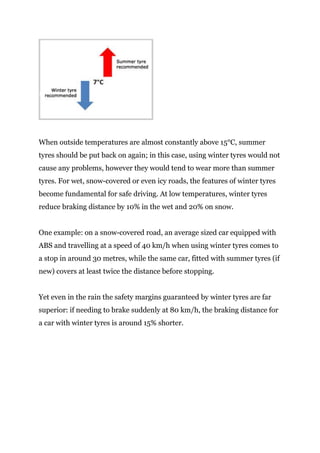
Winter tyres are recommended when the temperature falls below 7°C. This
is in fact the temperature at which summer tyre treads tend to harden,
causing a considerable decline in performance, comfort and driving safety.
The specific compound used for winter tyres, however, ensures flexibility at
such temperatures, thus guaranteeing perfect contact with the ground at all
times.
When outside temperatures are almost constantly above 15°C, summer
tyres should be put back on again; in this case, using winter tyres would not
cause any problems, however they would tend to wear more than summer
tyres. For wet, snow-covered or even icy roads, the features of winter tyres
become fundamental for safe driving. At low temperatures, winter tyres
reduce braking distance by 10% in the wet and 20% on snow.
One example: on a snow-covered road, an average sized car equipped with
ABS and travelling at a speed of 40 km/h when using winter tyres comes to
a stop in around 30 metres, while the same car, fitted with summer tyres (if
new) covers at least twice the distance before stopping.
Yet even in the rain the safety margins guaranteed by winter tyres are far
superior: if needing to brake suddenly at 80 km/h, the braking distance for
a car with winter tyres is around 15% shorter.
Winter tyres therefore ensure safe driving in autumn and winter, as they
can face any road conditions without requiring chains. In addition,
alternating summer and winter tyres significantly extends tyre life.
Winter tyres: identification
The M+S symbol stands for MUD & SNOW, and is the symbol that legally
identifies tyres with higher performance in the snow than summer tyres.
This is placed on winter tyres, as well as on many all-season and off-road
tyres. The symbol is placed on tyres that comply with certain requirements
in terms of tread dimensions / features, without however needing to pass
any special tests.
The peaked mountain with snowflake symbol, on the other hand, identifies
winter tyres with suitable performance in severe snow conditions; these
must be very heavily siped and be made using compounds and materials
that pass strict international tests.
Winter tyres: four wheel drive vehicles
One quite common misconception is that four wheel drive vehicles don’t
need winter tyres. While on one hand a 4x4 guarantees better traction than
a 4x2, above all when starting from a standstill, on the other it offers no
advantage when braking or performing an emergency manoeuvre (the main
trade magazines are trying to help convey this fundamental concept).
For SUVs especially, the higher inertia due to the extra weight and higher
centre of gravity makes situations such as an icy descent or cornering on
snow-covered surfaces even trickier.
Winter tyres: which types are allowed
All tyre sizes specified on the car’s registration certificate, while if there are
special sizes reserved for winter tyres these are considered additional
alternatives and not restrictions. When choosing a winter tyre, drivers need
to consider the most common situations they will face: as a general rule, on
snow-covered roads the narrower the tread, the more grip the tyre will
provide.
For winter tyres, the speed rating (maximum) can be lower than the limit
specified for the vehicle, however never less than Q (=160 km/h). In this
case, the new maximum speed limit must be highlighted inside the car, in a
position that is clearly visible to the driver, for example a sticker on the
steering wheel or on the dashboard. The main speed ratings are:
• Q: up to 160 km/h
• R: up to 170 km/h
• S: up to 180 km/h
• T: up to 190 km/h
• H: up to 210 km/h
• V: up to 240 km/h
• ZR: over 240 km/h
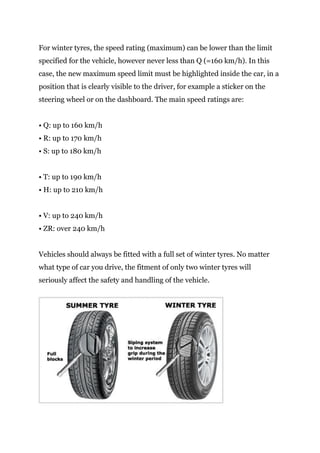
Vehicles should always be fitted with a full set of winter tyres. No matter
what type of car you drive, the fitment of only two winter tyres will
seriously affect the safety and handling of the vehicle.
The high empty-full ratio ensured by the number, depth and width of the
tread grooves also helps discharge large amounts of water, thus improving
resistance to aquaplaning.
Source: http://tyre.marangoni.com/
LinkedIn source: https://www.linkedin.com/pulse/winter-tyres-when-why-hessamaldin-abolghassemi-finixx-
tyre-sales-?trk=prof-post
Winter tyres: technical features
A winter tyre differs from other types of tyres due to the following features:
• Softer or thermal compound, rich in silica, which provides good grip even at low
temperatures. Unlike other types of tyres, winter tyres reach their optimum
operating temperature much more easily and quickly, while the tread blocks
remain more elastic, ensuring adequate friction even on very cold surfaces.
• Heavily siped tread and specific patterns: grip on snow- or mud-covered surfaces
is provided by the more complex block pattern; moreover, the siping in the tread
fills with snow and, as the snow-snow bond is stronger than the rubber-snow
bond, this improves road grip.

Winter tyres when and why

  • 1.
    Winter tyres: whenand why? WINTER TYRES Winter tyres have technical and constructional features that make them suitable for use on snow- or mud-covered surfaces, and when the bitumen is especially cold, guaranteeing better grip on slippery and wet surfaces. Winter tyres are recommended when the temperature falls below 7°C. This is in fact the temperature at which summer tyre treads tend to harden, causing a considerable decline in performance, comfort and driving safety. The specific compound used for winter tyres, however, ensures flexibility at such temperatures, thus guaranteeing perfect contact with the ground at all times.
  • 2.
    When outside temperaturesare almost constantly above 15°C, summer tyres should be put back on again; in this case, using winter tyres would not cause any problems, however they would tend to wear more than summer tyres. For wet, snow-covered or even icy roads, the features of winter tyres become fundamental for safe driving. At low temperatures, winter tyres reduce braking distance by 10% in the wet and 20% on snow. One example: on a snow-covered road, an average sized car equipped with ABS and travelling at a speed of 40 km/h when using winter tyres comes to a stop in around 30 metres, while the same car, fitted with summer tyres (if new) covers at least twice the distance before stopping. Yet even in the rain the safety margins guaranteed by winter tyres are far superior: if needing to brake suddenly at 80 km/h, the braking distance for a car with winter tyres is around 15% shorter.
  • 3.
    Winter tyres thereforeensure safe driving in autumn and winter, as they can face any road conditions without requiring chains. In addition, alternating summer and winter tyres significantly extends tyre life. Winter tyres: identification The M+S symbol stands for MUD & SNOW, and is the symbol that legally identifies tyres with higher performance in the snow than summer tyres. This is placed on winter tyres, as well as on many all-season and off-road tyres. The symbol is placed on tyres that comply with certain requirements in terms of tread dimensions / features, without however needing to pass any special tests. The peaked mountain with snowflake symbol, on the other hand, identifies winter tyres with suitable performance in severe snow conditions; these must be very heavily siped and be made using compounds and materials that pass strict international tests.
  • 4.
    Winter tyres: fourwheel drive vehicles One quite common misconception is that four wheel drive vehicles don’t need winter tyres. While on one hand a 4x4 guarantees better traction than a 4x2, above all when starting from a standstill, on the other it offers no advantage when braking or performing an emergency manoeuvre (the main trade magazines are trying to help convey this fundamental concept). For SUVs especially, the higher inertia due to the extra weight and higher centre of gravity makes situations such as an icy descent or cornering on snow-covered surfaces even trickier. Winter tyres: which types are allowed All tyre sizes specified on the car’s registration certificate, while if there are special sizes reserved for winter tyres these are considered additional alternatives and not restrictions. When choosing a winter tyre, drivers need to consider the most common situations they will face: as a general rule, on snow-covered roads the narrower the tread, the more grip the tyre will provide.
  • 5.
    For winter tyres,the speed rating (maximum) can be lower than the limit specified for the vehicle, however never less than Q (=160 km/h). In this case, the new maximum speed limit must be highlighted inside the car, in a position that is clearly visible to the driver, for example a sticker on the steering wheel or on the dashboard. The main speed ratings are: • Q: up to 160 km/h • R: up to 170 km/h • S: up to 180 km/h • T: up to 190 km/h • H: up to 210 km/h • V: up to 240 km/h • ZR: over 240 km/h Vehicles should always be fitted with a full set of winter tyres. No matter what type of car you drive, the fitment of only two winter tyres will seriously affect the safety and handling of the vehicle.
  • 6.
    The high empty-fullratio ensured by the number, depth and width of the tread grooves also helps discharge large amounts of water, thus improving resistance to aquaplaning. Source: http://tyre.marangoni.com/ LinkedIn source: https://www.linkedin.com/pulse/winter-tyres-when-why-hessamaldin-abolghassemi-finixx- tyre-sales-?trk=prof-post Winter tyres: technical features A winter tyre differs from other types of tyres due to the following features: • Softer or thermal compound, rich in silica, which provides good grip even at low temperatures. Unlike other types of tyres, winter tyres reach their optimum operating temperature much more easily and quickly, while the tread blocks remain more elastic, ensuring adequate friction even on very cold surfaces. • Heavily siped tread and specific patterns: grip on snow- or mud-covered surfaces is provided by the more complex block pattern; moreover, the siping in the tread fills with snow and, as the snow-snow bond is stronger than the rubber-snow bond, this improves road grip.