TIRE SAFETY SAFETY is the number 1 value of the company!!!  Louis Raspino, President & CEO
1 Most of us operate motor vehicles on a daily basis and hardly ever pay any attention to one of the most vital parts of the vehicle which are our tires. TIRE SAFETY
Unfortunately very few of us change this bad habit until it is too late. TIRE SAFETY
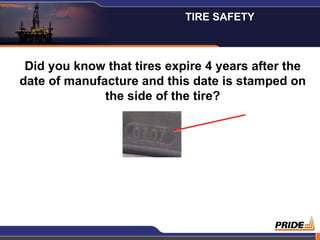
Did you know that tires expire 4 years after the date of manufacture and this date is stamped on the side of the tire? TIRE SAFETY
It is very easy to find out what the expiration date is on a tire, if you check on the side of it, you will have a 4 digit number stamped on it, this number indicates the week and the year it was manufactured, the expiration date will be 4 years later. TIRE SAFETY
This number indicates that the tire was manufactured on the 7 th  week of 2007 or which is the same February 2007, that would place the expiration date on February 2011 0 7 0 7 7 th  week of the year “February” Year of manufacture 2007 TIRE SAFETY
If we use expired tires these are likely to burst and result in a very serious or even a fatal accident,  it would be a good practice for us to check our tires and make sure they have not passed their expiration date TIRE SAFETY
Another important point that we miss many times is proper tire inflation most of the gas stations in Mexico will calibrate your tires at 28 PSI and if you are going to travel they will even in many cases bring your pressure down to 24-26 PSI because they will “heat up on the highway and the pressure will come back up”.  DO NOT ALLOW THIS TIRE SAFETY
On the side of the tire, you will also find the maximum allowable inflating pressure for that specific tire, some tires have a maximum pressure of 32 PSI some are rated at 44PSI and some even at 50 PSI. Check your specific tire to see what the maximum pressure is for your tires, it is an acceptable practice to have your tires a few pounds below maximum allowable pressure but not too much. TIRE SAFETY
MAX PRESS ACCEPTABLE 32 PSI 28 PSI 44 PSI 35 PSI 50 PSI 44 PSI Different tires are designed for different pressures you will find your maximum tire inflation pressure on a small number next to the rim on the side of the tire, never exceed this pressure (44 psi) MAX PRESS TIRE SAFETY
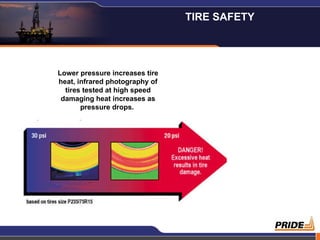
Lower pressure increases tire heat, infrared photography of tires tested at high speed damaging heat increases as pressure drops.  TIRE SAFETY
Another important point to consider is the load we put on our tires, many times we overload our vehicles without paying any attention to the strain this puts on our tires, exceeding the maximum load rating on a tire may also lead to tire failure and could result in an accident. TIRE SAFETY
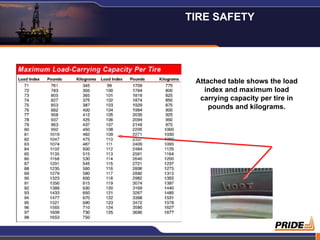
Attached table shows the load index and maximum load carrying capacity per tire in pounds and kilograms. TIRE SAFETY
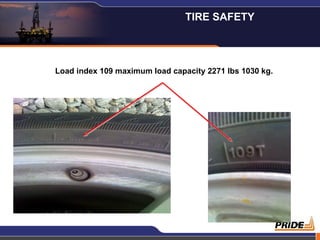
Load index 109 maximum load capacity 2271 lbs 1030 kg. TIRE SAFETY
The speed rating for which a tire is designed is indicated by a letter next to the load index, adjacent table shows the speed ratings in Km/h & Mph. TIRE SAFETY
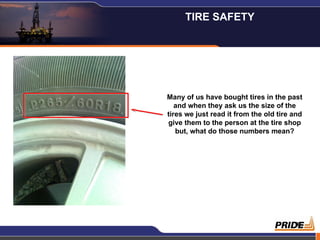
Many of us have bought tires in the past and when they ask us the size of the tires we just read it from the old tire and give them to the person at the tire shop but, what do those numbers mean? TIRE SAFETY
P 265 / 60 R 18 Passenger car tire Tire width in Millimeters Radial Tire Aspect ratio Height to width of tire 60% of width in this case 18 Inch Wheel TIRE SAFETY
TEMPERATURE RESISTANCE The letters will indicate a tire’s resistance to heat. Tires are rated from highest to lowest resistance as A, B or C TIRE SAFETY  Simbolo Symbol Area A Hot area Area Caliente B Normal Area Area Normal C Cold Area Area Fria
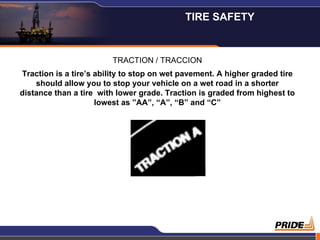
TRACTION / TRACCION Traction is a tire’s ability to stop on wet pavement. A higher graded tire should allow you to stop your vehicle on a wet road in a shorter distance than a tire  with lower grade. Traction is graded from highest to lowest as ”AA”, “A”, “B” and “C” TIRE SAFETY
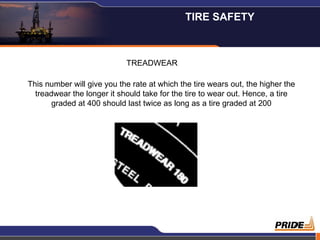
TREADWEAR This number will give you the rate at which the tire wears out, the higher the treadwear the longer it should take for the tire to wear out. Hence, a tire graded at 400 should last twice as long as a tire graded at 200 TIRE SAFETY
WHAT WE NEED TO KNOW ABOUT TIRES Date of manufacturing Maximum inflating pressure Traction Treadwear Maximum load capacity per tire Speed Rating Temperature resistance Tire size TIRE SAFETY
We hope this information was useful to you, if you have any doubts or questions, please contact the members of your QHSES team they will be glad to assist you in anyway they can, have a safe and successful day. TIRE SAFETY

امنیت تایرهای اتومبیل

  • 1.
    TIRE SAFETY SAFETYis the number 1 value of the company!!! Louis Raspino, President & CEO
  • 2.
    1 Most ofus operate motor vehicles on a daily basis and hardly ever pay any attention to one of the most vital parts of the vehicle which are our tires. TIRE SAFETY
  • 3.
    Unfortunately very fewof us change this bad habit until it is too late. TIRE SAFETY
  • 4.
    Did you knowthat tires expire 4 years after the date of manufacture and this date is stamped on the side of the tire? TIRE SAFETY
  • 5.
    It is veryeasy to find out what the expiration date is on a tire, if you check on the side of it, you will have a 4 digit number stamped on it, this number indicates the week and the year it was manufactured, the expiration date will be 4 years later. TIRE SAFETY
  • 6.
    This number indicatesthat the tire was manufactured on the 7 th week of 2007 or which is the same February 2007, that would place the expiration date on February 2011 0 7 0 7 7 th week of the year “February” Year of manufacture 2007 TIRE SAFETY
  • 7.
    If we useexpired tires these are likely to burst and result in a very serious or even a fatal accident, it would be a good practice for us to check our tires and make sure they have not passed their expiration date TIRE SAFETY
  • 8.
    Another important pointthat we miss many times is proper tire inflation most of the gas stations in Mexico will calibrate your tires at 28 PSI and if you are going to travel they will even in many cases bring your pressure down to 24-26 PSI because they will “heat up on the highway and the pressure will come back up”. DO NOT ALLOW THIS TIRE SAFETY
  • 9.
    On the sideof the tire, you will also find the maximum allowable inflating pressure for that specific tire, some tires have a maximum pressure of 32 PSI some are rated at 44PSI and some even at 50 PSI. Check your specific tire to see what the maximum pressure is for your tires, it is an acceptable practice to have your tires a few pounds below maximum allowable pressure but not too much. TIRE SAFETY
  • 10.
    MAX PRESS ACCEPTABLE32 PSI 28 PSI 44 PSI 35 PSI 50 PSI 44 PSI Different tires are designed for different pressures you will find your maximum tire inflation pressure on a small number next to the rim on the side of the tire, never exceed this pressure (44 psi) MAX PRESS TIRE SAFETY
  • 11.
    Lower pressure increasestire heat, infrared photography of tires tested at high speed damaging heat increases as pressure drops. TIRE SAFETY
  • 12.
    Another important pointto consider is the load we put on our tires, many times we overload our vehicles without paying any attention to the strain this puts on our tires, exceeding the maximum load rating on a tire may also lead to tire failure and could result in an accident. TIRE SAFETY
  • 13.
    Attached table showsthe load index and maximum load carrying capacity per tire in pounds and kilograms. TIRE SAFETY
  • 14.
    Load index 109maximum load capacity 2271 lbs 1030 kg. TIRE SAFETY
  • 15.
    The speed ratingfor which a tire is designed is indicated by a letter next to the load index, adjacent table shows the speed ratings in Km/h & Mph. TIRE SAFETY
  • 16.
    Many of ushave bought tires in the past and when they ask us the size of the tires we just read it from the old tire and give them to the person at the tire shop but, what do those numbers mean? TIRE SAFETY
  • 17.
    P 265 /60 R 18 Passenger car tire Tire width in Millimeters Radial Tire Aspect ratio Height to width of tire 60% of width in this case 18 Inch Wheel TIRE SAFETY
  • 18.
    TEMPERATURE RESISTANCE Theletters will indicate a tire’s resistance to heat. Tires are rated from highest to lowest resistance as A, B or C TIRE SAFETY Simbolo Symbol Area A Hot area Area Caliente B Normal Area Area Normal C Cold Area Area Fria
  • 19.
    TRACTION / TRACCIONTraction is a tire’s ability to stop on wet pavement. A higher graded tire should allow you to stop your vehicle on a wet road in a shorter distance than a tire with lower grade. Traction is graded from highest to lowest as ”AA”, “A”, “B” and “C” TIRE SAFETY
  • 20.
    TREADWEAR This numberwill give you the rate at which the tire wears out, the higher the treadwear the longer it should take for the tire to wear out. Hence, a tire graded at 400 should last twice as long as a tire graded at 200 TIRE SAFETY
  • 21.
    WHAT WE NEEDTO KNOW ABOUT TIRES Date of manufacturing Maximum inflating pressure Traction Treadwear Maximum load capacity per tire Speed Rating Temperature resistance Tire size TIRE SAFETY
  • 22.
    We hope thisinformation was useful to you, if you have any doubts or questions, please contact the members of your QHSES team they will be glad to assist you in anyway they can, have a safe and successful day. TIRE SAFETY