BY
Y.SANNUTHI
11HP1A0271
EEE
A Technical Seminar On
DIFFERENT TYPES OF
WIND FARMS
ASCEW
CONTENTS
Introduction
Types of wind farms
Types of wind turbine
Operation of wind turbine
Comparision to other energy sources
Advantages
Factors effecting wind farms
conclusion
INTRODUCTION
 A "wind farm" is a group of wind turbines in the same location used for
production of electric power.
 Individual turbines are interconnected with a medium voltage power
collection system.
 At a substation, this medium-voltage electrical current is increased in
voltage with a transformer for connection to the high voltage transmission
system.
 A large wind farm may consist of a few dozen to several hundred
individual wind turbines, and cover an extended area of hundreds of
square miles (square kilometres), but the land between the turbines may
be used for agricultural or other purposes.
TYPES OF WIND FARMS
 On-Shore
 Off-Shore
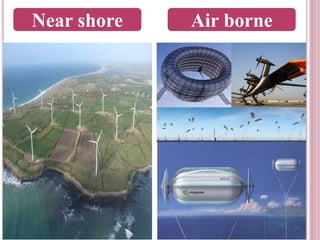
 Near-Shore
 Air borne
Off-shoreOn-shore
Near shore Air borne
ON-SHORE WIND FARM
It Converts kinetic energy-mechanical energy-
electrical energy.
Wind turbines operate on a simple principle i.e
The energy in the wind turns three propeller-like
blades around a rotor. The rotor is connected to the
main shaft, which spins a generator to create
electricity.
 Wind turbines are mounted on a tower to capture
the most energy. At 30 meters or more above
ground, they can take advantage of faster and less
turbulent wind.
 Early turbines were small by today's standards,
with capacities of 20-30 kW each. Since then, they
have increased greatly in size delivering up to 7
MW.
OFF-SHORE WIND FARM
 Off shore wind farms is also called as
floating wind parks.
 Floating wind parks are wind farms that
site several floating wind turbines closely
together to take advantage of common
infrastructure such as power
transmission facilities.
 A floating wind turbine is an
offshore wind turbine mounted on
a floating structure that allows
the turbine to generate electricity.
TYPES OF WIND TURBINES
Most common industrial design
today.
HAWT have the main rotor shaft
and generator at the top of a tower
and must be pointed into the wind.
HAWT, where wind velocities are
high.
Able to increase height of tower to
harness higher wind velocities at
higher altitudes.Horizontal Axis Wind Turbine Design
 Horizontal Axis Wind Turbine
Vertical Axis Wind Turbine Design
VAWT have the main rotor shaft
arranged vertically .The
generator and gear box placed
near the ground.
Utilizes wind flow in all
directions (360°).
Constructed on buildings to
avoid ground level turbulence.
 Vertical Axis Wind Turbine
OPERATION OF WIND TURBINE
COMPARISON TO OTHER ENERGY
SOURCES
 Environmentally friendly.
 Large resource supply.
 Cheap operating costs.
 Wind – 55.80/ MWh
Coal – 53.10/ MWh Natural
Gas – 52.50/ MWh
Coal Natural Gas
Wind
vs
Safe & Pollution free.
Inexhaustible.
Inexpensive after installation.
It is cheaper to put more coal into an
existing power station than to build a new
wind farm.
ADVANTAGES
Negative Impacts
Bird Strikes
Location
Wind speed
Altitude(height)
Effect on power grid
Factors Affecting Wind Farms
CONCLUSION
Nowadays, wind energy is developing rapidly all around the
world. There are many options of wind power generation and
collection system configuration.
Wind energy has matured to a level of development where it is
ready to become a generally accepted utility generation
technology ,a brief discussion of this development is
presented.
Different types of wind farms

Different types of wind farms

  • 1.
    BY Y.SANNUTHI 11HP1A0271 EEE A Technical SeminarOn DIFFERENT TYPES OF WIND FARMS ASCEW
  • 2.
    CONTENTS Introduction Types of windfarms Types of wind turbine Operation of wind turbine Comparision to other energy sources Advantages Factors effecting wind farms conclusion
  • 3.
    INTRODUCTION  A "windfarm" is a group of wind turbines in the same location used for production of electric power.  Individual turbines are interconnected with a medium voltage power collection system.  At a substation, this medium-voltage electrical current is increased in voltage with a transformer for connection to the high voltage transmission system.  A large wind farm may consist of a few dozen to several hundred individual wind turbines, and cover an extended area of hundreds of square miles (square kilometres), but the land between the turbines may be used for agricultural or other purposes.
  • 4.
    TYPES OF WINDFARMS  On-Shore  Off-Shore  Near-Shore  Air borne
  • 5.
  • 6.
  • 7.
    ON-SHORE WIND FARM ItConverts kinetic energy-mechanical energy- electrical energy. Wind turbines operate on a simple principle i.e The energy in the wind turns three propeller-like blades around a rotor. The rotor is connected to the main shaft, which spins a generator to create electricity.  Wind turbines are mounted on a tower to capture the most energy. At 30 meters or more above ground, they can take advantage of faster and less turbulent wind.  Early turbines were small by today's standards, with capacities of 20-30 kW each. Since then, they have increased greatly in size delivering up to 7 MW.
  • 8.
    OFF-SHORE WIND FARM Off shore wind farms is also called as floating wind parks.  Floating wind parks are wind farms that site several floating wind turbines closely together to take advantage of common infrastructure such as power transmission facilities.  A floating wind turbine is an offshore wind turbine mounted on a floating structure that allows the turbine to generate electricity.
  • 9.
    TYPES OF WINDTURBINES Most common industrial design today. HAWT have the main rotor shaft and generator at the top of a tower and must be pointed into the wind. HAWT, where wind velocities are high. Able to increase height of tower to harness higher wind velocities at higher altitudes.Horizontal Axis Wind Turbine Design  Horizontal Axis Wind Turbine
  • 10.
    Vertical Axis WindTurbine Design VAWT have the main rotor shaft arranged vertically .The generator and gear box placed near the ground. Utilizes wind flow in all directions (360°). Constructed on buildings to avoid ground level turbulence.  Vertical Axis Wind Turbine
  • 11.
  • 12.
    COMPARISON TO OTHERENERGY SOURCES  Environmentally friendly.  Large resource supply.  Cheap operating costs.  Wind – 55.80/ MWh Coal – 53.10/ MWh Natural Gas – 52.50/ MWh Coal Natural Gas Wind vs
  • 13.
    Safe & Pollutionfree. Inexhaustible. Inexpensive after installation. It is cheaper to put more coal into an existing power station than to build a new wind farm. ADVANTAGES
  • 14.
  • 15.
    Location Wind speed Altitude(height) Effect onpower grid Factors Affecting Wind Farms
  • 16.
    CONCLUSION Nowadays, wind energyis developing rapidly all around the world. There are many options of wind power generation and collection system configuration. Wind energy has matured to a level of development where it is ready to become a generally accepted utility generation technology ,a brief discussion of this development is presented.