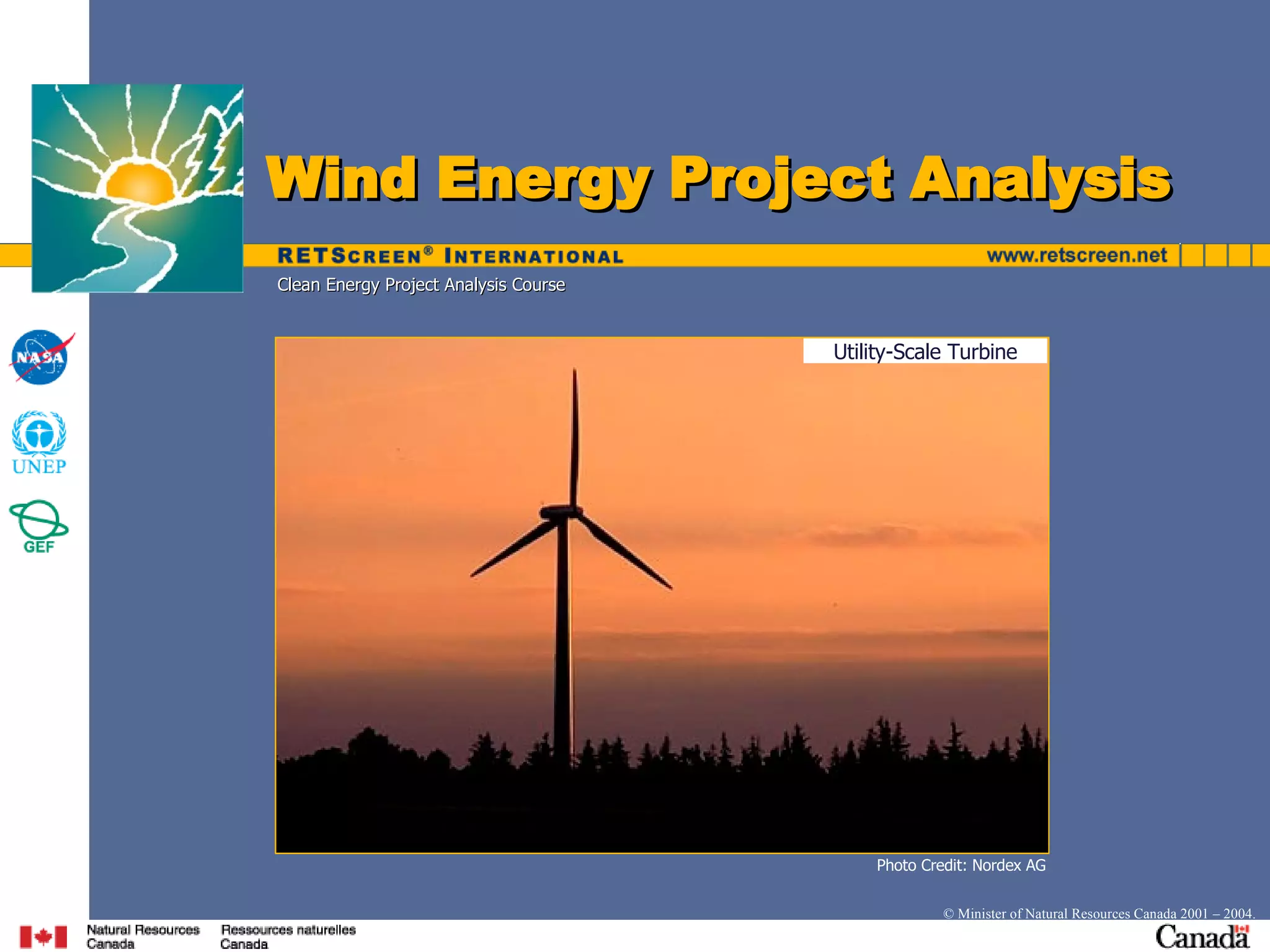
Photo Credit: Nordex AG ©   Minister   of   Natural   Resources   Canada   2001   –   2004 . Clean Energy Project Analysis Course Wind Energy Project Analysis Utility-Scale Turbine
Objectives Review basics of Wind Energy systems Illustrate key considerations for Wind Energy project analysis Introduce RETScreen ®  Wind Energy Project Model
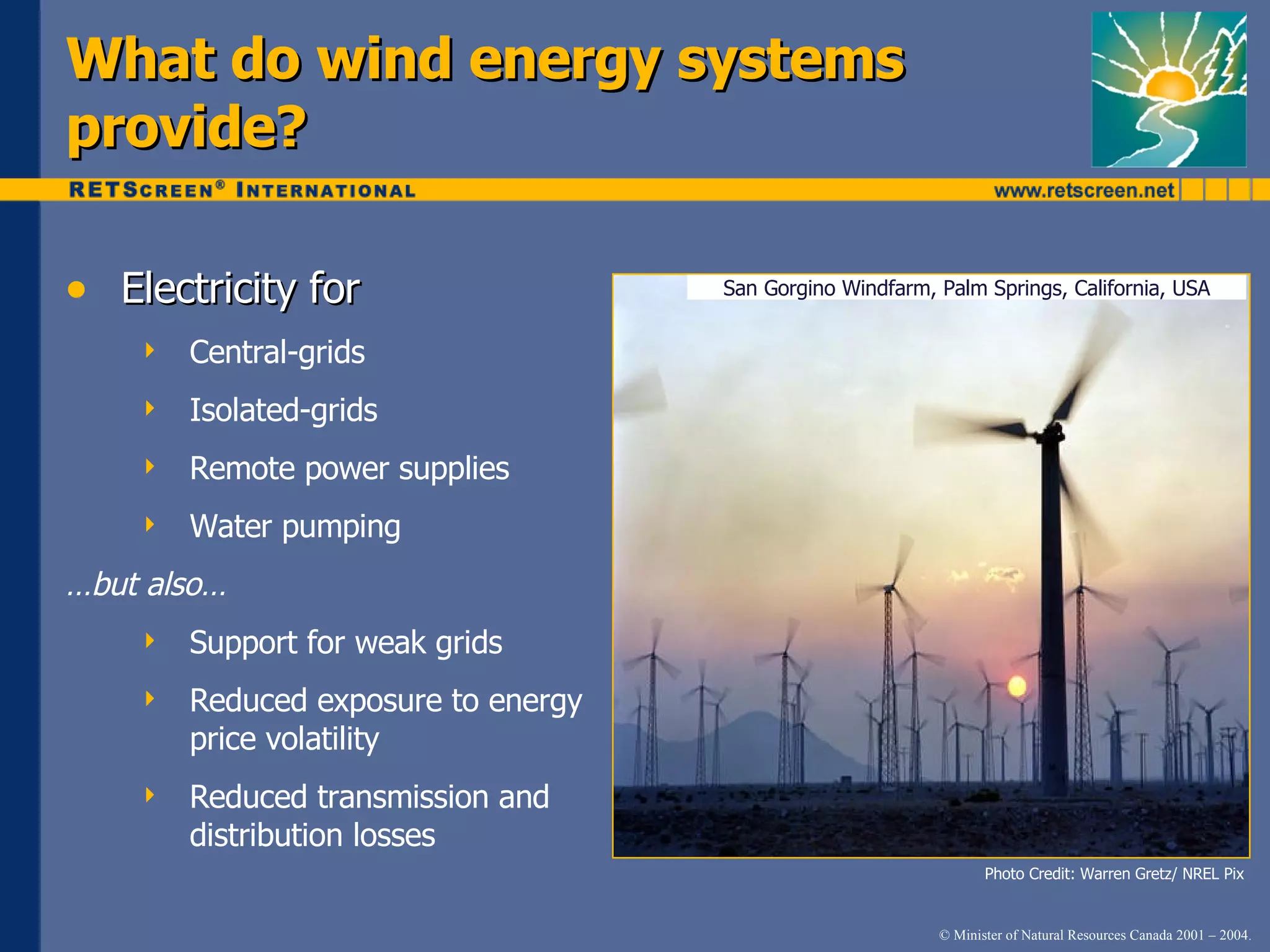
Electricity for Central-grids Isolated-grids Remote power supplies Water pumping … but also… Support for weak grids Reduced exposure to energy price volatility Reduced transmission and distribution losses What do wind energy systems provide? Photo Credit: Warren Gretz/ NREL Pix San Gorgino Windfarm, Palm Springs, California, USA
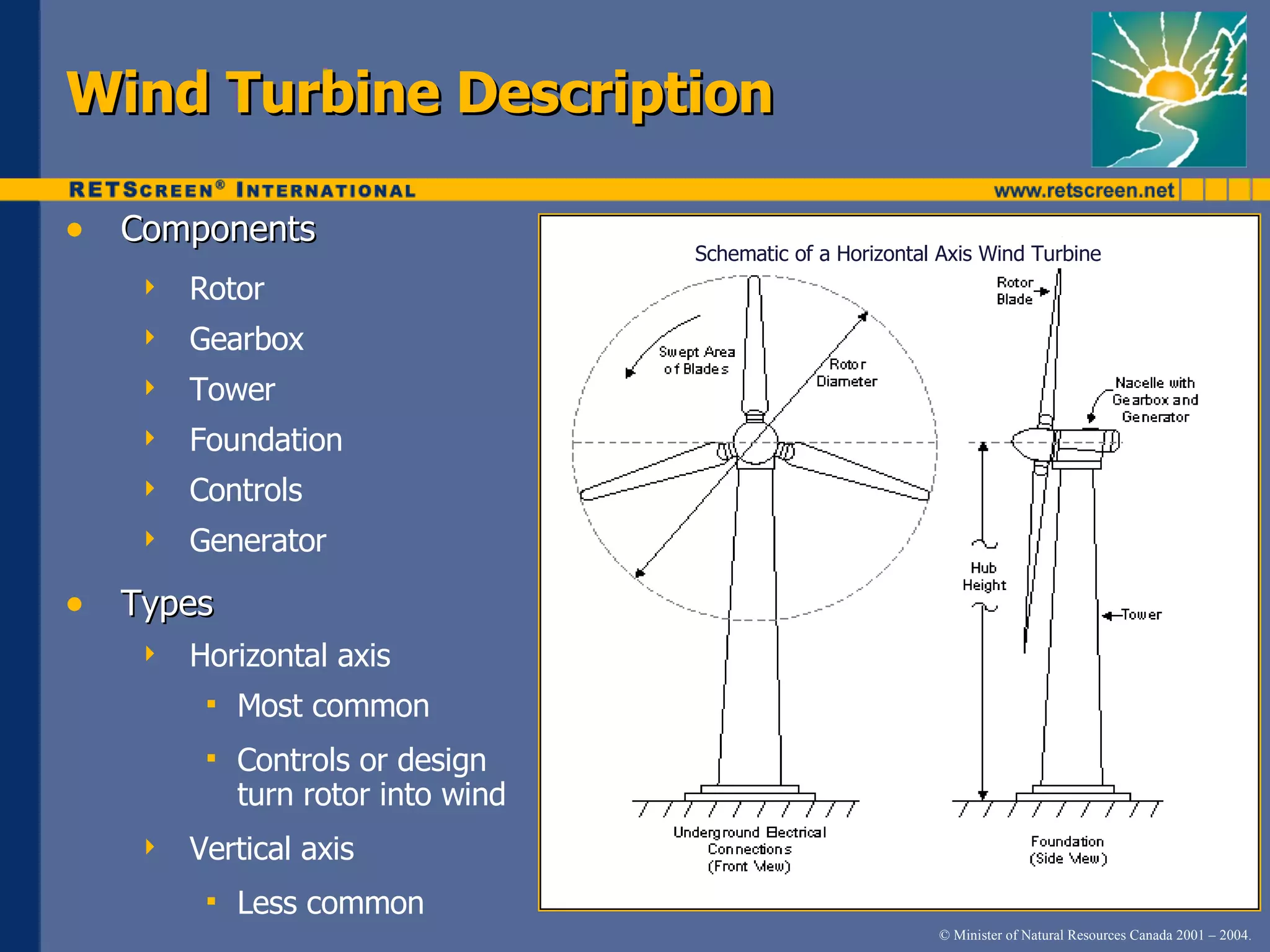
Wind Turbine Description Components Rotor Gearbox Tower Foundation Controls Generator Types Horizontal axis Most common Controls or design turn rotor into wind Vertical axis Less common Schematic of a Horizontal Axis Wind Turbine
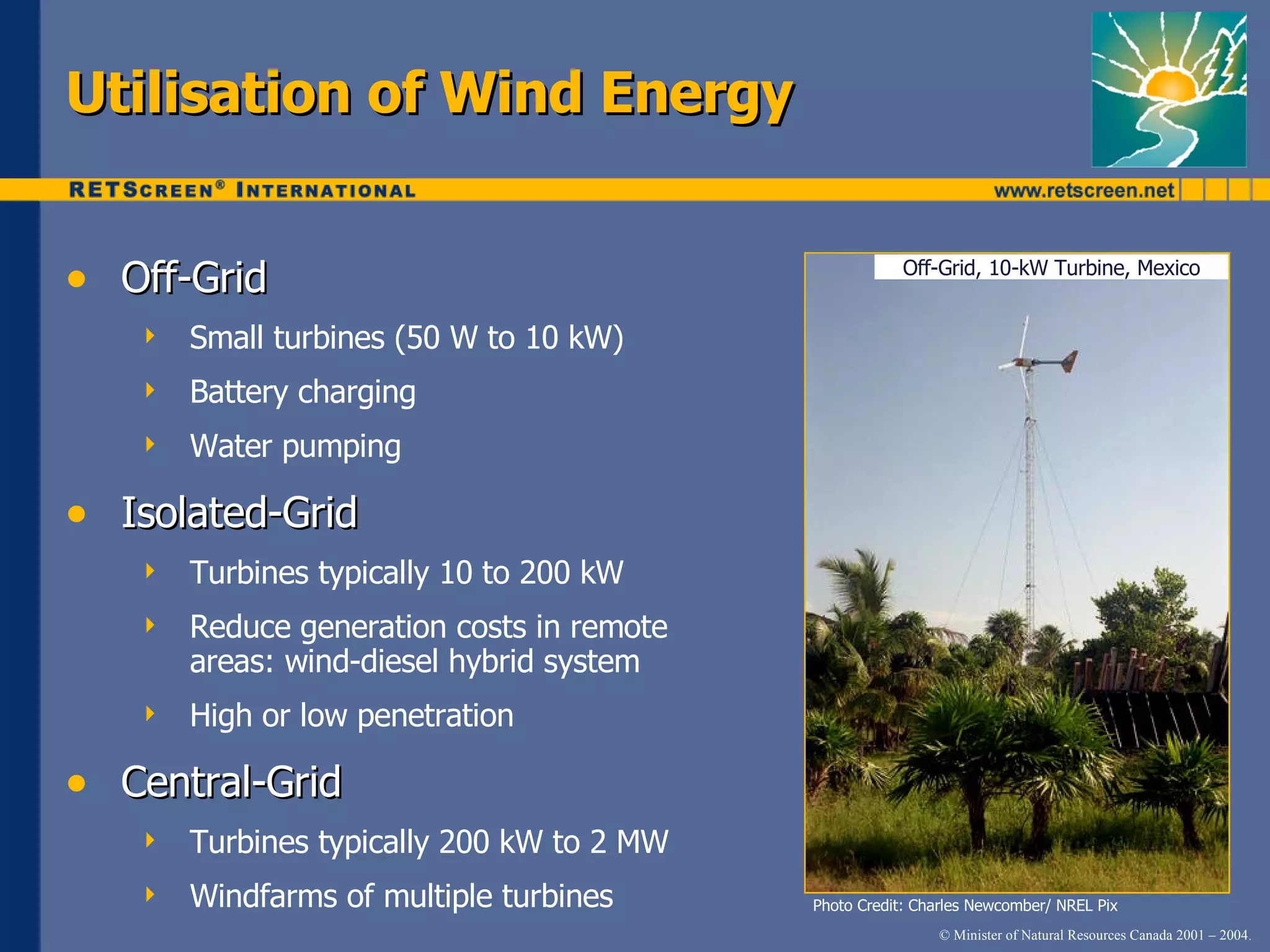
Utilisation of Wind Energy Off-Grid Small turbines (50 W to 10 kW) Battery charging Water pumping Isolated-Grid Turbines typically 10 to 200 kW Reduce generation costs in remote areas: wind-diesel hybrid system High or low penetration Central-Grid Turbines typically 200 kW to 2 MW  Windfarms of multiple turbines Photo Credit: Charles Newcomber/ NREL Pix Off-Grid, 10-kW Turbine, Mexico
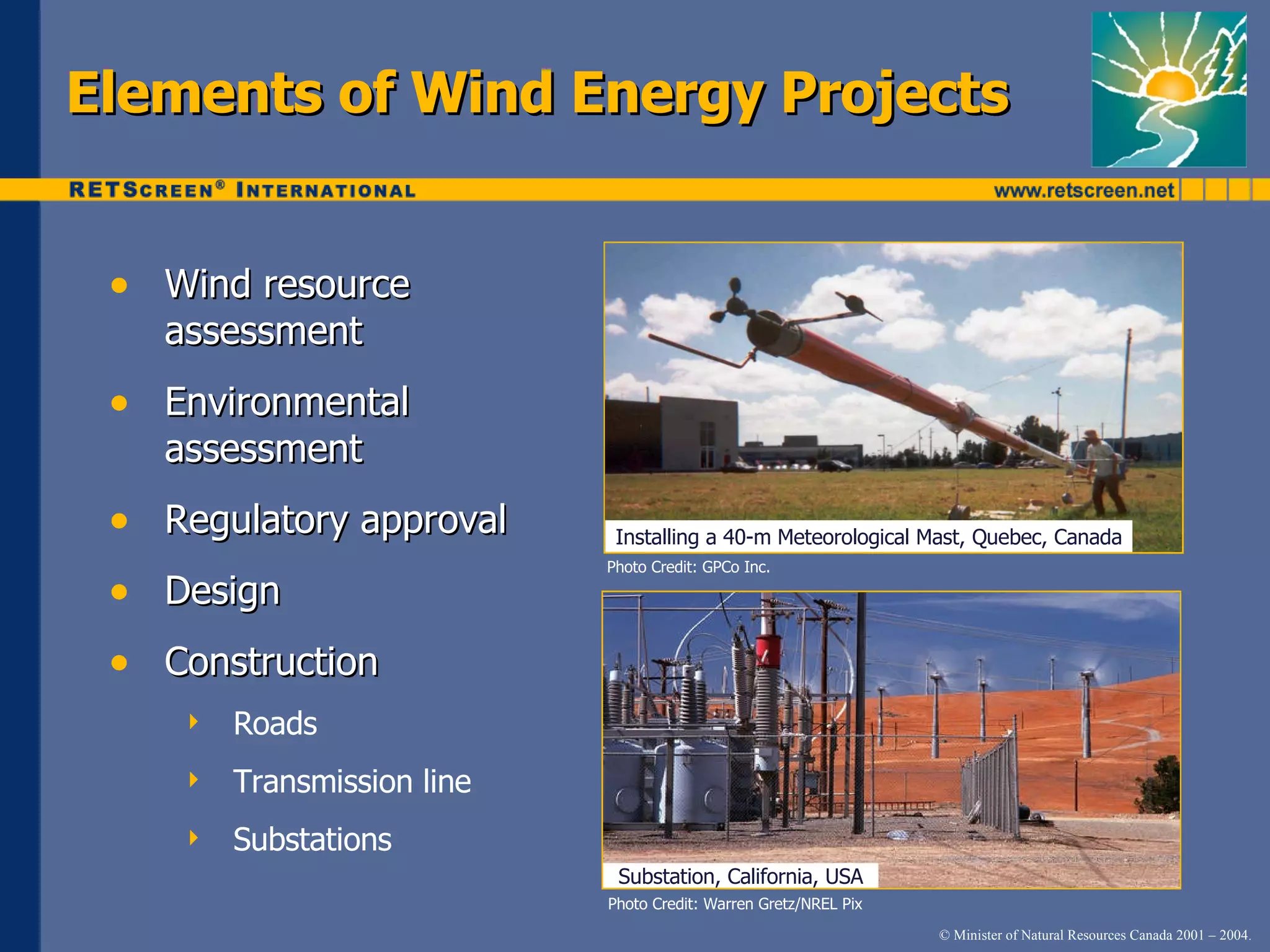
Elements of Wind Energy Projects Wind resource assessment Environmental assessment Regulatory approval Design Construction Roads Transmission line Substations Photo Credit: Warren Gretz/NREL Pix Photo Credit: GPCo Inc. Installing a 40-m Meteorological Mast, Quebec, Canada Substation, California, USA
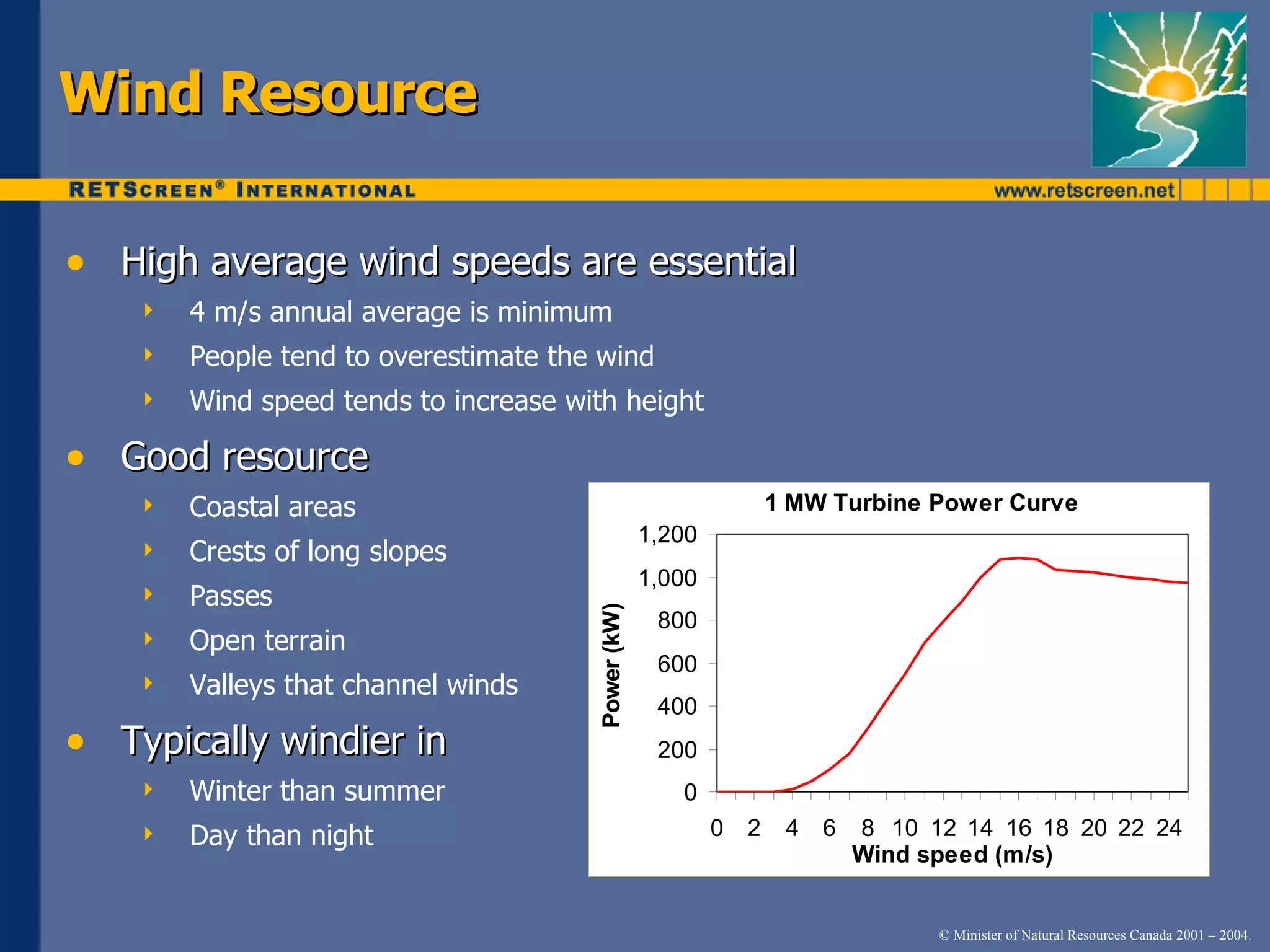
High average wind speeds are essential 4 m/s annual average is minimum People tend to overestimate the wind Wind speed tends to increase with height Good resource Coastal areas Crests of long slopes Passes Open terrain Valleys that channel winds Typically windier in Winter than summer  Day than night Wind Resource
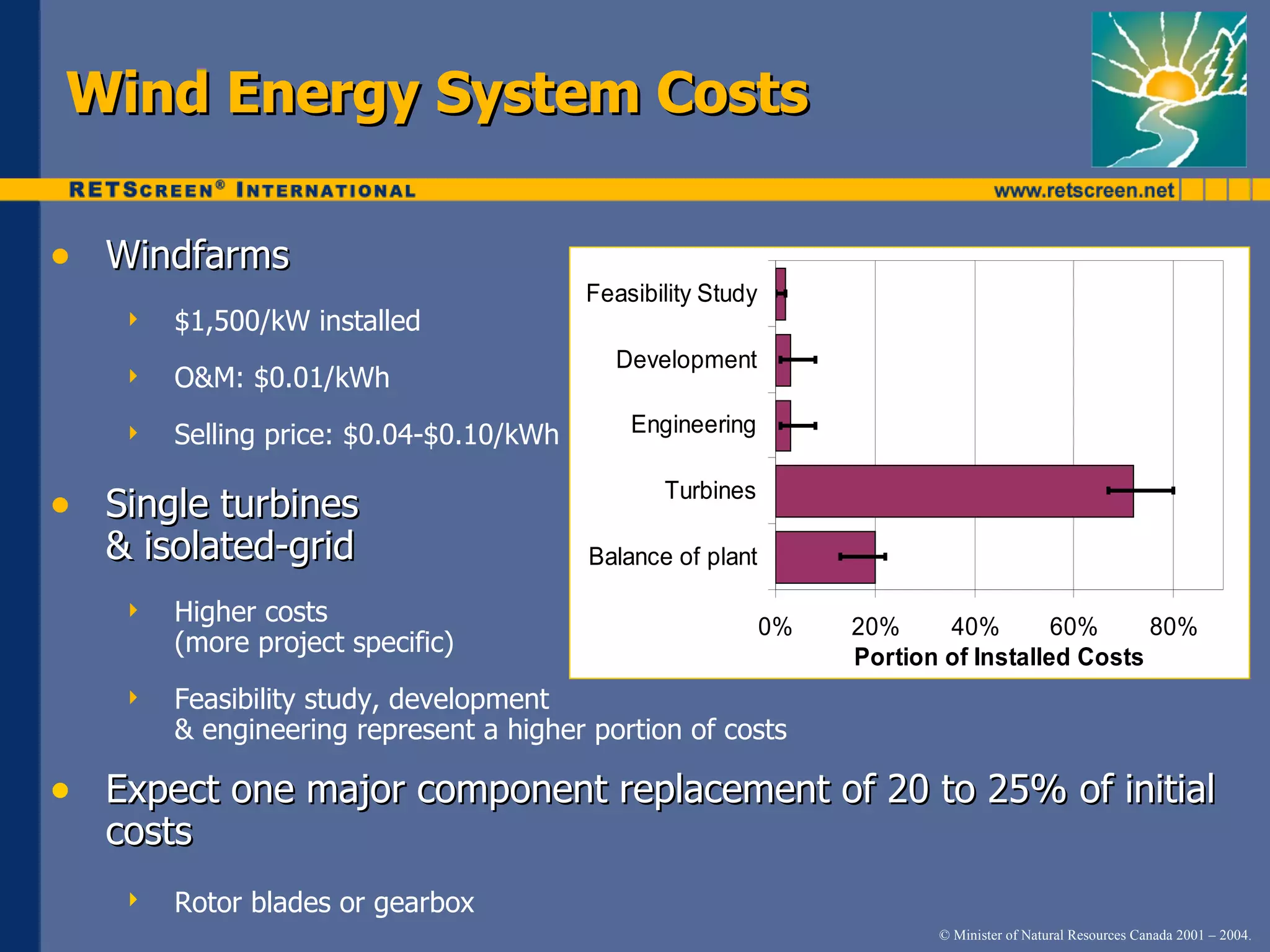
Wind Energy System Costs Windfarms $1,500/kW installed O&M: $0.01/kWh Selling price: $0.04-$0.10/kWh Single turbines  & isolated-grid Higher costs (more project specific) Feasibility study, development  & engineering represent a higher portion of costs Expect one major component replacement of 20 to 25% of initial costs Rotor blades or gearbox
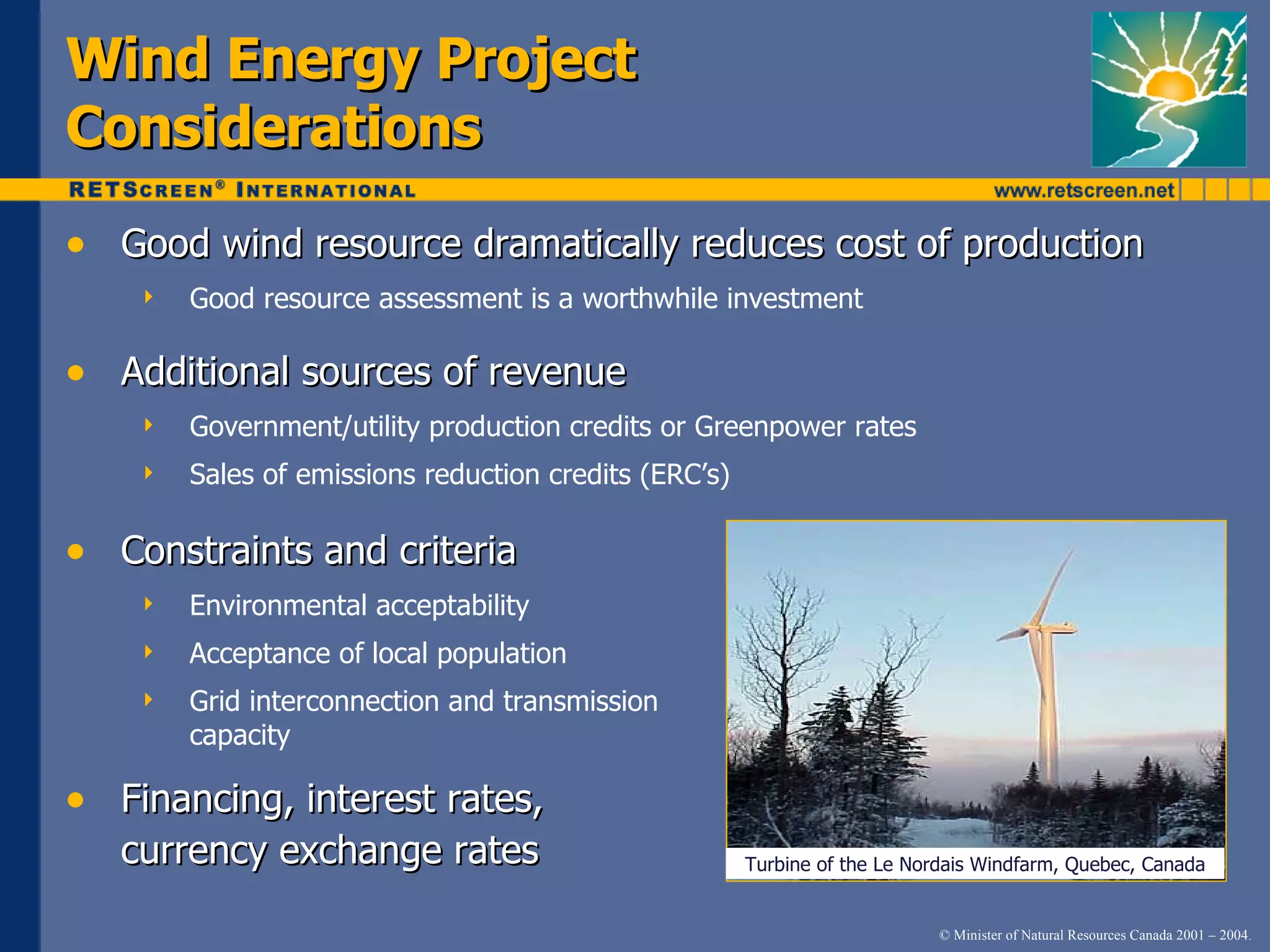
Wind Energy Project Considerations Good wind resource dramatically reduces cost of production Good resource assessment is a worthwhile investment Additional sources of revenue Government/utility production credits or Greenpower rates Sales of emissions reduction credits (ERC’s) Constraints and criteria Environmental acceptability Acceptance of local population Grid interconnection and transmission capacity Financing, interest rates,  currency exchange rates Turbine of the Le Nordais Windfarm, Quebec, Canada
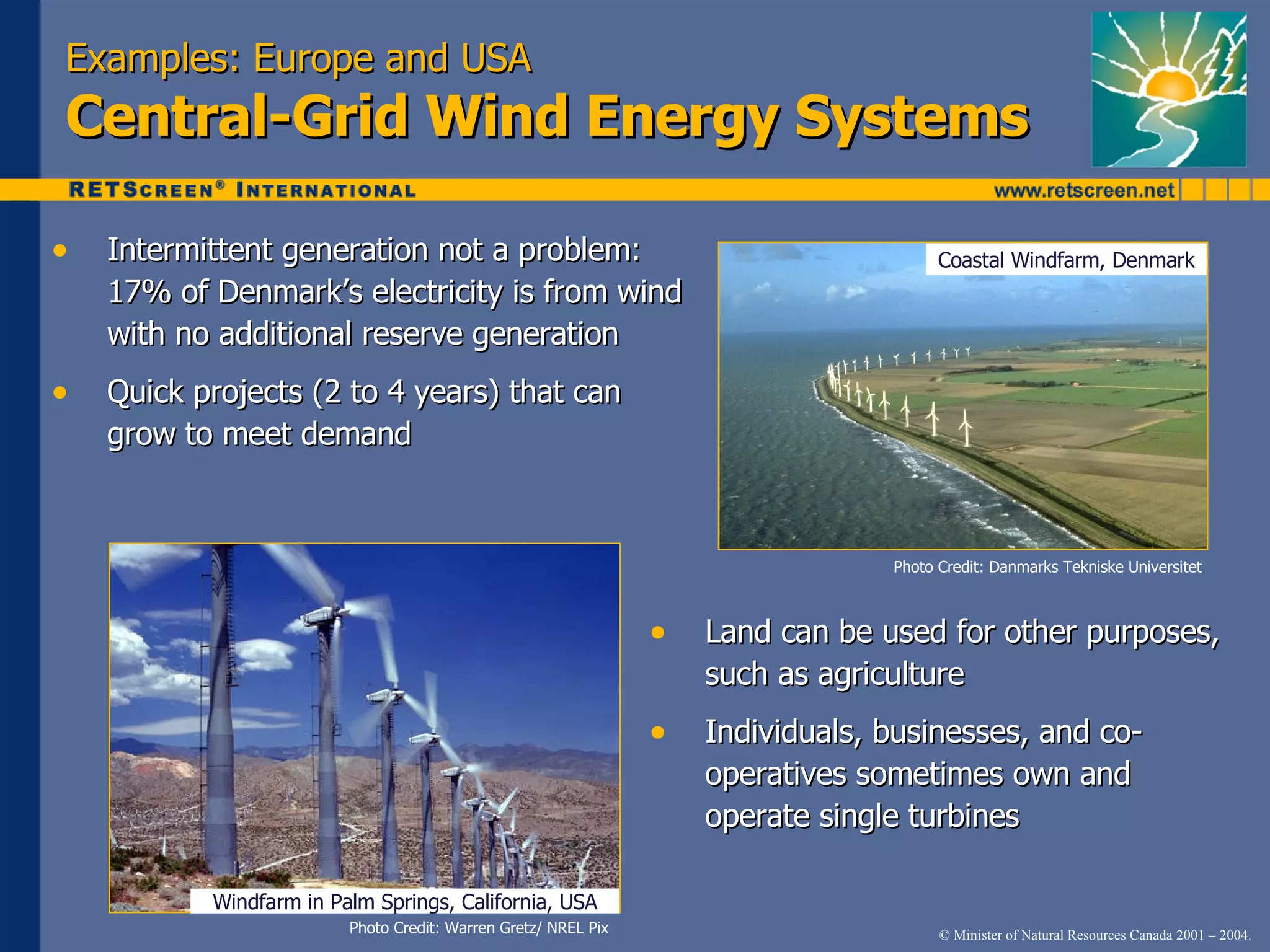
Examples: Europe and USA Central-Grid Wind Energy Systems Intermittent generation not a problem: 17% of Denmark’s electricity is from wind with no additional reserve generation  Quick projects (2 to 4 years) that can grow to meet demand Photo Credit: Warren Gretz/ NREL Pix Windfarm in Palm Springs, California, USA Land can be used for other purposes, such as agriculture Individuals, businesses, and co-operatives sometimes own and operate single turbines Photo Credit: Danmarks Tekniske Universitet Coastal Windfarm, Denmark
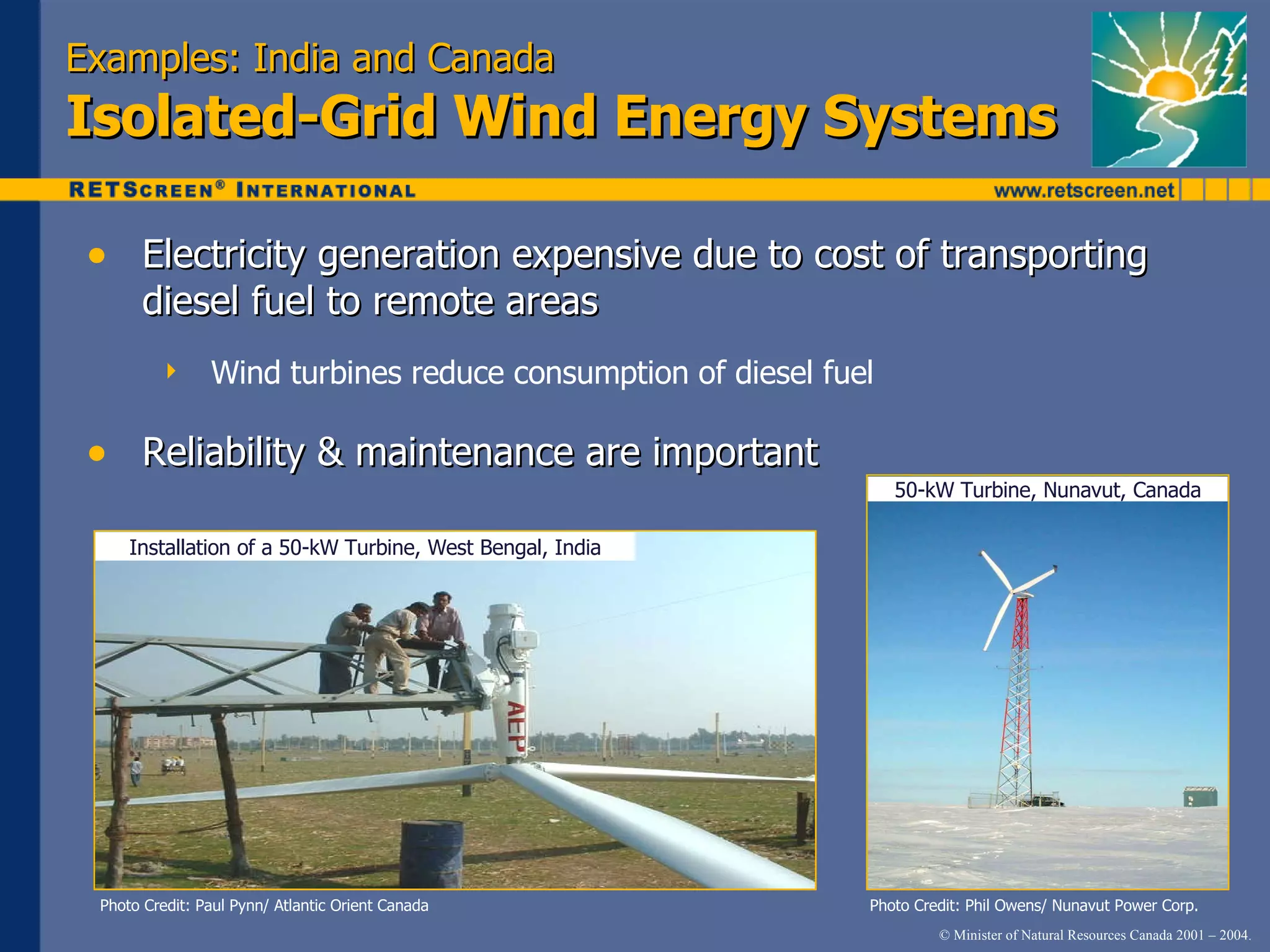
Examples: India and Canada Isolated-Grid Wind Energy Systems Electricity generation expensive due to cost of transporting diesel fuel to remote areas Wind turbines reduce consumption of diesel fuel Reliability & maintenance are important Photo Credit: Paul Pynn/ Atlantic Orient Canada Photo Credit: Phil Owens/ Nunavut Power Corp. 50-kW Turbine, Nunavut, Canada Installation of a 50-kW Turbine, West Bengal, India
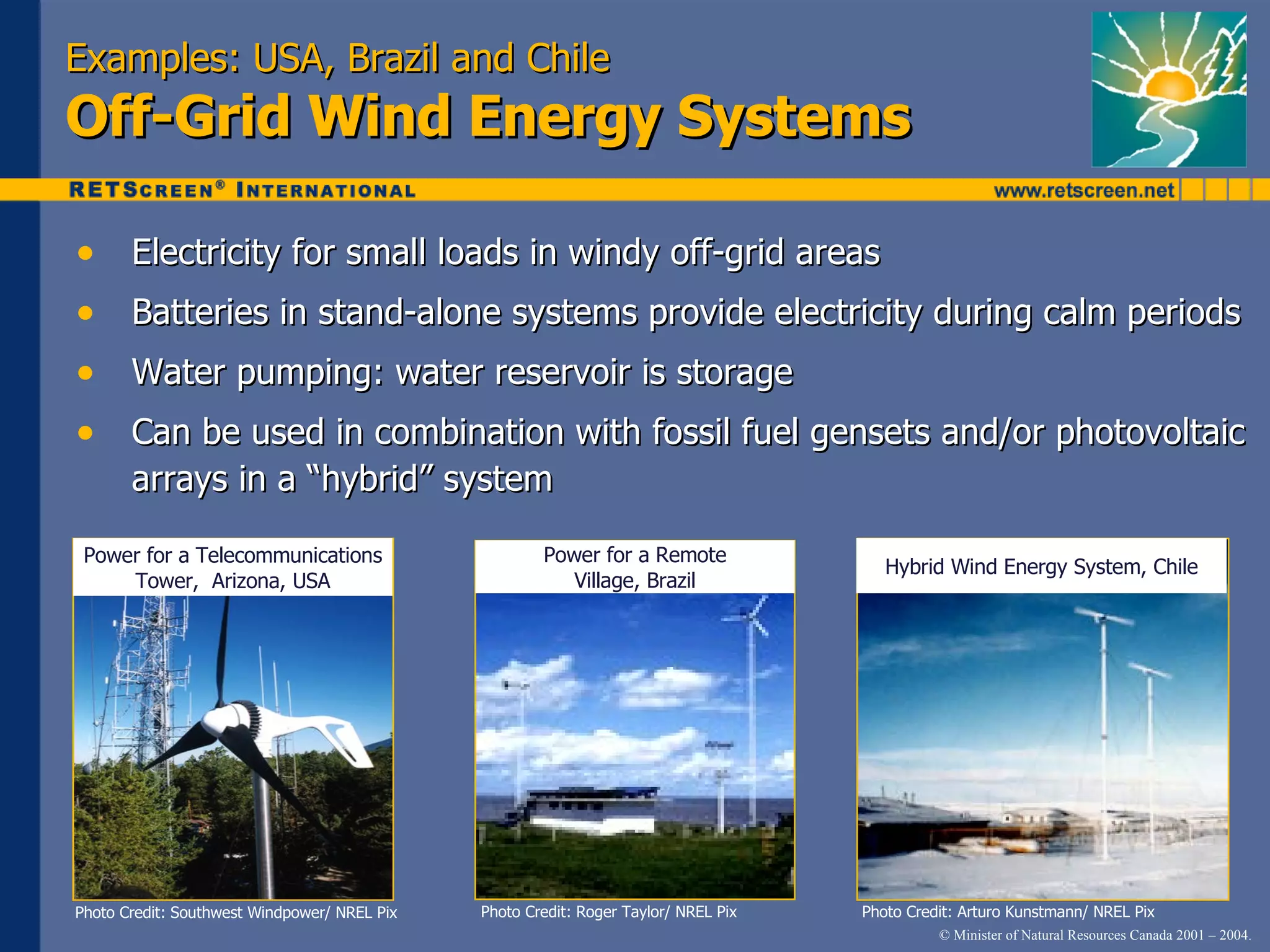
Examples: USA, Brazil and Chile Off-Grid Wind Energy Systems Electricity for small loads in windy off-grid areas Batteries in stand-alone systems provide electricity during calm periods Water pumping: water reservoir is storage Can be used in combination with fossil fuel gensets and/or photovoltaic arrays in a “hybrid” system Photo Credit: Arturo Kunstmann/ NREL Pix Photo Credit: Roger Taylor/ NREL Pix Photo Credit: Southwest Windpower/ NREL Pix Power for a Telecommunications Tower,  Arizona, USA Power for a Remote Village, Brazil Hybrid Wind Energy System, Chile
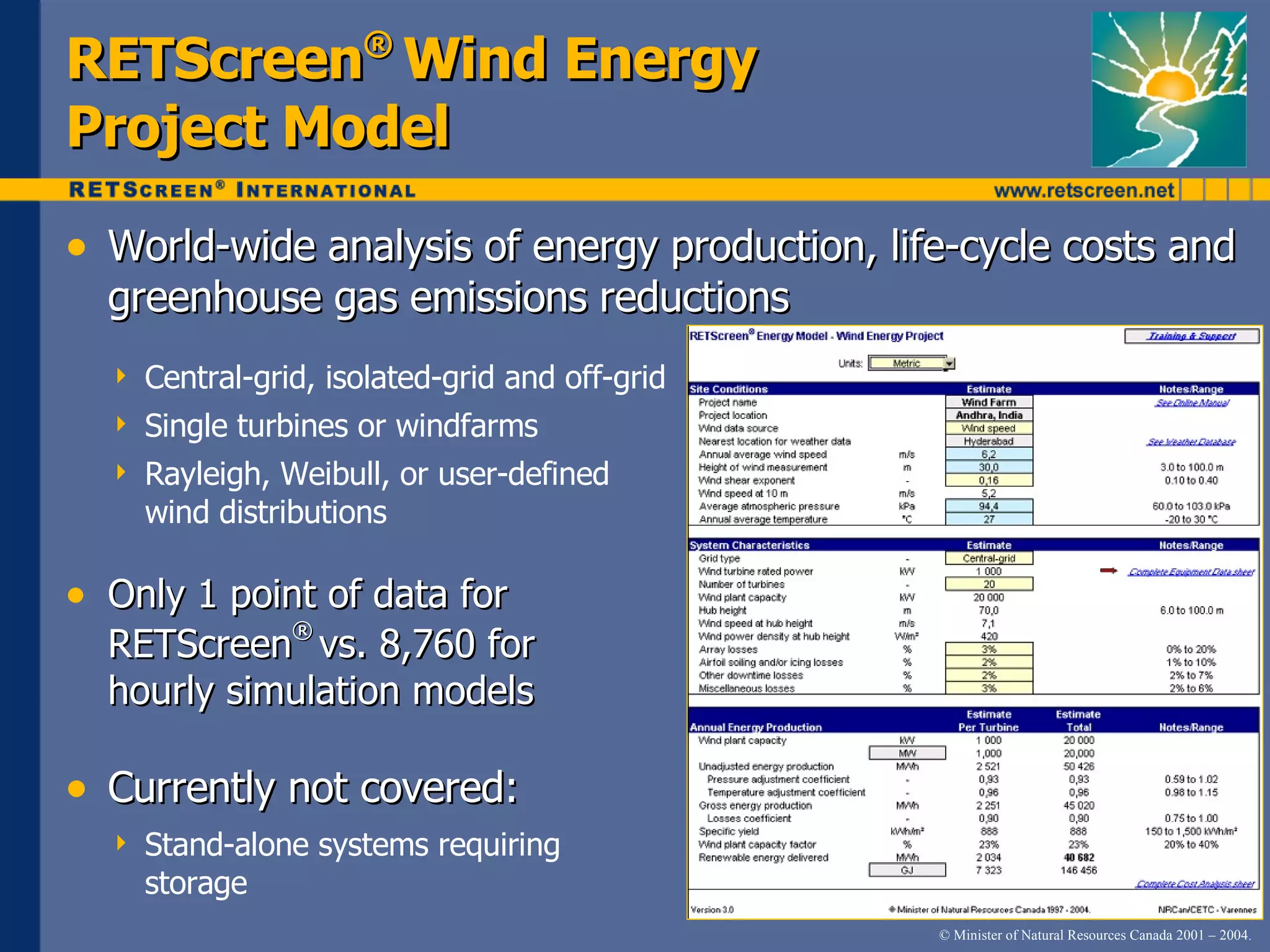
RETScreen ®   Wind   Energy   Project   Model World-wide   analysis   of   energy   production,   life-cycle   costs   a nd   greenhouse   gas   emissions   reductions Central-grid,   isolated-grid   and   off-grid Single   turbines   or   windfarms Rayleigh,   Weibull,   or   user-defined   wind   distributions Only   1   point   of   data   for   RETScreen ®   vs.   8,760   for   hourly   simulation   models Currently   not   covered: Stand-alone   systems   requiring   storage
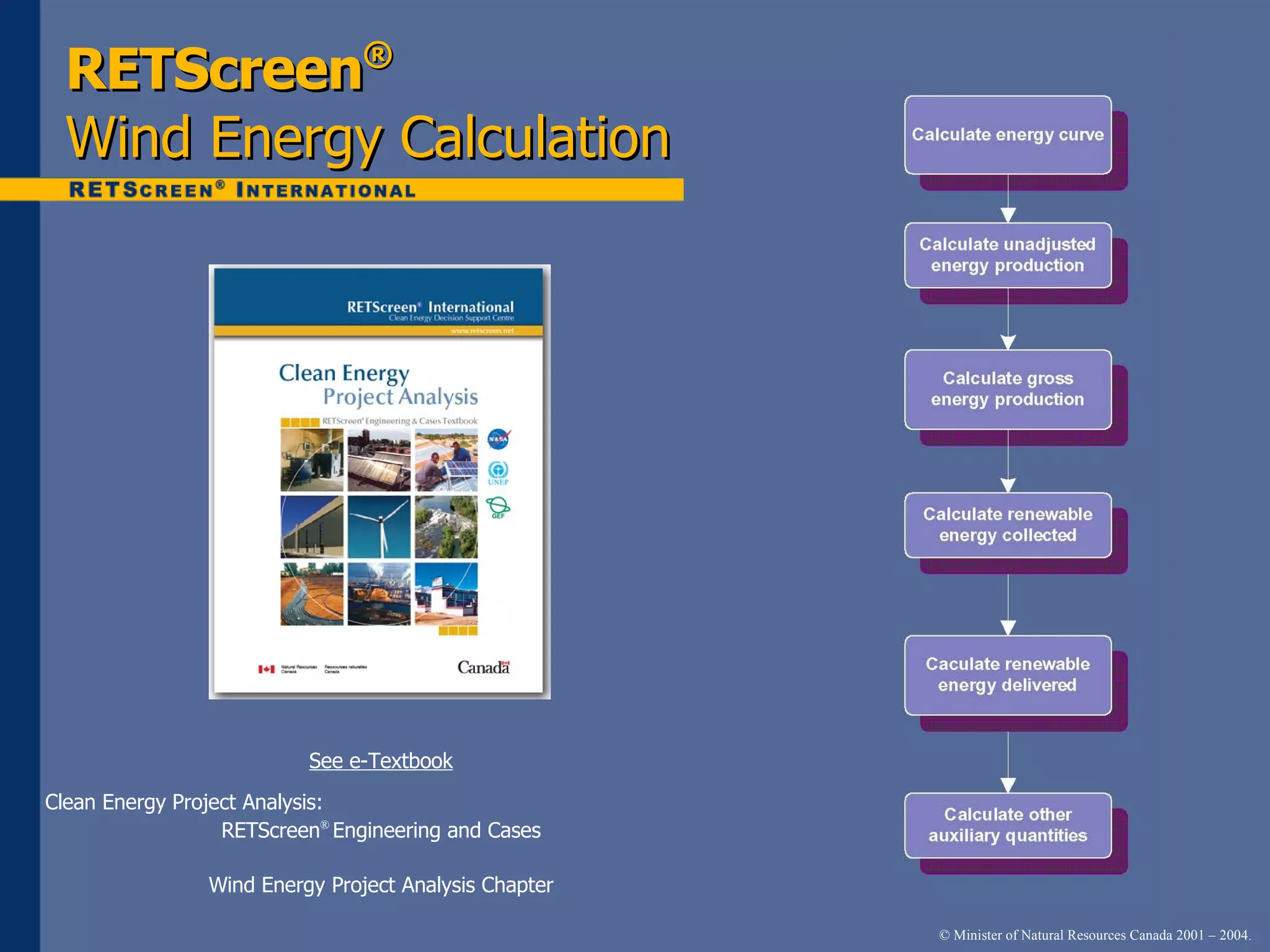
RETScreen ® Wind   Energy   Calculation See e-Textbook Clean Energy Project Analysis:  RETScreen ®  Engineering and Cases Wind Energy Project Analysis Chapter
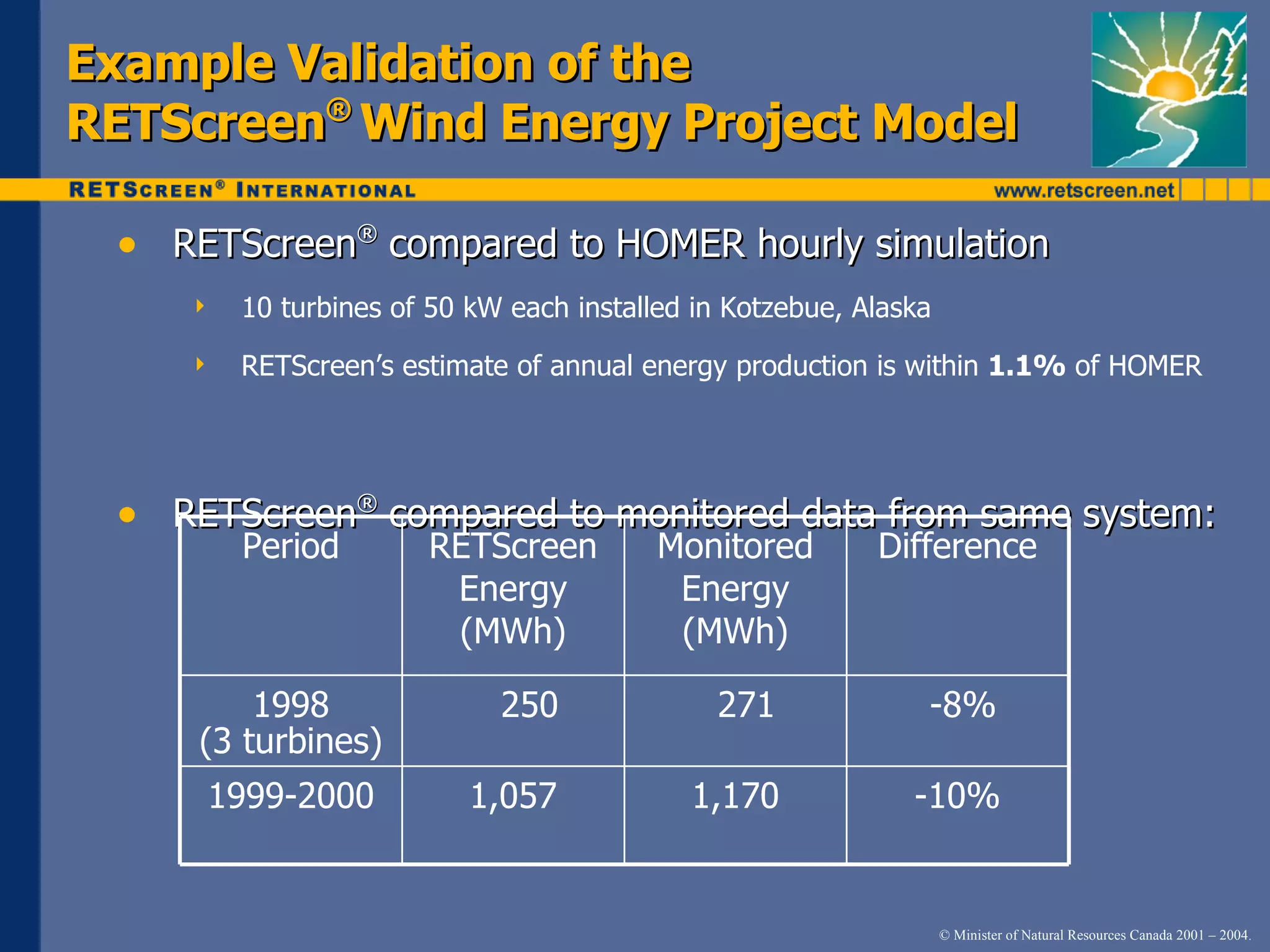
Example   Validation   of   the   RETScreen ®   Wind   Energy   Project   Model RETScreen ®   compared   to   HOMER   hourly   simulation 10   turbines   of   50   kW   each   installed   in   Kotzebue,   Alaska RETScreen’s   estimate   of   annual   energy   production   is   within   1.1%   of   HOMER RETScreen ®   compared   to   monitored   data   from   same   system: -10% 1,170 1,057 1999-2000 -8% 271 250 1998 (3 turbines) Difference Monitored Energy (MWh) RETScreen Energy (MWh) Period
Conclusions Wind   turbines   provide   electricity   on   and   off   grid   world-   wide A   good   wind   resource   is   an   important   factor   for   successful   projects Availability   of   production   credits   or   Greenpower   rates   are   important   for   on-grid   projects RETScreen ®   calculates   energy   production   using   annual   data   with   an   accuracy   comparable   to   hourly   simulations RETScreen ®   can   provide   significant   preliminary   feasibility   study   cost   savings
Question s? Wind Energy Project Analysis Module RETScreen ®  International Clean Energy Project Analysis Course www.retscreen.net For further information please visit the RETScreen Website at

Wind Energy Project Analysis

  • 1.
    Photo Credit: NordexAG © Minister of Natural Resources Canada 2001 – 2004 . Clean Energy Project Analysis Course Wind Energy Project Analysis Utility-Scale Turbine
  • 2.
    Objectives Review basicsof Wind Energy systems Illustrate key considerations for Wind Energy project analysis Introduce RETScreen ® Wind Energy Project Model
  • 3.
    Electricity for Central-gridsIsolated-grids Remote power supplies Water pumping … but also… Support for weak grids Reduced exposure to energy price volatility Reduced transmission and distribution losses What do wind energy systems provide? Photo Credit: Warren Gretz/ NREL Pix San Gorgino Windfarm, Palm Springs, California, USA
  • 4.
    Wind Turbine DescriptionComponents Rotor Gearbox Tower Foundation Controls Generator Types Horizontal axis Most common Controls or design turn rotor into wind Vertical axis Less common Schematic of a Horizontal Axis Wind Turbine
  • 5.
    Utilisation of WindEnergy Off-Grid Small turbines (50 W to 10 kW) Battery charging Water pumping Isolated-Grid Turbines typically 10 to 200 kW Reduce generation costs in remote areas: wind-diesel hybrid system High or low penetration Central-Grid Turbines typically 200 kW to 2 MW Windfarms of multiple turbines Photo Credit: Charles Newcomber/ NREL Pix Off-Grid, 10-kW Turbine, Mexico
  • 6.
    Elements of WindEnergy Projects Wind resource assessment Environmental assessment Regulatory approval Design Construction Roads Transmission line Substations Photo Credit: Warren Gretz/NREL Pix Photo Credit: GPCo Inc. Installing a 40-m Meteorological Mast, Quebec, Canada Substation, California, USA
  • 7.
    High average windspeeds are essential 4 m/s annual average is minimum People tend to overestimate the wind Wind speed tends to increase with height Good resource Coastal areas Crests of long slopes Passes Open terrain Valleys that channel winds Typically windier in Winter than summer Day than night Wind Resource
  • 8.
    Wind Energy SystemCosts Windfarms $1,500/kW installed O&M: $0.01/kWh Selling price: $0.04-$0.10/kWh Single turbines & isolated-grid Higher costs (more project specific) Feasibility study, development & engineering represent a higher portion of costs Expect one major component replacement of 20 to 25% of initial costs Rotor blades or gearbox
  • 9.
    Wind Energy ProjectConsiderations Good wind resource dramatically reduces cost of production Good resource assessment is a worthwhile investment Additional sources of revenue Government/utility production credits or Greenpower rates Sales of emissions reduction credits (ERC’s) Constraints and criteria Environmental acceptability Acceptance of local population Grid interconnection and transmission capacity Financing, interest rates, currency exchange rates Turbine of the Le Nordais Windfarm, Quebec, Canada
  • 10.
    Examples: Europe andUSA Central-Grid Wind Energy Systems Intermittent generation not a problem: 17% of Denmark’s electricity is from wind with no additional reserve generation Quick projects (2 to 4 years) that can grow to meet demand Photo Credit: Warren Gretz/ NREL Pix Windfarm in Palm Springs, California, USA Land can be used for other purposes, such as agriculture Individuals, businesses, and co-operatives sometimes own and operate single turbines Photo Credit: Danmarks Tekniske Universitet Coastal Windfarm, Denmark
  • 11.
    Examples: India andCanada Isolated-Grid Wind Energy Systems Electricity generation expensive due to cost of transporting diesel fuel to remote areas Wind turbines reduce consumption of diesel fuel Reliability & maintenance are important Photo Credit: Paul Pynn/ Atlantic Orient Canada Photo Credit: Phil Owens/ Nunavut Power Corp. 50-kW Turbine, Nunavut, Canada Installation of a 50-kW Turbine, West Bengal, India
  • 12.
    Examples: USA, Braziland Chile Off-Grid Wind Energy Systems Electricity for small loads in windy off-grid areas Batteries in stand-alone systems provide electricity during calm periods Water pumping: water reservoir is storage Can be used in combination with fossil fuel gensets and/or photovoltaic arrays in a “hybrid” system Photo Credit: Arturo Kunstmann/ NREL Pix Photo Credit: Roger Taylor/ NREL Pix Photo Credit: Southwest Windpower/ NREL Pix Power for a Telecommunications Tower, Arizona, USA Power for a Remote Village, Brazil Hybrid Wind Energy System, Chile
  • 13.
    RETScreen ® Wind Energy Project Model World-wide analysis of energy production, life-cycle costs a nd greenhouse gas emissions reductions Central-grid, isolated-grid and off-grid Single turbines or windfarms Rayleigh, Weibull, or user-defined wind distributions Only 1 point of data for RETScreen ® vs. 8,760 for hourly simulation models Currently not covered: Stand-alone systems requiring storage
  • 14.
    RETScreen ® Wind Energy Calculation See e-Textbook Clean Energy Project Analysis: RETScreen ® Engineering and Cases Wind Energy Project Analysis Chapter
  • 15.
    Example Validation of the RETScreen ® Wind Energy Project Model RETScreen ® compared to HOMER hourly simulation 10 turbines of 50 kW each installed in Kotzebue, Alaska RETScreen’s estimate of annual energy production is within 1.1% of HOMER RETScreen ® compared to monitored data from same system: -10% 1,170 1,057 1999-2000 -8% 271 250 1998 (3 turbines) Difference Monitored Energy (MWh) RETScreen Energy (MWh) Period
  • 16.
    Conclusions Wind turbines provide electricity on and off grid world- wide A good wind resource is an important factor for successful projects Availability of production credits or Greenpower rates are important for on-grid projects RETScreen ® calculates energy production using annual data with an accuracy comparable to hourly simulations RETScreen ® can provide significant preliminary feasibility study cost savings
  • 17.
    Question s? WindEnergy Project Analysis Module RETScreen ® International Clean Energy Project Analysis Course www.retscreen.net For further information please visit the RETScreen Website at

Editor's Notes

  • #2 This is the Wind Energy Project Analysis Training Module of the RETScreen Clean Energy Project Analysis Course. In this presentation, we examine the use of wind energy, as generated by wind turbines, such as the one shown in this photo.