GOVERNENT COLLEGE OF NURSING
G.R.M.C. , GWALIOR (M.P.)
PRESENTATION ON : WILM’S TUMOR
PRESENTED BY-
Neha Sahni
M. Sc. Nursing Final Year
Child Health Nursing
.
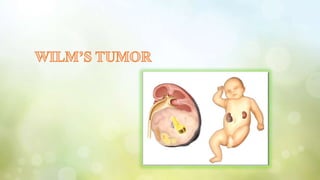
Wilm’s Tumor or nephroblastoma is a highly
malignant embryonal neoplasm that may involve one
or both kidneys.
 Usually it is unilateral, but in 5% cases it may be bilateral.
 It involves left kidney more than right kidney.
 It affects children between 3-5 years of age.
 The disease occur in about 1 out of 2-5 lakh children.
 The exact cause of this tumor is unknown.
Mostly Wilm’s Tumor is unilateral but it can be bilateral in 5% of cases.
Nephroblastoma are generally large and rapid growing.
They develop in renal parenchyma or at the tip of kidney.
It causes suppression of normal tissue remaining
Majority of tumors presents as a single expanding mass, surrounded by
a connective tissue that separates the kidney & tumor.
Although the tumor is encapsulated the membrane may be very thin and
get easily torn.
Rupture of tumor puts the patient at risk of hemorrhage & peritoneal
dissemination of tumor.
 Enlarged abdomen
 Pain due to hemorrhage
 Urethral obstruction
 Anorexia
 Hematuria
 High blood pressure
 Increased growth on one side of body
 Nausea & vomiting
 HISTORY :- The child may have a positive family history of cancer.
 PHYSICAL EXAMINATION :- reveals presence of an abdominal mass and
HTN.
 URINALYSIS :- may show presence of blood in urine
 ABDOMINAL ULTRASOUND
 ABDOMINAL X-RAY
 CHEST X-RAY
 BLOOD INVESTIGATION :- BUN, Creatinine, CBC
 INTRAVENOUS PYELOGRAPHY
RADIATION
THERAPY
SURGERY
CHEMOTHERAPY
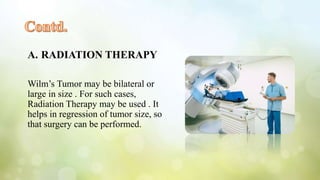
A. RADIATION THERAPY
Wilm’s Tumor may be bilateral or
large in size . For such cases,
Radiation Therapy may be used . It
helps in regression of tumor size, so
that surgery can be performed.
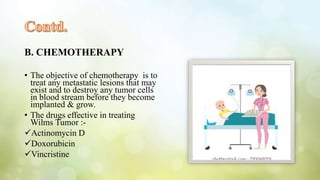
B. CHEMOTHERAPY
• The objective of chemotherapy is to
treat any metastatic lesions that may
exist and to destroy any tumor cells
in blood stream before they become
implanted & grow.
• The drugs effective in treating
Wilms Tumor :-
Actinomycin D
Doxorubicin
Vincristine
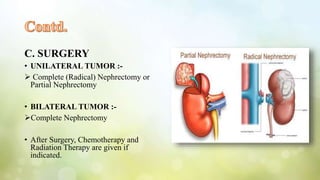
C. SURGERY
• UNILATERAL TUMOR :-
 Complete (Radical) Nephrectomy or
Partial Nephrectomy
• BILATERAL TUMOR :-
Complete Nephrectomy
• After Surgery, Chemotherapy and
Radiation Therapy are given if
indicated.
The goal of treatment is to cure as many children as possible
while limiting side effects. Treatment for Wilm’s Tumor is
based mainly in the stage of cancer:-
• STAGE I
• STAGE II
• STAGE III
• STAGE IV
• STAGE V
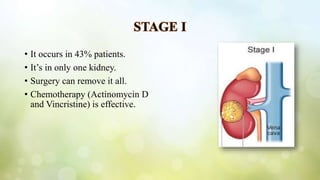
STAGE I
• It occurs in 43% patients.
• It’s in only one kidney.
• Surgery can remove it all.
• Chemotherapy (Actinomycin D
and Vincristine) is effective.
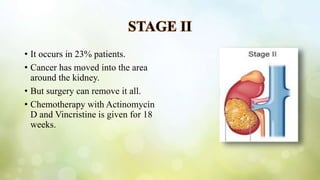
STAGE II
• It occurs in 23% patients.
• Cancer has moved into the area
around the kidney.
• But surgery can remove it all.
• Chemotherapy with Actinomycin
D and Vincristine is given for 18
weeks.
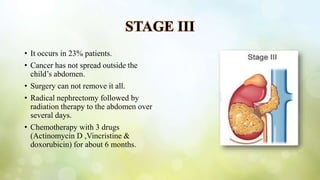
STAGE III
• It occurs in 23% patients.
• Cancer has not spread outside the
child’s abdomen.
• Surgery can not remove it all.
• Radical nephrectomy followed by
radiation therapy to the abdomen over
several days.
• Chemotherapy with 3 drugs
(Actinomycin D ,Vincristine &
doxorubicin) for about 6 months.
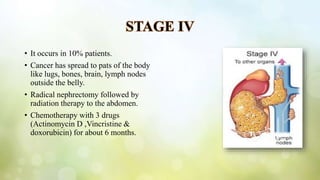
STAGE IV
• It occurs in 10% patients.
• Cancer has spread to pats of the body
like lugs, bones, brain, lymph nodes
outside the belly.
• Radical nephrectomy followed by
radiation therapy to the abdomen.
• Chemotherapy with 3 drugs
(Actinomycin D ,Vincristine &
doxorubicin) for about 6 months.
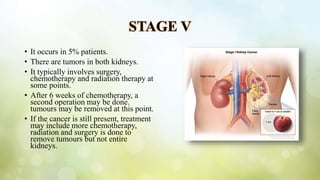
STAGE V
• It occurs in 5% patients.
• There are tumors in both kidneys.
• It typically involves surgery,
chemotherapy and radiation therapy at
some points.
• After 6 weeks of chemotherapy, a
second operation may be done.
tumours may be removed at this point.
• If the cancer is still present, treatment
may include more chemotherapy,
radiation and surgery is done to
remove tumours but not entire
kidneys.
1. PREOPERATIVE CARE –
• Prepare the parents and child for surgery.
• Explain parents not to palpate the abdomen of the child.
• Explain child about post operative care, if he or she is old enough.
• Caution should be taken while turning and handling the child.
2. POST OPERATIVE CARE –
• Monitor vitals
• Monitor renal functioning by monitoring weight, intake & output and
kidney function test value.
• Use aseptic techniques while doing dressing.
• Explain parents about follow up & continuing about the tie of
discharge.
• Ineffective protection related to antineoplastic agents, radiation
therapy, or leukopenia.
• Impaired oral mucous membrane related to chemotherapy.
• Anxiety related to change in health tatus and treat of death.
• Risk for injury related to side effects of medications and
complications.
.

wilms tumor.pptx

  • 1.
    GOVERNENT COLLEGE OFNURSING G.R.M.C. , GWALIOR (M.P.) PRESENTATION ON : WILM’S TUMOR PRESENTED BY- Neha Sahni M. Sc. Nursing Final Year Child Health Nursing
  • 2.
  • 3.
    Wilm’s Tumor ornephroblastoma is a highly malignant embryonal neoplasm that may involve one or both kidneys.
  • 4.
     Usually itis unilateral, but in 5% cases it may be bilateral.  It involves left kidney more than right kidney.  It affects children between 3-5 years of age.  The disease occur in about 1 out of 2-5 lakh children.  The exact cause of this tumor is unknown.
  • 5.
    Mostly Wilm’s Tumoris unilateral but it can be bilateral in 5% of cases. Nephroblastoma are generally large and rapid growing. They develop in renal parenchyma or at the tip of kidney. It causes suppression of normal tissue remaining
  • 6.
    Majority of tumorspresents as a single expanding mass, surrounded by a connective tissue that separates the kidney & tumor. Although the tumor is encapsulated the membrane may be very thin and get easily torn. Rupture of tumor puts the patient at risk of hemorrhage & peritoneal dissemination of tumor.
  • 7.
     Enlarged abdomen Pain due to hemorrhage  Urethral obstruction  Anorexia  Hematuria  High blood pressure  Increased growth on one side of body  Nausea & vomiting
  • 8.
     HISTORY :-The child may have a positive family history of cancer.  PHYSICAL EXAMINATION :- reveals presence of an abdominal mass and HTN.  URINALYSIS :- may show presence of blood in urine  ABDOMINAL ULTRASOUND  ABDOMINAL X-RAY  CHEST X-RAY  BLOOD INVESTIGATION :- BUN, Creatinine, CBC  INTRAVENOUS PYELOGRAPHY
  • 9.
  • 10.
    A. RADIATION THERAPY Wilm’sTumor may be bilateral or large in size . For such cases, Radiation Therapy may be used . It helps in regression of tumor size, so that surgery can be performed.
  • 11.
    B. CHEMOTHERAPY • Theobjective of chemotherapy is to treat any metastatic lesions that may exist and to destroy any tumor cells in blood stream before they become implanted & grow. • The drugs effective in treating Wilms Tumor :- Actinomycin D Doxorubicin Vincristine
  • 12.
    C. SURGERY • UNILATERALTUMOR :-  Complete (Radical) Nephrectomy or Partial Nephrectomy • BILATERAL TUMOR :- Complete Nephrectomy • After Surgery, Chemotherapy and Radiation Therapy are given if indicated.
  • 13.
    The goal oftreatment is to cure as many children as possible while limiting side effects. Treatment for Wilm’s Tumor is based mainly in the stage of cancer:- • STAGE I • STAGE II • STAGE III • STAGE IV • STAGE V
  • 14.
    STAGE I • Itoccurs in 43% patients. • It’s in only one kidney. • Surgery can remove it all. • Chemotherapy (Actinomycin D and Vincristine) is effective.
  • 15.
    STAGE II • Itoccurs in 23% patients. • Cancer has moved into the area around the kidney. • But surgery can remove it all. • Chemotherapy with Actinomycin D and Vincristine is given for 18 weeks.
  • 16.
    STAGE III • Itoccurs in 23% patients. • Cancer has not spread outside the child’s abdomen. • Surgery can not remove it all. • Radical nephrectomy followed by radiation therapy to the abdomen over several days. • Chemotherapy with 3 drugs (Actinomycin D ,Vincristine & doxorubicin) for about 6 months.
  • 17.
    STAGE IV • Itoccurs in 10% patients. • Cancer has spread to pats of the body like lugs, bones, brain, lymph nodes outside the belly. • Radical nephrectomy followed by radiation therapy to the abdomen. • Chemotherapy with 3 drugs (Actinomycin D ,Vincristine & doxorubicin) for about 6 months.
  • 18.
    STAGE V • Itoccurs in 5% patients. • There are tumors in both kidneys. • It typically involves surgery, chemotherapy and radiation therapy at some points. • After 6 weeks of chemotherapy, a second operation may be done. tumours may be removed at this point. • If the cancer is still present, treatment may include more chemotherapy, radiation and surgery is done to remove tumours but not entire kidneys.
  • 20.
    1. PREOPERATIVE CARE– • Prepare the parents and child for surgery. • Explain parents not to palpate the abdomen of the child. • Explain child about post operative care, if he or she is old enough. • Caution should be taken while turning and handling the child.
  • 21.
    2. POST OPERATIVECARE – • Monitor vitals • Monitor renal functioning by monitoring weight, intake & output and kidney function test value. • Use aseptic techniques while doing dressing. • Explain parents about follow up & continuing about the tie of discharge.
  • 22.
    • Ineffective protectionrelated to antineoplastic agents, radiation therapy, or leukopenia. • Impaired oral mucous membrane related to chemotherapy. • Anxiety related to change in health tatus and treat of death. • Risk for injury related to side effects of medications and complications.
  • 23.