WILDLIFE HABITAT
PRACTICES FOR YOUR
FARMPresented by: Tiffany Beachy
Private Lands Wildlife Biologist
Smithfield, VA
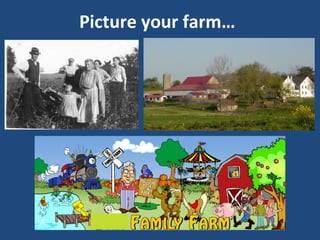
Picture your farm…
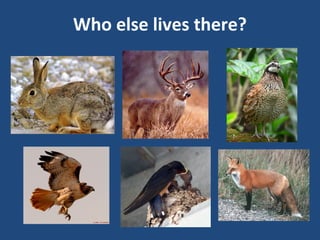
Who else lives there?
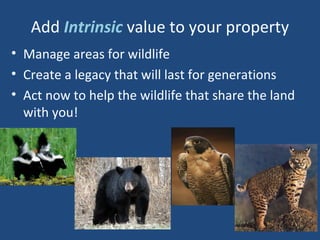
Add Intrinsic value to your property
• Manage areas for wildlife
• Create a legacy that will last for generations
• Act now to help the wildlife that share the land
with you!
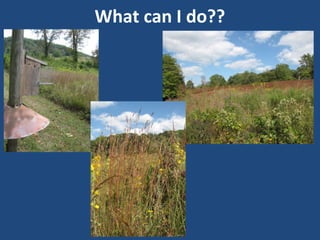
What can I do??
Priority Habitats
• Emphasis on habitats of national, regional, or state
significance
• 5 priority habitat types in Virginia:
1. Upland grassland habitat
2. Riparian corridor habitat
3. Woodland and seasonal habitat for migrating wildlife
4. Fish passage/stream improvement
5. Other decreasing habitats
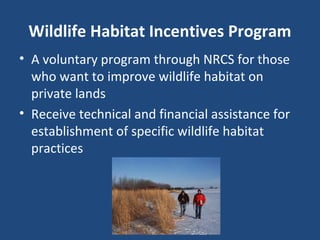
Wildlife Habitat Incentives Program
• A voluntary program through NRCS for those
who want to improve wildlife habitat on
private lands
• Receive technical and financial assistance for
establishment of specific wildlife habitat
practices
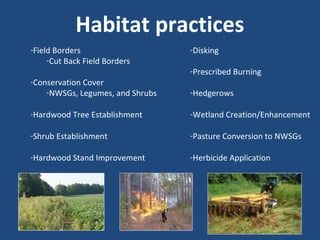
Habitat practices
-Field Borders
-Cut Back Field Borders
-Conservation Cover
-NWSGs, Legumes, and Shrubs
-Hardwood Tree Establishment
-Shrub Establishment
-Hardwood Stand Improvement
-Disking
-Prescribed Burning
-Hedgerows
-Wetland Creation/Enhancement
-Pasture Conversion to NWSGs
-Herbicide Application
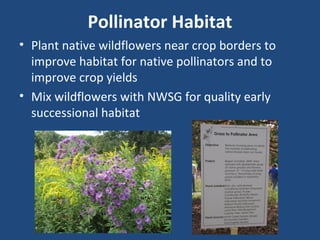
Pollinator Habitat
• Plant native wildflowers near crop borders to
improve habitat for native pollinators and to
improve crop yields
• Mix wildflowers with NWSG for quality early
successional habitat
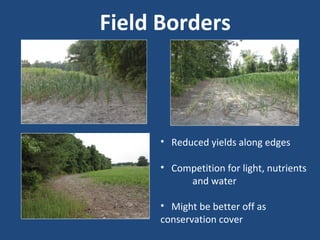
Field Borders
• Reduced yields along edges
• Competition for light, nutrients
and water
• Might be better off as
conservation cover
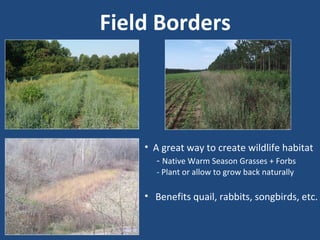
Field Borders
• A great way to create wildlife habitat
- Native Warm Season Grasses + Forbs
- Plant or allow to grow back naturally
• Benefits quail, rabbits, songbirds, etc.
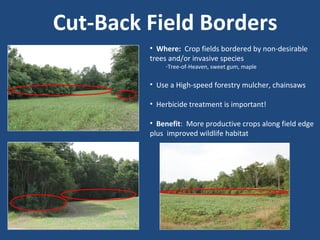
Cut-Back Field Borders
• Where: Crop fields bordered by non-desirable
trees and/or invasive species
-Tree-of-Heaven, sweet gum, maple
• Use a High-speed forestry mulcher, chainsaws
• Herbicide treatment is important!
• Benefit: More productive crops along field edge
plus improved wildlife habitat
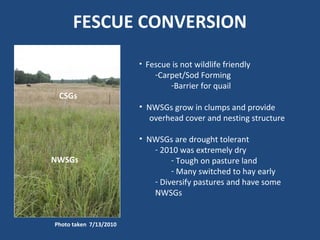
FESCUE CONVERSION
• Fescue is not wildlife friendly
-Carpet/Sod Forming
-Barrier for quail
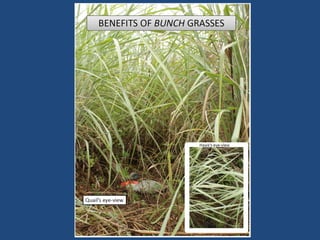
• NWSGs grow in clumps and provide
overhead cover and nesting structure
• NWSGs are drought tolerant
- 2010 was extremely dry
- Tough on pasture land
- Many switched to hay early
- Diversify pastures and have some
NWSGs
NWSGs
CSGs
Photo taken 7/13/2010
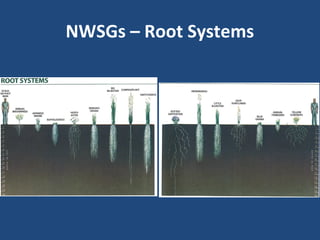
NWSGs – Root Systems
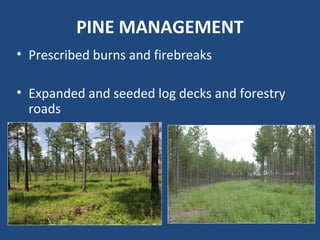
PINE MANAGEMENT
• Prescribed burns and firebreaks
• Expanded and seeded log decks and forestry
roads
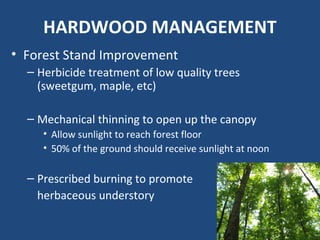
HARDWOOD MANAGEMENT
• Forest Stand Improvement
– Herbicide treatment of low quality trees
(sweetgum, maple, etc)
– Mechanical thinning to open up the canopy
• Allow sunlight to reach forest floor
• 50% of the ground should receive sunlight at noon
– Prescribed burning to promote
herbaceous understory
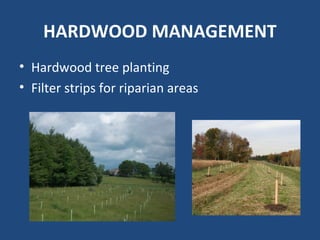
HARDWOOD MANAGEMENT
• Hardwood tree planting
• Filter strips for riparian areas
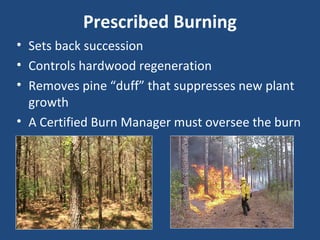
Prescribed Burning
• Sets back succession
• Controls hardwood regeneration
• Removes pine “duff” that suppresses new plant
growth
• A Certified Burn Manager must oversee the burn
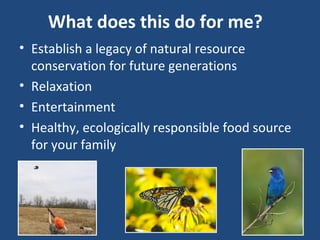
What does this do for me?
• Establish a legacy of natural resource
conservation for future generations
• Relaxation
• Entertainment
• Healthy, ecologically responsible food source
for your family
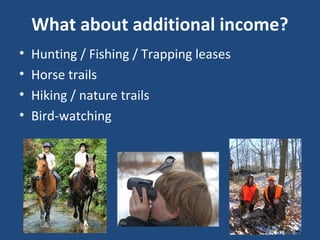
What about additional income?
• Hunting / Fishing / Trapping leases
• Horse trails
• Hiking / nature trails
• Bird-watching
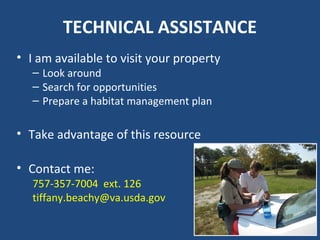
TECHNICAL ASSISTANCE
• I am available to visit your property
– Look around
– Search for opportunities
– Prepare a habitat management plan
• Take advantage of this resource
• Contact me:
757-357-7004 ext. 126
tiffany.beachy@va.usda.gov
Questions??

Wildlife Habitat Practices for Your Farm

  • 1.
    WILDLIFE HABITAT PRACTICES FORYOUR FARMPresented by: Tiffany Beachy Private Lands Wildlife Biologist Smithfield, VA
  • 2.
  • 3.
  • 4.
    Add Intrinsic valueto your property • Manage areas for wildlife • Create a legacy that will last for generations • Act now to help the wildlife that share the land with you!
  • 5.
  • 6.
    Priority Habitats • Emphasison habitats of national, regional, or state significance • 5 priority habitat types in Virginia: 1. Upland grassland habitat 2. Riparian corridor habitat 3. Woodland and seasonal habitat for migrating wildlife 4. Fish passage/stream improvement 5. Other decreasing habitats
  • 7.
    Wildlife Habitat IncentivesProgram • A voluntary program through NRCS for those who want to improve wildlife habitat on private lands • Receive technical and financial assistance for establishment of specific wildlife habitat practices
  • 8.
    Habitat practices -Field Borders -CutBack Field Borders -Conservation Cover -NWSGs, Legumes, and Shrubs -Hardwood Tree Establishment -Shrub Establishment -Hardwood Stand Improvement -Disking -Prescribed Burning -Hedgerows -Wetland Creation/Enhancement -Pasture Conversion to NWSGs -Herbicide Application
  • 9.
    Pollinator Habitat • Plantnative wildflowers near crop borders to improve habitat for native pollinators and to improve crop yields • Mix wildflowers with NWSG for quality early successional habitat
  • 10.
    Field Borders • Reducedyields along edges • Competition for light, nutrients and water • Might be better off as conservation cover
  • 11.
    Field Borders • Agreat way to create wildlife habitat - Native Warm Season Grasses + Forbs - Plant or allow to grow back naturally • Benefits quail, rabbits, songbirds, etc.
  • 12.
    Cut-Back Field Borders •Where: Crop fields bordered by non-desirable trees and/or invasive species -Tree-of-Heaven, sweet gum, maple • Use a High-speed forestry mulcher, chainsaws • Herbicide treatment is important! • Benefit: More productive crops along field edge plus improved wildlife habitat
  • 13.
    FESCUE CONVERSION • Fescueis not wildlife friendly -Carpet/Sod Forming -Barrier for quail • NWSGs grow in clumps and provide overhead cover and nesting structure • NWSGs are drought tolerant - 2010 was extremely dry - Tough on pasture land - Many switched to hay early - Diversify pastures and have some NWSGs NWSGs CSGs Photo taken 7/13/2010
  • 14.
  • 16.
    PINE MANAGEMENT • Prescribedburns and firebreaks • Expanded and seeded log decks and forestry roads
  • 17.
    HARDWOOD MANAGEMENT • ForestStand Improvement – Herbicide treatment of low quality trees (sweetgum, maple, etc) – Mechanical thinning to open up the canopy • Allow sunlight to reach forest floor • 50% of the ground should receive sunlight at noon – Prescribed burning to promote herbaceous understory
  • 18.
    HARDWOOD MANAGEMENT • Hardwoodtree planting • Filter strips for riparian areas
  • 19.
    Prescribed Burning • Setsback succession • Controls hardwood regeneration • Removes pine “duff” that suppresses new plant growth • A Certified Burn Manager must oversee the burn
  • 20.
    What does thisdo for me? • Establish a legacy of natural resource conservation for future generations • Relaxation • Entertainment • Healthy, ecologically responsible food source for your family
  • 21.
    What about additionalincome? • Hunting / Fishing / Trapping leases • Horse trails • Hiking / nature trails • Bird-watching
  • 22.
    TECHNICAL ASSISTANCE • Iam available to visit your property – Look around – Search for opportunities – Prepare a habitat management plan • Take advantage of this resource • Contact me: 757-357-7004 ext. 126 tiffany.beachy@va.usda.gov
  • 23.

Editor's Notes

  • #17 Can’t plant loblolly or do a pre-commercial thinning under WHIP, but you can burn thinned pines
  • #24 Have a good evening!