Conservation
Choices
Your guide to
conservation and
environmental
farming practices.
Candy Thomas
State Agronomist
Natural Resources Conservation Service
candy.thomas@ks.usda.gov
Conservation Choices
Total Resource Management:
The key to a successful total
resource management
system takes careful and
complete planning, patience,
organization, and teamwork.
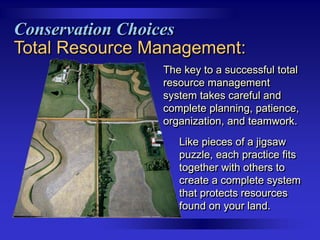
Like pieces of a jigsaw
puzzle, each practice fits
together with others to
create a complete system
that protects resources
found on your land.
Conservation Choices
Total Resource Management:
When designing a total resource
management plan, remember to . . .
• Consider your objectives for your farm
• Take an inventory; think about every
field, pasture, pond, and stream
• Consider the problems you want to
solve, e.g., erosion, water quality
Conservation Choices
Total Resource Management
Checklist:
• What are the natural resources on my farm?
• What crops do I plan to plant?
• Have I minimized runoff?
• Am I using crop rotations to reduce disease
and pest problems?
• What type of wildlife would I like on my farm?
Conservation Choices
Total Resource Management
Checklist: (continued)
• Does any practice interfere with or cancel out
another practice?
• Can I use filter strips to filter nutrients from
runoff water?
• Am I making the best use of animal manure
as nutrients for plants?
Conservation Choices
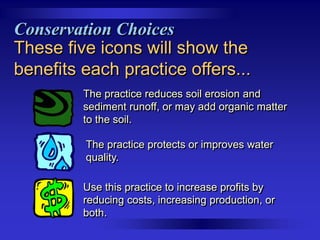
These five icons will show the
benefits each practice offers...
The practice reduces soil erosion and
sediment runoff, or may add organic matter
to the soil.
The practice protects or improves water
quality.
Use this practice to increase profits by
reducing costs, increasing production, or
both.
Conservation Choices
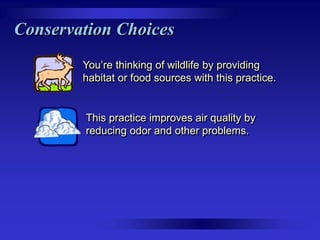
You’re thinking of wildlife by providing
habitat or food sources with this practice.

This practice improves air quality by
reducing odor and other problems.
Conservation Practices

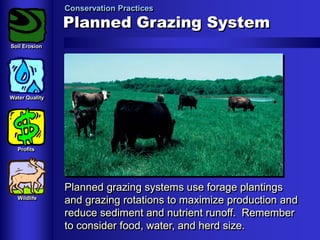
Planned Grazing System
Soil Erosion

Water Quality

Profits

Wildlife

Planned grazing systems use forage plantings
and grazing rotations to maximize production and
reduce sediment and nutrient runoff. Remember
to consider food, water, and herd size.
Conservation Practices

Planned Grazing System
Soil Erosion

How it helps . . .
Water Quality

• Improves vegetative cover, reducing erosion,
and improving water quality
• Increases harvest efficiency and helps ensure
adequate forage throughout grazing season

Profits

Wildlife

• Increases forage quality and production, which
helps increase feed efficiency, and can
improve profits
• Rotating also evenly distributes manure
nutrient resources
Conservation Practices

Upland Wildlife Habitat Management
Soil Erosion

Water Quality

Wildlife

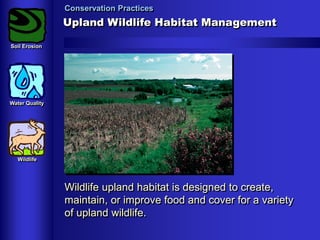
Wildlife upland habitat is designed to create,
maintain, or improve food and cover for a variety
of upland wildlife.
Conservation Practices

Upland Wildlife Habitat Management
Soil Erosion

How it helps . . .
Water Quality

• Ground cover reduces soil erosion, adds
organic matter to the soil, filters runoff, and
increases infiltration
• It can add value to your farmstead

Wildlife

• Planned wildlife habitat provides food and
cover for wildlife.
Conservation Practices

Wildlife Food Plot
Soil Erosion

Water Quality

Wildlife

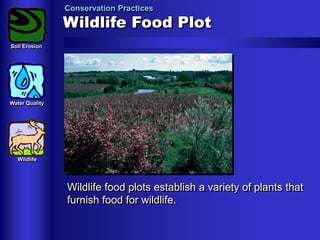
Wildlife food plots establish a variety of plants that
furnish food for wildlife.
Conservation Practices

Wildlife Food Plot
Soil Erosion

How it helps . . .
Water Quality

• Standing crops with unharvested grain provide
food to wildlife that may otherwise not be
accessible after heavy snows or ice
• A food plot helps maintain wildlife on your farm
by providing a reliable food source

Wildlife
Conservation Practices

Filter Strip
Soil Erosion

Water Quality

Wildlife

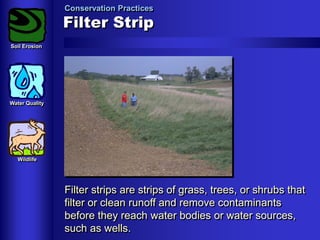
Filter strips are strips of grass, trees, or shrubs that
filter or clean runoff and remove contaminants
before they reach water bodies or water sources,
such as wells.
Conservation Practices

Filter Strip
Soil Erosion

How it helps . . .
• Grass, trees, and shrubs provide cover for
small birds and animals
Water Quality

• Ground cover reduces soil erosion

Wildlife

• The vegetative strip moves row crop
operations farther from a stream
• Vegetation prevents contaminants from
entering water bodies, protecting water quality
Conservation Practices

Grassed Waterway
Soil Erosion

Water Quality

Wildlife

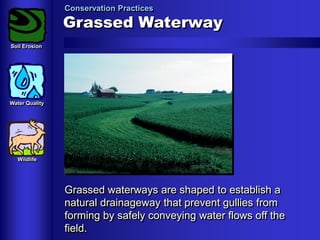
Grassed waterways are shaped to establish a
natural drainageway that prevent gullies from
forming by safely conveying water flows off the
field.
Conservation Practices

Grassed Waterway
Soil Erosion

How it helps . . .
• Grass cover protects the drainageway from
gully erosion
Water Quality

• Vegetation may act as a filter absorbing some
of the chemicals and nutrients in runoff water
Wildlife

• Vegetation provides cover for small birds and
animals
Conservation Practices

Contour Farming
Soil Erosion

Water Quality

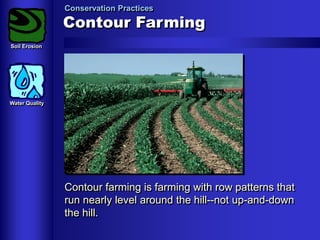
Contour farming is farming with row patterns that
run nearly level around the hill--not up-and-down
the hill.
Conservation Practices

Contour Farming
Soil Erosion

How it helps . . .
• Contouring can reduce soil erosion by as much
as 50 percent from up-and-down hill farming
Water Quality

• By reducing sediment and runoff, and
increasing water infiltration, contouring
promotes better water quality
Conservation Practices

Contour Buffer Strips
Soil Erosion

Water Quality

Wildlife

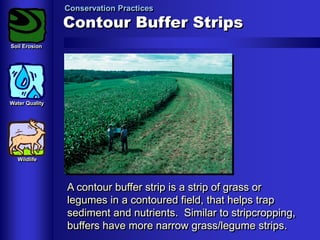
A contour buffer strip is a strip of grass or
legumes in a contoured field, that helps trap
sediment and nutrients. Similar to stripcropping,
buffers have more narrow grass/legume strips.
Conservation Practices

Contour Buffer Strips
Soil Erosion

How they help . . .
• Vegetation provides cover and habitat for small
birds and animals
Water Quality

• The strips reduce erosion by slowing water
flow and increasing water infiltration into soil
Wildlife

• By reducing siltation and filtering nutrients and
chemicals from runoff, grass strips improve
water quality
Conservation Practices

Terrace
Soil Erosion

Water Quality

Wildlife

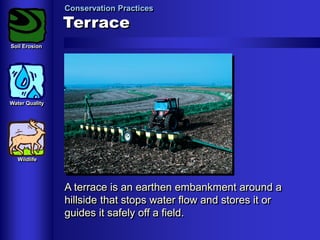
A terrace is an earthen embankment around a
hillside that stops water flow and stores it or
guides it safely off a field.
Conservation Practices

Terrace
Soil Erosion

How it helps . . .
• Both water and soil quality are improved
Water Quality

Wildlife

• Terraces with grass on front or backslopes can
provide valuable nesting habitat
Conservation Practices

Field Border
Soil Erosion

Water Quality

Profits

Wildlife

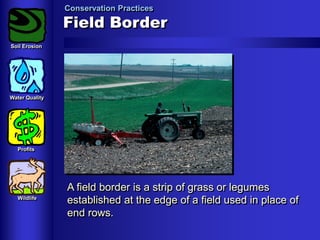
A field border is a strip of grass or legumes
established at the edge of a field used in place of
end rows.
Conservation Practices

Field Border
Soil Erosion

How it helps . . .
Water Quality

• Vegetative cover reduces sheet and rill erosion
by slowing water flow
• Vegetation filters runoff, improving water quality

Profits

Wildlife

• Grass and legume strips may be harvested in
some cases and are easier to turn on than end
rows
• Vegetation provides cover and habitat for small
birds and animals
Conservation Practices

Well Protection
Soil Erosion

Profits

Wildlife

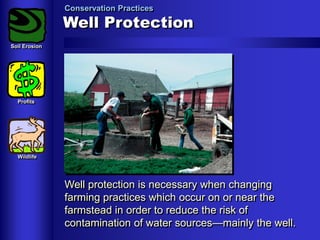
Well protection is necessary when changing
farming practices which occur on or near the
farmstead in order to reduce the risk of
contamination of water sources—mainly the well.
Conservation Practices

Well Protection
Soil Erosion

How it helps . . .
Profits

• Modifications in farming operations may
improve your efficiency and reduce operation
or production costs
• Soil conservation practices may be necessary
to divert runoff from the well area

Wildlife
Conservation Practices

Range Planting
Soil Erosion

Water Quality

Profits

Wildlife

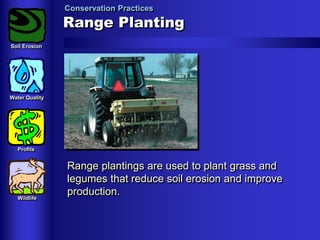
Range plantings are used to plant grass and
legumes that reduce soil erosion and improve
production.
Conservation Practices

Range Planting
Soil Erosion

How it helps . . .
Water Quality

• Heavy grass cover slows water flow, reducing
soil erosion
• Good grass stands protect water quality by
filtering runoff water and increasing infiltration

Profits

Wildlife

• Lush pastures and rangeland offer wildlife
cover and habitat
• As plants recycle and roots die, organic matter
in the soil is improved
Conservation Practices

Stream Protection
Soil Erosion

Water Quality

Wildlife

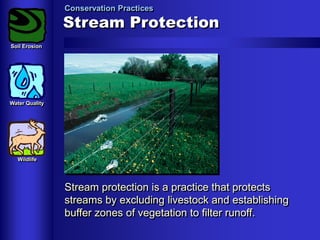
Stream protection is a practice that protects
streams by excluding livestock and establishing
buffer zones of vegetation to filter runoff.
Conservation Practices

Stream Protection
Soil Erosion

How it helps . . .
• Streambanks are covered with rocks, grass,
trees, or other cover to reduce erosion
Water Quality

• Better water quality results from reducing
amounts of nutrients, chemicals, animal waste,
and sediment entering the stream
Wildlife

• Buffer zones provide cover and habitat for
birds and small animals
Conservation Practices

Crop Residue Management
Soil Erosion

Water Quality

Profits

Wildlife

Air Quality

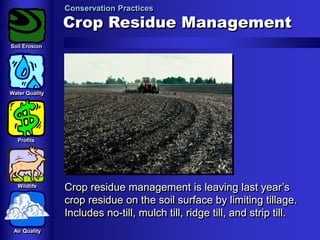
Crop residue management is leaving last year’s
crop residue on the soil surface by limiting tillage.
Includes no-till, mulch till, ridge till, and strip till.
Conservation Practices

Crop Residue Management
Soil Erosion

How it helps . . .
Water Quality

• Ground cover prevents soil erosion and
protects water quality
• Residue improves soil tilth and adds organic
matter to the soil as it decomposes

Profits

• Fewer trips and less tillage reduces soil
compaction
Wildlife

• Time, energy, and labor savings are possible
with fewer tillage trips
Air Quality
Conservation Practices

Crop Rotation
Soil Erosion

Water Quality

Profits

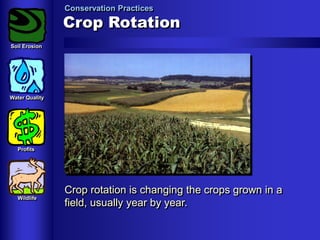
Wildlife

Crop rotation is changing the crops grown in a
field, usually year by year.
Conservation Practices

Crop Rotation
Soil Erosion

How it helps . . .
Water Quality

Profits

Wildlife

• Pesticide costs may be reduced by naturally
breaking the cycles of weeds, insects, and
diseases
• Grass and legumes in a rotation protect water
quality by preventing excess nutrients or
chemicals from entering water supplies
• Meadow or small grains cut soil erosion
dramatically
• Crop rotations add diversity to an operation
Conservation Practices

Cover Crop
Soil Erosion

Water Quality

Air Quality

Wildlife

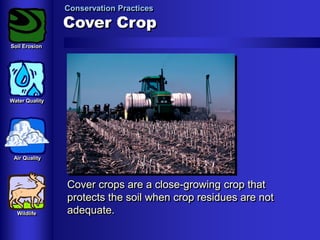
Cover crops are a close-growing crop that
protects the soil when crop residues are not
adequate.
Conservation Practices

Cover Crop
Soil Erosion

How it helps . . .
Water Quality

Air Quality

Wildlife

• Cover crops keep ground covered, add organic
matter to the soil, trap nutrients, improve soil
tilth, and reduce weed competition
• Provides cover and feed for wildlife and
pollinator habitat
Conservation Practices

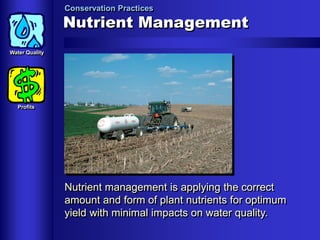
Nutrient Management
Water Quality

Profits

Nutrient management is applying the correct
amount and form of plant nutrients for optimum
yield with minimal impacts on water quality.
Conservation Practices

Nutrient Management
Water Quality

How it helps . . .

Profits

• Sound nutrient management reduces input
costs and protects water quality by preventing
over application of commercial fertilizers and
animal manure
• Correct manure and fertilizer application on all
fields can improve soil tilth and organic matter
• Nutrients should be applied with the right
placement, in the right amount, at the right
time, and from the right source to minimize
nutrient losses to surface and groundwater
Conservation Practices

Pest Management
Soil Erosion

Water Quality

Profits

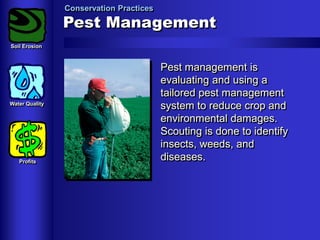
Pest management is
evaluating and using a
tailored pest management
system to reduce crop and
environmental damages.
Scouting is done to identify
insects, weeds, and
diseases.
Conservation Practices

Pest Management
Soil Erosion

How it helps . . .
Water Quality

• Scouting and spot treatment of only those
pests that are reaching the economic threshold
can save money
• Using fewer chemicals improves water quality

Profits

• Specific treatments for specific pests on
specific areas of a field prevents over
treatment of pests
Conservation Choices
Challenges Ahead . . .
Farmers are applying conservation and
environmental practices to their land at
record rates.
Farmers have accepted the challenge
of protecting our natural resources and
continue to educate themselves about
new technologies and techniques as
they are developed.
Conservation Choices
Helping People Help the Land
The USDA Natural Resources
Conservation Service’s technical staff is
here to give you a hand to help you put
conservation on the land and protect and
preserve our natural resources.
Equal Opportunity
Nondiscrimination Policy
The U.S. Department of Agriculture (USDA) prohibits discrimination against its customers, employees and applicants for employment on the bases of
race, color, national origin, age, disability, sex, gender identity, religion, reprisal, and where applicable, political beliefs, marital status, familial or parental
status, sexual orientation, or all or part of an individual’s income is derived from any public assistance program, or protected genetic information in
employment or in any program or activity conducted or funded by the Department. (Not all prohibited bases apply to all programs and/or employment
activities.)
To File an Employment Compliant
If you wish to file an employment complaint, you must contact your agency’s EEO Counselor within 45 days of the date of the alleged discriminatory act,
event, or in the case of a personnel action. Additional information can be found online at http://www.ascr.usda.gov/complaint_filing_file.html.
To File a Program Complaint
If you wish to file a Civil Rights program complaint of discrimination, complete the USDA Program Discrimination Complaint Form, found online at
http://www.ascr.usda.gov/complaint_filing_cust.html, or at any USDA office, or call (866) 632-9992 to request the form. You may also write a letter
containing all of the information requested in the form. Send your completed complaint form or letter to us by mail at U.S. Department of Agriculture,
Director, Office of Adjudication, 1400 Independence Avenue, S.W., Washington, D.C. 20250-9419, by fax at (202) 690-7442, or email at
program.intake@usda.gov.
Persons with Disabilities
Individuals who are deaf, hard of hearing or have speech disabilities and you wish to file either an EEO or program complaint please contact USDA
through the Federal Relay Service at (800) 877-8339 or (800) 845-6136 (in Spanish).
Persons with disabilities, who wish to file a program complaint, please see information above on how to contact us by mail or by email. If you require
alternative means of communication for program information (e.g., Braille, large print, audiotape, etc.), please contact USDA’s TARGET Center at (202)
720-2600 (voice and TDD).
Supplemental Nutrition Assistance Program
For any other information dealing with Supplemental Nutrition Assistance Program (SNAP) issues, persons should either contact the USDA SNAP
Hotline Number at (800) 221-5689, which is also in Spanish, or call the State Information/Hotline Numbers.
All Other Inquires
For any other information not pertaining to civil rights, please refer to the listing of the USDA Agencies and Offices.

Thomas conservation choices

  • 1.
    Conservation Choices Your guide to conservationand environmental farming practices. Candy Thomas State Agronomist Natural Resources Conservation Service candy.thomas@ks.usda.gov
  • 2.
    Conservation Choices Total ResourceManagement: The key to a successful total resource management system takes careful and complete planning, patience, organization, and teamwork. Like pieces of a jigsaw puzzle, each practice fits together with others to create a complete system that protects resources found on your land.
  • 3.
    Conservation Choices Total ResourceManagement: When designing a total resource management plan, remember to . . . • Consider your objectives for your farm • Take an inventory; think about every field, pasture, pond, and stream • Consider the problems you want to solve, e.g., erosion, water quality
  • 4.
    Conservation Choices Total ResourceManagement Checklist: • What are the natural resources on my farm? • What crops do I plan to plant? • Have I minimized runoff? • Am I using crop rotations to reduce disease and pest problems? • What type of wildlife would I like on my farm?
  • 5.
    Conservation Choices Total ResourceManagement Checklist: (continued) • Does any practice interfere with or cancel out another practice? • Can I use filter strips to filter nutrients from runoff water? • Am I making the best use of animal manure as nutrients for plants?
  • 6.
    Conservation Choices These fiveicons will show the benefits each practice offers... The practice reduces soil erosion and sediment runoff, or may add organic matter to the soil. The practice protects or improves water quality. Use this practice to increase profits by reducing costs, increasing production, or both.
  • 7.
    Conservation Choices You’re thinkingof wildlife by providing habitat or food sources with this practice. This practice improves air quality by reducing odor and other problems.
  • 8.
    Conservation Practices Planned GrazingSystem Soil Erosion Water Quality Profits Wildlife Planned grazing systems use forage plantings and grazing rotations to maximize production and reduce sediment and nutrient runoff. Remember to consider food, water, and herd size.
  • 9.
    Conservation Practices Planned GrazingSystem Soil Erosion How it helps . . . Water Quality • Improves vegetative cover, reducing erosion, and improving water quality • Increases harvest efficiency and helps ensure adequate forage throughout grazing season Profits Wildlife • Increases forage quality and production, which helps increase feed efficiency, and can improve profits • Rotating also evenly distributes manure nutrient resources
  • 10.
    Conservation Practices Upland WildlifeHabitat Management Soil Erosion Water Quality Wildlife Wildlife upland habitat is designed to create, maintain, or improve food and cover for a variety of upland wildlife.
  • 11.
    Conservation Practices Upland WildlifeHabitat Management Soil Erosion How it helps . . . Water Quality • Ground cover reduces soil erosion, adds organic matter to the soil, filters runoff, and increases infiltration • It can add value to your farmstead Wildlife • Planned wildlife habitat provides food and cover for wildlife.
  • 12.
    Conservation Practices Wildlife FoodPlot Soil Erosion Water Quality Wildlife Wildlife food plots establish a variety of plants that furnish food for wildlife.
  • 13.
    Conservation Practices Wildlife FoodPlot Soil Erosion How it helps . . . Water Quality • Standing crops with unharvested grain provide food to wildlife that may otherwise not be accessible after heavy snows or ice • A food plot helps maintain wildlife on your farm by providing a reliable food source Wildlife
  • 14.
    Conservation Practices Filter Strip SoilErosion Water Quality Wildlife Filter strips are strips of grass, trees, or shrubs that filter or clean runoff and remove contaminants before they reach water bodies or water sources, such as wells.
  • 15.
    Conservation Practices Filter Strip SoilErosion How it helps . . . • Grass, trees, and shrubs provide cover for small birds and animals Water Quality • Ground cover reduces soil erosion Wildlife • The vegetative strip moves row crop operations farther from a stream • Vegetation prevents contaminants from entering water bodies, protecting water quality
  • 16.
    Conservation Practices Grassed Waterway SoilErosion Water Quality Wildlife Grassed waterways are shaped to establish a natural drainageway that prevent gullies from forming by safely conveying water flows off the field.
  • 17.
    Conservation Practices Grassed Waterway SoilErosion How it helps . . . • Grass cover protects the drainageway from gully erosion Water Quality • Vegetation may act as a filter absorbing some of the chemicals and nutrients in runoff water Wildlife • Vegetation provides cover for small birds and animals
  • 18.
    Conservation Practices Contour Farming SoilErosion Water Quality Contour farming is farming with row patterns that run nearly level around the hill--not up-and-down the hill.
  • 19.
    Conservation Practices Contour Farming SoilErosion How it helps . . . • Contouring can reduce soil erosion by as much as 50 percent from up-and-down hill farming Water Quality • By reducing sediment and runoff, and increasing water infiltration, contouring promotes better water quality
  • 20.
    Conservation Practices Contour BufferStrips Soil Erosion Water Quality Wildlife A contour buffer strip is a strip of grass or legumes in a contoured field, that helps trap sediment and nutrients. Similar to stripcropping, buffers have more narrow grass/legume strips.
  • 21.
    Conservation Practices Contour BufferStrips Soil Erosion How they help . . . • Vegetation provides cover and habitat for small birds and animals Water Quality • The strips reduce erosion by slowing water flow and increasing water infiltration into soil Wildlife • By reducing siltation and filtering nutrients and chemicals from runoff, grass strips improve water quality
  • 22.
    Conservation Practices Terrace Soil Erosion WaterQuality Wildlife A terrace is an earthen embankment around a hillside that stops water flow and stores it or guides it safely off a field.
  • 23.
    Conservation Practices Terrace Soil Erosion Howit helps . . . • Both water and soil quality are improved Water Quality Wildlife • Terraces with grass on front or backslopes can provide valuable nesting habitat
  • 24.
    Conservation Practices Field Border SoilErosion Water Quality Profits Wildlife A field border is a strip of grass or legumes established at the edge of a field used in place of end rows.
  • 25.
    Conservation Practices Field Border SoilErosion How it helps . . . Water Quality • Vegetative cover reduces sheet and rill erosion by slowing water flow • Vegetation filters runoff, improving water quality Profits Wildlife • Grass and legume strips may be harvested in some cases and are easier to turn on than end rows • Vegetation provides cover and habitat for small birds and animals
  • 26.
    Conservation Practices Well Protection SoilErosion Profits Wildlife Well protection is necessary when changing farming practices which occur on or near the farmstead in order to reduce the risk of contamination of water sources—mainly the well.
  • 27.
    Conservation Practices Well Protection SoilErosion How it helps . . . Profits • Modifications in farming operations may improve your efficiency and reduce operation or production costs • Soil conservation practices may be necessary to divert runoff from the well area Wildlife
  • 28.
    Conservation Practices Range Planting SoilErosion Water Quality Profits Wildlife Range plantings are used to plant grass and legumes that reduce soil erosion and improve production.
  • 29.
    Conservation Practices Range Planting SoilErosion How it helps . . . Water Quality • Heavy grass cover slows water flow, reducing soil erosion • Good grass stands protect water quality by filtering runoff water and increasing infiltration Profits Wildlife • Lush pastures and rangeland offer wildlife cover and habitat • As plants recycle and roots die, organic matter in the soil is improved
  • 30.
    Conservation Practices Stream Protection SoilErosion Water Quality Wildlife Stream protection is a practice that protects streams by excluding livestock and establishing buffer zones of vegetation to filter runoff.
  • 31.
    Conservation Practices Stream Protection SoilErosion How it helps . . . • Streambanks are covered with rocks, grass, trees, or other cover to reduce erosion Water Quality • Better water quality results from reducing amounts of nutrients, chemicals, animal waste, and sediment entering the stream Wildlife • Buffer zones provide cover and habitat for birds and small animals
  • 32.
    Conservation Practices Crop ResidueManagement Soil Erosion Water Quality Profits Wildlife Air Quality Crop residue management is leaving last year’s crop residue on the soil surface by limiting tillage. Includes no-till, mulch till, ridge till, and strip till.
  • 33.
    Conservation Practices Crop ResidueManagement Soil Erosion How it helps . . . Water Quality • Ground cover prevents soil erosion and protects water quality • Residue improves soil tilth and adds organic matter to the soil as it decomposes Profits • Fewer trips and less tillage reduces soil compaction Wildlife • Time, energy, and labor savings are possible with fewer tillage trips Air Quality
  • 34.
    Conservation Practices Crop Rotation SoilErosion Water Quality Profits Wildlife Crop rotation is changing the crops grown in a field, usually year by year.
  • 35.
    Conservation Practices Crop Rotation SoilErosion How it helps . . . Water Quality Profits Wildlife • Pesticide costs may be reduced by naturally breaking the cycles of weeds, insects, and diseases • Grass and legumes in a rotation protect water quality by preventing excess nutrients or chemicals from entering water supplies • Meadow or small grains cut soil erosion dramatically • Crop rotations add diversity to an operation
  • 36.
    Conservation Practices Cover Crop SoilErosion Water Quality Air Quality Wildlife Cover crops are a close-growing crop that protects the soil when crop residues are not adequate.
  • 37.
    Conservation Practices Cover Crop SoilErosion How it helps . . . Water Quality Air Quality Wildlife • Cover crops keep ground covered, add organic matter to the soil, trap nutrients, improve soil tilth, and reduce weed competition • Provides cover and feed for wildlife and pollinator habitat
  • 38.
    Conservation Practices Nutrient Management WaterQuality Profits Nutrient management is applying the correct amount and form of plant nutrients for optimum yield with minimal impacts on water quality.
  • 39.
    Conservation Practices Nutrient Management WaterQuality How it helps . . . Profits • Sound nutrient management reduces input costs and protects water quality by preventing over application of commercial fertilizers and animal manure • Correct manure and fertilizer application on all fields can improve soil tilth and organic matter • Nutrients should be applied with the right placement, in the right amount, at the right time, and from the right source to minimize nutrient losses to surface and groundwater
  • 40.
    Conservation Practices Pest Management SoilErosion Water Quality Profits Pest management is evaluating and using a tailored pest management system to reduce crop and environmental damages. Scouting is done to identify insects, weeds, and diseases.
  • 41.
    Conservation Practices Pest Management SoilErosion How it helps . . . Water Quality • Scouting and spot treatment of only those pests that are reaching the economic threshold can save money • Using fewer chemicals improves water quality Profits • Specific treatments for specific pests on specific areas of a field prevents over treatment of pests
  • 42.
    Conservation Choices Challenges Ahead. . . Farmers are applying conservation and environmental practices to their land at record rates. Farmers have accepted the challenge of protecting our natural resources and continue to educate themselves about new technologies and techniques as they are developed.
  • 43.
    Conservation Choices Helping PeopleHelp the Land The USDA Natural Resources Conservation Service’s technical staff is here to give you a hand to help you put conservation on the land and protect and preserve our natural resources.
  • 44.
    Equal Opportunity Nondiscrimination Policy TheU.S. Department of Agriculture (USDA) prohibits discrimination against its customers, employees and applicants for employment on the bases of race, color, national origin, age, disability, sex, gender identity, religion, reprisal, and where applicable, political beliefs, marital status, familial or parental status, sexual orientation, or all or part of an individual’s income is derived from any public assistance program, or protected genetic information in employment or in any program or activity conducted or funded by the Department. (Not all prohibited bases apply to all programs and/or employment activities.) To File an Employment Compliant If you wish to file an employment complaint, you must contact your agency’s EEO Counselor within 45 days of the date of the alleged discriminatory act, event, or in the case of a personnel action. Additional information can be found online at http://www.ascr.usda.gov/complaint_filing_file.html. To File a Program Complaint If you wish to file a Civil Rights program complaint of discrimination, complete the USDA Program Discrimination Complaint Form, found online at http://www.ascr.usda.gov/complaint_filing_cust.html, or at any USDA office, or call (866) 632-9992 to request the form. You may also write a letter containing all of the information requested in the form. Send your completed complaint form or letter to us by mail at U.S. Department of Agriculture, Director, Office of Adjudication, 1400 Independence Avenue, S.W., Washington, D.C. 20250-9419, by fax at (202) 690-7442, or email at program.intake@usda.gov. Persons with Disabilities Individuals who are deaf, hard of hearing or have speech disabilities and you wish to file either an EEO or program complaint please contact USDA through the Federal Relay Service at (800) 877-8339 or (800) 845-6136 (in Spanish). Persons with disabilities, who wish to file a program complaint, please see information above on how to contact us by mail or by email. If you require alternative means of communication for program information (e.g., Braille, large print, audiotape, etc.), please contact USDA’s TARGET Center at (202) 720-2600 (voice and TDD). Supplemental Nutrition Assistance Program For any other information dealing with Supplemental Nutrition Assistance Program (SNAP) issues, persons should either contact the USDA SNAP Hotline Number at (800) 221-5689, which is also in Spanish, or call the State Information/Hotline Numbers. All Other Inquires For any other information not pertaining to civil rights, please refer to the listing of the USDA Agencies and Offices.