Wildlife Management for Late
Successional Species
Brian Donahoo, Kirsten Jedd, Frank Sicignano, & Jon-Michael Tokar
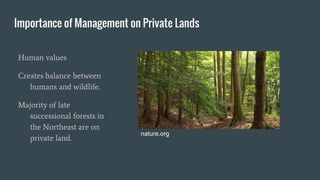
Importance of Management on Private Lands
Human values
Creates balance between
humans and wildlife.
Majority of late
successional forests in
the Northeast are on
private land.
nature.org
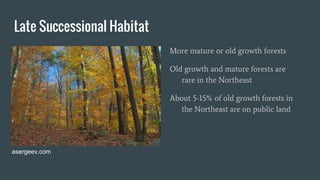
Late Successional Habitat
More mature or old growth forests
Old growth and mature forests are
rare in the Northeast
About 5-15% of old growth forests in
the Northeast are on public land
asergeev.com
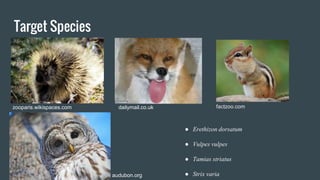
Target Species
zooparis.wikispaces.com dailymail.co.uk factzoo.com
audubon.org
● Erethizon dorsatum
● Vulpes vulpes
● Tamias striatus
● Strix varia
Inventory
Tree Species: American Ash, American Beech, Black Cherry, Hemlock, Sugar Maple, Striped Maple, White Birch, and Yellow
Birch.
No signs of threatening invasives
Signs of wildlife observed: Squirrel nests, buck rubs.
Total basal area of property: 1,055 meters squared.
Most of the trees fell into the size classes 0-10, 10.1-20, and 20.1-30 cm DBH. Second plot showed higher number of trees in 30.1-
40 cm DBH size class.
Management Options
Goal 1:
1. Provide a healthy environment for late successional plant species to grow in
Objective 1:
1. Decrease early successional plant species by 75% in 1 year
2. Increase the amount of shade tolerant plant species by 25% in 1 year
Strategy 1:
1. Selective Cutting
Action 1:
1. Marking and cutting early successional plant species
2. Planting shade tolerant plant species
Management Options
Goal 2:
1. Create a healthy habitat for late successional animal species to live in
Objective 2:
1. Increase the amount of North American Porcupines by 75%, Red Foxes by 50%, Eastern Chipmunks by 50%, and
Barred Owls by 40% in 2 years
Strategy 2:
1. Educate the private landowner on the different types of habitats and food resources that late successional species
use
Action 2:
1. Snag trees
Management Options
Goal 3:
1. Pass over management plans practices to private landowner
Objective 3:
1. Increase education resources by 50% with in 1 year
Strategy 3:
1. Educate the private landowner and the surrounding landowners
Action 3:
1. Private landowner starts taking actions that would maintain the late successional forest on the property
Monitoring Recommendations
Use two models, one to check existing habitat suitability, and one for use during
management plan execution stage.
Habitat Evaluation Procedure (HEP): indices of habitat quality where quality is
measured by vegetation structure, composition and spatial arrangement. Used to
determine current suitability.
Habitat Suitability Index (HSI): numeric value that assesses the capacity of a habitat
to support a species. Use to ensure management plan is working.
Multivariate-statistical model: identify habitat variables that have the greatest affect
on wildlife. Determine which Variables to keep eye on and manipulate.
Results
Increased wildlife presence on the property
Hunting or Aesthetic Values
Be more at one with nature
Increased Privacy from Neighbors
Heating and Timber from Harvested Early-Successional Trees/ SNAG’s
Timeline
Year: 1-5
HEP (beginning) then HSI every 6 months
Cut Down early successional species (year 2, then as needed)
Plant Late Successional Species (Year 2, possibly 3)
Cut down SNAGs and replenish Coarse Woody Debris (as needed)
Habitat Inventory (Year 2/3)
Wildlife Survey (Year 4)
Year: 6 onwards
Literature Cited
“Chapter 4: Old-growth Forests and Biodiversity.” Conserving Biodiversity Through Sustainable Forestry: A Guide to Applying
NCSSF Research. District of Columbia: National Commission on Science for Sustainable Forestry, 2007. Web.
Kays, Roland W., and Don E. Wilson. Mammals of North America. Second Edition ed. Princeton: Princeton University Press:
Princeton and Oxford, 2009. 48, 72, 174. Print.
Peterson, Roger Troy., and Virginia Marie. Peterson. Birds of Eastern and Central North America. Fifth Edition ed. Boston:
Houghton Mifflin Company, 2002. 204. Print.
Mahan, Carolyn G., Amanda D. Rodewald, and Richard H. Yahner. “Managing Forest for Wildlife.” 2012. 55-73. Print.
Bolen, Eric G., and William L. Robinson. “Chapter 1: What is Wildlife Management.” Wildlife Ecology and Management. Fifth
Edition ed. 1-6. Print
Bogan, Daniel. “Understanding the Management Hierarchy: Goals, Objectives, Strategies, and Actions of Your Management

Wildlife Presentation

  • 1.
    Wildlife Management forLate Successional Species Brian Donahoo, Kirsten Jedd, Frank Sicignano, & Jon-Michael Tokar
  • 2.
    Importance of Managementon Private Lands Human values Creates balance between humans and wildlife. Majority of late successional forests in the Northeast are on private land. nature.org
  • 3.
    Late Successional Habitat Moremature or old growth forests Old growth and mature forests are rare in the Northeast About 5-15% of old growth forests in the Northeast are on public land asergeev.com
  • 4.
    Target Species zooparis.wikispaces.com dailymail.co.ukfactzoo.com audubon.org ● Erethizon dorsatum ● Vulpes vulpes ● Tamias striatus ● Strix varia
  • 5.
    Inventory Tree Species: AmericanAsh, American Beech, Black Cherry, Hemlock, Sugar Maple, Striped Maple, White Birch, and Yellow Birch. No signs of threatening invasives Signs of wildlife observed: Squirrel nests, buck rubs. Total basal area of property: 1,055 meters squared. Most of the trees fell into the size classes 0-10, 10.1-20, and 20.1-30 cm DBH. Second plot showed higher number of trees in 30.1- 40 cm DBH size class.
  • 6.
    Management Options Goal 1: 1.Provide a healthy environment for late successional plant species to grow in Objective 1: 1. Decrease early successional plant species by 75% in 1 year 2. Increase the amount of shade tolerant plant species by 25% in 1 year Strategy 1: 1. Selective Cutting Action 1: 1. Marking and cutting early successional plant species 2. Planting shade tolerant plant species
  • 7.
    Management Options Goal 2: 1.Create a healthy habitat for late successional animal species to live in Objective 2: 1. Increase the amount of North American Porcupines by 75%, Red Foxes by 50%, Eastern Chipmunks by 50%, and Barred Owls by 40% in 2 years Strategy 2: 1. Educate the private landowner on the different types of habitats and food resources that late successional species use Action 2: 1. Snag trees
  • 8.
    Management Options Goal 3: 1.Pass over management plans practices to private landowner Objective 3: 1. Increase education resources by 50% with in 1 year Strategy 3: 1. Educate the private landowner and the surrounding landowners Action 3: 1. Private landowner starts taking actions that would maintain the late successional forest on the property
  • 9.
    Monitoring Recommendations Use twomodels, one to check existing habitat suitability, and one for use during management plan execution stage. Habitat Evaluation Procedure (HEP): indices of habitat quality where quality is measured by vegetation structure, composition and spatial arrangement. Used to determine current suitability. Habitat Suitability Index (HSI): numeric value that assesses the capacity of a habitat to support a species. Use to ensure management plan is working. Multivariate-statistical model: identify habitat variables that have the greatest affect on wildlife. Determine which Variables to keep eye on and manipulate.
  • 10.
    Results Increased wildlife presenceon the property Hunting or Aesthetic Values Be more at one with nature Increased Privacy from Neighbors Heating and Timber from Harvested Early-Successional Trees/ SNAG’s
  • 11.
    Timeline Year: 1-5 HEP (beginning)then HSI every 6 months Cut Down early successional species (year 2, then as needed) Plant Late Successional Species (Year 2, possibly 3) Cut down SNAGs and replenish Coarse Woody Debris (as needed) Habitat Inventory (Year 2/3) Wildlife Survey (Year 4) Year: 6 onwards
  • 12.
    Literature Cited “Chapter 4:Old-growth Forests and Biodiversity.” Conserving Biodiversity Through Sustainable Forestry: A Guide to Applying NCSSF Research. District of Columbia: National Commission on Science for Sustainable Forestry, 2007. Web. Kays, Roland W., and Don E. Wilson. Mammals of North America. Second Edition ed. Princeton: Princeton University Press: Princeton and Oxford, 2009. 48, 72, 174. Print. Peterson, Roger Troy., and Virginia Marie. Peterson. Birds of Eastern and Central North America. Fifth Edition ed. Boston: Houghton Mifflin Company, 2002. 204. Print. Mahan, Carolyn G., Amanda D. Rodewald, and Richard H. Yahner. “Managing Forest for Wildlife.” 2012. 55-73. Print. Bolen, Eric G., and William L. Robinson. “Chapter 1: What is Wildlife Management.” Wildlife Ecology and Management. Fifth Edition ed. 1-6. Print Bogan, Daniel. “Understanding the Management Hierarchy: Goals, Objectives, Strategies, and Actions of Your Management